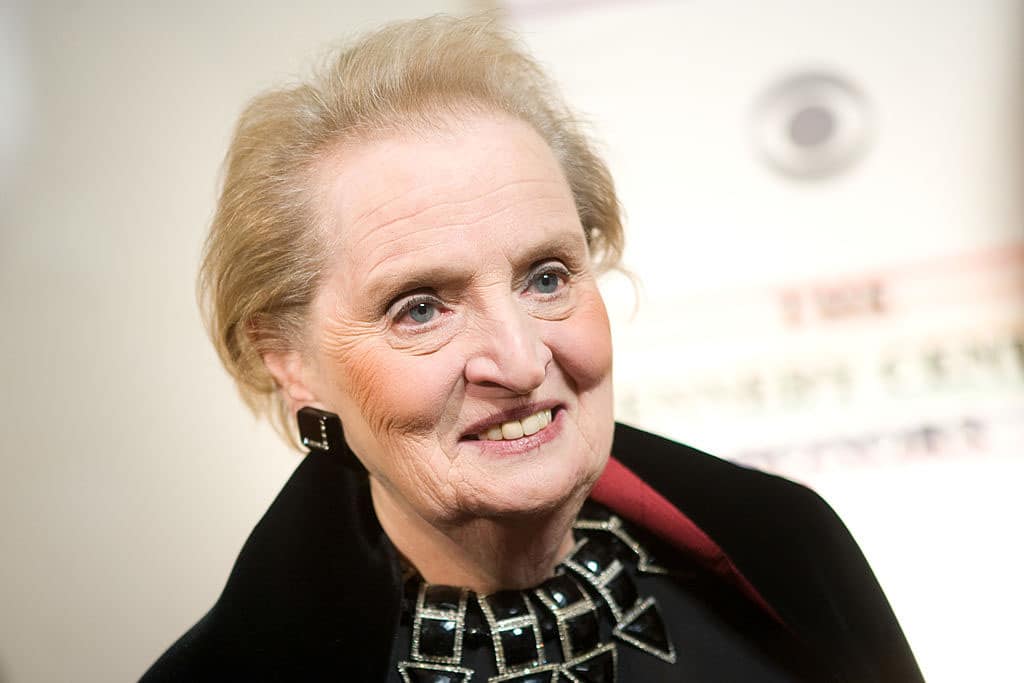
Jewish groups issued various statements mourning the passing of former Secretary of State Madeleine Albright on March 23.
Albright, 84, had died from cancer, according to a statement from her family. Albright had served as the Secretary of State from 1997-2001 under President Bill Clinton, and U.S. Ambassador to the United Nations from 1993-7.
Jewish groups paid homage to her.
“ADL is heartbroken to learn of the passing of former Secretary of State #MadeleineAlbright, the first woman to serve in that position and a champion in the fight for freedom and against oppression,” the Anti-Defamation League (ADL) tweeted. “Albright was a recipient of ADL’s Distinguished Leadership Award in 1996 and an honorary chair of our Centennial Committee. Our thoughts, prayers and condolences go out to Secretary Albright’s family members and loved ones. May her memory and legacy forever be a blessing.”
ADL is heartbroken to learn of the passing of former Secretary of State #MadeleineAlbright, the first woman to serve in that position and a champion in the fight for freedom and against oppression. pic.twitter.com/MBlW9Ny4ra
Albright was a recipient of ADL’s Distinguished Leadership Award in 1996 and an honorary chair of our Centennial Committee. Our thoughts, prayers and condolences go out to Secretary Albright's family members and loved ones. May her memory and legacy forever be a blessing.
The American Jewish Committee (AJC) similarly tweeted, “AJC is deeply saddened to learn of the passing of our dear friend Madeleine Albright. She was a true trailblazer who went from fleeing the Nazis as a child to leading American diplomacy as the first woman to serve as Secretary of State. May her memory be a blessing.”
AJC is deeply saddened to learn of the passing of our dear friend Madeleine Albright.
She was a true trailblazer who went from fleeing the Nazis as a child to leading American diplomacy as the first woman to serve as Secretary of State.
Democratic Majority for Israel Co-Chairs Ann Lewis and Todd Richman and President and CEO Mark Mellman also said in a statement, “We are heartbroken to learn of the passing of Dr. Madeleine Albright. As our nation’s top diplomat, she broke barriers and fought for human rights at home and abroad. A refugee from Nazi Germany and Soviet communism, she was tough, courageous, and a clear-speaking believer in democracy. Her moral leadership and courage will be an inspiration for generations to come. We’re indebted to her for her service to America.”
World Jewish Congress President Ronald S. Lauder said in a statement that Albright had “paved the way for women in high-ranking positions in U.S. politics, serving as our country’s permanent representative to the United Nations and its first female secretary of state” and called Middle East terrorism “the instrument of cowards.” “She was also a stalwart ally in the international efforts on behalf of Holocaust survivors. Addressing the opening ceremony of the December 1998 Washington Conference on Holocaust-Era Assets, she declared, ‘Our goal must be justice, even though justice in this searing context is a highly relative term. We know well our inability to provide true justice to Holocaust victims. We cannot restore life nor rewrite history. But we can make the ledger slightly less out of balance by devoting our time, energy and resources to the search for answers, the return of property and the payment of just claims.’ On behalf of the more than 100 Jewish communities affiliated with the World Jewish Congress, we extend our heartfelt condolences to the entire Albright family. May her memory be for a blessing and may she continue to inspire future generations.”
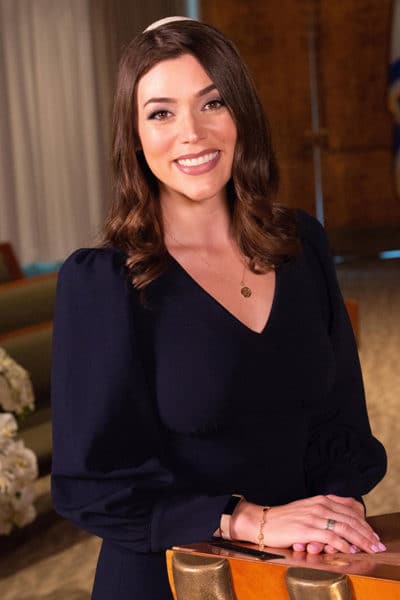
Installation of Senior Cantor, Emma LutzFriday, March 25 at 6:15 p.m. | In-person and Online
Since joining Stephen Wise Temple & Schools in 2016, Cantor Emma Lutz has made a significant mark on the Wise community. She has guided our Wise School students, mentored our youth, shared moments of joy and sorrow with our families, and brought beautiful, soulful music into our Sanctuary. On Friday, March 25, we will officially install Emma as our senior cantor. As part of a special Shabbat evening, we will host incredible cantors, rabbis, and musicians from around the country—as well as young singers from our Wise community—all gathering on our beautiful hilltop campus to celebrate Cantor Emma Lutz with joyous song. We hope to see you here in person for this this momentous occasion, which will be followed by a celebratory reception on Nahmias Plaza. The service will also be streamed online. We look forward to being together for a special evening of song, as we mark this meaningful milestone in our community.
When I was a little girl, my grandmother shared with me the story of how she became the first bat mitzvah on the West Coast. In May of 1939, when so much of the world was shifting and even crumbling around her (a bit like today), she stood on the bima at Temple Sinai in Long Beach and proudly led her congregation in prayer. Later on, when she was installed as president of her Hadassah chapter in 1998, she was honored in a special ceremony on the bima at Stephen Wise Temple for those two great accomplishments achieved some sixty years apart.It is no accident that I also ended up on this bima. As you well know, the hard work, commitment, and generosity of those in our family and extended family so often lays the groundwork for our own stories.Please join us for a special Shabbat service & celebration on Nahmias Plaza at 6:15 p.m. on March 25 when I am officially installed as Senior Cantor of Stephen Wise Temple & Schools. The service will, of course, be accompanied by great and prayerful music, lifted up by the voices of our youth and so many cherished cantors and colleagues from around the country. And yet, it is the presence of our community–your presence–that will make the evening truly sacred.
One verse, five voices. Edited by Salvador Litvak, the Accidental Talmudist
Then Moses said to Aaron, “This is what the Lord spoke, [when He said], ‘I will be sanctified through those near to Me, and before all the people I will be glorified.’” And Aaron was silent.
– Lev. 10:3
Rivkah Slonim Education Director at the Rohr Chabad Center at Binghamton University
As the war in the Ukraine rages on, my thoughts go to the iconic words we chant on Yom Kippur: who shall live and who shall die. And just as urgently: how will we live?Why? For what?
My father was born in Kharkiv during World War II. In fact, the hospital was bombed just as he entered this world and his mother was forced to swoop him up — still attached to her by the umbilical cord — and run for their lives. Living in Ukraine as observant Jews in those days meant certain danger and enormous self-sacrifice. Their eventual escape was fraught with peril. Miraculously they resettled in Israel.
Today my father counts almost forty descendants who serve as Shluchim/chot(male and female emissaries) in the Rebbe’s army. I, my siblings and many of our children are stationed in locations as varied as Luxemburg, New Jersey, Munich, Connecticut and Monaco, among others. Until most recently, even for the shluchim/chot in Russia and in the Ukraine, the decades of self-sacrifice in the former Soviet Union seemed to give way to a new, almost prosaic form of burning devotion.
And then, a few days ago a picture surfaced on social media of a 44-year-old man who had just been circumcised in a Chabad Center in Ukraine, all while shell fire rained down outside.And the ancient words from our verse reminded me: “Through those that are near me, I shall be sanctified.” That is how, why, and for what we live.
Gershon Schusterman Rabbi, businessman, mashpia
For having “offered an unauthorized, strange fire,” Aaron’s sons, Nadav and Avihu, died at the Tabernacle’s inauguration. To console Aaron, Moses said that God was thus sanctified, implying that their deaths was an exalted event. Rashi says that Moses told his brother, “I knew the Tabernacle would be sanctified through those intimate with God, and I thought it would be me or you. But now I see that your sons were greater than us.” Now, it is obvious that what they had done was wrong. How can this be reconciled with their closeness to God being greater than even Moses and Aaron’s?
The mystical interpretation casts an illuminating take on this event.
Death is not in and of itself tragic. The circumstances surrounding it determine the appropriate response. The end of a holy life well lived, can be a call for celebration.
The Tabernacle’s inauguration commemorated God’s moving-in with His beloved — the Jewish people — into their new home. This was an opportunity to sanctify and exalt God through displaying the exemplary devotion of those most intimate with Him. The young and impetuous Nadav and Avihu, righteous though they were, stoked their holy ecstasy to the point of no return, expiring in their unauthorized, strange fire. They were sinful for having exceeded the appropriateness of how to worship God, yet at the pinnacle of their ecstatic rapture they were closer and more intimate than Moses and Aaron.
“And Aaron [comforted by Moses’ words and submitting to God’s will], was silent.”
Rabbi Adam Kligfeld Senior Rabbi, Temple Beth Am
In Jewish and secular lore and law, silence is acquiescence. In square-jawed cowboy culture, silence is resolve. In eastern traditions, silence is meditative and contemplative. In an argument, silence can be maddening, suggesting the other’s unwillingness to engage; or it can be comforting, representing intentional listening. Silence is a Rorschach test. It is nothing, and everything, and sometimes means what the observer of it senses it means.
Rabbinic interpretation makes many things of Aaron’s silence after his sons’ tragic deaths. Rashi reads Aaron’s silence as steely, equanimous faith, for which Aaron was rewarded. While it is hard to valorize utter quietude in the face of such tragedy, as suppressing real emotions can lead to great emotional pain, meeting certain moments of travail with full acceptance can also be a pathway through the bleakness. An even more challenging model may be the one offered by Rabbi Shlomo HaKohen of Radomsk, an 18th C. Hasidic master, as he contrasts Aharon’s silence with King David’s joyful eruption from the depth of darkness. In Psalm 30, David describes tearful nights and mournful days, a reality of depression. And yet the Psalm ends with David’s proclaiming that, even amidst the pain, he will sing joyfully to God, and not be silent, using the same Hebrew word used in our verse.
Some tragedies are too overwhelming to simply sing through. There are times for quiet mourning and audible weeping. And yet, we live only once, a life which continues even after our loved ones die. Ought we not at least attempt to live, even through pain, with song? With dance? With exultation?
Judy Gruen Author, “The Skeptic and the Rabbi: Falling in Love with Faith.”
Aaron’s sons Nadav and Avihu had brought “strange fire,” unauthorized incense offerings, on the Altar of the newly constructed Tabernacle. Whether they had gotten carried away in spiritual ecstasy or had decided to “improve” upon God’s instructions, this improvising proved a catastrophic error. God took their lives as a result. It was a shocking denouement to the festive inaugural service of the Tabernacle, the new focal point of our service to God. Here, Moses tries to comfort his brother over these losses. Aaron’s silence is a haunting testimony to his acceptance of God’s judgment.
Judaism is only meaningful and viable when we are loyal to God’s word through following halacha. This creates a community of shared values. However, Judaism based exclusively on formulaic instructions soon becomes dry and cold. That’s why we also need kavana, the heartfelt inspiration that infuses soul into to physical actions. However, Judaism based exclusively on DIY heartfelt inspiration not only lacks credibility; it is unsustainable.
The Tabernacle service affirms that both halacha and kavana are vital to a thriving Jewish spirituality. The edifice was built with voluntary contributions by people “whose hearts had motivated them,” or “whose hearts inspired them” – intention was key. While performing the sacrificial service, though, the Kohanim needed to channel their kavana exclusively and totally to God’s exacting instructions. It was no time for DIY spirituality. Ideally, we are all meant to become a mamlechet Kohanim, a nation of priests inspired to live according to God’s flawless blueprint for living.
Denise Berger Freelance writer
Vayidom Aharon. Aharon was silent. Two of his sons were consumed by fire after bringing an inappropriate offering. In the very next sentence Moshe has conveyed what seems like an unfeeling message from G-d. And here is Aharon, silent. He doesn’t protest, he doesn’t explode, he doesn’t break down, he doesn’t even ask why. He’s just silent.
We don’t get any more information about this incident. But we do know that Aharon, more than any other figure in Tanach, is associated with love. He is known to be a “rodef shalom”, someone who chases after peacemaking opportunities. When his descendants, the Kohanim, bestow their blessing, they specifically do so “b’ahava”, with love. And when Aharon dies, the entire Jewish people grieve.
I was recently doing a mindfulness class, where the focus was love and compassion. We started in silence. Fifteen minutes in to the thirty-minute session, I found myself wondering, “When are we going to get to the love?” Eventually we got there. And what I realized is that in order to fully connect with the love, we needed to be quiet first.
Maybe this is what Aharon was doing. Maybe he was giving himself the space to just be in that moment, be in his feelings, be in his own heart. Our nature is to constantly express, respond, act. Aharon’s example is showing us a different option, one that cultivates a space for love to grow.
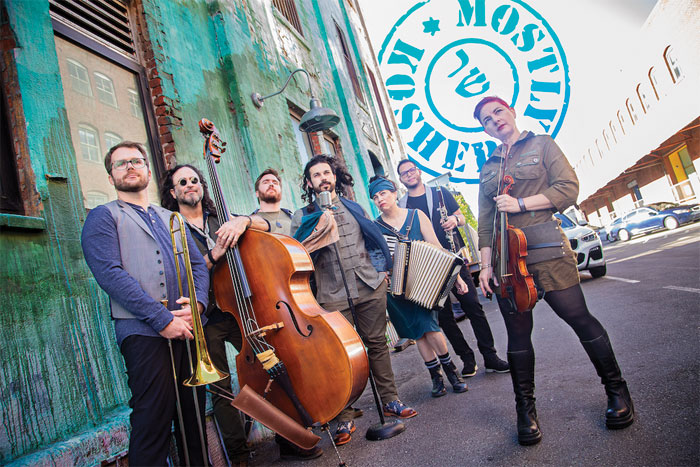
In 2010, Leeav Sofer was inuniversity studying clarinet and voice. To help pay for his education, he’d play piano at weddings and private parties. After one wedding, Sofer was talking to an elderly lady, who said, “You’re Jewish, and a clarinet player? You must play klezmer!”
While Sofer was familiar with Jewish music he’d heard in synagogue, he had never played klezmer in his life.
“So I answered, ‘Of course I play klezmer!’” said Sofer. “She responded, ‘So you must have a Klezmer band?’ [I said] ‘Of course I have a klezmer band!’”
The woman followed by saying she was the president of the local synagogue’s sisterhood and they had a huge gala every year. She wanted Sofer’s “band” to headline the concert.
“I responded in a sheepish voice ‘Greaaaaaat…’” Sofer said. He quickly went into action, calling all his Jewish university colleagues and asking if they wanted to be in his klezmer band. “Soon I ran out of Jewish colleagues so I started calling the non-Jews: ‘Want to be in my klezmer band? What’s klezmer? We’ll find out together!’”
Sofer got together enough members, and they researched and treated the concert as if they were preparing for a recital. From that performance came five more, then five more after that.
“Soon enough we needed a name, and since some of us were global-music-loving non-Jews, we decided on Mostly Kosher.” – Leeav Sofer
“Soon enough we needed a name, and since some of us were global-music-loving non-Jews, we decided on Mostly Kosher,” said Sofer.
Twelve years, multiple tour dates, a groundbreaking appearance at Disney’s California Adventure Park and a recent concert at Skirball Cultural Center later, and the critically acclaimed band has released their second album, “This World is Yours.”
The band kicked off the release with a party at the Skirball on February 24. The album contains traditional klezmer and modern rock songs, including the title song, which is an original lyrical and musical response to the Yiddish Hanukkah lullaby “Barukh Ateh,” written in 1921 by Solomon Golub and Abraham Reisen.
The tracks, which respond to various sources like the biblical Songs of Solomon and Ladino folk songs, include messages about social justice, mutual understanding and unbridled joy. “The World Is Yours” was inspired by the rock albums “The Rise and Fall of Ziggy Stardust and the Spiders From Mars” by David Bowie and “Hazards of Love” by the Decemberists.
Sofer, who is Israeli but grew up in California, learned the traditional Jewish songs as a kid; his mother was a cantor at Pasadena Jewish Temple and Center as well as Long Beach’s Temple Beth Shalom.
“I spent so much of my childhood traveling back and forth to Israel, as well as hearing Israeli folk music around the house from my dad,” he said. “Coincidentally, the Ashkenazi yiddishkeit of klezmer music was not a big part of my childhood.”
“The World is Yours” came together over a four-year period, including the 20 months during lockdown in LA. Violinist and founding band member Janice Mautner Markham said that the pandemic has been a challenge for the band.
“We had to deal with canceled performances and tours, as well as strange isolation from our friends and collaborators,” she said. “But, we tried to use the time as creatively as possible.”
One of the aims that Mostly Kosher has is to bring together Jews and non-Jews. For instance, in 2016, they became the first Jewish music ensemble to join the Festival of Holidays at Disney’s California Adventure Park.
“With Disney being such a huge national and international tourist attraction, we had the honor to share, and in many cases, be the first impression of Judaism for thousands of tourists,” Sofer said. “It’s a true honor representing our culture and faith at the parks.”
With antisemitism rising, the band is building a theatrical family show and taking it to public schools and communities across the country.
“I don’t spend much of my time focusing on using our music to help Jews connect deeper to their roots,” said Sofer. “I spend more time focusing on how to reach across the bridge, how to bring neighbors together and bridge us to one another. I believe that deepening our connection to our roots is by looking to the future, looking towards progress and looking towards creating new Jewish roots starting right here and now with this music… and then handing it to someone completely different than you.”
Standing in the back of the overcrowded conference room, I had a moment of disorientation. All around me stood Federation executives and lay leaders from the largest American cities. We were arrayed in a circle with some of us sitting in chairs while others, like myself, standing behind them. In the center of the room were bottles of water and juice placed eloquently on a small conference table while a flip chart with sticky notes was thrown into a corner. This scene is one that could have taken place at any hotel in the world. Except we weren’t packed in together discussing new models of Jewish engagement or funding models of Jewish education. We came to Novatel Hotel in Warsaw, Poland, to listen and discuss the unfolding disaster in Ukraine, to meet with our global partners and assess next steps for the critical funding that propels our Jewish response to this humanitarian crisis.
At one end of the circle sat several Ukrainian refugees, exhausted and crestfallen, who came to the hotel because they wanted to immigrate to Israel.
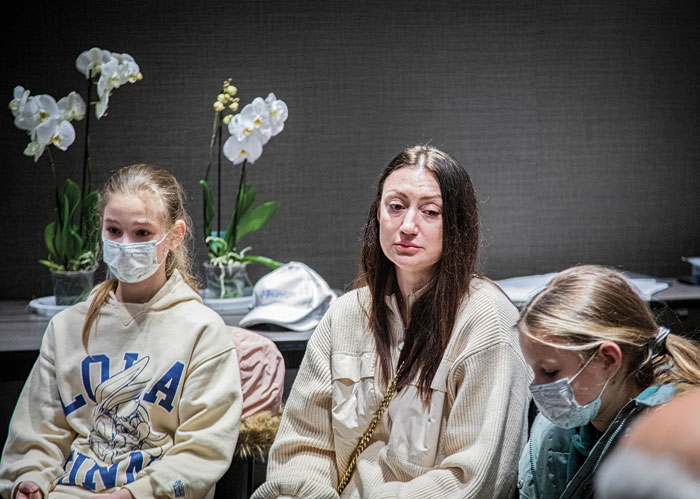
At one end of the circle sat several Ukrainian refugees, exhausted and crestfallen, who came to the hotel because they wanted to immigrate to Israel. Among those seated was a young mother named “Anna” who related to us how she and her two children, a six-year-old boy and a three-year-old girl, made the treacherous journey from their home in Ukraine to Warsaw. She began her story by relating that on March 4, when the Russian army shelled the nuclear power plant in Zaporizhzhia, her husband told her, “You have 15 minutes, take what you can and go. Just save our children and go!” She quickly gathered life’s most vital documents, a change of clothes and some jewelry and shoved them into a single bag. Arriving at the local train station, she found it overrun with families just like hers, saying goodbye to husbands, fathers and brothers as they waited for a train — any train — as long as it headed west. Anna and her children were finally hoarded with fourteen other passengers into a compartment designed for four. “The train moved slowly,” she said, stuffed with women, children the elderly and the frail. Anna said that her compartment had seven women and 11 children. They took turns sitting and standing for 22 hours on the slow-moving behemoth before it finally lumbered into Liviv. “No one slept,” she said, “and almost no one spoke.”
Anna’s journey is not unique in Ukraine. The Russian invasion carries with it a strategic brutality that purposely targets schools and hospitals, turning mothers and children into targets in an attempt to terrorize the population into capitulation.
Photo Courtesy Rabbi Noah Zvi Farkas
Anna’s journey is not unique in Ukraine. The Russian invasion carries with it a strategic brutality that purposely targets schools and hospitals, turning mothers and children into targets in an attempt to terrorize the population into capitulation. While most of the men stay behind, conscripted to fight for their country, there are now more thanthree million refugees on the move, filling trains, cars, even large commercial vehicles mostly heading west and north to Poland, Romania, and Moldova. Nearly everywhere, the same scene played itself out. Young children, huddled together playing, their older siblings losing themselves in their phones while mothers sit quietly exhausted, staring into the distance.
In the freezing night they stood by the thousands, without shelter, services or certainty.
After arriving in Liviv, Anna said she transferred to a bus that ferried her to the Polish border. Now into her second day of her journey, she along with her children were made to wait in line, with thousands of others. “I could not see where the line finished, and it never seemed to move,” she added. For over 12 hours, she stood in the last gasp of Ukrainian winter, holding her young daughter in her arms until they both went numb. Her son, held close by holding on to the strap of her backpack, eventually fainted from exhaustion. In the freezing night they stood by the thousands, without shelter, services or certainty.
Photo Courtesy of Rabbi Noah Zvi Farkas
It wasn’t until the next morning, as the international rescue teams began arriving, that they received any help. A car, driving up and down the road picking up refugees, saw Anna and her children. Eventually she crossed the border and took a bus to Warsaw, arriving at the central bus station. One of the aid workers found out that she was Jewish and said, “You have to go to the Novatel,” which is where they are helping Jews.
The Jewish Agency For Israel, or JAFI, had taken over the entire building of the Novatel—every hotel room, conference room, ballroom, the parking lot, the restaurant and even parts of the lobby, transforming them into a refugee center, consulate, logistics hub and motor pool.
The Jewish Agency For Israel, or JAFI, had taken over the Novatel — every hotel room, conference room, ballroom, the parking lot, the restaurant and even parts of the lobby, transforming them into a refugee center, consulate, logistics hub and motor pool. There, refugees would pour out of chartered buses or simply walk in from the street. They were given a place to rest, counseling and new clothing. To support this effort, JAFI has mobilized its entire global network of social workers, educators and administrators. Over one hundred JAFI employees are now operating in Poland and surrounding areas. Roman Polonsky, the managing director of JAFI, shared with me that nearly 12,000 Jews have made their way safely to Israel with another approximately 10,000 in the pipeline of shelters spreads across five countries.
Rabbi Noah Farkas, President and CEO of JFEDLA and Lynn Bider, Federation’s Campaign Chair, in front of the Jewish Agency Booth at the refugee center on the Poland/Ukraine border. Photo courtesy Rabbi Noah Farkas
The State of Israel plays a special role in this crisis. Politically, it is triangulated between wanting to support the territorial integrity of Ukraine and its Jewish president, while not wanting to antagonize Russia, which has a military base on Israel’s dangerous northern border in Syria. The political balance for Israel is difficult. Prime Minister Naftali Bennett has attempted to thread the needle of diplomacy by speaking with both sides and floating the idea of peace talks in Jerusalem. Israel has not sent weapons to Ukraine, but has condemned the Russian invasion on the floor of the UN and has recently sent a field hospital.
On a deeper level, Israel is similarly caught between wanting to support the general refugee efforts from Ukraine and balance that with the mass wave of immigration it is now facing. At first, Israel put up a few barriers to refugees, requiring a hefty deposit from Israelis seeking to sponsor refugees who do not wish to make aliyah (that has now been walked back), as well as changing visa agreements between Ukraine and Israel to make it harder to travel there. More recently, Israel has expedited the immigration of Ukrainian Jews under the Law ofReturn, securing paperwork in just a few hours for most families and chartering several immigrant-filled planes a week. Even with both the political and humanitarian difficulties, Israel continues to surpass many other countries, including the United States, when it comes to the number of refugees it is accepting into its borders.
Photo Courtesy of Rabbi Noah Zvi Farkas
The scale of the catastrophe for Jewish life occurring in Ukraine and Russia cannot be overstated. Beginning in the 19th century, Odessa was the third largest Jewish population center in the world. In Poland, Warsaw’s population was reported to be 40% Jewish before World War II. The Holocaust, as we know, changed everything. Half of Europe’s Jews were murdered and millions more dispersed globally. Europe was considered by many to be a toxic wasteland whose very soil dripped with antisemitism, and the memory of the dead grits our collective jaws with sorrow and anger.
When the Soviet bloc fell in the 1990s, however, Jewish life returned to Ukraine and other Eastern European cities. With the Federation’s core annual support, the Joint Distribution Committee, Hillel, Chabad and others rebuilt community centers, synagogues, and aid societies.A revitalization and renaissance of Jewish life was just sprouting. According to the best numbers we have, there are around 200,000 Jewish people in Ukraine and another 250,000 in Russia. But the story of the Jewish renaissance in Eastern Europe is shifting. The Jewish Agency is expecting as many as 100,000 Jews to immigrate to Israel from Ukraine and Russia because of this crisis, threatening some of the revitalization. There is talk of Ukraine and Russia depleting their Jewish community entirely as Jewish refugees pour into other countries. The global map of world Jewry appears to be changing again.
While Ukraine and Russia are truly under threat, the Jewish community of Poland is rising. On my first morning in Warsaw, we went to the Hillel House of Poland, built at the location of the Great Synagogue that was torched in 1943 at the end of the Warsaw Ghetto uprising. On our visit there, we saw all the trappings of a vibrant Jewish life. The walls were clad with posters with kitschy phrases meant to appeal to the youth. There were program booklets for Shabbat dinners strewn about. There were wall calendars filled in with dates of programs and events yet to come. Normally, young adults would come on a regular basis to engage in Jewish life. Now, however, Hillel of Poland has been converted to a play center for families. Magda Dorosz, a dynamic educator and Executive Director of the Hillel of Poland, said that the young adults who were her clients are now her partners, volunteering to watch children so mothers and grandparents can rest. When we visited, we saw two young brothers playing in one room, while their grandparents ate perogies. “The Lego Movie” was playing on TV. Magda told me that this family can have an hour or two of respite here, an island of normalcy in a sea of chaos.
The city of Lublin, east of Warsaw, was an epicenter of Jewish life for hundreds of years. In the early 20th century, Rabbi Meir Shapiro established Yeshivat Chochmei Lublin, (Yeshiva of the Sages of Lublin), creating the model of modern Jewish Yeshiva education. Daf Yomi, the daily study of the Talmud over a seven-year cycle, was invented there. Rabbi Shapiro was the first Orthodox Jew to become a member of Sejm, the Polish Parliament, representing the Jewish Minority of the country. As with Warsaw, the Shoah turned centers of Jewish life into centers of Jewish death. Majdanek, the most urban of death camps, was responsible for the murder of almost 80,000 Jews from the surrounding areas, including 18,000 in one day during the grimly-named SS operation “Harvest Festival.” As with other places we visited, Jewish life was returning to Lublin. The Yeshiva was given back to the Jewish community in 2003 and reopened in 2007. The community built a four-star hotel to support visitors to the region.
The following morning, we arrived at the border of Poland and Ukraine…Mothers with children walking quietly, their faces drawn and ashen with deep circles under their eyes, their hands absent-mindedly holding on to their children, pulling them along for the thousandth time.
The hotel in Lublin has now been converted into a refugee center by the Federation’s partner, the American Joint Distribution Committee (JDC). JDC, like JAFI, has significant operations on the ground in Ukraine, working with the population under fire, along the border and with refugees who have been able to escape. With the Federation partnership, JDC is currently providing some 2,000 beds in locations in Moldova, Hungary, Romania and Poland. The hotel in Lublin acts as a transition point until refugees can arrange entry to other European countries or as they wait for their aliyah papers and evacuation flights to Israel. Many of these refugees are elderly people with limited mobility, like “Friedreich,” a retired professor wearing puffy slippers, his sallow face depicting deeply cut eyes. Friedrich left the bombing in such a rush that he had no papers. Friends were able to get him to a train station where he finally crossed the border and ended up at the hotel. As we sat with him, he remained very quiet, speaking only a few words at a time. Clearly exhausted, he sat in his malcontent sipping nervously at a cup of tea and nibbling on a biscuit.
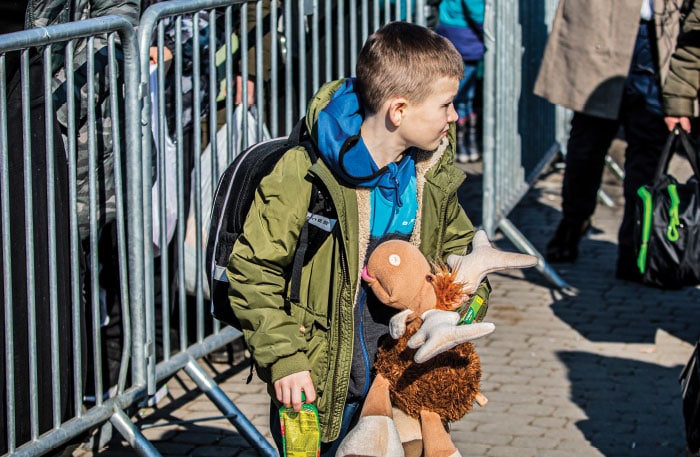
In the hotel’s basement a warehouse had been organized to sort the hundreds of donated goods and clothing to help refugees. Bags of new diapers were piled to the ceiling next to a table overloaded with stuffed animals where a young boy in a hooded jacket was gleefully “shopping” for a soft, lovable companion to hold on to for his never-ending journey. There is something touching, even beautiful, in the irony that the hotel and the Yeshiva were brimming with the life force of the Jewish community taking care of each other only a few miles from the now ossified death camp, adding another chapter to the grand story of Jewish resiliency. They tried to murder us all, and now they are gone, and we are here, doing what we have always done for thousands of years: helping each other inscribe our names in the book of life.
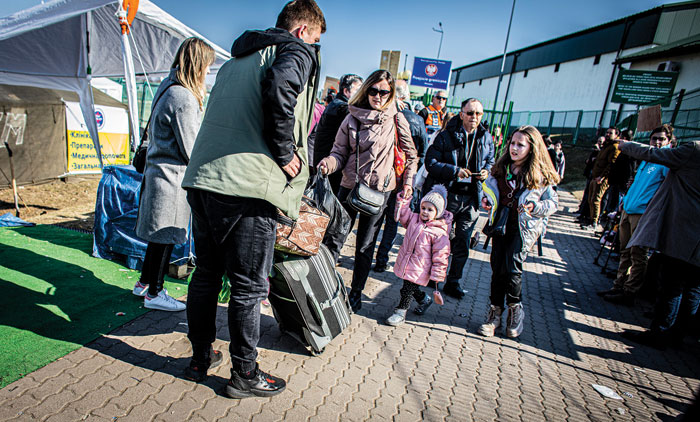
The following morning, we arrived at the border of Poland and Ukraine. It was a warm and cloudless day, and the dried wheat fields shown brown and gold against the blue sky—an inspiring sight that calls to mind the blue and yellow fields of the Ukrainian flag. As we alighted from the bus and approached the crossing, we noticed the silence. It was like we were living inside Anna’s memory of her own journey. Mothers with children walking quietly, their faces drawn and ashen with deep circles under their eyes, their hands absent-mindedly holding on to their children, pulling them along for the thousandth time. The only noises to be heard were the Polish police, quietly directing the queue to waiting buses that were loaded quickly with aid workers offering chai, hot food, shampoo and extra clothing. It looked like a funhouse reflection of a farmer’s market, where vendors from their tents were giving away their goods to a sullen and somber parade of women, children and elderly. A quietude of uncertainty mixed with despair covered the scene like a heavy blanket. No one dared to speak loudly.
The system of refugee response on behalf of our global partnership ensures that everyone, no matter their ethnicity, religion or background, are brought in and given shelter, a meal, and are directed to the most appropriate next step on their journey.
/As we moved to the border fence made of green metal, I heard Hebrew being spoken, rising above the din of other languages. I lifted my eyes and saw, waving from a makeshift pole above the very first tent nestled along the border, the blue Star of David — standing proudly, ready to offer to aid the tired and hungry and traumatized. The flag belongs to an Israeli group called Hatzalah bli’ G’vulot, or Help without Borders. They were some of the first to arrive at the border as the war broke out. We spoke in Hebrew with the aid workers, and Areyh Levi, their representative, said there was a ninety-five-year-old Holocaust survivor who was at the refugee center a mile away. He needed a medical evacuation immediately. I said, “I’ll pass the world and see what we can do.” Someone asked him if he gives aid to everyone or only to Jews. He shared that, “Jew or no Jew, everyone is a child of God and deserves help,” adding, “80 years ago Poland selected Jews from non-Jews. We don’t do selection.” Indeed, the system of refugee response on behalf of our global partnership ensures that everyone, no matter their ethnicity, religion or background, are brought in and given shelter, a meal, and are directed to the most appropriate next step on their journey. I’m reminded of the portion in the Mishnah that says, “We support the non-Jewish poor along with the Jewish poor, for the sake of peace”(Mishna Gittin 5:8).It demonstrated that feeding the hungry, clothing the naked, and giving first aid is not something we do out of our own expediency. It’s what we do because it is a deep Jewish value that spans multiple millennia.
As we left the border, we handed out lollipops to the children. It was but a small gesture in the scope of this global crisis, but if Judaism has taught me anything, it is that the reward for doing a mitzvah is the mitzvah itself. Redemption is found not just in the apocalyptic liberation, but in the millions of acts of lovingkindness that accrue over a lifetime. Walking back to the bus, as I looked back at the border fence, the words of psalms came to my lips, “I shall not die, but live and proclaim the works of God …Open the gates of righteousness, so that I may proclaim the glory of God” (Psalm 118:17-19).
All of the buses that leave the border crossing flow into a refugee center more than a mile away. Just weeks ago, in another life, this refugee center was an indoor shopping mall complete with a shoe store, fast-food restaurants, clothing boutiques and a pharmacy. When we entered it was apparent that each of these stores had been hastily converted into something else. The shoe store was cleared out to become a registration booth for Polish volunteers who wanted to drive refugees in their private vehicles. Two of the clothing stores were stuffed with cots for sleeping families. The fast-food counters were converted to community kitchens, delivering hot meals, tea and coffee to refugees and volunteers alike. And everywhere there were signs scribbled on cardboard with the phone numbers, names of Facebook groups, and maps of Poland written in Russian and Ukrainian. In the back of the mall, relief agencies staked out positions, taping their flags and posters to walls, including the Jewish Agency, waving the blue-and-white. Only the pharmacy remained in full operation, working with a doctor’s group to deliver medicine. Outside we met with the JDC representative who had been attending to the Holocaust survivor mentioned to us at the border. An ambulance was called in and medics were evaluating him in preparation to take him to Warsaw. As quiet as it was at the border, the refugee center was loud, bustling with hundreds of people looking for help and looking to help. The teeming mutuality of needs and charity, of volunteer and refugee, was inspiring. The rising tide of despair this war has wrought has been met with and outmatched by the rising tide of humanity. No one went unnoticed. No question went unanswered.
Imagine if Israel had existed in 1939. How many trains could be filled taking Jews to ports and ships bound for Israel instead of death camps?
It must be stated clearly that the effectiveness of the fastest global Jewish response in history to this crisis is possible because of the Federation system, its century-long relationship with the Jewish Agency and the American Joint Distribution Committee, and a strong and secure State of Israel.
The Federation system is arguably the largest Jewish volunteer project in our history. The global network that reaches into homes, synagogues and schools is the same network that ensures Jews can be saved from warzones like Ukraine. For more than a hundred years, the Federation’s core annual campaigns have funded the global network between North American Jewry and the rest of the Jewish world. To date, the Federations have mobilized nearly 30 million dollars in relief funding with millions of more dollars flowing into the pipeline for this urgent need. However, many of us take this system for granted and it is only in times like these, when the system is truly needed, that we understand why the Federation asks for annual campaign dollars. As someone told me, “You can’t build the fire house during the inferno.” It is the yearly campaign that creates the infrastructure and levels of coordination that, when called upon, can move millions of dollars, set up massive refugee centers, supply temporary housing, trauma services, rail, road and air logistics. The fastest global response in Jewish history exists because of the organizational coordination of these vital organizations, funded through the Federation’s annual campaign year in and year out. It is only possible because we, as a Jewish community, have made the decision to act collectively.
It also needs to be said that none of this is possible without a strong and secure State of Israel. In one of our briefings, Danielle Mor, a representative of the Jewish Agency, shared with us a telegram from February 9, 1943, years before the State was born, when the smoke from the crematoria of the Holocaust blackened Europe’s sky. The London office of the Jewish Agency said that after intense negotiations with House of Commons and the Ottoman Empire, some 4,250 Jewish children could be brought to Palestine from Romania, Bulgaria and Hungary. But they could only be brought 50 at a time because Turkey would not allow more people to be processed through their immigration center. In addition, once the five-year immigration limit was achieved, His majesty’s government would cease the rescue operation. Knowing the fate of the Jewish population of Eastern Europe, the telegram closed by saying, “If nothing else is to be done, it would take 10 months to move the 5,000 children. This is totally inadequate.” In hindsight, these words are truly haunting. Some eighty years later, the Jewish Agency has, in less than three weeks, moved twice as many Jews to safety than it could in 10 months. Imagine if Israel had existed in 1939. How many trains could be filled taking Jews to ports and ships bound for Israel instead of death camps? It is only because of the global Jewish relationship, between Federation, its affiliates and Israel, and the work of many other organizations, that we can look at this moment and feel that “never again is now.”
The truth is that all of the world’s children are watching us. Our own children are watching us.
As we left the refugee center, we saw a red charter bus bound for somewhere — where, I do not know. I saw that the adults were sitting up front, while the kids, many of them, were sitting in the rear. I thought to myself, this might be the first time on their journey that mothers didn’t have to hold their children so close. Perhaps it’s because they made new friends, or maybe because they slept for the first time in days. It’s hard to know. A few looked at us and waved sheepishly and smiled. As the bus turned on to the main road, heading west, I knew the lives of these child refugees were being defined by this moment. But the truth is that all of the world’s children are watching us. Our own children are watching us. Our generation is defined by what we learned from the past, but also by how we are witnessed by our future. Under our children’s gaze we now stand. And how we act now will write the story of our time. I invite all of us to take action and lean into the Federation’s global system of mutual responsibility that our forebears created for us, and that we now have the privilege to pass on to our children.
Rabbi Noah Farkas is the President and CEO of the Jewish Federation of Greater Los Angeles.