fbpx

February 23, 2022

Table for Five: Vayakhel

One verse, five voices. Edited by Salvador Litvak, the Accidental Talmudist

Moses said to the children of Israel: “See, the Lord has called by name Bezalel, the son of Uri, the son of Hur, of the tribe of Judah. He has imbued him with the spirit of God, with wisdom, with insight, and with knowledge, and with [talent for] all manner of craftsmanship.

-Ex. 35:30-31


Nili Isenberg
Pressman Academy, Judaics Faculty

Scientists have debated whether genius is derived from innate talent, or if hard work and practice (Gladwell’s “10,000 hour rule”) are all that are needed for anyone to become the next Shakespeare. As a mother and educator, I know that each child comes into the world with their own characteristics and predispositions, but I also realize that great things can be accomplished with a growth mindset. 

Bezalel, master of the Tabernacle Atelier, had all the characteristics of innate genius. Ramban (1194 – 1270) explains that “Israel in Egypt had been crushed under the work in mortar and brick. … It was thus a wonder that there was amongst them such a great man who knew how to work with silver and gold, in cutting of stones, and in carving of wood… A craftsman, an embroiderer, a weaver…” Bezalel’s talent even went beyond physical arts, into the spiritual realm. The rabbis (Brachot 55a) declared that he “knew how to join the letters with which heaven and earth were created.” 

If the Torah perspective is that such gifts are given through the “Spirit of God,” is there a place for effort, perseverance, and passion? A Midrash (Shemot Rabbah 40:2) provides some insight. “God showed Moses the book of the first man and said, ‘Each person I have given a role from the beginning, just like Bezalel…’” As such, we must remember that the ultimate purpose of any talent is to develop it to accomplish our sacred roles in this world.


Rabbi Benjamin Blech
Professor of Talmud, Yeshiva University

Judaism, it’s oft been noted, is far more concerned with Moses than it is with Michelangelo. The prophet played a more prominent role in our past than the artist. Jews emphasized the beauty of holiness more than they worshipped the Greek ideal of the holiness of beauty. And yet, contrary to those who would have us believe that beauty was simply dismissed as an unworthy object of spiritual concern, it is remarkable that this verse not only singles out Bezalel as a master craftsman but reminds us by way of his name of the powerful link between the beautiful and the Almighty. 

Bezalel’s life mission was, according to the Sages, to have the Mishkan – the first portable Temple – reflect the ideal that we make manifest the glory of God by way of artistic beauty. The holy needs to be beautiful because it is a reflection of the Creator who is the source of all beauty. 

Indeed, it was Michelangelo Buonarroti who defined art in precisely this spiritual way, “The true work of art is but a shadow of the Divine perfection.” It is not a coincidence then that the Hebrew meaning of the name Bezalel means precisely this: B’tzel El – “in the shadow of God.” Names define us. The Hebrew word for soul is neshamah. Central to the word, the two middle letters are shem – the Hebrew for name. Our name describes the mission of our soul. Moses reminded the Jews that “the Lord has called by name Bezalel” to teach us forever that the beauty of art is the shadow of God.


Ilan Reiner
Architect & Author of “Israel History Maps”

Bezalel the architect, full of divine wisdom, will craft the parts and pieces of the Mishkan (Tabernacle) and put them together. The Torah doesn’t tell us how the Mishkan was put together, only what it was made out of and what purpose it served. How do you build a physical structure that, when completed, would be the manifestation of God’s presence amidst the people of Israel? 

The Talmud tells us that God imbues wisdom to those who already have wisdom. Any architect can analyze the functional requirements of a temple. Anyone craftsman can fashion wood boards and curtains. It takes one with the Spirit of God, however, to assemble into a Mishkan – a perfect place that’s the source of holiness and purity to the people. 

When describing the people who helped build the Mishkan, the Torah uses the term “Wisdom of the Heart,” emphasizing that the architecture of the Mishkan is more than just knowing the materials, their quantities and what function they serve. It’s about understanding the deeper meaning and the real purpose of the Tabernacle. That “Wisdom of the Heart,” belonging to the people who contributed, the craftsmen and craftswomen, and the architect in charge, brought the Mishkan to perfection. Although it seems like a flimsy structure, made of wood, sheets, and fabric, it stood at the heart of people for almost 500 years. It came from the heart and lasted for as long as the heart of the people was beating within it.


Rabbi Ilana Grinblat
VP, Community Engagement, Board of Rabbis of Southern California, The Jewish Federation of Greater Los Angeles

My father-in-law has told me repeatedly about this verse. His name is Uri, and his father’s name is Yehuda. He is proud that his name, Uri from the tribe of Yehudah appears in the Torah. 

There’s a tradition that there are 600,000 letters of the Torah corresponding to the 600,000 souls of Israel who left Egypt. There are more than 600,000 Jews today, but the idea is that there are 600,000 souls which divide into sparks that become our souls. There are 304,805 black letters in the Torah, but the tradition considers the Torah to be black fire written on white fire. Therefore, the 600,000 letters include both black letters and white letters (as spaces between the black letters). Each of us has our own letter of Torah. Just as every letter of the Torah is necessary, every Jew is essential to the Jewish people. We each have our own place in the sacred story. 

My father-in-law found his verse. What about the rest of us? Where is your place in the text? If you had to pick one verse from the Torah that best encapsulates your life’s journey, which verse would it be? Which letter of Torah corresponds to your soul? Would your letter be one of the black letters or one of the white spaces in between? 

Like Uri son of Yehuda, may we all find our place in Torah.


Rabbi Scott N. Bolton
Congregation Or Zarua, New York, NY

The new logo for the Bezalel Academy of Arts and Design radiates the glow of Jerusalem, shines light of Torah from two ancient tablets, and reflects the Middle-Eastern-meets-Israeli style that defined the Bezalel School or Movement from the start. The Hebrew font suggests a boldness and maturity, maybe because these moments suggest we are beyond the flowering of the pioneer times of Zionist spirit. 

We’re reminded of the meeting between Theodor Herzl and the artist Boris Schatz (1867-1932) who became an ardent Zionist. In 1903, he presented his vision to Herzl to establish an arts and crafts school in the Land of Israel. In 1905, at the Seventh Zionist Congress, a resolution was passed to establish the Bezalel School of Art. The idea behind the name was to link new generations of artists to the ancient biblical artisan of Exodus. Despite aniconism over the millennia, the encouragement to engage in artistic production became yet another way Jewish spirit would make its way to expression. The mission: “to train the people of Jerusalem in crafts, develop original Jewish art and support Jewish artists…” 

The school was known for teaching traditional metal work, carpet weaving, woodcarving, the graphic arts, and photography. In 1955, it became The Bezalel Academy of Arts and Design. Today, the architecture program is in the historic building and the Academy flourishes at Hebrew University. More and more artists continue to express themselves and tie into Jewish roots, because of the openness and opportunities created by Bezalel.

Table for Five: Vayakhel Read More »

If the World’s #1 Sponsor of Terror Deserves a Carrot, Why Not Russia?

While President Biden and Western negotiators are offering billions in sanctions relief to convince Iran to return to the nuclear deal, they have decided that Russia deserves no such carrot to halt its aggression against Ukraine. Quite the contrary— it merits only sticks.

How does this make sense?

The West offers billions that it knows will be used by Iran to support its terror proxies, but Russia gets only the stick of escalating sanctions. With Iran we act like suckers and with Russia we act like bullies. What kind of coherent geopolitical strategy is that?

As dangerous as a nuclear Iran would be, an all-out war in Ukraine would be a disaster for the world and for America. In addition to the tragic human toll, an analysis on CNN.com listed six ways such a war would hurt the United States: Continued rise in gas prices, historic inflation, market turbulence, slower economic growth, higher borrowing costs and more cyberattacks.

In other words, our fearless leaders should be doing all they can right now to prevent this all-out war. We need shrewd leaders who are problem-solvers. Instead, we get loud displays of chest-thumping: “Hey Vlad, you better not go any further or we’ll punish you.”

Does Vladimir Putin look like the kind of guy who’ll run back with his tail between his legs and suffer global humiliation?

Do we really think such public saber rattling will scare off the Russian bear? Does Vladimir Putin look like the kind of guy who’ll run back with his tail between his legs and suffer global humiliation?

If we can find a carrot for the world’s #1 sponsor of terror, why can’t we find one for Russia? If we’re willing to accept a 10-year sunset clause on Iran’s nuclear program, why not negotiate a similar limit to NATO’s encroachment toward Russia—including a guarantee that Ukraine won’t join NATO for a fixed period of time?

At this point, we need quiet diplomacy that will help Putin save face, not loud threats that will make him dig in even deeper.

At this point, we need quiet diplomacy that will help Putin save face, not loud threats that will make him dig in even deeper. But instead of defusing and de-escalating, we’re doing the very opposite.

I used to think that our leaders always had something up their sleeves, some grand strategy or classified intelligence that would guide them to a positive outcome. I no longer believe that. Now I get the feeling our leaders are no better than we are.

Instead of getting results, they just talk a lot.

If the World’s #1 Sponsor of Terror Deserves a Carrot, Why Not Russia? Read More »

Netaneli, a Major Influence on Persian Jews, Dies at 100

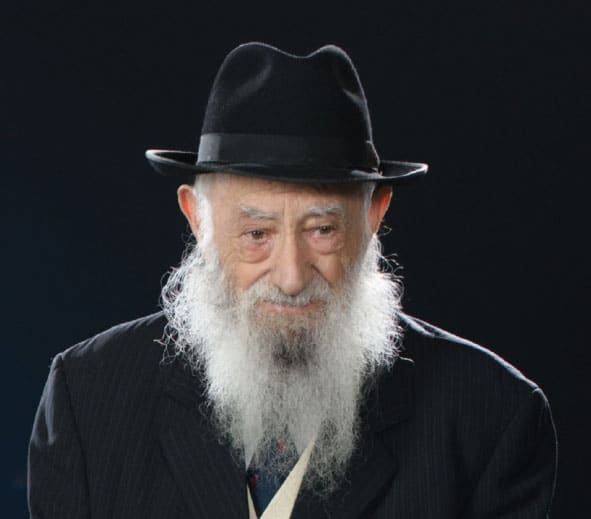
R’ Ovadia ben R’ Eliyahu Netaneli, a man who influenced the lives of many Persian Jews and the father-in-law of Rabbi David Shofet, founder of Nessah Educational and Cultural Center, died in Jerusalem on the Shabbat of February 4. He was 100 years old.

“While he was not [technically] a rabbi, he was very knowledgeable,” Shofet, leader of the largest Persian synagogue in America, told the Journal. “Some people do not need smicha (ordination). He knew more than a rabbi.” 

Netaneli’s unquenchable thirst for learning, combined with his talent for teaching and influencing others, made him a heavyweight in the Persian Jewish world.

“Whatever he wanted to do, he could achieve,” Shofet said. “He knew all of the Torah. He was the Torah reader on Shabbat when I met him [in Iran]. He used to learn with his brother, Rabbi Yehoshua Netaneli, one of the founders of Oztar HaTorah in the city of Shiraz. He went to [Netaneli] with any questions he had.” 

Liora Shofet Refua, Shofet’s daughter and Netaneli’s granddaughter, said, “His speech under my chuppah at Nessah was something people talked about for a long time afterward. My children are his first great-granddaughter and great-grandson, and although we live in Los Angeles and he was in Jerusalem, he truly shepped nachas from all of the kids.”

“Talk to anyone in Los Angeles now who lived in Tehran back in the ‘60’s, ‘70’s or ‘80’s, and you would hear what my grandfather would do for the Jewish community there.” – Liora Shofet Refua

According to Shofet Refua, many Persian Jews in LA would say he greatly influenced them, even though he didn’t live in LA. “Talk to anyone in Los Angeles now who lived in Tehran back in the ‘60’s, ‘70’s or ‘80’s, and you would hear what my grandfather would do for the Jewish community there,” she said. “It still affects their lives here nowadays.”

She described her grandfather as fiercely devoted to his synagogue in Jerusalem and to Torah learning. “He attended services every day, even into his mid-90s,” she said. “He lived on the third floor of a building without an elevator. But he braved the stairs up and down, to and from his home to the synagogue, until it was physically impossible to do.” 

Netaneli was born in the ancient Iranian city of Hamedan, traditionally believed to be the location of the tombs of Esther and Mordechai from the Purim story. Shofet Refua said he came from a devoutly religious family with a deep love of Israel. His father, Eliyahu, acquired property there long before the establishment of the modern state. 

In Iran, Netaneli worked as a broker in the plastics industry. He was deeply involved in Jewish communal affairs, particularly within the famed Abrishami Synagogue, the central synagogue in Tehran.  

Shofet Refua’s grandfathers-to-be worked as a team, Netaneli alongside Rabbi Yedidia Shofet, the chief rabbi of Tehran (and the father of Rabbi David Shofet), in communal and spiritual matters. Netaneli led prayer services and gave Torah lectures regularly.

Shofet said that after the 1979 Iranian Revolution, “my father was the rabbi of the biggest shul in Tehran, and [Netaneli] was with him. When my father had to leave, there was a kind of emptiness. No one was there to take care of the community, so my father-in-law stepped in. He started to teach.”

People were very happy with him in that role. “He became part of the beit din (rabbinical court) also,” said Shofet. “He was different from other rabbis. He was a problem-solver. When there were problems between a husband and wife, they relied on him.”

Mastering gematria – knowing the numerical value of every Hebrew letter – was one of Netaneli’s more impressive accomplishments, his son-in-law said.

“When he went to Israel 30 years ago at the age of 70, he was a member of the community of HaRav Mordechai Eliyahu, the Sephardic chief rabbi of Israel. Now, my father-in-law knew Hebrew, but not enough to deliver a speech. He said he wanted to give a d’var Torah. Rabbi Mordechai said yes because he knew enough gematria.”

Shofet said a crucial dimension of Netaneli’s life was that he was always positive. Above all else, the late leader loved to learn. 

“In his life, he had one big purpose: to go to Israel, to sit down and to learn there. He worked very hard. He was in the bazaar, and he was very successful in what he did. But learning, that was his passion. That was his commitment every day.”

Netaneli, a Major Influence on Persian Jews, Dies at 100 Read More »

Why “Ask a Jew” Is My Favorite Jewish Podcast of 2022

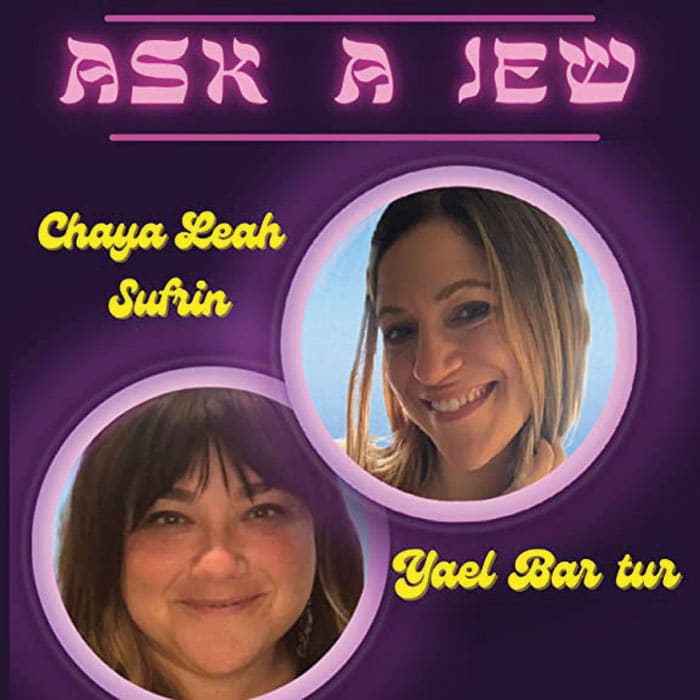
As far as accessing diverse Jewish voices is concerned, I didn’t know how sorely I needed to hear from a foul-mouthed Hasidic mother of four and a self-described Israeli “secular sinner” until I began listening to the new podcast, “Ask a Jew.” But after five minutes of listening to Chaya Leah Sufrin and Yael Bar-Tur trading barbs and asking each other questions most of us couldn’t bring ourselves to ask them, I was hooked. 

“What’s the goal of Talmudic studies?” Bar-Tur, my favorite heathen, asks Sufrin in one of the first episodes. Sufrin, who is Hasidic and genuinely interested in Bar-Tur’s life, also has a question for her co-host: “How often do you have sex?”

Listening to “Ask a Jew” is like eavesdropping on the best coffee date in the world between two of the most quick-witted, but wildly different, women you’re likely to meet. 

I’ll admit I never expected to hear those words on-air from a Hasidic woman. And it’s a question neither Bar-Tur nor Sufrin agrees to answer, but listening to the build-up of the conversation as it culminates into brilliantly impromptu (and hilarious) insights is as good as it gets in the world of podcasts. In fact, listening to “Ask a Jew” is like eavesdropping on the best coffee date in the world between two of the most quick-witted, but wildly different, women you’re likely to meet. 

The premise is simple, but electric: Sufrin, who lives in Long Beach, California, and Bar-Tur, who grew up in Herzliya without ever having spoken more than a few words to non-secular Israeli Jews, ask each other various questions, from what it’s like to be a single woman living in New York City (Bar-Tur) to why, once a year, Jewish women bake phallic-shaped challahs. Yes, schlissel, or key challah, is customarily made in preparation for the Shabbat after Passover as a sign to earn a good livelihood, but it does have a certain resemblance, and Sufrin’s response, in which she acknowledges that her friends “really think they’re making keys,” is so good precisely because it’s ad-libbed and innocently honest.   

That’s one of the secrets to Sufrin’s crucial role in “Ask a Jew.” She masters a difficult balance between describing the positive meaning she derives from being an observant Jew, while remaining unabashedly honest about aspects of Jewish practice that, let’s face it, still need some explaining. 

“I’m done. My kids are never getting married. I have just ruined their chances, so let’s just go for it now,” Sufrin concedes in one episode after a particularly honest conversation about men. She and her husband have four sons, ages 12 to 19. 

“None of them listen to the podcast,” Sufrin told me while describing her experience trying to balance one of her son’s Talmudic studies while allowing him to watch all 33 seasons of “The Simpsons” during the pandemic. Sufrin is nothing if not a master of circumstantial flexibility. She’s also in a league of her own. 

“Before every episode I ask her [Sufrin], ‘Can I ask this?’ and usually, she laughs. She’s never once said something is off limits,” Bar-Tur said. “In fact, I have probably asked not to talk about certain things related to my lifestyle more than she has. But that’s what makes it great. I can ask things earnestly that are truly on my mind. Mostly, I worry that her family will think I’m a bad influence, but so far they think she might be a bad influence [on me].”

Bar-Tur and Sufrin met in a virtual chat room while listening to another podcast, “The Fifth Column.” 

“I remember being very surprised that this political/not-family-friendly/hilarious current affairs podcast has a Haredi listener, but it turns out there are quite a few,” said Bar-Tur, who messaged Sufrin during a Zoom “happy hour” for “The Fifth Column” podcast.

“When I came to LA, she invited me over for Shabbat, and I just felt so comfortable with her. I always thought our conversations were funny given that we have such different backgrounds, and I told her we need to record them.” – Yael Bar-Tur

“When I came to LA, she invited me over for Shabbat, and I just felt so comfortable with her,” said Bar-Tur. “I always thought our conversations were funny given that we have such different backgrounds, and I told her we need to record them.”

She continued, “I realized how many stereotypes I had about Orthodox people and I was floored by how little I knew. I thought everyone should learn from her, and I am not embarrassed to ask her the questions that are on everybody’s mind, I think.”

Bar-Tur is a social media consultant specializing in crisis and law enforcement who previously served as the director of social media for the New York City Police Department. She moved to the United States in 2007 to “pursue the American dream,” serving at the Consulate General of Israel in LA for three years before moving to Cambridge to study public policy at Harvard’s Kennedy School of Government. She moved to New York City in 2012.

Sufrin was born in Crown Heights, Brooklyn and moved to Southern California at age eight, when her father was offered work as a Chabad rabbi in Long Beach. Her father’s parents were Holocaust survivors and Sufrin, who studied history as an undergraduate, taught high school Jewish history for 12 years. For the past six years, she has worked for Long Beach Hillel, first as senior Jewish educator and, for the past four years, as executive director.

Married at 20, Sufrin had her first child at 21, which often inspires her to ask Bar-Tur questions about single life. “Yael, do you get lonely?” Sufrin asks in one episode, admitting that, as a mother of four, she is always surrounded by others, but also experiences moments of loneliness. When Bar-Tur says that she “isn’t a miserable single,” but a woman who “loves going on dates and getting butterflies,” Sufrin confesses that she is jealous. 

“I love asking Yael about being single and not having kids,” Sufrin said. “[Motherhood] is such a huge part of my life that it’s hard for me to imagine life as a single adult. Her freedom and independence are certainly attractive to me to a degree. Talking about it with her helps me understand her life more.” 

Bar-Tur also poses the right questions, such as when she asks Sufrin, “Does your community talk about mental health?” The two are natural speakers and their on-air chemistry is deliciously palpable. 

“I do feel envious sometimes at her level of faith and strong sense of community,” said Bar-Tur. “I live a very different life — no dependents, no religious community, and though I have lots of freedoms and enjoy my lifestyle, I do think the practicing lifestyle sounds very fulfilling. I’d like to learn more about religion and have more perspective and insight.”

Sufrin is obsessed with world events and pop culture, and that’s unique, given that most Hasidic families do not own televisions or follow current events as closely as non-Hasidic Jews. “People in my community are incredibly uncomfortable with how open I am,” Sufrin said, “but I have always been a consumer of media. I love reading, music, politics, journalism, etc. From an early age, it was clear that I was curious about the world around me.”

Sufrin grew up loving bands such as Nirvana, Weezer and Linkin Park. She secretly watched “Beverly Hills, 90210” and “Friends,” and, when she was older, she watched the “Sex and the City” series in its entirety. 

Bar-Tur was thrilled recently when she ran into several young, Haredi men who said they listened to the podcast, but the most meaningful feedback came from a secular cousin in Israel, who told her that the show inspired her to look very differently at Orthodox Jews. In their own way, Sufrin and Bar-Tur hope to bridge the gap between observant and secular Jewry.

Sufrin said, “Although my parents are Chabad shluchim, they are open minded and were raised in homes that encouraged ‘worldliness.’ My grandparents got three newspapers delivered every day. They had a TV in their house when no one else had one. I definitely took it up to another level, but I was always encouraged to be curious about the world. I remember distinctly being in seventh grade and listening to the Anita Hill trial on the radio every day. My friends thought I was nuts. They had no idea who Anita Hill was and they certainly didn’t care about the trial. [But] I was glued.” 

With “Ask a Jew,” Sufrin hopes to expand the media representation of Orthodox Jews, and women in particular, beyond shows such as “Unorthodox” or “My Unorthodox Life.” An impassioned and educated civic action advocate, she was awarded the “40 Under 40” award in 2016 by the Mayor of Long Beach and currently serves on a committee to help develop a Jewish Community Relations Council (JCRC) in that city. She has also been involved with the Jewish Federation of Long Beach and the Alpert JCC. 

“I really enjoy working with the local Federation because I feel like I am a bridge between the Orthodox world and the more liberal Jewish world of [the] Federation,” she said. 

The podcast is hosted on Paloma Media with the help of the duo’s friend, Nancy Rommelmann, who owns the platform. Bar-Tur records from Rommelmann’s studio in Chinatown and Sufrin calls in from Long Beach (she recorded the first two episodes in person in New York City). 

“We call our editor Mickey, who isn’t Jewish, ‘Mickey the Mohel” because he chops it up for us and we also couldn’t do this without him,” said Bar-Tur. 

Recent podcast titles include, “G-d Loves the New England Patriots,” in which Bar-Tur asks Sufrin if, despite her tattoo, she can be buried in a Jewish cemetery; “There Were No Fat People in the Holocaust,” in which Sufrin admits to nursing a hangover from Las Vegas (while Bar-Tur asks her if there are kosher restaurants in Sin City); and “Jews Want to Convert Your Babies.” In that episode, the duo discussed the hostage situation in Texas and jokingly asked which is worse: antisemitism, or Coldplay? 

“I think our audience is anyone who is interested in faith in any way, Jewish, non-Jewish, it doesn’t matter,” said Bar-Tur. “There are no ‘wrong’ or ‘stupid’ questions on our show. It is inclusive in a way that anyone can listen and participate without fear of being looked down on. It turns out there are so many things people want to know, but they are just too afraid to ask.”

As for Sufrin, she admits that she doesn’t actively promote the podcast in her own community. “Some have listened and I’ve gotten some positive feedback,” she said. “I’m sure my occasional cussing makes people uncomfortable, but I’m trying to do that less so that people can hear my message and not get stuck on my foul language.”

The duo is still learning about their similarities as well as their differences. “We have the same obsession with nineties pop culture, but we have very different tastes in men,” said Bar-Tur.

In the shallowest sense, Bar-Tur and Sufrin are stereotypes: one, a young Jewish woman who seemingly over-indulges in single life in New York City; the other, an Orthodox wife and mother with seemingly little agency of her own. But neither plays by the rules of those stereotypes. 

Bar-Tur isn’t, as she describes herself with her trademark self-deprecating humor, a “trainwreck,” but a thoughtful, curious and accomplished young woman. Sufrin isn’t a stereotype of a stereotype; namely, an unorthodox Orthodox woman who is hell-bent on making sure everyone knows she’s a rebel. There’s an unadulterated love for Judaism in her insights that neither overly praises nor defames the Hasidic experience. 

For the most enjoyable experience of “Ask a Jew,” I highly recommend listening from the very first episode, which sets the tone for everything to come. There are few conversations, if any, between secular and religious Jews that come close to matching the rapport between the duo. Simply put, it’s not being done. And “Ask a Jew” works precisely because Sufrin and Bar-Tur are completely and unabashedly themselves, not in spite of it. 

“We are both so opinionated and have so much to say about the world, and the fact that our lives are so different makes it all even more interesting,” said Sufrin. “Also, as Yael said in our first show, ‘There just aren’t enough Jews in media.’” 

“Ask a Jew” is available on various podcast platforms including Audible, Amazon and Apple. Yael Bar-Tur and Chaya Leah Sufrin encourage listeners to engage with them on Twitter @yaelbt and @saysCL or to email PalomamediaNYC@gmail.com.

Why “Ask a Jew” Is My Favorite Jewish Podcast of 2022 Read More »

Amnesty Israel Head Slams Report Accusing Israel of Apartheid As “A Punch to the Gut”: “Neither True Nor Helpful”

Amnesty International Israel Executive Director Molly Malekar blasted the organization’s February 1 report alleging that Israel is engaging in apartheid, calling it “a punch to the gut” and saying that it’s “neither true not helpful” in how it depicts Palestinians as apartheid victims in a February 21 interview with Zman Yisrael, The Times of Israel’s (TOI) sister Hebrew website.

Malekar argued that there is “serious debate” over whether or not Israel meets the legal definition of apartheid, but Amnesty is supposed to be a human rights group, not a group that focuses on “theoretical definitions.” She quoted her daughter, a painter, as saying that the report “painted all of Israel, all of us, in one color, uniform, opaque … If you want to change things, you have to ‘paint’ both what is not good and requires change, as well as what is good,” per The Jewish Chronicle (JC). Malekar added that there is a fight in Israel over the “character” of the country and that the report doesn’t acknowledge the good work that human rights activists are doing in the country. Consequently, the report “prevents dialogue” on the matter, Malekar argued.

Additionally, Malekar described the depiction of Palestinians in Israel as “as perpetual, passive victims of apartheid” as “neither true nor helpful.” “There is discrimination against Palestinian citizens of Israel, but they have rights, some in key positions; they are campaigning and influencing, and this should be recognized, appreciated and encouraged,” she said.

Malekar did defend Amnesty against claims of anti-Israel bias, pointing to how the organization has criticized Iran, the Palestinian territories and Arab countries over their handling of human rights, but argued that Amnesty isn’t doing enough to fight antisemitism out of fear being labeled a “pro-Israel” organization. “This is completely wrong,” Malekar said. “Israel and world Jewry are not one and the same.”

StandWithUs Co-Founder and CEO Roz Rothstein said in a statement to the Journal, “StandWithUs is encouraged by growing criticism of Amnesty International’s (AI) report falsely accusing Israel of ‘apartheid.’  We agree with Molly Malekar, Executive Director of AI in Israel’s assessment that the report does not appear to promote any worthy goal, but instead may actually do real harm. As an AI insider, Malekar confirmed what many have been saying since the release of the report: while AI’s mission is to promote human rights around the globe, its report smearing Israel does the opposite.” In a separate statement, StandWithUs noted that the Amnesty report has been “denounced by numerous governments, including the United States, Germany, the United Kingdom, Austria, the Czech Republic, Australia, Ireland, and Canada” and has been praised by “terrorist groups such as Hamas, the Popular Front for the Liberation of Palestine (PFLP), and Palestinian Islamic Jihad. The BDS [Boycott, Divestment and Sanctions] Movement, which seeks to eliminate Israel and strip away Jewish rights to self-determination, praised the report as well.”

NGO Monitor tweeted that Malekar’s comments on Amnesty and antisemitism “gives context why @AmnestyUK refused to fight antisemitism in 2015 (only motion rejected at its annual meeting), why it refused to fire an employee who engaged in antisemitic behavior, & why Amnesty denies Jewish connections to historic and religiously sites in the region.” They also criticized Malekar’s rebuff of claims of anti-Israel bias against Amnesty, arguing that the organization advocates for BDS and has a “disproportionate focus on Israel.”

Amnesty Israel Head Slams Report Accusing Israel of Apartheid As “A Punch to the Gut”: “Neither True Nor Helpful” Read More »

ADL Hosts Webinar Supporting Lipstadt Nomination

The Anti-Defamation League (ADL) held a “Day of Action” webinar on February 17 with actor Josh Malina and Rabbi Shira Stutman explaining how people can lobby their senators to confirm Emory University Professor Deborah Lipstadt as the Special Envoy to Monitor and Combat Antisemitism.

ADL CEO Jonathan Greenblatt began the webinar by noting that there was 114% increase in antisemitic incidents across the United States from 2015-20, and that there was a “shocking” increase in antisemitism in Britain following the Israel-Hamas conflict in May 2021. “There’s no question that global antisemitism is a problem, and a pervasive one,” he said. Greenblatt argued that “advocacy can play a significant role” in fighting global antisemitism and the envoy is the most important figure who can lead such a fight. The envoy was first established under the Bush administration in 2004, and in 2021 the Biden administration elevated the position to an ambassador-level role requiring Senate confirmation.

“Professor Lipstadt’s scholarship is without dispute incredibly impressive,” Greenblatt said. Lipstadt, 74, is particularly known for her Holocaust scholarship and for successfully fighting against a libel lawsuit from Holocaust denier David Irving. 

Some of Lipstadt’s agenda items as envoy would include going after those who attempt to promulgate antisemitism disguised under the “criticism of Israel” line. “Our view at ADLis that anti-Zionism is antisemitism. Whether or not it’s intended that way, that ultimately tends to be how it plays out,” Greenblatt said. Additionally, Lipstadt’s also interested in calling out the rise of fascism and Holocaust denial in eastern European countries as well as any hate that happens in the U.S., according to Greenblatt. The ADL CEO also touted his organization’s work with prior envoys Ira Forman and Elan Carr in promoting the International Holocaust Remembrance Alliance definition of antisemitism and fighting cyberhate, respectively. “I think you’ll see Professor Lipstadt build on that and do even more,” Greenblatt said.

Malina said during the webinar that he is annoyed that in his line of work, antisemites like Mel Gibson continue to be “uplifted, glorified and employed.” 

Malina said during the webinar that he is annoyed that in his line of work, antisemites like Mel Gibson continue to be “uplifted, glorified and employed.” “This is a bad time for prominent antisemites like Mel Gibson to be in the headlines everyday,” Malina said. He added that while he is “not accomplished” in the field of activism, he knows that activism requires you “to act.” “You have to pick up the phone, be willing to call your senator [and] you have to be willing to write an email,” Malina said.

The actor later recalled when he attended a rally held by the Jewish Federation of Greater Los Angeles in 2001 supporting Israel’s right to exist and was told that most Jewish celebrities don’t attend Israel rallies. “I was really struck by that, and it made real to me the truism that showing up can be an act of defiance it can be a statement of values,” he said. Malina added that he engages in conversations with friends and colleagues about antisemitism and warns them early on that such conversations can be difficult, particularly when it comes to Israel, as sometimes anti-Israel rhetoric is antisemitism but not all of criticism of Israel is antisemitic.

Stutman, who co-hosts the “Chutzpod!” podcast, said that “Judaism to a certain extent is an activist tradition” and that “activism is just as much a part of what it means to be Jewish as any of these other rituals,” such as observing Shabbat and keeping kosher. “We can think that Jewish ideas are the beginning and end of what it means to be Jewishly involved but Jewish ideas are the beginning,” she said. “We’re supposed to have the ideas have the conversations and then do something about them. Doing something about them is actually what can sort bend the arc in a whole new direction.” She later added that “for every senator that you call you will actually feel better rather than worse about the world.”

The webinar ended with viewers being shown that they can text “ENVOY” to 52886, which will allow them to get a text back with a link to contact their senator and urge them to confirm Lipstadt.

ADL Hosts Webinar Supporting Lipstadt Nomination Read More »

Pandemic-Driven Art and Other Exhibits at UCLA Hillel Dortort Center

When the pandemic began and Southern California went into lockdown, Isaac Brynjegard-Bialik wanted to regain a sense of control over his life. So, he said he did the same thing that Jewish artists have always done in difficult times: he started making golems. 

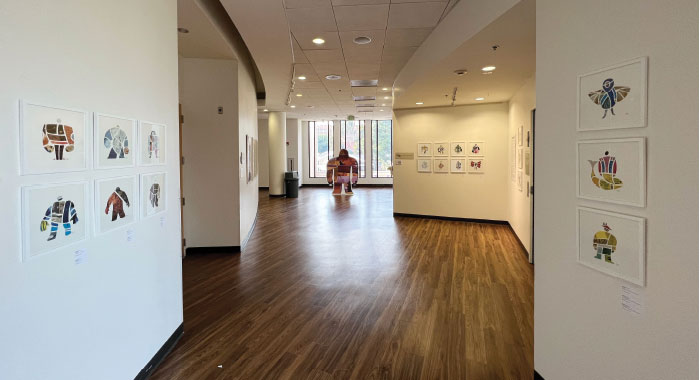
Brynjegard-Bialik cuts up comic books and reassembles them into work made of clean lines and patterns, sinuous shapes and sharp edges, large fields of color and small intimate spaces.

“Golems are a Jewish creation, and so is the American comic book world, and the movies and culture have sprung up from that,” he said. “Jews are storytellers and problem-solvers and seekers of justice — golems bring that all together.”

Brynjegard-Bialik’s “Paper Golems: A Pandemic Diary” along with Ruth Weisberg‘s “The Water Dancers” and Aline Mare’s “Mirabilia” are being featured at the Dortort Center for Creativity in the Arts at UCLA Hillel through March 11. The Center is hosting a winter 2022 reception on Tuesday, March 1, from 7 to 9 p.m.

When Brynjegard-Bialik was a student at UCLA, he spent a lot of time at Hillel, so displaying his art in such a formative and foundational place has a lot of significance.

When Brynjegard-Bialik was a student at UCLA, he spent a lot of time at Hillel, so displaying his art in such a formative and foundational place has a lot of significance.

“Since the work is such a personal series of my experiences weathering the pandemic in Southern California, showing the work in this community [and] sharing it with people who faced all of this with me felt like exactly the right way to bring these golems into the light,” he said.

Perla Karney, the artistic director for the Dortort Center, said, “It’s been the joy of my life to bring art and culture to Hillel at UCLA.”

Karney, who is in her 18th year as artistic director, has exhibited more than 100 artists from around the world. Since 2005, she has given UCLA School of the Arts and Architecture students a platform to showcase their art every spring.

“I am obviously very honored and thrilled to have Ruth Weisberg display her art at Hillel at UCLA together with Isaac Brynjegard-Bialik and Aline Mare,” Karney said. “Each artist brings their unique vision and immense talent to their works. I feel so blessed and grateful that our galleries at Hillel at UCLA have gained so much respect in the Jewish artist community.”

Ruth Weisberg is professor of fine arts and director of the USC Initiative for Israeli Arts and Humanities at the University of Southern California; she founded the Jewish Artists Initiative of Southern California in 2004. 

“I make art out of all aspects of my identity, finding in the process that art integrates my experiences, beliefs and Jewish heritage,” Weisberg said.  

“The Water Dancers,” Weisberg’s exhibit, show images “mostly of women underwater, [which] are very dreamlike and imaginative,” she said. “The largest painting depicts lovers embracing set ambiguously in a watery harbor, which is actually a depiction of the harbor at Tel Aviv. I hope in the case of all these works of art, the viewer will ask themselves, ‘How much is a dream and how much is a new reality?’” 

Weisberg’s work is in 60 major museum collections, including the Art Institute of Chicago, the Biblioteque Nationale of France, the Metropolitan Museum of Art and the Whitney Museum. 

Mare’s contribution to the exhibit, “Mirabilia,” includes new works on paper from her “MicAline” series. She incorporates the materials used in her body of imagery, such as salt, seeds and mica sheets, to create rich, immersive sculptural experiences.

Courtesy of Aline Mare

“I am drawn to the teachings in the Kabbalah where secret truths remain abstracted,” Mare said. “This series examines images of minerals and a sense of the body in transformation, pointing to hidden realms of knowledge and the cycles of life.”

She continued, “I have always loved the quote attributed to Hillel: ‘If not now, when.’ My work addresses the ‘now’ as a mystical state of consciousness.”

Rabbi Aaron Lerner, the executive director at Hillel at UCLA, said that in creating this exhibit, “Perla has been indomitable. She works with dozens of different constituents to make an exhibit happen. And in spite of Covid, she’s done it again. We celebrate her vision and ability, in addition to the keen eye that brings such incredible art to Hillel at UCLA.”

Hillel at UCLA is located at 574 Hilgard Avenue in LA. The gallery is free and open to the public. Hours are Monday through Friday, from 10 a.m. to 4 p.m.

Pandemic-Driven Art and Other Exhibits at UCLA Hillel Dortort Center Read More »

Treat Your Spouse Like the Hotel Guest of Your Life

When I was five years old, my parents got divorced. It was horrible. I felt sick to my stomach every day, I had trouble sleeping and I became a lonely latchkey kid. That’s why when I got married to my husband Daniel, I made a decision to do everything I could to stay married. As frustrated as I get with my husband sometimes, I stop myself from thinking about divorce. In my head, it’s just not an option. 

One of the most valuable lessons I learned about keeping a marriage together came from a fellow married friend. He said to us, “Want to know the best piece of relationship advice I ever got? Treat your spouse like the hotel guest of your life.”

It sounded funny, but it’s absolutely true.

Think about how the concierge at the finest hotel you’ve ever stayed in treated you… whenever you needed anything, they dropped what they were doing because you were their number one priority.

Think about how the concierge at the finest hotel you’ve ever stayed in treated you. They greeted you with a smile. They provided you with refreshments. And whenever you needed anything, they dropped what they were doing because you were their number one priority.

When Daniel asks me to do something for him – it could be as simple as getting him a glass of water – I try to do it right away. When I act quick, it gets me into the habit of prioritizing my marriage. It also builds mutual trust between Daniel and I. It shows that when he needs me, I’m there for him, and vice versa.   

Another thing about a good hotel concierge is that they are always kind and courteous. Unfortunately, spouses are not always kind and courteous to one another. Just like with any family dynamic, we may sometimes treat the ones who are closest to us the worst. Why? I guess we have the “security” and we feel like we can. 

However, this isn’t true – especially with marriage. No marriage is 100% secure. The more times you’re mean to each other or disrespectful or don’t put each other first, little cracks start to appear in the foundation. It all builds up overtime until suddenly, you’re having a screaming match at 2 a.m. because one of you, without fail, never puts your socks in the hamper (ladies, I’m sure you know what I’m talking about). 

A hotel concierge is a total stranger and yet, they are so nice to every guest they meet. This may sound silly, but when I’m arguing with my husband, I stop and ask myself, “Is this how a concierge would treat him?” or even, “Is this how I would treat a friend?” Of course it’s not. It’s odd that at times, we treat our friends, and even strangers, better than we treat our spouses.  

There are, of course, instances where I can’t help my husband with something right away, like when I’m behind on my work. Instead of ignoring his request, I make sure to explain why I need some extra time. My husband can’t read my mind. 

I also always try to put myself in my husband’s position and ask myself, “Is this how I would want to be treated?” There have been times where I’ve snapped at him, and when I calmed down, I realized that I wouldn’t enjoy being treated that way. I put my marriage before my pride and I apologize. That’s something a hotel concierge is eager to do as well: They’ll say they’re sorry if you didn’t have an outstanding experience. They don’t let their ego get in the way. The survival of the hotel is more important to them. The survival of my marriage is more important to me. 

What I’ve learned matters the most in my relationship is that my husband and I are always willing to try to make things better. The minute we give up on each other, it’s over. By doing little things every day to make one another feel good, we’re taking our friend’s wise advice, one small – but monumental – step at a time.


Kylie Ora Lobell is the Community and Arts Editor of the Jewish Journal.

Treat Your Spouse Like the Hotel Guest of Your Life Read More »

Seventy is the New My Back Hurts

I was born on April 20, 1952. That means on my next birthday, I will turn 70 years old. If I weren’t Jewish, that would scare the bejesus out of me. Since I am Jewish, I guess it scares the bemoses out of me. I have friends who have already hit 70 and called me in a panic. I gave them my best sage wisdom. It’s only a number. You’re as young as you feel. Don’t let a number dictate your life. Your best years are still ahead of you.

What a crock. The sweat beads are pouring off me. I am now the one in a major panic. I’m almost at the point of needing to be sedated. As I write this, it’s 2 pm. I am under the covers and in bed. I didn’t climb into bed to write this. I was already in bed, getting ready for my afternoon nap. Naptime is very important to old people. I usually nap from around 1:45 p.m. until 7:00 p.m., but got started late because I could not find my hot water bottle and neck pillow. Without my nap, I am useless; with it, I’m half useless. 

Without my nap, I am useless; with it, I’m half useless.     

When someone asked me what it is I feared about 70, I said, “Dying, getting sick, breaking a hip, having a bad back, wrinkles, bad teeth, going blind, deaf, rotting toenails, becoming obsessed with hot soup, and of course, my sex life fading into the sunset.” How important sex was to me when I was in my 20’s. I remember thinking if I could not have it, I might die. Now I think if I have it, I might die. You can’t beat the system. 

There are a lot of things that are about to start changing and I don’t know if I am ready. 

My wife and I recently went to the Big Island of Hawaii for five days. It was our 32nd wedding anniversary trip. We upgraded the rental car to a convertible Ford Mustang. They are great cars, but the bucket seats are so very low to the ground. When I parked at the hotel and attempted to exit the car, that’s all she wrote. Boom! I wrenched my back. Out of nowhere, a sharp pain shot across where my butt crack is housed. The feeling was not dissimilar to when the dentist pokes an exposed nerve then hands you a bill for 900 dollars that insurance won’t cover. The result of this back-wrenching was that my wife had to drive the entire trip. The pain was so bad, I had to resort to stretching. 

Two things old people like to brag about is if they can drive at night and if they are limber. I remember taking a stretching class at LA Fitness. All the old men and ladies that can still palm the floor and do cartwheels are always in the front rows, deliberately limber-shaming all the Cheeto and Babka eaters in the back.  

In Judaism, there’s something special about the number 70. Curiously, we see this number come up in Scripture and Midrash. There are 70 nations and languages. Seventy members of Jacob’s family came to Egypt. There are 70 elders, 70 “faces” of the Torah, and 70 years of exile. In addition, there are no specific customs relating to the celebration of one’s birthday except one’s Bar/Bat Mitzvah. However, 70 years is very significant in Jewish writings. The Sages state that at 70, one reaches the age of “fullness [of years]” (Pirkei Avot 5:21). It is thus definitely appropriate to mark the occasion by expressing gratitude for having lived what the rabbis consider a full life.

So maybe I wasn’t wrong when I told my friend that 70 is only a number. You’re as young as you feel. Don’t let a number dictate your life. Your best years are still ahead of you. 

The way for me to look at 70 is I’m still very much alive. I’m still relatively healthy. I’m still creative. I have a terrific family and friends who love me. I have gratitude to God. My wife makes a great lentil soup and prune pudding. And, most important, I can still drive at night. Touching my toes? I’m still working on it.


Mark Schiff is a comedian, actor and writer.

Seventy is the New My Back Hurts Read More »

New Proposal Would Force CA School Districts to Adopt “Liberated” Curriculum if Students Want Admission to UC Schools

Bay Area Jewish communal organizations are understandably upset by the Castro Valley school board’s recent unanimous decision to approve a high-priced contract with the Liberated Ethnic Studies Model Curriculum Coalition (LESMC), the educational consulting group that promotes an overtly anti-Jewish and anti-Zionist “critical” ethnic studies curriculum and consulting services.

As the first school district to formalize a relationship with LESMC after Governor Newsom signed the bill mandating an ethnic studies graduation requirement, the Castro Valley school board’s decision was particularly sobering for the Jewish community. It suggested that the new law’s “guardrails”—language added to the bill to encourage local school districts to avoid adopting a curriculum like the Liberated one—may not provide the protection against antisemitism that many had hoped.

Even more sobering than the board’s decision, however, was how that decision was justified by Castro Valley Assistant Superintendent Jason Reiman. Calling the Liberated group “one of the most well-reputed providers for professional development and training,” Reiman revealed that “LESMC has been working with the Alameda County Office of Education for some time … [and] most districts have been working with them in some capacity in our region.”

Indeed, LESMC leaders, faculty and affiliated educators have a foothold in many if not most of the school districts up and down the coast, occupying key leadership roles that provide them the opportunity to promote the implementation of the Liberated curriculum in their districts. These include San Diego, Los Angeles, Santa Barbara and San Francisco Unified School Districts, as well as several smaller districts throughout the Golden State.

Add to the significant number of LESMC-affiliated boots on the ground the strong support that the Liberated group has from the state’s largest teachers’ unions and higher education ethnic studies establishment, and it’s not hard to see that what happened in Castro Valley last month will likely repeat itself in a large majority of school districts in the state.

Alarmingly, these dire odds are about to get considerably worse if a proposed new admissions requirement is approved and implemented by the University of California (UC).

UC’s adoption of this proposal will force every high school in the state to teach a Liberated ethnic studies course, and nearly every student in the state will be compelled to take it.

Currently, all ten UC campuses require incoming freshmen to have taken a designated number of high school courses in seven subject areas, such as History, English, Mathematics and Science. The new proposal (revision to Regulation 424.A.3) from the UC Board of Admissions and Relations with Schools, currently being reviewed by the system-wide Academic Senate, adds an eighth subject area, Ethnic Studies, to the A-G line-up. In order to fulfill the proposed admissions requirement, students must take a one-semester high school ethnic studies course. But, according to the new proposal, it’s not sufficient for students to take any ethnic studies course offered by their high school; they must take a course whose content meets the criteria determined by “a UC faculty ethnic studies working group.”

And here’s where the truly insidious nature of this proposal becomes apparent.

A perusal of the proposed ethnic studies course criteria would leave any experienced K-12 educator aghast. In contrast to the concise descriptions of the pedagogically sound knowledge base and analytical skills that students must acquire to be considered adequately prepared for UC admission in each of the current seven subject areas, the proposed Ethnic Studies criteria are concerning: they contain ideologically-laden jargon, demand rigid adherence to a set of highly controversial and politicized tenets and moral valuations, and force students to engage in behavior that promotes partisan, political goals.

While not overtly antisemitic, the ethnic studies course criteria are firmly rooted in ideologies that are deeply anti-Jewish and anti-Zionist, and, when incorporated into an “approved” classroom will inevitably lead to the portrayal of Jews as “white, privileged oppressors” and Zionism as a “racist, colonialist system of oppression.” In UC-approved ethnic studies classrooms, where students will be required to “dismantle systems of oppression,” Jewish and Zionist students will undoubtedly have a large target on their backs.

Significantly, these ethnic studies criteria strongly resemble the language in the LESMC’s Guiding Principles & Values. This is hardly surprising, considering the make-up of the six-member “UC Faculty Ethnic Studies Working Group” responsible for writing the course criteria:

  • Working Group Chair Christine Hong, who directs the UC Santa Cruz Critical Race and Ethnic Studies Department, features LESMC on the CRES homepage, and the CRES-affiliated UC Santa Cruz Center for Racial Justice prominently features LESMC on its “Political Education” webpage.
  • Andrew Jolivette, Chair of the UC San Diego Ethnic Studies Department, includes LESMC as one of four “Affiliated Programs”—and the only non-UCSD supported program—on his department’s website. Jolivette has also participated in several webinars with LESMC leaders that promote the Liberated group’s efforts.
  • Consistent with LESMC’s explicitly anti-Zionist positioning, both Hong and Jolivette have endorsed an academic boycott of Israel, and last May Hong’s CRES department issued a virulently anti-Israel statement that falsely accused Israel of “settler colonialism” and “ethnic cleansing” and endorsed an open letter calling for an academic boycott of Israel.
  • Tricia Gallagher-Guersten is an LESMC Leader.
  • All but one of the Working Group committee members have publicly voiced their support for the discredited, overtly antisemitic first draft of the state mandated Ethnic Studies Model Curriculum, whose drafters founded LESMC and used the first draft as the blue-print for their Liberated curriculum.

It’s important to point out that the goal of this new proposal is not to ensure that students take an ethnic studies course before coming to UC; almost all of them will have done that anyway, thanks to the new mandate. Rather, the goal of this proposal is to force every school district in the state to adopt the Liberated curriculum, or risk their students not being accepted for admission to UC schools.

The goal of this proposal is to force every school district in the state to adopt the Liberated curriculum, or risk their students not being accepted for admission to UC schools.

And although California’s new ethnic studies high school requirement does not apply to California private schools, if UC adopts this proposal and adds an ethnic studies admissions requirement, all private schools, including Jewish day schools, will also be forced to offer a Liberated ethnic studies course for their UC-bound students.

In other words, UC’s adoption of this proposal will force every high school in the state to teach a Liberated ethnic studies course, and nearly every student in the state will be compelled to take it.

While all parents should be outraged that such a politically motivated and directed course could be required for UC admission, Jewish parents should be particularly outraged, and enormously alarmed, at the antisemitic bigotry that will be unleashed by this proposal.

This is surely not what state legislators intended when they overwhelmingly voted for the requirement last summer. But having passed a bill that was easily exploited by a small but highly influential group of ideologically-driven activist-educators intent on hijacking the state’s schools for their own political ends, California state legislators must act now to stop this catastrophic proposal.


Tammi Rossman-Benjamin is the director of AMCHA Initiative, a nonpartisan, nonprofit organization dedicated to combating antisemitism at colleges and universities in the United States. She was a faculty member at the University of California for 20 years.

New Proposal Would Force CA School Districts to Adopt “Liberated” Curriculum if Students Want Admission to UC Schools Read More »