fbpx

February 23, 2022

From Brooklyn Housewife to Zionist Lobbyist

“Irish, sympathetic, hates British, will definitely help.”  So read an entry in the diary of Brooklyn housewife Esther Kaplan, after meeting with Rep. John J. Rooney, an Irish-American congressman from New York City, seventy-five years ago this week.

Mrs. Kaplan had no background in lobbying or political activism, but when her son David was arrested by the British for trying to smuggle Holocaust survivors into Palestine in 1947, she reinvented herself as a Zionist lobbyist and took her case straight to Capitol Hill.

The arrest of David Kaplan and other crew members of the S.S. Ben Hecht, and the protests that ensued in the United States, comprise a fascinating but little-known chapter in the history of the campaign by Americans to help create the State of Israel.

On a chilly morning in late February 1947, six hundred Holocaust survivors trudged up the gangplank of the S.S. Ben Hecht in the French harbor of Port de Bouc. The ship was sponsored by the activist Bergson Group, and named in honor of the journalist and Hollywood screenwriter who authored the group’s most controversial newspaper ads denouncing British rule in Palestine.

The ship’s captain was Robert Levitan, a burly six-foot-four former Merchant Marine who said he “jumped at the chance” to participate in the mission because he had “felt impotent in the 1930s and early 1940s, hearing about Hitler’s persecution of the Jews and not being able to do anything about it.”
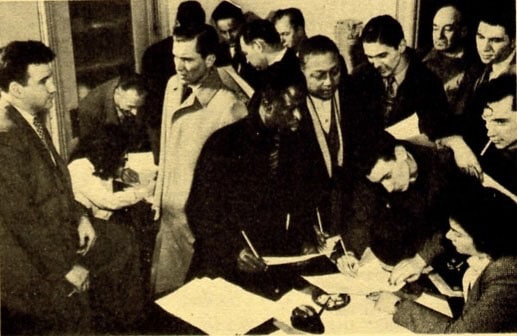
The scene at the Bergson Group’s New York headquarters as would-be crew members of the S.S. Ben Hecht signed up to be interviewed.

“We had twenty men, with twenty different reasons for joining up,” Levitan remembered. “We had some very young boys who were reared in Zionistic homes and were gung-ho Zionists. We had an Irishman who hated the British, and he volunteered just because it was against the British. Our cook was a black man, one of the gentlest men you could ever meet, and he just liked helping out the underdog.”

SALAMI, AND MORE SALAMI

On March 1, the Ben Hecht departed from the French harbor. As the ship traversed the Mediterranean, one of the engines repeatedly broke down, a water tank leaked, and rough weather wreaked havoc. The food supply, however, held steady, thanks to a Bergson supporter in New York who had donated two thousand pounds of kosher salami.

“We had salami soup, salami and eggs, everything you can think of with salami,” Captain Levitan recalled. Despite the near-starvation many had only recently endured as prisoners in Nazi concentration camps, “they refused to eat until they confirmed that the salami was kosher.”
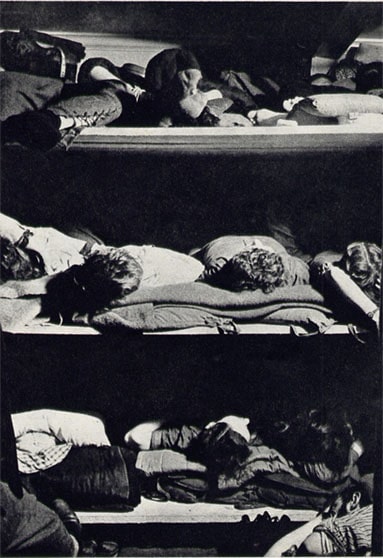
The “beds” on which the refugees slept on the ship were little more than wooden shelves. The cramped accommodations were necessary in order to enable as many passengers as possible to fit board.

“The refugees covered every inch of space,” recalled crew member Robert O’Donnell Nicolai, of Illinois. “Sleeping quarters were any place they could find that was long enough to lie down on … [yet] there was very little complaining. You can’t help admiring people like that. They wanted water, and couldn’t get it; they wanted the sunny side of the deck, couldn’t get that because it was jammed. There were many professional men in the party: doctors, dentists, engineers. In [postwar] Europe all they had to look forward to was digging ditches or building roads. In Palestine, they were going to begin life all over again.”

At first, Nicolai said, “the refugees were inclined to be suspicious of us non-Jews; they couldn’t understand why we had volunteered for the trip. But after they got the idea, which was that we [were] angry at the way the Jews of Europe had been treated, they thawed. From then on, we were buddies.”

On March 8, 1947, just ten miles from the Tel Aviv shore, three British destroyers confronted the Ben Hecht. The flag of Honduras was flying from the ship’s mast, but the British were not fooled by the disguise. “Two of the destroyers slammed into the side of our ship,” Captain Levitan recalled. “You could hear the steel rails crunching and the side of the ship denting.” The crew hastily raised a homemade Zionist flag to replace the Honduran one.

Photo of the S.S. Ben Hecht as it was being intercepted by British destroyers on March 8, 1947. The photo was taken from one of the British patrol planes overhead.(Courtesy of the family of H. Robert Levitan.)

Everyone aboard was arrested. The passengers were taken by the British to a detention camp in Cyprus, where they would remain until the establishment of Israel the following year. The captain and crew, however, as American citizens, were jailed at the Acre Prison fortress, north of Haifa, alongside imprisoned members of Menachem Begin’s underground militia, the Irgun Zvai Leumi.

For some months, the Irgun had been planning an attack on the Acre prison to free its fighters. The plan had stalled because the escapees would need identification papers, with current photographs, to avoid being arrested at British roadblocks. The prisoners had no means of supplying such photos to their comrades on the outside–until Captain Levitan presented them with a small camera that he had managed to bring with him into the prison.
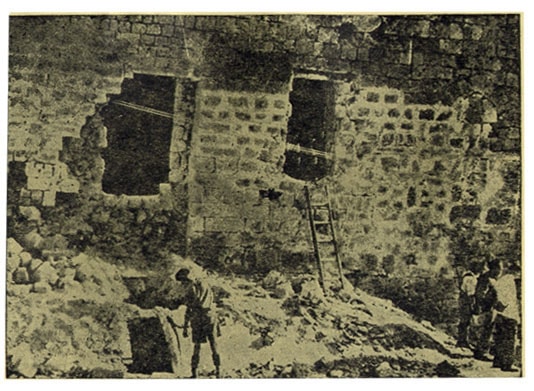
The holes that the Irgun blasted in the prison walls, through which their comrades escaped.

On May 4, an Irgun force blew a hole in the southern wall of the fortress from the outside, while prisoners used smuggled explosives to destroy cell doors and internal walls. Forty-one Jewish fighters escaped in the daring raid, which the international media described as the most spectacular prison break of modern times—and a major blow to British prestige. The operation was later immortalized in the film “Exodus.”

LOBBYING FOR FREEDOM

Word soon reached Mrs. Esther Kaplan, in Brooklyn, that her son David, the ship’s radio operator, was behind bars. The plight of her son and his comrades transformed the demure housewife into a political dynamo.

“Our home was converted into a beehive of activity,” she wrote. “We borrowed typewriters, and friends came and worked assisting in sending out petitions. Aunt Pearl came, made pots of vegetable soup and sandwiches to feed the helpers.” The newly-enlisted activists wrote letters, organized rallies, and contacted politicians to relate the story of the Ben Hecht.

On March 19, Mrs. Kaplan headed for Washingon. With the aid of the Bergson Group and the American Zionist Emergency Council, she met with numerous leading members of Congress or their staff. Some were sympathetic to the Jewish cause because of what the Jews had suffered in the Holocaust; others had their own particular reasons—such as the aforementioned Congressman Rooney, who resented British rule in Ireland and felt a kinship with Jews opposing British rule in Palestine.
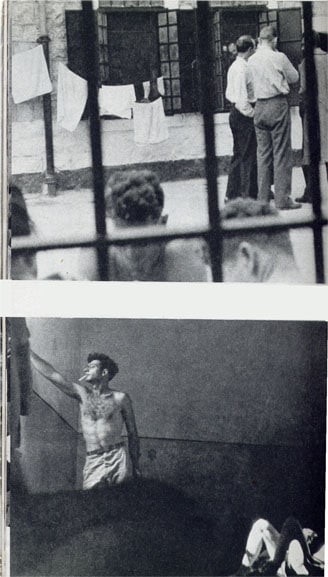
TOP: Crew members from the Ben Hecht in the Acre prison. BOTTOM: Two of the Ben Hecht crew members in their cell at Acre: David Gutman (standing) and Harry Hershkowitz.

Sometimes Mrs. Kaplan’s reputation preceded her; when she met with Rep. Leo Rayfiel (D-NY), she was told that his office had already received petitions bearing hundreds of signatures from Mrs. Kaplan’s supporters back home. Congressman Hugh Scott of Philadelphia delivered a speech on the House floor about the imprisonment of the Ben Hecht crew after hearing from Mrs. Kaplan about her son’s ordeal.

The lobbying had its share of trying moments. Late on Friday afternoon of the first week, Mrs. Kaplan arrived at the home of a local family with whom she would be spending Shabbat. She was emotionally and physically exhausted. Her diary reads:

“Rainstorm, windy, miserable cough and chills … Entered Rabbi’s home late, tired, wet from rain and greatly discouraged. Greeted at door with friendly welcome by [Rebbetzin] Esther Pruzansky and Deborah, 5 years old. ‘Gut Shabbos, please come in and join us.’ What a welcome, warm, genuinely sincere! I could see the candles burning in the dining room, white Shabbos tablecloth gleaming, the challahs covered, the wine decanter … Deborah already made a prayer for me over the candles–a ‘Come Sabbath Queen, bless our guest Mrs. Kaplan’ … I’m crying as I write this …”

Reinvigorated by her Shabbat with the Pruzansky family, Mrs. Kaplan set out for another round of meetings with members of Congress and Truman administration officials.

The lobbying, public protests, and negative publicity took their toll. By the end of March, the British government announced that the Ben Hecht crew members would be deported to the United States.

U.S. Attorney General Tom Clark assured the prisoners that no criminal charges would be brought against them when they returned home. The Truman administration did not want to be seen as persecuting young men who were regarded as heroes by American Jewish voters.

The crew of the Ben Hecht arrived in New York City on April 16, where they were given red carpet treatment at a City Hall reception hosted by Acting Mayor Vincent Impellitteri. Five days later, they were feted at a gala dinner in their honor, hosted by a very proud Ben Hecht, with comedian Milton Berle among its headliners.

Although the ship did not succeed in bringing its passengers to the Holy Land, the voyage of the Ben Hecht generated important international publicity about the plight of the Holocaust survivors in Europe. The unexpected role of the crew members in facilitating the Acre prison break contributed to another blow at the British ruling authorities. And the efforts by grassroots Zionist activists on behalf of the imprisoned crew helped inform the American public about the Palestine crisis.

Mrs. Esther Kaplan never set out to be a lobbyist in Washington. But events thrust that fate upon her, and she rose to the challenge, playing a small but vital part in the historic struggle for Jewish statehood.


Dr. Medoff is founding director of The David S. Wyman Institute for Holocaust Studies, and the author of more than 20 books about Jewish history and the Holocaust. His latest is America and the Holocaust: A Documentary History, forthcoming from the Jewish Publication Society / University of Nebraska Press.

From Brooklyn Housewife to Zionist Lobbyist Read More »

CONGRATS to Sydney Roberts, youngest swimmer ever to swim Bonifacio Strait from Sardinia to Corsica!

Sydney Roberts swam in under FIVE hours (4:55) from Italy to France: Bonifacio Strait from Sardinia to Corsica Summer 2021–YOUNGEST SWIMMER EVER!! Her advice: “Keep PUSHING yourself!”

LISTEN to Conversations with Coach Pedro with Sydney Roberts talking about swimming!

Sydney Roberts is an open water swimmer who started her swimming in the San Francisco Bay with Water World Swim when she was only 12 years old. Her goal was always to swim long distances and she set a goal, to swim a challenging swim. Once she started swimming in the cold waters of the bay, she immediately started to become one of the fastest and dedicated to take challenges like swimming from Alcatraz and other long distances swims, either with wetsuit or skin.

When she was only 16 years old she found her goal by becoming interested in a 15 to 16 kilometers swim, like the Bonifacio Channel in Italy, a swim from the Island of Sardinia, Italy  to Corsica, France Unfortunately, her goal came right before the pandemic hit the entire world. She definitely did not give up her dreams and kept her commitment to keep training and not to give up.

With the help of Water World Swim coaches, like Coach Mike and Coach Jake, and others in the coaching team, she kept persevering, just waiting for the opportunity once the countries would reopen. Being a High School senior, came time that she would have to start choosing her School to go to college but at the same time to continue with her training. Even knowing she would swim in warmer waters, she continue training training in open waters, due to the closing of all places like swimming pools, and during the pandemic and winter. She finalize her training in Winter of 2021 swimming four hours and without wetsuit. On this conversation she tell us details of her training and also about her swim across the Bonifacio Channel in 5 hours. She is also a great musician, that plays many instruments, being her favorite, the fidler, that she plays with a musical group. Giving us a demo of her virtuosity at the end of this conversation.

https://waterworldswim.com/sydney-roberts-15-km-bonifacio-swimmer/

Swim: Bonifacio Strait from Sardinia to Corsica!

Learn about Sydney’s swim from Bridge to Bridge: Swimming in San Francisco to Change the World! and Will You to Swim Bridge to Bridge to Change the World?

CONGRATS to Sydney Roberts, youngest swimmer ever to swim Bonifacio Strait from Sardinia to Corsica! Read More »

Judaism Through the Eyes of an Influencer ft. Emily Austin

This week on Schmuckboys, Libby, Maxine, and Marla are thrilled to have on Emily Austin, a Jewish influencer, actress, sports journalist, and yes, college student! They discuss A LOT of great topics such as ghosting, how going to Jewish day school nurtures Jewish identity but also brings on the pressure of marriage, what it’s like being vocally Jewish on social media when your content isn’t Jewish-focused, dating in sports and more! And of course the girls end off with a game of “Cute or Cringe” and “On a Scale of 1 to Schmuckboy.”

Judaism Through the Eyes of an Influencer ft. Emily Austin Read More »

Carolina Lopez-Ruiz

Carolina Lopez-Ruiz: Phoenicians and the Making of the Mediterranean

Shmuel Rosner and Carolina Lopez – Ruiz discuss her new book: Phoenicians and the Making of the Mediterranean.
Carolina López-Ruiz is Professor of Classics at The Ohio State University. Her work focuses on cross-cultural interactions in the ancient Mediterranean world.

Follow Shmuel Rosner on Twitter.

Carolina Lopez-Ruiz: Phoenicians and the Making of the Mediterranean Read More »

Rethinking Hannah Arendt

“Arendt” was a name I heard quite often growing up, but one I didn’t think much of. I knew that Hannah Arendt had written “The Origins of Totalitarianism” and “Eichmann in Jerusalem,” two seminal pieces of 20th-century literature that were never assigned to me even in the most comprehensive courses on despotic ideologies. Syllabus after syllabus was barren of her work, which made no difference to me—I figured there must have been a good reason for it. 

As I began my career in the Jewish world, I learned that the American Jewish perception of Arendt, certainly in my community of Jews who left Europe before the Shoah, was of a commanding intellectual with the insight to illuminate the human nature behind the Holocaust. This differs dramatically from the common European Jewish and especially Israeli perception of her, as a narcissistic observer who blamed the Jewish people for their own destruction while casually chain-smoking from her apartment in New York, miles from harm’s way. In reading her books for the first time and delving into the world of knowledge she had constructed for herself, I realize that neither of these characterizations of Hannah Arendt are entirely accurate.

To American Jews, this remains an intriguing insight that does nothing to absolve Nazis, but rather explains the psychology behind mass atrocity.

“Eichmann in Jerusalem” was never presented to me as controversial. It is in this 1963 collection of essays, originally published in The New Yorker as a commentary on trial of Nazi Adolf Eichmann, that the phrase “banality of evil” first appears, referring to Arendt’s hypothesis that the greatest evil in the world is committed not by savages and monsters but by ordinary men: nobodies, bureaucrats, meek subordinates who swallowed their orders and executed them without second thought. Arendt illustrated a portrait of Eichmann not as a brazen antisemite, but as a sluggish old man with a head cold who was swept away in the hateful climate of his age. Duty and loyalty were everything to him, the consequences of which never seemed to faze him. To American Jews, this remains an intriguing insight that does nothing to absolve Nazis, but rather explains the psychology behind mass atrocity. But for Europe’s Jews and Israel’s, fifteen years from the gas chambers, who wanted nothing more than to see Eichmann as the vicious tyrant he was and to have him hanged as such, Arendt appeared to be if not defending than at least minimizing the responsibility of all those in Nazi high command who “followed orders.” 

When Arendt discusses the Judenrat, Nazi-designed Jewish councils created to manage the Jewish communities and in some cases cooperate with the Nazis in the liquidation of ghettos and transport of civilians to concentration camps, she just adds insult to injury. She writes: 

“Wherever Jews lived, there were recognized Jewish leaders, and this leadership, almost without exception, cooperated in one way or another, for one reason or another, with the Nazis. The whole truth was that if the Jewish people had been really unorganized and leaderless, there would have been chaos and plenty of misery but the total number of victims would hardly have been between four and half and six million people.” 

Arendt continues, “To a Jew, this role of the Jewish leaders in the destruction of their own people is undoubtedly the darkest chapter of the whole dark story.” 

Given the provocative nature of this passage, the outrage from her fellow Jews is understandable. In fact, The New Yorker received hundreds of rancorous complaints. It is rumored that the State of Israel itself attempted to prevent Arendt from publishing, and even personal friends of Arendt distanced themselves from her on account of the perception that she had betrayed her own people. This pain is real. Indeed, had I been alive then, I might have very well shared the same revulsion—bewildered by Arendt’s insensitivity regarding the choices the Jewish people were forced to make under the most depraved of circumstances, each individual a victim in his own way. The pages in her book dedicated to the Judenrat remain, at the very least, offensive, and a mischaracterization of the number of victims who died and how.

She was bound by her interpretation of truth, not by national or religious sentiments.

But Arendt did not report on the trial of Eichmann to defend the Jewish people or even to indict the evils of Nazism. Between her ears was the brain of a journalist and a philosopher, not of an ardent Zionist (though she worked with Zionist organizations in her youth) or a human rights prosecutor. She was bound by her interpretation of truth, not by national or religious sentiments. Furthermore, it is not entirely fair to brand her an enemy of the community, considering Israel was also harsh when it came to those believed to have collaborated with Nazis. Israel passed “The Law of Punishment of Nazis and Their Collaborators” in 1950, prosecuted collaborators throughout the decade, and even tried Rudolf Kastner, a politician in the Labor Party, for alleged crimes of cooperation during the war. Arendt was harsh, but perhaps her ideas came from a place of anger, not unlike the anger of her Jewish and Israeli contemporaries. 

Perhaps we might see Arendt not as a reckless provocateur or self-hating Jew, but as a thinker who sought to understand the reality of the world. Possibly the most prescient takeaway from Arendt’s work, spanning from the infamous Eichmann trial to her broad writings on human nature and authoritarianism, was, in her own words, the “totality of moral collapse” in Europe under the Nazis. She was able to investigate how and why and under what conditions genocide can take place, and in an era in which the violation of rights is pervasive I find her work not comforting, but perhaps necessary. Her work should certainly be listed in class syllabi, considering the discussions and controversies she provokes are still of paramount importance.


Blake Flayton is New Media Director and columnist at the Jewish Journal.

Rethinking Hannah Arendt Read More »

The Dangers of Negating Jewish Identity

If one were to draw a straight line between recent controversies involving the Colleyville synagogue attack, Whoopi Goldberg, and Brooklyn College, respectively, one would find a common theme: the negation of Jewish identity. 

The attack on Congregation Beth Israel in Colleyville, Texas was “not specifically related to the Jewish community,” an FBI agent said in a press conference afterward, even though the perpetrator’s stated intention had been to communicate with a rabbi in New York whom the attacker fancifully assumed controlled the fate of an imprisoned terrorist.

The Holocaust was not an example of Nazi genocide against the Jews, but rather a mere illustration of “man’s inhumanity to man,” Goldberg said on her talk show, “The View,” notwithstanding Hitler’s well-documented pronouncements about Jewish racial inferiority and his intention to eradicate European Jewry altogether. At Brooklyn College, the Department of Education’s Office of Civil Rights has opened an investigation into claims of anti-Semitic harassment, including a warning by an administrator to a Jewish student to “get your whiteness in check.”

Jews don’t conform to standard definitions of a racial, ethnic, or religious group, so the temptation to characterize all or most of them as white based on skin color is understandable, if problematic.

Increasingly, Jewish identity in America is subsumed by notions of “whiteness,” as the lens through which many Americans view race doesn’t allow for a nuanced understanding of Jewish identity. Jews don’t conform to standard definitions of a racial, ethnic, or religious group, so the temptation to characterize all or most of them as white based on skin color is understandable, if problematic.

But the consequences of diminishing Jewish identity and relegating Jews to the white and privileged class, as some of the Brooklyn College aggressors did, have already proven themselves to be serious.  The Colleyville episode showed that it is possible, even though the FBI later walked back the agent’s remark, to dismiss an attack on a Jewish target as an essentially random occurrence.

The Whoopi Goldberg episode demonstrated that, even at a time when some Holocaust survivors are still living, the power of the Holocaust to educate younger generations has been devalued, as the central narrative of anti-Jewish genocide has been undermined. At Brooklyn College, two Jewish students in the graduate Mental Health Counseling program felt compelled to withdraw because of the stress of the harassment they endured on campus.

To see how little regard is paid to Jewish sensibilities with respect to cultural slights, one need look no further than the University of California’s instructional publication, “Recognizing Microaggressions and the Messages They Send.”  The document provides a list of examples of comments that target individuals based on their memberships in “marginalized groups,” a category that seems not to include Jews or Israel supporters, despite the alarming degree of hostility directed toward Jews on UC campuses in recent years. We learn from UC’s list that the statement “America is a land of opportunity” is a microaggression, while none of the anti-Semitic tropes routinely used to bash Israel and intimidate Jewish students merit a mention.

But the gravest danger posed by the redaction of Jewishness from discussions about marginalized groups is the unsettling public apathy toward an antisemitism that has increasingly turned violent.  In October 2018, the deadliest mass killing of Jews in American history occurred at the Tree of Life Synagogue in Pittsburgh.  Other deadly attacks on Jewish targets have followed.

According to 2019 FBI hate crime statistics, Jews are overwhelmingly the most heavily targeted religious group in the United States. More than 60 percent of hate crimes in that category were directed toward Jewish targets in 2019.  In May 2021 anti-Semitic violence spiked in the wake of clashes between Hamas and Israel.

Antisemitism comes from multiple sources: the far right, the far left, and Islamist extremists. All of these streams of Jew-hatred must be treated with great seriousness. They are all variations of an ancient social illness that has shown a unique ability to persist and adapt to modern circumstances.

The different forms of antisemitism that manifest themselves today find support across political, cultural, and religious lines. The overlap and interconnectedness of these viral hatreds has fed a normalization of antisemitism evidenced in public comments, violent attacks, the bullying of students, and the minimization of the Holocaust.  It is also reflected in the callous indifference of those who claim to protect vulnerable groups but reflexively opt to treat Jews as privileged oppressors, regardless of the vulnerability of Jewish individuals and institutions.

As we continue to devise and implement strategies to confront antisemitism in the U.S. and abroad, it is important to ask, when did the diminution of Jewish identity become acceptable? 

As we continue to devise and implement strategies to confront antisemitism in the U.S. and abroad, it is important to ask, when did the diminution of Jewish identity become acceptable? When did antisemitism stop being a form of oppression?  When did it become OK to dismiss antisemitism as a distraction from other social or political priorities? Most of all, where are our allies?

The answers may be uncomfortable for some, but for Jews, the stakes couldn’t be higher.


Eric Fusfield is B’nai B’rith International’s director of legislative affairs and deputy director of the B’nai B’rith International Center for Human Rights and Public Policy.

The Dangers of Negating Jewish Identity Read More »