fbpx

December 3, 2021

Getting to Know Your Candles – a Hanukkah Writing Workshop with Emily Stern – NIGHT 8 2020

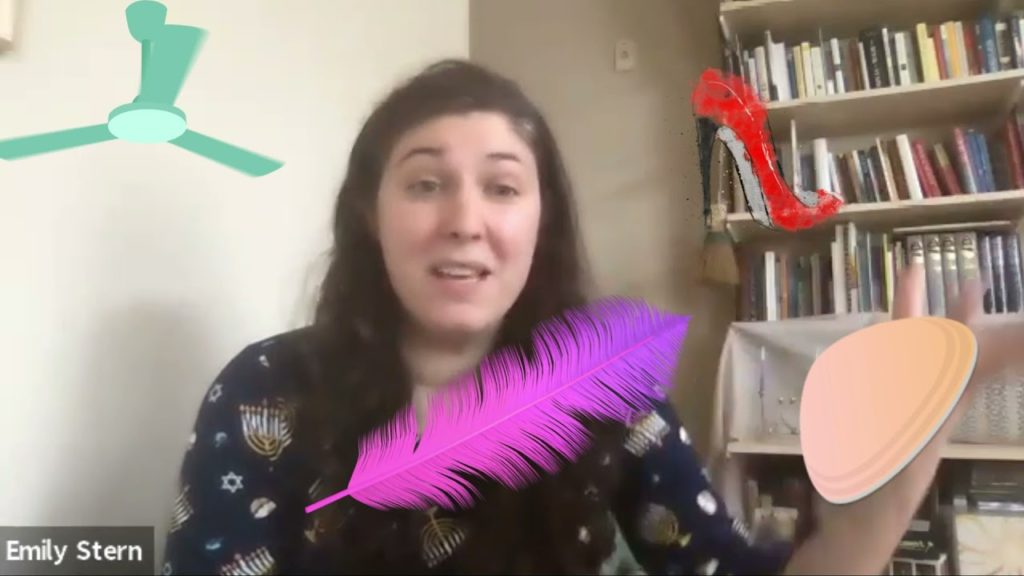
On this last night of Hanukkah, Emily will give you the greatest gift of all— time. Time to bask in the light of the Shechina. Who could ask for anything more? In this series of videos for Hanukkah, Emily offers a different teaching and writing exercise for “getting to know your candles” before lighting Hanukkah candles each night. Corresponding to the number of candles we light each night, these teachings and writing prompts are to help you get in touch with your personal intention and cultivate a unique relationship with your candles each night. Song at the beginning and end is attributed to the Rainbow Family.

#Shechina #Hanukkah #writing #EmilyStern #Chanukah #Candlelighting

Getting to Know Your Candles – a Hanukkah Writing Workshop with Emily Stern – NIGHT 8 2020 Read More »

Satirical Semite: My Crazy Ex-Wife

I don’t like to speak ill of the dead, but it’s not applicable with my ex-wife Victoria because she is one of the undead. The other reason usual rules don’t apply is because Vicky is imaginary and never existed. Several of my friends were going through horrible divorces and I felt left out, so I invented my own nightmare spouse. My heart pulsates when she calls. Unlike her, at least I have a beating heart. I once set the “Jaws” theme as her personal ringtone, but it seemed a bit unfair and cruel to killer sharks.

I had to buy Victoria a house as part of the settlement, so I selected a nice property in the state of Victoria, Australia. The 15,000-km distance from London makes me feel regretful, but unfortunately I couldn’t find anything further away.

Victoria was a master mistress of misdirection. She virtue-signaled, pretending to be a good person. This went so far that she volunteered three nights a week at a children’s cancer hospital, staying up all night with terminally ill patients. She would then rush back at 5.30 a.m. to make me a fully-cooked breakfast and iron my shirt for the day, but once there was a slight crease on the shoulder, which proved that she just didn’t care. It was all about her. Vix also spent alternate weekends helping at a refugee center. She was in it for the glory, even if she refused multiple awards for volunteering, saying “I’m not in it for the glory.” I think we can agree about the nature of her true intentions.

I imagined that Australia would help Vicky reconnect with her ancestral heritage since her great-great-grandparents were British convicts, sent there on prison ships January 1, 1818. Their crime was something like slave trading, manufacturing kosher haggis, or smuggling forbidden Chinese electronic goods into Britain via a hidden cove in Northern Scotland. That was back in the days when Scottish people hated the English and wanted to leave the United Kingdom and join the European Union. Coincidentally the date of her family’s exile coincided with the publication of Mary Shelley’s “Frankenstein.” The book was a biography of Vicky’s great-great-grandmother.

She enjoys Australia even though it has been closed to tourists for two years due to COVID restrictions. “Yes it’s a police state with draconian rules where people haven’t been able to visit dying relatives in Western Australia, but thank God this isn’t New York city. Who cares if  99.72% of their covid patients survived? 0.28% didn’t! I think it’s great that our lives are restricted, the country is mostly closed—at least we are protected!!  Also did you know that there is 1 in 54 chance of driving into a deer if you live in California, and 4.5% of fatal car accidents in Australia are caused by colliding with kangaroos. We should also ban cars, and roads. Where we are going, we won’t need roads,” although I’m not entirely sure where she is going.

“We should also ban cars, and roads. Where we are going, we won’t need roads,” although I’m not entirely sure where she is going.

I am proud of the kids we had together, although Vicky keeps moaning about my loving, long-distance parenting efforts. “Can you stop calling at 2 am saying you forgot the time difference?” Each of our quintuplets is perfectly healthy, and how much sleep does a four-year-old need anyway?

Each of the quins are named after John Travolta film characters, even the girls. Unfortunately they are all rubbish at dancing. So much for my plans to exploit them by forming a Von-Trapp-Jackson-Five dance troupe and make a fortune while they perform 20 shows a week in Las Vegas.

Victoria was not into recycling, but I carefully composted all of our food scraps, cultivating a bio-pile inside the kitchen throughout the length of our marriage. When the kids were born I insisted on biodegradable diapers, and since the local council’s recycling efforts couldn’t be trusted, I added these to our bio-mountain. “Get that sh*t out of my house!” was her microaggressive response. I can’t help it if she hates the planet.

You can’t win them all. It could be worse. In comparison, Victoria was the most reasonable of my five imaginary ex-wives. Which reminds me, I really should get a real wife in real life. 


Marcus J Freed is single. www.marcusjfreed and on social @marcusjfreed

Satirical Semite: My Crazy Ex-Wife Read More »

Alleged Vaccine Injuries in Israel: Underreported, Coincidental or a Tool for Anti-Vaxxers?

“I ran to get vaccinated,” Niva of Tel Aviv said in a telephone interview about health problems that occurred immediately after her first dose of the Pfizer vaccine in Israel. “I waited with baited breath. I came from a world in which you don’t doubt vaccines.”

She even skipped the line for her age group (40-50) to get the jab.

“Symptoms appeared already right after the vaccination,” she said. They included severe hand, neck and back pain. “From moment to moment, day to day, new symptoms came, or they got worse, or they changed …Tingling turned to numbing; numbing turned to pain. It spread to my toes, then to all of my feet.”

She hoped they would pass, since COVID vaccine symptoms were widely advertised to be “mild and temporary.” When the time came for the second dose, she went to the vaccination center, mainly to speak with the on-site physician about her suspected side effects. She noted that neither he nor the nurse reported her symptoms to the Ministry of Health. Nevertheless, the doctor made some calls.

“And he was so happy to tell me: ‘You can get another vaccine.’ I said: ‘That wasn’t my question. I wasn’t coming for permission. I wanted to know why it’s happening.’ And he said: ‘How should I know?’ And he was mean about it. And I said, ‘What should I do?’ And he said: ‘Get another vaccine.’ And I asked: ‘What if it makes my situation worse?’ And he said, ‘There’s a hospital nearby. You can go to the hospital.’ I was shocked. He didn’t care.”

Niva continued: “That morning I was crying in the shower from pain. I couldn’t even tilt my head back to wash my hair, and this man just says: ‘Just go to the hospital.’ As if my life were a game. I said: ‘What are you talking about? I’m in such pain. Is that your answer?’ He shouted at me: ‘If you don’t want to get vaccinated then what are you doing here? You’re wasting my time.’ I owe this man a lot. Because he was so obnoxious, he made me get up and leave and not get a second vaccine.”

What followed were weekly visits to doctors and specialists over the course of a year. As a freelancer, Niva couldn’t work or collect any unemployment or disability benefits during that time. She asked for her identity to be kept private; she doesn’t want her medical history available online to prospective employers.

Niva is part of a growing community of people in Israel, and worldwide, who suspect or have been confirmed with a severe adverse event (SAE) from the COVID vaccine, but which they often dub “vaccine injuries.”

Judging from dozens of anecdotes posted on the 42,000 member-strong Facebook group dedicated to the possibly “injured,” medical professionals in Israel are quick to dismiss any connection between the vaccine and sudden health concerns, which include mild symptoms like coughing and vaginal bleeding to serious ones like heart attack, stroke, and even sudden death of a loved one.

I posted a call for interviews, and “Odelia” reached out to me, with more questions than answers. A week and a half since his “booster” shot, her boyfriend is suffering from pain, burning and tingling sensations, as well as trembling throughout various parts of his body. He manages to sleep only four hours a night.

“We’re going through a sea of doctors,” she said. “Some say that it’s a ‘panic attack.’ It’s a desperate situation because he still doesn’t feel well. On the one hand, maybe it’s from the vaccine; on the other hand, you think maybe it’s something psychiatric. It’s so unclear, unfortunately.”

Since that frightful day at the vaccination center, Niva’s health deteriorated to include tinnitus (ringing in the ears), hypercsusis (hypersensitivity to noise), vertigo, dizziness, shortness of breath, inability to concentrate, and memory loss. One doctor dismissed her symptoms as the result of stress, another to a panic attack. Finally, exam after exam, scan after scan, she was diagnosed with small fiber neuropathy, an autoimmune disease of the peripheral and autonomous nervous system.

Finally, doctors pinpointed the vaccine. As a precaution, she received a certificate of exemption from further COVID doses. She is not eligible for Israel’s Green Pass, which affords fully vaccinated Israelis full participation in Israeli life; instead, she’s entitled to free tests.

“I’m very fortunate because a lot of people I know don’t have a name for what they have because their tests are all good, so they start questioning themselves,” she said. “So I’m very lucky because I have a severe condition. At least I get serious treatment when I go to doctors.”

But at what point can anecdotes be admissible as evidence of a vaccine side effect?

According to Dr. Joel Kaye, an immunologist and head researcher at an Israeli pharmaceutical company as well as a volunteer at Midaat, an Israeli vaccine advocacy organization, it takes a certain mass of reported events that occurred in proximity to the vaccine to rule out a coincidence. This number must also be compared to the number of similar conditions reported in previous years for the same age group.

Based on these calculations, myocarditis, inflammation around the heart, emerged as a bona-fide side effect of the Pfizer vaccine.

“Initially, it was anecdotal until there were enough cases that there was a signal that it was significant enough for the health authorities to investigate,” Kaye said. “And now we know it’s a known, very rare side effect of the vaccine.”

At the start of the vaccination campaign, however, Israel’s reporting mechanisms were flawed, preventing the efficient gathering of data. The Health Ministry website offered only a “multiple choice” style of reporting listing only common, anticipated side effects, like headache, fever, and fatigue. It has since been updated to include a field for personal details in case of follow-up as well as an empty field for a freestyle description of possible side effects. However, it is less detailed and transparent than the United States’ “Vaccine Adverse Event Reporting System,” (VAERS).

Kaye believes any and all reports should be taken seriously.

“It should be investigated,” Kaye said. “It should be ruled whether it’s related or not related. Having said that, many so-called severe reactions have nothing to do with the vaccine. It’s coincidental. A matter of timing.”

One independent grassroots Israeli organization, however, believes vaccine injuries in Israel have gone vastly underreported due to negligence at best and purposeful suppression at worst. Founded by a group of health professionals, attorneys and concerned citizens, the People’s Committee has collected over 4,700 testimonies of people claiming serious and even fatal injuries immediately since being inoculated. The viral Israeli-made documentary, “The Testimonies Project,” drew from this pool to tell the sad tales of 40 Israelis who believe the vaccine caused them, collectively, a range of severe cardiac, blood, neurological, auto-immune, and skin problems.

“Israel was chosen to be the test lab country and data was supposed to go out to the world and it’s not going out,” said Limor Paraira, a businesswoman by profession and head of the People’s Committee documentation team. “The data that goes out is mostly good.”

On November 28, the People’s Committee submitted a petition to the Israeli Supreme Court to appoint an independent commission to investigate the matter to avoid any conflict of interest. She cannot claim to know why the Health Ministry would behave with lack of transparency regarding health complaints possibly related to the jab.

“There are many theories branded as conspiracies,” she said. “But there’s an interest in pushing this experimental vaccine.”

In request for comment on the “Testimonies Project” and the matter of adverse effects, the Ministry of Health’s Corona division spokesperson characterized the film’s editing as “partisan” and could therefore not comment on the health cases it described.

“Adverse events after vaccination are reported to the Public Health Services’ Epidemiology Division of the Ministry of Health, which reviews the reports and analyzes the data,” read the statement. “If the report involves hospitalization, a serious illness, or a fatality, it is followed up by the Risk Management Committee appointed by the Ministry of Health Director General. If the Committee suspects a causal relationship, the Ministry respectively adjusts the clinical care considerations for vaccination.”

Repeated requests for access to the results of the reports and data have so far gone unanswered.

Documents with charts detailing moderate to severe side effects to the COVID vaccine are embedded as links into the Israeli Healthy Ministry’s website, and most figures usually rate a small number of cases per one million doses. Paraira dismisses them as “scribble.” The government’s document (in English) on the safety profile of the booster attributes 77 adverse effects to the third shot; Paraira has received over 300 complaints, some of which are reported directly by physicians who fear the Health Ministry would disregard them or that tying them to the vaccine would cost them professionally.

She suspects that in Israel, vaccine hesitancy toward the booster can be attributed to first- and second-hand accounts of bad vaccine reactions. According to the Health Ministry’s latest figures, just over 4 million received the third booster, about 1.7 million fewer than those who were double-vaccinated. She also believes her assembled testimonies represent a fraction of existing injuries due to lack of reporting on the part of both physicians and sick patients.

“They’re afraid because they depend on doctors, and they need to pass a serious psychological barrier, from being an admirer of vaccines to being on the ‘other side,’ the side they condemned,” Paraira said. “So they sit quietly and suffer.” For now, she says, she has tasked herself to serve as their mouthpiece.

Kaye puts his trust in the medical establishment and believes they are operating in good faith. The nature of the pandemic makes it difficult to acquire reliable data in real-time. All vaccines have side effects and adverse effects, the latter usually affecting a miniscule fraction. Claims of SAEs must be measured against the risk benefit given the massive, multi-billion volumes of doses that have been administered globally.

“Having said that, if you’re the person who falls into that category that’s considered ‘risk,’ obviously for you that’s terrible, but you’re looking at the level of the population, always.”

The growing community of people likely suffering from adverse effects want to be regarded as more than a rare “statistic,” if they even become recognized as such.

“If I had Corona, they would’ve listened to me,” Niva said. “They would’ve cared for me. I would’ve gotten admiration. When I say it’s from the vaccine, the burden is on me to prove the connection. I’m in misery as it is.”

Niva has recently determined to become healthy again. Alienated from both the pro-vax and anti-vax milieu, she has made a new community among people on social media forums, numbering in the thousands internationally, who share her experience. Odelia’s partner has also joined a Whatsapp group for people who suspect neurological injury from the vaccine, and one Israeli doctor has attributed his symptoms to his booster, possibly paving the way for better access to treatment.

“The way they brush it off is very disappointing,” Niva said. “They have to take responsibility. I understand vaccines are good for the society as a whole but if a person takes a hit then don’t abandon that person. There are Corona clinics where people who had long-COVID can get treatment. I wish they had similar clinics for people who had ‘long-COVID-vaccines.’”

 

Alleged Vaccine Injuries in Israel: Underreported, Coincidental or a Tool for Anti-Vaxxers? Read More »

“We’ve been here for two thousand years”: Dalia Sofer’s Novel of Post-Revolutionary Iran

We all know Jews have been part of the social fabric of Iran (formerly Persia) for millennia. After all, Queen Esther—assuming the woman who saved the Jews from evil Haman and gave us cause to wear flouncy princess dresses and tiaras and drink uninhibitedly every Purim actually existed—was living there back in the 5th century BCE. And unlike those who left or were expelled from Arab lands, many Iranian Jews stayed on well after the state of Israel was founded. That’s not to say there is a large Jewish population currently residing in Iran. The 1979 Islamic Revolution, unsurprisingly, caused an exodus; of 100,000 or so Jews living in Iran some forty-ish years ago, now less than 10% remain. Still, the eight or ten thousand Jews who didn’t relocate to Beverly Hills or Toronto comprise a not insignificant community. But why, you might ask, would they have stayed?

Dalia Sofer’s new novel, “Man of My Time,” answers this question in small part. It should be noted that the novel is almost exclusively concerned with a (nominally) Muslim family, not a Jewish one. This is a departure for Sofer. Her first novel, “Septembers of Shiraz,” revolves around a Jewish family, Isaac and Farnaz Amin, and their children, Shirin and Parviz, who suffer the repercussions of the revolution in various ways: as a prisoner, the wife and daughter of a prisoner, a son in exile. It paints a bleak picture of life for Jews after the Revolution, one in which Jews have become suspect for simply having relatives in Israel or making too much money; throughout, Isaac insists to the Revolutionary Guards that he was not a Zionist spy, but he lacks the means to prove his innocence. The 2015 film version, starring Salma Hayek as Farnaz and Adrian Brody as Isaac, consists primarily of closeups of Brody’s face, the camera revelling in its ability to express misery in myriad ways. At the conclusion of Sofer’s first book, the Jewish family sees no way to stay: escape from Iran, at any cost, is the only option. 

“Man of My Time” is a different beast. The chief distinction between the two novels, published thirteen years apart, is the position of the main character, Hamid Mozaffarian—the “Man”—an idealist dedicated to the revolution. If “The Septembers of Shiraz” is concerned with victims, “Man of My Time” is more interested in perpetrators.

Minoo is always two steps ahead of our benighted narrator, reading and thinking deeply, while Hamid is at best “a tourist of revolutionary thought,” allowing himself to be a pawn in the hands of various ambitious figures, a man without a moral compass.

Here, only one character is Jewish: Minoo Levy. Minoo is Hamid’s girlfriend in his early years. She, like Hamid, is an idealist. She’s also a smart, spunky character. When Hamid says, magnanimously, “Your people have their esteemed place. You are, after all, Esther’s children!” Minoo replies, “Yes, that’s our claim to fame. Esther. The beautiful slave who became queen and saved her people. That story legitimizes us as a museum validates relics.” Determined not to be a passive (or dead) relic but rather a valiant and vibrant activist, Minoo joins the National Front, denounces “westoxification,” advocates the liberal democracy she believes a revolution will make possible, and joins Hamid to create political graffiti, writing slogans to accompany his drawings. Minoo is always two steps ahead of our benighted narrator, reading and thinking deeply, while Hamid is at best “a tourist of revolutionary thought,” allowing himself to be a pawn in the hands of various ambitious figures, a man without a moral compass.

Hamid’s family flees Revolutionary Iran, along with hundreds of thousands of other Iranians. Hamid stays; so does Minoo. Hamid finds Minoo’s choice to remain in Iran odd—as might a reader. She explains, “I stayed because two thirds of the Jewish population has left. And if everyone leaves, then what? We’ve been here two thousand years. Someone must persevere until things settle down.” Long after Minoo disappears from the narrative, her words, and her ghostly presence persevering, still linger. What did and does it mean for Jews to persevere in Iran? 

Reading on, I kept hoping for the return of Minoo. Minoo, I wondered, what did you achieve by staying? In Minoo, Sofer, a Jew who left Iran as a child, imagines an alternate destiny. But she doesn’t imagine it fully, at least not for the reader. Still, we know that Minoo represents thousands: Iran is home to the largest Jewish population in the Middle East outside of Israel. Five seats in the Iranian parliament are reserved for non-Muslims; Homayoun Sameh Yeh Najafabadi currently holds the Jewish seat. Thanks in small part to the existence and perseverance of the Jewish community, religious minorities in Iran are mostly allowed to live and worship in peace. It’s easy to accuse those who remained of legitimizing the regime (a regime that is both repressive and very hostile to Israel), but we must recognize that they have also played an important role, safekeeping significant sites of Jewish heritage—and perhaps also saving Iran from becoming an absolute Islamic theocracy.

Sofer is a clever writer, and “Man of My Time” is a fast-paced novel, the historical backdrop informative without getting in the way of the story. Hamid’s downward spiral is utterly predictable and yet fascinating to observe. In fact, despite the horrors Sofer chronicles, there is an almost voyeuristic pleasure one takes in reading about Hamid’s terrible choices and the impact they have. As for whether this villainous character ultimately redeems himself—to find out, you’ll have to read the book! 


Karen E. H. Skinazi, Ph.D, is a senior lecturer and the director of Liberal Arts at the University of Bristol (UK) and the author of  Women of Valor: Orthodox Jewish Troll Fighters, Crime Writers, and Rock Stars in Contemporary Literature and Culture.

“We’ve been here for two thousand years”: Dalia Sofer’s Novel of Post-Revolutionary Iran Read More »

Antisemitic Stickers Found in Beverly Hills

A couple of antisemitic stickers were found in The Flats area of Beverly Hills on December 2.

Scottish journalist and Zionist activist Eve Barlow tweeted out photos of the stickers; one stated, “Why are Jews allowed to suck baby penis?” with obscene photos and the other accused Israel of being behind the 9/11 terror attacks. Both stickers were found on signs warning that anybody who parked on the respective street would be towed away.

Stop Antisemitism noted in a tweet that the stickers directed people to look at GoyimTV, which is part of the Goyim Defense League (GDL). According to the Anti-Defamation League (ADL), the GDL “is a small network of virulently antisemitic provocateurs led by Jon Minadeo II of Petaluma, California.”

On November 28, a slew of flyers alleging that the “COVID agenda” is “Jewish” was found in front of Beverly Hills homes. Those flyers also reportedly had the same logo for GoyimTV.

Jewish groups condemned the stickers.

“We are appalled that antisemitic fliers continue to be found in Beverly Hills during the week of Hannukah,” Anti-Defamation League Los Angeles Jeffrey I. Abrams said in a statement to the Journal. “We have already engaged with the Beverly Hills Police Department to address a similar situation that took place on the first night of Hannukah and we will continue to work with law enforcement to address this hateful vitriol.”

He added: “Sadly, this only reaffirms the uptick in antisemitism across the country, as documented by both ADL’s 2020 Audit of Antisemitic Incidents and the FBI’s 2020 Hate Crimes Statistics Report. We remain vigilant in our fight against hatred and bigotry wherever it rears its ugly head.”

American Jewish Committee Los Angeles Regional Director Richard S. Hirschhaut similarly said in a statement to the Journal, “This has been a particularly gut-wrenching week for Beverly Hills and its new Chief of Police, Mark Stainbrook. A week bookended by expressions of vile, grotesque antisemitism and the horrific murder of a beloved Los Angeles icon and philanthropist. But as the nation’s first municipality to enact the International Holocaust Remembrance Alliance (IHRA) Working Definition of Antisemitism, Beverly Hills has unequivocally declared that it is no place for hate and that the purveyors of such crude bigotry will not go unpunished. To Chief Stainbrook and Mayor Wunderlich, please know that a concerned, vigilant, and grateful community stands with you.”

Associate Dean and Director of Global Social Action Agenda at the Simon Wiesenthal Center Rabbi Abraham Cooper also said in a statement to the Journal, “The bullying and demonization of Jews in word and in violent hate crimes unleashed this Chanukah.

It’s up to us to teach our kids not to be cowered by the haters and bigots [and it’s] up to our elected officials and neighbors to denounce these crimes.”

StandWithUs CEO and Co-Founder Roz Rothstein said in a statement to the Journal, “Rattling off conspiracies, blood libels and other vicious slurs about Jews is despicable no matter when it happens.  But promoting such bigotry against Jews on their religious holidays in order to detract from the joyous celebration, is particularly heinous. It should come as no surprise, however, that the Jewish people will stand tall and continue to enjoy our beautiful holidays like Chanukah, despite the venom that is spewed by hate-filled people.”

Antisemitic Stickers Found in Beverly Hills Read More »

Getting to Know Your Candles – a Hanukkah Writing Workshop with Emily Stern – NIGHT 7 2020

The seventh night of Hanukkah is a special night because the number 7 is about perfection of nature and wholeness. Join Emily on this relaxing journey as she guides you into the essence of your soul as you name your Divine identity, Your divine identity is who you are in the eyes of G-d. In this series of videos for Hanukkah, Emily offers a different teaching and writing exercise for “getting to know your candles” before lighting Hanukkah candles each night. Corresponding to the number of candles we light each night, these teachings and writing prompts are to help you get in touch with your personal intention and cultivate a unique relationship with your candles each night. Opening Song: Lyrics from a poet, source unknown, music by Emily Stern

#7thNight #Hanukkah #DivineIndentity #sevenheavens #shabbat #chanukah

Getting to Know Your Candles – a Hanukkah Writing Workshop with Emily Stern – NIGHT 7 2020 Read More »

Getting to Know Your Candles – a Hanukkah Writing Workshop with Emily Stern – NIGHT 6 2020

Hanukkah begins in the month of Kislev, and is the only holiday that spans two months. On this first night of the month of Tevet, let us reveal the good that comes out of the hidden light of Hanukkah in this 4 part writing prompt. In this series of videos for Hanukkah, Emily offers a different teaching and writing exercise for “getting to know your candles” before lighting Hanukkah candles each night. Corresponding to the number of candles we light each night, these teachings and writing prompts are to help you get in touch with your personal intention and cultivate a unique relationship with your candles each night. Song “So Much Magnificence” is from the Rainbow Family #Hanukkah #tevet #writing

Getting to Know Your Candles – a Hanukkah Writing Workshop with Emily Stern – NIGHT 6 2020 Read More »

Blessing For What is Forbidden — and Permitted

In Parashat Miketz, Joseph is raised from the depths of the royal prison to the very heights of Pharoah’s palace. Having proven himself a wise interpreter of dreams and a shrewd consultant, Pharoah makes him an official over the land. He is second only to Pharoah himself and is given a new name and a wife.

“Pharaoh then gave Joseph the name Zaphenath-paneah; and he gave him for a wife Asenath daughter of Poti-phera, priest of On” (Genesis 41:46).

“Poti-phera” should sound familiar. In last week’s Torah portion, Joseph was serving in the house of Potiphar. It was there that Joseph resisted the seduction of Potiphar’s wife. Our sages inform us that “Poti-phera” is indeed Potiphar. Having resisted the mother, Joseph now weds the daughter.

In Thomas Mann’s opus “Joseph and His Brothers,” the attempted seduction of Joseph takes up no less than 200 pages. We enter deeply into the psychology of Potiphar’s wife and come to sympathize with her. Wedded to a eunuch, she has no chance of sexual or romantic satisfaction in her marriage.

We watch as her fancy for Joseph morphs from a bemused curiosity into a wild lust and a dangerous obsession. The once dignified wife is brought low, resorting to witchcraft in an attempt to coerce Joseph’s heart, and finally, when she has despaired of him for the last time, removing him from her life the only way she knew how—accusing him falsely and having him cast into the “pit” of prison.

According to Mann, resisting this seduction was no easy thing for Joseph. He was tempted to the extent that an excruciating effort was required to keep himself from sin.

This section of Mann’s masterpiece is thus wrenching and titillating, tragic and erotic. It speaks to the way that taboo not only serves to tame man’s baser instincts, but also amplifies them by bestowing an alluring aura of the forbidden.

When Joseph finally marries, however, Mann writes the following: “What had once been evil and dared not happen, was now to be good.” That is to say that sex, once a sin to be resisted, was now an act of holiness between the groom and bride. Joseph is mystified and thrilled by this transfiguration.

At Hebrew College where I am studying to become a rabbi, we are currently engaged with the study of Kiddushin, or the laws of Jewish betrothal and marriage. The blessing recited by grooms at a traditional Jewish wedding evokes Joseph’s experience.

“Blessed are You, Lord our G-d, Sovereign of the Universe, who sanctified us with His commandments and commanded us concerning the forbidden sexual relationships, and forbade us from betrothed women, but permitted to us our wives by way of [the laws of] marriage and betrothal.”

It is a strange blessing. Nowhere else do we bless over what is forbidden to us.

It is a strange blessing. Nowhere else do we bless over what is forbidden to us. For instance, we do not say before a meal, “Blessed is G-d who forbade us un-kosher foods and permitted us kosher ones.”

One way to explain this irregular blessing is that it expresses a rabbinic discomfort with sexuality—a desire to temper the wedding’s implicit sexual content with a reminder that sex is highly regulated by the Torah.

Perhaps, also, the blessing is an expression of a deeper truth—that sexual acts are made meaningful by the restrictions that circumscribe them. This is because sexuality embodies, paradoxically, both our great capacity for good and our great capacity for evil.

Sex is an expression of love, a site of pleasure, and means of union and communication; but it can also be a tool of abuse, a site of trauma, a means of seeking oblivion in another human being. We therefore bless God for what is forbidden.

As a society, we are currently renegotiating our understanding of which forms of sexuality are forbidden and which are permitted. This is not unique to our time, but is rather the ongoing work of human culture. For example, my own generation has rethought norms of sexual orientation, identity, monogamy, consent, and power dynamics. In some cases, what was permitted has become forbidden. In others, what was forbidden has become permitted.

Both are worthy of blessing.

We bless God for instructing us in the ways of the Torah.

For forbidding the forbidden.

For permitting the permitted.

For transforming what was evil into what is good.


Matthew Schultz is the author of the essay collection “What Came Before” (2020). He is a rabbinical student at Hebrew College in Newton, Massachusetts.

Blessing For What is Forbidden — and Permitted Read More »

Which is your favorite Fairmont? Century Plaza joins the Family!

Which is your favorite Fairmont?

I visited the brand new Fairmont Century Plaza in Century City–it is stunning and waiting for you!

Did you know that this hotel is on the former backlot of 20th Century Fox Studios? “Fairmont Century Plaza has a long history as a cultural epicenter. Originally deemed “The Hotel of the Future,” Century Plaza has always been home to industry disruptors, beloved Hollywood stars, American presidents, cultural trendsetters, and those just looking to bask in the energy of it all.”

See more of my favorite Fairmont moments in this video playlist and my articles below:

 
MORE ABOUT MY FAIRMONT STAYS:

Which is your favorite Fairmont? Century Plaza joins the Family! Read More »