fbpx

November 19, 2021

Unscrolled Vayishlach: The Meaning of Freedom

In the night, when Jacob is left alone on the far side of the river Jabbok, a “man” comes and wrestles with him.

Three questions arise:

First, what was Jacob doing alone on the far side of the river? After all, he has already sent his wives, his concubines, his children, and all his camp over to the other side. What is he doing without them?

Rashi (bless him) suggests that he forgot a few small containers and went back for them. Rashbam, however, saw something else at play. “He intended to flee.” (32:23).

How different are Rashi and Rashbam’s readings. In the former, punctilious Jacob won’t dare leave a piece of property behind. In the latter, he is ready to abandon everything – his entire family – out of fear of encountering his brother, who once promised to kill him.

Our second question: who is the man that accosts Jacob, either as he is gathering “small containers” or attempting to slink off in the night. The commentators unanimously understand him to be an angel of God. Perhaps he is the guardian angel of the Esau, but perhaps not.

Our third question: what does it mean to wrestle with an angel?

Rashi tells us that this act of “wrestling,” (yei’aveik), may be connected to the word “dust” (avak), as in: their great scuffle caused the dust at their feet to rise up around them.

The story thus completely subverts common notions of “divine encounter.” Here, there are no bright lights, mystic visions, or heavenly choirs. The angel, unwinged, takes the appearance of a common “man.” The cloud of God’s presence is replaced by a cloud of dust. The revelatory act is replaced with violent striving.

They struggle with one another through the night.

“Then [the angel] said: “Let me go, for dawn is breaking.” But he answered, “I will not let you go, unless you bless me.” (Genesis 32:27).

A fourth question arises: why did the angel feel the need to flee as dawn broke?

On an intuitive level, we already understand that such an encounter as this belongs to the nighttime, to solitude and darkness, to the state of terror that dwells on the far side of life’s great crossings. Still, the commentators venture to give us a sensible answer.

According to Bereishit Rabbah, the angel must flee at daybreak because he must go to work. His shift of singing God’s praises in heaven begins with the shining of the sun.

Some of the rabbis push back on this idea, stating that the angels who sing God’s praises are created each morning – shaped from the waves of a river of angelic fire at dawn and then returned to its surging depths at night. This “man,” therefore, could not be one of them.

Before Jacob lets the angel depart, the angel gives him a new name, Israel. The sun then rises.

It would seem, then, that Jacob too – like the angels who cycle in and out of the river of fire – has been made new. He is not the person he was yesterday.

It would seem, then, that Jacob too – like the angels who cycle in and out of the river of fire – has been made new. He is not the person he was yesterday.

This is a central teaching of Torah. The world is never more than a day old, for it is created constantly anew. As put by the Hassidic rabbi, R Yitzhak Meir of Gur, “the world constantly comes into existence and is sustained by the divine utterance.”

To believe this is to see all things as miracles. As Ramban writes, “All our matters and circumstances are miraculous… they do not follow nature or the general course of the world.”

The sense of this statement is that there are, in fact, no laws of nature. As Rabbi Gil Student paraphrases it, “Every time I drop a rock and it falls, that is not gravity but a miracle.”

This is not superstition. In a strict sense, there really are no “laws” of nature. A drop of rain falling from the sky does not trace its path in accordance with “laws” that somehow exist separate to it. Rather, the drop of rain improvises. It falls in line with the forces that tug upon it, yielding to the yearning of the earth.

This is true of all existence, and to recognize this is to escape, however briefly, from the karmic wheel – the drudgery of causality and fixity, in which life is not improvised but rather proceeds predictably and inexorably like dominos falling in a line.

In the encounter with God, as Martin Buber taught, “causality cowers at [our] heels.”

It is in this encounter that Jacob finds the power to release himself from the cycle of grievance and revenge, deception and flight, that heretofore colored his life. It is in this encounter that he claims a new name. It is in this encounter that he finds himself, like the great universe around him, sustained at every instance by the divine utterance.

This is nothing other than the meaning of freedom.


Matthew Schultz is the author of the essay collection “What Came Before” (2020). He is a rabbinical student at Hebrew College in Newton, Massachusetts.

Unscrolled Vayishlach: The Meaning of Freedom Read More »

Our Moral Ecology is in Peril

Panic has taken over much of the world on the topic of climate change. It is clear to most scientists that the world is in physical danger and that dramatic change must occur, or all that we hold dear will be in peril.

This has occurred because we live in a fragile ecosystem in which interrelated elements depend on one another for survival. If too many of these factors are not sustained, the whole system is compromised and will collapse.

If that realization has finally taken hold in most countries, the concept has most certainly not been applied to human societies, and there is indeed a human ecosystem that has been neglected at least as much as the physical one.

In fact, our moral ecology is in equal peril. Humans have been at each other’s throats throughout history without any consideration for the fact that we are part of an interdependent network that can only thrive when it is cooperative.

The history of the world is the history of war. Man’s efforts to throttle his fellow companion instead of living in peace has a long history. Many people have pondered the question of where God is when there is great suffering in the world, but the truth is that most of the pain of the world is what we inflict on one another.

Many people have pondered the question of where God is when there is great suffering in the world, but the truth is that most of the pain of the world is what we inflict on one another.

There is the occasional bright light of hope to encourage the optimists. The Catholics and Protestants finally realized that they could differ and yet still live in the same world. After a thousand years of war, European countries decided to create an economic union whose interdependence makes war almost impossible. These are huge and impactful developments.

Since the rise of democracies, no democracy has gone to war with another democracy. This is why it is essential that our democracies remain stable and not fall vulnerable to extremism, as they have in recent years. However, the number of democracies is in decline, and this is another blow to our moral ecology.

Judaism’s contribution to the world in this area has been profound. Paul Johnson, a Catholic historian, writes in his “A History of the Jews,” that “thanks to the Jews, we owe the idea of equality before the law, both divine and human; of the sanctity of life and the dignity of the human person; of the individual conscience and so of personal redemption; of the collective conscience and so of social responsibility; of peace as an abstract ideal and love of the foundation of justice, and many other items which constitute the basic moral furniture of the human mind.”

These lessons of Judaism’s moral framework have been adopted by the Western world and once formed the basis for our greatest democracies, but they are beginning to erode. Since the technological revolution following World War Two, the world has changed rapidly, and there is a crisis in the moral sphere to parallel the physical one.

As our arms become ever more sophisticated and lethal, and the world is inundated with power centers, it has never been clearer that we will not fight our way to peace. Victories in war are temporary. Human accord will always triumph over discord, even when it seems impossible; the Abraham Accords were a fantasy a decade ago and now the Gulf States and Israel are linked diplomatically and economically.

All actors on the world stage need to understand that their future, and the world’s fate, depend on our fundamental understanding that we are part of a moral ecosystem and that none will survive unless we all do. As surely as the physical ecosystem can no longer sustain our neglect and abuse, so too our moral ecosystem can no longer bear our hatred and animosity.

In Genesis 6:5, God is described as convinced that Man’s every inclination is toward evil. Yet, after the Flood, He makes a pledge—the sign of the rainbow—never to destroy the world again. For the rest of history, God leaves it to us, the human race, to sustain or destroy our world. An urgent call for a universal commitment to moral ecology should now be the world’s united project.


Dr. Paul Socken is Distinguished Professor Emeritus and founder of the Jewish Studies Program at the University of Waterloo.

Our Moral Ecology is in Peril Read More »

Britain to Designate Hamas As a Terror Group

British Home Secretary Priti Patel announced on November 19 that she is designating Hamas in its entirety as a terror organization.

Previously, only Hamas’ military wing had been considered a terror group in the United Kingdom; now the political wing would fall under that designation. The designation has to be approved by parliament, which the UK government hopes will happen by November 26. Should the approval happen, anyone who voices support for Hamas could face up to 14 years in prison, according to the Associated Press (AP).

“This is an important step, especially for the Jewish community,” Patel said in a speech. “Hamas is fundamentally and rabidly antisemitic.”

Anshel Pfeffer, who writes for Haaretz and The Economist, noted in a tweet that the designation “will have major implications on Hamas’ financial operations of which London has long been a hub (and a home to some key Hamas operatives as well).”

Israeli Prime Minister Naftali Bennett praised the UK in a tweet. “Hamas is a radical Islamic group that targets innocent Israelis & seeks Israel’s destruction. I welcome the UK’s intention to declare Hamas a terrorist organization in its entirety — because that’s exactly what it is. Thank you to my friend @BorisJohnson for your leadership.”

Jewish groups also praised the UK.

“Full proscription ends the dangerous loophole via which this terrorist organisation can spread its extremist poison here and raise funds and support in the UK,” Board of Deputies of British Jews President Marie van der Zyl said in a statement. “Hamas regularly espouses violent ideology and grotesque antisemitism. It is responsible for countless terror attacks including suicide bombings, the murder of Israeli citizens and others, the use of Palestinian civilians as human shields, repression of political opponents, women, and LGBT people.

“We are immensely grateful that it will no longer have any safe harbour or support in the UK. We thank the Prime Minister, the Home Secretary, and the Government for this decisive action in tackling extremism.”

The Community Security Trust, a UK nonprofit dedicated to providing Jews with security, also said in a statement that “Hamas is a terrorist organization dedicated to the destruction of the world’s only Jewish state” that spreads antisemitic propaganda. “Their UK-based supporters have made pro-Palestinian campaigning in this country more radical and extreme. It is entirely correct that the political activities that support their murderous terrorism have no place here.”

Muslims Against Antisemitism tweeted, “Too many times we have seen pictures of U.K. activists & even elected politicians meeting people like Hamas’ Ismail [Haniyeh]. It finally must & will stop because of this action.”

StandWithUs Israel Executive Director Michael Dickson tweeted, “Hamas have been responsible for grisly and brutal terror attacks that have maimed and murdered Brits as well as many others.”

The American Jewish Committee (AJC) commended the UK and called other countries to join them in a tweet; in another tweet, the AJC shared a video highlighting Hamas’ “genocidal agenda.”

The European Leadership Network’s British affiliate tweeted, “Terrorist organisation Hamas is committed to the annihilation of the world’s only Jewish state & causes immense suffering to Palestinians. The UK Government is absolutely right to ban activities that support them & ELNET UK welcomes this announcement.”

Stop Antisemitism tweeted, “Between Justin Bieber and being designated a terror group in the UK, Hamas isn’t having a good week,” referencing the fact that Hamas called on Bieber to cancel his October 2022 concert in Tel Aviv.

Hamas voiced outrage against the UK government’s move, charging that it’s part of the UK’s effort to engage in “aggression against the Palestinians, per the AP.”


Britain to Designate Hamas As a Terror Group Read More »

You Are the Light We Need

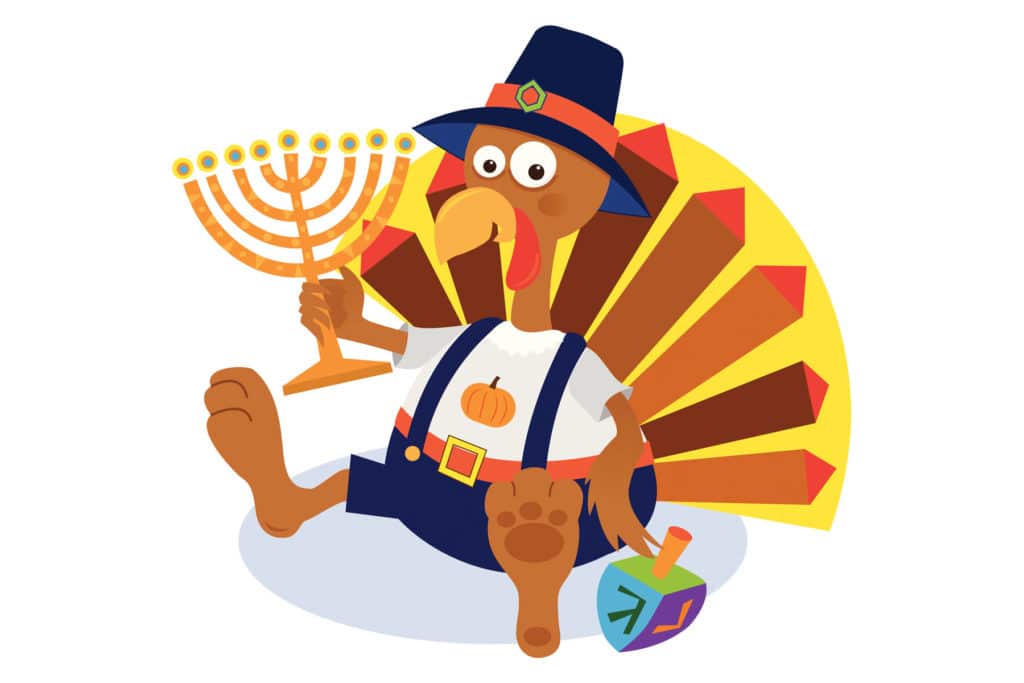
It once again feels odd that Hanukkah will take place during the Thanksgiving holiday. Technically, Hanukkah begins a week from Sunday. As strange the timing, the confluence of themes may elevate our holiday experience.

In the Bnei Yissaschar, a famous Chassidic text known for its mystical teachings, we learn that we use 36 candles during the holiday of Hanukkah. The 36 candles “parallel the thirty-six times that ‘light, ‘candle’ and ‘luminaries’ are mentioned in the Torah, which hints to the hidden light that shined for the first human being for thirty-six hours.” This hidden light is different from the practical nature of the sun, moon, and stars. It is a light that as human beings, we strive to uncover and restore every single day. A light of goodness. A light of benevolence. A light of civility. A light of kindness. And when we light the Hanukkah candles, we are reminded of the exact light God expects us to bring into this world.

On holidays like Thanksgiving, we tend to be on our best behaviors. There is an air of gratitude and thanks, taking note of the ways other humans have touched our lives. And yet, often, that humility leaves the dinner table as soon as the plates are cleared. Perhaps, this year, we need Hanukkah to appear just days after. In a world in which ill-talk, damaging speech, and rumors fuel daily conversations, emails, and social media, let the holiday of Hanukkah rededicate our lives to the purpose God intended. We are meant to be God’s light. A light that dispels the darkness of shame, rage, gossip, and malice. A light that repairs, rebuilds and heals. A light that once revealed, shines for eternity.

I have been reticent to start decorating for Hanukkah. Why bring out the dreidels when we have yet to eat the turkey? But I think those 36 candles are more than necessary. It is time to get ready for our Festival of Lights. May our Thanksgiving and Hanukkah be filled with graciousness and love.

Let each flame kindle a spark within your soul. You are the light we need.

Shabbat Shalom


Rabbi Nicole Guzik is a rabbi at Sinai Temple. She can be reached at her Facebook page at Rabbi Nicole Guzik. For more writings, visit Rabbi Guzik’s blog section from Sinai Temple’s website.

You Are the Light We Need Read More »