fbpx

October 28, 2021

Seeing Through the Eyes of a Traveling Truth-Teller

Bernard-Henri Lévy is almost always described as a philosopher, a public intellectual or both.  Yet these terms are misleading.  He does not issue pronouncements from the comfort and safety of a study or a studio in Paris.  As we find out in his new book, “The Will to See: Dispatches From a World of Misery and Hope” (Yale University Press), Lévy has put himself in harm’s way in the dangerous and troubled places that he writes about, including Afghanistan, Iraq, Libya, Syria and Ukraine.

“I persisted in traveling … to stateless Kurds cast adrift by nations that deny them the right to be our brothers, to cursed Mogadishu, to abandoned Donbass, to crumbling Afghanistan,” he writes. His mission is very much of the moment: “It is because of this way of thinking, which was already in a bad state, collapsed under the weight of the global house arrest imposed in reaction to the coronavirus that I decided, at age seventy-two – and as I have done all my life – to take to the road.”   

Lévy in Afghanistan

For that reason, Lévy deserves to be regarded as much as war correspondent as a philosophe.  To be sure, he has written a dozen books, ranging from “War, Evil and the End of History” to “The Testament of God.” As a young man, he reveals, “the idea of putting language to a use other than literature” did not appeal to him and his fellow intellectuals, “appearing as an affront to the lofty notions we held of words and their proper uses.”  But he could not fail to see what was happening in the wider world, and he added documentary filmmaker and frontline correspondent to his curriculum vitae.   Indeed, many of the chapters in his new book first appeared in the pages of Paris Match and the Wall Street Journal.

On a 2019 visit to the Kurdish communities in Turkey, Syria, Iraq and Iran, for example, Lévy inspects a children’s prison where he finds “a hundred-odd adolescents, all boys, like Nelson from New York or little Ahmed from Toulouse.”  Their only crime is that they have “a father or a mother who was a terrorist.” The Kurds themselves, he points out, are forgotten and friendless “after being abandoned by the Americans and left with their backs to the wall” to face the predations of the Turks, “the criminals against humanity in Damascus” and the pro-Iranian forces in Iraq. He praises one of the Kurdish leaders for “being able, like the generals of the French revolutionary army, of the Israel Defense Forces, and of the early Soviet revolution, to stand up so superbly to the rest of the world.”  And he wonders aloud “[h]ow could the nation of generals John Pershing and George Patton, the world’s oldest democracy, succumb to such an act of self-betrayal?”

Lévy reminds us that we live in a world that is no longer dominated by American power or influence, and the players of consequence are numerous and diverse.  

Lévy reminds us that we live in a world that is no longer dominated by American power or influence, and the players of consequence are numerous and diverse.  His account of a visit to Somalia in 2020, for example, he describes the threat of the al-Shabab jihadists in the capital city of Mogadishu, where mortar attacks and firefights, car bombs and suicide bombers, sniper duels and hostage-taking are known as “Mogadishu music.”  The government relies on a “mixed bag of an army” that includes a few Navy SEALs, some officers on loan from Uganda and Burundi, and private contractors from an American NGO, but perhaps the best prospect for “[imposing] any semblance of order on the insane chaos” is, surprisingly, Turkey. 

“[W]ith the American limiting themselves to air strikes, the European Union administering a massive aid program of which no trace can be detected on the ground, and the Chinese not yet aware of the interest of this accursed country, only the Turks remain,” he reports, “and they are only too happy to find themselves alone on the Horn of Africa….”

Of course, everything we find in “The Will to See” is filtered through the thought and experience of a philosopher. In that sense, the book is also a memoir and a manifesto. “What makes me run?” he muses. “What leads me to throw myself once again in this mess or that inferno?” In a moment of ironic wit, he observes: “One who changes his locale, the Talmud says, changes his mazal.”  More often, he muses on his intellectual and literary forebears and the examples they have set. Descartes, for example, was “one who lives the philosophical adventure like a battle, a charge, requiring as much bravery as it does wisdom.” 

But it is also true that Lévy has come to play the role of a gadfly, a truth-teller who insists on confronting us with the little wars and local atrocities that are often underplayed or wholly ignored by Western governments and media: “[A]n inner compass provokes me to say, ‘No, impossible, intolerable; and what is most intolerable – disgusting, really – is the fierce indifference of my fellow Westerners.”  He readily concedes that he has “disguised himself as a reporter” but is actually an activist.

“I am not a journalist because my slant is the inverse of the journalist’s,” he explains. “I never set out on a reporting trip without the firm intention of intervening in what I see and changing what I show.” 

Exactly here, by the way, we find one of Lévy’s self-affirmations: “[T]he Jew in me cannot help but recognize himself in the inability to report facts without matching them with a good and rightful action – dare I say a mitzvah – the ultimate purpose of which will be the repair of the world, the tikkun olam.” Lévy goes on to explain that he was “one of those leftist sympathizers…who never succumbed to the infantile disorder of hate for Israel.” His “true return to Jewishness,” as he puts it, is based on what he defines as “the affinity between the universalism to which we aspired as students and the other universalism that, through its will to repair the world and to accompany it on the paths to redemption, constitutes the genius of Judaism.”

Upcoming events:

Book talk: “The Will to See: Dispatches from a World of Misery and Hope” on October 31 at Glazer Campus, Wilshire Boulevard Temple https://www.wbtla.org/bhl

Special screening of new documentary film: “The Will to See” at The American Cinematheque (Los Feliz Theatre) on Monday November 1 at 7 pm.  https://www.americancinematheque.com/now-showing/the-will-to-see/

Q&A with Lévy

Bernard-Henri Lévy spoke by Zoom with the Jewish Journal’s book editor, Jonathan Kirsch, about his latest book, “The Will to See.”

Jewish Journal: You write in your new book about your “return to Jewishness” and how it led you to write one of your earlier books, “The Genius of Jewishness.”  Throughout the world – and in Israel itself — Jews bitterly debate what it actually means to be a Jew.  How would you define your Jewishness?

Lévy: In one sentence, I would say that Jewishness is the only identity I know which cannot be reduced to a single identity. It is so complex to be a Jew, it is such an accumulation of paradox and reflection and knowledge, that the word “identity” is a very poor way to express it.

JJ: You write about eight places around the world where you personally witnessed and wrote about suffering and struggle, and Afghanistan is one of them. Americans have recently learned the lesson that the Soviet Union learned a half-century ago and Great Britain learned more than a century ago – it is a graveyard for countries that regard themselves as Great Powers.  What lessons do you hope that Americans will learn from our long-running war in Afghanistan?

Lévy: I refuse the comparison between what is happening today and what happened to the Soviets and the Brits.  America did not lose the war. America won the war.  The Taliban were defeated.  Twenty years after their defeat, they were reduced to the margins of Afghan society, they were underground.  America succeeded in Afghanistan.  I was there only a few months before the Taliban took over – I am a witness, and I write about it in my book. Under the umbrella of America, a real civil society was developing in the cities of Afghanistan. Behind the wise and benevolent shelter of American troops, women in Afghanistan started the process of liberation.

JJ: And yet most Americans see the end of the war in Afghanistan as a defeat. 

Lévy:  I hear it from both sides, Trump and Biden, that the war in Afghanistan was failure, an endless failed war.  But it’s not true. America and the West in general made a terrible mistake in withdrawing. We had no reason to withdraw from Afghanistan. America has troops in so many countries of the world –  in Germany, Japan and Korea, for some seventy years.  The role of a great power is to have great diplomats, to have a great influence, and sometimes to have a few troops, too.  If America decides to become Switzerland, then we shall leave the field to the Iranians, the Turks, the Russians, the Chinese, and the Muslim Brotherhood.  That’s the position we are in, and that’s a tragedy.

 JJ: You write about what you memorably describe as “Creation being uncreated (and desecrated) in a sort of reverse Big Bang that blasts masses of surplus people into nothingness.” Yet the subtitle of your book is “Dispatches From a World of Misery and Hope.” What hope do you have for a different and happier fate than the Big Bang in reverse?

What gives me hope are the people who suffer the most and yet stand up, full of dignity. 

Lévy:  The hope is that we still believe in tikkun olam, both Jews and non-Jews. There are battalions of great spirits who believe that being human means that we make the effort to repair the world. I have encountered them in the cursed and damned areas of the world on the trips to hell that I describe in the book. What gives me hope are the people who suffer the most and yet stand up, full of dignity. 

JJ: Your conclude your book with an affirmation and a challenge: “I believe that a life is not a life and does not make us accomplished people unless it is a little more than life and adheres to an idea, an ideal, a principle, or certain values that transcend it and raise it above itself.”  So I ask: What is the idea, the ideal, the principle or the value to which you have adhered?

Lévy in Bangladesh

Lévy: For me it is the Torah, the ultimate object of study, which enriches and fills my life and which assists us interpreting repairing the world and repairing the world.

Book Excerpt from “The Will to See”

I believe that over the life that lives on, over the life that, emitting its own light, crosses space and time to take root in another life; over that satellite of life, that capsule of life, that life palpitating like a synthesized soul, aching like a missing limb, and lacking nothing but consciousness — I believe that over such a life death has no hold as long as there are ears to hear it and to divine the sound of the voice that breathed it.

Blessed by words, in a sense. Saved by the life of books. That is another conviction. And it reassures me.

And finally I believe that a life is not a life and does not make us accomplished people unless it is a little more than life and adheres to an idea, an ideal, a principle, or certain values that transcend it and raise it above itself.

“Liberty or death,” said the French revolutionaries. 

“Better to die standing than to live on one’s knees” was the cry of the childhood heroes whom I still admire.
And that could be said of many others, less glorious or not glorious at all, untraceable, nameless: I believe there is in every woman and every man a passage to greatness, every single one, not only the great by their transcendental calling, such as kings, near-kings, artists, and writers.

I love life passionately and hope to love it still longer and better. But I know that it is worthing nothing if it is not fed by the idea, not of a great death, but of a great life. And I believe the greatest of lives are those that — having resolved to leave a last word, not to death but to life — decide not to accept death when it prowls around those whom one loves or whom one has decided to protect.

I have found beautiful stories of resistance, struggle, goodness, and abnegation that I have never forgotten and that testify to a true love of life lived greatly. 

I have never given much credence to all the stories of adrenaline, intense moments, and so on that are told about war reporters. I don’t believe that skirting the abyss and, in so doing, leaving open an inner window on death boosts the gusto for life that one feels upon returning safe and sound. I believe even less in it since I have many times had the opposite experience of returning from a reporting trip in which I saw death close up, not my own but that of others, and had trouble resurfacing and resuming life as I had lived it before. But I think I know what I sought from all those distance voyages, those reporting adventures. What I was chasing is probably the exquisite diversity of my fellow man. But I also found in those lands that I frequented fifty years ago, twenty years ago, or a few months ago, lands where one is great not because one is born that way but because one has no other choice and cannot behave otherwise. I have found beautiful stories of resistance, struggle, goodness, and abnegation that I have never forgotten and that testify to a true love of life lived greatly. 

It may be said that these convictions are vague and rhetorical and will not do me any good when the moment comes for me, too, to take my life.

Maybe that’s true.

But that’s not the moment I’m talking about.

I’m talking about right now.


Jonathan Kirsch, author and publishing attorney, is the book editor of the Jewish Journal.

Seeing Through the Eyes of a Traveling Truth-Teller Read More »
Jay Sanderson’s Night of Gratitude

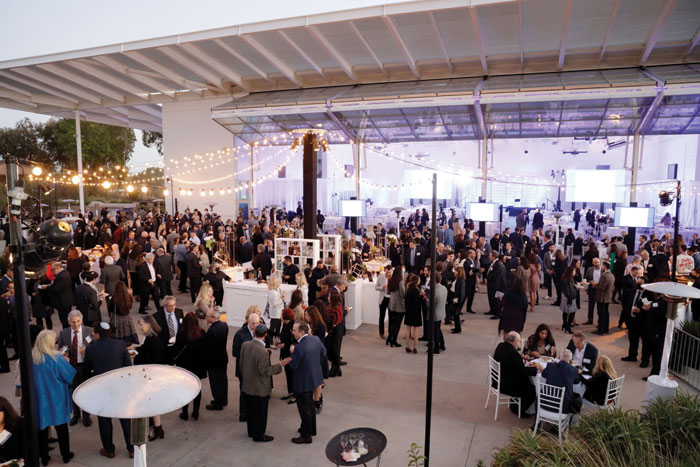
Facing 500 community members who had come to honor him as he ends his 12-year tenure as head of the Jewish Federation of Greater Los Angeles, Jay Sanderson found himself in an unusual position: speechless. He stumbled to find the right words to express his infinite gratitude for the opportunity to have served a community he loves.

Gratitude was an appropriate theme for the evening.

In the midst of a lingering pandemic that has kept many of us isolated, the communal gathering itself was cause for gratitude. It felt like a giant family reunion, with everyone eager to reconnect. Thanks to a jumbo green smoothie I inhaled before leaving my house, I was able to forego the food buffets that were scattered throughout the glittering outdoor setting at Stephen Wise Temple, and focus on the great Jewish art of cocktail schmoozing.

In the midst of a lingering pandemic that has kept many of us isolated, the communal gathering itself was cause for gratitude. It felt like a giant family reunion, with everyone eager to reconnect.

Because some people wore masks (as we were instructed to do; we also had to provide proof of vaccination), the schmoozing was not as smooth as usual, for the obvious reason that masked faces are not instantly recognizable. But that didn’t stop the over-caffeinated mingling. We were like 500 human bumper cars, delighted to keep bumping into friends and colleagues we hadn’t seen since those ancient days pre-COVID.

The breezy word “schmooze,” however, doesn’t do justice to some of the deeper conversations. After a few seconds of small talk, Richard Sandler, David Renzer and I jumped into the epic issue of why Jews are good at being divided, but not so good at being united (with some wonderful exceptions). We didn’t have time to go over solutions.

I lucked out when I bumped into the incoming head of the Federation, Rabbi Noah Farkas, and we efficiently used our schmooze time for important stuff like his future gig (“I will spend much of the first year doing a lot of listening”), his insightful commentary on Parsha Noah, “Constrained Creativity,” (which we published in the Journal) and my recent visit to the holy Israeli city of Tsfat. 

In normal times, the event would have been held at a large hall in a fancy hotel. But these are not normal times. In the pandemic era, people prefer the safety of outdoors, whether for praying, eating or partying. After the outdoor cocktails, we all entered a large space with an open feel for the formal part of the evening.

It was fitting that the setting symbolized a time of transition. The pandemic has disrupted lives and communities in ways we can’t yet fully grasp. As much as the Jewish community has shown tremendous resilience, a feeling of uncertainty prevails. When so many people are so reluctant to enter any indoor space, and have plenty of safer alternatives, it is bound to trigger anxiety among communities that have long relied on in-person gatherings inside valuable real estate. That is just one source of anxiety; there are plenty of others, from loneliness to chronic health concerns to loss of livelihoods.

Sanderson, who is the subject of our cover story this week, spoke about the Federation’s continuing efforts to support the community during the pandemic. He didn’t need to elaborate on his other accomplishments. A well-crafted video highlighted the multiple programs he initiated during his tenure to help fulfill the Federation’s evolving mission.

In handing the torch to his successor, Sanderson reassured Farkas that he will take over an operation with a great staff and plenty of assets. What is Sanderson’s greatest asset? I’ve known Jay for a long time. He is a strategic thinker who works hard and knows how to get things done. But if I had to name one asset, I would say simply: He cares. He cares deeply about every member of our community. That comes naturally to him.

Jay has never been big on empty promises. While he knew it was impossible to please everyone, he embraced every segment of the incredible kaleidoscope that is Jewish Los Angeles—and found new and innovative ways to assist them. 

Jay has never been big on empty promises. While he knew it was impossible to please everyone, he embraced every segment of the incredible kaleidoscope that is Jewish Los Angeles—and found new and innovative ways to assist them. 

That kaleidoscope of Jewish LA came to honor him at Stephen Wise Temple. Of the many things Jay was grateful for, I’m sure he also was grateful that he enabled this long overdue community reunion, under the stars in a city we love. 

On this night of gratitude, you could feel that sentiment everywhere you looked.

Jay Sanderson’s Night of Gratitude Read More »

Saying Farewell to the Federation, Jay Sanderson Is Ready to Write His Next Chapter

The small cardboard boxes that lined the top of his office credenza said it all. Jay Sanderson, president and CEO of the Jewish Federation of Greater Los Angeles, had started the task of methodically packing the numerous memorabilia he collected throughout his career. 

“Going through all these items brings back memories,” he said. “I just came across a handwritten note from then Prime Minister of Israel Benjamin Netanyahu after we had lunch many years ago.”

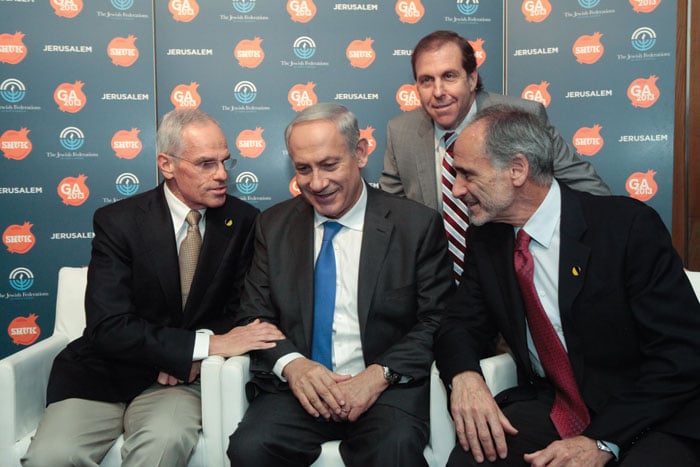
Sanderson with then Israeli Prime Minister Benjamin Netanyahu and Richard Sandler and Les Bider, past Federation chairs in 2013

After 12 years leading the Federation, Sanderson, 64, will be handing over the proverbial torch to Rabbi Noah Farkas on January 1, 2022. Sanderson is ready to start a new chapter of his life, a chapter that he looks forward to writing. 

“From the day I took this job, I told the board the exact day I would leave,” he said.

“Some people stay in jobs too long. This is a 24/7 job. I didn’t think I could or should be here more than 12 years.” — Jay Sanderson

When asked how he could have known that his tenure would last precisely 12 years, he answered, “Some people stay in jobs too long. This is a 24/7 job. I didn’t think I could or should be here more than 12 years. I felt that would be just the right amount of time for me to accomplish what I wanted and then for new leadership to take over.” 

On October 17, more than 500 people, including rabbis from all denominations, political leaders, Federation partners, staff and friends, gathered at Stephen Wise Temple for dinner and to express gratitude to Sanderson. The evening benefitted the Federation’s young adult engagement and leadership development programming and raised $1.7 million, but is expected to grow to $2 million, a Federation spokesperson said.  

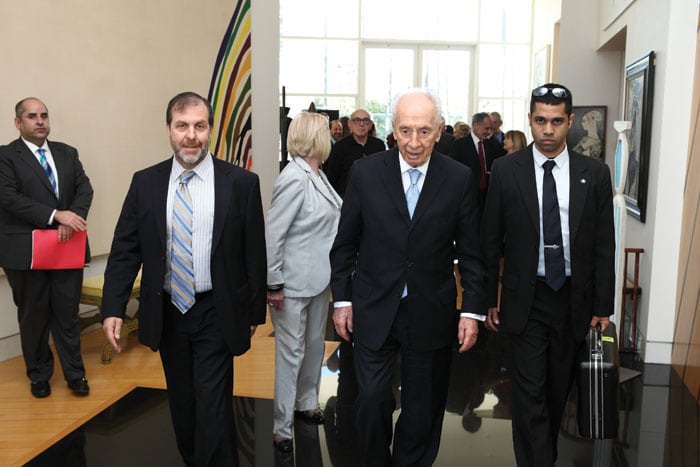
Jay Sanderson with Shimon Peres in 2015 at the Federation’s King David Society event

Sanderson is one of the busiest and most powerful Jewish leaders in L.A., throughout the country and in Israel. But his rise to the top of Jewish communal leadership wasn’t fast, easy or painless.

He was born in Boston to parents Herbert and Rhoda Sanderson and lived in the suburb of Chelsea, Mass. “When my mother was pregnant, the doctors didn’t know she was having twins,” Sanderson said. “As a result, my twin brother Jeffrey was oxygen deprived and born developmentally disabled.”

Then, when Sanderson was five, his father died suddenly of a heart attack at age 42. He, his mother Rhoda and Jeffrey moved to Salem, Mass., where he experienced a fair share of antisemitism. “We had no money, and I had no Jewish friends,” Sanderson said. “When I was around 13, two older kids buried me alive in the back of the Rainbow Terrace Housing Project where we lived. I screamed and screamed until another kid heard me and saved my life. I knew they did that because I was Jewish.” 

In 1972, a rabbi in his community arranged for him to visit Israel through The Jewish Agency. He was just 14, traveling with kids who were a couple of years older. Little did he know that the trip would change his life. 

“Four of us were selected to have brunch on a kibbutz with David Ben-Gurion, and I was one of them,” he said. “When we finished, as I got up to leave, I felt a hand on my shoulder. It was Ben-Gurion. He turned me around and said, ‘Make me a promise. Protect my people. Protect my country.’ That was the moment I became a Zionist.”

It takes only a couple of minutes chatting with Sanderson to see he truly is a born storyteller. His love of stories led him to study journalism and then theatre at Syracuse University, where he earned a B.S. degree in film and a minor in theatre. 

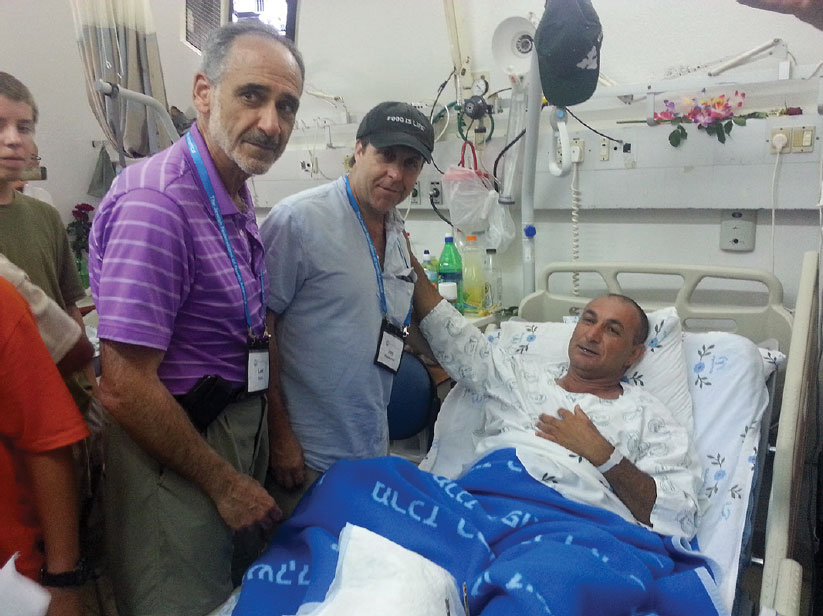
Jay Sanderson with terrorism victim in Israel, 2014

“I wanted to be a writer, and where better to write than Los Angeles?” Sanderson said. 

In 1980, he drove alone cross-country to L.A. in his 1967 Chevy Malibu to take a job at 20th Century Fox. He worked as a script consultant on one movie and then immediately was laid off, the victim of an actors strike. While he remained enamored with living in L.A., the movie capital of the world, and had lots of fun, he wasn’t pursuing his passion for writing. He had writers’ block and was running out of money. 

His luck changed when he was on the Venice boardwalk one day. 

“I saw a woman sitting on the steps of a building crying,” Sanderson said. “She was an ex-addict running a drug rehabilitation program called Tuum Est (Latin for “It’s up to you”). She had just been given notice that she had to renovate the building, or they would be out of business. I had zero experience renovating buildings or in drug rehabilitation, but I said I would help her.” 

He talked his way into a job as the director of development of the rehab, which eventually became Phoenix House. “The next thing I know, I’m running the whole program — the largest residential drug rehabilitation program west of the Mississippi,” Sanderson said. 

The added benefit of working there was meeting his future wife Laura, who was interning for her licensure in psychology. They were engaged three weeks after they met. 

Running the drug program gave Sanderson experience not only in social services, but also in fundraising and forging partnerships, unique skills required for institutional management. Laura introduced Sanderson to Camp Alonim on the Brandeis-Bardin campus that she frequented. It was also where the two married. 

As fate would have it, it was through Brandeis-Bardin that Sanderson met Larry Weinberg, a founder of AIPAC, a major real estate developer and philanthropist. Weinberg knew Sanderson had experience in writing and fundraising and was committed to the Jewish community. They quickly bonded.

“Larry then comes to me with a couple of people and [says], ‘We have this thing. We believe there should be a Jewish Television Network (JTN), there really is nothing here but an idea. You have all this media, fundraising and Jewish community experience. Any interest?’ I knew I had to get back to where I started – back to writing,” Sanderson said.  “It was television and I was a writer. So I said yes. But I had one condition. I said if there’s nothing here, let me build it like I want. He agreed.” 

Sanderson soon learned that building JTN was harder than he thought. It was in debt to a cable company, and with multiple cable television stations in every market, Sanderson found himself flying around the country, convincing cable stations to air JTN shows. 

“I immediately realized that we Jews spend an awful lot of time talking to ourselves. If you’re an engaged Jew, and you watch a Jewish program, what have you accomplished?” Sanderson asked rhetorically. “I then realized I had to turn JTN into a production company and get Jewish programs to the mass market.”

He did just that. As a production company, JTN became a major partner with PBS, producing the biggest, most expensive Jewish television series ever produced, “The Jewish Americans.” Sanderson proudly said that at least one hour of “The Jewish Americans” has been watched by at least 35 million people and nominated for numerous awards. 

Then something amazing happened: the internet. That led Sanderson to come up with the idea of creating a Jewish internet channel. He built a prominent board of directors, garnered investors and sold the idea to major internet players such as America Online (AOL). He raised millions of dollars to launch this idea that had never been done before. Things were looking good until the internet bubble burst, and Bernie Madoff’s scheme was discovered.

“I was an internet millionaire for about 30 seconds,” Sanderson said with a chuckle. “Investors pulled out. Everything was falling apart.” 

That’s when fate entered the picture.

“I was driving from my home in Encino to work through the canyon and at around Mulholland Drive, my cell phone rang,” he said. 

Calling was the head of an executive search firm looking for a replacement for then-Jewish Federation of LA president and CEO John Fishel. “He told me they were looking for someone ‘out of the box’ and were simply calling to ask me if I had any ideas,” Sanderson said. “When he posed the question, the words that I never thought I would utter fell out of my mouth: ‘What about me?’ There was the longest pregnant pause I’ve ever experienced. I didn’t know if we had lost the phone connection or what. His reply was ‘Are you serious?’”

“They were looking at a who’s who of people all over the country … I never thought I would actually get the job.”— Jay Sanderson 

Sanderson admitted he wasn’t thrilled with the grueling search process, which lasted nine months. “They were looking at a who’s who of people all over the country,” he said. “I never thought I would actually get the job.”

Then, of course, he got the job. 

While speaking with the many people who have worked with and for Sanderson, similar descriptions emerge. Disruptor, a word which Sanderson wears as a badge of honor, is often mentioned. Less philosophically, few can resist describing his work style as strong, direct and unwavering. But many partners and colleagues are quick to point out that over the years, he has softened his approach. They say he welcomes new ideas and is always willing to listen, even if he doesn’t particularly like the idea. But many say he usually finds a way to make it work. 

In speaking with people who know him well, it is clear that his professional relationships often become personal friendships. “Jay is a very dear and treasured friend of my entire family, my five children, their spouses who are married, my husband and me,” Julie Platt, past chair of the Federation board and national campaign chair of the Jewish Federations of North America, said. “He is our friend beyond being our professional guide. He has responded to challenges as our friend within my family as any good friend would do.” 

Rachel Moore, president and CEO of The Harry and Jeanette Weinberg Foundation, which has funded many Federation projects and initiatives, said, “Jay is not afraid to speak his mind and show courage in difficult moments to advance the agenda for the Jewish community.”

Marvin Schotland, president and CEO of the Jewish Community Foundation of Los Angeles, who has worked with Sanderson for more than 30 years, added, “You can always count on Jay to be brutally honest with you. He’s not afraid to take chances [and] he’s not afraid of what people think about him. You get the straight scoop from Jay, whether you like it or not. Jay thinks he is right all of the time. He’s not, but he’s right most of the time.”

The fact that Sanderson threw his hat in the ring for the Federation job is somewhat curious. He said that at first he wasn’t sure he even wanted the job. He noted that prior to joining the organization, he didn’t see the L.A. Federation structure as effective. “It was challenging to have a lot of accountability or transparency in an umbrella of beneficiary agencies,” he said. 

When he started, Sanderson’s assessment of the institution proved to be on target. The generation of potential donors Sanderson was dealt asked “good questions,” he said. “They asked, ‘Why should I give to the Federation when I can give directly to an agency that does the work?’” 

From the very beginning, the new president and CEO said he knew the Federation needed a transformation.

“At my first all-staff meeting I said, ‘I know people are unhappy here. I also know people are afraid or don’t like change. You might prefer being unhappy [with] change, but I promise you I am not going to be creating a change process, but a transformation process. I hope you stick with it. I know everybody will feel better, the place will be more effective, we’ll raise more money and the community will appreciate us more.’”

With 146 Jewish Federations stretched across the American landscape, Sanderson explained that for some Jewish Federations, the traditional model still works. He cited Chicago and Pittsburgh as examples where Jewish communities are more centralized. In those cases, and others, the Federations have a hand in most programs and projects that serve their Jewish communities. 

But L.A. is different, and Sanderson knew it from day one. 

“The Los Angeles Jewish community not only covers the largest geography of any Jewish Federation in America, it also is the most dynamic and challenging Jewish community in the diaspora,” he said. “We have the largest Israeli population outside of Israel. We have the largest Persian Jewish population in the world. We have the largest percentage of millennials. We are home to many large synagogues and strong Jewish institutions with high visibility that do their own fundraising. In many cases, people don’t even give to us. And I’m OK with that, because it helps the Jewish community. But if you give a million dollars to a secular museum and nothing to the Jewish community, we need to talk about that.”

“The Los Angeles Jewish community not only covers the largest geography of any Jewish Federation in America, it also is the most dynamic and challenging Jewish community in the diaspora.” — Jay Sanderson

When Sanderson arrived at the Federation, it had a budget of $42 million and 174 employees. Today, the budget tops $55 million, and there are 130 employees.

The operational procedure for creating and sustaining projects  Sanderson brought to the Federation is seemingly easy to describe, but not so easy to achieve. As he explained it, the first step is to identify a Jewish need in the community, and then find the right professionals with the right experience and skillset to address and meet those needs. This often involves partnering with an existing organization to support and expand their work. 

Next, it’s critical to establish sufficient funding so the project can achieve its goals. Wrapped in this process is the promise that the Federation will be intimately involved every step of the way, providing professional guidance and assistance from an engaged staff. And, donors whose funds make projects possible are kept in the loop so they see the impact of their dollars. 

The dinner event included a video presentation that showcased numerous Federation projects and initiatives that benefitted from Sanderson’s leadership and stewardship. 

They included: Ezra Network, Centennial Mission, Community Service Days, NuRoots, The Geri & Richard Brawerman Leadership Institute, Brawerman Fellowship, Tour de Summer Camps, Community Leadership Institute, Community Security Initiative, Lifetime Achievement Award, Los Angeles Jewish Abilities Center, Israel Trauma Coalition, Unistream, LA Jewish Teen Initiative, General Assembly in LA, Jay’s 4 Questions Podcast, Wildfire Response, Save Our Survivors, COVID Response and The BAR Center at the Beach.

Asking Sanderson to single out the most meaningful projects the Federation has spearheaded and continues to move forward is like asking a parent to name their favorite child.

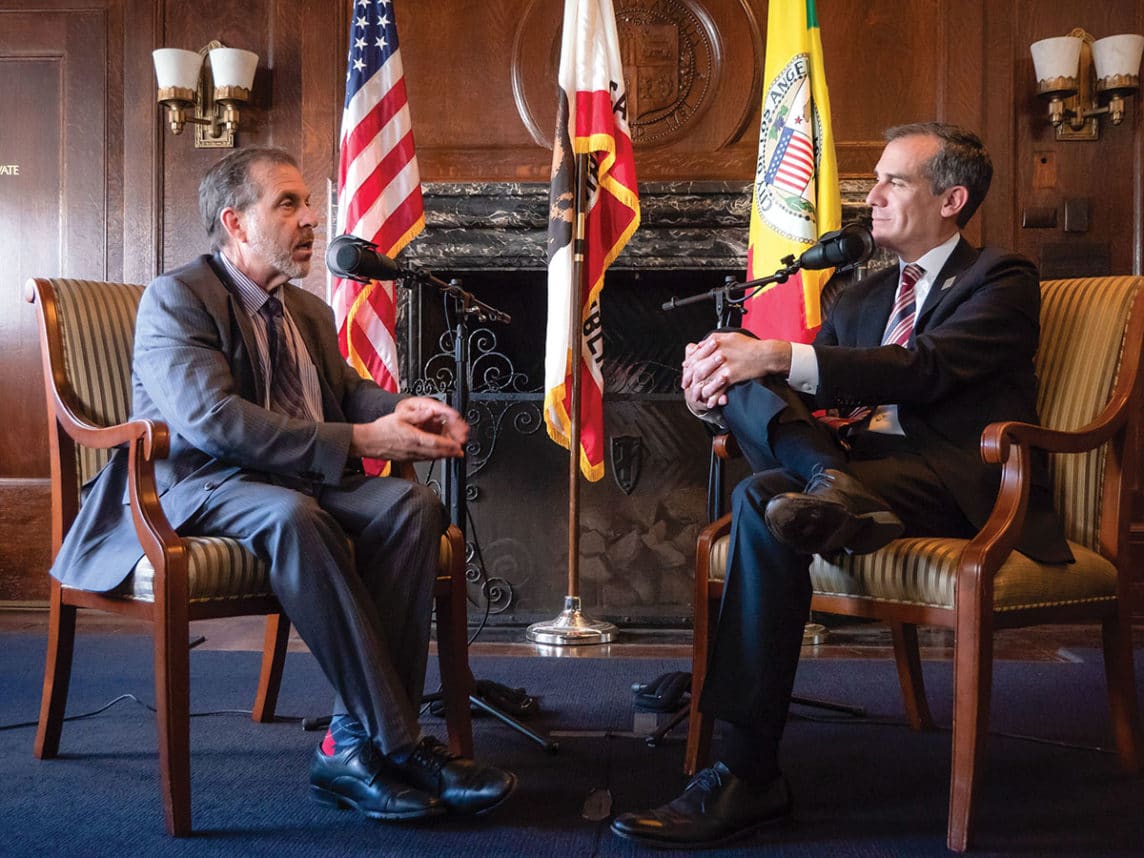
Los Angeles Mayor Eric Garcetti speaks with Sanderson on “Jay’s 4 Questions” podcast in 2018

Nevertheless, he was at no loss to offer examples with the same energy, excitement and passion that must have been present when the projects were created. He cites the Ezra Network as a timely and relevant example of a social service program that helps individuals and families in need – especially in the wake of the ongoing pandemic.

“What does someone do when they suddenly lose their job?” Sanderson said. “What if both breadwinners lose their jobs? What happens if a family all of a sudden finds themselves in crisis?” 

The reference was not only to the havoc caused by the pandemic, but also to the uncertainty of life itself. “I’ll tell you what they do,” Sanderson said, answering his own question. “They call their rabbi.” 

In conjunction with Jewish Family Service of LA, Bet Tzedek Legal Services and Jewish Vocational Services SoCal (JVS), a team was put together to help the Jewish community access social workers, legal counselors, job counselors, mental health professionals and financial services, all at no cost. The Ezra Network is accessible through many entry points, including 21 synagogues from Orthodox to Reform.

When describing some of the lives that the Ezra Network has touched, Sanderson’s voice lowered as he cited an example. A wife lost her job, and her husband, a contractor, didn’t have the funds to renew his contractor’s license due to a downturn in his business. After they reached out for help, the professionals at the Ezra Network arranged for the wife to undergo career retraining, and the Federation paid for the husband’s license renewal. 

“The idea is not to support someone forever,” Sanderson said. “It is to lend a hand and get people back on their feet so they can once again become self-sufficient.”

Eventually, the wife obtained employment in a new career and her husband relaunched his business. When things got back on track, they attended an Ezra Network event and described how the program was there for them. 

“The wife then presented us with a check for $180, a small gesture, but it was important to them to show their gratitude,” Sanderson said. “It caught everybody off guard. It was a very touching moment.”

As Sanderson talked about how the Ezra Network works to ease trauma for families in L.A., he pivoted to discussing trauma on a mass scale, primarily in Israel. 

“With Israelis facing constant attacks from rockets, a number of years ago we learned that Israel had no resources or framework to deal with trauma resilience,” Sanderson said. “That’s when we found and partnered with Talia Levanon, co-founder of the Israel Trauma Coalition. We are proud to be their partner in helping Israelis deal with trauma. But not just in Israel. They were in Las Vegas and Pittsburgh after the shootings. They were right here after the fires. They are the first place people call to deal with trauma.”

Levanon said that after the war in 2014, when most Federations were putting their energy into the south of Israel, “Jay understood the larger scenario. The L.A. Federation supported a process of strengthening the north of the country and Jerusalem to be prepared and able to respond.”

Albert Praw, the current Federation chair, offered the Community Security Initiative (CSI), which creates programs that provide security, monitoring and training for over 600 Jewish schools, synagogues and community organizations, as one of Sanderson’s prize achievements. “Federation has been able to execute on [this and many more] initiatives because Jay has recruited, trained and retained the best professional staff,” he said. “It has become the model for the entire Federation system.”

Coming full circle, Sanderson spoke with pride about The BAR Center at the Beach, the rebuilt and reimagined Israel Levin Senior Center on the Venice boardwalk. The BAR Center holds a special place in Sanderson’s heart because it is a mere four blocks from Tuum Est, his entry into the nonprofit, social service world. Named for lead donors Bennett and Allison Rosenthal and designed by Hagy Belzberg of Belzberg Architects, the $10 million BAR Center plans to offer programs and services that reach beyond seniors to engage the next generation of Jewish leadership. It’s scheduled to open its doors to programming in early 2022.

The BAR Center at the Beach

At the dinner event, Sanderson was filled with emotion and gratitude as he thanked his staff, partners, funders and the attendees, but most of all his mother, wife and children, Jonah and Isabelle. “People ask me what is my legacy? They are my legacy,” he said. 

The outpouring of joy was momentarily tempered when Sanderson spoke of his brother, who passed away seven months ago. “When I stand on a stage, I never stand alone,” he said. “I stand with my brother, who never had a chance to live a full life.” 

Sanderson’s developmentally disabled brother lived in a group home with three roommates, all of whom got COVID-19 — but Jeffrey didn’t. Although quarantined, he developed a severe infection and then he got COVID. In a few days, he was gone. 

“I couldn’t get to the east coast fast enough, and even if I could, they wouldn’t let me in the hospital,” Sanderson said. “We couldn’t have a funeral, but we will have one as soon as we are able.”

“It seems as though we’re having a rough patch. But we’re strong and resilient. If we Jews are anything, we are resilient.” – Jay Sanderson

The biggest question of the evening was, what would Sanderson’s next chapter be? It’s clear he has no plans to retire. His Instagram account @jaysanderson_la describes him as a chef, mixologist (someone who has a rich appreciation of the ingredients and techniques used to create innovative cocktails), somm (short for the French sommelier, a wine connoisseur), storyteller, Federation exec and world traveler. 

While the night belonged to Sanderson, he had some words for the Rabbi Farkas, the incoming president and CEO, whom he addressed from the stage.

“I have had the honor of doing this job,” he said. “It is now your honor, and with honor comes responsibility. But look around this room. And there are many, many more people who couldn’t be here tonight. This is a strong Jewish community [with] great rabbis, great lay leaders, great everything. Every box gets checked in Los Angeles.”

When his appointment was announced in June, Farkas told the Journal, “I am overwhelmed with gratitude to have been selected as the next president and CEO of The Jewish Federation of Greater Los Angeles. The Federation is uniquely positioned to foster a flourishing Jewish community and it is a gift to have been asked to serve. I look forward to many years together moving boldly into a future that is both dynamic and caring, but is most of all filled with a spirit of cooperation.”

Jay Sanderson with Federation executive staff at farewell dinner
(Photo by Howard Pasamanick Photography)

 Sanderson ended his 15-minute speech with the wisdom that so many have come to appreciate from the soon-to-be former head of the Federation.

“It seems as though we’re having a rough patch,” he said. “Young people are feeling confused about what it means to be Jewish. So many Jews feel disenfranchised and disconnected. There are so many among us that don’t feel the warm embrace of a Jewish community. Israel is not looked upon the way that I see it. Not perfect, but perfect for me. But we’re strong and resilient. If we Jews are anything, we are resilient.”

Saying Farewell to the Federation, Jay Sanderson Is Ready to Write His Next Chapter Read More »

A Bisl Torah: Starting with Why

Our Sinai Temple Atid Director, Briana Benaron and I decided to take the morning to map out the upcoming year. Atid (future) is our Sinai Temple micro community for Jewish young professionals. And instead of jumping into which programs we should plan for the calendar, she paused and asked, “Why?”

We took five minutes to watch Simon Sinek’s talk on “How great leaders inspire action.” He is also the author of “Start with Why.” The short presentation was a reminder that programmers usually start with what and how. We know how to put out dreidels for Hanukkah. Planning a latke buffet is second nature. But the why is what will make any program transform into one aspect of a mission driven enterprise.

The rest of our hour was spent on why. Why the need for a Jewish young professional group? Why is a synagogue providing a spiritual home? Why is this niche a priority? Distilling the why inspired us to work harder, be intentional and remember the holy tasks we are blessed to tackle every single day.

While the Torah often asks us to do a mitzvah without an explicitly attached meaning, the study of Torah itself seems to encourage the “why”. When we open verses of the parsha, read and wonder about its relevancy in our lives, our minds and hearts are trained to ask, “Why is this story important? Why do I need the structure of a spiritual practice to infuse my life with purpose, morality and responsibility?” Even the famous phrase commanding Shabbat, Shamor v’Zachor (observe and remember) suggests that with each ritual we observe, we should remember the imbedded “why”. Rabbinic literature, both traditional and contemporary looks at the “what and how” and provides additional space to wonder, question, imagine and dig deep, pushing us forward with a strengthened sense of commitment.

Asking the question “why” is a constant reminder that the answers aren’t obvious. We often get bogged down in details and decorations. But starting with why transforms our task into a holy mission.

Try a little why in your life…And why not start now?

Shabbat shalom


Rabbi Nicole Guzik is a rabbi at Sinai Temple. She can be reached at her Facebook page at Rabbi Nicole Guzik. For more writings, visit Rabbi Guzik’s blog section from Sinai Temple’s website.

A Bisl Torah: Starting with Why Read More »