Bobby Slayton – nicknamed both “Yid Vicious” and “The Pit Bull Of Comedy” to those who know him well — has been performing his own intense style of stand-up comedy for over 40 years. One of the most respected, and energetic comics working today, Slayton’s many television credits include “Curb Your Enthusiasm,” “The Tonight Show,” “Family Guy” and his own Showtime special “Born To Be Bobby,” while you may have also seen him in the films “The Rat Pack,” “Get Shorty,” “Ed Wood” and “Dreamgirls.”
Slayton’s latest project is “A Small Book Of Jewish Comedians,” as released via Reel Art Press earlier this month. Co-authored with Reel Art Press founder and editor-in-chief Tony Nourmand, “A Small Book Of Jewish Comedians” shines a light on many of those who have dominated the comedy scene and brought joy to so many throughout their lives. And happen to be Jewish. This includes Larry David, Mel Brooks, Garry Shandling, Buddy Hackett, Sid Caesar, Jackie Mason, Gilda Radner, Groucho Marx, Lenny Bruce, Rita Rudner, Rodney Dangerfield, Joan Rivers, Jerry Lewis, and George Burns. Quite possibly my favorite book of 2021, this release not only includes rare photographs of comedy greats, yet also some of their best material.
On October 28, 2021, I had the pleasure – and I do mean “the pleasure” – of speaking with Bobby Slayton via Zoom, as embedded below. Among the topics we discussed within our chat:
How the comedians were selected for “A Small Book Of Jewish Comedians”
Whether we may see a second edition of “A Small Book Of Jewish Comedians,” given how many other great comics and writers there have been over the years
Why he considers himself “semi-retired” while still being in great shape, having representation and being ready to perform
How he really feels about his Hebrew school education
Career highlights as both a stand-up comedian and an actor
Favorite spots to dine at in Los Angeles and Las Vegas
More on Bobby Slayton and “A Small Book Of Jewish Comedians” can be found by clicking here, here and here.
The San Diego Unified School District (SDUSD) Board of Trustees passed a resolution on October 26 to include the teaching of antisemitism in the ethnic studies curriculum.
The resolution stated that “reports of white supremacist, antisemitic, anti-Jewish, and anti-Israeli graffiti, bullying, harassment, and violence on SDUSD campuses has been on the rise in recent years such that administrators, teachers, and student leaders need updated and readily available training and resources to prevent and address antisemitism in all its forms” and acknowledged that “anti-Zionism and anti-Israel bias can descend into antisemitism when they promote demonization, discriminatory double standards, and/or delegitimization of Israel and its existence.” “The Board of Education denounces the rise in antisemitic rhetoric and hate-motivated crimes and incidents that denigrate Jewish students and staff in the communities served by SDUSD,” it read.
The resolution also stated that the board “supports balanced and open classroom discussion, including the use of unbiased and politically neutral materials on issues like the Israeli-Palestinian conflict” and condemns “content that delegitimizes the right of any people, including Jews and Palestinians, to self-determination,” but this provision was later removed.
ADL San Diego Regional Director Tammy Giles said in a statement, “We are deeply appreciative of the San Diego Unified School District’s action in affirming that antisemitism and anti-Jewish rhetoric have no place in our classrooms. This commitment to fighting antisemitism will ensure students feel safe and supported in their identities. With over 50,000 individuals of Jewish descent living in the city of San Diego, ADL welcomes the District’s willingness to partner in creating a more inclusive and equitable space for learning for all students.”
Associate Dean and Director of Global Social Action Agenda at the Simon Wiesenthal Center Rabbi Abraham Cooper similarly said in a statement, “All of the credit for this breakthrough resolution goes to local Jewish parents who drew a line against demonizing Israel and the inevitable bullying of Jewish students and teachers in San Diego schools who love Israel and are proud of their heritage.
“We hope that the example set by the community-based activists in San Diego will inspire Jewish parents and decent people everywhere to oppose and if necessary, overturn efforts to import the Middle East conflict into the classrooms and halls of our nation’s public schools.”
StandWithUs CEO and Co-Founder Roz Rothstein praised the resolution as a “positive step,” telling Jewish News Syndicate that it uses the International Holocaust Remembrance Alliance (IHRA) definition of antisemitism. “While language about teaching the Israeli-Palestinian conflict was removed from the original version, district policy still requires such topics to be covered in an unbiased way,” she said. “We will continue to work with students, parents and other members of the community to build on this resolution.”
On October 8, Governor Newsom signed a bill into law requiring ethnic studies to be taught in all state schools starting in 2029.
The Louis D. Brandeis Center for Human Rights Under Law is calling for the University of Massachusetts (UMass) Boston to investigate their Students for Justice in Palestine (SJP) chapter over the harassment of a pro-Israel reporter a few months earlier.
On June 24, Dexter Van Zile, a research fellow for CAMERA (Committee for Accuracy in Middle East Reporting and Analysis), was covering a UMass SJP rally in front of the Anti-Defamation League’s regional office in Boston. One of the speakers at the rally pointed out that Van Zile was in the crowd taking notes and accused him of attempting “to smear and muckrake our righteous movement.” The speaker then urged the crowd to start chanting “Zionist Go Home!” at Van Zile, and they did. Video footage of the incident shows several people surrounding Van Zile, calling him a “Nazi” and a “pig.” He was also shoved and spat on; a handful of people urged the crowd to stop and not give him “ammunition.”
https://youtu.be/HH2Tb8Nk9QM
https://youtu.be/ZATKGAdbxrI
Van Zile told the Journal that someone also grabbed his pen and another person emptied their water bottle on him. “I knew frankly that it was game on at that point. I was terrified.” He also said that someone wearing a yellow vest repeatedly told him to move; when Van Zile eventually relented and agreed to move, the man in the yellow vest shoved him.
“It was a pretty traumatizing experience,” Van Zile said, as it was the first time he had ever been “singled out” and had his personal space invaded when covering an anti-Israel rally. He added that he used to read scripture from the pulpit at church from time-to-time (Van Zile is a Roman Catholic), but lately he has made himself “unavailable” because “I just don’t want to stand up in front of a large group of people.” “I will walk into Boston and wonder if any of the people who were at the rally who harassed me that day are around.”
But what particularly irks Van Zile is the thought of what it must be like for UMass Jewish students who support Israel to have to deal with those SJP protesters. “If that’s what they’re going to do to me in the broad daylight in the streets of the city while people are just walking past, what do people think they’re gonna do to a Jew on campus when they don’t think anyone’s looking?” Van Zile said. “And that’s the thing that I think the administrators in the UMass system need to take into consideration.”
Van Zile claimed that he filed a complaint to the university about the incident, and yet UMass hasn’t issued a public statement on the matter, nor have they discussed the incident with Van Zile. “That’s a profoundly troubling thing,” Van Zile said. “I [got] to go home and be with my family that evening. If I were a Jew on the campus of UMass Boston, I would have to share living space, classroom and cafeteria space and public space with the type of anti-Israel protesters that we saw in front of the ADL, and I think the administrators really need to think about that. What are they going to do?”
The Brandeis Center similarly wrote in an October 26 letter to UMass Boston, “If the University fails to act, its Jewish students are left to wonder what might happen to them if they were to go anywhere near a UMass Boston SJP rally, let alone dare to voice their objections to the anti-Semitic discourse of the organization’s speakers.”
The Simon Wiesenthal Center tweeted that they echo the Brandeis Center’s letter and asked why UMass Boston “failed to deal with [the incident] immediately.”
CAMERA tweeted, “It’s outrageous that @UMassBoston has still taken no action after a student organization mobbed and assaulted @dextervanzile on the streets of Boston. The university administration must act.”
It's outrageous that @UMassBoston has still taken no action after a student organization mobbed and assaulted @dextervanzile on the streets of Boston
DeWayne Lehman, UMass Boston’s Director of Communications, said in a statement to the Journal, “The university is aware of this event that occurred in downtown Boston during the summer. The universityimmediatelyinvestigated the incident within the process defined by the Code of Student Conduct at UMass Boston. This was a student disciplinary investigation, a process that is governed by the federal Family Educational Rights and Privacy Act (FERPA) and other student privacy regulations. For this reason, the university will not be providing any additional information concerning its investigation into this incident or the outcome of such investigation.” He added that Chancellor Marcelo Suárez-Orozco said in a statement to community in July “re-affirming our resoluteopposition to anti-Semitic hatein any form and specifically sharing with the community the processes by which members of the community can file complaints about behavior and access resources.”
UMass Boston SJP did not respond to the Journal’s request for comment.
Van Zile also told the Journal that he filed a report with the Boston Police Department about the incident; a spokesperson from the department told the Journal that an investigation is ongoing and they cannot comment on open investigations.
The Jewish Community Relations Council (JCRC) Boston said in a statement to the Journal, “As we said at the time of this event, JCRC condemns these protesters as disgusting and hateful. Everyone has the right to protest. They do not have the right to bully and intimidate those who come to observe them peacefully. We have and will continue to stand with the victim of this targeted hatred, and to support him in his pursuit of justice. We need those in power in our city and at the university to ensure that going forward, the streets of our city will be safe from the kind of hateful bullying that was experienced in June.”
Before I came to the United States and had discovered the New Yorker, pinnacle,
as New York Times’s A.O. Scott calls it, of middlebrow sophistication,
I used to read, in London, Private Eye, a most amusing literary monocle,
but have climbed from middlebrow to a much more pretentious elevation,
reading the New York Review of Books and London’s, far more anti-Zionistic,
plus TLS (Times Literary Supplement), and Jewish Review of Books,
not much too much, I hope, to read, with an effect that since it’s synergistic
does not spoil my highbrowness like the broth that’s spoiled by far too many cooks.
Two publications much enjoyed by members of the Jewish online universe
now publish verses I compose, inspired often by the journals that I name above,
enabling me for many unclose readers with my rhymes and reason to converse,
sent them before the deluge like old Noah’s post-diluvian dove.
The brows of both the Jewish Journal and the Times of Israel are in the Jewish middle,
which corresponds to the beinonim who to readers of the Tanya should appeal.
Dear viewers, please enjoy my verse like music that I used to play upon my fiddle,
until by old age made a Yiddel who on fiddles can no longer daily spiel.
***
According to the Tanya by Rabbi Shneur Zalman of Liadi, the founder of Chabad Hasidism, the beinoni is one whose deeds and misdeeds are equally balanced, this being the highest goal that most people are able to reach, since the goal of having a majority of virtues outweighing one’s misdeeds is beyond most people.
In “An Ink-Stained Hymn to the Joy of Print,” A. O. Scott, explaining how Wes Anderson pays antic tribute to the old New Yorker and its far-flung correspondents, writes in the 10//22/21 NYT:
The French Dispatch of the Liberty, Kansas Evening Sun is the full name of a weekly periodical that isn’t quite The New Yorker but also isn’t quite not The New Yorker. Its editor, Arthur Howitzer Jr., has a few things in common with Harold Ross and William Shawn, the men who together and sequentially established The New Yorker as a pinnacle of middlebrow sophistication in the decades before and after World War II. Like Ross, Howitzer is from the western part of Middle America (Kansas, rather than Colorado), and like Shawn he’s a soft-spoken perfectionist. Really, though, he’s Bill Murray in a Wes Anderson film, which is to say the ideal grown-up, an embodiment of impish, saturnine charm and eccentric integrity.
Gershon Hepner is a poet who has written over 25,000 poems on subjects ranging from music to literature, politics to Torah. He grew up in England and moved to Los Angeles in 1976. Using his varied interests and experiences, he has authored dozens of papers in medical and academic journals, and authored “Legal Friction: Law, Narrative, and Identity Politics in Biblical Israel.” He can be reached at gershonhepner@gmail.com.
Faced with one of the driest periods in state history, Governor Gavin Newsom asked California residents in July to voluntarily reduce water use by 15%. So far, we’ve missed the mark in water conservation, reducing consumption by just 5% from a year ago.
Saving 15% can seem daunting, but every little bit of conservation adds up and makes a difference.
How can we do better? Saving 15% can seem daunting, but every little bit of conservation adds up and makes a difference. Here are some water saving tips I’ve implemented in my own household that are simple and did not require a lot of effort. I’m eager to get my next water bill to see how much I’ve saved.
Check for leaks
There could be a leak in your home, and you might not even know it. To check, don’t use any water for two hours, but make a note of what’s on your water meter before and afterward. If the meter numbers have gone up, you have a leak and it’s time to hire a plumber to investigate.
Save in the shower
A whopping 75% of water usage happens in our bathrooms. And a lot of that is from the shower. According to the American Water Works Association, a typical shower lasts eight minutes. With a standard showerhead that uses 2.5 gallons of water per minute, each shower can add up to 20 gallons of water. So if you reduce your daily shower time to five minutes, you will save 225 gallons every month. If everyone in the family does this, imagine how much water you’ll save.
Stop flushing so much
I don’t mean to be graphic, but you don’t really need to flush your toilet every time you use it. Some older toilets use up to seven gallons of water per flush. Even the newer ones, which are required to consume no more than 1.6 gallons per flush, make up asubstantial part of your water usage. By flushing just one time less each day, we can reduce our monthly water usage by a minimum of 584 gallons a year.
Make your older toilets flush less water
A simple way reduce water use is to minimize the amount of water that goes into your toilet tank. To do so, fill a plastic half-gallon bottle (such as an orange juice or bleach bottle) half-way with rocks to weigh it down, then fill it with water and tightly close its lid. Place the container inside your toilet tank, and you will save a half gallon each time you flush. Note: sometimes people put a brick in the tank for this same purpose, but bricks can erode and add sediments to your toilet.
Turn off the tap while brushing
This sounds really obvious, but leaving water running while brushing is a bad habit many of us can’t seem to break. However, when you know that every minute 3 to 5 gallons of water comes out of the average faucet, you’ll realize this is just another simple opportunity for saving water.
Use the dishwasher more
According to the Natural Resources Defense Council, using an automatic dishwasher is more water efficient than hand washing. New Energy Star® dishwashers use three to five gallons of water per wash, compared to up to 27 gallons used by traditional hand washing, counting for those who let the water run the entire time they’re washing. Even older dishwashers that use up to 15 gallons per wash beat traditional hand washing. Just be sure to run your dishwasher only when it is fully loaded. And scrape your dishes first, instead of rinsing them before putting them in the machine.
Only wash full loads of clothes
The Alliance for Water Efficiency estimates the average American family washes almost 400 loads of laundry each year. That’s a lot of laundry. You can make the most of each load by making sure the machine is filled, even if the washer has adjustable load settings. And avoid the permanent press cycle, which adds up to 5 gallons for the extra rinse. If you’re planning to replace an older washing machine, which typically use 40 to 45 gallons per wash,consider either a front- or top-loading high efficiency model, which generally uses only 14 to 25 gallons.
Keep a bucket handy for reuse
Don’t let water go down the drain when it can be used for other purposes, like watering plants or cleaning. If you have to let the water in your sink or tub run for a few seconds to heat up, collect the cold water in a bucket to use later. You’ll be amazed at how much water you collect – all of which would otherwise just disappear down your drain.
Jonathan Fong is the author of “Flowers That Wow” and “Parties That Wow,” and host of “Style With a Smile” on YouTube. You can see more of his do-it-yourself projects at jonathanfongstyle.com.
How on earth did the prisoners of Zion and refuseniks have the courage to do what they did? Applying to leave for Israel, studying Hebrew and Judaism, and demonstrating for human rights while knowing full well that their actions could cause them to lose their livelihoods or end up in the cruel gulag or in years of hard labor camps—where did they get the strength, the fortitude, the dedication?
Like many Jews of my generation, we thought we were somewhat aware of what was going on in Soviet Russia. We had read Elie Wiesel’s “The Jews of Silence.” We marched. We attended rallies. I wrote a song in honor of Natan Sharansky, interviewed former Prisoners of Zion and refuseniks who made aliyah, and directed a play on the kangaroo court trial of Ari Volvovsky, an underground Hebrew teacher whose family was adopted by our community of Efrat. Our daughter interviewed female refuseniks, now living in Israel, for her bat mitzva project; they included, among others, Volvovsky’s wife, Mila, and Tatiana (Tanya) Edelstein, of blessed memory, the wife of the former Speaker of the Knesset, Yuli Edelstein.
So I thought I knew something.
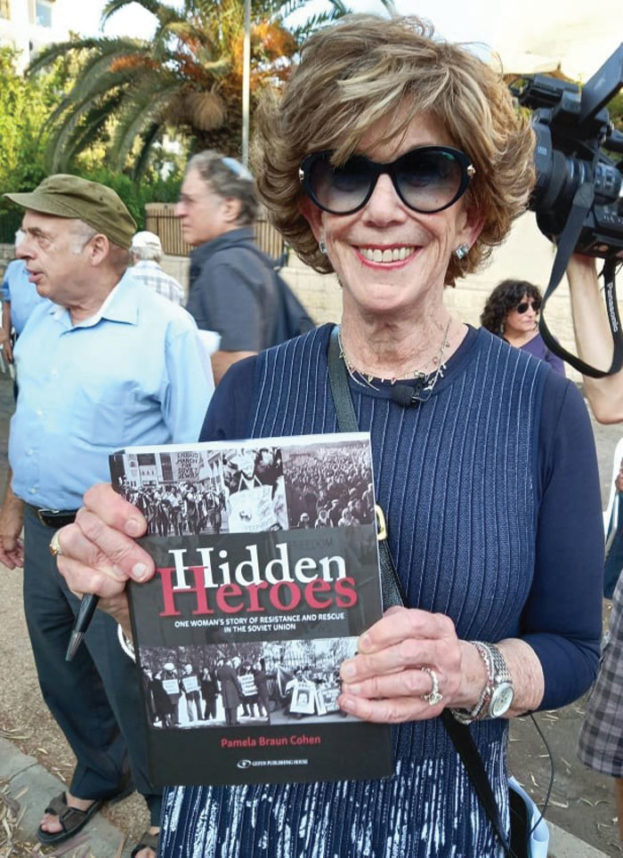
Reading Pamela Braun Cohen’s book “Hidden Heroes” opened my eyes in a way that I didn’t think possible. Her stories are astonishing and spellbinding.
Reading Pamela Braun Cohen’s book “Hidden Heroes” opened my eyes in a way that I didn’t think possible. Her stories are astonishing and spellbinding.
She introduces us to the heartbreaking, horrific and inspirational stories of both the well-known Soviet Jewish personalities and of those whose names are less known to the public. But Cohen, who lived in Deerfield, Illinois, a suburb of Chicago, also tells the story of those who fought from her side of the world.
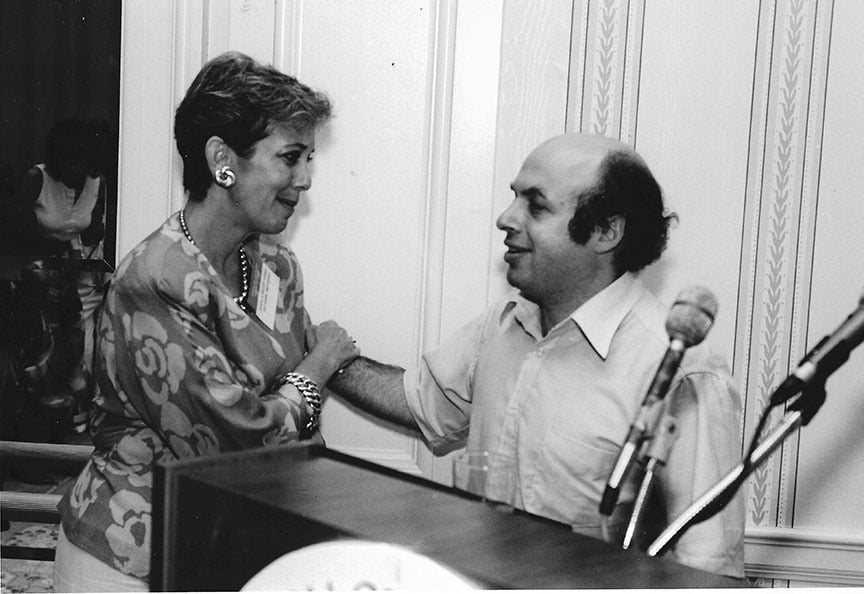
Pamela Braun Cohen at the book launch, with Natan Sharansky to her right. / Photos courtesy of Toby Klein Greenwald
An August 31 book launch in Jerusalem was hosted by Gefen Publishing House, and by Yosef Abramowitz, who was recently nominated by 12 countries for a Nobel Prize for his work in solar energy and was an activist for Soviet Jewry. Sharansky recalled, from the podium, how his jailers had taunted him, “Look who is fighting for you! Just students and housewives.” But those students and housewives, along with others, helped shake the world and change history.
Cohen takes us from the Soviet Jewish awakening—encouraged by Israeli’s victory in the Six Day War—through the notorious Leningrad trials in 1970 of 11 people, mostly Jews, who had tried to hijack a plane “to marshal international attention,” including Sylva Zalmanson, her husband Edward Kuznetsov and Yosef Mendelevich. She concludes her book in the 1990s.
Of the Leningrad hijackers she writes, “[They were] Jewish moral giants who had pitted themselves against the Kremlin. But I wanted to know more … How had they come to make a decision that would result in years of imprisonment and hard labor in Siberia?”Kuznetsov and Mark Dymshits, the pilot who was to fly the captured plane, were sentenced to death, a sentence that was eventually commuted, due to international pressure.
Cohen was a happy Jewish mother and wife who was involved in her synagogue, sent her kids to Jewish camps, car-pooled, and enjoyed family barbecues and weekends in Wisconsin. But her life changed forever when she learned about the Soviet Jewish struggle.
She began to read about the struggle in the Philadelphia Jewish Exponent; eventually, she began to write for the publication. “Soon enough, my dining room table, spotted with coffee stains, was covered with newspaper clippings. I was part of a group of activist-oriented mothers … with babies on our laps and toddlers at our feet … who met regularly to discuss affairs of the nation and write to our congressional representatives.” They discussed civil rights, the Vietnam War and more. She began to rally the group “to protest the Kremlin’s denial of the right of Jews to emigrate.”
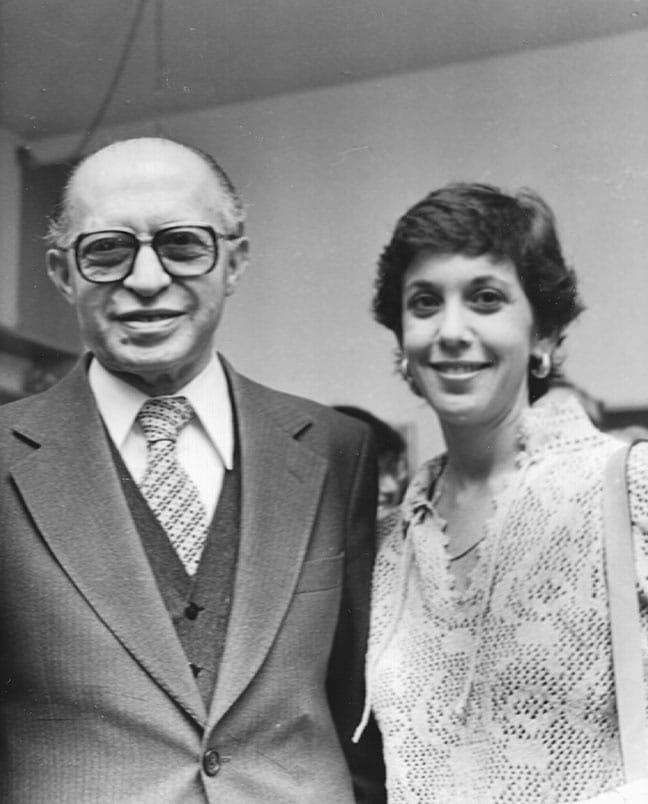
With Prime Minister Menachem Begin, UCSJ meeting, Jerusalem, 1981
As she got more involved, she learned of the CASJ (Chicago Action for Soviet Jewry), the UCSJ (Union of Councils for Soviet Jews), and the SSSJ (Student Struggle for Soviet Jewry), all of whom pressed for the Jackson-Vanik Amendment. It was one of the initiatives for which the UCSJ worked closely with Congress to ensure that the Soviets were not granted most-favored-nation-status as long as Jews could not emigrate freely.
In 1986 Cohen became national president of the UCSJ. She was joined in her efforts by Marillyn Tallman, who had been her Jewish history teacher. Another of Tallman’s students was Tom Lantos, who later became a congressman from California and the cochairman of the Congressional Human Rights Caucus.
Cohen says that people were astonished at what she and others were doing with such passion, and challenged her, “You think you can take on the Kremlin?” But at her first UCSJ annual meeting she discovered that she was in good company with self-educated Sovietologists, savvy activists, volunteers, doctors and business people and “strong, gutsy women” who were “capable of facing down any KGB goon, each running her own council … All were consumed with the right of Jews to emigrate in the face of anti-Jewish persecution.”
Cohen overcame a natural shyness to reach out to congressmen, senators, presidents and prime ministers. She flew across country as necessary, and made many trips to the Soviet Union. Her first trip was in 1978, with her husband, Lenny. They packed their suitcases, as did other Jewish tourists, with books, tallitot, tefillin, kosher mezuzah klafim, cameras, tape recorders and other items that could be sold on the black market so refuseniks who had been fired from their jobs, after applying for aliyah, would be able to subsist.
Her name became known. Even the KGB knew about Pamela and her colleagues. On her trips to the USSR, she knew she was being followed and listened to.
Cohen and the Union of Council activists took a bi-partisan approach, and she tries to give credit to all those who helped. I asked which U.S. politicians were the most helpful. “President Reagan. His undiplomatic assertion that the USSR was an ‘evil empire’ gave him a diplomatic edge for negotiation on trade, arms control and human rights. And George Shultz. Senators Henry Jackson and Frank Lautenberg established a firm foundation for the movement, the former by tying emigration to trade and the latter by redefining Soviet Jewish emigrants as refugees … Democrats and Republicans in the Senate and the House were united on the issue of Soviet Jewish emigration, Soviet human rights abuse, and Soviet antisemitism!” In the fall of 1976, the wives of two refusenik-protestors who had been arrested, Boris Chernobilsky and Yosef Ahss, sent appeals to Betty Ford and Rosalynn Carter. Three weeks later the men were released.
Cohen’s home phone would ring at all hours of the day and night. Calls from refuseniks were constantly being sabotaged by the KGB.
Cohen’s home phone would ring at all hours of the day and night. Calls from refuseniks were constantly being sabotaged by the KGB. Cohen trained the operators from the American side to push back and not take no for an answer from their Soviet counterparts.
She credits her husband Lenny and their children with supporting her every step of the way, even when evenings with friends morphed into Pamela’s lecturing. “What? You don’t know who Mendelevitch is?” She could not understand how there were some Jews who didn’t get it. The family’s life was saturated with the cause. Cohen recalls how when she and her husband were on a romantic weekend getaway, she said to him, upon awaking, “Lenny, did I tell you that Lev Blitshtein went to visit Ida Nudel in Siberia?” That same Lev Blitshtein was denied exit by the Kremlin on the excuse that he had knowledge of “state secrets,” even though he was the only sausage-maker in Russia.
The morning after the bat mitzva party of her daughter, Brooke, she writes, “Before she opened her gifts and we could relive the moment together, I allowed a limousine to carry me off to the airport for a fight to DC for our annual UCSJ meeting. Maybe that’s when I began asking the Almighty to take care of my children as I was trying to take care of His.
“It is written in Leviticus, ‘Do not stand by the blood of your brother’ [19:16]. We were impelled by an imperative to rescue … We were Jews. We were one people. They were ours.” She and others were fervently committed that never again would Jews on the other side of the world be silent.
Even when the doors of the USSR started to open a bit in the ’70s and ’80s, it was a trickle compared to the hundreds of thousands of refuseniks still denied emigration visas. Families were torn apart; the Soviets would cruelly give permission for some members of a family to leave and not to others, placing them in an impossible dilemma.
Resistance was taking place all over the USSR. There were thirteen young activists in Kiev, representing the “Second Generation in Refusal,” who wrote a heartfelt letter to the Communist Party Congress speaking of their desire to go to their “historic home.” They were all arrested. There were also large number of Jews living in Central Asia who were trying to get out. Cohen describes her first harrowing plane ride in horrific snowy, stormy weather to that area, when the flight attendant seated herself next to her, asking her questions that made it clear she was KGB. Cohen did not know if she and her cohorts on that trip would get out of it alive.
Cohen and her colleagues were always seeking creative solutions to help the refuseniks. On one occasion they got bear fat through the UCSJ’s council in Alaska for a Chinese homeopathic practitioner to treat Yaakov Mesh, to heal him from the brutal beating he had received in prison; they sent it with a tourist from Alaska going to Vladivostock. Mesh recovered.
The battle of the Kremlin against the Jewish refuseniks was also a psychological one, so the CASJ sent the refuseniks copies of the UCSJ’s statements, press releases, news articles, statements in the “Congressional Record,” and relevant op-eds. They would photograph the items, repack the negatives in their original packages so they looked like unused rolls of film, and then tourists would drop them off at the home of refusenik Yakov “Yasha” Goredetsky, who would then arrange for them to be developed, copied and distributed to the refusenik community. She learned that these photos “lifted the morale, brought hope,” and the refuseniks knew they were not alone. Subsequently they did the same things with Hebrew audio tapes.
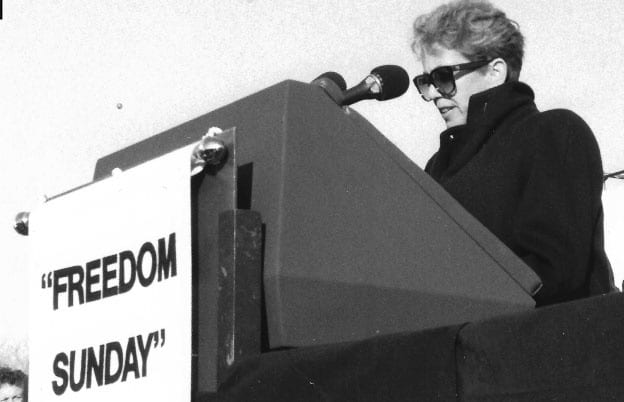
Speaking at Freedom Sunday, Washington, DC, December 6, 1987
Cohen writes, “Once they applied to leave, crossing the invisible line into defiance of the Soviet demand for submission … refuseniks’ actions lit up the night sky like flashing comets. Every act of defiance reflected their inner liberation, their desire to live in freedom, in Israel—to live as Jews … the only freedom in the USSR was among the dissidents and refuseniks. Both [Anatoly] Altman and Sharansky said they experienced that freedom to resist in rat-infested frigid prison cells.”
Hebrew teachers like Aleksander Kholmiansky and Yuli Edelstein were arrested; a gun had been planted in Kholmiansky’s apartment and narcotics in Edelstein’s. Ari Volvovsky was sentenced to three years for teaching Hebrew. I interviewed the Kholmianskys in Israel in 1988 and met them again at Cohen’s book launch.
There were interlocking threads. Cohen was called by a California congressman’s foreign affairs assistant who wanted to help a California woman who had been hit by a troika while visiting Moscow. The U.S. embassy was closed; Cohen found a Moscow refusenik, Leonid Stonov, to meet her husband at the airport. The assistant asked how to thank her. She asked for President Reagan to send a letter to Volvovsky at the labor camp. Ari was “invited” to the office of the camp commandant who asked if he was a friend of President Reagan’s. He said, “Well, if President Reagan wants to be my friend, I don’t mind.” He was released a few months later.
Pamela told me that some of the people who she feels were the most central in her organization were “UCSJ’s national director, Micah Naftalin, and David Waksberg, Lynn Singer, Glenn Richter, Judy Balint, Bob Gordon, Morey Schapira, Ruth Newman, Helene Kedvin, Sandy Spinner, Babette Wampold.” They all had specialties in the battle plan.
First Meeting with Vladimir Slepak, Freedom Sunday, US Capitol Building, December 6, 1987
The British 35s, also called “The Women’s Campaign for Soviet Jewry,” brought Mikhail Shirman, a young Soviet Jewish refugee living in Israel, to the Reykjavik Summit in Iceland in 1986, where Reagan and Gorbachev would be meeting.Shirman was critically ill and needed a bone marrow transplant from his sister, still in the USSR, but the Kremlin would not let her leave. A Chicago Tribune reporter asked him why he was there, and he answered, “I’ve come to meet my murderer.” “The next morning,” writes Cohen, “Mikhail’s story was on the front pages of the world’s press … But by the time Gorbachev let his sister leave, it was too late.” Cohen attended Mikhail’s shloshim in Israel.
Pamela drew closer to Judaism while working for Soviet Jewry. After her son had a fall that left him unconscious and needing surgery, when he pulled through, they koshered their home. She saw how Soviet Jews were endangering themselves to live as Jews, and was inspired to live more Jewishly herself.
“It took many years to understand that Esses … Volvovsky, Mendelevich and others who hacked their way through the thick, secular Communist propaganda were not only creating a path for their own Jewish Soviet people, but also for me, far away in Deerfield. … Many of us in the West would later come to realize that in the process of rescuing Soviet Jews, we ourselves had been rescued.”
You may not be able to read this book in one sitting, and not just due to its length. The horrors endured by the Prisoners of Zion and the refuseniks and their families are incomprehensible, as is their courage, as is the perseverance of their champions thousands of miles away. “Hidden Heroes” will both haunt and inspire you for a long time to come.
Toby Klein Greenwald is an award-winning journalist, theater director and editor-in-chief of WholeFamily.com
By the time I’m 80, I’ll finally be vegan
By 85, a dancer, wild and free.
By 143, I’ll stand firm like a tree,
stretching without apology
towards only my sun.
At 189, I won’t eat or sleep much anymore
I see myself there
a tortoise, slow and wise.
“Yes…” I’ll say, slight grin, wrinkled eyes —
“Yes, I recall that there from long ago
oh the drama
back when time passing
gave texture
to the way things seemed.”
Things are so much quieter now
I’ll reflect at 199 —
so much life lived
tasting
trying
wet tears long spent.
At 267, all of life will be touch.
soft hands of great great great grandchildren
their laughter at play.
I will be only my smile then.
Hands and a smile.
Just touching
and blessing.
At 294, perhaps I’ll grow tired
of this long held illusion
that there is you and I.
That we find ourselves only
right here and right now
That aging and loving
are not one and the same.
By the time I’m 300 —
I might be ready to fly.
Rabbi Sara Brandes is a hands-on healer and author of Magical World: Stories, Reflections, Poems. Find her at www.awakenedbody.org.
I know I am not the only one who has faced this hurdle when trying to log on. It’s especially frustrating when we are wanting to be part of a video conference – and it seems like all the forces of the universe are conspiring against us.
Sometimes we take it personally, as though we are not wanted.
There are many reasons behind being unable to connect. Perhaps the internet is down. Perhaps you can’t find a password or a link. Perhaps someone sent you the wrong link. Perhaps you are pressing the wrong button. Who knows? When it doesn’t work, we often say, “The hell with it,” and walk away.
While this happens online – it also happens in our relationships. There are times when we are just unable to connect with those who mean something to us. Is it them? Is it us? Is it some external force?
I noticed something last time I was unable to connect online. My computer screen told me, “Trying to reconnect.”
I loved that.
This week, let’s make “trying to reconnect” a priority. In that moment in time you feel like walking away, try another way to reconnect in your relationships. What a difference it will make!



 On October 28, 2021, I had the pleasure – and I do mean “the pleasure” – of speaking with Bobby Slayton via Zoom, as embedded below. Among the topics we discussed within our chat:
 Los Angeles poet Rick Lupert created the