fbpx

October 27, 2021

Mourner’s Kaddish for the Sunrise Movement

Yitgadal v’yitkadash sh’mei raba b’alma di v’ra chir’utei; v’yamlich malchutei b’hayeichon u-v’yomeichon, uv’hayei d’chol beit yisrael, ba-agala u-vi-z’man kariv, v’imru amen.

We should all be concerned about climate change. Global warming is an existential issue, dramatic legislation is needed to reverse its effects, and the American political system has proven itself woefully inept at addressing this properly. Many organizations have formed around the cause of combating climate change, one being the Sunrise Movement, a campaign catering to and comprised of young people. Over the last several years, the Sunrise Movement has gained political notoriety for their undiplomatic tactics, such as protesting in Congressional offices, blocking off highways in major cities, and espousing an anti-establishment, often anti-capitalist message. In doing so, the movement has alienated large swaths of the American electorate who would otherwise be supportive of their goals, which include banning fracking and passing a Green New Deal. It should come as no surprise, then, that branches of the organization would turn to scapegoating Jews and Jewish groups as a desperate attempt at relevancy.

On Wednesday, The Washington, D.C. “hub” of the Sunrise Movement released a letter explaining why they were rescinding their participation from an upcoming rally in D.C. for expanded voting rights and statehood for our nation’s capital. “We are declining a speaking slot due to the participation of a number of Zionist organizations … this includes the Jewish Council on Public Affairs, the National Council  of Jewish Women, and the Religious Action Center for Reform Judaism, which are all in alignment with and in support of Zionism and the State of Israel.”

The antisemitism packed into this statement is overwhelming, from accusing Israel of being an illegitimate colonial entity, to tokenizing the experiences of Mizrahi Jews in Israel, to inferring American Zionists are not serious fighters for voting rights, and of course, to highlighting the values of self-determination and political sovereignty yet refusing to extend this worldview to the Jewish people. The hatred reaches a climax when Sunrise DC concludes by asking the organizers of the event to remove Jewish organizations from their roster, “as Zionism is incompatible with statehood and political sovereignty.”

Fortunately, many influential names have protested, with Congressmen Ritchie Torres and Jerry Nadler and organizations like the Jewish Democratic Council of America publicly condemning their ideological compatriots. Yet still, the national chapter of the Sunrise Movement failed to specifically address the D.C. hub’s bigotry in refusing to share a stage with Jews, and instead released a statement condemning both “antisemitism” and “anti-Palestinian racism,” and of course reaffirming their organization’s collective support for the liberation of Palestine.

The transparent takeaway from such a hateful expression is failure. As American liberals vent their frustrations with Senators Kyrsten Sinema and Joe Manchin as the two maneuver their way out of supporting President Biden’s robust climate agenda, answering not to their constituents but to special interests, legislation that could bring real optimism to the environmentalist front is being watered down. This is quite the disappointing development for the Democratic base. When campaigns feel defeated or betrayed, scapegoating the Jews (or the Jewish state) promises a surefire way to “rally the troops” and to feel assertive once again.

Antisemitism destroys anything that uses it as much as it destroys the Jews. Once a country, political party, or group begins demonizing Jews, collapse is imminent. This is because antisemitism often functions via conspiracy theories, and conspiracy theory-thinking indicates the absence of a clear strategy to achieve a set of goals. The Sunrise Movement was destined for this trap as soon as their approach to climate activism turned from lobbying Congress away from non-renewable energy to an “intersectional justice” approach, consisting of radical identity politics, socialism and populism. Their strategy has failed, and so the evils of “Zionism” are drawn out as a distraction, serving as a “Two Minutes of Hatefor incensed supporters.

Antisemitism destroys anything that uses it as much as it destroys the Jews. Once a country, political party, or group begins demonizing Jews, collapse is imminent.

As many Jews hurried to criticize the Sunrise Movement DC online, I realized just how predictable this scandal was for a student of Jewish history. Could there be more of a cliche than a flailing political movement suddenly casting Jews from their midst, and justifying it with  “The Jews are too capitalist, too communist, too religious,” and in this case, “too Zionist”? Since the beginning of our exile, we are consistently framed as what’s standing in the way of whomever’s success.

The tragedy lies in yet another noble cause capsizing, its last gasp of air being a swipe at the Jews. I’ll sing the Mourner’s Kaddish for the Sunrise Movement, not because I feel sympathy for them and their members, but because attacks against my people reveal just how pathetic are those who engage in such attacks. We are sadly no closer to a carbon tax, to doing away with fossil fuels, or to expanding public transportation, but at least progressives have been made aware that boycotting the Jews is another way of admitting defeat.


Blake Flayton is New Media Director and columnist at the Jewish Journal.

Mourner’s Kaddish for the Sunrise Movement Read More »
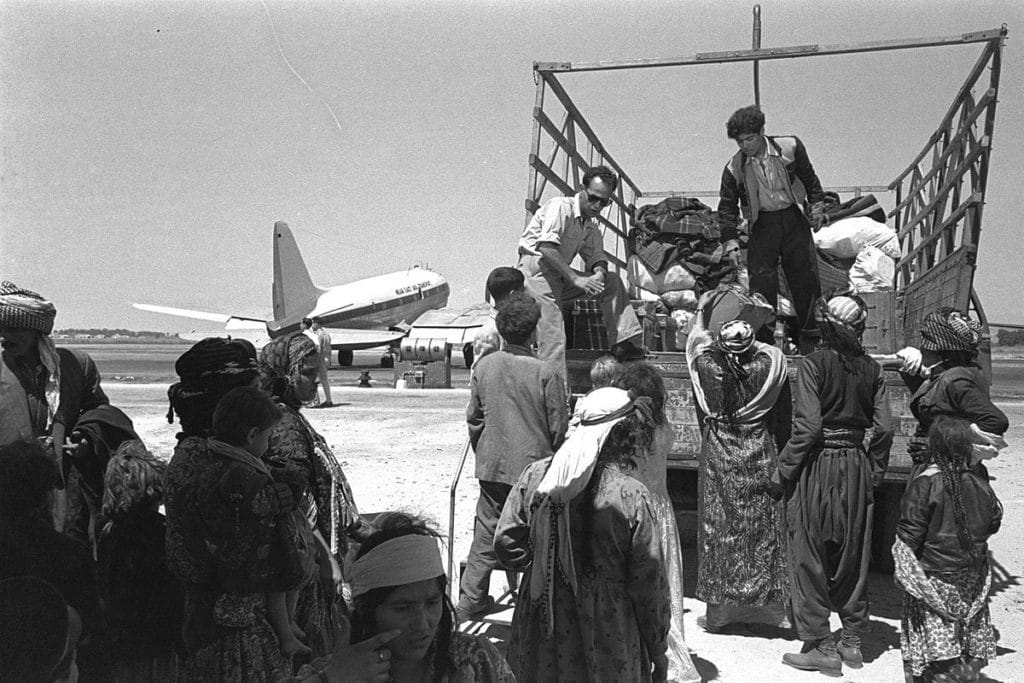
The End of Exile: Iraqi Jew Recalls Escape From Baghdad 70 Years Ago

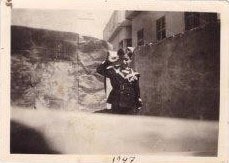
A young boy in uniform stands with his arm raised in a mock salute, his gaze steady.

The boy’s expression is partially eclipsed as the sunlight hits only one side of his face, but he appears to be staring back out at the photographer. The black-and-white image is grainy and the buildings in the background are nondescript.

Taken in 1947, this photograph shows a young boy named Farouk Sayig, later known as Baruch Meiri, standing near his family home in Baghdad, Iraq.

A picture taken in 1947 in Baghdad, Iraq, of Baruch Meiri. (Courtesy)

It’s an eye-catching image of a bygone era; a glimpse into some of the final years of a once-thriving Jewish community that had resided in Iraq for over 2,500 years.

Born in 1940 in Baghdad, Baruch Meiri was the eighth of nine children.

Like tens of thousands of other Jews living there, Meiri and his family escaped from Iraq as part of a mass exodus that saw some 130,000 Jews airlifted to Israel via Iran and Cyprus from 1950 to 1952, in Operation Ezra and Nehemiah.

An Iraqi law mandated that they had to renounce their citizenship and could never return.

“I was 10 years old,” Meiri told The Media Line. “We took a taxi to the airport and I remember that there was a very long line at the entrance. We barely had anything on us – no money or gold – because we didn’t have anything.

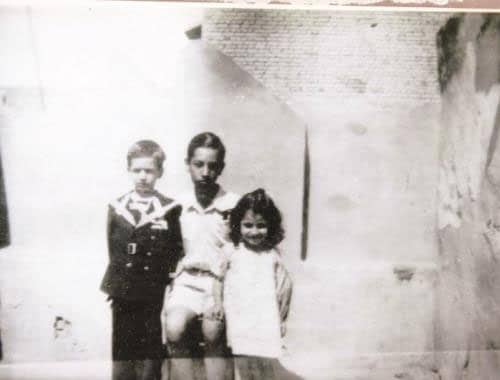
A photograph taken in Baghdad, Iraq, showing Baruch Meiri and some of his siblings. (Babylonian Jewry Heritage Center)

“We flew on one of the first flights out from Baghdad to Cyprus,” he continued. “But the plane had a mechanical issue and we stayed in Cyprus for an additional two days before getting to Israel.”

Operation Ezra and Nehemiah came after years of violence and persecution. Nazi propaganda during World War II and rising Iraqi nationalism stoked antisemitic sentiment in the country during the 1940s, with the hatred reaching a fever pitch shortly after Meiri was born during the Farhud, a violent event that took place on June 1-2, 1941.

The Farhud was a Nazi-inspired pogrom that broke out in Baghdad over the Jewish holiday of Shavuot. Hundreds of Jews were killed or raped and 1,000 injured, though exact casualty figures remain unclear.

“During the pogroms my parents fled to the house of the neighbors, who were community leaders,” Meiri said, recalling the event and his Muslim neighbors. “My mother managed to save our family.”

Growing up, Meiri’s family was very poor. In order to make some extra pocket money, the young Farouk bought a few cucumbers at the local market and began selling them to other schoolchildren at a profit. In this way, he was able to buy sweets and pastries for himself.

“I learned to become self-reliant,” Meiri said. “Don’t let the world tell you that you can’t do something, just do it.”

“This is how I acted when we immigrated to Israel as well and we were in a transit camp, a place that later became Or Yehuda,” a city in central Israel, he added.

The newly arrived immigrants to Israel were all given new names when they were sent to live in a transit camp. Farouk Sayig became Baruch Meiri.

Life in the Transit Camps

Due to the large influx of Jewish immigrants pouring in to the nascent state of Israel, which had only been established a few years prior in 1948, conditions at the transit camps were very poor. The camps, also referred to as ma’abarot, were meant to be temporary shelter for lack of better housing options.

They were marred by poor sanitation, overcrowding and limited supplies of water and electricity.

The majority of immigrants inside Meiri’s camp were Iraqis, however freshly arrived Turkish and Libyan Jewish families also lived in the Or Yehuda camps. In the winter of 1951, Israel suffered its harshest winter in a century, making life in the ma’abarot particularly unbearable.

“The tent, which was our house, drifted into the Ayalon River and we were left with nothing,” he recounted. “Big trucks came and took all the children in the camp to Givat Brenner, a kibbutz. Every winter, for three months, we would be sent away from our parents to this kibbutz.”

The Meiri family was upgraded to more permanent lodging a few years later and Baruch’s father, who had been a jeweler back in Iraq, was sent to work as a farmer, an area in which he had no experience.

For his part, at 16 years old Baruch Meiri got his first serious job working as a newspaper delivery boy for Maariv, one of Israel’s most important daily newspapers. He would later rise up in the ranks of the paper, and became the manager of Maariv’s Jerusalem branch.

Meiri also won several awards for journalists over his career and penned a number of acclaimed books in Hebrew, including an autobiographical work in which he described life in the ma’abarot.

“It was my dream to become a journalist,” Meiri said. “Iraqi Jews understood that the only way to succeed in Israel was through hard work and studying. There are no shortcuts. They understood that Israel, at the time, was a poor country that had only just been founded.”

“If you see an obstacle, don’t stand next to it and cry… . Instead, think of how to overcome it,” he said.

Baruch Meiri shows off his swimming medals. (Facebook)

Meiri, now 80, has four daughters and 13 grandchildren and has shown no signs of slowing down. Over the past decade, he has transformed himself into an Israeli swimming champion for his age category. In fact, he has already won 40 medals.

Celebrating the End of Exile

The Iraqi Jewish community is one of the oldest and most significant Jewish diasporas.

Following Operation Ezra and Nehemiah, only 10,000 Jews remained in Iraq and most of them left after Saddam Hussein came to power in 1979.

Today, only three Jews still live in Iraq, according to Orly Baher Levy, chief curator of the Babylonian Jewry Heritage Center in Or Yehuda.

In the early 20th century, the Jewish community in Iraq lived relatively well, with many Jews holding important positions in Iraqi society and in the halls of power. It was not until the 1930s that Jews living there began to suffer from more serious persecution.

“Up until then they had been an integral part of Iraqi society; they were Jews, but they were first of all Iraqi,” Baher Levy explained to The Media Line. “And then bit by bit they started to feel like outsiders. The local populace suddenly saw them as Jews [and not Iraqis], and became jealous of them.”

The Babylonian Jewry Heritage Center first opened to the public in 1988. It is the largest museum of its kind dedicated to documenting, preserving and researching the cultural heritage of Babylonian Jewry.

In addition to exhibitions and lectures, the museum houses a large collection of Iraqi Jewish artifacts, including Judaica, manuscripts, books and photographs.

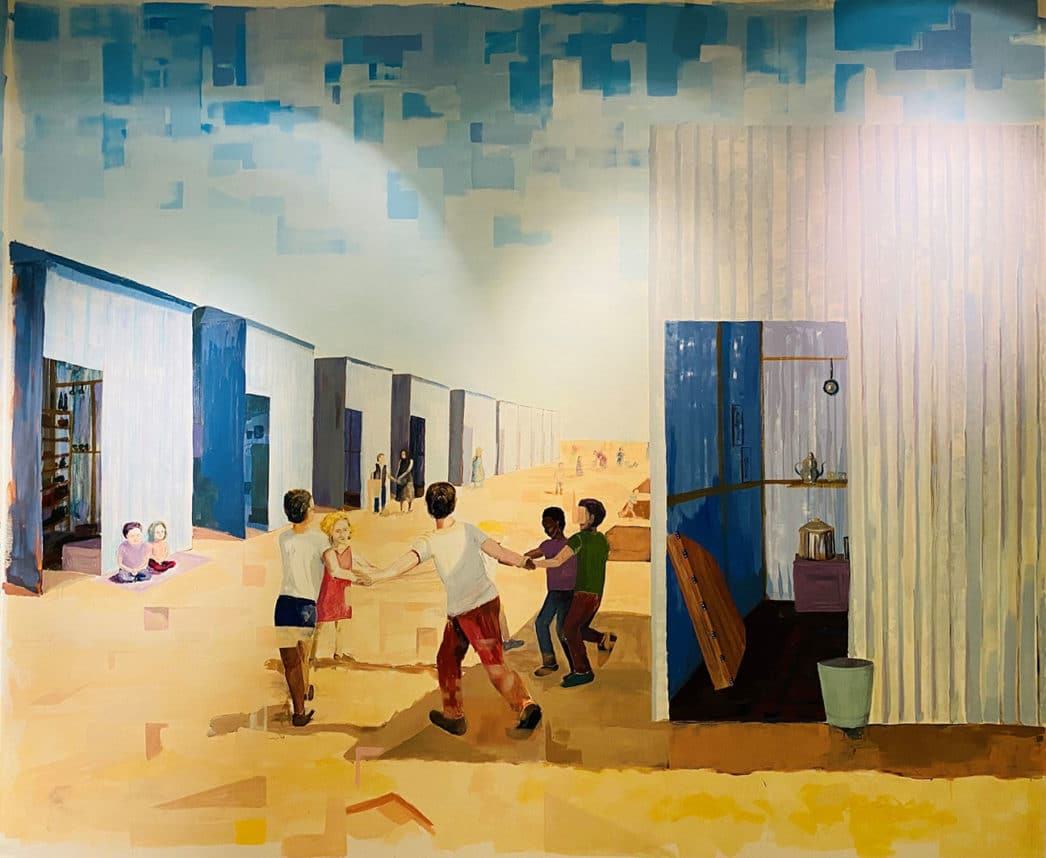
Part of a set of murals titled “Transitions” painted by artist Rubi Bakal (b. 1981) in 2020 now on display at the Babylonian Jewry Heritage Center. The murals depict life for newly-arrived Iraqi immigrants to Israel in the transit camps. (Babylonian Jewry Heritage Center)

On Tuesday, the museum will hold an event marking the 70th anniversary of the Jewish exodus from Iraq to Israel via Operation Ezra and Nehemiah. Leading Iraqi-Israeli speakers and artists will take part in the celebrations, including Baruch Meiri. The festivities also will include traditional Babylonian Jewish music, art and food.

Mordechai Ben Porat, 98, one of the original organizers of Operation Ezra and Nehemiah and who also spearheaded the founding of the Babylonian Jewry Heritage Center, is slated to attend the museum celebrations.

One of the goals is to keep Iraqi Jewish traditions and history alive for the next generation.

“With that aliyah we can say that the Babylonian exile ended,” Lily Shor, director of external relations and events at the Babylonian Jewry Heritage Museum, told The Media Line.

“All the Jews around the world were once in the tribe of Judah, and they were taken to Babylon” after the destruction of the First Temple, Shor said. “During the immigration wave of the 1950s, some 110,000 Jews came to Israel and only 9,000 remained in Iraq. This means that the exile effectively ended.”

The End of Exile: Iraqi Jew Recalls Escape From Baghdad 70 Years Ago Read More »

Stop Cheapening Important Historical Terms

Recently, heroic human rights activist Natan Sharansky, who spent over nine years in Soviet prisons as part of his very personal and also very public fight for Jewish freedom in the Soviet Union, commented on how the use of the term “Refusenik” to describe people who refuse to get vaccinated against COVID-19 “cheapens” the term.

Sharansky (who coined the “3-D” test for determining when criticism of Israel is actually antisemitic”) described how the term “Refusenik” came to be: “Half a century ago, a modest Russian language teacher from London, Michael Sherbourne, started making regular phone calls to Jewish activists in Moscow. He coined the term to describe the people who were refused to get visas to leave for Israel.” Sharansky added that the term “became the symbol of people refusing to accept the rules of the totalitarian regime … It was the term that became the code word for the biggest mobilization of the Jewish people and freedom-loving people from all over the world in order to bring down the Iron Curtain.”

Sharansky then went on to say that using the term “Refusenik” to describe anything other than those who stood up to and suffered imprisonment and worse at the hands of the Soviet tyrants and apparatchik cheapens the term.

Sharansky’s concern regarding the misuse of the term “Refuseniks” brings to mind the frequent misuse by Israel-haters, particularly on social media, of terms like “apartheid” or “genocide” in order to attack Israel and to justify (as Sharansky described) their weaponization of the 3-Ds (demonization, delegitimization and double standards) against Israel.

“Apartheid” is defined by the Merriam-Webster Dictionary as “a former policy of segregation and political, social, and economic discrimination against the nonwhite majority in the Republic of South Africa.” The Merriam-Webster Dictionary adds the following note to its definition: “The extreme racial segregation of apartheid lasted from 1948 to 1994 and included such restrictions as where people of certain races could live or own land, what jobs they could hold, and who could and couldn’t participate in government.”

Apartheid, which in the Dutch creole Afrikaans language means “apartness,” was a brutal system of government created by European colonialists (largely Dutch and English) who had no historical, religious or indigenous connection to the land they ruled, via their system of denying anyone deemed “Black or colored” the right to vote and numerous other rights.

In Apartheid South Africa, any non-white person could not: vote, participate in government, become members of the parliament or supreme court, become officers in the army or police,  go to beaches, malls or hospitals, or even sit on the same park bench as a “white” person.

No such restrictions or government-mandated segregation exist in Israel where Arabs, Jews, Druze, Circassians and others regularly visit the same beaches, busses, malls, stores, hospitals, etc. In Israel, all citizens, regardless of color, ethnicity or faith, have the same civil rights, vote in Israel’s elections, and serve in all aspects of government, including in Israel’s parliament (the Knesset) and on its Supreme Court.

In Israel, an Arab judge, George Karra, an Israeli Supreme Court justice, sentenced the Jewish former president of the country to nine years in prison. In Israel, numerous Arabs and Druze serve as high ranking officers in Israel’s military and in its various police and security services. And in Israel, the Chair of the Board of the country’s largest bank (Leumi) is an Arab. Can anyone imagine any of these things occurring under the brutal government-mandated segregation called “apartheid” in South Africa?

Of course not. Given the clear inapplicability of the actual definition of “apartheid” to life and law in Israel, the Israel-haters simply change the definition of the term to fit their deceptive narrative.

When those who label Israel an “apartheid state” are confronted with the inaccuracies of their charge by those noting that no citizens in Israel are treated differently based on their race, faith or ethnicity, they quickly switch gears and defend their inapt use of this inflammatory trigger word by claiming they are not referring to how Israel treats its own citizens, but by how it treats Arabs who are not Israeli citizens, those who are under the jurisdiction of either the Palestinian Authority or Hamas.

A distinction between how countries treat citizens and non-citizens is not “apartheid.” All countries treat citizens and non-citizens differently, and all countries offer to their citizens certain rights and benefits they don’t offer to non-citizens. But those who hate Israel never seem to be concerned by these facts, or by how the way they dramatically alter the basic definition of “apartheid” both cheapens the term and diminishes the suffering endured by Black people in Apartheid South Africa.

A distinction between how countries treat citizens and non-citizens is not “apartheid.” All countries treat citizens and non-citizens differently, and all countries offer to their citizens certain rights and benefits they don’t offer to non-citizens.

Instead, to defend their characterization of Israel as an apartheid state, they make false claims including the statement that Israel has separate roads and license plates for Arabs and Jews. The truth is that for necessary security reasons, in some parts of the disputed territories Israel has separate roads for citizens and non-citizens. And it has different colored license plates for those who are Israeli citizens (again, regardless of ethnicity or faith) and for those who are not citizens and live under the jurisdiction of the Palestinian Authority or Hamas. None of this equates to the race-based rules and distinctions that were imposed on all citizens of South Africa under apartheid.

When it comes to “genocide,” the Israel-haters take the misuse and cheapening of an important historical term to another level.

“Genocide” is a term “used to describe violence against members of a national, ethnic, racial or religious group with the intent to destroy the entire group.” It describes “acts committed with intent to destroy” a national, religious, or ethnic group. The first use of the term “genocide” was in 1944 by Raphael Lemkin, a Polish-Jewish lawyer who fled Nazi occupied Poland in 1941. As a boy, Lemkin was greatly disturbed by the Turkish mass-murder of Armenians during WWI; and in 1944 he was searching for a term to describe the Nazi crimes against the Jewish people, and he came up with “genocide” by combining genos, the Greek word for race or tribe, with the Latin suffix cide (“to kill”).

Given that the International Holocaust Remembrance Alliance’s definition of antisemitism includes: “[d]rawing comparisons of contemporary Israeli policy to that of the Nazis” and “[d]enying the fact, scope, mechanisms (e.g. gas chambers) or intentionality of the genocide of the Jewish people at the hands of National Socialist Germany and its supporters and accomplices during World War II (the Holocaust),” it is not particularly surprising that Israel-haters would try to do both of the foregoing by deploying the term “genocide” to describe Israel’s actions toward Palestinians.

But if using the term “Refuseniks” to describe COVID-19 anti-vaxxers cheapens the history of actual Refuseniks, then what is the effect of describing as “genocide” a conflict that in nearly 100 years has resulted in around 25,000 Israeli and 17,000 Palestinian casualties?

In the genocide that first horrified Lemkin, the Ottoman Empire killed approximately 1,000,000 Armenians in barely 1.5 years. In the genocide from which Lemkin escaped in 1941, the Germans killed over 6,000,000 Jews in barely four years. And in the last genocide of the 20th century, in Rwanda, the Hutu majority killed over 800,000 Tutsi in less than four months.

These are genocides. Approximately 17,000 people killed in various armed conflicts over the course of nearly 100 years is not a genocide. In the case of the Holocaust, the worldwide Jewish population before 1939 and the beginning of WWII was 16.6 million. By the end of WWII, over one third of the world’s Jews were dead. And today, nearly 80 years after the Holocaust, the worldwide Jewish population is still well below its pre-WWII numbers at 15.2 million.

This stands in sharp contrast to the Palestinian population. At the end of WWII, and three years before the Palestinians’ leadership rejected peace and partition and chose instead to join forces with the entire Arab League in a disastrous attempt to destroy Israel (a war that killed 1% of Israel’s population, the equivalent of 3.3 million Americans), the Palestinian Arab population was barely 1 million. Today, according to the Palestinian Authority itself, there are over 11 million Palestinians worldwide, and well over four million living under the Palestinian Authority and Hamas. This is not a genocide. It is a war that has sadly lasted nearly 100 years, and while every loss of life in war is tragic, not every loss of life in war is part of a genocide. If it was, then the term would lose all meaning, and it would certainly lose the meaning intended by Lemkin: to mark particularly heinous crimes against humanity like those perpetrated by the Ottoman Empire and the Nazis.

Those who hate Israel abuse, misuse and cheapen terms like “apartheid” and “genocide” (and many others, like “ethnic cleansing” and “occupied territories,” which would require more room than there is in one essay to discuss) for two reasons. The first reason is clarified by Sharansky’s 3-Ds.

If one associates the one Jewish state with two of the great evils of “apartheid” and “genocide,” then the demonization and delegitimization of Israel are not far behind. And if one can get people to believe that a state with equal civil rights for all citizens, regardless of color or ethnicity, is practicing “apartheid” and/or that a population growth of ten times in under 80 years is “genocide,” then the effort to get people to apply a double or different standard to the one Jewish state has plainly succeeded.

If one associates the one Jewish state with two of the great evils of “apartheid” and “genocide,” then the demonization and delegitimization of Israel are not far behind.

In Sharansky’s lament regarding the misuse and commoditization of the term “Refusenik,” Sharansky expressed concern not only with how the term is being cheapened, but also with the loss of any sense of proportion.

Those who hate Israel want this loss of proportion. They want the world to focus unique and oversized attention on the one Jewish state. If the world were to focus attention to those most in need of it (such as the Uyghurs, the Rohingya, the starving in Yemen, the victims of slave trade in Africa, the displaced from war in Syria, the refugees in South Sudan, etc.), then the Palestinian Arab leadership—which has declined every peace/partition offer since 1937—could no longer count on the outsized focus of the world on Israel, and also keep pinning their misguided hope on the idea that one day the world will help them destroy Israel without them having to make any compromises for peace.

This is what makes this misuse and cheapening of terms like “apartheid” and “genocide” so disturbing. It trivializes the horrors experienced by those who suffered under apartheid and genocide and minimizes the evil of their perpetrators. It also further emboldens the continued rejectionism of the Palestinian leadership, a rejectionism that has prevented peace in the Levant between Palestinians and Jews for nearly 100 years.

When good people make it clear that this misuse and cheapening of such important and historical terms is unacceptable, and is itself a form of antisemitism, then peace among Palestinians and Jews will become far more likely. May that day arrive soon. Be”H.


Micha Danzig served in the Israeli Army and is a former police officer with the NYPD. He is currently an attorney and is very active with numerous Jewish and pro-Israel organizations, including Stand With Us and the FIDF, and is a national board member of Herut North America.

Stop Cheapening Important Historical Terms Read More »

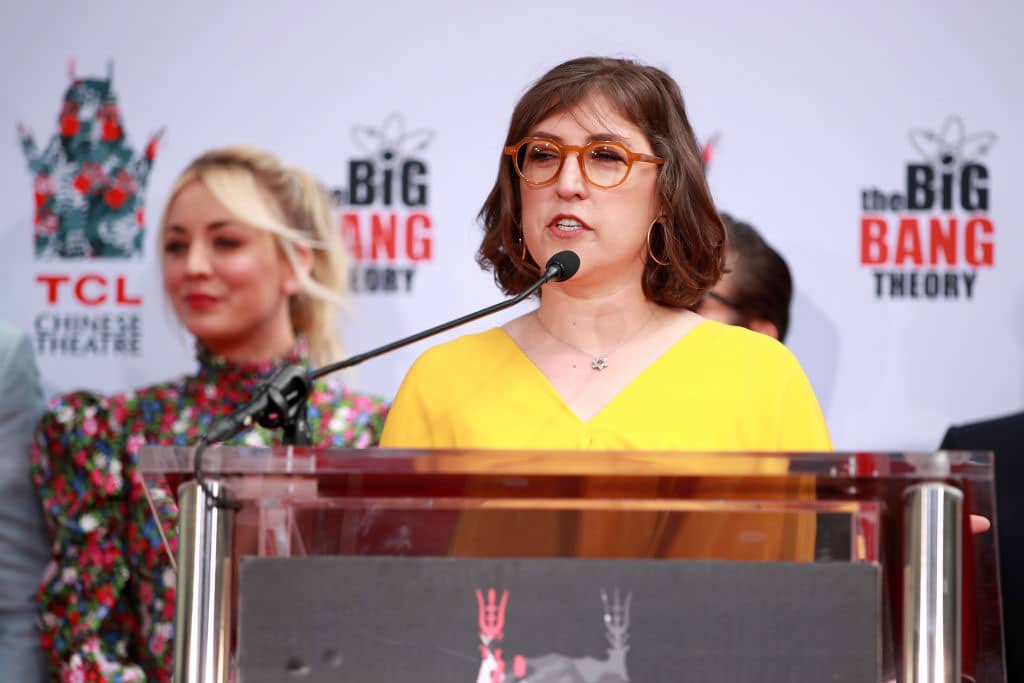
Mayim Bialik, Gene Simmons, Neil Patrick Harris Highlight Celebrities’ Letter Against Boycott of Israeli LGBTQ+ Film Festival

Multiple Hollywood celebrities signed an open letter published by the Creative Community for Peace (CCFP) lambasting efforts to boycott an LGBTQ+ film festival in Tel Aviv.

The letter, which was signed by actors and actresses including Mayim Bialik, Neil Patrick Harris and Mila Kunis and musicians such as Kiss bassist Gene Simmons, states that the Tel Aviv International LGBTQ+ Film Festival (TLVFest) in November reflects the “unity and truth” of how movies bring together “people of all races, ethnicities, and backgrounds” in Israel and will feature “films from filmmakers of all backgrounds, including Palestinians.”

“We reject any attempt to boycott TLVFest – Israel’s largest LGBTQ Film Festival – which works to showcase the stories of LGBTQ people globally and create a brighter future for LGBTQ people both inside Israel and around the world,” the letter stated. “We stand united with all the participating filmmakers against the divisive rhetoric espoused by boycott activists who seek to misinform, bully and intimidate artists into removing their films from the festival or shame them for participating in the festival. We believe that anyone who works to subvert TLVFest merely adds yet another roadblock to freedom, justice, equality, and peace that we all desperately desire, especially for the LGBTQ community that is persecuted throughout the Middle East and around the world.

“Artists should never be silenced, and art should not be subverted for political goals.”

Writer and comedian Lee Kern, who signed the letter, also posted his own letter on the matter, calling the Boycott, Divestment and Sanctions (BDS) movement a “clown show” perpetuated by “mentally incurious bozos.” “It was set up by those who wish to destroy Israel – which places those who support the BDS movement in the same company as white supremacists and reactionary Islamic fundamentalists such as Hamas and the Taliban,” he wrote. “It is a hate movement – not a justice movement.”

Kern added that singling out Israel “is pure mendacity disguising itself as progressivism. If several children in a classroom misbehave but the teacher only ever punishes the black pupil; that’s racism. It would also call into question how accurately that teacher is interpreting the behavior of the black student. Nothing they have to say about the conflict has any value.”

He also noted that LGBTQ+ Israelis actually do have something of value to say given their experience in Israel. “May the boycotting extremists fail.”

According to The Times of Israel, pro-BDS figures have alleged that the festival is an example of “pinkwashing,” meaning that in their view, Israel is touting its record on gay rights to distract from its treatment of the Palestinians.

Yair Hochner, who heads the festival, issued a statement rejecting accusations of pinkwashing. “The very existence of TLVFest stands against the homophobic, racist and misogynistic parts of the parliament (Knesset) of Israel, and we say that openly and proudly,” he said. “We will also continue to collaborate with queer Palestinian filmmakers who are interested in coexisting peacefully and building a much more tolerant and inclusive Middle East, both for Israelis and Palestinians.”

Hochner added that “the festival will never serve as a diversion from the human rights violations being committed by the state of Israel” and “will always strive to end any apartheid system and military occupation that imprisons children, demolishes homes, and holds people under siege, and to echo aloud the voices of the voiceless and oppressed.”

CCFP Director Ari Ingel said in a statement, “Anti-Israel boycott activists intentionally use inflammatory language and make provocative statements, to try and bully filmmakers into backing out. Their messages intentionally involve an element of dishonesty and misinformation that only furthers hostility and dampens hope for peace, which all of us so urgently desire.”

Anti-Defamation League CEO Jonathan Greenblatt thanked CCFP for the letter in a tweet. “#BDS serves no one, but authentic stories — Israeli & Palestinian — can lift up the #LGBTQ experience and bring all of us closer together.”

Mayim Bialik, Gene Simmons, Neil Patrick Harris Highlight Celebrities’ Letter Against Boycott of Israeli LGBTQ+ Film Festival Read More »

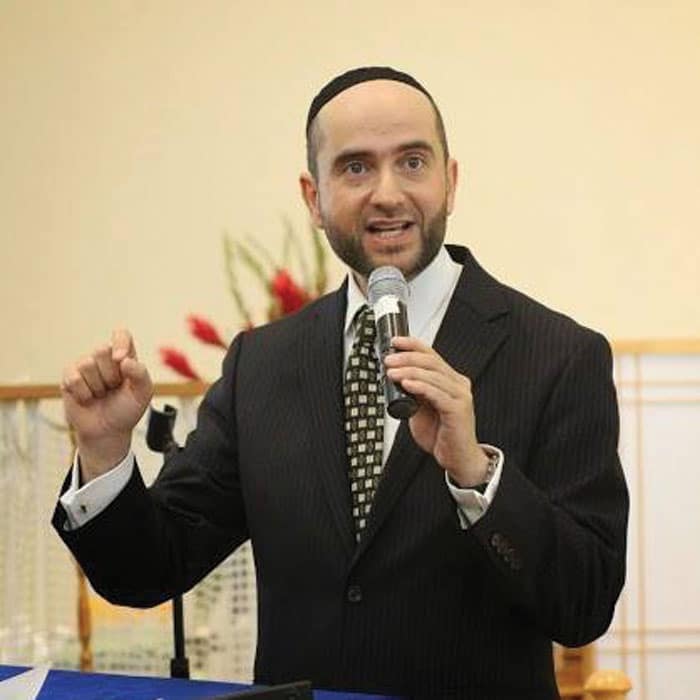
Rabbis of LA | Pini Dunner: The Orthodox Optimist

To engage Pini Dunner on the subject of his Judaism is to time travel backwards and forwards into Jewish history.  

It usually starts with his illustrious rabbinic lineage: Both his father and grandfather were prominent European rabbis, though his father, an international businessman, led Jewish advocacy organizations rather than a congregation. But then the story stretches wider — to the mother born in 1941 in the Netherlands — and becomes wilder — detailing how Dunner’s maternal grandfather, a cheesemaker, used his contacts in the chemical industry to obtain bomb materials for the Dutch resistance in exchange for ration cards. It occurred to this wise grandfather that the only way to protect Dutch Jews in hiding was to lessen the material burden on their often ambivalent non-Jewish hosts. By the end of the war, Dunner told me, his grandfather had saved some 750 Jews.  

“I always had this sense about the burden of history,” Dunner, the English-born Orthodox rabbi of Young Israel of North Beverly Hills, said. “I think one of the feeble aspects of youth is that we are quick to discard those things that were meaningful to previous generations, but I always had this sense that Jewish history amounted to a charge in life.”

Dunner projects that classic, conservative, immersive Judaism of the kishkes. He is thoroughly traditional, and in a sense, unself-critical, steeped in the credos of Jewish history, learning and observance to the point of enchantment. He deploys his commitment to Judaism in a multitude of ways: pulpit rabbi, scholar, author, YouTube teacher, Israel advocate. “I have a very wide portfolio of activities that I’m engaged in as a communicator and educator,” he told me. “There is nothing I will not do in my attempt to give meaning to Jewish identity and help perpetuate and strengthen Judaism and Jews around the world.”

“Jewish history tells us that Jewish life is not going to die. It may morph from one thing to another, priorities may change, but Judaism doesn’t change.”

In his articulate, accented English, Dunner, 51, regaled me with stories from the past. He recounted with pride how his grandparents went to the mikvah under cover of night during Nazi occupation. He described his paternal grandfather’s imprisonment in East Prussia and escape to London. He knew, in great detail, how all his many relatives in the Diaspora flourished and then didn’t, how some migrated to Europe, some to America, and how all yearned to return to the land of Israel.

Some might think this preoccupation with history would inspire cynicism or concern about the Jewish future. But instead, Dunner tells a story about an old friend who used to go around to London synagogues fundraising for Jewish non-profits with a lecture entitled, “The Jewish World: Reasons to be Cheerful.”  

“There hasn’t been an era since the beginning of modern Jewish history when there weren’t doomsayers telling us all that Jewish life was over,” Dunner said with the self satisfaction of hindsight. “And I’m not talking about people getting killed — the Holocaust came as a shock to everybody. I’m talking about people saying the displacement of Jews to the United States would kill the Jewish world; that Zionism would be the death knell because cultural nationalism is not Jewish; that the loss of Yiddish as a central language would be the end of Jewish life; that uprooting all the Jews from North Africa and elsewhere in the Middle East would be ruinous. Everything has been about destroying Jewish life and yet here we are, at least 250 years since Moses Mendelssohn, and Jewish life is still thriving. Now, go figure.”

I ask Dunner to elucidate one “reason to be cheerful” about the Jewish future. So he tells me a story — about Christians.

Several years ago, Dunner helped organize a trip to Israel for Evangelical Christian leaders as part of his work with the Israel Christian Nexus. On his list of recommended sites, Dunner included an unusual suggestion for Christians: Mir Yeshiva in Mea Shearim, one of the largest yeshivas in the world in one of the most militantly religious neighborhoods in the world. Bishop Robert Stearns, head of the Nexus, immediately said yes, that’s where the group should go. So Dunner found himself in the unenviable position of having to convince Mir’s Rosh Yeshiva that he should allow a group of Christian pastors into the sacrosanct Jewish House of Study.

“There was a very long pause when I called him,” Dunner recalled. “Then he said, ‘I cannot officially endorse that, but if you come after 10 p.m., [the yeshiva] is half empty and if you go there at that time it won’t cause a stir. But I never spoke to you…’”

Among the Charedim in Israel, Christians are still viewed with great suspicion due to a long history of Christian anti-Semitism, blood libels and blame, Inquisitions, forced conversions and the like. But on that night, 30 pastors poured into the Jerusalem Beit Midrash where 100 or so boys were still studying and according to Dunner, it was a lovefest. They opened a page of Talmud together and engaged in conversation. On the way out, a prominent pastor with a congregation in the tens of thousands told Dunner he had “met Jesus” in that yeshiva. Two students had asked the pastor all kinds of pointed questions, forcing him to defend his beliefs. 

According to Dunner, this pastor said he had never had to defend his views before. Gospel is gospel. But it occurred to him that Jesus defends his ideas in the gospels, arguing with his interlocutors in much the same way those two yeshiva boys had argued with the pastor. “He realized, ‘Jesus must have studied at Mir Yeshiva!’” Dunner said. 

“That was one of the most remarkable occurrences of my life,” he continued. “That is the power of the integration of different religious groups. Once you meet each other, you get a sense that what we share is more important than what we disagree about.

“So who am I to be a predictor of doom and gloom vis á vis the Jewish world? I subscribe to history. And Jewish history tells us that Jewish life is not going to die. It may morph from one thing to another, priorities may change, but Judaism doesn’t change.”


Fast Takes with Pini Dunner

Danielle Berrin: What’s currently on your night table?

Pini Dunner: A book about Ahad Ha’am

DB: Last show you binge-watched?

PD: “Fauda.”

DB: Your day off looks like…

PD: The same as my day on.

DB: Favorite thing to do in Israel?

PD: Pray at the Kotel

DB: Something about you most people don’t know?

PD: I’m a youngest child. 

DB: Most essential Torah verse?

PD: V’ahavta L’reiacha Kamocha, Love your neighbor as yourself. 

DB: Biggest challenge facing the Jewish world?

PD: Apathy.

DB: Guilty pleasure?

PD: Schmaltz herring.

DB: Favorite Jewish food?

PD: Cholent.

DB: If you weren’t a rabbi you’d be…

PD: Studying in yeshiva.

Rabbis of LA | Pini Dunner: The Orthodox Optimist Read More »

“Space Jews” and Redistricting

I rarely used to watch Netflix or any other streaming network. Then COVID hit, and I started watching “Law and Order” voraciously, as well as “Cobra Kai” and a couple of other guilty pleasures. As I was reading the recent news about comedian Dave Chappelle and people wanting to boycott him due to his offensive jokes about transgender people, I was curious to know what the fuss was about. In Chappelle’s comedy special, “The Closer,” he makes a joke that appears to assert that Jews want to control the world (“The Protocols of the Elders of Zion,” anyone?). “In my movie idea, we find out that these aliens are originally from earth. That they’re from an ancient civilization that achieved interstellar travel and left the earth thousands of years ago,” he says. “Some other planet they go to, and things go terrible for them on the other planet, so they come back to earth, [and] decide that they want to claim the earth for their very own. It’s a pretty good plot-line, huh? I call it ‘Space Jews.’” Later during his routine, Chappelle speaks about a “true story” regarding a former African American slave who was freed and then became a slave owner himself. “How can a person that went through slavery perpetuate the same evil on a person that looks just like him?” he asked. “It’s mind blowing. And shockingly, they’re making a movie about him. Ironically, it’s called ‘Space Jews.’”

One of the [redistricting] plans is extremely detrimental to those in the more observant Jewish community. 

Last week I was on a Zoom call with the Los Angeles City Commission as they are deciding how to change district lines that would change who represents the various communities. In Los Angeles, redistricting must happen every 10 years when the census data comes out in order to create equitable districts focused on population percentages and the voting rights acts. One of the plans is extremely detrimental to those in the more observant Jewish community. 

There has been a push to make changes to the current proposal that would still allow the community to be representative fairly. As I have seen the process progress through its various iterations, I have observed what seems to be, at times, underlying antisemitism; and at other times, I have witnessed overt antisemitism. This was apparent on the Zoom call. As various interest groups stood up for themselves, rightfully so, and discussed why the plan worked or did not work for them, they received very little, if any, push back from people. Everyone shared their special interests, their struggles, and explained why a certain plan worked for their special interest group. Unfortunately, when it came to what is best for the observant Jewish community, people spoke up and claimed that it is unfair for a religious group to have special treatment. Some Jews even joined the pushback: “I am so and so and I am Jewish and I oppose this plan as a Jew.” When concerns came from the Latino community, African American community, Asian American community, Armenian American community and others there was no direct push back based on race, ethnicity, religion, or any other category. Instead, each group was heard and given a chance to speak to what would or would not benefit their community. The difference was telling.

And that brings me back to Chappelle’s “Space Jews.” Comedy should make light of certain things; it’s an important function of the genre. At the same time, antisemitic tropes are exactly that: antisemitic tropes. Jokes based on antisemitic, racist or other stereotypes can be harmful to minority communities in some cases. But while Chappelle’s jokes disparaging Jews are just as blatant and potentially harmful as his jokes about the transgender community, most of the uproar is focused on the latter instead of the former. It’s as if everyone has silently agreed that it’s okay to peddle jokes laden with antisemitic tropes, that of all the minority communities that need protecting, Jews don’t make the cut. 

As a community, where do we draw the line? Whether we’re dealing with political boundaries or antisemitism in Hollywood, where are the voices of reason? Why are we vocal when we see some forms of bigotry but become quiet and meek when it comes to speaking out against the voices of antisemitism? 

Given the disparity between who are willing to speak up for Jews and those who are willing to speak up for every other minority community, I can’t help but whether, if “Space Jews” was a real film, ticket sales would soar. Sadly, I suspect the film would be a blockbuster hit, if for no other reason than the absence of voices of reason when it comes to Jews.


Rabbi Dr. Chaim Meyer Tureff is the Rav Beit Sefer at Pressman Academy, an author, and founder and director of STARS, which guides people struggling with addiction. He can be reached at rav.meir18@gmail.com.

“Space Jews” and Redistricting Read More »

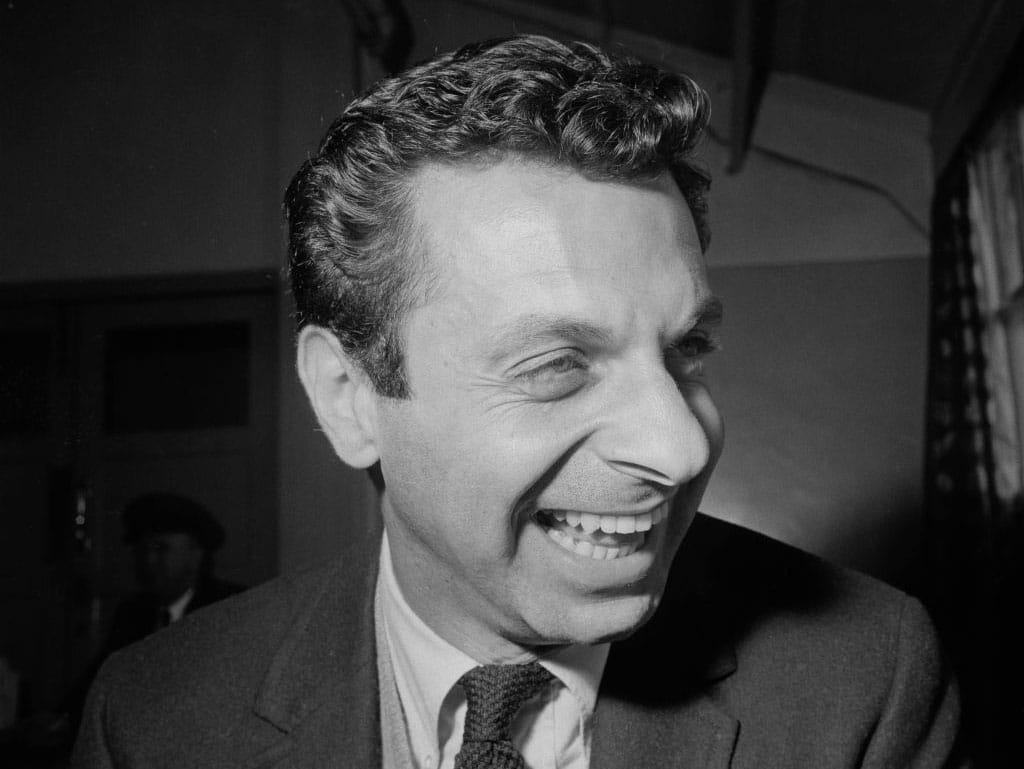
The Inspiration of Mort Sahl, Comedy Legend and Social Satirist

Over the past decade, I’ve made more than a few trips up to Mill Valley, Calif.

I didn’t go to experience the beautiful scenery or the fresh air in Northern California. Instead, I went because there was a true treasure hidden up there: comedy legend Mort Sahl, who died on October 26 at the age of 94.

Mort was a father of American comedy, and one of my favorite artists. He was living his golden years in Mill Valley and, even in his ‘90s, would do an hour-long “sit down” comedy show every week at the Throckmorton Theatre. He’d rant about current news stories, take questions from the audience, recount tales about his days writing jokes for speeches for his friend President John F. Kennedy and share anecdotes about his old days in Hollywood, streaming everything on Facebook Live.

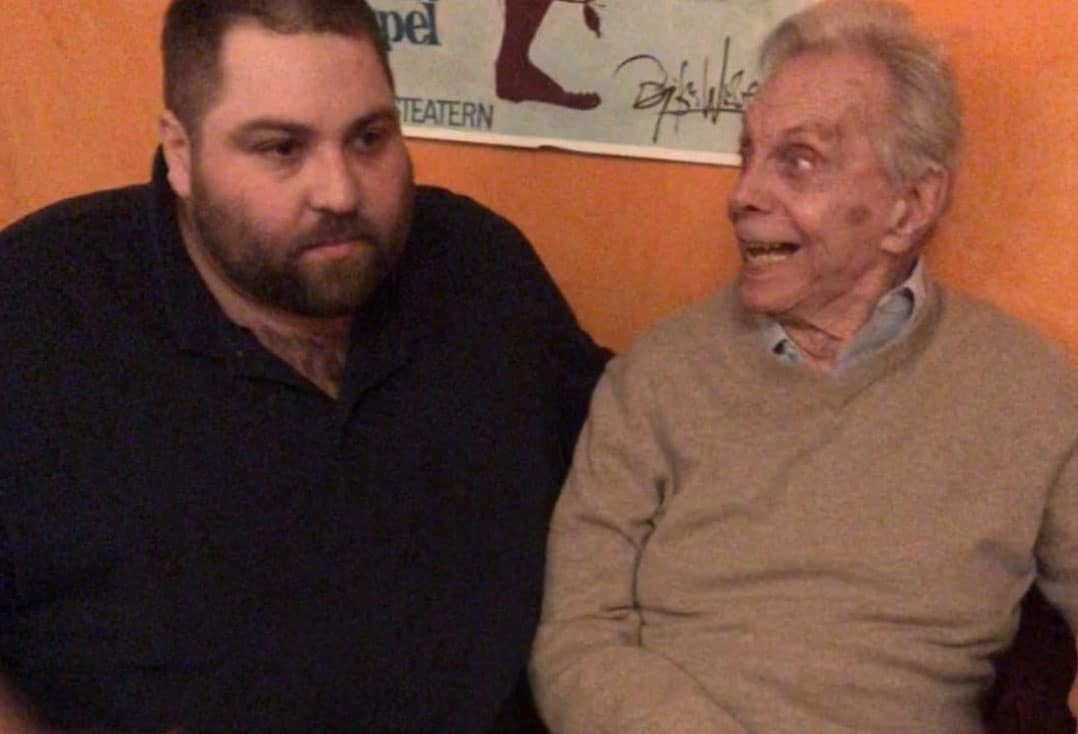
Daniel Lobell with Mort Sahl. Photo courtesy Daniel Lobell

Born Morton Lyon Sahl, the comedian got started in the San Francisco scene, where he made a name for himself at the famous “hungry i” nightclub in the 1950’s. The club was home to the coolest acts; comedians that played there attracted a more intellectual crowd, and Mort quickly became the star attraction.

More than a comedian, he was known as a social satirist, and would famously go up on stage with that day’s newspaper under his arm, pull it out while seated on a stool and start reading and riffing off of it in real time.

More than a comedian, he was known as a social satirist, and would famously go up on stage with that day’s newspaper under his arm, pull it out while seated on a stool and start reading and riffing off of it in real time.

Mort became massively popular and would go on to tour the country, appear on late night television and become one the first comedians to get a cover story in Time magazine. Additionally, he acted in a number of films and had his own one-man show on Broadway. Many of the great comedians like Lenny Bruce, Jonathan Winters and Woody Allen cited Mort as one of their biggest influences.

Woody in particular looked up to the man. Even when Mort’s career took a fall after Kennedy’s assassination because Mort became hyper focused on the Warren Report’s inaccuracies, Woody would still sing Mort’s praises and talk publicly about how, if not for Mort, he wouldn’t have thought of stand-up comedy as something worth pursuing.

Photo courtesy Daniel Lobell

In fact, Woody himself made me aware of Mort when I was 19. As a young comedian and jazz fan, I would hang around The Carlyle hotel in Manhattan to hear Woody perform with his jazz band on Monday night. On occasion, Woody would spend a few minutes chatting with me and was generous enough to recommend people I should become familiar with both in jazz and in comedy. Mort was high up on his comedy list.

I always loved Mort’s casual conversational style. It inspired me to allow myself to explore the art form as a stand-up comic and not feel constrained to the set up and punchline formula. I loved the way he made the medium feel more intimate and spoke to an audience as if it were him speaking to a bunch of his buddies at a dinner party. Until his passing, he was a living, breathing icon who told the story of American comedy as the art form we know today. For more on Mort Sahl, I highly recommend that you read the biography written on him from 2017, “Last Man Standing” by James Curtis.

May Mort’s neshama have an aliyah in the heavens, and may his work continue to inspire great art from those of us who are still alive. Rest in peace, Mort.

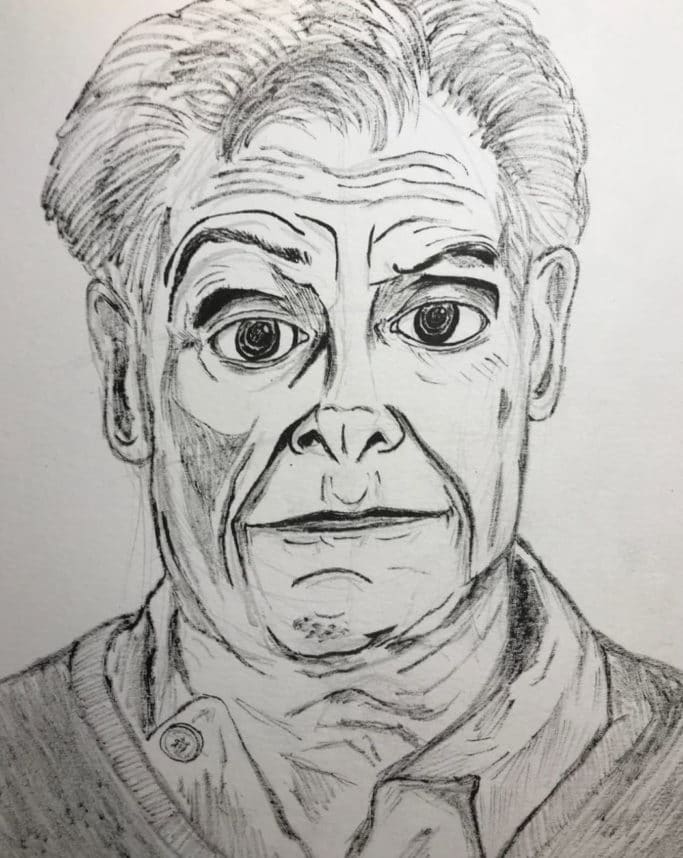
Drawing of Mort Sahl by Daniel Lobell

Daniel Lobell is a comedian and podcaster living in Los Angeles. He is the author of the Fair Enough comic book series and hosts the Doctorpedia podcast.

The Inspiration of Mort Sahl, Comedy Legend and Social Satirist Read More »

Target, Barnes & Noble Stop Selling Holocaust Denial Books

Target and Barnes & Noble both announced that they would stop selling four books promulgating Holocaust denial at the urging of the Simon Wiesenthal Center.

The Jerusalem Post reported that the books were “Not Guilty At Nuremberg” by Carlos Porter, a Holocaust denier, “The Auschwitz Myth – Legend or Reality?” by former Nazi officer Wilhelm Stäglich, “A Censorship Is Taking Place!” by Germar Rudolf, who was convicted by Germany of being a Holocaust denier and “What Is Truth?” by Paul Rassinier, a Holocaust denying communist.

“We assume these large online booksellers do not mass-market books promoting terrorism or pedophilia,” Rabbi Abraham Cooper, Associate Dean and Director of Global Social Action Agenda at the Wiesenthal Center, said in a statement. “At a time of surging anti-Semitic hate crimes here in the US, it is beyond the pale that a book would be marketed by someone who insults the memory of 6 million Jewish victims of the Nazi genocide.”

Target told the Wiesenthal Center, “It’s never our intention to offend our guests with the merchandise we carry. Please know that we have removed this book from our assortment.”

Barnes & Noble similarly told the Wiesenthal Center, “As soon as we are made aware of any such offending titles, we take prompt action to remove offending titles in accordance with our policy, as we did with ‘Not Guilty at Nuremberg.’  We had not been aware of this title’s existence on barnesandnoble.com. Upon receipt of your correspondence, in accordance with our content policy, we immediately removed it from our website.”

StandWithUs CEO and Co-Founder Roz Rothstein, the daughter of Holocaust survivors, tweeted that Target and Barnes & Noble “never should have been selling them in the first place” and that StandWithUs and CAMERA [Committee for Accuracy in Middle East Reporting in America] were also protesting against Target and Barnes & Noble selling those books.

UPDATE: Walmart has also announced that they will stop selling the books, according to the Wiesenthal Center.

Target, Barnes & Noble Stop Selling Holocaust Denial Books Read More »

Music Industry Influencers Gather to Set Record Straight on Israel, Antisemitism

On a recent October evening, hundreds of music industry influencers gathered in Beverly Hills to talk Israel, peace and music at an event that Creative Community for Peace (CCFP) put together. For the last decade, CCFP has been leading a mission to provide balance to discourse and correct misinformation about Israel in the entertainment industry. 

At the October 7 event, CCFP honored a few powerful voices in music today, praising their work in not losing sight of the big picture that music plays in affecting people — ultimately dubbing them “Ambassadors of Peace.”

Twelve-time Academy Award-nominated songwriter Diane Warren was one of the honorees. 

In addition to co-writing hit film songs like “I Don’t Want To Miss A Thing” and “Nothing’s Gonna Stop Us Now,” Warren is a proud Israel advocate. She told the Journal that even though she hasn’t been to Israel in 12 years (where she was a guest of Shimon Peres), she would do anything she could to help the country.  As a vegan for many years, Warren likened “standing up for the voiceless and protecting the innocent lives” to not only treating animals with care and respect, but also treating our fellow humans the same.

Another honoree, Ben Maddahi, spoke about changing harmful narratives about Israel that pervade the entertainment industry. As the Senior Vice President of Artists and Repertoire (A&R) for Columbia Records, he talked about encounters with “celebrities and influential figures spreading misinformation, sometimes unknowingly, and sometimes knowingly, about Israel.” 

He said in his acceptance speech that it felt like the whole world had turned on him in regards to Israel. But what gave him hope was that people in CCFP made phone calls to celebrities and influential figures to make sure they understood the ramifications of their social media posts.

“CCFP does critical work to teach people in the entertainment industry about the truth about what’s happening in Israel,” Maddahi said. “We need to rebalance the narrative because right now, it’s one sided and extremely poorly informed.” 

CCFP Director Ari Ingel told the audience that their work is critical in these times.  

“Antisemitism is back,” he said. “But I guess it never really left. When things go bad, [antisemitism is] the first thing to come back. There has been a surge an antisemitic crime in Los Angeles over the last year. Just speaking up and speaking out against any hatred I think is important and has a snowball effect. You don’t realize the snowball effect it has. It’s incumbent upon all of us in the entertainment community to not stay silent anymore.”

One of the co-founders of CCFP, David Renzer, told the Journal that what they’re doing is energizing the entertainment industry to unite and taking a stand against antisemitism. 

“It’s part of our mission to provide balance to the discourse,” he said. “We’re talking to Spotify, SoundCloud, iTunes and YouTube on a weekly basis to point out issues where there might be antisemitic content. We’re talking to film and television companies if there are issues there. In the last year and a half, many executives from various companies have reached out to us because they have been concerned.”

One of the most powerful messages of the evening came in the acceptance speech of the CEO of The Recording Academy, Harvey Mason Jr. He spoke about promoting art to advance peace.

“Like so many times throughout history, when the world has felt anguish and pain, music has been the medicine,” he said. “When we felt isolated, music brought us together.” 

Mason also discussed an unsolicited email he received from an Iranian musician, Mehdi Rajabian, who had been put in jail for working with a woman. Upon being released, he then made another record with female singers, telling Mason that he would possibly face going back to jail. He wanted to get this music out so the world could hear it.

“[Music] is a shared language spoken and heard by people who otherwise may have nothing in common.” — Harvey Mason Jr.

“I helped him release it [and] I share his goals,” Mason said. “[Music] is a shared language spoken and heard by people who otherwise may have nothing in common. When any two people realize that they may be more alike than different, whether it’s an artist, or fans standing right next to each other, moving to the same beat, that’s where the understanding happens.” 

Music Industry Influencers Gather to Set Record Straight on Israel, Antisemitism Read More »

In American Jewish Life, Don’t Take Halloween for Granted

I never thought I’d have two stories related to Halloween this week, but bear with me — there’s a lesson to be learned from this seemingly superfluous holiday.

Over 30 years ago, my overwhelmed mother and father were given a few weeks to decide where to enroll me (then age 7) and my sister (then age 10) immediately after we arrived in the United States. Our family visited a local Jewish school in West Los Angeles that assured us it was Orthodox. But we didn’t understand such terms because back in Iran, there were no Jewish denominations. “Why are they saying the school is ‘Orthodox’? It’s Jewish, isn’t it? There’s either Jewish or not-Jewish,” my father told my mother. The discussion about Jewish private schools proved moot—after my parents saw the tuition costs for the Jewish school, they enrolled their daughters in a lovely (and more importantly, free) public school in Beverly Hills.

Suddenly, the choice of being afraid was the best reassurance that we were in a safe, wonderful country. 

At the time, I wondered whether my parents had made the right decision. And then, one month after starting school, I witnessed how children in this country embraced a festive and magical night called Halloween. There were funny costumes. There was bountiful candy. But more than anything else, it seemed that in America, people voluntarily chose to be frightened; they actually sought out fear, whether by watching scary movies or wearing gory costumes. What a change. In Iran, no one chose to be scared; we were already terrified out of our wits by the regime and Iraqi missiles that fell out of the sky during the Iran-Iraq War. Suddenly, the choice of being afraid was the best reassurance that we were in a safe, wonderful country. 

Halloween was my first introduction into the world of the truly secular, and of American culture itself (however commercialized). After I watched the seductively fun festivities of that first Halloween, I begged my parents to never change their minds and enroll me in a Jewish school.

I’m no rabbi, but it’s my understanding that from a strictly Halachic perspective, Halloween is forbidden in Judaism. But I also believe that most of us would rather make that choice for ourselves. 

I’m not blaming Halloween on my total lack of Jewish education, or the fact that I didn’t learn the “Aleph Bets” until I was in my late twenties, or even that, for many years, I shunned Jews who were more religious than me. I’m simply stating that, as a child, Halloween served as the biggest reason why I hoped my parents wouldn’t become more observant Jews. 

For their part, my mother and father didn’t seem to care about the holiday one way or another; they had bigger fish to fry than whether their daughters donned witches’ hats and ate candy. As long as my sister and I were no longer in Iran, that was all that mattered. 

But this isn’t 1989; there is no influx of Jewish refugees from the Middle East (and the former Soviet Union) who are flocking to the United States and making important choices about their children’s Jewish upbringing (or lack thereof). The novelty of a “safe America” has worn off. For the most part, we’re comfortable.  But in terms of maintaining our Jewish identity, it is precisely that comfort that can be our biggest enemy. 

In that vein, I wanted to capture a moment in time in the life of Jewish L.A.: In 2021, in our state of comfort, do we embrace or reject Halloween? Is Halloween truly a metaphor for our American identities as well as our slow, gentle assimilation?

My own community of Iranian Jews has only been in this country for 40 years, but nearly all of the Iranian American Jewish families I know that are traditional, but not religious, celebrate Halloween with their kids. In just four decades, we’ve gone from dressing our children as Esther and Mordechai (Purim is the ultimate Persian Jewish holiday) and teaching them messages about Jewish survival and the power of community, to frantically searching for Spiderman and Disney princess costumes at the Rite-Aid in Beverly Hills to partake in a fun holiday that was nevertheless rooted in paganism and idolatry.  

Suffice it to say, my parents never again dressed me up in a Purim costume after we came to this country. Why bother with two holidays? Seeing all of those costumes and all that candy, they easily (and very mistakenly) conflated Halloween with Purim.

In asking local rabbis of various denominations one seemingly simple question (“Should Jews Celebrate Halloween?”) in a separate spread in this paper, I knew I was opening a can of [gummy] worms: Some rabbis responded with clear “No’s;” other rabbis basically said, “No, but;” still others were much more open to Halloween as an innocent experience not to be shunned by the American Jew (or Jewish American). I can imagine that nearly all of the rabbis were forced to think about their congregants in responding to the question. As the leader of a congregation, you can’t exactly disallow Halloween if half of your members have already bought their costumes (I hear Dr. Fauci masks are a big hit this season). 

I’m no rabbi, but it’s my understanding that from a strictly Halachic perspective, Halloween is forbidden in Judaism. But I also believe that most of us would rather make that choice for ourselves. 

A year or two after we resettled in the U.S., my mother had her own epiphany when she saw faux headstones on the lawn of a local Iranian Jewish family’s home. “There’s the mezuzah on the doorpost,” she pointed, seemingly horrified, “and here are fake graves in front of the house. What’s going on here? This is the least Jewish thing I’ve ever seen.”

But by then, it was too late. My sister and I had too much invested in our newly American identities (and all that candy) to let go of Halloween. So how did I maintain and grow my Jewish identity? Maybe it was the absence of real fear that I learned at Halloween that gave me the courage to become a proud Jew.


Tabby Refael is a Los Angeles-based writer, speaker, and civic action activist. Follow her on Twitter @RefaelTabby

In American Jewish Life, Don’t Take Halloween for Granted Read More »