fbpx

October 27, 2021

Table for Five: Chayei Sarah

One verse, five voices. Edited by Salvador Litvak, the Accidental Talmudist

“Listen to us, my lord, you are a prince of God in our midst; in the choicest of our graves bury your dead. None of us will withhold his grave from you to bury your dead.”

-Gen. 23:6


Dr. Erica Rothblum
Head of School, Pressman Academy

We are God’s partners in the world, and we see two models of this partnership in the verse. The first is a lesson on how to treat other people: Avraham must bury Sara in a land where he owns not even a plot of land — and his humble request of the Hittites is met with overwhelming generosity. While he calls himself a stranger, they call him Prince; while he shares that he has nothing, they offer him his choice of plots. This model of kindness towards strangers is held up as one to emulate. We are told again and again, not just in this verse, that we are obligated to treat other people, and especially the stranger, with generosity and kindness. Part of being God’s partner is emulating God in our relationships. 

Avraham refuses this offer, however, and realizes he has an obligation in this scenario, which is our second model of partnership. God had previously told Avraham that he will inherit the land of Canaan — so when the Hittites offer the burial plot for free, Avraham could accept their offer and wait for God to fulfill God’s promise. Instead Avraham realizes he is God’s partner in fulfilling this promise, and Avraham buys the cave. And we are taught — despite all the promises, God does not and will not do it alone. 

We cannot wait for God to deliver; we must take an active role in making our world a better place through kindness and generosity.


Rabbi Yossi Eilfort
President, Magen Am USA

Confidence is a crucial element in security operations. It is one of the top traits we train our teams in, as a mediocre plan with a confident performance outshines a stellar plan with a wavering team. But confidence becomes a liability when coupled with unhealthy pride. A poor mixture of the two will often lead to disaster. 

When Abraham begins the negotiations to purchase a burial plot, he describes himself as a “stranger and a settler”. He spoke with a confident humility, with no attempt to hide or massage his identity. No attempt to seek a better position.  One might think he’d have better chances by praising or emulating the locals, but his approach was simply “This is who I am, and this is what I need to accomplish.” The locals respond by praising him for who he really is, “a Prince of G-d”. 

Often times, we feel a need to justify who we are or to compromise on our principles, in order to appease the voice inside ourselves that tell us to blend in and stop being so different. The truth is, we need to trust G-d in His creative power and have a confident humility — embracing the differences we have and the beautiful traditions He gave us. When we respect our own, and are confident in our position, the natural reaction is for others to reflect and share that respect.


Rabbi Adam Kligfeld
Senior Rabbi, Temple Beth Am

Morrie Schwartz, immortalized in Mitch Albom’s “Tuesdays with Morrie,” famously arranged a funeral for himself while alive, so he could be uplifted by the praises and encomiums that often only erupt after one’s last breath.  Our Jewish tradition is excellent at the dual mitzvot of k’vod hamet (honoring the deceased) and nihum avelim (comforting mourners).  We activate quickly and purposefully, ensuring that the dead are eulogized and buried with honor, the survivors surrounded with love.  It is one of the things that ritual, communal Judaism does best.

What are we not as great at? Proffering honor during life, particularly at the end of life.  An old rabbinic tradition reads into our verse an object lesson for what not to do in this regard. The Hittites with whom Avraham is negotiating speak with great generosity, including the promise that no one will hold back a burial plot upon his or his family’s death.  Focusing on “bury your dead,” the interpretation suggests that it will be in death that honor will come from them to Avraham. In life? Not so much.  

So too, the commentary continues, in too many Jewish communities. Eulogies and public praise and dedications…in death.  While too many approach that death, at the end of life, lacking resources, comfort and ease.  For a tradition that venerates life above all, we should transfer some of the kavod/honor we will give at someone’s death to when they are still with us, breathing, able to appreciate more fully our generosity.  


Marcus J Freed
Author of The Kabbalah Sutras, @marcusjfreed

Four years ago I was hit by a car and had a near-death experience whilst undergoing life-saving brain surgery. I found myself in a void and saw two windows; a white window which was the gateway to the next world, and a gold one that would lead me back to this life. In that moment I saw that death is an illusion and that our consciousness goes with us. 

Rabbi Schneur Zalman of Liadi taught that there is no death and that souls of the righteous are more powerful after passing. In this verse the Sons of Heth make four mentions of the word for ‘bury’ (Kever) and we could see each of these as relating to the four worlds or energetic dimensions referred to by Kabbalah. The Hebrew spelling of ‘Heth’ is the same word as the eighth letter of the Hebrew alphabet (Het). This gematria (numerology) of the number eight represents the supernatural. We could thus read this passage through a mystical lens as “the sons of eight” speak to Abraham, and the burial cave of Machpelah as a portal for the elevation of the Jewish people to the four worlds, or energetic dimensions. 

If you rearrange the last two letters for burial – KVR (kever) – you get KRV (kiruv) which means ‘drawing closer’. When we emulate Abraham’s quality of chesed (kindness, generosity), we become closer to our fellow humans, and get closer to God. As Russell Crowe said in Gladiator, “what we do in life, echoes in eternity.”


Nina Litvak
AccidentalTalmudist.org

When Abraham’s wife Sarah dies in Hebron, he asks the local Hittites to sell him a burial site. He begins his request by describing himself as a “sojourning stranger.” This seems a bit odd. Abraham wants to make a deal with the Hittites but immediately makes it clear he has no interest in becoming one of them. Wouldn’t ingratiating himself bring a greater chance of success? It seems more propitious to start with something like “I stand in admiration of you, please sell me a burial plot for my wife.” 

What’s even odder is the way the Hittites respond, addressing Abraham as a “prince of God” and showing him great respect (although they are slippery in negotiation.) Rabbi Jonathan Sacks compares this to an earlier episode: Abraham’s nephew Lot in Sodom (Gen. 19.) In both situations a believer in the One God finds himself in a land of idolatry, but they react in different ways. Abraham maintains his separate identity, while Lot assimilates, becoming important enough to sit at the gate. Interestingly, it is Abraham who is treated with greater respect. When Lot tries to protect his guests, the people of Sodom turn on him. “He came here as a sojourner, and already he acts the ruler!” 

In the words of Rabbi Sacks, “Non-Jews respect Jews who respect Judaism. Non-Jews disrespect Jews who disrespect Judaism.” An understandable reaction to anti-Semitism is to assimilate and conform to the majority culture. But we’re respected more when we’re not afraid to be different.

Table for Five: Chayei Sarah Read More »

The Rapture of Reshas

Whether it was the Arboretum in Arcadia, the Huntington Library in Pasadena or SeaWorld in San Diego, Neil’s mother and her friends would always find a bench with the best view and settle in for “Sephardic Snack Time.” I can just see young Neil with his pudgy cheeks munching on his favorite treat—reshas with kashkaval or kasseri cheese. He might be second generation American, but he still grew up eating the foods of the old, old country: Spain (by way of the exiled community of Rhodes).

Reshas are light, crunchy crackers that are twisted into a pretzel shape. Noted Ladino scholar and beloved friend of Neil and the entire Rhodesli community Moshe Lazar explains that the name resha derives from rejas, the Spanish word for ironwork, since the pretzel shapes of the crackers look like the fancy ironwork that adorned many Spanish courtyards.

Some Sephardic bakers use a reshas recipe that includes sugar and orange juice and those are delicious. I prefer to keep them savory. This is a simple yeast and flour recipe that my mother-in-law Becky Sheff gave me many years ago. The dough rises for an hour, then is punched down and allowed to rise for another half hour. Twisting the dough into a pretzel shape requires a bit of practice and a little patience, so feel free to roll the dough into simple sticks or small circles. After shaping, the reshas are coated in an egg wash and generously sprinkled with toasted sesame seeds. To prevent the sesame seeds from flying all over the place, I prepare a bowl of seeds and a bowl of water, then I dip my wet finger into the sesame seeds and press them into the resha.

The trick to a really good, extra crispy resha is the step called “bizcochare,” where you double bake the cracker. You bake once to achieve a golden color and then rebake at a low temperature.

This recipe yields a large quantity of crackers. You can halve the recipe, but just know that reshas keep for weeks in an airtight container and they are so good that they will be consumed pretty quickly.

My family loves reshas with our Shabbat Desayuno (breakfast) of burekas, huevos haminados (brown eggs), olives and cheeses. My father enjoys them with his afternoon coffee.

—Rachel

Reshas Recipe
(Makes approx. four dozen reshas)

4 tablespoons dry yeast
1 teaspoon sugar
3 ½ cups warm water
10 cups flour
¾ cup oil
2 teaspoons kosher salt
2 eggs for egg wash
Sesame seeds

Preheat oven to 350°F

In a glass bowl, combine the yeast, sugar and water, then set aside and allow to proof for 10 minutes.

In a stand mixer, use the dough hook to combine the yeast mixture, oil, flour and salt. After five minutes of mixing, the dough should be smooth. 

Cover the dough with a dish towel and let rise for an hour, Punch the dough down and let rise for another half an hour.

Cut the dough into four balls. Take one ball at a time and separate into small walnut size balls, then roll each ball into a strip of dough and tie into a pretzel shape.

Place each resha on a parchment lined baking sheet.

Brush the reshas with egg wash and sprinkle with sesame seeds.

Bake the reshas for 15 minutes or until golden in color. Allow them to cool completely. Lower oven to 200°F and bake reshas for one hour.

Store cooled reshas in an airtight container or jar.


 Rachel Sheff and Sharon Gomperts have been friends since high school. They love cooking and sharing recipes. They have collaborated on Sephardic Educational Center projects and community cooking classes. Find recipe video clips and recipes on Instagram SEPHARDIC SPICE GIRLS and Facebook SEPHARDIC SPICE SEC FOOD.

The Rapture of Reshas Read More »

Feast of New Israeli Movies Coming to LA

The 94th Academy Awards, though delayed until March 27, are generating the usual speculations and rumors, among them the traditional preoccupations of this column — will Israel FINALLY win an Oscar and, in general, will Jewish talent be suitably recognized.

“Love It Was Not” is based on an actual World War II incident.

Local movie buffs will get their first chance to view one of the latest Israeli movies, “Love It Was Not,” at two Laemmle theaters, the Royal in West Los Angeles and the Town Center in Encino, starting Nov. 5.

The film revolves around the unlikely romance, set in Auschwitz, between prisoner Helena Citron, a cantor’s daughter from Slovakia, and Franz Wunsch, an SS officer in the death camp, who is charmed by her looks and lovely singing voice, Helena is so beautiful that a Nazi guard speculates that “she must have Aryan blood in her.”

Thanks to her protector, Helena and her sister survive years in Auschwitz, and even the final death march of the prisoners, as Russian troops approach.

Many years later, after Germany surrenders, Helena receives a letter from Wunsch’s wife, explaining that her husband is on trial in Austria as a war criminal, and pleading with Helena to testify on his behalf.

The film, originally a student project, was written and directed by Maya Sarfaty, is an Israeli co-production with Austria, but neither country chose it as its Oscar entry for foreign language film, now renamed “best international feature,”

“Love It Was Not,” the title of the song Helena performs for the assembled SS guards, is based on an actual World War II incident, when the word and act of love, in its loftier sense, was rarely practiced.

The Israeli film academy did not choose “Love It Was Not” as the country’s top movie of the year, thus eliminating its chance for Oscar honors.

Instead the nod went to an even more unusual film, titled “Let It Be Morning,” which was produced by and features Palestinian Arabs residing on the West Bank.

It is a tale of two brothers, one born in and a citizen of Israel, the other a resident of the West Bank. The Israeli brother travels to the West Bank to attend his brother’s  wedding, only to find that in the intervening few days Israeli soldiers have blocked the only road leading back to his hometown.

The film’s director, Eran Kolirin,  previously helmed the highly successful “The Band’s Visit,” which also treated Jewish-Arab relations with a light touch and later became an equally enjoyable Broadway musical.

In any case, the Israel film academy voted in “Let It Be Morning” to represent Israel in the Oscar race.

Judging from past incidents, the choice is likely to rile a few Israeli cabinet ministers, as well as their like-minded American Jews.

The Journal will explore the themes of the two films more thoroughly after slated interviews with the directors. 

Greg Laemmle, head of the theater chain bearing the family name, alerted the Journal to three other upcoming Israeli films.  

One is “Minyan,” set in Brooklyn of the 1980s, about a gay young Jewish immigrant and his friendship with an elderly American. The second, the documentary “Speer Goes to Hollywood,” chronicles the attempts of the Nazi armaments minister, in charge of 12 million slave laborers, to persuade Hollywood studios to make a film based on his autobiography, showing that he was really a good guy.    

The third film is “Aulcie,” which tells the story of the African-American basketball star who became an Israeli idol when he helped lead the Israeli Maccabi team to a European championship.

In the meanwhile, for readers too preoccupied with viruses and politics to keep up with approaching Academy Awards, here is the latest scoop.

The 94th Academy Awards will take place at the Dolby Theatre in Hollywood on March 27. The late date was chosen to avoid conflict with other events that might detract the attention of TV viewers. One is the Winter Olympics in Beijing (Feb. 4-20) and the other the Super Bowl (Feb. 18).

Feast of New Israeli Movies Coming to LA Read More »

The Promise of Abraham

It’s been a long couple of weeks. Dave Chappelle tells resentful jokes about Jews. Sally Rooney won’t allow her book to be translated into Hebrew. An environmental advocacy group withdrew from a voting rights march “due to the participation of a number of Zionist organizations.” 

And the ongoing vilification of Israel and the Jewish community on college campuses proceeds unabated, this week at Virginia Tech University, where the Graduate Student Senate passed the most recent in the series of BDS resolutions that emerge periodically from student activists and their misguided advocacy, and at the University of Illinois, where Jewish students filed a civil rights complaint with the Department of Education alleging an antisemitic campus environment that was often exacerbated by faculty, administrators and staff.

There are reasons for legitimate optimism in the prospect for notable progress in the Middle East. That would make these stateside challenges less burdensome.

We are ready for some good news, or at least a temporary respite from the cultural denigration that has now become an unhappy, exhausting but largely endurable aspect of Jewish life in America. But there are reasons for legitimate optimism in the prospect for notable progress in the Middle East. That would make these stateside challenges less burdensome.

When Israel forged working agreements to normalize relations with four Middle Eastern Arab states last year, even the historic nature of the cooperation with Bahrain, Morocco, Sudan and the United Arab Emirates received a less enthusiastic response than was deserved given the wide political divide between the Trump Administration and most American Jews. But the Abraham Accords have laid the groundwork for increasingly strong economic and societal ties between Israel and the other countries. After decades of conventional wisdom that presumed relationships between Israel and the Muslim world could not improve until Palestinian issues had been fully resolved, these treaties are demonstrating that peace between Israelis and Palestinians could come as a result of improved relations rather than a condition for them.

That peace is still a long way off. But we’ve already seen greatly enhanced trade and tourism activity between Israel and these other countries. And in the last several days, other potentially impactful steps have emerged. Most tantalizing is the possibility that regional behemoth Saudi Arabia might be considering a U.S. offer to join the Abraham Accords and normalize relationships with Israel. National Security Advisor Jake Sullivan broached the subject when he met this month with Saudi Crown Prince Mohammed bin Salman and reportedly received a cautious but positive response. While the U.S. and Saudi Arabia still have many differences of their own to resolve, any steps the Saudis take toward better relationships with Israel could lead to similar progress with other countries in the region.

It has also been reported that Israel and the U.A.E. are planning a joint space mission in which the two countries could plant their respective national flags on the moon by 2024. The mission would also include the launching of a satellite that the two countries would operate cooperatively and use for a series of collaborative research projects that suggests a much longer-term partnership.

Of less substantive importance but symbolically valuable is the prospect of Israel teaming up with other countries in the region to host a future World Cup soccer championship. A combined bid from the Unites States, Canada and Mexico was awarded the 2026 Cup, which has created a precedent that led Gianni Infantino, v the president of FIFA (the international governing body of soccer/football) to suggest that Israel, the U.A.E. and other Middle Eastern countries could join forces to hold the 2030 World Cup with games played throughout the region.

The likelihood of a Middle Eastern World Cup that includes Israel is exceedingly small. But the fact that Infantino’s suggestion was not immediately dismissed (or ridiculed) is encouraging.  Soccer fans’ passions often spring from nationalist and ethnic roots. That the idea of such a joint effort is even faintly plausible means that the street passions that Middle Eastern leaders often use to avoid forward progress might not be an insurmountable obstacle.

Each development represents a small step forward at best. But taken together, it becomes easier to see a path forward to a better future for Israel and throughout the Middle East—and makes the anti-Zionist and antisemitic agitators here in our own backyard a little less bothersome.


Dan Schnur is a Professor at the University of California – Berkeley, USC and Pepperdine. Join Dan for his weekly webinar “Politics in the Time of Coronavirus” (www/lawac.org) on Tuesdays at 5 PM.

The Promise of Abraham Read More »

Should Jews Celebrate Halloween?

There’s no doubt that Halloween, that whimsical event that offers both children and adults a day to simply play, is nevertheless rooted in paganism. As a result, some rabbis argue that the Torah prohibits Jews from partaking in Halloween customs, as they are rooted in idolatry —however muted (or non-existent) those roots have become. But these days, isn’t Halloween as quintessentially American as a Thanksgiving dinner or New Year’s Eve in Times Square? It depends whom you ask. Many rabbis lovingly embrace the opportunity to partake in what they describe as an innocent way to engage with our greater community, particularly in light of an isolating pandemic. Others clearly point out that, whereas the pilgrims of the Thanksgiving story teach us universal lessons about compassion and gratitude, the ancient Celts donned costumes and lit bonfires to ward off ghosts during the festival of Samhain (which, in the eighth century, the Catholic Church co-opted and turned into All Hallows’ Eve, or All Saints’ Eve). Therefore, it seems there are two Halloweens — one rooted in magical superstition and communicating with the dead — and the other a flagrantly commercial and fun way to communicate through costumes and little hands that eagerly await treats. Should Jews celebrate Halloween? We asked local rabbis to weigh in.

When I reflect on Halloweens of my childhood and adulthood, I think of the value of ‘hachnasat orchim’ — opening our doors to the adorable costumed little strangers that seek only sweetness in return.” — Rabbi Ron Li-Paz

“While Halloween undoubtedly has pagan roots, the holiday (not holy day) as celebrated in the United States is, for most of society, entirely untethered from religion and spirituality.  I therefore don’t hold it in conflict with our Jewish values. In fact, when I reflect on Halloweens of my childhood and adulthood, I think of the value of ‘hachnasat orchim’ — opening our doors to the adorable costumed little strangers that seek only sweetness in return.”

— Rabbi Ron Li-Paz,
Senior Rabbi of Valley Outreach Synagogue & Center for Jewish Life, Calabasas


“The Baal Shem Tov teaches that Judaism is about love— loving God and God’s creations. Our Jewish holidays nourish this love, and any sense of fear takes the form of repentance and yirah (awe) directed toward God. In addition to the significant halachic concerns about the pagan origins of Halloween, I think that this concept of fear is telling. Fear is not something we as Jews seek out or evoke, and Halloween— even with its fun— does just that. There’s a human impulse to dwell in the scary and mysterious. But the Jewish message is to spend our days creating much needed love and goodness. For that reason, our day to dress up and be silly is Purim, which is characterized by mitzvot of joy, charity, gifts, faith, and gratitude. There is, however, an additional halachic value to consider: Building positive relationships with our non-Jewish neighbors. For that reason, while the Orthodox practice is not to celebrate Halloween, many (including my family) choose to give out candy to those who do— which I believe only furthers that Jewish value of love.”

—Rabbanit Alissa Thomas-Newborn,
B’nai David-Judea Congregation


“Halloween. Dark and pagan. I’m not a fan.  — Rabbi Daniel Bouskila

“Halloween. Dark and pagan. I’m not a fan. If we insist on drawing comparisons to Purim, consider this: what message do we prefer teaching our children? To knock on a stranger’s door in a costume and demand a treat ‘or else,’ or to knock on someone’s door, in that same costume, and say ‘I’ve brought you something’? Trick or treat – to take.  Mishloach Manot – to give. Entitlement or generosity? Parents, you choose.”

— Rabbi Daniel Bouskila,
Sephardic Educational Center & Westwood Village Synagogue


“As a child of 1960s suburbia, I have fond memories of Halloween trick-or-treating in costumes my mother made for us. None of us had any idea, from the friends and neighbors we met during these celebrations, that the day marked any kind of religious observance. The only place I heard that was from my Hebrew Academy and later Yeshiva High School teachers. 

Mordecai Kaplan, founder of Reconstructionist Judaism, defined Judaism as an evolving religious civilization. Kaplan celebrated that American Jews walk proudly in two civilizations – Jewish and American. Halloween was a secular celebration and the only time all year we kids interacted with many of the adults in our neighborhood. Halloween was a time when we and they anticipated a friendly exchange and for a few weeks afterwards, the neighborhood felt smaller and warmer.

“If the pandemic has taught us anything, it is that we should take advantage of being together and connected in as many ways as possible.”
— Rabbi Amy Bernstein

When people argue that Jews shouldn’t celebrate Halloween because it is a non-Jewish holiday, I wonder which iteration they mean; Samhain and the Celtic New Year’s Eve, the Catholic All Martyrs’ (later All Saints Day) Eve, early American autumnal ‘play parties’, or 1950s children’s celebrations? The reconstruction by Americans of a thousands’ year old tradition marking the transition from autumn to winter has always really been about building community and sharing a communal bounty of treats. There is nothing we need more, in my opinion, than a way to share pleasant interactions with our neighbors in this time of deep fracture and social division. If the pandemic has taught us anything, it is that we should take advantage of being together and connected in as many ways as possible.”

— Rabbi Amy Bernstein,
Senior Rabbi, Kehillat Israel Reconstructionist Congregation


“I was born in Spain and never participated in festivities that have satanic roots. In spite of that, today, Halloween may be a sweet festival when we give candies to kids. I have no problem with that. However, the Jewish people should not participate. We have Purim.”

— Rabbi Moises Benzaquen,
Rabbi, West Coast Torah Center in Beverly Hills


“‘Should’ Jews celebrate Halloween? I don’t think it ought to be promoted. But if someone really wants to, given how thoroughly it is deracinated from any religious roots, and is really just an excuse for lawn ornaments and candy, I don’t think it hurts.”

— Rabbi David Wolpe,
Max Webb Senior Rabbi, Sinai Temple


“Our Kabbalat Shabbat dinners always have a theme at Hillel at UCLA. For example, we are having a ‘Mizrachi Shabbat’ and we’ve already had ‘Autumn Shabbat,’ as well as a ‘Game Night Shabbat’ — and the students decorate our dining hall according to each theme. The Hillel Student Board actually approached me about having a Halloween themed Shabbat, on the Friday before the holiday. Apparently, it was done before my time with my predecessor’s approval. Flashes of fake skeletons hanging from the ceiling of the dining hall and spider webs made out of cotton balls raced through my mind and I quickly said ‘no.’ I told them that this was a line I was willing to draw and that I was completely aware of the fact that they were going to celebrate Halloween on campus and within their sororities and fraternity parties — but within Hillel and on Shabbat, we need to keep it Jewish. The following week, the students came back to me with counter ideas: ‘Rabbi, we totally understand that this is your line, but what if we call it ‘Purim in October?’ was one of their proposals. In the end, I finally agreed to ‘Candyland Shabbat,’ where pareve candy would just be set all over the tables as an ode to the non-Jewish Holiday. The OU-JLIC, who also hold programming at Hillel, agreed with me that this was a fair compromise as well.

“I have no objection to Jewish folks dressing up for Halloween and passing out candy to trick or treaters. At the same time, it needs to stay outside of the synagogue — that is, it cannot be integrated within Judaism. There’s no place for ‘Shalloween.’” — Rabbi Tarlan Rabizadeh

I completely understand why people feel compelled to integrate the outside world with their Judaism. At the same time, I feel that it’s my role to remind people just how rich and fulfilling Judaism is within itself — and its own original ancient holidays and themes. I have no objection to Jewish folks dressing up for Halloween and passing out candy to trick or treaters. At the same time, it needs to stay outside of the synagogue — that is, it cannot be integrated within Judaism. There’s no place for ‘Shalloween.’”

— Rabbi Tarlan Rabizadeh,
Simha and Sara Lainer Senior Jewish Educator & Director of Student Life, Hillel at UCLA


“As someone who celebrates Jewish Pluralism, I have found benefit in acknowledging that Jews always live in two civilizations. Our most beloved rituals would not exist were not religious syncretism a thing. If the experience flows from the secular into the religious (think: Mimouna), then, as American Jews, we must ask ‘How does the religious flow into the secular?’ Halloween, a beloved ritual embraced by the followers of Hallmark Spirituality, has great potential to imbue the values of tzedakah (charity), hachnasat orchim (hospitality to guests) and even serve as a reminder of the coming of our miraculous holidays, Hanukkah and Purim. From thanking our troops with the gift of a thoughtful sweetness, to welcoming our neighbors with creative installations (our favorite is ‘Shabbat ShaBoo’ – when Shabbat coincides with Halloween and we light the Jack-o-Lanterns with Shabbos candles), Halloween is another opportunity to celebrate that we are American Jews or Jewish Americans.

In our family, our children know that a portion of their candy will go to Soldier’s Angels. We grant the kids to eat as much as they want on the day of Halloween (it’s never as bad as you think!), as that night ‘Hanukah Harry will come and take the candy away.’ The candy miraculously reappears for dreidel [games], amongst the sufganiyot and glow of the menorot; but be warned: All that is left, ‘will again be taken by Hanukkah Harry and return in a piñata for Purim.’ And so it does, and so the flow continues, year after year.”

—Rabbi Lori Shapiro,
Founder and Artistic Director, The Open Temple in Venice


“Imagine how our Father Abraham and Mother Sarah felt living alone in the world, where everyone was celebrating every pagan holiday and custom. There were parades, parties, celebrations, and pageantry everywhere. Still, Abraham and Sarah changed the hearts and minds of tens of thousands. They nurtured Isaac all alone against the world and Isaac was pure in all his ways.

What was their secret? Abraham and Sarah always spoke positively and lived with excitement about their Judaism. Children today need positive reasons why they should live as a Jew, instead of hearing why you can’t do this or refrain from that. Today in 2021, here in Los Angeles, there are thousands of Jewish children who do not even think of Halloween because everything in their Jewish life fulfills them.

 So, should Jews celebrate Halloween? I can’t think of one reason why they should.”

— Rabbi Chaim Mentz,
Chabad of Bel Air


“As a young girl in Toronto, Canada, growing up in an immigrant ‘survivors’ community, after Sukkot, October was marked by pumpkin carvings, creating a costume, and knocking on doors for candy. There was no awareness of its Christian and Celtic origins, nor its connection to remembering ‘Saints,’ flirting with demons, or visiting graves to honor the dead. Its origins have long been diffused into spontaneity and celebration.

As a marker of shorter days, harvest bounty, and communal festivity and sharing, I believe it brings some ‘light’ and ‘sweetness’ to our neighborhoods, and a little fun for children everywhere, especially after being shut in.”

— Rabbi and Cantor Eva Robbins,
Co-Founder, N’vay Shalom Synagogue

Should Jews Celebrate Halloween? Read More »

Trust and Rights When It Comes to Israel

At the end of last week, six Palestinian organizations were designated by Israel as “terrorist organizations.” The U.S. State Department did not seem pleased with the move, nor did several Israeli leftist ministers and European governments and even some Jewish groups. The organizations are human rights organizations—well, that’s their official title. Israel claims that the title is misleading and that these organizations engage in supporting acts of terrorism. When the U.S. asked for proof Israel said the U.S. already has this information. But since the two governments didn’t seem to be in sync, and the US kept insisting that it was not informed in advance about the coming move, it was decided that an envoy carrying more details will visit the US in the coming days.

What is this debate all about?

Many of Israel’s critics made it sound as if the debate is about human rights. “We believe respect for human rights, fundamental freedoms and a strong civil society are critically important to responsible and responsive governance,” State Department spokesman Ned Price said. But that’s just not true: Israel announced that the groups in question are a front for terrorist activities. Of course, this doesn’t mean that they do not also deal with human rights issues. It does mean that in addition to these important and legitimate actions they engage in illegitimate actions. 

Now, there are three separate issues one must deal with. That is, except for an intra-Israeli political component: Defense Minister Benny Gantz irked his coalition partners by taking this decision without consulting them. 

The first one is a question of trust. Do you trust the information provided by Israel? Do you trust the information provided by these groups? The Israeli public, in general, is going to trust its security forces. Not all of it, but most of it. Note that the designation of these organizations as terrorist groups did not come from a fringe, or highly controversial minister. Gantz of Blue and White is known for having mainstream views and pragmatic approaches to almost all things. 

What about the rest of the world? Well, Europe funds most of these organizations one way or the other, and hardly troubles itself with verification of proper use of the money. Europe is skeptical of all Israeli security assertions and tends to automatically believe that Israel is the bad guy. Sadly, in this case the U.S. also seemed skeptical of Israel’s true motivation. 

Now, let’s assume that Israel has proof—that it can prove that some of these human rights organizations had meetings in which terrorist attacks were discussed, and efforts were made to recruit people to carry them out. What happens then?

Then we enter the debate of priorities and balance. On one side of this debate there are those who might say something such as “promoting human rights is important enough even if the price is toleration of some terror activities.” That’s the European stance even though they’d never express it in such way (in fact, many Israelis are going to suspect that the actual stance of some Europeans is principled support for Palestinian terrorism against Israel). On the other side of this debate there are those who might say that every hint of suspicion against a human rights organization is reason enough to shut it down. Admittedly, some rightwing Israelis would support such stance because they do not much care about Palestinian human rights.

Reasonable people are going to look for a middle ground in between these two extremes. Obviously, Israel must allow human rights organizations to serve the Palestinians. Obviously, Israel must not allow these organizations to use their access and funds as cover for terror activities.

Reasonable people are going to look for a middle ground in between these two extremes. Obviously, Israel must allow human rights organizations to serve the Palestinians. Obviously, Israel must not allow these organizations to use their access and funds as cover for terror activities. And this raises once more the question of trust: do you trust Israel’s security forces’ ability to both gather the information about these groups and strike the right balance as it ponders what measures should be enacted to deal with their extracurricular activities?

I do not always trust the official statements of Israel’s security forces. I know from experience that occasionally they would overstate their case, or overinterpret their information, as all offices in all countries do. Still, the question in this case is not about my or your belief in Israel’s version; it is about our belief in two versions: Israel’s version versus the version of the six human rights organizations. As every good Bayesian knows (Thomas Bayes introduced “Bayes Theorem” in the 1770s,) the way to assess a probability that a certain factual claim is valid begins with a credence: 

In your judgment, and based on your prior experience, what are the odds that Israel isn’t telling the truth? 

In your judgment, and based on your prior experience, what are the odds that the six organizations aren’t telling the truth? 

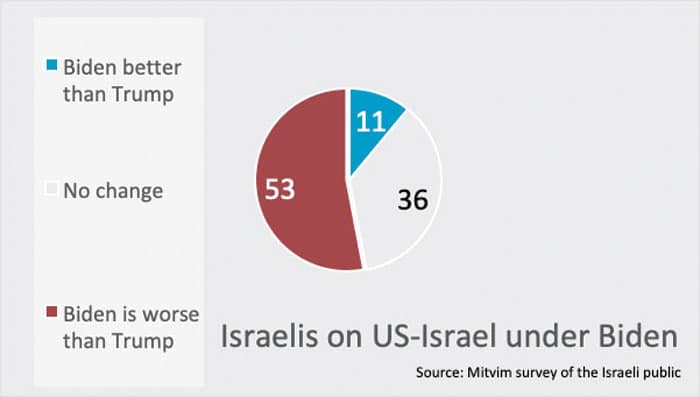
I think the answer is quite obvious and clear. Does this mean that Israel should be believed without doubt? No, it shouldn’t. Does this mean that Israel should have the benefit of the doubt? It certainly does. Hence, the perplexed response of the government and the public amid the U.S.’s distrust and disbelief. Hence the answer to the question of why Israelis prefer the Trump administration (who instinctively believed Israel) over the Biden administration (who instinctively doubts Israel).

Something I wrote in Hebrew

This week I dealt with a seeming budgetary paradox:

If education is so important, how can the Israeli public possibly want to cut it? True, the cut the public proposes in the poll is only a percentage. But the education budget is very large. A percentage point cut is a cut of billions of shekels … The answer to this question is found by cross-referencing the education budget question with another question we asked—about teachers’ salaries. The public wants to cut the education budget, but, and this is important but, to raise the salaries of teachers …. The public looks at the education system and sees an expensive, cumbersome and wasteful system … And on the other hand, the public is looking at teachers, and wants to raise their salaries.

A week’s numbers

This is not a big surprise, and yet, worthy of our attention. Just note: this isn’t about “Trump better than Biden”; it is about “Trump better than Biden for Israel.”

A reader’s response

Elli Hoffman responded to my article about Shimon Peres and sexual harassment:

“Israelis did not like Peres for most of his career. There was always something shifty about him. Still, he did great things for the country, and we should appreciate these things no matter what else he did.”


Shmuel Rosner is senior political editor. For more analysis of Israeli and international politics, visit Rosner’s Domain at jewishjournal.com/rosnersdomain.

Trust and Rights When It Comes to Israel Read More »

32% of Jewish College Students Say They’ve Encountered Antisemitism on Campus in New ADL, Hillel Survey

A new survey published by the Anti-Defamation League (ADL) and Hillel International found that a third of Jewish college students say they have experienced antisemitism on campus.

The October 26 survey, which polled 400,000 students over more than 1,000 college campuses, found that 32% said they encountered some sort of antisemitic experience and 79% of them said it happened more than once; 19% said they were targeted with antisemitic comments online and 13% said they experienced it in person. Only 1% said they were physically attacked due to being Jewish. Thirty-one percent said they witnessed any antisemitic incident, even those that weren’t targeting them personally; in total, 43% said they were targeted with antisemitism or witnessed it happening elsewhere.

Additionally, 15% said they felt the need to conceal their Jewish identity on campus; 12% said they were blamed for the actions of the Israeli government and 10% said they felt unwelcome at a campus organization because of their “actual or perceived support for Israel as a Jew.” But 74% of students who were active in the campus Jewish community said they felt safe being openly Jewish on campus; that number was 65% for those who were not active in the campus Jewish community. Sixty-nine percent said they were concerned about antisemitism from the right on campus and 62% said they were concerned about antisemitism from the left.

One student told the ADL and Hillel that “expressing support for the Jewish community or Israel is immediately met with ostracizing and harassment to the point of not being able to talk about it in class” and another said that there was “leftist rage” toward Jewish students over the actions of the Israeli government, prompting that student to hide their Jewish identity.

Nearly 50% believe there needs to be change in how their campus handles antisemitism, as some believe their university or college are not well-informed on the matter and may not even investigate antisemitic incidents. One student told the ADL and Hillel that their school’s staff “was widely ill-equipped to deal with antisemitism, and many of them even made accidentally offensive comments while working with us. I also learned that antisemitism is not covered in the diversity, equality and inclusion training for employees, which explains a lot but is unacceptable.”

The ADL and Hillel urge universities and colleges to include antisemitism in orientations and trainings on campus and better address antisemitic incidents.

“Jewish students are facing more antisemitism and hate on college campuses than we previously thought,” ADL CEO Jonathan Greenblatt said in a statement. “We need to ensure that every Jewish student feels safe and empowered to express their Jewish values and their whole selves when they are in the classroom, residence halls and throughout campus life.”

Adam Lehman, President and CEO of Hillel International, also said in a statement: “This survey makes clear that antisemitism and hate are of growing concern for Jewish college students and merits the serious attention of university leaders across the country. These findings underscore the importance of our work at Hillel engaging with university administrators to address the campus climate for Jewish students and ensure that all students can live and study in a safe and welcoming environment.”

32% of Jewish College Students Say They’ve Encountered Antisemitism on Campus in New ADL, Hillel Survey Read More »

The Gentle Barn: My Tikkun Olam Bat Mitzvah Project

By Madeleine Maze

Hello friends and family, Mitzvah means “good deed” in Hebrew. It is common to engage “a mitzvah project” when preparing for a Bat Mitzvah, because as a Bat Mitzvah, I will be a member of the larger Jewish community. It is important for Jews to be of service and engage tikkun olam, the Hebrew phrase that refers to the rabbinical teaching that Jews are meant to repair the world through acts of love and kindness.

Many of you know that I love animals. In fact, I love them so much that I often encourage my parents to get just one more dog—because we only have 5 and that’s not nearly enough. As a young child I dreamed of becoming a veterinarian. These days, my vision is more aligned with being a conservation biologist. However, my first days in middle school have me skeptical about my future scientific self. I am considering living by one simple guiding principle:  Follow the path of LESS math. Stay tuned and I’ll keep you posted! But regardless of math, I remain committed to animals. I believe that humans must be their champions. Unfortunately, we humans don’t always respect mother earth and her creatures. Too many animals are abused, underfed, sick, and abandoned. It makes me so angry that animals are needlessly killed, illegally poached, and widely mistreated. Our oceans are sick and filling up with plastic, our forests are burning and otherwise shrinking, and the loss of habitat and species diversity is becoming increasingly critical. We humans cannot exist without nature, we are part of nature, and humans are often confused about this.

This is why I have chosen to help the Gentle Barn Foundation by both raising money and volunteering onsite with the animals for my mitzvah project.  The Gentle Barn is an animal sanctuary with locations here in Santa Clarita, Tennessee and Missouri. The Gentle Barn is dedicated to creating a kinder world by rescuing and healing animals.  The Gentle Barn is also committed to teaching people kindness and compassion to animals, each other and our planet. It provides animals with sanctuary.  It helps kids who are struggling at home and in school.  It offers animal-assisted therapy and rehab programs for children and adults. For many years my family and I have shared time with the animals and people at the Gentle Barn and we have raised money and visited annually with our TIOH community. The Gentle Barn is a special place for animals and progress and learning; but it’s also a special place for me and many of us here today. The Gentle Barn holds a very special place in my heart. Check out this slideshow for a glimpse of our past gatherings at the Gentle Barn.

This is where you all come in! Please help support my project by donating money. Any amount – big or small – is appreciated. In lieu of a gift to me, please send what you can to this organization. Here is a link to make a Postcard Donation and I will be notified so I can thank you personally.  https://www.gentlebarn.org/donate/postcard

You can also support Gentle Barn by visiting them yourself. Spend a wonderful day learning the animals’ stories, hugging the cows, giving the pigs tummy rubs, and cuddling the turkeys. Although Gentle Barn does not currently have any resident camels (and that’s disappointing since there are many camels in my Dvar), you should still go see the Luigi the rooster, Earl the emu, Dreidel and Menorah the pigs, and Holy Cow the cow. You can also get involved by sponsoring an animal, or donating time to their programs. Please do your part to ensure that more animals are treated with respect and dignity, as you recommit every day to healing our world.


The Gentle Barn: My Tikkun Olam Bat Mitzvah Project Read More »