fbpx

September 29, 2021

A Bisl Torah: To Begin Again

It happens in mere seconds. The book of Devarim, the final verses of the Torah are read, we stand in recognition and less than a minute later, the first book of the Torah takes its place. If someone left the room, the transition between ending and beginning would hardly be apparent.

There may be a holiday (Simchat Torah) declared to acknowledge rereading the Torah, but the time in between finishing and starting anew is almost negligible. A reminder that sometimes, beginnings don’t need major deliberation or fanfare. The start of a journey can be as easy as turning a page or reversing the hourglass. It’s our own mental and emotional blocks that often inhibit beginnings to occur. But if we model the reading of Torah, the restarts we want to see in our lifetime can be seamless. One fluid motion, briefly acknowledging an ending without getting stuck, rooted, unable to step forward.

We have permission to redo, jump back in, try another time, begin again. Whether we want to reimagine a relationship, go back to school, try a new profession, take on a hobby, or start a journey, the Jewish calendar focuses on movement. A fleeting pause between Moses’ death and the art of creation. Time is given to live out the next chapter. Verse by verse, we learn, we grow, we live.

Don’t take too long to begin. Again. There is no better time than right now.

Shabbat shalom


Rabbi Nicole Guzik is a rabbi at Sinai Temple. She can be reached at her Facebook page at Rabbi Nicole Guzik. For more writings, visit Rabbi Guzik’s blog section from Sinai Temple’s website.

A Bisl Torah: To Begin Again Read More »

A Moment in Time: How Numerous Are Your Works, Oh God!

Dear all,

We went to the Aquarium of the Pacific over the weekend. Maya and Eli paused to marvel as twin parrots feasted on some juice. I recalled a line from our morning liturgy:
מה רבו מעשיך יי/Mah rabu ma-asecha, Adonai
(How numerous are Your works, oh God!).

Sometimes I need to remember to look at the world through the eyes of a toddler.

What is it like to see an animal having lunch?
What is it like to feel the wind on your face?
What is it like to notice the sun breaking through a cloud?
What is it like to smell bread baking?
What is it like to sing with joy?

We have an opportunity each day to be overjoyed in the simplest touchstones of life. In that moment in time when my twins saw these parrot twins, it was the beauty of creation in full bloom!

(Now – for 1,000,000 rabbi points: how many living beings are a pair of twins?)

With love and shalom,


Rabbi Zach Shapiro

A Moment in Time: How Numerous Are Your Works, Oh God! Read More »

Table for Five: Bereshit

One verse, five voices. Edited by Salvador Litvak, the Accidental Talmudist

And the Lord God said, “It is not good that man is alone; I shall make him a helpmate opposite him.”

-—Gen 2:18


Miriam Yerushalmi
CEO SANE, Author, Reaching New Heights series

“Hashem Elokim, the L-rd G-d,” relates this message. The two names of G-d refer to the male and female aspects of the Creator. The name “Elokim, G-d,” being numerically equivalent to the word “hateva, nature,” refers to the aspect of Divine power controlling the natural world and continually endowing us with life-energy, while “Hashem, L-rd” refers to the aspect of Divinity that transcends nature. Both names are used here to teach that both these aspects are necessary for a whole and wholesome life. 

These Divine energies are “opposite” to each other, yet together they create and sustain our physical and spiritual universe. It is not good for man to be alone without Hashem; human nature should merge with the Divine. Just as the two Divine aspects are merged, so too in marriage: in order to become whole, spouses merge their natures, which were designed deliberately by Hashem to be opposite. Working together, they create their world. 

Glass is transparent; it presents no barrier to our sight. When one side of a glass panel is coated with silver, the glass becomes a reflective mirror. We can no longer see through it, but our field of vision is advantageously increased: now we see ourselves, and we see into areas our eyes could not reach before. What seemed to be a stumbling-block is actually a stepping-stone. When Hashem and His Torah are brought into the marital relationship, the couple merit to help each other reach new heights in this world and the next. 


Rabbi Elchanan Shoff
Beis Knesses of Los Angeles

“My father [the Saintly Rabbi Chaim of Volozhin, student of the Gaon of Vilna and founder of the present day Yeshiva movement devoted to Torah study for its own sake] would always encourage me, if he perceived that I was not appropriately empathizing with the pain of others and constantly repeat to me that ‘Humans were not created just for themselves, but rather to be of benefit to others, in whatever way they possibly can.’” So recorded R. Yitzchak of Volozhin for posterity. 

I recall being told in yeshiva to repeat those words over and over again. The Hebrew words “l’hoil lachrini” mean “to be of benefit to others.” Say it again with me, said my Rabbi, “l’hoil lachrini”. Again! Again! [Feel free to try this at home!] The Torah tells us that Adam was complete, but we are then informed that it’s not good for man to be alone. Loneliness is terrible. Those who tragically lose the will to live on, are often terribly lonely. 

What gives meaning to life is what we contribute. This does not simply mean trite statements of “I support cause A or B.” Bumper stickers and lawn signs are far from what is being demanded of us. We must be integral to the lives of others. There must be people whose lives are measurably improved because we are part of their story. One can only be a good person when they are of benefit to others. Say it with me, “l’hoil lachrini, l’hoil lachrini.”


Erez Safar
Torah/Kabbalah columnist lightofinfinite.com

King David says in Tehillim, “The world was built with chesed (loving-kindness).” Our sages teach that “The light that was created on the first day shone from one end of Creation to the other.” In Kabbalah we learn that this was the light of chesed— “an infinite, uncompounded light that filled all of Creation.” The light of Chesed is at the heart of everything. 

I can’t help but hear John Mayer singing, “just keep me where the light is,” a reminder that we all share this desire to give and receive love and light. The root of the Hebrew word for love, ‘ahava’, is the word ‘hav’, which means ‘to give’. Real love is something you only receive through giving love. 

The Torah says, “It is not good for man to be alone,” because it would be impossible to manifest goodness without a recipient for them. In Talmud Yevamot, Rabbi Ḥanilai says, “Any man who does not have a wife is left without joy, without blessing, without goodness. As it says, ‘And you shall rejoice, you and your household’” (Deuteronomy 14:26). This verse indicates that joy comes from the household, from shared love. 

Ahava has the same gematria (numerical value), 13, as the word Echad (‘one’). As many of us know, 26 is the numerical value of Hashem’s four-letter name, the ultimate Divine Infinite Light. So, if we share our love and our oneness— 13 + 13— then we manifest that Divine Light. 


Rabbi Ilana Grinblat
VP of Community Engagement, Board of Rabbis of Southern California

During college, I spent a semester in Ghana. That Yom Kippur, I observed the holiday in the room where I was staying in a remote village. As I prayed and fasted, I thought about Jews around the world who were praying and fasting. Although I was the only one in the room, I didn’t feel alone. 

“Lo Tov Hiyot Ha’adam Livado…” It is not good for the human to be alone… 

This past year and a half has been a living midrash on this verse. The isolation from extended family and friends – which has been necessary to preserve our lives and our health during this pandemic – has been painful. Paradoxically, on the other hand, for those of us with families at home, the pandemic precluded alone time. Never being alone was also not good — constant demands without a moment of silence to catch our breath. 

Yet, this verse teaches us a deeper truth – the one I glimpsed in Ghana that Yom Kippur years ago. Whether or not we are alone in a room, even when we are lonely, our tradition teaches that we are not actually alone. We are created in holy partnership with one another and with God. We have a sacred bond and a deeper purpose shared by Jews around the globe and by people of integrity worldwide. 

“Lo Tov Hiyot Ha’adam livado… It is not good for the human to be alone…” This verse summarizes the essence of our faith. The rest is commentary.


Dr. Sheila Tuller Keiter
Judaic Studies Faculty, Shalhevet High School

What’s the good word? In the creation narrative, that word is “good.” During creation, God repeatedly evaluates His work, declaring it good. Only in our verse does God reevaluate the culmination of His efforts, the completion of man, as not good. Only the human being is less than perfect and requires revision, the addition of a partner. Yet, it is not clear that this partner produces the sought-after good. 

The introduction of another human being quickly devolves through temptation, miscommunication, and peer pressure into violation of God’s sole prohibition – don’t eat the forbidden fruit. And this sets the tone for the rest of Genesis in which rancorous human relations lead to murder, incest, rape, war, enslavement, jealousy, revenge, estrangement, etc. Maybe God’s initial creation was perfect after all. Perhaps it was better for man to be alone. 

God did not err when He created man. Rather, the imperfection was deliberate. Man is a social animal. Humans need each other, not just for survival, but for their emotional and spiritual well-being. While human interaction is perilous, it is essential to our happiness and growth. Eighteen months after a pandemic imposed unprecedented isolation upon us, synagogues and schools are open again. Setting aside those with real vulnerability, many others have become accustomed to their seclusion, not out of fear, but out of inertia. The cost to the self and to community is invisible but devastating. It is not good for man to be alone. Take reasonable precautions, but go back to shul. 

Table for Five: Bereshit Read More »

Rabbis of LA | Rabbi Jason Weiner: The Calm, Unanxious Presence

When Jason Weiner began serving as a chaplain at Cedars-Sinai Medical Center nearly fifteen years ago, he was completely unprepared for what he would encounter. 

Still in his 20s, Weiner had not trained for this kind of work, nor was he convinced he wanted to do it. His first patient visit stunned him with its gravity: A high school teacher had been hospitalized due to stress and shock. As Weiner sat with him, the teacher confessed that earlier that week, he had belittled a student, telling her that if she spent as much time studying as she did applying makeup, she might amount to something one day. The student committed suicide. The teacher was bereft.

“He was crying and I had no idea what to say,” Weiner, 42, recalled. “I felt horrible for him and that young woman. Then, my next patient asked, ‘Rabbi, should we pull the plug? What does Jewish law say?’ I was like, wow, this is intense. I’m a little bit out of my league here.’”

At the time, Weiner was happy in his role as a congregational rabbi at Young Israel of Century City. But when Cedars’ then-chaplain, Rabbi Levi Meier fell ill, Weiner could not refuse a colleague’s request for help.

“I found it very difficult at first,” he said of stepping into one of the most delicate and demanding ecclesiastical roles. “People were dealing with really severe crises, asking me questions about life and death. If I gave the wrong answer, it could impact someone’s life in a very significant way. I was really intimidated by that and it was really hard.”

But he didn’t turn away. Instead, Weiner spent the next several years training and immersing himself in the role. His willingness to inhabit a path he did not plan for is proof that a calling is not always a choice. And it’s an apt metaphor for a rabbinate that has since been defined by endless encounters with fate; by illness, accidents and death, illustrating that there are experiences in life for which preparation is secondary to presence.

“It’s about showing people that you sincerely care, that you’re with them and that you’re listening.”

“It took me a while to realize it’s not so much about what you say or what advice you give,” Weiner said. “It’s about being a truly compassionate, un-anxious presence. It’s about showing people that you sincerely care, that you’re with them and that you’re listening. Because the goal is to help people find their own strength and their own way of coping.”

After his predecessor, Rabbi Meier, died, Cedars did a search for a new Jewish chaplain. But by then, Weiner had become indispensable and they hired him.   

“At that point I had fallen in love,” Weiner said. “I found it to be very sincere and meaningful work. Every day you’re on the front lines of life and death, so things matter in the hospital in ways that are sometimes more profound and feel more important than in other areas of life.” 

He was also temperamentally suited to the position. “I’m an introvert,” he said, “better at listening than talking.” 

Unlike the pulpit, where preaching is the central power of the platform, Weiner’s work depends more on routine and even mundane actions. 

Over the last year and a half, as the Covid-19 pandemic catapulted Cedars into crisis mode, families were prohibited from visiting their loved ones at bedside. Weiner got used to holding up smartphones so families could FaceTime. Or delivering homemade meals to patients who were picky eaters. One woman, he told me, slept outside in her car for more than a month while her husband fought Covid from a hospital bed. Weiner moved the husband closer to the window so he could wave to his wife waiting below.

In extraordinary circumstances, simple things can rise to the level of the miraculous.

Early in the pandemic, when even nurses and doctors avoided entering patients’ rooms, Weiner ensured that observant Jews were properly prepared for burial. During his first Jewish Covid death, he stood in the hallway, on the phone with the family, reciting Hebrew prayers while a non-Jewish nurse risked her health to close the patient’s eyes and mouth and position the body according to Jewish law. 

“I was for sure putting myself at severe risk,” he said. “But I had this attitude of, ‘I have to do this. People are counting on me. Sometimes it was a burden, but it also felt like a privilege.”

With five kids and a wife at home, Weiner was vigilant about taking every precaution against Covid. Every day, he wore layers of personal protective equipment (PPE) and took loads of vitamins. For months on end, he would go home, shower and change his clothes before greeting anyone in his family. But he was less well defended against the emotional and psychological toll of the tragedies he witnessed and the energy he expended.

“I don’t cope well,” he confessed. “When I first started, I remember sitting at a restaurant on Pico and an ambulance went by. And I had this vision in my head of the scene at the emergency room, and all the sudden I got very nervous and anxious. All the stuff I see, it’s in me. I absorb it.” 

Weiner said he’s getting better at the self care aspect, and now runs as often as possible to relieve his stress. Before Covid, he would listen to podcasts and lectures during his free time. But now, he prefers to listen to music.

The hardest part of the job, he said, is confronting his own powerlessness. How do you pray for healing when healing isn’t possible?

Weiner recalled one time he became close to a young patient who was terminally ill and later died. When Weiner showed up at the shiva, her father raged at him in grief: “Your prayers didn’t work!” he shouted. Mi Shebeirach, the Jewish prayer for healing, seemed like false hope.

“I felt like I really failed,” Weiner said. 

It made him rethink his approach to prayer. 

“Now I help people look at prayer in terms of building a relationship with God,” he said, “or as a coping mechanism, a metaphysical support system. Prayer can be about hope but not expectation. 

“Prayers aren’t about being answered, they’re about being heard.”

Fast Takes with Rabbi Jason Weiner

Danielle Berrin: What’s currently on your night table?

Jason Weiner: The Choice by Edith Eger

DB: Last show you binge-watched?

JW: On YouTube, the Israeli show Od Nifgash “We will meet again.”

DB: Your day off looks like…

JW: Running at the beach.

DB: Favorite thing to do in Israel?

JW: Just being in Jerusalem. Anywhere in Jerusalem makes me happy.

DB: Something about you most people don’t know?

JW: I was in a punk rock band in high school and college.

DB: Most essential Torah verse?

JW: Every human is created betzelem elohim, in the divine image

DB: Biggest challenge facing the Jewish world?

JW: Apathy

DB: Guilty pleasure?

JW: Dark chocolate

DB: Favorite Jewish food?

JW: Latkes

DB: If you weren’t a rabbi you’d be…

JW: A city planner.

Rabbis of LA | Rabbi Jason Weiner: The Calm, Unanxious Presence Read More »

A Hundred Days of Getting Used to Bennett

The coalition that was formed to replace Benjamin Netanyahu in power—and, make no mistake, this was the main goal of its establishment and the main motivation that made it possible—has been in power for about a hundred days. And I must confess that I became aware of this insignificant number only when Yoav Krakovski, a leading political analyst, invited me (and a few more figures) to a TV interview to honor this date. 

One hundred is a symbolic, round number. A hundred days in power is also a common cliché, as if something must happen by this date, or cannot happen when the date passes, as if a hundred days hold the key to a term, as if—and that’s the most ridiculous notion—there is still a customary hundred days of grace. 

There is not. 

Certainly, no grace. And nothing that must happen to a new government in its first hundred days except survival. Supported by the most unlikely and most narrow coalition of 61 Members of Knesset—the minimum number that is still a majority—the government indeed survives. 

Less than three years ago Naftali Bennett was getting ready to retire his political career. The year was 2019. The round of election was still not called “the first”; it was just an election, and Israel did not yet realize that another election, and another one, and another one, was quickly coming. And Bennett was the big loser. Just weeks prior to Election Day, Bennett, the leader of a mid-size religious party, decided to jump ship and launch an independent startup. As a former high tech entrepreneur and a young, bold, some would say rash politician, this was not out of character. Bennett got tired of the old party, and desired a shinier vehicle from which to begin his rise to the top. 

So, he made a gamble, and crushed. He was 1454 votes short—a tiny number—and his party did not cross the electoral threshold. Many Israelis assumed he was done. His main political ally, Ayelet Shaked, was slated to begin a stint as a TV commentator. Bennett himself was mulling another round in the high tech sector. But then, something strange happened. Bennett’s loss became Netanyahu’s. Because of the missing votes, that tiny fraction, Netanyahu could not form a coalition. Another round of election was called, and then another one. And once the most unlikely loser, Bennett suddenly became the most unlikely winner.   

In this process, from nearly having to quit politics to becoming Israel’s Prime Minister Bennett, amazingly, collected very few additional votes—from just short of four seats in the Knesset in 2019, to just above six in 2021. Two seats made the difference. Two seats, and four rounds of election, and a multiplicity of parties who no longer accepted Netanyahu as a viable candidate to be the PM. 

The rest of the story is well-known. Like the basketball shot on the buzzer, it is a reminder that no game is over until it’s really over, and that dramatic turnarounds occur more than we tend to think, especially in sports and politics. Using the wild card of heading the only party that could sit in both camps, Bennett was able to demand and get the top job. To become the PM, he shattered more than one precedent, and has reneged on more than one pre-election promise. Many Israelis who belong to the camp that lost power can neither forgive nor accept him as a legitimate leader of the country. For them, the first hundred days were days of first hope—“this cannot go on for very long”—then a sober realization—“this seems a little more stable than we expected.” 

Other Israelis, who support the government, can’t wipe the smile off their faces. Prime Minister Bennett, Prime Minister Bennett, Prime Minister Bennett. It is still not quite natural to say “prime minister” without a “Benjamin” to follow. And yet, there it is. 

Earlier this week, Bennett made his second trip in a short time to the United States. His first was to the White House, on miserable timing. As the U.S. was evacuating Afghanistan in haste, and dramatic reports projected chaos, the Israeli PM shows up at the door. President Joe Biden’s mind was elsewhere. The nation’s mind was elsewhere. The novelty of the visit—here’s an Israeli PM you’ve never heard of—was mugged by other realities. 

The goal of Bennett’s second visit was to deliver a speech at the UN General Assembly. That is, to conquer the stage on which his predecessor used to shine. Bennett has excellent English, a youthful, energetic appearance, and a reasonable delivery. But he is no Netanyahu. Neither as a public speaker nor when it comes to the gravitas that a leader could only accumulates with experience and time. 

That said, in his UN speech on Monday, just minutes before the holiday in Israel, Bennett scored an important political point: he proved that there’s an Israeli other than Netanyahu who can speak a decent English and deliver a respectable speech on the world stage. His message to the international community was twofold: first, Iran is very much on my mind; and second, I am not even going to pretend that the Palestinian issue is a priority for me. The issue of Iran is urgent, and Bennett was not far from threatening that Israel is about to act. By being so forthright, he was in synch with the U.S. The Biden administration needs a credible threat with which to draw Iran back to the negotiating table. Bennett, without criticizing the JCPOA, was trying to hand the U.S. such a tool.

Bennett is a fresh face, he is a promise of a different future, he is a possible remedy for some of the ills that inflicted Israel in the last couple of years. But the truth is that 100 days is a very short time. It is still too early to say for how long it will feel fresh, and whether the promise can be realized. But there are some things we can already say about his government.

First, it is a government like no other before it. A government without a real head, and without a real boss. Each and every leader of each and every party is king in his own field.

First, it is a government like no other before it. A government without a real head, and without a real boss. Each and every leader of each and every party is king in his own field. Benny Gantz is king of Defence, Yair Lapid king of Foreign Affairs, Avigdor Lieberman king of Finance. From time to time, there is tension between the leaders, especially when there is an overlap in areas of responsibility. But they all know that they either get along, or go home. One Member of Knesset could put an end to the coalition. 

That’s why this is also a government that is run with great caution. Every political mistake could be a fatal mistake. Every insult could be detrimental to the government’s longevity. So the ministers are relatively polite, and collegial. They try to stay away from provocation. This is an atmosphere to which Israelis are not used, as the later years under the Netanyahu governments were years of constant rift and provocation. 

Since there’s no true feasibility of provocation and infighting, the Bennett-Lapid government must be business-like. Within the obvious constraints of politics and the occasional mishap, the government is busier with work and less busy with political maneuver. That’s not because of a personal tendency of all of its components to matter-of-factness, but because everything that is not matter-of-fact undermines the stability of a fragile construct.

Finally, it is a government whose main glue is the long shadow on the cunning opponent. In fact, while there is affection between members of the coalition—and a constant stream of heartwarming scenes of leaders whose views aren’t compatible having a civil, friendly, even amused, dialogue—there should be no illusion: if Bibi’s gone, there will remain very little glue that could hold this coalition of rivals together. 

What has the government done in a hundred days? Its main practical achievement is the budget. The first vote was tense, but the package moved to the next stage—the one of deliberation. Surely, changes will be made, and frustrations will be many. But Finance Minister Lieberman, with his own power to preserve or topple the coalition, and with his eye on the ball, is likely to accomplish his goal using the tactics that Prime Minister Levy Eshkol, a long time ago, described as follows: “I compromise and I compromise—until I get what I want”.

Funny that passing a budget is perceived as such an achievement. Having a budget is supposed to be a trivial act, the basic governmental duty. But after a few years of not having a budget, because of political instability and chaos, suddenly even the routine seems unusual. True—there is an attempt to pass some real reforms in this budget, some of which are only possible because the ultra-Orthodox parties are no longer members of the coalition. But two reservations need to be attached to these reforms. First, they have not yet passed the Knesset committees and the second and third readings. Second, they are impressive compared to the inaction of recent years, but a considerable number of them are almost banal. I mean, maybe the retirement age for women will finally really go up. This is an important move. Even revolutionary. But how much can one applaud for something so obvious, so late to come?

The government managed to get us used to life without Netanyahu on Balfour Street, where the PM lives.

What else has the government done in a hundred days? Alongside the practical achievement there is also a psychological achievement. The government managed to get us used to life without Netanyahu on Balfour Street, where the PM lives. It has managed, to a lesser degree, but not entirely through its own fault, to dim the chorus of incessant political shrieks that has deafened us in the past few years. It brought some quiet. Not enough, but some. The “only Netanyahu” chorus is almost silent. The “no Netanyahu” chorus lost its zeal and reason. From time to time, some spasms of broken cries still terrify the Knesset. Like a curiosity from distant days. In fact, this may be a most important achievement of the coalition. Because the political and social price that Israel has paid for the uproar of recent years has, in the aggregate, been much higher than the price of the delay in passing the budget.

There are also areas in which the new government is hardly impressive. It is no more successful in the battle against the Corona than its predecessor. As in the case of the previous one, its only salvation is the vaccines. There is no strict governance, no ability to enforce rules and no sense of efficient maintenance of law and order. Israel still seem to lack the ability to make and implement decisions that require complex execution. Any parent who sends children to school, and must grapple with the daily tweaks of policies, can give a variety of examples of the government’s lack of coherence.

It is also important to note that the government has not yet stood a real security test. The situation on the Gaza border is tense, but still not out of control. The situation on the Lebanon border hasn’t changed much since Israel moved from Bibi to Bennett. A short-lived eruption of violence in the West Bank, following the escape of Palestinian prisoners from the Israeli jail, did not turn into a wave (and the escapees were quickly captured). 

This is important because every government’s real test is a crisis. This is especially important because this specific government is designed in a way that could turn a security crisis into a political test that it could not pass. But even that isn’t as clear as the opposition might hope. True, the coalition relies on an Arab party, Raam, with all the obvious complications that such alliance entails when Israel has to fight against Palestinian militias. Just a few days ago, MK Walid Taha of the Raam party told an interviewer that an operation in Gaza will not necessarily undermine the stability of the current coalition and isn’t going to lead to a resignation of party leaders from the government. Hamas leaders in Gaza could not believe their ears. “This is a position that does not reflect the opinion of the Palestinian people living in the occupied state,” a Hamas spokesman said in a statement. 

After a hundred days, is the new government a success?   Obviously it’s too early to have a clear verdict, but one thing is clear. At this point, a government that includes the supporters of the Judea annexation from New Hope, alongside the two-staters of Meretz, is no longer a passing curiosity; a government that includes the neoliberal members of Yamina alongside the semi-socialist members of Labor no longer seems an impossibility; a government in which power is shared with an Islamist Arab party is no longer a crazy idea. In other words, a hundred days is long enough for us, Israelis, to get used to something that not very long ago would have been considered a looney proposition—such as a Prime Minister from a party with six Knesset seats.  

The Bennett government is hardly consensual, and is certainly unique, unusual, even bizarre. And yet, it looks like something resembling a government. In recent weeks, as we were testing what the public thinks about the stability of the government, we discovered that there is only a small percentage of Israelis who assume that the government will fall before the end of 2021. This is mostly the wishful thinking of right-wing voters, who still can’t quite fathom how political calamity inflicted a camp—the rightwing—who has the ideological advantage on almost every issue. Still, half of the respondents to our survey believe that the government will survive at least until the end of 2022. About a quarter believe that it is likely to survive beyond 2023. Not bad for a man on the verge of quitting politics. Not bad for a country on the verge of having a fifth consecutive election.


Shmuel Rosner is senior political editor. For more analysis of Israeli and international politics, visit Rosner’s Domain at jewishjournal.com/rosnersdomain.

A Hundred Days of Getting Used to Bennett Read More »

My First Challah

Good news from Austin! My two grandchildren are back in school—masked and socially-distanced but very happy to have their lives back. Unlike some finicky adults, these first- and fourth graders don’t give a whit about wearing masks all day. If that’s what it takes to be with friends again and get a break from parental oversight, it’s worth it. In early September, their calendar is already jam-packed with after-school activities, sleepovers, and birthday parties—just like the old days. Suddenly, baking with grandma over Zoom, an activity we did through the pandemic, is so old school.

Honestly, I would do almost anything to touch my grandkids first thing in the morning and tuck them in at night for three days. It has been a very long five months.

Not one to give up, I concocted a plan to re-introduce baking together with an in-person session. After seducing the parents with a three-day all-inclusive babysitting package including enriching museum visits, a glorious day at the beach, and organic made-from-scratch meals, they broke down and booked tickets to Los Angeles for Labor Day. Our exchange was simple. They got a romantic getaway in Laguna; I got three days in paradise with my favorite people, Piper and Finn. I swore that compulsive handwashing plus daily bathing and shampooing would not be a bother. Honestly, I would do almost anything to touch my grandkids first thing in the morning and tuck them in at night for three days. It has been a very long five months.

Selecting the right baking project was easy. With Rosh Hashanah starting Monday night, a homemade challah was a an obvious choice. Since I had managed to avoid bread baking during my 30 years of child-rearing and working full time, we were all newbies. Though I was a bit anxious and had no time for recipe-testing, Piper’s proficiency with dough handling gave me the confidence I needed to make the traditional egg bread. I chose a basic recipe, minus all the wacky add-ins like apple sauce, turmeric, chocolate chips and even garlic. Who wants garlicky challah when comfort is the top priority?

When I told Piper over the phone that we would be making challah, I was pleased that she knew what I was talking about since her family doesn’t observe the traditions. Theirs is a mixed family. “There’s a Jewish girl at my school who makes challah every week with her mom,” Piper said. “It’s delicious!” She wanted to make challah, but she assured me that she would not be having a Bat Mitzvah. “We are normal people,” she smartly explained. 

Even as someone who is fully Jewish, my memories of the High Holidays are mixed. As a girl in the Bronx, the whole world would stop during this time. It was like a national holiday. Everyone put on their best new clothes and whether your family had the money for seats in synagogue or not, you promenaded on the Grand Concourse to show the world that you were ready for whatever the year might bring. Twenty years later, as a newcomer to Los Angeles, with a little boy to raise and without any family nearby, we joined a reform Temple. We hoped to connect with strangers in order to educate our son in being a Jew. But he, like his parents, never felt comfortable with all the rituals and high theatrics. Not to mention the signals of status that telegraphed to us that we surely did not belong. After his Bar Mitzvah, we stopped going.

On the Jewish holidays we started gathering with our neighborhood friends and celebrating in an easy way, in the comfort of our homes surrounded by the warmth of those we knew well and loved.

Then, in our forties a miracle happened. On the Jewish holidays we started gathering with our neighborhood friends and celebrating in an easy way, in the comfort of our homes surrounded by the warmth of those we knew well and loved. Not everyone could recite the Hebrew prayers, and some people did not get dressed up, but our kids and the holiday rituals held us together year after year. Now, though the children are mostly gone, we continue to gather on the holidays, to raise a glass or two. 

When I became a grandparent, I found myself thinking more about my own childhood, and what I absorbed from my grandparents. To me, a little girl in 1950s Bronx, they seemed to be from another planet. They wore funny clothes, listened to Yiddish radio, and ate weird foods. Remember stuffed derma? Now I realize they were clinging to their own beloved traditions to preserve the dissolving European past. 

As a contemporary grandmother, I’m surprised at how often I weave bits about my birth family’s Jewishness into the stories that I tell the children. I like to sneak in a Yiddish expression, throw them an exaggerated facial expression, sneak them a handmade butter cookie—subtle signs of being Jewish and being loved. Making a challah together was sharing with Piper a taste of my own past.
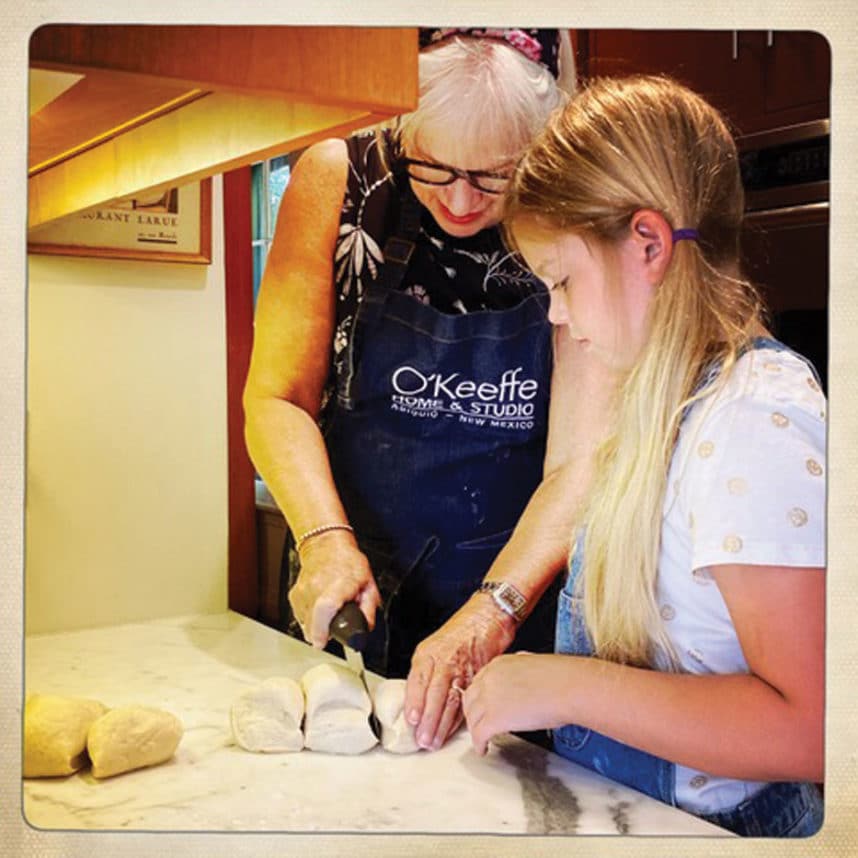
Watching her confidently twist the strands to make that sunny loaf reminded me of how much she has grown. When we started baking, about a year ago, the girl had no technique. Just a lot of enthusiasm and attention to detail. Now she has not an ounce of anxiety where making a dough is concerned. And when it comes to kneading and punching down the dough, she has far exceeded her grandma. She has the touch. And way more strength in the wrists.

My hope with all this baking is to weave together strands of my own past so that Piper and Finn will know more about where they came from later. When life gets more complicated.


Los Angeles food writer Helene Siegel is the author of 40 cookbooks, including the “Totally Cookbook” series and “Pure Chocolate.” She runs the Pastry Session blog. During COVID-19, she shared Sunday morning baking lessons over Zoom with her granddaughter, eight-year-old Piper of Austin, Texas.

My First Challah Read More »

Fire, Flood and Future Democratic Foundations

Experts suggest that sustained hot and dry weather makes climate skeptics more willing to accept the reality of our climate catastrophe.

As this burning Western summer twists into a fall fire season with no end in sight, with California’s record-breaking fires still largely uncontained, one can only hope they’re right. After all, the entire earth had its hottest July on record this year. California and other western states had their hottest summer, and the contiguous United States edged out the catastrophic Dust Bowl year of 1936.

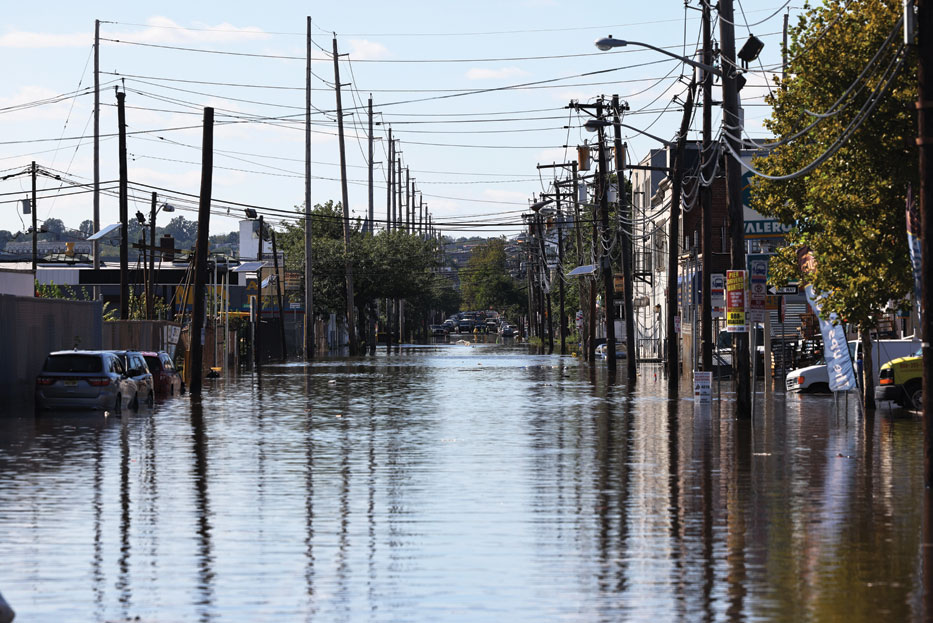
As demonstrated by the deadly inundation of New York, Philadelphia, and other parts of the Northeast this September, though, our unfolding climate disaster takes many forms: no less flood and plague than fire and famine. When Hurricane Ida hit New Orleans, a power station built expressly to withstand hurricanes was knocked out; the city sat dark for two days, and in a horrible irony, hundreds of thousands still have no drinkable water two weeks later. In South Florida, sea-level rise already threatens neighborhoods as far as 20 miles inland.

Clearly, flood is no less a threat than fire. So, why are we so reticent about drawing big conclusions from inundation, and might that be changing? In the wake of Ida’s devastation, the Biden administration has begun to propose genuinely bold energy initiatives (while continuing to approve new fossil fuel projects, an enormous source of carbon emissions; meanwhile, the stated goal of “net zero by 2050” remains desperately inadequate).

What political meaning should we make of this stage in our general catastrophe? How we can learn from present disasters to prepare for still-harder futures? What should we be doing to focus fear, anger, or anxiety in useful ways?

We have terrifying stories of flood foreseen to guide us. We have the story of the flood. And yet, too much water may make us expect we’ll have more chances to get it right. After all, in Bereishit Noah’s foreknowledge of the storm came bundled with a covenant of life on earth.

Contemporary novelist Kim Stanley Robinson’s “New York 2140” offers a compelling, but perhaps misleading, iteration of flooding’s simultaneous threat and political hope.

Robinson’s New York is a salty swamp, his Central Park a hellish refugee camp. Tentacular fluvial reclamations threaten the city daily. In that space, the novel pursues democratic hope. Total subjection to creeping devastation forms the basis for a new sort of ark, for radical transformations of finance, property, and citizenship. Residents of this fictional New York unite to do everything the IPCC now urges with increasing desperation in our real lives. And indeed, Robinson’s literary hope finds echoes today in the New York Times’ declaration that “Climate Disaster Is the New Normal” and in its accompanying question: “Can We Save Ourselves?”

Robinson’s latest novel, “The Ministry for the Future,” is at once his most hopeful regarding climate change and his most democratically despairing. In one episode, an atmospheric river devastates Los Angeles, overwhelms all authorities. Angelenos rescue each other in flotillas of kayaks, but democratic forms of life and government fall by the wayside. All told, things go better than could be feared. People survive, pointed like Noah toward a future at once uncertain and filled with possibility. In one version of that story, Robinson concludes:

The entire city of Los Angeles is going to have to be replaced. Which was great. Maybe we could do it right this time.”

There can be strange hope in a flood. Water is in a very immediate sense life. We are each mostly water, after all.

There can be strange hope in a flood. Water is in a very immediate sense life. We are each mostly water, after all. And the collective character of inundation, its universal presence in the alluvial plains most heavily settled by humans, underscores the sharedness of our attachments to place. We are all in this together. We can rebuild. We can get it right this time.

Maybe.

It’s nice to think that we pull together in crises. Certainly, we sometimes do. That’s the vision Robinson presents—a city of kayakers conducting floating rescue missions both anarchic and socially coordinated.

Our oldest story about flood, though, offers less promise. Pragmatically, Parashat Noach delivers an injunction to prepare for new foundings and a caution that we will struggle to rebuild amidst devastation.

The story of the flood is often treated as a story about the need for stringent observance. Sometimes, as in the powerful commentaries of Rav Shmuly Yanklowitz, it appears as a vision of human responsibility to and for other species, and a reminder of what we owe to other humans.

We can also learn from Noah how to prepare for catastrophe with an eye to refounding from almost nothing.

How we live together in a hotter, darker future is going to have an awful lot to do with how we manage to live together today, as that future looms.

This means we cannot look to somehow discover new democratic capacities in spaces of disaster. No more so than Noah could discover Adamic innocence after the flood! How we live together in a hotter, darker future is going to have an awful lot to do with how we manage to live together today, as that future looms. If we want democratic possibilities in the future, we have to carry what social ecologist Murray Bookchin called “democratic lifeways,” egalitarian approaches to decision-making with limited resources, into and across catastrophes.

While it’s long been clear that we would fail to forestall a great deal of climate suffering, and while the current round of suffering somehow leaves many hearts and minds unmoved, we still have options for practicing democratic habits.

Whether swept by fire or by flood tomorrow, today’s democratic practices—like Noah’s birds of the sky reseeding the earth—will offer raw materials for making future worlds together, for repairing a world in still-darker times. Our charge is to prepare for hard futures in part by discovering, while we yet have the resources to do so, how to be democratic together.

Our leaders, and we, are not yet able to get serious about limiting climate change. But the social forms we practice most intensely today will be, so long as our species persists, tomorrow’s foundations of political possibility.

To carry forward democratic foundations, we have to account for both fire/drought and flood as shared futures.

Unlike water, fire feels alien. It towers, licks at the sky, blossoms in toxic smoke that chokes out life. It looms as sheer death, Sodom and Gomorrah razed to nothing. Water is different, though. Even too much water, terrifying and sublime, carries that ambivalent promise of future blooms, of life in the deserts.

More than anything else, this summer’s floods (among which the U.S.’s share barely registers) should induce in us frantic activity on behalf of collective survival—transformative social change at all levels. But, if they will not, and if seemingly endless walls and whorls of fire will not, they should at the very least galvanize each of us to urgent creative action.

We must strive now to discover and live on behalf of future democratic foundations, how and wherever we may find ourselves.


Ira Allen is Associate Professor of Rhetoric at Northern Arizona University and author of The Ethical Fantasy of Rhetorical Theory. His current work focuses on witnessing and constitution writing in the face of climate change.

Fire, Flood and Future Democratic Foundations Read More »

More Than 180 Local Rabbis Support Genetic Screening Initiative

When it comes to Jewish genetic diseases, some people would rather not know their carrier status because knowing can be overwhelming. But the truth is, the sooner you know your status, the more options you will have in terms of family planning. That’s why more than 180 local rabbis have supported the mission of Gene Test Now — to raise awareness about Jewish genetic diseases and to educate the Jewish community about the importance of genetic carrier screening.

Carrier screening looks at specific genes that are known to be associated with specific disease. They test to see if you are a carrier for a genetic condition that can be passed down to future generations. Generally, the diseases tested for are recessive conditions, meaning a carrier of the disease does not show any symptoms. But just because you are a carrier for a disease does not mean you will pass it on. In fact, most individuals are carriers for one or more genetic conditions, but if you and your partner are not carriers of the same conditions then there is no risk for your children. If both you and your partner are carriers for the same genetic disorder, there is a 1 in 4 (25%) with each pregnancy that the child could be affected with the disease. And thanks to medical advances, there are many options available to help these couples have a healthy child.

So many rabbis are vocal in their support for carrier screening because of its importance for the health of future generations. Rabbi Elliott Dorff of American Jewish University, in a Zoom webinar earlier this year on genetic screening conducted by the Jewish Journal and Gene Test Now, noted: “In the Jewish tradition, my body belongs to God… We have a fiduciary duty to God to take care of our bodies and that means preventive care as well as curative care. And in the case of genetic testing, this is one way to try and make sure that the children that we have are healthy and not burdened with a genetic disease.”

Gene Test Now provides helpful informational articles and videos on its website. While the non-profit organization does not perform testing, it has partnered with JScreen, headquartered at Emory University’s Department of Human Genetics, which offers at-home screening via saliva. Jewish Journal readers can receive $36 off a screening kit from JScreen by visiting genetestnow.com/getting-tested and using promo code JJLA36.

Rabbi Dorff sums up the need for genetic screening this way: “You have a duty to the future generations to do what you can to prevent illness. And genetic testing is a critical way of doing that.”

GeneTestNow.com is a nonprofit initiative of the Doris Factor Endowment Fund of the Jewish Community Foundation of Los Angeles.


More Than 180 Local Rabbis Support Genetic Screening Initiative Read More »

Israel and America: Vive La Différence

It’s a strange experience to walk around a town and notice that virtually everyone is Jewish. It’s as if all of Los Angeles was Pico-Robertson.

That’s the vibe I’ve been feeling this past week as I’ve been hanging out in the holy city of Tsfat in the north of Israel. There are Jews everywhere.

I mention this only because when we talk about Israeli and American Jewry—and worry about the growing rift between the two communities—we seem to overlook some obvious differences, such as: The great majority of Jews in Israel are surrounded by other Jews. They are immersed in Jewishness and Israeliness. In the areas where most Jews live, they represent well over 80 or 90 percent of the population. When there’s a Jewish holiday, everyone feels it. It’s in the air.  

There’s another, more quirky difference: the definition of a “safe space.” In America today, that ubiquitous term is usually reserved for college students triggered by any number of microaggressions, from an offensive passage in a Mark Twain novel to seeing someone culturally appropriate a certain ethnic custom.

In Israel, a safe space typically means a thick, concrete bomb shelter.

Jewish observance in Israel also feels more fluid. There are plenty of Israelis who won’t attend synagogue on Shabbat but will never miss Shabbat dinner. “Traditional” Jews may go to shul on Shabbat but then drive to the beach in the afternoon. It’s not uncommon for secular Israelis to study the Bible or even the Talmud.

Do any of these differences really matter? Only in the sense that the better we understand our differences, the better equipped we’ll be to deal with the rifts.

We have a tendency to see things through a personal lens, projecting our own values on others. For example, it’s impossible to imagine a Chief Rabbinate in America with authority over religious and civic matters. Let’s face it, the fact that Chief Rabbis in Israel have so much power drives many of us nuts. But it’s a reality Israeli Jews have to face that we don’t.

Another obvious difference is in the area of security. If I asked 100 Jews in Israel if they’ve ever had to run into a bomb shelter, there’s a good chance all of them would say yes. If I asked 100 Jews in America? Probably zero.

Israel may share a lot of values with the West, but unlike the myth, it is hardly the 51st state of the United States. For better or worse, Israel belongs in an ancient, tribal and terror-infected Muslim-Arab region.

We live in completely different lands, faced with completely different challenges. The evaporation of Jewish identity that has plagued American Jewry is not a problem in Israel, but the fear of being attacked by rockets is not a problem in America.

The key point is this: American and Israeli Jews live in completely different lands, faced with completely different challenges. The evaporation of Jewish identity that has plagued American Jewry in recent decades is not a problem in Israel, but the fear of being attacked by rockets is not a problem in America.

Take the issue of democracy. Israel shares many of the ideals of a classic democracy—such as freedom of speech, freedom of religion, representative government, and so on—but it is also the world’s only Jewish state. That duality makes democracy in Israel uniquely complex and delicate. We don’t face that same problem in America, although we have plenty of our own.  

Of course, it’s perfectly OK to share genuine beefs. I can’t wait, for example, for the Israeli government to follow through on its commitment to build a new egalitarian section at the Western Wall. That may not be a big deal for most Israelis, but it matters to many American Jews.

It’s common for Diaspora Jewry to argue that since Israel is the state of all the Jewish people, all Jews should have a say in its affairs. That’s true, but only up to a point.

It’s one thing to engage in civil dialogue while expressing our disagreements; it’s quite another to lash out and lecture one another while ignoring our radically different predicaments. 

A lot of American Jews, for instance, are exhausted with the Palestinian conflict and have complained loudly for years about Israel’s failure to make peace. Israelis also want peace, but many of them worry that if they leave the West Bank, it would turn into another Gaza with rockets falling on Ben Gurion Airport. Who are we to tell them from the comfort of our American homes not to worry about that?

Here’s my wish: we go easy on one another. We recognize our different realities and adjust our expectations accordingly. We engage and exchange but put a priority on addressing our own problems. We connect around the bonds of Jewish peoplehood that bind us together.

Here’s my wish: we go easy on one another. We recognize our different realities and adjust our expectations accordingly. We engage and exchange but put a priority on addressing our own problems. We connect around the bonds of Jewish peoplehood that bind us together.

And when we feel the urge to share our beefs, we do it respectfully and lovingly, as if we were family members or longtime neighbors living in the same Jewish town.

Israel and America: Vive La Différence Read More »