fbpx

August 9, 2021

Film Probes Hitler’s Impact Today

When Adolf Hitler became dictator of Germany, his propagandists circulated the story that he had been born in a manger, an obvious allusion to Jesus Christ, coming back to save the world.

To this day, otherwise rational people will insist that the Fuhrer, born 122 years ago, is still alive, with the same certainty as adherents of the Elvis Presley Lives cult believe in the immortality of their idol. Others are unshaken in their belief that the Jan. 6 attack on the Capitol building in Washington was actually a friendly tourist visit.

Similar delusions going back to the Nazi era continue to influence us today, according to the documentary film “The Meaning of Hitler,” opening August 13 in American theaters. The film is based on the book of the same title by Sebastian Haffner.

The Journal interviewed the film’s co-directors, Petra Epperlein and Michael Tucker, who assembled a battery of top scholars to cull their thoughts on the lasting impact of the Fuhrer’s reign on succeeding generations.

Epperlein was born in East Germany, and Tucker was born in Hawaii. They are married to each other and neither is Jewish (although Tucker said that their daughter studied at the Hebrew University in Jerusalem and lives in Israel.)

The resultant film caps a four-year inquiry in nine countries into decades of cultural fascination with the Nazi leader and the ramifications of such a fascination on present politics.

Among the American and Israeli mega-thinkers they assembled were Martin Amis, Yehuda Bauer, Saul Friedlander, David Irving, Serge Klarsfeld and Deborah Lipstadt.

Although none of the experts would go so far as to make a direct comparison between ex-President Trump and the German dictator, it was pointed out that there are some similarities in their techniques to rally and maintain their grips on ardent followers.

Both leaders infused a sense of victimhood into their followers, and by playing on their real and perceived grievances established a strong sense of solidarity with them.

“This is a difficult time around the world … and where does the hate come from?” Tucker asked rhetorically.

The Journal raised the somewhat heretical question of whether history actually repeats itself and whether we can mold a better future by learning from the mistakes of preceding generations.

To the endlessly repeated warning that “those who do not learn from history are condemned to repeat it,” the German philosopher Georg Wilhelm Friedrich Hegel countered that “the only thing we learn from history is that we learn nothing from history.”

An example of the latter observation is mankind’s enthusiasm for war from the first cavemen to the latest super-weapons.

“The Meaning of Hitler” opens Aug. 13 at the Royal Theatre in West Los Angeles and the Town Center in Encino. The film is also available through Video on Demand.


Film Probes Hitler’s Impact Today Read More »

Elul: T’shuva, Masters of Return

An urban executive with very little Jewish education started studying with a rabbi. He had been encouraged by one of his peers to give it a try and Torah study soon became a high point in his week. This encounter with his heritage boosted his Jewish self-esteem and gave him fodder to discuss with his family now that they had started dining together on Friday nights. One thing that bothered him, however, was when the rabbi referred to their sessions as “learning together.” The executive called the rabbi on this one day: “We’re not learning together, rabbi. You are teaching me. Why not call a spade a spade?” “No, quite the opposite,” said the rabbi. “I learn from your world of experience and you learn from mine.” “What?” the executive replied, “Don’t patronize me! I barely went to Hebrew school and you are a well-trained rabbi.” The rabbi thought for a moment and responded: “Imagine you are racing Michael Phelps in an Olympic-sized swimming pool. Who would win?” “Well, of course Phelps would destroy me,” said the executive. The rabbi stated, “Now picture the two of you dropped in the middle of the Pacific Ocean. Who would win in a race back to LA? You see, we’re both in the middle of the Pacific, you and me. In the vast world of God’s Torah, the deepest ocean in the universe, we’re even.”

The month of Elul, before the High Holidays, is the beginning of the season of t’shuva (return). Introspection is challenging and it’s easier to ignore issues. One is tempted to give up, to believe resolutions are futile and that next year will be just the same. We are all in the same boat: not quite tzadikim or resha’im (righteous or evil), all drifting in the great Pacific trying to survive.

Elul is the time to press reset, to clear the cache, reformat the hard drive. We blow the shofar every morning of the month in an attempt to awaken our souls from a tepid stupor of habit and mediocrity. We step out of our busy lives to figure out why we are living them. We can only set personal goals when we perceive the disparity between where we are and where we could be. Hopefully, we do this crucial work before we show up in the synagogue on the first of Tishrei (the first day of Rosh Hashana). Get an early start on t’shuva—that way, there’s still time for a rewrite if the first draft of our mission statement is lacking. Imagine hearing on a certain day in the future that we can fill a basket with jewels from a king’s treasury. How exciting! It would be dumb to show up with a basket already full of junk, leaving no room for the king’s gifts. Elul is the time to get priorities straight, clearing our basket so we can fill it with God’s light on Rosh Hashana.

Elul is the time to press reset, to clear the cache, reformat the hard drive. We blow the shofar every morning of the month in an attempt to awaken our souls from a tepid stupor of habit and mediocrity.

Jews don’t believe in original sin. We believe in original purity. Elul is like a spiritual car wash; we scrub off accumulated road grime and return to the candy-apple-red finish underneath. An important component of t’shuva is ownership. We try to figure out where we are falling short with God and take responsibility. The other ten months of the year we tend to pass the buck. Now we take the fall. Are we blaming our upbringing, family members or the rabbi for our issues? Just one more chocolate croissant? Just one more drink for the road?

The dog ate your tefillin? Rosh Hashana is Yom HaDin, Judgment Day. This Judge knows every secret. We anticipate the prosecuting attorney’s arguments by analyzing our weaknesses and preparing a case explaining why we deserve another year.

The concept of t’shuva was initiated before the Big Bang. According to the Talmud, seven things were created before the universe, the first of which was Torah. T’shuva was second! Torah is the blueprint for all reality and t’shuva is an imperative for God’s highest creation, human beings, to have the chance to restore and maintain the relationship. So crucial is this relationship that the paragraph regarding t’shuva in the daily Sh’moneh Esrei is the only place God’s “desire” is mentioned (Blessed are You, God, Who desires repentance). God craves closeness with us and choosing to reciprocate is up to us. Our sages teach that Elul is a Hebrew acronym for “I am my beloved and my beloved is mine,” from King Solomon’s Song of Songs. The intimacy God desires is not just a friendship or a parental relationship. God wants the deepest love from us, like the bond between spouses.

When we are in the synagogue during the holidays, the most important dialogue isn’t in the machzor (holiday prayer book); it’s in our hearts, helping God understand what we need in our lives. During Elul, we formulate this answer, getting realistic in terms of our abilities. Before we beg God for a better job, a raise or a spouse, we build ourselves into vessels for sustaining heavenly blessing. We do this in two ways: by bolstering our personal strengths and repairing our weaknesses. That way, even if we’re not in an actual synagogue on Rosh Hashana, we stand confidently when delivering our holiday prayers.

By the time we get to Yom Kippur, we get the gift of a clean slate. Cleaning the slate with our fellow man is equally, if not more, important. All the prayer in the world won’t substitute for a formal apology to a wronged friend. Don’t let guilt and disgruntlement fester. During Elul, our rabbis urge us to clear the air of the pain and suffering we inflict on others, especially those closest to us, with a simple “I’m sorry.”

We can utilize the power of the month of Elul to penetrate our essence, to bond with community, to demand the world become free from war, disease, disaster, cruelty and suffering. One of the amazing aspects of the High Holidays is having the opportunity to pray together. Using different styles of worship, in different buildings, in different countries, but still together—even during a pandemic. We are the Jewish People. We are one. Connected, needing each other. Humbly travelling through history, accompanied by our loving Creator. Masters of return.


Sam Glaser is a performer, composer, producer and author in Los Angeles. He has released 25 albums of his music, he produces music for various media in his Glaser Musicworks recording studio and his book The Joy of Judaism is an Amazon best seller. Visit him online at www.samglaser.com.

Elul: T’shuva, Masters of Return Read More »

Mayor of NJ Town Where Unilever is Headquartered Urges Them to “Reconsider” Ben & Jerry’s Decision

Mario M. Kranjac, the mayor of the Englewood Cliffs, NJ, urged Ben & Jerry’s parent company, Unilever, to “reconsider” Ben & Jerry’s Israel decision in an August 9 letter. Englewood Cliffs is where Unilever’s United States headquarters are located.

Kranjac wrote in the letter, a copy of which was obtained by the Journal, that Ben & Jerry’s decision to cease operating in the “Occupied Palestinian Territory” was “disturbing” and violated the state’s law against the Boycott, Divestment and Sanctions (BDS) movement.

“I strongly encourage you to reevaluate your company’s position and to treat everyone fairly without the virtue signaling that ultimately creates unfair treatment,” Kranjac wrote to Unilever CEO Alan Jope. “While we are grateful for the presence of Unilever in our community, discrimination of any kind will not be tolerated.”

He went on to call Israel “one of the most democratic and free countries in the world” as well as “a beacon of freedom in the Middle East, and one of America’s greatest allies. It concerns me that your company is so quick to chastise Israel, while continuing to support and profit from other countries and movements that daily commit substantial human rights violations, genocide, unlawful imprisonment, forced ‘re-education,’ and race-based classifications.”

Kranjac concluded his letter to Jope with a call for the company to live up to its mission statement of adding “vitality to life” and said that Englewood Cliffs “stands with Israel” as well as “anyone that is wrongly targeted. I strongly encourage you to reconsider your decision on this matter and to add vitality to all lives.”

Jope wrote in a July 27 letter to the Anti-Defamation League that Unilever has “welcomed [Ben & Jerry’s] decision to stay in Israel emphatically” and that “Unilever rejects completely and repudiates unequivocally any form of discrimination or intolerance. Anti-Semitism has no place in any society. We have never expressed any support for the Boycott Divestment and Sanctions (BDS) movement and have no intention of changing that position.” However, following the July 19 announcement, Ben & Jerry’s independent board released a statement claiming that the part of the announcement that stated they were going to remain in Israel was never run by them.

A spokeswoman for New Jersey’s Treasury Department told NJ.com that they were investigating “whether any actions must be taken to ensure continued compliance with the state’s anti-BDS law.” A spokeswoman for New Jersey Governor Phil Murphy, a Democrat, also told NJ.com that the governor “was disappointed in the decision by Ben and Jerry’s. The governor believes we must continue working toward the shared goal of peace and mutual respect.”

Mayor of NJ Town Where Unilever is Headquartered Urges Them to “Reconsider” Ben & Jerry’s Decision Read More »

Fat Torah Aims to Bring More Fat Inclusivity to the Jewish Community

Rabbi Minna Bromberg was at a Chanukah party at her daughter’s gan, where everyone was invited to eat sufganiyot. When the song leader told the room, which was full of two- to five-year-olds and their parents of all sizes, that they should get back to dancing unless they’ve gotten too fat from all those sufganiyot, Bromberg was aghast.

“I was mortified by his implicit judgment of my own fat body and I was angered that he would say such a thing about bodies in general to a room full of young children, but I was also filled with this knowing: Chanukah is a holiday that is a celebration of fat, literally,” she said. “We eat fried foods to commemorate fat as a symbol of our people’s miraculous revival and endurance.”

Bromberg, who is based in Jerusalem and has spent 30 years as a fat activist and 10 years in the rabbinate, had an idea: She would create an organization called Fat Torah to combat fatphobia in the Jewish community and deploy Jewish tradition for the liberation of all bodies.

Through the organization, Bromberg and her Social Media and Development Coordinator Emily Rogal provide trainings to faculty and staff at Jewish communal organizations, run workshops for congregations and Hillels, mentor and supervise individuals who want to apply a Fat Torah lens to their life and/or work, and nurture a growing online community of people who are passionate about body liberation and Jewish life.

“There is already excellent research out there to support the sad fact that fat people are discriminated against in healthcare, employment, education, public accommodations and beyond,” she said. “Weight stigma also impacts people of all sizes, causing body dissatisfaction and leaving people at increased risk of eating disorders. I don’t believe that Jewish communities are necessarily worse at dealing with weight stigma than other parts of the world, but we certainly aren’t immune from the stigmatizing effects of anti-fatness either.”

I don’t believe that Jewish communities are necessarily worse at dealing with weight stigma than other parts of the world, but we certainly aren’t immune from the stigmatizing effects of anti-fatness either.”

One of Bromberg’s favorite, but most heartbreaking, facets of her work is connecting with people who have dealt with weight stigma in the Jewish community. She’s heard from clergy who are given unwanted “advice” and commentary on their bodies from congregants and colleagues, and congregants who feel unwelcome in their communities because of the fat-shaming in which their clergy publicly engage. Bromberg also works with single people with concerns about shidduch issues—those who are told they can’t find a partner due to their size—or people who are fat-shamed at the mikvah.

“[There is] the endless pervasiveness of diet culture at every communal event (whether in-person or by Zoom) which can be deeply and immediately harmful to anyone trying to recover from disordered eating,” she said. “Lifting up these voices and these stories is a core part of Fat Torah’s work.”

According to Bromberg, there are various ways to fight back against fat stereotypes and discrimination against fat people within Jewish communal spaces. For instance, it’s important to make sure that gathering places are physically accessible to people of all sizes and to stop complimenting weight loss and educate others on it, too.

“We often don’t know the cause of the weight loss and could inadvertently be ‘complimenting’ an underlying illness that causes weight loss, grief, depression and/or disordered eating,” she said. “When we publicly compliment weight loss we signal not only to the person we are complimenting but to everyone around them that they are more acceptable in a thinner body (and were therefore less acceptable in a larger body).”

Bromberg also believes the movement needs to start at home with individuals who commit to working on their relationship with their own bodies. “People who learn to accept their own bodies are more likely to be able to extend that acceptance to others as well,” she said.

When it comes to fat-shaming and fat acceptance, it’s crucial to look at the bigger picture. Bromberg cited the fact that all human beings are created in the Divine image, which means that fat bodies are no less Godly or worthy of human dignity and basic respect than thinner bodies.

“We have this wonderful midrash (in the Mishnah Sanhedrin 4:5) that describes how when a human king stamps coins in his image they all look the same, but when God creates humans in the divine image we all look different,” she said. “The diversity of human bodies is here being extolled as a marker of God’s greatness; at Fat Torah we aim to insure that body diversity can truly be celebrated in this way in our Jewish communities.”

Fat Torah Aims to Bring More Fat Inclusivity to the Jewish Community Read More »

By Tolerating Iranian Belligerence, Biden Playing With Fire

What does a guy have to do to get thrown out of nuclear arms negotiations, anyway?

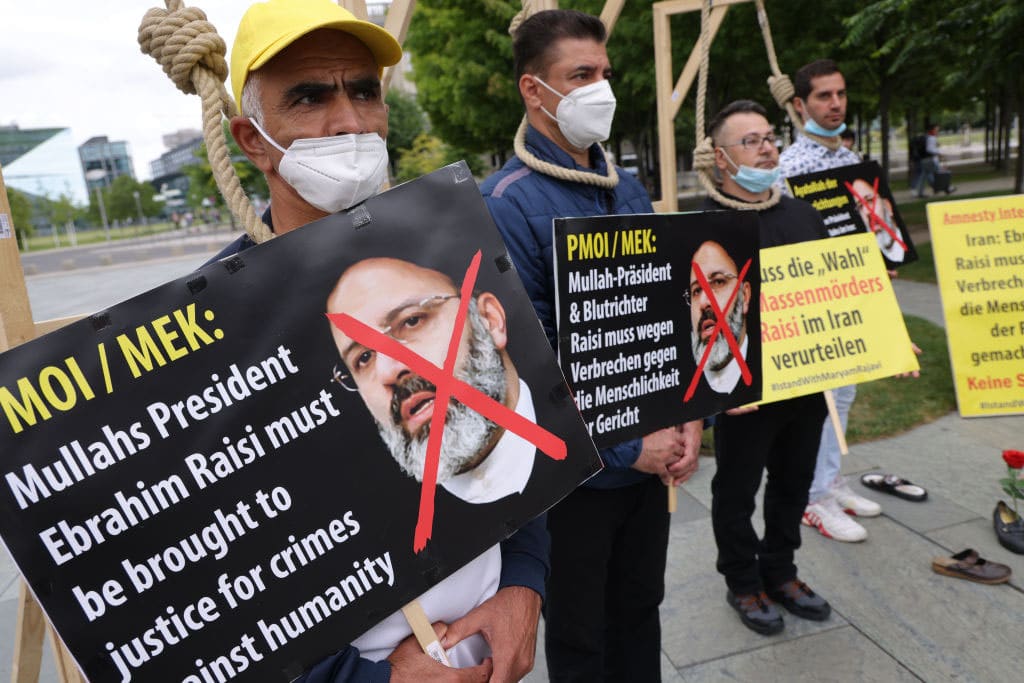
That may be the question that newly-elected Iranian President Ebrahim Raisi asked himself when he officially took office last week. Raisi and his fellow hardliners seem to have been doing everything in their power to convince the Biden Administration that their continued efforts to resurrect the Joint Comprehensive Plan of Action (JCPOA) talks is a waste of time. But the president’s negotiators continue to persevere—or at least to indicate that they are still ready to persevere if only the Iranians would actually meet with them.

Even before the Iranian team put the meetings on hold shortly after Raisi’s election back in June, they were still refusing to meet with their American counterparts in person, leaving it to European functionaries to engage in shuttle diplomacy between the two nations most central to any potential agreement. It would seem logical that negotiations on such sensitive topics would require a sufficient level of mutual trust so that the two parties could at least be in the same room together. But apparently not.

Raisi’s ascent to the presidency was only one in a series of provocations that may have ended the talks under more normal circumstances. Over the course of his career, Iran’s new president became notorious for his alleged role in the execution of thousands of political prisoners and members of leftist armed groups. (Amnesty International says Raisi must be investigated for “crimes against humanity” and United Nations officials have called for an independent inquiry into his role in the mass deaths.) His election, after a campaign in which his credible opponents were barred from the ballot, resulted in a record-low turnout in which millions of Iranian voters stayed away from the polls in protest.

Shortly after Raisi had been declared the winner, Iranian-backed militia in Iraq and Syria launched attacks on U.S. troops in those countries. The terrorist organizations Hamas and Hezbollah, both trained and financed by Iran’s military, have attacked Israel from the Gaza Strip and Lebanon respectively. None of these acts of aggression have stopped the nuclear negotiations. Even allegations that Tehran had planned to kidnap an American citizen, a Brooklyn-based Iranian American journalist who has criticized the regime, did not deter the Biden Administration’s push for additional talks.

So there was little surprise last week after Iran carried out a fatal drone strike on an Israeli oil tanker off the coast of Oman. Tehran denied that they had anything to do with it. The U.S. and the United Kingdom joined Israel in condemning the attack and cited evidence that supported their allegations. But while Biden Administration officials criticized Iran’s belligerence on one hand, their efforts to re-start the nuclear negotiations have continued apace.

Biden’s advisors have argued from the beginning that cutting off the talks would simply clear the way for Iran to advance its efforts toward nuclear capability. But that is exactly what is happening anyway, and if Raisi appoints his own negotiating team the process will be prolonged even further. And Tehran’s increasing comfort in deploying ballistic weapons and terrorist activity suggests that including those types of activities in a follow-up agreement (let alone a re-negotiated JCPOA) is even less likely than before.

Biden’s advisors have argued from the beginning that cutting off the talks would simply clear the way for Iran to advance its efforts toward nuclear capability. But that is exactly what is happening anyway…

The other possibility is that Biden understands that the likelihood of cajoling Iran’s leaders back into a substantive nuclear agreement is small and that his real purpose for continuing to go through this charade is to demonstrate to the Europeans that he is serious about expending every possible effort to achieve a new deal. As I’ve written about in this space before, Biden’s most important geopolitical goals are far from the Middle East. His primary focus has always been on threats from China and Russia, and he knows that will require the support and cooperation of Western Europe to prevail in those confrontations. So it’s entirely possible that going through the motions with Iran is his way of reassuring the Europeans that they can once again think of the U.S. as reliable allies.

But this pretense cannot continue indefinitely. Every time the Iranian government engages in belligerent activity without being held accountable, they are further emboldened. At a certain point, Biden will need to push back. Regardless of how important he believes a new nuclear agreement to be, enabling a menace like Tehran will only lead to less desirable and more dangerous outcomes.

By Tolerating Iranian Belligerence, Biden Playing With Fire Read More »

Mood Swings: In Israel, a Pandemic’s Pandemic

On Sunday, when the Olympic Games were finally over, Israelis were feeling good about themselves. It was—the media reported, armed with data—the best ever Olympics for Israel. That is, in seventy years. What makes it the best ever? Four medals, two of them gold medals. The last record was two medals, one gold and one bronze, in Athens in 2004. Moreover, this time the medals are in more prestigious sports. Israelis are used to medals in Judo (it was a disappointment this time), but In Tokyo, the gymnastics team was able to fight its way to the top. Artem Dolgopyat won gold in the men’s artistic gymnastics floor routine, and Linoy Ashram took the gold in the women’s rhythmic gymnastics competition (the Russian were highly upset about that win).

So Sunday was a day of celebration. But just a week earlier, the airwaves were filled with a chat about Israel’s miserable performance. Some analysts proposed that the team was poorly prepared, others suggested that the people in charge “take responsibility.” Athletes came close to winning in other sports. But close is not enough. Close—being number four—is failure. Making it—being number three—is success.

It took about a week and two medals to turn the Olympics from a lamented failure to a glorious success. When Israelis grumbled, they did it wholeheartedly. When they celebrated, they did it without a shred of self-mockery. The pendulum swung from misery to elation in no time. We are used to such things at sports (a second to the buzzer, your team is one behind, then a shot at the buzzer, and your team is one up). The trouble is that rather than sports being a respite from real life, they become a symbol of real life, or maybe, its source of inspiration.

Think about the pandemic, and take a look at this Gallup graph. Consider the sharp twists and turns. Are you optimistic? Yes. I mean, no. I mean, yes. I mean, no. In June, nine out of ten Americans thought that the Corona situation was “getting better.” In July, just four out of ten felt the same way. It is true that as the situation on the ground changes, one might expect the mood to change. And yet, we’ve been living with the pandemic for quite some time. We should know it is a tricky thing to handle; we should be somewhat cautious in our elation when we score a point, and not be completely devastated when we lose a point.

In Israel, the situation is somewhat similar. Not so long ago, Israel celebrated its great achievement in being the most vaccinated country on earth. Prime Minister Netanyahu, then still in power, declared victory, with more than a hint that his political rivals (many of them were publicly skeptical about his vaccination initiative) did not know what they were talking about. Then, a new government was formed, headed by a PM who literally wrote a book with the presumptuous title “How to Beat a Pandemic.” July was a cruel month for both these leaders, and for all who prematurely celebrated the end of the pandemic.

Netanyahu’s magic in bringing the vaccines and making Israel so advanced in distributing them still stands. And yet, the twenty percent of the population he neglected to vaccinate (those are people who refuse to take the shot, and were able to get away with it), suddenly feels much more significant than it did a few months ago. Prime Minister Bennett’s good advice to the previous government still stands, and yet, when he was handed the reigns he promptly discovered that giving advice is easier than implementing a coherent policy. Under his leadership, Israel is on its way to a possible fourth forced quarantine. The infighting within his government has begun to resemble the sad infighting within the previous government. His past statements—such as the one in which he explains that a quarantine is due to a “terrible managerial failure”—have come back to bite him.

What happened? How did it happen? The answer is mood swings. When there can only be “a scandal or a festival” (as a famous old Israeli song, under the apt name “No Dull Moment,” contends), there is no middle ground to be occupied by responsible leadership. Either the pandemic is over, and we are all free to do as we please (including the people who did not bother to get the vaccine), or the pandemic is spreading fast, and we have no choice other than to send everyone back home. Either the government is doing a great job, no questions asked,  or it is failing miserably and does not deserve any hearing.  

Headlines, political speeches, tweets, leaflets, protests and ads are all intended to grab our attention and hence tend to make the world seem more dire or auspicious than it really is.

Can we learn something from all of this? I think we can, and it is to moderate our tendency to respond with hype to all things. You want examples? Here’s one: No, on January 6th the U.S. was not on the verge of a coup. The events on Capitol Hill were serious and dramatic, but American democracy was not under threat. You want another example? No, PM Netanyahu was not the devil and PM Bennett isn’t a savior (the same is true for Trump and Biden). And another one: No, the pandemic is not the worst thing that ever happened to us. In fact, compared to many other events of the last 200 years, it ought to be considered a medium level disruption.

And here’s the last one: No, the headline you just read in the newspaper is probably not reason enough to become highly agitated. Remember that headlines, political speeches, tweets, leaflets, protests and ads are all intended to grab our attention and hence tend to make the world seem more dire or auspicious than it really is. So, we should manage our mood swings like a good government must manage a pandemic. We should acquire the gradually extinct ability to distinguish between a signal and an explosion.


Shmuel Rosner is an Israeli columnist, editor, and researcher. He is the editor of the research and data-journalism website themadad.com, and is the political editor of the Jewish Journal.

Mood Swings: In Israel, a Pandemic’s Pandemic Read More »

Eyes Wide Shut: AB 101 Bill Poses Danger for California Students

“High school students want to see themselves reflected in history,” said Assemblymember Jose Medina, as he introduced his signature ethnic studies graduation requirement bill, AB 101, to colleagues on the Assembly floor.

Several of the bill’s numerous co-authors expanded on Medina’s sentiments in championing the bill: “It’s important that our students have every opportunity to learn about the history, accomplishments and contributions of diverse communities and leaders that call California home,” stated Assemblymember Robert Rivas. “It’s going to strengthen the diversity in our state,” affirmed Assemblymember Evan Low. “This bill,” promised Assembly member David Chiu, “is the next step to a more inclusive society, one that is reflective and supportive of students of all backgrounds and communities in our state.” And after noting that California is the most diverse state in the nation, Assemblymember Akilah Weber pleaded, “Let us prepare our children for a better future by empowering them with the knowledge of their history and the history of their classmates.”

After hearing these impassioned and moving speeches, one could hardly disagree with Assemblymember Lorena Gonzalez, who wondered incredulously “why anyone would vote against this bill.”

What gives many Californians pause, however, is that the multicultural and inclusive vision of ethnic studies praised by lawmakers and embraced by the vast majority of Californians—one that celebrates the state’s diversity and offers students a non-politicized, fact-based understanding of the history, accomplishments and challenges of all Californians—is a far cry from the vision of ethnic studies proposed by the educators responsible for developing the curricula most likely to be used in schools.

No one understands this better than AB 101’s own author. In August 2019, after an enormous controversy erupted over the first draft of the state-mandated Ethnic Studies Model Curriculum (ESMC), Medina immediately joined 13 members of the Legislative Jewish Caucus in publicly opposing this draft. He stated that its antisemitic bias would “marginalize Jewish students and fuel hatred and discrimination against the Jewish community.” He understood that the first draft, which included overtly anti-Jewish and anti-Zionist material, would inevitably incite bigotry and hostility, especially antisemitism, in California classrooms. He also decided to postpone his graduation requirement bill, the precursor to AB 101, in the hope that a re-do of the ESMC would be consistent with the author’s desire for “a curriculum that is inclusive of all of our cultures and backgrounds.”

Medina understood that the first draft of the ESMC—rooted in a narrow conceptualization of “critical” ethnic studies that limited its focus to four racialized groups and promoted partisan political ideologies and activism that equated capitalism with racism, lionized violent revolutionaries and pushed students to engage in “tactics of resistance” that included anti-Israel boycotts—was clearly at odds with the inclusive and politically-neutral intent of his bill.

And Medina’s strategy worked. In March of this year, the State Board of Education (SBE) approved a less politicized, more inclusive version acceptable to lawmakers—just in time for the introduction of the latest iteration of Medina’s bill.

But a far more serious problem remains.

Although AB 101 recommends school districts adopt the SBE-approved curriculum, it also allows for the use of any curriculum approved by a local school district, even the extremely controversial, highly politicized and overtly antisemitic first draft that Medina vigorously opposed. And there is considerable evidence that the rejected draft—or a more extreme version—will be used by most school districts if AB 101 becomes law.

Although AB 101 recommends school districts adopt the SBE-approved curriculum, it also allows for the use of any curriculum approved by a local school district, even the extremely controversial, highly politicized and overtly antisemitic first draft that Medina vigorously opposed.

Soon after their curriculum was rejected, authors of the first draft launched a petition demanding that education officials reverse their decision and adopt the first draft as the state-mandated curriculum. Signatories on the petition included California’s two largest teachers’ unions—the California Teachers Association and United Teachers of Los Angeles—as well as a large majority of the ethnic studies departments at the University of California and California State University, and more than a dozen local school districts.

More recently, original ESMC drafters established the for-profit Liberated Ethnic Studies Model Curriculum Institute (LESMC) to further promote the main elements of the rejected first draft and offer school districts their educational expertise in implementing the “liberated” curriculum in their schools. While the group has yet to publish their final curriculum, several webpages under “Preparing to Teach Palestine: A Toolkit” suggest the “liberated” curriculum will be even more politicized, divisive and antisemitic than its predecessor.

One webpage smears Israel with false charges of “settler colonialism” and “apartheid” and uses classic antisemitic tropes of Jewish wealth and power to vilify Jewish organizations speaking out about antisemitism; another encourages teachers to “create a space within your school” to engage in anti-Zionist activism and to fight the “Zionist backlash,” identified as “white supremacy”; and a third offers “a few resources” that vilify Jewish organizations, promote anti-Zionist groups calling for Israel’s destruction, and provide “skill-building” and “training” on “how to start your own BDS campaigns.”

Alarmingly, the California Teachers Association endorses the LESMC’s work, urging members to “[v]isit liberatedethnicstudies.org for ideas about K-12 #EthnicStudies curriculum.” Even more concerning is that the CTA is a proud co-sponsor of AB 101, whose endorsement of the rejected first draft of the ESMC and the more extreme “liberated” curriculum is surely known to the bill’s author and co-authors.

Even more concerning is that the CTA is a proud co-sponsor of AB 101, whose endorsement of the rejected first draft of the ESMC and the more extreme “liberated” curriculum is surely known to the bill’s author and co-authors.

Indeed, considering the open support of the state’s major teachers unions, higher education ethnic studies community and local school districts for the statewide adoption of exclusionary, politicized and bigoted curricula clearly at odds with the bill’s intent, the Assemblymembers’ statements can only be viewed as a kind of willful blindness. California legislators must open their eyes to the unintended but inevitable consequences of AB 101, and the dangers they pose for California students.


Tammi Rossman-Benjamin is the director of AMCHA Initiative, a nonpartisan, nonprofit organization dedicated to combating anti-Semitism at colleges and universities in the United States. She was a faculty member at the University of California for 20 years.

Eyes Wide Shut: AB 101 Bill Poses Danger for California Students Read More »