fbpx

August 2, 2021

Peachy Keen: Spectacular Summer Semolina Cake

A favorite summer ritual, as a young married couple, was to pick up a peach pie from Marie Callender’s, a famous Los Angeles pie emporium during the 70’s and 80’s every few weeks during summers, piled high with fresh, sweet, juicy peaches and we’d take them to the home of Neil’s Uncle Jack and Aunt Sylvia. We would sit around the table in the hot summer nights, have some freshly brewed coffee — Yuban of course! — and dig into delicious fresh peach pie.

Neil‘s grandmother and Aunt Sylvia’s mother, “Ermana Miriam Levy”, were friends from Rhodes and now part of the LA Rodesli community. My mother-in-law Becky was a grade below Sylvia at the Manual Arts High School in South Central Los Angeles, an area that was home to the Sephardic Jewish community in the 30’s and 40’s. Their friendship was cemented during the war years, when Becky would drive Sylvia and their girlfriends home from dances at clubs like the Hollywood Palladium in the wee hours of the night. Sylvia married Uncle Jack, who came from Cuba and had charisma and a wonderful sense of humor.

When Neil was in high school, he would walk to Shabbat service at Magen David, the Syrian synagogue on Melrose Avenue and after he would stop at Jack and Sylvia’s home for a traditional Sephardic lunch of burekas, huevos haminados, cheese and olives. Having lost his father when he was six months old, Jack and Sylvia were second parents to Neil. We loved them so much that we called our son Max Jacob and our daughter Rebekah Sylvia in their honor.

Peaches, that delicious summer fruit, were first cultivated in northern China. From China, peaches were brought to Japan and India. Peaches were widely grown in Persia and legend had it that Alexander the Great brought them to Greece after he conquered the Persian Empire. Whether that is true cannot be proven but peaches were widely grown in Greece by 300 BCE. The Ancient Romans mistakenly believed that peaches were native to Persia and called peaches malum persicum “Persian apple.” This later became the French peche and peach in English. Ibn al-Awwam, in his 12th century Book On Agriculture describes peach tree cultivation in Spain. The Spaniards brought peaches to the Americas in the 16th century.

Although Thomas Jefferson had peach trees at Monticello, peaches weren’t grown commercially in the United States until the 19th century, when farmers began to grow them in Maryland, Delaware, South Carolina, Virginia and of course, most famously, Georgia.

When I took home economics at Beverly Hills High, the first cake they taught us how to make was Strawberry Shortcake with fresh strawberries and whipped cream. I was instantly addicted and constantly baking them. That’s when my love of cakes with fruit began.

Over the years, I have experimented a lot with baking cakes. Since both my parents were diagnosed with diabetes I have strived to make them healthy-ish. I cut the white sugar in half and substitute with honey, maple syrup or coconut sugar. In a gluten sensitive world, I have found many healthy alternatives to flour, like semolina, almond flour, coconut flour and oat flour. The results are delicious and my family and guests will barely notice the difference.

One of my favorite recipes is this Spectacular Summer Semolina Cake, a great way to incorporate the flavor of peaches (and to use up all the ripe peaches in my home). Almond extract and grated orange rind awakens the fruity aroma of the fresh peaches. Adding semolina adds a slight crunchy texture and the orange juice keeps it moist. Pouring the jammy peach syrup over the cake is just heavenly!

— Rachel Emquies Sheff

Join us at Sephardic Temple Tifereth Israel on Thursday, August 26th at 7pm for a Rosh Hashana cooking demonstration and tasting. Also at Beth Jacob, on Tuesday, August 31st at 7pm. Find details on our facebook and Instagram.


Spectacular Semolina Summer Cake with Pure Peach Syrup Recipe

2 cups semolina
¾ cup all purpose flour
4 teaspoons baking powder
1 tablespoon finely grated orange rind
6 large eggs
1 cup sugar, plus 1/4 cup for peaches
1 cup avocado oil or vegetable oil
1 & ½ cup orange juice
1 teaspoon almond extract
4 medium peaches, pitted and sliced into wedges
1 cup finely sliced toasted honey almonds or plain toasted almonds

Preheat oven to 350F.

Line a springform pan or cake pan with parchment paper, then grease.

Wash, dry and slice peaches into half inch moons, leaving the peel on.

Place peaches in a bowl with ¼ cup of sugar, set aside.

Combine all the dry ingredients and orange rind in a small bowl and set aside.

In a stand mixer or with a hand-held mixer, in a large bowl, beat eggs and sugar until a creamy pale yellow, about 5 minutes.

Add the oil and beat for another minute, add orange juice and combine.

Slowly add dry ingredients to wet using a spatula, do not over mix.

Gently mix in ½ of the almonds into batter.

Pour batter into prepared pan.

Strain any sugar syrup from the peaches and reserve.

Add the peach slices evenly into batter and sprinkle the remaining ½ cup of almonds on top.

Bake cake in the center of the oven for 50 to 60 minutes until the cake is golden and firm.
Let cool on wire rack.

Pure Peach Syrup

2 peaches, peeled and cubed
1 cup sugar, plus sugar syrup from peaches ½ cup water Juice of half a lemon
1 cinnamon stick

Pour the peach syrup, sugar, water, lemon juice In a small sauce pan and bring to a simmer, until all sugar has dissolved.

Add the cinnamon stick and peaches, slowly simmer until peaches are very soft and liquid has become a thickened syrup, about 30 minutes.

Serve over sliced cake.


Rachel Sheff and Sharon Gomperts have been friends since high school. They love cooking and sharing recipes. They have collaborated on Sephardic Educational Center projects and community cooking classes. Follow them on Instagram @sephardicspicegirls and on Facebook at Sephardic Spice SEC Food.

Peachy Keen: Spectacular Summer Semolina Cake Read More »

Listening to What Often Seems Absurd

Sigmund Freud deserves fame as the teacher
of what’s mistakenly defined by most of his supporters as a “talking cure.”
To be effective its most vital feature
is not the talking about facts which patients feel are true yet can’t be really sure,
but that there’s somebody out there who listens
to them. Talking may alleviate our pain because our feelings and our words are heard.
Talk unfreezes us with mental frissons,
released from mental prisons where we’d lost our freedom due to thoughts that were absurd.
Therapeutic as the Freudian couch is
our listening process — even when we’re lying down, we’re told in Deuteronomy! —
troubled less by thoughts that lead to grouches
when we are being heard not just by God but other listeners with bonhomie.

Inspired by an article by Rabbi Lord Jonathan Sacks on the Shema, a prayer based on a text in Deuteronomy 6:4-9, “To Lead is to Listen,” posthumously published on Shabbat Eiqev 5781, 7/28/21. The prayer’s name, “Shema” means “listen.”

In Judaism listening is a deeply spiritual act. To listen to God is to be open to God. That is what Moses is saying throughout Devarim: “If only you would listen.” So it is with leadership – indeed with all forms of interpersonal relationship. Often the greatest gift we can give someone is to listen to them….

Viktor Frankl, who survived Auschwitz and went on to create a new form of psychotherapy based on “man’s search for meaning,” once told the story of a patient of his who phoned him in the middle of the night to tell him, calmly, that she was about to commit suicide. He kept her on the phone for two hours, giving her every conceivable reason to live. Eventually she said that she had changed her mind and would not end her life. When he next saw the woman he asked her which of his many reasons had persuaded her to change her mind. “None,” she replied. “Why then did you decide not to commit suicide?” She replied that the fact that someone was prepared to listen to her for two hours in the middle of the night convinced her that life was worth living after all.


Gershon Hepner is a poet who has written over 25,000 poems on subjects ranging from music to literature, politics to Torah. He grew up in England and moved to Los Angeles in 1976. Using his varied interests and experiences, he has authored dozens of papers in medical and academic journals, and authored “Legal Friction: Law, Narrative, and Identity Politics in Biblical Israel.” He can be reached at gershonhepner@gmail.com.

Listening to What Often Seems Absurd Read More »

Report: Social Media Platforms Have Failed to Properly Address Antisemitism

A new report from the NGO Center for Countering Digital Hate (CCDH) states that social media platforms haven’t adequately addressed antisemitism permeating their sites.

The report examined 714 antisemitic posts on Facebook, Instagram, TikTok, Twitter and YouTube from May 28-June 29 that generated 7.3 million impressions combined and found that these “platforms failed to act on 84% of reports of anti-Jewish hate.” Additionally, the social media giants failed “to act on 89% of antisemitic conspiracy theories” as well as 75% “of extremist anti-Jewish hate.” As an example, the report pointed to how Facebook labeled a post claiming that “the Holocaust of six million Jews is a hoax” as “false information” but did not remove it. Additionally, the report pointed to conspiracy theories regarding the Rothschild family and billionaire George Soros as well as conspiracy theories that Jews were behind the COVID-19 pandemic and the 9/11 terror attacks as examples of antisemitism that the social media giants failed to take action against.

The report also documented various antisemitic Facebook groups that had 37,530 members and were allowed to remain on the platform; such groups included “Expose the Talmud,” “Exposing Zionism’s Insidious Crimes” and “Rothschild Zionism,” among others. Twitter, Instagram and TikTok also didn’t crack down on antisemitic hashtags that went viral such as “#holohoax,” “#killthejews” and “#synagogueofsatan.” TikTok also only banned 5% of users that “racially [abused] Jewish users” and failed to act on 76% of antisemitic comments on TikTok, such as comments stating that the Holocaust “never happened.”

The report concluded with a call for these platforms to “hire, train and support moderators to remove hate,” stating that “while we welcome moves from Facebook to introduce clearer policies on anti-Jewish hatred, the fact that it performs worst of all platforms in our study at removing antisemitic content shows that any new policies will not be effective without hiring and training moderators who recognize hatred when they see it.” The report also called for legislation that allows for those who are victimized by antisemitic abuse on social media to be able to seek financial restitution from these platforms.

“This is not about algorithms or automation; our research shows that social media companies allow bigots to keep their accounts open and their hate to remain online, even when human moderators are notified,” CCDH CEO Imran Ahmed said in a statement. “No one has a fundamental right to have an account on a social media platform to bully Jews or to spread hatred that we know can end in serious offline harm.”

Spokespeople for Facebook, Twitter, YouTube and TikTok all said in separate statements to The Guardian that they denounce antisemitism and have made progress in removing antisemitic posts from their platforms, but are continuing to improve their efforts in doing so.

Report: Social Media Platforms Have Failed to Properly Address Antisemitism Read More »

Satirical Semite: Reality Olympics

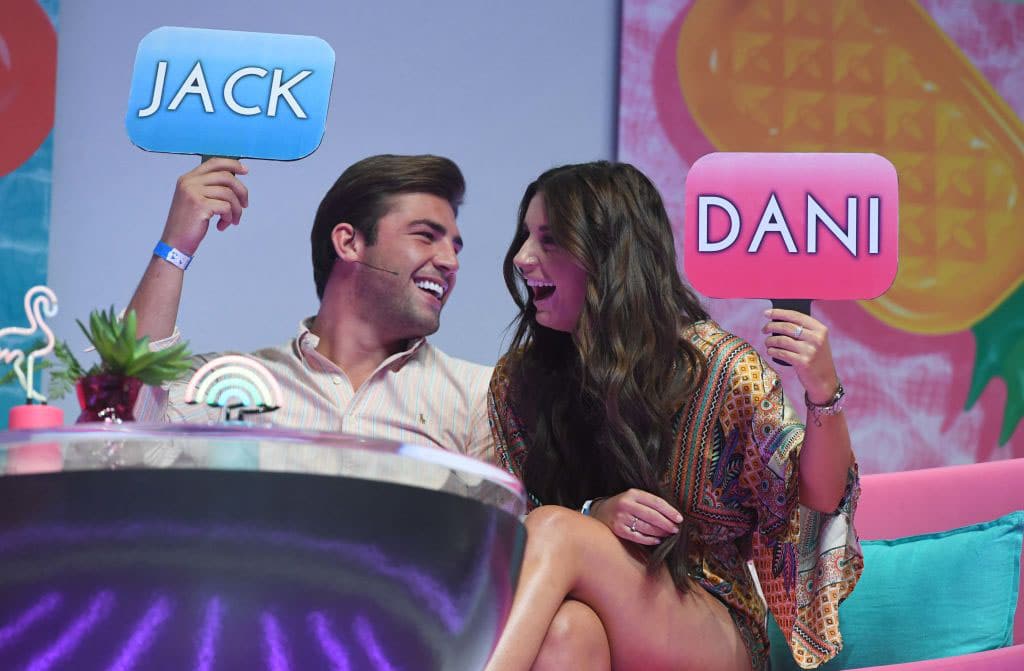
I decided to buy a television for the first time in 12 years. Netflix, Prime Video and Disney+ usually take care of my viewing needs, but I couldn’t bear to miss another year of the Olympic Games. It was impressive to see young athletes in their prime, displaying toned muscles and incredible stamina. They swam, ran and got into bed with another. Then I realized I was watching “Love Island.”

Much like the Olympics, gym membership is maximized and body fat minimized to join “Love Island,” and the show is definitely an endurance marathon, at least for the viewers. It’s the televisual equivalent of a 10km Olympic Marathon Swimming event, rather than a High Dive, simply because the conversational waters are too shallow.

“Love Island” is the reverse of the traditional Jewish approach to dating. A typical shidduch date is more like “Mutual Values Island,” which has all the branding appeal of a five-day-old sushi platter. “Love Island” contestants often spend the night in bed together and then establish whether they like one another, unlike a shidduch, which happens in a public place, with physical contact held off until the wedding night. Television programming is generally unsympathetic to Orthodox Judaism, with mostly negative portrayals in shows such as “My Unorthodox Life,” “Unorthodox” or “Shtisel.” Israeli soap opera “Srugim” was more positive about the religious dating scene, but for the most part all we are left with are Reb Tevye’s daughters yearning for a matchmaker while some bloke is upstairs fiddling on the roof.

“Love Island” is the reverse of the traditional Jewish approach to dating. A typical shidduch date is more like “Mutual Values Island,” which has all the branding appeal of a five-day-old sushi platter.

Back in the 2000s, I appeared in a UK reality series called “Ladette to Lady” featuring “young women who dwell in England’s underbelly are given the opportunity to clean up their lives.” A finishing school was set up for a group of women who included a gas fitter, a plumber and a car mechanic. They were taught skills for upper-class women and judged on prowess. Male suitors were shipped in for weekend social events, and the gents were refined, monied and upper-class. One person’s job was managing a pack of foxhounds that were used for weekend fox hunts back when the bloodsport was still legal. Then there was a Semite with frizzy hair, and I felt like the only Jew for a thousand miles.

The biggest challenge was a Friday night seven-course dinner that was being filmed and would eventually be broadcast on BBC worldwide. I stayed within a walkable distance since it was Shabbat, but not only was it not kosher, it was also the middle of Passover. I could barely look at the food let alone eat it. At the time, my day job was teaching at an eating disorders unit for anorexic teenagers, where I’d seen various techniques for sitting at a dinner and pretending to eat while just moving one’s food around the plate, which enabled me to engage in fake eating. I made an excuse to go to the bathroom and instead went to consume some kosher-for-Pesach cake and a handful of matzahs. A seven-course feast it wasn’t.

Are public morals in a freefall? The 1965 Dating Game show in the US was a chaste affair with an unmarried person behind a screen asking questions from three potential partners on the other side. Now we have “Naked Attraction,” where people choose a partner by evaluating their naked body standing on a podium like a Roman slave, a slab of meat on a butchers’ block. “Temptation Island” involved couples agreeing to individually live with a group of singles of the opposite sex and test the durability of their relationship, while “Too Hot To Handle” puts a bunch of modelesque singles in tempting situations in competition for a big cash prize that reduces whenever there is physical contact between contestants. For the most part, they manage feats of celibacy that sometimes last as long as seven hours, albeit while they are asleep.

Programmers are aware of the psychological consequences The 2018 “Love Island” contestant Niall Aslam, for example, visited a psychiatric unit after leaving the show. So far there have been three “Love Island” suicides, including two former contestants and one presenter. It is beyond horrific. At least 20% of the commercial breaks promote positive mental health, links to psychotherapeutic hotlines and messages to be kind to oneself. It’s like a heroin dealer handing someone a stash along with a leaflet for Narcotics Anonymous.

It looks like reality television is becoming increasingly sinister and just one step away from featuring “Celebrity Euthansia in Switzerland,” or “Real Car Crashes of New York City,” although news helicopters sometimes cover the latter. For now, I’m sticking to the Olympics.


Marcus J Freed is an actor, filmmaker and business consultant. www.freedthinking.com.


Satirical Semite: Reality Olympics Read More »

The Great COVID Divide

“The war has changed.”

Those four words, culled from a Center for Disease Control memorandum that became public last week, warned us that COVID-19 is not nearly as under control as most of society had come to believe. The speed and strength of the Delta variant has shaken our confidence regarding the progress we have made in fighting the pandemic, and it has strongly reinforced the importance of vaccinations as greatly enhanced—though not absolutely fail-safe—protection against the spread of the virus.

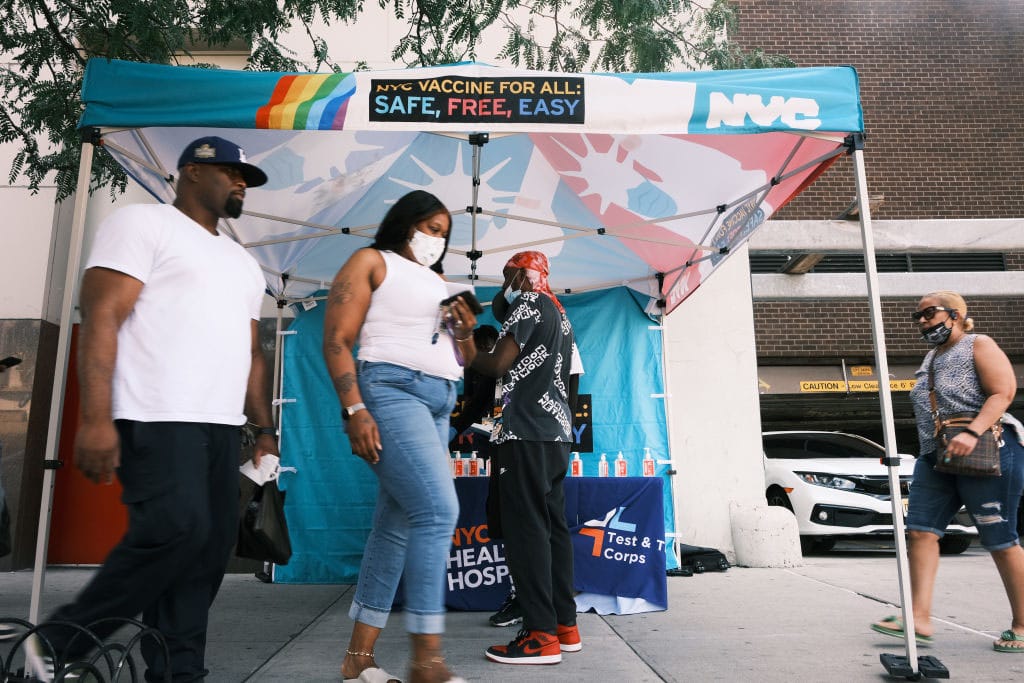
We also learned last week that Jewish Americans are much more likely to get vaccinated against COVID-19 than the rest of the population. According to a recent study from the Public Religion Research Institute, 85 percent of Jews have either had the shot or are planning to do so, compared with just over 70 percent of all Americans. These results should not be particularly surprising. The demographic characteristics that are most frequently seen among resistors—lower levels of education, residents of rural and small town America, members of minority communities, young people and working class individuals—are not nearly as heavily represented among Jews as the overall population.

But this cultural disconnect means that the growing tensions between those who have been vaccinated and those who have not could be especially intense for many of us in the Jewish community who struggle to understand the motivation of the holdouts.

The emergence of the Delta variant, and the wide range of responses to the heightened calls for vaccines, masks and social distancing, makes it feel like we are on the precipice of a much larger and more dangerous divide in American society than we have experienced to date. The anger and the mutual disdain between those of us who have followed COVID guidelines and those who have not have surfaced fairly consistently over the course of the pandemic. But it appears as if that fury is about to explode in a potentially destructive way.

Because the data shows so clearly that mutant strains of the virus disproportionately impact those who have not been vaccinated, the resentment from those who have taken the shot toward those who have not is much more palpable. Unlike last year, we now have pharmaceutical protection available to us. But those who have resisted or rejected vaccination are now putting the rest of us at risk, and we are beginning to see increasingly frequent examples of that hostility playing out around the country.

This year is different. The people we know to be responsible for COVID’s resurgence are very apparent, and the temptation to lash out against them will only intensify.

When the shutdown came last spring, most of our venting had a convenient partisan outlet. Those who followed social distancing rules could condemn Donald Trump for his response to the virus; those who ignored mask mandates and other requirements blamed an assortment of mayors, governors and health department officials. But much of the vitriol seemed like an outgrowth of typical campaign bickering: the charges and insults fit neatly into the context of a presidential campaign. Even though the stakes—in terms of people’s jobs, homes and lives—were much higher than in most partisan political debates, the contours of the COVID argument largely mirrored that of the general election dialogue.

Except for those familiar political foes, it was also difficult to find a useful scapegoat for a once-in-a-century worldwide plague. Making China into a target was tempting, but Trump’s maladroit attacks on that country turned that resentment into a partisan issue as well. Those who criticized China for its nebulous role in identifying and confronting the virus risked being typecast as Trump supporters, which quickly discouraged half the country from any serious Sino-bashing. Blaming either nature or biology was equally unsatisfying, and so we were left with a seminal crisis but no villain to whom we could assign responsibility.

But this year is different. The people we know to be responsible for COVID’s resurgence are very apparent, and the temptation to lash out against them will only intensify. But screaming, yelling and threatening are rarely effective tools for persuasion. Those of us who have been vaccinated and are understandably frustrated by the holdouts are going to need to find a more encouraging and productive strategy for winning converts. If we give in to our angry instincts, the societal divide will grow even wider. It won’t be easy, but we need to find a way to communicate more effectively and compassionately. If we succumb to our rage, the virus wins.

The Great COVID Divide Read More »

Pro-Palestinian NYC Rally Features “Globalize the Intifada” Chants

A pro-Palestinian rally in New York City on July 31 featured protestors chanting “globalize the Intifada” and other anti-Israel chants.

The Jerusalem Post and Daily Caller reported that there were also chants of “we don’t want no two states, we want all of it” and “from the river to the sea Palestine will be free.” Banners held by protestors displayed statements like “Zionism is terrorism” and “We will free Palestine within our lifetime.”

The Caller’s Jennie Taer noted that the organization Within Our Lifetime, which organized the rally, explained that the need to “Globalize the Intifada” stems “from the urgent need to defend our lands, resist our oppressors, and break free from the genocidal grip of U.S. imperialism and Zionism.”

Jewish groups denounced the chants.

“After a surge of violent #antisemitism perpetrated by extremists using the Gaza conflict as cover for their hate, this rally shows why Jewish people feel unsafe in our communities,” Anti-Defamation League CEO Jonathan Greenblatt tweeted. “It should be condemned without hesitation by leaders at all levels.”

The American Jewish Committee also tweeted, “The chant ‘globalize the Intifada’ should horrify us all. The First and Second Intifadas were waves of terrible violence that left 1,300+ Israelis dead, many killed in suicide bombings targeting buses, cafés, and malls. This is a call for mass murder.”

StandWithUs Israel Executive Director Michael Dickson similarly tweeted, “Intifada means violent uprising. It’s terror. The Intifada brought carnage to countless innocents who were blown up in suicide bombings on the streets of Israel. What would ‘globalizing the intifada’ mean?”

Stop Antisemitism also tweeted that “Globalize the Intifada” means “murder and destruction.”

StandWithUs CEO and Co-Founder Roz Rothstein tweeted that the “we don’t want no two states chant” shows that the protesters “clearly dont want a Jewish State as their neighbor. As they say, in Chant # 2 – They want ‘All of It.’ #Israel [isn’t] leaving.”

Within Our Lifetime did not respond to the Journal’s request for comment.


Pro-Palestinian NYC Rally Features “Globalize the Intifada” Chants Read More »

Chai Lifeline Brings Together Pro Basketball Players and Local Rabbis to Help Kids Battling Illness

For one rare Sunday afternoon, families whose children are confronting serious illnesses and diseases converted the YULA High School campus into a whole new world of excitement and energy.

Since 1987 Chai Lifeline has been a nationwide provider of emotional, social and financial support for Jewish families impacted by illness and crisis. Last weekend the organization teamed up with YULA for a community party that attracted a crowd of about 400.

The centerpiece was a laughter-filled 90-minute basketball game, pitting the Harlem Dreams, an exhibition show team, against a slightly shorter team of community rabbis, and providing hilarious closure to the day.

“Today is about community coming together to celebrate Chai Lifeline and the first year in Los Angeles for our Camp Simcha Without Borders program,” said Randi Grossman, Chai Lifeline’s West Coast Regional Director. Chai Lifeline came to Los Angeles in 1999.

“We wanted to bring together our families, our volunteers, our friends and supporters for a day of being together.”

For the first time in Los Angeles, Chai Lifeline is introducing Camp Simcha Without Borders, a new Lifeline concept of localized camps across the country instead of only one main location. Fifty campers from LA and surrounding areas, ages 5 to 18, will gather this summer in a private home for separate four-day sessions for boys and girls.

Grossman described the grim backgrounds of many in the happy YULA crowd.

“Illness impacts families, and children, in different ways,” she said. “We have kids who are dealing with serious illnesses, but you never would know it to look at them. With others, the illness is obvious.

“If it is an illness that impacts a child’s life, we want to help. We have children who have acute illnesses, going for cancer treatments. Others are dealing with lifelong illnesses, like cerebral palsy, cardiac issues, transplant issues, rare genetic disorders. It runs the gamut, all children whose lives are impacted by illness.”

Grossman explained how families newly in need find them. “We work closely with local hospitals,” she said. “When they have a Jewish family who comes into their system, they
tell them about Chai Lifeline so we can help them.”

The Shemtovs, George and Lisa and their children Chloe, 5, Benny, 9, and Koby, 11, are typical of the grateful families who spilled across the YULA campus. He is a software engineer and she helps run a real estate management company.

Benny was diagnosed with leukemia almost two years ago, “and we got through the dark times with the help of Chai Lifeline,” Lisa said. “They were there from the start, the very first week.”

The Shemtovs, whose children are students at Yavneh Hebrew Academy, had heard of Chai Lifeline “but we didn’t know what they did,” George said.

“They are amazing, unbelievable. They support the kids going through it, the siblings, the parents. They give party favors, gifts and different kinds of activities.”

Lisa, who is now active with Chai Lifeline volunteers, said a contact person is appointed for each household. “They check regularly on you at least once a week, sometimes twice.

“Whenever you want or need anything, they are there for you, whether it is for insurance or any kind of emotional, psychological support. They are always there to help you navigate through these times.

“The kids had the best time with their Big Brother and Big Sister,” the grateful mother explained. “We met many wonderful people. But the kids’ relationship with their Big Brother was special because he brought so much energy and happiness. Chloe was the flower girl at his wedding. Her Big Sister was her counselor at camp for a week.”

The Chai Lifeline reps and the Shemtovs “became family,” George said. “They know what we are going through, and they bring a lot of positive energy.”

As for Benny, “he really is strong now. He went through this like a champ.”

Lisa explained that presently they are “in a maintenance stage. We have another year and a half to go.”

Nationwide, about 1500 children will participate in Chai Lifeline’s camps this summer, ranging from the main setting in upstate New York to cities across the country. Lifeline founder Rabbi Simcha Scholar said that Camp Simcha Without Borders was created last year because of the COVID-19 pandemic, for the first time introducing local camps in cities across America.

The basketball matchup, rabbis vs. pros, emerged, Grossman said, when Chai Lifeline officials met Lefty Williams, co-founder of the Harlem Dreams and a former Globetrotter, while planning basketball workshops for their kids’ summer camps.

“We wanted to do an event to really bring the community to meet Camp Simcha,” Grossman said. “Lefty spoke up. ‘What if we did a game?’ he asked, and the celebration at YULA was born.”

Grossman had another thought.

“I believe this is the first time a team of community rabbis has played a professional team,” she said.

As the plan burgeoned, Coach Yitzy Katz and Shmuel Barak, two of Chai Lifeline’s 143 Young Leaders, put together and then managed a group of eager game-minded rabbis.

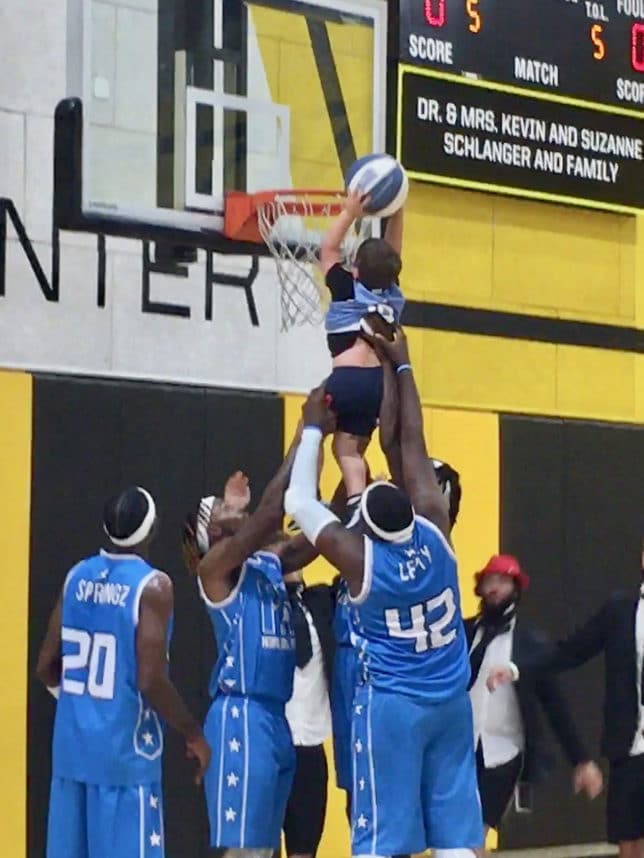
Ari, the youngest Chai Lifeline scorer, receives a boost from Harlem Dreams’ Lefty Williams.

The Harlem Dreams, led by the master performer Williams, handed the rabbis their only loss of the season, 81-66, despite the efforts of: Rabbi Joshua Maslow, YULA; Rabbi Shimon Abramczik, YULA; Rabbi Eli Broner, Hillel Hebrew Academy; Rabbi Shlomo Einhorn, Yavneh Hebrew Academy; Rabbi David Mahler, Gindi Maimonides Academy; Rabbi Adir Posy, Beth Jacob Congregation; Rabbi James Proops, Young Israel of Century City; Rabbi Kalman Topp, Beth Jacob Congregation; and Jonathan Ravanshenas, Shalhevet School.

After the final basket, a somber announcement blared across the packed YULA gymnasium:

“This game, this night, all was in memory of Noah Arnold. Noah loved YULA, Noah loved Chai Lifeline, and Noah loved sports.”

A student at YULA, Noah died earlier this year.

“It was a pleasure this evening to remember a young man, Noah Arnold of Blessed Memory,” Rabbi Topp said. “Noah was full of personality. He was larger than life.

“His parents, Lisa and Scott [members of Rabbi Topp’s Beth Jacob Congregation], were here tonight.”

In addition, Noah is survived by his siblings, Shane and Gigi.

Chai Lifeline West Coast, 475 S. Robertson Blvd., Beverly Hills. (310) 274-6331. (310) 553-5160.

Chai Lifeline Brings Together Pro Basketball Players and Local Rabbis to Help Kids Battling Illness Read More »

The Anti-Defamation League and Hillel are Now Working Together to Document Antisemitism on Campus

(JTA) — Over the last year, Jewish college students took it upon themselves to combat antisemitism at their schools. Now, two major Jewish organizations are working together to play a stronger role in fighting antisemitism on campus.

Some of the student activists documented incidences of antisemitism at colleges nationwide, often submitted anonymously, while others have taken a confrontational tone on social media. With some  portraying themselves as the ideological successors to early Zionist activists, the students often argue that anti-Zionism and antisemitism overlap.

In a new partnership, Hillel International and the Anti-Defamation League are aiming to take a more traditional approach to the same issues — one that they say will not always treat anti-Israel activity as antisemitism.

Hillel and the ADL will together create a college-level curriculum on antisemitism and jointly document antisemitic incidents on campuses in the United States. But not every student government resolution endorsing the movement to Boycott, Divest from and Sanction Israel, known as BDS, will wind up in the groups’ database.

“Anti-Israel activism in and of itself is not antisemitism,” an ADL spokesperson told the Jewish Telegraphic Agency. “Situations vary widely with BDS, we will carefully evaluate each one and make a determination based on our criteria for antisemitism.”

For example, the ADL spokesperson told JTA, a BDS resolution alone would not count as antisemitism, “but if a student was excluded from the debate because he or she was Jewish, then it might be counted.”

The Hillel-ADL partnership, which will begin in the coming academic year, follows a spike in reported antisemitic incidents on campus. In the school year that ended in 2021, the ADL tallied 244 antisemitic incidents on campuses nationwide, an increase from 181 the previous school year. Hillel has a presence on more than 550 campuses and says it serves more than 400,000 students.

Accusations of antisemitism on campus have received significant attention from large Jewish organizations for years. Some Jewish leaders have long said anti-Zionist activity on campus constitutes antisemitism, especially as a string of student governments endorsed BDS.

Hillel International prohibits partnerships with, and the hosting of, campus groups that support BDS. Anti-Zionist groups have at times targeted Hillel; last week, Students for Justice in Palestine at Rutgers University criticized the school’s Hillel in a statement endorsed by other campus groups.

In addition, the ADL has documented white supremacist propaganda campaigns on campuses nationwide.

Multiple national groups have filed complaints with the Department of Education’s Office of Civil Rights based on campus antisemitism allegations. In 2019, President Donald Trump signed an executive order mandating “robust” enforcement of civil rights protections for Jews on campus and including some anti-Israel activity in the definition of antisemitism. Pro-Palestinian activists said the order would have a chilling effect on free speech on campus.

The ADL and Hillel International plan to develop a curriculum about the history of antisemitism and how it manifests currently. They will also survey schools nationwide to provide a better picture of the state of antisemitism on campus, and will create a dedicated system to tally incidents of antisemitism at colleges and universities, including a portal for students to report incidents confidentially.

The ADL did not detail how it would verify whether confidentially submitted incidents actually occurred, beyond telling JTA they would be judged by the methodology the group uses in its annual audit of antisemitic incidents. The methodology states that “ADL carefully examines the credibility of all incidents, including obtaining independent verification when possible.”

In recent months, the student activists have formed their own organizations to further their online activism, called the New Zionist Congress and Jewish on Campus. The New Zionist Congress hosts an online book club and discussions about Zionism, while Jewish on Campus records stories of college antisemitism on its Instagram account, which has posted more than 400 times and has 32,000 followers.

The ADL said its partnership with Hillel would “complement” student activism and that the group “will firmly support well-meaning student-led efforts to push back against antisemitism on campus.”

The effort with Hillel is also the third partnership with an external organization that ADL has announced in the past two weeks. It recently launched a partnership to combat antisemitism with the Union for Reform Judaism, and last week began an initiative with PayPal to research how extremists use online financial platforms.

The Anti-Defamation League and Hillel are Now Working Together to Document Antisemitism on Campus Read More »

Simon Biles and Why Anxiety is Killing Us

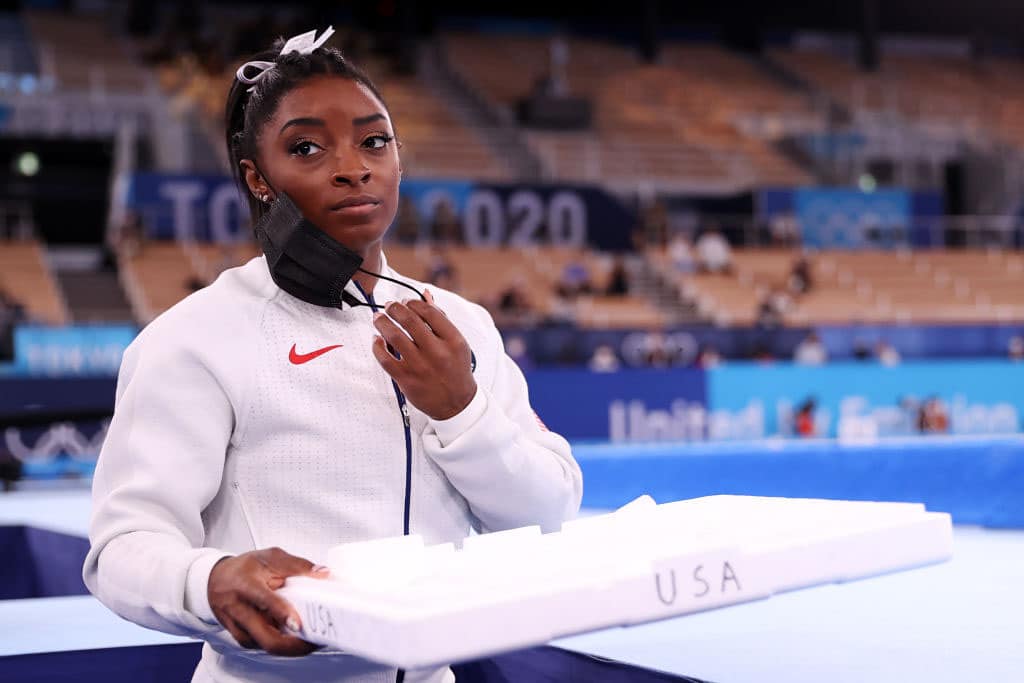
The biggest story coming out of the Tokyo Olympics is not about competition, but its absence. Simon Biles was arguably the biggest Olympic star in the world going into the 32nd Olympiad. NBC, which bets billions of dollars on the games, endlessly promoted her as the star to watch as the world congregated in Japan a year late.

Then, something extraordinary happened. Simon Biles, feeling jittery and not herself, decided not to compete after a shaky performance in the Team all around competition. She explained that she had lost a sense of orientation and could greatly harm herself if she continued to attempt summersaulting in the air.

She was pilloried by people like Piers Morgan, who called her a quitter. He wrote, “There’s nothing heroic or brave about quitting because you’re not having ‘fun’—you let down your team-mates, your fans and your country.”

That is the kind of ruthlessness you can expect when you stop entertaining the circus.

If there is one unspoken message heard by all young people today, it is not the message of the Bible that all are created in the image of God and therefore have infinite worth. No, it’s the exact opposite that is communicated. The message is that you are born unlovable. You are plain and ordinary. And only if you win a gold medal, make a billion dollars on an internet start-up, are a beautiful model, or stand out in some other superlative way, will you be special.

If there is one unspoken message heard by all young people today, it is not the message of the Bible that all are created in the image of God and therefore have infinite worth.

It’s a soul-destroying message that is ruining the world and greatly accelerating the decline of mental health.

If there is one great tragic outcome of the decline of religion in the Western world, it is the silencing of religion’s most important message: that every human being is of infinite value. That whispered message of religion used to, at least, balance out the cacophony of noise coming from Western values that celebrate only wealth, fame and power, thereby debasing all of us into circus animals trained to perform.

From childhood, we are led to believe that unless we get into an Ivy-League school we’re nothing. Unless we’re really thin and attractive, we’re nothing. Unless we have—at least!—tens of thousands of followers, we’re nothing.

Last week, another teenager threw himself off New York’s newest high-rise tourism monument at Hudson Yards in Manhattan. This is how the New York Times described the tragedy:

“Just two months after the Vessel, a honeycomb-like spiral of staircases in Hudson Yards, reopened with design changes meant to lower the risk of suicides, a 14-year-old boy died by suicide there on Thursday afternoon, the police said. The death, which was the fourth suicide at the tourist attraction in a year and a half, angered community members who have repeatedly called on developers to build higher barriers on the walkways and raised questions about the effectiveness of the structure’s suicide-prevention methods.”

We take as a given that when New York City constructs new buildings, it must take into account, from the outset, the reality that people are going to hurl themselves off them, especially teenagers. I see this every time I cross from New Jersey into New York on a bike across the George Washington Bridge, the world’s busiest. The views into the Manhattan skyline used to be gorgeous. But now they are obscured by ugly netting designed to stop broken and forlorn souls who have given up on life from casting themselves into the Hudson River below.

But along with these precautions, why aren’t we getting to the root causes of this pandemic of Western depression that is exacerbated by the ongoing chorus of worthlessness without achievement?

Enter Simon Biles, the greatest gymnast of all time, who decided that she loves the sport but she won’t destroy herself just to cater to the fans, TV, and the endless quest for medals. There is nothing wrong with competition. Indeed, it is the very engine of capitalism and is responsible for the West’s great wealth. But there is something wrong with soulless competition, which says that without a gold medal one is little more than the Tin Man from the “Wizard of Oz,” lacking heart and comprised of worthless metal.

On the night that I turned 40, I stayed awake waiting for “it” to hit me like a freight train. The “it” was the promised wisdom from the words of the Sages: At 40 a man becomes wise.

I had thought myself smart but not wise, and I knew the famous Jewish saying about the difference between the two: the smart man can extricate himself from a situation into which the wise man would never have gotten himself into in the first place.

I wanted to be wise. I wanted the great secret of life, the nugget of wisdom that was going to make it all better—the granule of knowledge passed on from the ancients that would make life simple, smooth and effortless. I wanted the esoteric secret that renders life seamless, bereft of challenge and struggle.

It did not come to me that night, nor that year, nor the next. I was sorely disappointed. I felt cheated. I told my wife that the wisdom did not arrive, that I still did not have the answers to life’s great questions. Life, for me, was still a struggle.

But a few years later it came to me. The pinnacle of wisdom is to know that you are born worthy, that there is nothing you can accomplish that will ever be larger than being God’s child. That success in finance, fame or sports should never be anything more than an authentic desire to develop your potential and contribute to the world around you and a cause larger than you.

The pinnacle of wisdom is to know that you are born worthy, that there is nothing you can accomplish that will ever be larger than being God’s child.

But it should never be out of desire to prove yourself, which will only place you into the rat race, guaranteeing not satisfaction but lifelong misery, regardless of achievement. This great lesson is what Biles demonstrated at the Olympics. She did not quit on her team and fly, sullen, back to the United States. No. She withdrew from competition because she decided that if she was experiencing a mental or emotional crisis, she still mattered. She had nothing more to prove. And now she would cheer on her teammates from the sidelines and never abandon them.

We parents must take this lesson to heart and make our children feel that even without As in the classroom or a trophy from school sports, they still matter—infinitely. We have to stop making our children feel that they are unloved unless they “succeed.”

A few years ago I called my daughter who was studying at Seminary in Israel and said. “Baby girl, if I found a genie in a bottle on a beach who would give me unlimited power to change anything in the world, I wouldn’t change a single thing about you,” I told her.

Our children so often hear the opposite message. That we love them but we want to modify things about them. That they’re great kids, but Harvard is calling. That they’re worthy, but they can always be more deserving.

Once, one of my children’s teachers called to complain that our son was speaking during class. The teacher asked me to reprimand him. I called my son into my office. “Do you know why I want to speak to you?” My son responded, “Yes, because the teacher called to complain about me and said I wasn’t behaving in class.”

“That’s not right,” I said. “I called you into my office to tell you that I love you. That I don’t say it enough. That you’re the most amazing son and you give me endless pride. That no matter what you do I will always love you … And by the way, don’t interrupt your teacher in class.”

Go home and tell your wives how wonderful they are. Tell your husbands how much you cherish them. Make them feel valued and appreciated. Give them your attention and limitless affection. Honor and visit your parents. Love and treasure your grandparents.

Let us never allow loss to be our teacher. Let us learn to love and laugh not because life is short, but rather because it is infinitely precious.


Rabbi Shmuley Boteach, “America’s Rabbi,” is the international best-selling author of 30 books, winner of The London Times Preacher of the Year Competition, and recipient of the American Jewish Press Association’s Highest Award for Excellence in Commentary. He has just published “Holocaust Holiday: One Family’s Descent into Genocide Memory Hell.” Follow him on Instagram and Twitter @RabbiShmuley.

Simon Biles and Why Anxiety is Killing Us Read More »