fbpx

July 9, 2021

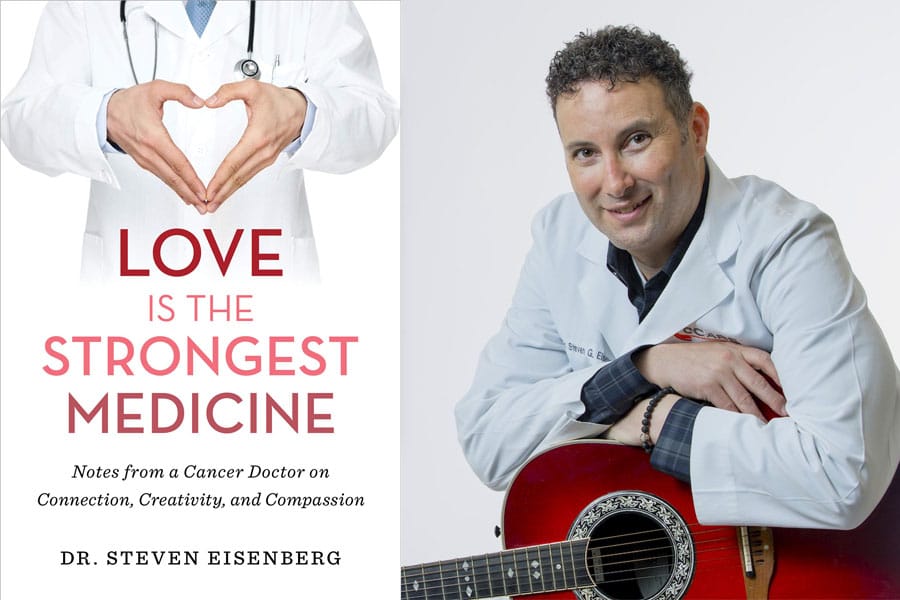
Book Review: “Love is the Strongest Medicine” by Dr. Steven Eisenberg

“Love is the Strongest Medicine” offers a revealing and intimate view of Dr. Steven Eisenberg’s two decades in oncology practice and traces the emergence of his unique persona: “the singing doctor.” A vivid storyteller, Eisenberg introduces us to a world of personal and medical challenges through his own story, interspersing it with the emotionally moving stories of numerous patients suffering from an eye-opening array of malignancies and attendant personal conflicts.

As an internist and geriatrician, I also inhabit the capricious world of medical illness revealed by Eisenberg. I have found that for some people, the flame of life burns so vigorously that it seems inextinguishable. For others, even young people, it can prove tenuous and at constant risk of flickering out. Tending the flame is never more dramatic than in oncology: the stakes are high and the margin for error, or even bad luck, is frighteningly narrow. Eisenberg possesses a gift for gleaning meaningful lessons from this high stakes arena. As we all eventually deal with illness and the inevitability of death, the lessons offer relevance beyond the world of cancer.

Tending the flame is never more dramatic than in oncology: the stakes are high and the margin for error, or even bad luck, is frighteningly narrow.

Eisenberg’s story begins at age 13 with a nearly fatal bicycle versus station wagon accident that set the stage for his medical career and teaches him about his own and others’ vulnerability as well as the value of compassionate care. The close call also provided a heartfelt personal lesson that he passes on both to patients and readers: don’t ever take life for granted. Indeed.

Eisenberg takes the reader through the challenges of medical school and the hazing-like rites of passage in his oncology fellowship at Georgetown University Hospital. There, the center’s arts and humanities program encouraged him to explore creative modalities to connect with his patients. He relates the story of “Ken,” a leukemia patient whose favorite song was “What a Wonderful World,“ and how singing the iconic tune together during a painful bone marrow extraction eased the procedure for both doctor and patient. Sharing music with patients turned out to be the most important of several modes used by Eisenberg to connect with patients on a deeper level. He tells the story of Janet, a pediatrician with stage IV metastatic cancer, enjoying her life to the fullest, to emphasize the need for cancer patients to grasp each moment, regardless of their prognosis. He also draws from the story of a patient who was a Buddhist monk to remind us to “be here now,” a lesson worth considering even for those in robust health.

Eisenberg’s transition from his Georgetown training to a private San Diego oncology practice was not a smooth one. He relates that the stresses of a productivity-based pay plan—caricatured as “eat what you kill”—created stress that distracted him from patient care and contributed to a series of personal maladies including asthma, migraines, insomnia and ulcerative colitis.

The potential conflict between the finance of medical practice and devotion to clinical care challenges many physicians, myself included. Even when intentions are altruistic, every practice must earn enough to pay its employees and keep the lights on. Eisenberg notes that when he joined colleagues in establishing cCARE, his current practice, his stress abated and his health issues improved. It’s likely that greater independence played a role in the abatement of his symptoms. Closer attention to the health practices he encourages for his patients—meditation, nutrition, personal connectivity—may also have proven important. Whatever the cause, the ultimate basis for Eisenberg’s apparent resolution of the issues is left as subject for speculation.

“Love is the Strongest Medicine” focuses intently on intense solo interactions between Eisenberg and his patients. This particular kind of one-on-one care is fading in American medicine as more team-oriented approaches take hold. As an internist, I refer patients to oncologists like Eisenberg for cancer care.  They continue to have hypertension, diabetes, asthma, and other active medical matters that I manage in coordination with the oncologist. Eisenberg never mentions his interactions with either primary care doctors or the infectious disease specialists, cardiologists, and others that contribute to his patients’ overall care. A bit more attention is given to allied health providers such as nurses and pharmacists, though they remain firmly in the background. The relative merits of  a more team-centered approach is debatable. Yet, one cannot help wondering whether Eisenberg’s own array of illnesses might have evolved differently were others sharing the burden of care.

Eisenberg’s singular devotion to each patient creates a world populated by the oncologist, the patient, the patient’s family, and the disease. Like all medical practices, this world is influenced by many externalities. The availability and the nature of health insurance towers above all others. Eisenberg recognizes this reality in his story of Clara, an undocumented and uninsured woman with Ewing’s sarcoma, an aggressive tumor that is rare in adults. Eisenberg labels the care system “ugly and embittering” for the obstructions it poses for the uninsured. His ultimately successful struggle to provide life-saving care to the embattled 20-year-old is one of the book’s highlights. Yet, Eisenberg does not comment on the tens of millions who are not undocumented and yet still lack basic coverage.

Like me, Eisenberg must encounter many more such patients without medical coverage. Prior to the protections of the Affordable Care Act (ACA) I assume that he  also encountered desperate patients asking him not to record a diagnosis on their chart in the hope that they would not lose coverage.  Eisenberg rightly encourages us all to take appropriate measures to protect our future health. Securing health insurance, for ourselves and others, belongs among those measures. That our wealthy society, an outlier among developed nations, fails to provide coverage for cancer victims and others deserves more than mere passing acknowledgment. Politics, like chemotherapy, often generates strong adverse reactions. An oncologist should not be too faint-hearted to deal with either.

Eisenberg maintains a clear and intense focus on both the individual patient and the reader.  That intimacy and the many hopeful tales are particularly valuable for patients embarking on cancer treatment and for affected families. As he notes, with one third of Americans expected to encounter an invasive cancer diagnosis at some point in their lives, the population at risk is large and growing. Those facing cancer, like others, would benefit from seizing the day, living the moment, and connecting with friends and family to create meaning in their lives. On that note, the singing doctor is pitch perfect.


Daniel Stone is Regional Medical Director of Cedars-Sinai Valley Network and a practicing internist and geriatrician with Cedars Sinai Medical Group. The views expressed in this column do not necessarily reflect those of Cedars-Sinai.

Book Review: “Love is the Strongest Medicine” by Dr. Steven Eisenberg Read More »

Death, Guilt and Innocence: An Ancient Lesson for Contemporary Times

It was a painful cri de coeur. A 22-year-old nurse wrote a letter to Rabbi Asher Weiss, asking how she could repent for a fatal mistake that she had made. She had been working in a coronavirus unit in a New York hospital at the height of the pandemic, and her supervisor asked her to add an additional overnight shift. A patient came in at 3:00 a.m. and was having great difficulty breathing. The hospital was short on ventilators, and the staff scavenged for whatever units they could find. This nurse was given an old, donated, home-use ventilator. Exhausted, she grappled with the unfamiliar machine, mistakenly putting the breathing tube into the wrong slot. She discovered her mistake only after the patient’s condition grew much worse. Sadly, he died soon after.

The nurse wrote to Rabbi Weiss saying she had not stopped crying since this happened. She asked him how she could atone for her sin.

Rabbi Weiss’s response is an example of true rabbinic brilliance; it was compassionate, clear and insightful. He explained to her that she should take pride in the knowledge that she spends every day helping to save the lives of others. If she failed to do so in this case, under extreme conditions, she should not feel guilty about it. First of all, failing to help is not the same thing as causing harm. He further explained, based on a remark by Nahmanides, that a medical professional can make fatal mistakes, but if they were deterred by the instances of failure, no one would ever take up the medical profession. Doctors and nurses must appreciate that they are engaged in a high risk profession; they cannot become paralyzed by worry. He concluded by telling the young woman that her mind should be calmed, and that she should be happy and positive.

Dozens of similar questions are found in the centuries of rabbinic responsa. The questions are all heartbreaking. Two different mothers, on different occasions, wrote to Rabbi Joseph Saul Nathanson about the deaths of their children; one failed to get out of bed when the baby had a crying fit, and found the baby dead the next morning. The other slept next to the baby, and presumably suffocated it by mistake during her sleep. Rabbi Akiva Eiger was asked to offer advice to a man whose son and his servant fell off his wagon and died. He recognized the accident occurred because he was driving too quickly. In the latter case, Rabbi Eiger advised the father to support poor orphans and to ask those the orphans to name a son after his son who died in the accident.

These responsa try to balance the imperative for responsibility and the need for forgiveness. The people posing the questions, like this nurse, are wracked by guilt, overwhelmed by the fact that their actions have caused the death of another. That is why they turn to their rabbi. They don’t know how they can live with themselves in the wake of such grievous errors. But at the same time, most of the cases take place in the gray area between a premeditated crime and a truly innocent mistake. Each reply attempts to encourage repentance while offering comfort.

This week’s Torah reading includes an important lesson about the gray area between absolute guilt and true innocence. When someone kills another person accidentally, they are exiled to a city of refuge. It is in this place of exile that they receive protection from the blood avenger, who is a member of the victim’s family. This very law seems to acknowledge that a person can be simultaneously innocent and responsible.

Accidental murderers are confined to the city of refuge. This type of home arrest seems to be a punishment, and infers a level of guilt. At the same time, accidental murderers are protected from the blood avenger, which seems to imply innocence. Even the very sentence imposed upon them has an enormous sense of grayness. They are to remain in the city of refuge until the death of the high priest. But how long will that be? A week? Fifty years? No one knows. It is a gray and ambiguous penance given to a gray and ambiguous crime.

The lesson of this passage is that there are times when a person must embrace responsibility and accept forgiveness at the same time. The trauma of having caused an accidental death can destroy a person’s life. In a 2017 article in The New Yorker, Alice Gregory wrote about six different people who had accidentally caused the deaths of others. Their pain is profound. In psychological terminology, they experienced moral injury. For this reason, the accidental killer seeks God’s atonement, hoping to be released from a crime they did not want to commit. Perhaps this is why all the cities of refuge were also the cities of Leviim. The Leviim served in the Temple. Shmuel David Luzzatto suggests that this means that the cities have a Divine character, and are an extension of the Temple in Jerusalem. By being gathered into God’s cities, the accidental killer experiences Divine forgiveness and protection.

The lesson of this passage is that there are times when a person must embrace responsibility and accept forgiveness at the same time.

But at the same time, the very need for exile is a reminder of the accidental killer’s responsibility. Rabbeinu Bachya explains that the accidental murderer often bears some responsibility. Even if the person was not negligent, there are many instances in which greater care could have been taken. The proper response to an accidental murder is to do a serious self-examination.

One hopes that will happen now, in the aftermath of the building collapse in Surfside. In a similar case in Israel, after the tragic collapse of a wedding hall in 2001, new legislation was introduced, and a method of building was outlawed. There are many mistakes that sit in the gray area between negligence and innocence; in cases where human life hangs in the balance, we must consistently check and recheck our standards to make sure those mistakes don’t occur again.

There are many mistakes that sit in the gray area between negligence and innocence; in cases where human life hangs in the balance, we must consistently check and recheck our standards to make sure those mistakes don’t occur again.

More significantly, we believe that every tragedy requires a response, even if we are completely innocent. The best response to moral injury is to look for redemption, to think of how to bring more goodness into the world. A classic example of this is personified by Dr. Gisella Perl. She grew up in pre-WWII Sighet, Hungary, and completed her post-doctoral studies in gynecology before her life was turned upside down. She was taken to Auschwitz, and found herself forced to work with Dr. Joseph Mengele. One of her responsibilities was to notify him regarding which Jewish women were pregnant. When she discovered that his sole intention was to perform medical experiments on these mothers and their fetuses, and then put them to death, Dr. Perl started to perform clandestine abortions on all the pregnant women in Auschwitz. She had to perform thousands of abortions. After the war, she went on to a distinguished career at Mt. Sinai Hospital in New York and volunteered her services at the Shaarei Tzedek Hospital in Jerusalem; she helped bring thousands of children into the world. Dr. Perl made it a habit to pray as she prepared to deliver each baby: “God, you owe me a life—a living baby.”

Guilt is painful; but the lesson of the Parsha is that even in such circumstances we can find refuge in God’s hands, and like Gisella Perl, bring redemption to the world, one baby at a time.


Rabbi Chaim Steinmetz is the Senior Rabbi of Congregation Kehilath Jeshurun in New York.

Death, Guilt and Innocence: An Ancient Lesson for Contemporary Times Read More »

A Bisl Torah: She’s Got Your Back

It’s a regular weekend occurrence for our family to venture to Target. This past Sunday, after checking out with items most certainly not on our list, we made our way to the parking garage. A homeless man took notice of how I held our sons’ hands, each with their fingers laced into my own. He smiled and spoke directly to Zachary and Henry, “Boys, take care of your mom. She’s got your back and you’ve got hers.”

I thought the boys would miss the conversation but Zachary gently looked up and said, “I know.”

I’m not sure what he knows: that I’ll always support him or that he supports me or both? It didn’t feel right to question or clarify his answer. Feeling heartened that my son understands the concept of holding someone up was more than enough.

Having someone’s back or offering unconditional support seems foreign, especially outside family circles. In a recent conversation with a colleague, we lamented how women in particular, learn the practices of gossip and belittling to help move up corporate ladders or advance in social circles. Why is it so hard to imagine room at the top for more than one? Teaching a curriculum of support is climbing together, ready with an open embrace and encouraging word when another falls off track.

Leviticus 25:33 teaches, “When your brother falls low and his hand falters beside you, then you shall strengthen him, sojourner or resident and he shall live beside you.” The Chofetz Chayim, a 20th century rabbinic commentator reveals that in the world to come, humanity will be questioned regarding their observance of mitzvot. But special attention is paid to whether we strengthened the hand of the fallen. He explains that a moment, our moment will come when only we can lift someone up. We can bolster someone’s spirits or let their hand falter, weakening before our very eyes.

There are so many things out of our control. This is something we know too well. But teaching, creating, and modeling circles of support…this is in our hands. May our children learn to catch someone when they fall. And may they learn from us, noticing our extended reach. This is our moment.

Shabbat shalom


Rabbi Nicole Guzik is a rabbi at Sinai Temple. She can be reached at her Facebook page at Rabbi Nicole Guzik. For more writings, visit Rabbi Guzik’s blog section from Sinai Temple’s website.

A Bisl Torah: She’s Got Your Back Read More »

Finding Freedom and Fireworks in Our Hearts with Cantor Emma Lutz

Shabbat Shalom! Thank you to Cantor Emma Lutz from Stephen Wise Temple for sharing her wisdom this past week about Fireworks, blessings and finding our way back to adventures. What she wrote really spoke to me and I asked for her permission to share it here:

MONDAY

As we continue to enjoy more normalcy after a challenging and unconventional year, the blessings of our life unfold renewed before us. This week, I will share some of the brachot (blessing) formulas that come from our tradition for special and eye-opening moments.  Every single year of my life—except the year that I lived in Jerusalem and celebrated in Gan Atzmaut, Independence Park—I have enjoyed Fourth of July fireworks with my father. Of course, I learned early on that Independence Day is our time set aside to honor the signing of the Declaration of Independence in 1776, officially forming the United States of America. And even with my pride in living in such a remarkable (if complicated) nation, I think of the Fourth of July as the day when I watch the night sky light up while laughing, joking, singing, and holding hands with my dad. I hope that yesterday you were able to enjoy seeing the night sky light up with fireworks, creating a new memory with loved ones, holding gratitude for our country’s rich history and for the gift of our independence, and perhaps experiencing awe and wonder for the greatness that is the sparkling sky above us. Our ancestors’ fascination with the sky and attempt to understand the great light shining down on us appears in the very first verses of our Torah. We read in Bereshit that God created the heavens and the earth first and immediately after, God created light; God quickly divided light from darkness and experienced the inherent goodness of it (Genesis 1:1-4). There is something so affirming, comforting even, about these first verses of Torah. As human beings, we stand small under the vastness of the great sky. And yet, as Jews, we trust that as we stare out into the sky, we are connected to God, connected to the first moments of creation, connected to something so much greater than ourselves. Of course, fireworks are manmade and temporary, but I love them because they draw our attention skyward in celebration and wonder. Our rabbis certainly did not have a blessing for fireworks, but they created blessings for the great lights above us, including lightning, comets, meteor showers, and shooting stars (and other natural wonders). May we continuously draw our attention to the sky and ponder the mystery of creation and our place in it with immense gratitude for the inherent goodness of God’s light.
ברוך אתה ה’ אלהינו מלך העולם עושה מעשה בראשית Baruch ata Adonai, Eloheinu melech ha-olam, oseh ma’aseh b’reishit Blessed are You, God, who re-enacts the work of creation
— Cantor Emma Lutz

TUESDAY

As we continue to enjoy more normalcy after a challenging and unconventional year, the blessings of our life unfold renewed before us. This week, I will share some of the brachot (blessing) formulas that come from our tradition for special and eye-opening moments.  Both wisdom and mysticism are embedded in the highly organized, ancient grammatical system of biblical Hebrew that also crafts our blessings. Hebrew, as you might already know, is formed on a system of three root letters attached to every word, creating organic connections between words with the same root. The Hebrew word for blessing, bracha, which comes from the Hebrew root bet reish chaf, is linked to the word to both breicha, or wellspring, and berech, meaning knee. I love these associations because, of course, we often bend our knees in the ritual of prayer, and it seems only fitting that our blessings are identified with a great wellspring, ever-flowing if only we open our eyes to life’s generous offerings. In addition to adhering to a brilliant set of grammatical laws, Hebrew letters also hold numerical values. The letters for blessing—betreish, and chaf—are assigned the values 2, 20, and 200 respectively. The word bracha (blessing) is made up of a series of twos, signifying the multiplicity of our blessings and insinuating the power of reciting a bracha to bring even more goodness into the world. When I think of one of the most special blessings in life (albeit mundane or overlooked because we ideally have access to it every single day), I think of food. Enjoying food is an opportunity to nourish our bodies, but also a time to share with others and to create new memories around meals, multiplying the blessings of our health and our joy. While we often recite HaMotzi, our prayer for bread, there are many Hebrew blessings for specific types of cuisine and one prayer that can be recited over almost any type of food. This week, take an extra ten seconds at meals to express gratitude for the wellspring of sustenance available to you.
.בָּרוּךְ אַתָּה יְיָ אֱלֹהֵינוּ מֶלֶךְ הָעוֹלָם שֶׁהַכֹּל נִהְיָה בִּדְבָרוֹ Barukh ata Adonai Eloheinu melekh ha’olam shehakol niyah bidvaro. Blessed are You, God, at whose word all that is offered to us came to be.
— Cantor Emma Lutz

WEDNESDAY

As we continue to enjoy more normalcy after a challenging and unconventional year, the blessings of our life unfold renewed before us. This week, I will share some of the brachot (blessing) formulas that come from our tradition for special and eye-opening moments.  When I became a mother for the first time in January 2020, new blessings unfolded before me in so many magical and unexpected ways. And two days after finally accompanying my daughter to receive her eight-week shots, allowing us the new freedom to take her out of the house safely, our city and much of the world beyond went into lockdown. Like so many parents, grandparents, and caregivers, we spent a year-plus finding ways to entertain and teach our child exclusively at home. As we have slowly regained normalcy, our lives have opened up in so many seemingly routine but now extra special ways. After so much loss, life’s blessings still abound. Last month, for the very first time, we went with Ruby and her friend, Ziggy, to the zoo! For many months prior, we read books at home about all of the different kinds of animals, from basic birds to giant elephants to the rare okapi, Ruby’s favorite. Watching her and Ziggy’s eyes open widely to the new wonders of the animal world after spending the majority of their life at home brought tears to my eyes. We missed so much, but we have so much to look forward to, and these beautiful children (like all of us) are so grateful and excited for all of the exploration ahead. There is a hilarious and endearing Yiddish term that my grandparents used to describe us kids when we were particularly rambunctious—vilde chaye—lovingly likening us to wild animals. Each of us, kids and adults alike, might feel a bit like newly freed animals who are tentative but excited to explore the world again. For those of us enjoying the zoo, taking trips to Yosemite and other national parks, or gazing upon animals outside our windows, our tradition teaches us to recite a special blessing upon seeing unique animals, an invitation to acknowledge the majesty of the sacred creatures with which we share God’s earth. Wishing you adventurous time out of doors this summer and many opportunities to utter this special blessing!
.בָּרוּךְ אַתָּה יהוה אֱלהֵינוּ מֶלֶך הָעולָם משנה הבריות Baruch ata Adonai, Eloheinu melech ha-olam, m’shaneh habriyot. Blessed are You, God, who makes creatures different.
— Cantor Emma Lutz
 

See Ruby in action

THURSDAY

As we continue to enjoy more normalcy after a challenging and unconventional year, the blessings of our life unfold renewed before us. This week, I will share some of the brachot (blessing) formulas that come from our tradition for special and eye-opening moments.  Now that the world is slowly and, God willing, safely returning to a new normal, many of us are planning long-awaited trips to visit family and friends, to enjoy the calm and beauty of a beach, or to see a new city we have long-yearned to explore. Travel is an opportunity for us to open up our lives to new experiences and to create sacred memories that sustain us through difficult times. Even a short or nearby trip can help us change our perspective, reset, or feel a deeper sense of appreciation for what we have at home. When I was nineteen, I took my first trip to Israel, which changed my life in so many ways. While preparing for that trip through Birthright and my UC Davis Hillel, I was given a small Traveler’s Prayer (Tefillat HaDerech) that I still carry in my wallet to this day. Every time Adam and I get on an airplane, we hold hands and recite the special prayer for travel. I have missed this ritual, a moment that not only helps me set an intention for a safe journey, but a special time set aside to fall into the rhythm of the comforting Hebrew words, to connect with my husband, and to express my deep gratitude for the great opportunity to wander God’s earth. For those of you who are planning to travel near or far in these summer months or anytime in the future, I hope that this blessing will open your trip in thankfulness, safety, and presence. Nisiah tovah, safe and happy travels!
יְהִי רָצוֹן מִלְּפָנֶיךָ ה’ אֱ-לֹהֵינוּ וֵא-לֹהֵי אֲבוֹתֵינוּ, שֶׁתּוֹלִיכֵנוּ לְשָׁלוֹם וְתַצְעִידֵנוּ לְשָׁלוֹם. וְתִסְמְכֵנוּ לְשָׁלוֹם. וְתַדְרִיכֵנוּ לְשָׁלוֹם. וְתַגִּיעֵנוּ לִמְחוֹז חֶפְצֵנוּ לְחַיִּים וּלְשִֹמְחָה וּלְשָׁלוֹם וְתַצִּילֵנוּ מִכַּף כָּל אוֹיֵב וְאוֹרֵב וְלִסְטִים וְחַיּוֹת רָעוֹת בַּדֶּרֶךְ וּמִכָּל מִינֵי פֻּרְעָנִיּוֹת הַמִּתְרַגְּשׁוֹת לָבוֹא לָעוֹלָם וְתִשְׁלַח בְּרָכָה בְּכָל מַעֲשֵֹה יָדֵינוּ, וְתִתְּנֵנוּ לְחֵן וּלְחֶסֶד וּלְרַחֲמִים בְעֵינֶיךָ וּבְעֵינֵי כָל רוֹאֵינוּ וְתִשְׁמַע קוֹל תַּחֲנוּנֵינוּ. כִּי אֵ-ל שׁוֹמֵעַ תְּפִלָּה וְתַחֲנוּן אָתָּה: בָּרוּךְ אַתָּה ה’, שׁוֹמֵעַ תְּפִלָּה. Y’hi ratzon milfanekha A-donai E-loheinu ve-lohei avoteinu she-tolikhenu l’shalom v’tatz’idenu l’shalom v’tadrikhenu l’shalom, v’tagi’enu limhoz heftzenu l’hayim ul-simha ul-shalom. V’tatzilenu mi-kaf kol oyev v’orev v’listim v’hayot ra’ot ba-derekh, u-mi-kol minei pur’aniyot ha-mitrag’shot la-vo la-olam. V’tishlah b’rakha b’khol ma’a’se yadeinu v’tit’nenu l’hen ul-hesed ul-rahamim b’einekha uv-einei khol ro’einu. V’tishma kol tahanuneinu ki E-l sho’me’a t’fila v’tahanun ata. Barukh ata A-donai sho’me’a t’fila.
May it be Your will, our God and God of our ancestors, that You lead us in peace and help us reach our destination safely, joyfully and peacefully. May You protect us on our leaving and on our return, and rescue us from any harm, and may You bless the work of our hands, and may our deeds merit honor for You. May you hear our requests and our prayers. Praise to You, Adonai, who listens to prayer. — Cantor Emma Lutz


Cantor Emma, Thank you for all of the blessings and for including the traveler’s prayer! Thank you for the music and your stories to guide our way! Lisa MORE WISDOM FROM CANTOR EMMA: 

Finding Freedom and Fireworks in Our Hearts with Cantor Emma Lutz Read More »