fbpx

July 9, 2021

Finding Refuge/Teaching in Exile – Comments on Torah Portions Mattot-Massei

Reflections on Torah Portion Mattot-Masei

Teaching in Exile

This week’s Torah portion is a double portion. The reason we have double portions is so that during a Jewish leap year, when there are 13 months instead of 12, we can “unpack” the double portions so that each Shabbat in a leap year has its own Torah portion. When there is no leap year, such as this year, certain portions double up. This double portion ends the book of Numbers (Ba-Midbar – “in the desert” in Hebrew).

Many of the themes in these two Torah portions have to do with final matters before the Israelites enter the Land of Canaan. One of these matters is the concept of the “cities of refuge” that will be established in the land. The Cities of Refuge are set up for cases of negligent homicide.

In ancient times, when a person killed someone accidentally but negligently, that person was still subject to the vengeance of the family of the deceased. In most pre-modern culture, any member of the opposing group in a feud would suffice for vengeance. If a Hatfield killed a McCoy, then a McCoy killed a Hatfield.

The law in this week’s portion, the “Blood Avenger” (go’el ha-dahm) was a step forward in the development of law. Instead of all the members of group being held responsible for a killing, only the actual perpetrator was held responsible. The offended clan or family would send out a Blood Avenger to seek retributive justice. The perpetrator could flee to a “city of refuge” to have the case heard.

If the killing were deemed completely accidental, the person is free to go. If it turns out that the person committed willful murder, the court hands him over to the Blood Avenger, who slays the murderer.  If the killing were negligent, but not intentional, the person can stay safely in the city of refuge until the current High Priest dies. At that time, the Blood Avenger is relieved of his duty to avenge the blood of his kinfolk, and the perpetrator can leave the city safely.

This law clearly seems to be intended to prevent something rampant in pre-modern times, and still in force in many places today: the vendetta. If a person from one tribe, group, gang, mob, race, religion, nation etc., kills a person from another group, the offended group feels it has the right and duty to kill any member of the group of the perpetrator. Destructive feuds follow. This law takes us a step out of the primitive world of blood vengeance and limits the avenger to killing only the perpetrator and introducesd the intervention of a court to adjudicate the case. The avenger is, of course, an executioner, but only of someone who has committed intentional murder.  Accidental killings are excused and negligent homicides are handled with the city of refuge.

The Talmud takes this wise and fairly straightforward law into unforeseen territory. The Bible says in Deuteronomy 4:42, where the matter is reviewed, that that person guilty of negligent homicide can flee to a city of refuge “and live.” ”.  The Talmudic rabbis ask what it means “to live.”  Obviously, he goes there to live and not to die; that is the purpose of the law. “To live” must mean something else. The rabbis decide (as recorded in Tractate Makkot 10a) that a person cannot live without the study of Torah, so if a person is exiled to the city of refuge, his teacher must go with him. And where the teacher goes, the whole yeshivah goes.

This reading of the text is, of course, contested, and there is no recorded case of a rabbi and the yeshivah following a negligent killer into the exile of a city of refuge (at least partly because rabbis and yeshivahs did not exist in the time of the Bible.)

The Talmud is probably referring to something deeper, something that every real parent, teacher, healer, therapist, life coach, mentor, true friend, etc. knows:  you can only guide another person if you are willing to go into the exile experienced by the person for whom you are caring.

The empathy and insight required for true guidance requires that the person who assumes the role of guide can somehow peer into the soul of the suffering one and not be defended from what one sees there.

The true witness to the suffering of another will not be untouched. Perhaps this is the mark of a healing presence, whether family, friend or counselor:  the willingness to suffer some of the exile of the one in pain. The rabbi of the man who kills negligently must go into exile with him, we are taught, as well as the entire yeshivah. I try to imagine how the curriculum of this mythological yeshivah is affected, as the students in this yeshivah in the city of refuge are by now mostly those guilty of negligent homicide.

I mean all of us. Relationships are often killed, negligently, by a thousand cuts. We often kill ourselves spiritually with relentless negative inner voices, cutting away at our sense of self.  We need to flee to the city of refuge, a state of mind in which we admit that we are sometimes slowly and negligently killing the spirits of others, killing relationships, killing our own well-being. In that exile in the city of refuge, we can confront that destructive negligence and seek the teaching that will release us.

Imagine that we are all in exile, all seeking the city of refuge, all seeking the teaching that will help us stop destroying that which we treasure.

Off the top of my head, here are two little teachings. We all live with resentment and regret. You are not human if you have not been hurt or regret hurting yourself or others. But we ought not be weighted down into the past. Each day is a day that opens onto a new horizon, a new canvas for self creation. Voices of resentment and regret must be addressed (they never go away), but they ought not dominate our inner dialogue. Our inner life should be guided toward openness, hope and joy.

A second teaching:  understand poetry and irony. Oftentimes, the greatest teachings are taught through metaphor and misdirection, bypassing the defended and skeptical ego self, directly reaching the heart. The path to free will is not free.

Shabbat Shalom!

Finding Refuge/Teaching in Exile – Comments on Torah Portions Mattot-Massei Read More »

Twitter Deplatforms White Nationalist Nick Fuentes

Twitter has de-platformed Nick Fuentes, who has been designated as a white nationalist by the Department of Justice.

Forbes reported that Fuentes posted on Telegram that his Twitter ban is the result of the Anti-Defamation League (ADL), which posted a “Five Things to Know” article about him. One of the things on the list was that “Fuentes has used his platforms to make numerous antisemitic and racist comments.” As examples, the ADL pointed to Fuentes calling Daily Wire writer and podcast host Matt Walsh a “shabbos goy race traitor” and Fuentes claiming the official six million Holocaust figure is overexaggerated, drawing a comparison with cookies in ovens; Fuentes has claimed he was kidding but wouldn’t retract the statement. Additionally, the ADL pointed to Fuentes calling for Republicans to tackle “Jewish Power” and that he doesn’t “see Jews as Europeans and I don’t see them as part of Western civilization.”

“Was it the Holocaust denial or the constant support for white supremacist ideology?” writer and activist Yoni Michanie tweeted. “Either way, good.”


Daily Wire Editor Emeritus Ben Shapiro tweeted, “Nick Fuentes is a garbage person with garbage beliefs. Twitter is also filled with lots of garbage people with garbage beliefs. Only certain people get banned. Nobody should trust Twitter’s supposed free speech neutrality.”


Pro-Israel activist Hen Mazzig tweeted, “The question is not why Nick Fuentes was banned from Twitter, it’s why Twitter did allow a Neo Nazi leader like him have an account in 2021?”


Fuentes had been in the news recently after a flyer circulated on social media about a fundraiser that Representative Paul Gosar (R-AZ) would be holding with Fuentes; Gosar later said he had no knowledge of the fundraiser.

In a July 4 op-ed for the Journal, George Washington University student Jack Elbaum urged conservatives to disavow Fuentes. “It should not be supremely controversial to suggest that white nationalism should fall outside of our limits of socially acceptable ideas. U.S. history since the 1960s has been, in part, characterized by a country-wide reckoning with our discriminatory and racist past. To believe that voices who advocate a retrogression to those backward times should be given just as much legitimacy as any other view is absurd.”

Twitter Deplatforms White Nationalist Nick Fuentes Read More »

ADL CEO Says There’s an “Antisemitism Problem” on the Left

Anti-Defamation League (ADL) CEO Jonathan Greenblatt declared in a July 9 Newsweek op-ed that there’s an “antisemitism problem” on the left.

“While extremism on the right has dominated the public conversation for much of the past five years, from moments during the 2016 campaign to the Jan 6 insurrection, right now the challenge is also rising among certain elements of the far left,” Greenblatt wrote. “Over the past several months, we’ve witnessed a series of incidents in which progressive activism, often displayed as pro-Palestinian advocacy, has morphed into single-minded anti-Israel aggression—and sometimes outright antisemitism. We all watched in horror as Jewish diners at a restaurant in Los Angeles were attacked and a Jewish man was beaten in broad daylight near Times Square – both by participants in pro-Palestinian demonstrations.”

He blamed the recent spike in antisemitic incidents in part on “an anti-Israel animus,” including from “some members of Congress who have made spurious claims about Israel’s actions and pushed a narrative that falsely accuses Israel of ethnic cleansing, systematically murdering Palestinian children, or of somehow being an apartheid state.” As examples, Greenblatt pointed to Representative Betty McCollum (D-MN) introducing a bill that called for the Biden administration to cease funds to Israel for “bombing Gaza into oblivion” and Representative Ilhan Omar (D-MN) comparing the United States and Israel to Hamas and the Taliban.

“This kind of anti-Israel sentiment is not limited to the halls of Congress,” Greenblatt wrote. “It is spreading. And it is dangerous.”

In the cultural sphere, Greenblatt pointed to instances in which a man’s restaurants in Detroit were given one-star reviews because of his open support for Israel and how “an Israeli food truck was disinvited from a [Philadelphia] food festival after organizers received threats because of its participation.” Overall, the ADL has recorded 251 antisemitic incidents since May 11, a 115% increase over the same timeframe a year ago.

“Demonizing Zionism as a concept represents a kind of anti-Jewish racism,” Greenblatt wrote. “Delegitimizing the Jewish state with exaggerated claims and unhinged charges, then dismissing the connection between that level of inflammatory rhetoric and the violence perpetrated against Jewish people, is willfully ignorant at best, intentionally malign at worst. Excluding Jews from political coalitions or public activities is discrimination, plain and simple.”

Greenblatt noted that some progressives have spoken out against antisemitism from the left, “but we need all our allies to listen and others to engage authentically. This might not be easy. It may require some serious self-reflection on the part of some partisans in order to admit their biases and acknowledge their insensitivity. But it’s imperative that leaders from all corners of society clearly, forcefully, unequivocally condemn antisemitism full stop.”

Writer Peter Fox tweeted that Greenblatt’s op-ed was “stunning.” “Antisemitism isn’t exclusive to one party. It is pervasive. A very sad, but important read.”

https://twitter.com/thatpeterfox/status/1413605784936718338?s=20


ADL CEO Says There’s an “Antisemitism Problem” on the Left Read More »

The Progressive Quandary

“Why do we hurt the people we love?”

It’s an age-old question one might ask of today’s progressive movement. Progressives are committed to helping women and children, racial minorities, the poor and the endangered. Yet in many instances the policies for which many progressives fight are fundamentally inconsistent with the goals of the movement.

Progressives see themselves as champions for the rights of women, yet many deny the existence of biological sex, demanding that transgender women be treated as biological women, whether in sports, the choice of public restrooms, or even in prisons. In California—and nationwide if Congress passes the Equality Act—biologically male prisoners can transfer into women’s prisons based on “individual preference,” without regard to hormones, surgery, or time spent living as the opposite gender. One can imagine the potential danger to which biological women might be exposed if forced to share a cell, or just to be in enclosed spaces, with a transgender woman.

While transgender women using a women’s restroom may not be as potentially dangerous as the forcing together of biological women with transgender women in prisons, many women are uncomfortable with the idea that they may be sharing the intimate space of a restroom with a biological male they do not know. Many progressives even oppose notifying women that biological males may be using women’s restrooms. The American Civil Liberties Union has filed a federal lawsuit challenging a Tennessee law that requires businesses and government facilities to post signs if they permit transgender people to use public restrooms of their choice.

Progressives have been known for their work on behalf of the rights of children. One would expect that preventing children from making irreversible surgical and medical changes to their body when they are not emotionally or psychologically mature enough to make these decisions would be at the forefront of their activism. Progressives, after all, recognize that teenagers are often mentally and emotionally immature—indeed, they insist that individuals under age 21 who commit crimes should be tried as minors because they are not mature enough to be held responsible for their actions–while still arguing that teenagers should be permitted to make permanent changes to their bodies.

One would expect that preventing children from making irreversible surgical and medical changes to their body when they are not emotionally or psychologically mature enough to make these decisions would be at the forefront of their activism.

In her controversial book “Irreversible Damage: The Transgender Craze Seducing Our Daughters,” Abigail Shrier suggests that in many cases young girls are not seeking surgical gender reassignment due to transgenderism or gender dysphoria, but as a result of other mental conditions or simply because of the allure of the social capital that comes with being transgender in a society that values marginalized positions. Shrier does not argue that surgical gender reassignment procedures should be off limits, but rather that children should not be able to make these decisions before they reach an age at which they are more psychologically mature. Many progressives, on the other hand, demonize perspectives like Shrier’s—perspectives that, ironically, protect children—in favor of positing that children have the right to modify their bodies in irreversible ways.

Schools are another battleground where progressive politics have an immense impact. Progressives want to improve educational outcomes for minority and low-income students, yet many oppose charter schools even when those schools provide education superior to public schools, and even when they serve primarily minority and low-income students, as in Newark, New Jersey, where 80% of the 20,000 students in charter schools are black and 16% are Hispanic, and 8,000 students are on charter waiting lists.

In the Los Angeles Unified School District, where tens of thousands of students have been on waiting lists for charter schools, progressives criticized charter schools because only 72% of students in those schools are living in poverty, while the percentage was 16% higher in non-charter schools. They also argue that charter schools take funding from public schools, although studies differ on this, with some indicating that in most states an increase in the percentage of students attending independent charter schools was associated with a significant increase in their host districts’ total revenue per pupil, total spending per pupil, local revenue per pupil, and per-pupil spending on support services.

While expressing concern for the safety of minorities, progressives argue that police funding should be reduced (initial rhetoric used the term “defunding,” but this proved to be a highly unpopular way to frame the argument) because of police misconduct toward people and communities of color. Yet a 2019 Vox poll found that despite being the racial group with the most unfavorable view of the police, most people in the Black community nevertheless support hiring more police officers. A June 2020 survey, taken after the killing of George Floyd, found that 50 percent of Black respondents still said that more police officers were needed on the street. This is hardly surprising, since according to a National Neighborhood Crime Study, predominantly Black neighborhoods average five times as many violent crimes, and Latino neighborhoods average about two and a half times as many violent crimes, as predominantly white neighborhoods.

In addition to hardline stances on domestic culture war issues that are contrary to their general philosophy, many who call themselves progressives have an increasingly problematic view of Israel. Although President Biden states, “I think that my party still supports Israel,” high-profile progressives such as New York Representative Alexandria Ocasio-Cortez and Senator Bernie Sanders have harshly criticized Israel in connection with the recent Gaza war, frequently noting the disparity in casualties, calling Israel an “apartheid state,” and questioning the $4 billion in aid the U.S. gives Israel as well as a recent $735 million arms sale. As noted by Ben Rhodes, a former deputy national security adviser in the Obama administration, “There was never this kind of pressure vocally from the left on issues related to Israel.” Never mind that Israel’s enemies are hardly models of democracy, respectful of their citizens’ freedoms or even their lives, or that less aid or reduced arm sales could render Israel—which President Biden says his party supports—less able to defend itself.

In addition to hardline stances on domestic culture war issues that are contrary to their general philosophy, many who call themselves progressives have an increasingly problematic view of Israel.

So why do progressives, while professing support of women, children, minorities, and even Israel, often favor policies that are inimical to the very people they seek to help?

Perhaps the progressive focus on the concept of equality, which has recently been replaced with “equity,” provides an explanation. Equity has less to do with ensuring that all people start from a place of equal opportunities and resources than it does with ensuring that all people end up at the same place regardless of personal choices. In other words, if some children get a better education than others; or if transgender women are not treated in the same way as biological women; or if police treat minority communities differently than middle-class white communities; or if children do not have full control over their bodies; or if Israel has overwhelming fire power when compared to its adversaries, the answer is policies that lessen the disparity without regard to the broader consequences of those policies.

Are educational opportunities unequal? Limit better opportunities. Does inequality between adults and children exist when it comes to control of one’s body? Emphasize freedom of choice even for children whose choices may later be regretted. Are transgender people treated differently from those whose genders align with their biological sex? Treat the two groups exactly the same, pretending that differences do not exist. Do police focus inordinately on minority communities? Reduce the number of police. Is the power struggle between Israel and Hamas characterized by inequality? Support policies that disadvantage Israel.

The quest for equality is at the core of progressive ideology. It may sound like a noble pursuit, but ideological purity often results in policies that damage real human beings, and even the people we love.


Gregory R. Smith is an appellate attorney and occasional contributor to the Jewish Journal.  He is of counsel to the Los Angeles firm of Lowenstein & Weatherwax.

The Progressive Quandary Read More »

I’m a Former Jewish Refugee. Would “The Squad” Have Given Me Refuge Today?

Lately, as I’ve been reading about newer members of Congress who clearly have a problem with Jews, I’ve found myself repeatedly asking, “Where’s my blood pressure medicine?” The only problem? I don’t have high blood pressure.

But there was something about watching Rep. Ilhan Omar’s (D-MN) interview with CNN’s Jake Tapper last week, in which she suggested that Jews aren’t “partners in justice,” or her recent accusation that the United States, Israel, Hamas and the Taliban are basically the same entity, that really triggered me.

There was also Omar’s recent condemnation of the Biden administration’s air strikes against Iranian-backed militias near the Iraq-Syria border. The congresswoman criticized U.S. policy that targets terrorists who pose direct risks to American personnel and facilities abroad. Seven of them were killed by American airstrikes last week. Omar condemned the “cycle of violence and retribution.”

Yes, she sits on the House Foreign Affairs Committee. And I’m starting to think that her pursuit of justice is only reserved for undermining Israel; in 2019, she didn’t even vote “yes” on a House resolution recognizing the 1915 Armenian genocide, in which Ottoman Turkey killed 1.5 million Armenians. How did Omar vote? “Present.”

Suffice it to say, the past few weeks have forced me to contemplate whether I should at least have a sphygmomanometer in the house.

I was raised to be diplomatic, but in this case, I’ll be blunt: I can’t take Omar anymore.

And that has made me ponder something very sad, but probably true: If she and other members of “The Squad,” including Alexandria Ocasio-Cortez (D-NY), Ayanna Pressley (D-MA), and Rashida Tlaib (D-MI) were in direct control of allowing persecuted Jews into the United States as refugees today, perhaps few of us would be given refuge.

Yes, I realize that the previous administration’s policies against refugees entering the U.S., as part of former President Donald Trump’s “Muslim ban,” was abysmal. And yes, I know that I’m only speculating about a few, fringe congressional leaders while the last administration actually blocked refugee resettlement on levels previously unseen in this country.

But it just so happens that I know a thing or two about Jewish refugees. In 1989, my family and I entered this country through the invaluable efforts of HIAS, an organization that provides humanitarian aid and assistance to refugees, as protected Jewish refugees from Iran.

I can’t help but compare “The Squad” to American leaders in the 1970s and 1980s, including Senator Ted Kennedy (D-MA), who sponsored the U.S. Refugee Act of 1980, and Senator Frank Lautenberg (D-NJ), whose 1989 landmark legislation, eponymously known as the Lautenberg Amendment, allowed between 350,000-400,000 Jews and other religious minorities from the former Soviet Union to resettle safely in the U.S. as refugees. In 2004, the amendment was extended to Jews, Christians, Baha’is, and other religious minorities who sought to flee Iran.

In the 1970s, the Jackson-Vanik amendment, co-sponsored by Sen. Henry “Scoop” Jackson (D-WA) and Rep. Charles Vanik (D-OH), enacted changes to the Trade Act of 1974 and effectively restricted American trade with Communist-bloc countries that blocked Jewish emigration and denied Jews other human rights. American trade became tied with the human rights of Jews. Imagine that?

Thankfully, Omar, Tlaib, Ocasio-Cortez and Pressley aren’t senators. But think about it: Given their deeply disturbing (and unabashedly public) views on Jews, why would they allow people whom they believe to be apartheid-practicing, money-controlling, minority-crushing, privileged oppressors into this country? (Although, frankly, it pains me to admit that I also question how much these lawmakers even like America, which they view as a bastion of racism).

In May, amid the fighting between Israel and Hamas, these American leaders were accused of proliferating messages that incited violence against Jews, whether Jews who were beaten in the streets in Los Angeles, New York, or, in the case of a horrifying incident last week involving a rabbi, stabbed outside of his home in Boston. What would make anyone think that if the leaders of “The Squad” had enough power, they wouldn’t subtly do things to keep “too many” Jews from entering the U.S.?

It’s a bold question, but it’s one worth asking. My childhood in post-revolutionary Iran taught me to take the words of leaders at nothing less than face value. No rationalizations.

My childhood in post-revolutionary Iran taught me to take the words of leaders at nothing less than face value. No rationalizations.

Ironically, watching American Jewish political behavior taught me to what lengths Jews in this country will go to rationalize and excuse antisemitism from their own beloved political parties.

For the record, I’m not imagining unlikely scenarios about desperate Jews in need of refuge. The era of Jews of fleeing oppressive countries is far from over. In fact, as long as there are Jews and oppressive regimes around the world, it will never be over. Think Venezuela. Or Iran. Or Libya. Actually, there isn’t a single Jew in Libya today. Not one, from the nearly 40,000 Jews who were still there in 1948.

There are, however, still up to 8,000 Jews in Iran, the largest population of Jews in the Middle East outside of Israel. What will happen if the regime, in a final, desperate act of scapegoating to maintain power, targets them?

Or what about the Jews of France, who, at nearly 500,000 people, constitute the biggest Jewish population in Europe? In the last two decades, tens of thousands of Jews have already left France for the safety of Israel or the U.S. Perhaps you’ll think me glib, but what will happen if France becomes like Iran or the former USSR of the late 1970s and 1980s, not in terms of becoming a dictatorship, but in terms of devolving into a place from where Jews desperately need to flee persecution?

While “The Squad” doesn’t have enough power to keep Jews out of America, I wouldn’t be surprised if, should there be a large resettlement of Jews in this country in the next few years, these controversial leaders would condemn this policy, citing concerns about justice, favoritism, and privilege. Let’s just say that if someone had seen my family and I as we awaited American asylum in a resettlement town in Italy, the last word that would have described us would have been “privileged.”

Let’s face it: If Rep. Omar can’t even condemn the stabbing of an American rabbi in 2021 (was Twitter down for a whole week?), I’m not exactly convinced that she will welcome Jewish refugees from Iran at Dulles Airport, while waving a little American flag.

Maybe some will accuse me of criticizing these leaders because they label themselves as staunch progressives. It has nothing to do with that.

But I also don’t believe in being selectively progressive. Using language that dehumanizes Jews and incites attacks against them on American streets isn’t progressive; believing that Jews have too much money and power isn’t progressive (it’s actually as old-fashioned as you can get); and not offering one word of condemnation or sympathy when a Jew is stabbed outside his home isn’t exactly progressive, either.

While it’s true that people can change—and their ideas and behaviors can evolve—sometimes, if fed enough misinformation against Jews, and if supported by enough radicals (including financial support), some leaders can actually go in the other direction. Case in point: It was then-President Jimmy Carter who signed the 1980 Refugee Act into law, which enabled tens of thousands of Jews, including my family, to come to this country. But given his decades of dangerous Israel-bashing and cozying up to some of the world’s biggest antisemites, look how he turned out.


Tabby Refael is a Los Angeles-based writer, speaker and civic action activist. Follow her on Twitter @RefaelTabby

I’m a Former Jewish Refugee. Would “The Squad” Have Given Me Refuge Today? Read More »

Ode to a Matzo Ball

I’ve never understood the appeal of a matzo ball. No great beauty, the spongy dough ball just sits there, taking up space in an otherwise nice bowl of chicken soup. As a kid I dreaded encountering it at holiday tables. No matter how hard I tried, I could never bring myself to finish, or even start, the scary soup.

Looking back, my aversion may have had something to do with a fear of carbohydrates passed along at an early age by my mother. “Cut back on the bread,” mom would warn me at breakfast as she pulled out the doughy centers of bagels and rolls and tossed them in the trash to save calories—a confusing dictum for a kid who still wasn’t eating her crusts.

I asked myself, “What is a matzo ball, after all, if not a bland, giant, doughy center with no crust?” I learned to hold my nose and pretend to taste as a guest at other people’s seder tables for the next 60 years.

But how could I give up on a food that so many treasured? When I read about the new restaurant Birdie G’s opening on the Westside in 2019, my matzo ball radar screen started blinking. Apparently, James Beard award-winning super chef Jeremy Fox was serving dishes like matzo ball soup and kugel inspired by his Jewish grandmother, Gladys, alongside creations like ‘Nduja & Strawberry Cavatelli with Calabrian chili and fennel pollen inspired by his experience cooking in Michelin-starred restaurants in the Bay area. ‘Nduja is fermented pork salumi, in case you don’t know. His $15 bowl of matzo ball soup featured in every review is described as a masterpiece—the major reason to go.

As soon as the pandemic started slowing down in early May, my husband and I nabbed a reservation on the patio to celebrate being alive and to taste the signature soup. Located in Santa Monica near Bergamot Station, the restaurant’s design was in perfect harmony with the chef’s modern concept. Zen-like in its simplicity, the patio was dotted with native plants, gravel pathways and well-sculpted trees. All was understated California chic. The eclectic menu sounded wonderful with inventive items like duck oca kebabs in beet coulis and a salad of several types of spring peas with burrata. The Jewish dishes were more like an add-on than the main event.

The matzo ball at Birdie G (Photo by Helene Siegel)

We started, of course, with the matzo ball soup with a side of house made matzo served with a generous dollop of perfectly salted butter. The soup was set on the table ceremoniously with a gold-plated spoon. After taking a photo for posterity, I dug in with a full heart, hoping to finally discover what my friends have been kvelling about all these years. Disappointment swiftly followed. The broth was deep, dark and mysterious with a musty, fermented flavor that caught in my throat. Lots of healthy things were floating in it. The ball itself, about the size of a small melon and nearly filling the bowl, was dense and tasted of many exciting things in addition to bland matzo. My husband’s judgement was less harsh. Never a man to turn down a matzo ball, especially one priced at $15, he deemed it “not bad.” To be honest, I loved everything else about the restaurant and would gladly go back. The dessert, a mini empress date bundt cake in a lake of molasses syrup, more than made up for my earlier stress.

Not ready to give up, I continue to study the beloved specialty. In reality, there is no one authentic matzo ball. As with many things Jewish, argument is baked into the story. Historically, the long-standing disagreements are over size and texture. Mimi Sheraton and Joan Nathan, historians of Jewish cuisine, agree on a ball no bigger than a walnut, as does the 1965 edition of “The Settlement Cookbook,” the Jewish “Joy of Cooking.” Meanwhile, the homely matzo ball grew to gargantuan proportions, as do many foodstuffs, here in the U.S. thanks to Jewish delis. So the same guys who gave us sandwiches stuffed with a pound of warm corned beef or pastrami, were also responsible for steroidal matzo balls?

In reality, there is no one authentic matzo ball. As with many things Jewish, argument is baked into the story.

Still on a quest to understand this inexplicable passion, I picked up my research recently with a visit to Langer’s, whose matzo ball soup is on every top five list in the city. At $5.95, they serve two tennis ball-sized dumplings in a bowl of pale-yellow broth devoid of any distractions—no soggy carrots, celery, or herbs. The ball itself is mild and fluffy. It offers absolutely no resistance when you take a bite—as my husband pointed out, you don’t even need teeth to eat it! The gestalt is one of total purity combined with a mild but strong character. One that you could love like a mother.

The matzo ball at Langer’s (Photo by Helene Siegel)

 When making a matzo ball:

The salient cooking tips are these: (1) Chill the balls before cooking for a lighter texture. (2) Boil them first in well-salted water before gently dropping them into the broth for a warm-up. (3) Seltzer and schmaltz are traditional additions. (4) Vodka or nuts are affectations best left for millennials.


Los Angeles food writer Helene Siegel is the author of 40 cookbooks, including the “Totally Cookbook” series and “Pure Chocolate.” She runs the Pastry Session blog. During COVID-19, she shared Sunday morning baking lessons over Zoom with her granddaughter, eight-year-old Piper of Austin, Texas.


Ode to a Matzo Ball Read More »

Mayor Garcetti Officially Nominated As Ambassador to India

Los Angeles Mayor Eric Garcetti has been officially nominated by President Joe Biden to be the next Ambassador to India.

Garcetti said in a July 9 statement, “Today, the President announced that I am his nominee to serve as U.S. Ambassador to India. I am honored to accept his nomination to serve in this role.”

He added, “I have committed my life to service – as an activist, as a teacher, as a naval officer, as a public servant, and if confirmed, next as an ambassador. Part of that commitment means that when your nation calls, you answer that call. And should I be confirmed, I’ll bring this same energy, commitment and love for this city to my new role and will forge partnerships and connections that will help Los Angeles.”

Should Garcetti, who served as the co-chair for Biden’s 2020 presidential campaign committee, be confirmed by the Senate, the Los Angeles City Council could either appoint an interim mayor until 2022 or convene a special election to replace Garcetti; the winner of the latter would serve until December 2022.

Biden’s other ambassador nominees announced on July 9 include Denise Bauer for Monaco, Peter Haas for Bangladesh and Bernadette Meehan for Chile.

Mayor Garcetti Officially Nominated As Ambassador to India Read More »

Biden Admin Criticizes Israel for Demolishing Alleged Palestinian Terrorist’s Home

The Biden administration is criticizing Israel for its recent demolition of a suspected Palestinian terrorist’s home and is pushing for Israel to end the practice.

On July 8, an Israeli military court indicted Muntasir Shalabi, a United States citizen, for allegedly killing Israeli student Yehuda Guetta, 19, in a May 2 drive-by shooting at the Tapuach Junction; two others were injured in the attack. The junction is located just south of Nablus, a city in the northern region of the West Bank.

Following the indictment, the Israeli military demolished Shalabi’s home in Turmus Aiya, a West Bank town north of Ramallah. A spokesperson from the U.S. Embassy in Jerusalem said in a statement, “We are following reports that the home was demolished. We believe it is critical for all parties to refrain from unilateral steps that exacerbate tensions and undercut efforts to advance a negotiated two-state solution.”

Ned Price, a spokesperson for the State Department, later said in a statement “that the home of an entire family shouldn’t be demolished for the action of one individual” and that “punitive demolitions exacerbate tensions at a time when everyone should be focused on principally ensuring calm.” He added that the Biden administration will be urging the Israeli government to end the practice altogether.

Israeli Prime Minister Naftali Bennett’s office told The Jerusalem Post in response, “The Prime Minister appreciates and respects the US. At the same time, [the Prime Minister] acts solely in accordance with security considerations of the State of Israel and the need for protection of the lives of Israeli citizens.”

According to the Times of Israel, Foreign Minister Yair Lapid was not made aware of the demolition.

Some pro-Israel Twitter users criticized the Biden administration’s critique of Israel’s policy of demolishing the homes of Palestinian terrorists.

“Shooting a Yeshiva student to death is an obstacle to peace,” the Simon Wiesenthal Center tweeted. “Demolishing the house of the murdering #terrorist isn’t an obstacle to peace – it is a measure of justice and warning to others enticed by pay-to-slay Jews [Palestinian Authority] policy.”


Writer Shoshanna Keats Jaskoll tweeted, “The practice is based on the assessment that it deters more terror. In this light, it [should] be seen as collective safety AND a way to avoid the worse consequences brought by additional terror- for Palestinians just as much as Israelis.”

She added in a subsequent tweet: “You can argue with the premise, tho you’ve unlikely done the research or seen the intel, but framing it as solely punishment & not deterrent is wrong. I do find it highly ironic given that the entire antizionist/BDS platform is one big collective punishment against Israel & Jews.”

International human rights lawyer Arsen Ostrovsky tweeted, “With all due respect to our American friends, we do not lecture you how to combat terror (we actually support you unwaveringly), so please don’t lecture us.”

According to the Post and World Israel News, Shalabi’s wife, Sanaa, and the Israeli leftist NGO HaMoked had argued against the demolishing the house because Shalabi had been estranged from his wife and spent most of his time in the U.S. and that Shalabi suffered from suicidal thoughts. However, “an Israeli government investigation found that the house was registered in [Shalabi’s] name, had originally belonged to his parents, and that he had spent up to two months every few years in the residence,” according to World Israel News.

Sanaa hailed her husband as a “resister” and said that Israel wants “to demoralize us, but we are steadfast. This is the situation of the entire Palestinian people.”

Biden Admin Criticizes Israel for Demolishing Alleged Palestinian Terrorist’s Home Read More »

Israeli Expertise Brings Closure to Surfside Disaster in Matter of Days

(The Media Line) The operation to search for survivors and bodies in the rubble of the collapsed Champlain Towers South condominium building in Surfside, Florida, a suburb of Miami, has been ongoing for two weeks. Sixty-four people have so far been confirmed dead and 76 are officially still missing. (Additional bodies have been recovered but authorities have yet to add them until their families are notified.)

On Thursday, June 24, at roughly 1:25 am Eastern Daylight Time, the 12-story building collapsed suddenly, with some reports stating that long-term degradation and structural issues were to blame for the incident.

By Friday, an Israeli task force was onsite, sifting through the upper layers of rubble in 12-hour shifts. The Israeli government conveyed offers of help from the Israel Defense Forces’ Home Front Command search and rescue team, which has become a world-leading expert after assisting in many other disasters around the world.

The IDF’s National Search and Rescue Unit, along with members of the Psychotrauma and Crisis Response Unit of United Hatzalah, an Israeli emergency medical services organization, arrived in Surfside on Sunday morning. With them were volunteers from ZAKA, the Israeli emergency response organization that specializes in gathering body parts for Jewish burial. It was known that many Jewish residents, including 20 Israelis, were among the missing.

The mission is very difficult. We’re finding a lot of people dead, extracting them, pulling them out, finding memories, furniture, toys … all smashed.

IDF Home Front Command: High-tech modeling shows where to search

Col. Golan Vach, commander of the IDF Home Front Command’s National Search and Rescue Unit, spoke to The Media Line from the site of the building collapse at Surfside. He said it was one of the worst disasters he had ever seen. “The mission is very difficult. We’re finding a lot of people dead, extracting them, pulling them out, finding memories, furniture, toys … all smashed.”

Col. Golan Vach, commander of the IDF Home Front Command’s National Search and Rescue Unit, at the Surfside disaster site. (IDF Home Front Command)

Asked about the cause of the collapse, Vach said it did not matter to search and rescue efforts. “What is important to us is the current situation.”

Using building information modeling tools and technologies and careful measurements taken on site, the Home Front Command was able to generate 3D digital models of the building before and after its collapse. This, combined with information gathered from surviving family members and friends, produced highly accurate information on where among the layered piles of debris each room in each apartment, and each missing person, could be expected to be found.

“We can tell you where each missing person is located based on the where the building stood initially and how it fell, where each apartment was, where each person slept,” Vach says. “We spoke to family members who gave us information on the layout of the apartments and the bedrooms where their loved ones slept. Many more bodies have been found, but officially the numbers are not released yet.”

Most of the modeling work was done in Israel before the team left for Florida. The last stage was done in the field, and completed hours after they arrived.

This high-tech modeling allows the Home Front Command to advise the search teams – altogether, hundreds of people that have come to Florida from across the US and around the world – on the exact locations where they should concentrate their efforts to find each and every missing person.

As a result, the recovery of bodies is much faster than would be possible otherwise, which helps bring closure to grieving families. Officially, 76 people remain missing. But in some cases, confirmation of death must be delayed until family can be notified, so the actual number still missing is significantly lower.

We have to help them manage their grief while they are still waiting for answers, and those answers still haven’t come.

United Hatzalah: Psychological first aid reduces risk of PTSD

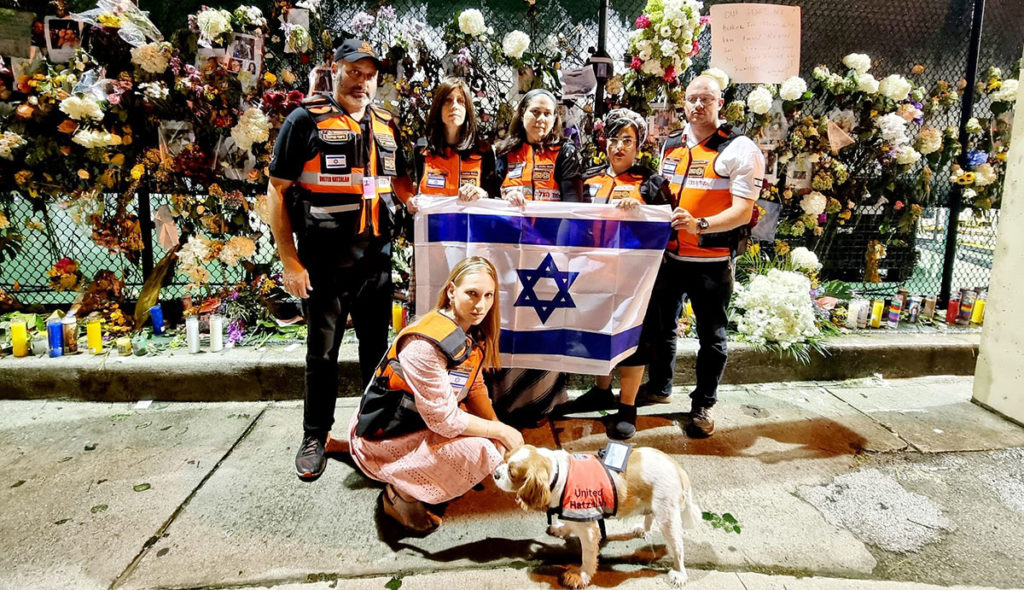
Working closely with the Home Front Command, United Hatzalah’s mission at the Surfside disaster was not to search for survivors or the bodies of victims. Rather, the organization sent six members of its Psychotrauma and Crisis Response Unit (PCRU), along with a therapy dog, who worked with families and community members to help them process their grief.

This innovative unit was founded in 2016 by Miriam Ballin, a therapist who noticed, after a motorbike accidentally hit her, how traumatized the accident left onlookers who witnessed the incident. Her experience sparked a realization that emergencies require not only medical but also psychological first aid and intervention– for victims, family members, first responders, and others.

The PCRU has provided such psychological support in a variety of circumstances, from bus bombings and car accidents in Israel to natural disasters abroad such as hurricanes Harvey and Irma, as well as the Pittsburgh Tree of Life synagogue shooting.

Raphael Poch, an emergency medical technician in the PCRU, told The Media Line that first responders who identify that a person is having a strong emotional reaction to an emergency will call members of the psychotrauma unit, who then help the person to process their grief.

“The point of the unit,” Poch says, “is to prevent what is called an acute stress reaction … a state of cognitive dissonance that develops after someone witnesses or participates in a traumatic incident and doesn’t know how to process it.”

An untreated acute stress reaction can develop into an acute stress disorder, which itself can develop into posttraumatic stress disorder. Prompt and proper intervention following a traumatic event can prevent, or nip in the bud, an acute stress reaction, making the later development of PTSD less likely.

Poch says the PCRU’s hardest job in Florida was helping family members as they wait for news about a missing loved one. “We have to help them manage their grief while they are still waiting for answers, and those answers still haven’t come,” he says. “There were harrowing situations: People who lost spouses, children, loved ones.”

One of the best ways to help family members, Poch’s team found, was to ask them for help. Engaging family in information gathering helps recovery and identification efforts while relieving them of a terrible feeling of uselessness as they await new of their missing loved ones.

Together with the Home Front Command, the PCRU set up tables at the hotel where family members were staying, “and we started asking the family members to give us information about their loved ones who were missing – either identifying marks or clothes they might have been wearing or who was home, who wasn’t home but was expected to be home, maybe who was on vacation, etc.”

This effort both gave the family members something to do and provided a lot of useful information that sped up the recovery and identification process. In addition, the interaction with family members built trust between them and the professional teams and provided the PCRU with an opportunity to assess whether they needed psychological first aid.

The circle of people affected in a tragedy like the Surfside collapse is much greater than the direct victims and their families.

For example, rescue and recovery workers themselves need psychological support, which the PCRU provides. “That wasn’t as difficult as working with the families. They have resiliency built up. … First responders were on the scene knowing what they were going into.”

However, their stoicism can itself be a barrier to processing the situation. “A lot of first responders have a tough-guy mentality, and they don’t like to open up about things.”

First responders may also be reluctant to seek out mental health support on the job for fear that it could harm their professional advancement. “I don’t think that’s the case, but a lot of people feel it might be,” Poch said.

Further afield, Poch said, was a man from a neighboring building, which was also evacuated. “He was living in a hotel and he couldn’t find his bearings, he couldn’t process what was happening. We worked with him to let him know it was OK to feel sad and frightened.” After meeting with a clinical psychologist on the PCRU team, the man was able to process his feelings and recognize what was actually taking place.

The popular favorite on the PCRU team is Lucy, the therapy dog. Lucy, a Cavalier King Charles Spaniel, is “trained to sense people who are having a difficult emotional time,” Poch says, and “will just go up to people and initiate contact. It will initiate a relationship.”

A family member waiting for news about her missing relative pets Lucy, the PCRU team’s therapy dog. (United Hatzalah)

Petting a dog has an immediate calming effect on many people, and also helps them to open up emotionally and process their feelings. “We had a lot of situations where first responders, who wouldn’t talk to anybody, came up to our dog and started petting and interacting with her.”

Poch describes one member of America’s National Urban Search & Rescue team who came up to Lucy, started petting her, and cried for around 2 minutes. “And then he got up, said, ‘Thank you very much; I feel better,’ and walked off.” That, too, says Poch, is an important form of mental health care.

The PCRU team has returned to Israel, but Hatzalah is currently assessing whether to send another team since the recovery efforts and need for psychological support continue.

They were able, with our systems, to extract many, many people who were trapped underneath the buildings that had collapsed.

Camero-Tech, seeing through walls

Netanya-based Camero-Tech, founded in 2004, develops micropower ultra-wideband radar systems that enable the detection of live objects behind walls and barriers. If people are trapped under concrete after a disaster like the Surfside condominium collapse, this is the technology first responders need to assist in search and rescue efforts.

Gilad Shadmy, Camero-Tech’s sales and marketing director, told The Media Line that in September 2017, the Camero-Tech system helped save many lives after a devastating earthquake in Mexico City, which killed 370 people and injured more than 6,000.

The IDF Home Front Command sent a delegation to assist local rescue efforts. They had purchased the Camero-Tech system, which they gave to local search and rescue teams. “They were able, with our systems, to extract many, many people who were trapped underneath the buildings that had collapsed,” Shadmy said.

Shadmy says Camero-Tech has several systems that can be helpful in search and rescue efforts after a building collapse. The Xaver-100 system “gives the operator the ability to get an indication of whether there is someone underneath the ruins” and how many meters away they are, up to a range of 20 meters from the operator. The Xaver-400 system detects not only the presence but also number and location of people hidden behind walls and barriers, also up to 20 meters away. The Xaver LR80 system enables the detection of live objects through a wall at more than 100 meters away.

The Camero-Tech team conducts rescue efforts using the Xaver-400 system. (Courtesy)

But at Surfside, though one person was rescued from the rubble, it now seems highly unlikely that there are any survivors left to find. On Wednesday, local authorities announced that the main objective of search teams was no longer rescue but recovery, and that the missing victims are presumed to be dead.

In a regular building collapse, you would find slabs of cement that create spaces and trap air inside after they fall. This allows people who are trapped inside to breathe, but here there is nothing.

MAGNUS rescue firm: Everything crumbled to dust

Hilik Magnus is the founder of MAGNUS International Search and Rescue, a Tel Aviv-based emergency management and on-ground search and rescue service provider that works with insurance companies, independent travelers and international organizations.

The company’s team was among the first search and rescue groups to reach the disaster areas in Thailand, South India and Sri Lanka in the wake of the 2004 tsunami that hit the region and caused massive devastation. The company also provided help to find missing Israeli nationals following the 2011 earthquake that hit Christchurch, New Zealand. More recently, MAGNUS was on the ground after the April 2015 earthquake that killed almost 9,000 people struck Nepal.

Hilik Magnus, founder of MAGNUS International Search and Rescue, May 2, 2005. (Hilik Magnus/Wikimedia Commons)

Though unfamiliar with the technical specifications of the collapsed Champlain Towers South, Magnus told The Media Line that the devastation appeared to be extreme and unlike other disaster sites he had seen.

“The building did not collapse normally. It looks like a heap of [rubble] from an eroded area.”

“It’s incredible what happened there and it’s very difficult because there is no machinery that can help.”

He noted that normally tractors and cranes would be used to remove cement slabs and iron bars, but that teams at Surfside have had to resort to manually removing rubble piece by piece due to the utter and total destruction.

“In a regular building collapse, you would find slabs of cement that create spaces and trap air inside after they fall. This allows people who are trapped inside to breathe, but here there is nothing. There is no chance that there are any survivors. Though I’m not there, it looks like everything has crumbled to dust.”

There is no technology, he said, that would make a difference in rescue efforts at this point.

“I have seen buildings fall in Turkey, Armenia and other places. … This collapse was extremely severe. I don’t know how they constructed this building, but it collapsed in a very absolute way. It turned into dust. It’s very strange.”

The fact that America asked us to come, was a great honor and privilege for us. And this cooperation led to great success working at a pace we never thought we could.

Lesson learned

Returning to Col. Vach, the Israeli military search and rescue unit commander, The Media Line asked what lessons could be learned from the Surfside disaster.

The key to providing speedy closure for families awaiting news about their missing loved ones, Vach said, was cooperation.

“The fact that America asked us to come was a great honor and privilege for us. And this cooperation led to great success working at a pace we never thought we could.

“Everyone, including myself, estimated that it would take months to find the bodies. But now we’re talking about days.”

Israeli Expertise Brings Closure to Surfside Disaster in Matter of Days Read More »