fbpx

June 2, 2021

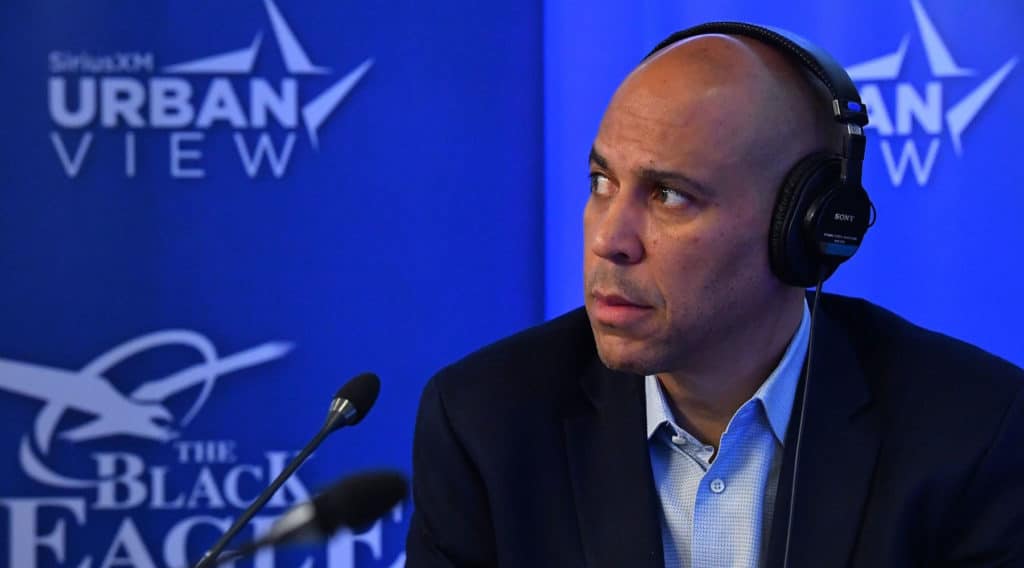
Cory Booker Starts New Coalition of Black and Jewish Senators to Tackle Antisemitism and Racism

(JTA) — Sen. Cory Booker is leading a group of U.S. Jewish and Black senators in establishing a coalition to fight antisemitism and racism.

The so-called Black-Jewish coalition will also include Booker’s fellow Democrats Sens. Raphael Warnock of Georgia and Richard Blumenthal of Connecticut, as well as Tim Scott, a South Carolina Republican from across the aisle.

“There’s been a long history of Black people and Jewish sisters and brothers working together on a whole range of concerns,” Warnock was quoted as saying by NJ.com.

The idea of convening the lawmakers was spurred by reports of rising antisemitism amid a national reckoning around racial injustice.

“We will be fighting both racism and anti-Semitism,” Blumenthal said. “I think we’re in the midst of a racial justice moment and a reckoning now that could draw us together.”

Scott Richman, director of the Anti-Defamation League in New York/New Jersey, praised the initiative.

“This would be an important step towards bringing together two communities with a shared commitment to justice and an end to bias and bigotry,” he told NJ.com.

A similar body, called the Congressional Caucus on Black-Jewish Relations, already exists in the House of Representatives.

Booker, who keeps a Hebrew bible on his Senate desk, has a long history of connections with the Jewish community. He often cites Torah passages and recites Hebrew quotes in public appearances.

Cory Booker Starts New Coalition of Black and Jewish Senators to Tackle Antisemitism and Racism Read More »

How Did Hamas Become the Darling of the West?

In February 2009, I wrote an essay about a symposium at UCLA that marked the beginning of Hamas’s penetration into academic circles. I also described the culture of fear that had overtaken many of my colleagues who felt it was unsafe to admit to supporting Israel. Twelve years later, in the wake of the most recent conflict between Israel and Gaza and the ensuing antisemitism carried out on our campuses and in our streets, I have revised and updated my original essay, which is just as relevant today as it was when it was first written.

Remember Eugène Ionesco’s “Rhinoceros”? Written in the late 1950s, the play describes the transformation of a quiet, peaceful town into anarchy when one after another of its residents is transformed into a lumbering, thick-skinned brute. Only Berenger, a stand-in for the playwright, tries to hold out against the collective rush into rhinocerism.

First, the townspeople notice a stray rhinoceros rumbling down the street. No one takes a great deal of notice other than to say that it “made a lot of dust.’’ It’s a “stupid quadruped not worth talking about,’’ although it does trample one woman’s cat.

Before long, an ethical debate develops over the rhino way of life versus the human way of life. ‘’Why not just leave them alone,’’ a friend advises Berenger. ‘’You get used to it.’’ The debate is quickly muted into blind acceptance of the rhino ethic, and the entire town joins the marching herd. Berenger finds himself alone, partly resisting, partly enjoying the uncontrolled sounds coming out his own throat: “Honk, Honk, Honk.”

These sounds from Ionesco’s play have echoed in my ears twice. First in 2009, when Hamas gave its premier performance at UCLA and, second, this past week, when rhinos roamed the streets of Los Angeles shouting, “Honk, Honk, Honk.”

These sounds from Ionesco’s play have echoed in my ears twice. First in 2009, when Hamas gave its premier performance at UCLA and, second, this past week, when rhinos roamed the streets of Los Angeles shouting, “Honk, Honk, Honk.”

Let’s start in January 2009, when an e-mail from a colleague at Indiana University queried: “Being at UCLA, you must know about this symposium…pretty bad.” Attached to it was Roberta Seid’s report on the now infamous “Human Rights and Gaza” symposium held a day earlier at UCLA.

To refresh readers’ memory, this symposium, organized by UCLA’s Center for Near East Studies (CNES), was billed as a discussion of human rights in Gaza. Instead, the director of the center, Susan Slyomovics, invited four speakers with long histories of demonizing Israel for a panel that Seid describes as a reenactment of a “1920 Munich beer hall.” Not only did the panelists portray Hamas as a guiltless, peace-seeking, unjustly provoked organization, but they also bashed Israel, her motives, her character, her birth and conception, and led the excited audience into chanting “Zionism is Nazism,” “F—, f— Israel,” in the best tradition of rhino liturgy.

But the primary impact of the event became evident the morning after, when unsuspecting, partially informed students woke up to read an article in the campus newspaper titled, “Scholars Say Attack on Gaza an Abuse of Human Rights,” to which the good name of the University of California was attached, and from which the word “terror” and the genocidal agenda of Hamas were conspicuously absent. This mock verdict, presented as an outcome of supposedly dispassionate scholarship, is where Hamas culture scored its first triumph—the first inch of academic respectability, the first inroad into Western minds.

Naturally, when students complained to me about how abused and frightened they felt during the symposium and how concerned they were about the direction taken by the Center for Near East Studies, I felt terribly guilty. “We should have anticipated such travesties,” I told myself, “we, the Jewish faculty at UCLA, should have preempted it with a true symposium on human rights, one that honestly tackles the tough moral and legal dilemmas that the Gaza situation presents to civilized society: How does society protect the human rights of a civilian population in which rocket-launching terrorists are hiding? How does one reconcile the right of a country to defend itself with the wrong of killing women and children when the former entails the latter? What is a legitimate military target?”

In 2009, these were new dilemmas that had not surfaced prior to the days of rockets and missiles, and we, the Jewish faculty, ought to have pioneered their study. Instead, we allowed Hamas’s sympathizers to frame the academic agenda. How can we face our students from the safety of our offices, I thought, when they deal with anti-Israel abuse on a daily basis—in the cafeteria, the library and the classroom—and as alarming reports of mob violence are arriving from other campuses?

How can we face our students from the safety of our offices, I thought, when they deal with anti-Israel abuse on a daily basis—in the cafeteria, the library and the classroom—and as alarming reports of mob violence are arriving from other campuses?

Burdened with guilt, I called some colleagues but quickly realized that a few had already made the shift to a strange-sounding language, not unlike “Honk, Honk.” Some had entered the debate phase, arguing over the rhino way of life versus the human way of life, and the majority, while still speaking in a familiar English vocabulary, were frightened beyond anything I had seen at UCLA in the 40 years that I had served on its faculty.

Colleagues told me about lecturers whose appointments were terminated, professors whose promotion committees received “incriminating” letters, and about the impossibility of revealing one’s pro-Israel convictions without losing grants, editorial board memberships, or invitations to panels and conferences. And all, literally all, swore me into strict secrecy. Together, we entered the era of “the new Marranos.”

Exaggeration? Jewish paranoia? Hardly. I invite skeptics to repeat the private experiment that I conducted among Jewish faculty in a reception hosted in 2008  by the Center for Jewish Studies at UCLA. I asked each of them privately: “Tell me, aren’t you a Zionist?” I then counted the number of times my conversant would look to the right, then to the left, before whispering: “Yes, but…” I am sure that anyone who repeats this experiment will be as alarmed as I was about the level of academic terror that descended on U.S. campuses, especially in the humanities and political and social sciences. Our generation of Jewish students are paying dearly for the failure of our academic leadership to acknowledge, assess and form a unified front to combat this academic terror.

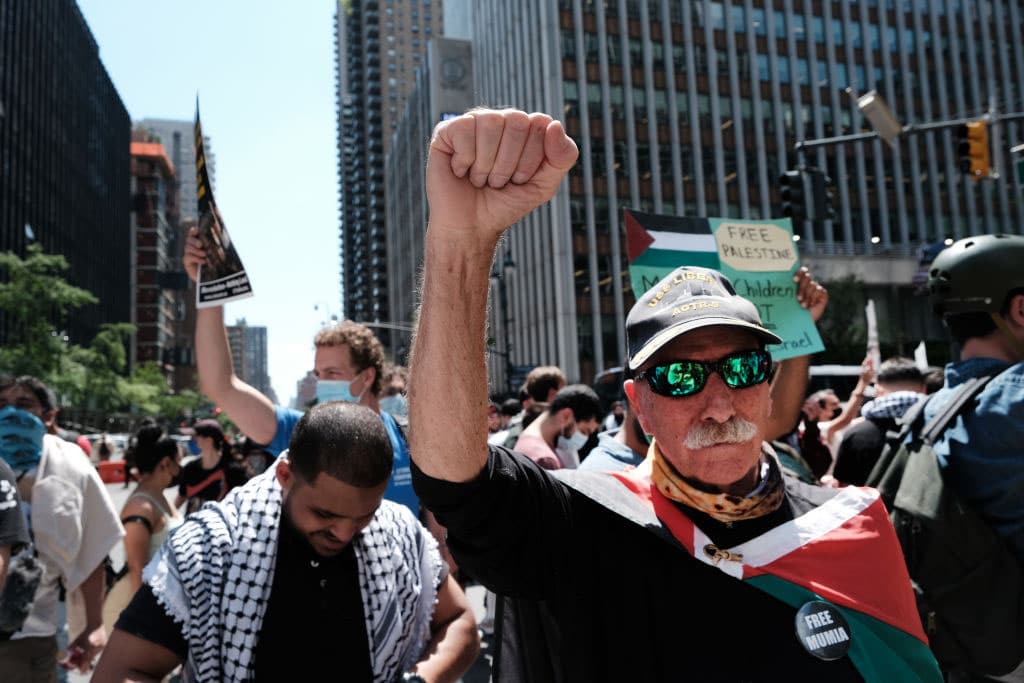
And this brings me to 2021 and to the latest war in Gaza. To the New York Times front page depicting the victims of Israel’s defense operation, as if they had never heard the word “Hamas” or read Hamas’s charter. To CNN’s anchor Fareed Zakaria asserting that Israel is a military superpower, hence Hamas does not pose an existential threat to it. To NYT analyst Nicholas Kristof asserting (in an interview with Bill Maher) that Israel, too, positions its military headquarters among civilians. To UCLA Department of Asian American Studies stating (on its official University website) its “Solidarity with  Palestine” and its authoritative understanding that such “violence and intimidation are but the latest manifestation of seventy-three years of settler colonialism, racial apartheid, and occupation.”

To the Statement of scholars of Jewish Studies and Israel Studies from various universities who, in the Forward,condemned “the state violence that the Israeli government and its security forces have been carrying out in Gaza.” To members of If Not Now, saying Kaddish for fallen Hamas fighters (among other victims). And, finally, to the mob roaming the streets of Los Angeles and shouting, “Honk, Honk, From the River to the Sea.”

Looking back on the past 12 years, there is no question that Hamas has gained a major uplift in status and respectability. It has become, in fact, the darling of the West. True, seasoned commentators remember to add the obligatory, “We are not condoning Hamas, of course, but…”

“But what?” I ask.

Doesn’t Fareed Zakaria imply that it is not the end of the world if 300,000 Israeli children continue to bleed sleeplessly for another 20 years under Hamas rockets? Didn’t Nicholas Kristof imply that if those children suffer post-traumatic scars for the rest of their lives that it is Israel’s problem because Israel, too, positions its headquarters in civilian areas?  Western analysts will go to any absurd lengths to fabricate symmetry between Israel and Hamas, because symmetry is our new goddess of right and wrong.

But let’s not forget that it all started in academia, with a herd of passionate intellectuals who managed to hijack the name of their academic institution, which hardly cared.

But let’s not forget that it all started in academia, with a herd of passionate intellectuals who managed to hijack the name of their academic institution, which hardly cared. Do not blame them. After all, intellectuals are trained to cheer their peers when the marching band starts playing, and academic institutions are too slow to understand what is being done in their names. Sadly, as Ionesco understood so well, we are all herd-honking organisms. Please take another look at the rhinos roaming the streets of Los Angeles, here, and see for yourself how hard it is to hold back and not join them with: Honk, Honk!


Judea Pearl is a Chancellor professor at UCLA, co-author of “The Book of Why,”
and president of the Daniel Pearl Foundation (www.danielpearl.org), named after his son. He and his wife, Ruth, are editors of “I Am Jewish: Personal Reflections Inspired by the Last Words of Daniel Pearl” (Jewish Light, 2004), winner of the National Jewish Book Award.

How Did Hamas Become the Darling of the West? Read More »

Google Diversity Head: “If I Were a Jew I Would Be Concerned About My Insatiable Appetite for War”

Kamau Bobb, Google’s Global Lead for Diversity Strategy and Research, is under fire for a 2007 blog post in which he said if he were Jewish, he would be concerned about Israel’s “insatiable appetite for vengeful violence.”

The post, which was first unearthed by the Washington Free Beacon, began with the following: “If I were a Jew today, my sensibilities would be tormented. I would find it increasingly difficult to reconcile the long cycles of oppression that Jewish people have endured and the insatiable appetite for vengeful violence that Israel, my homeland, has now acquired. This reconciliation would be particularly difficult now, in November, 79 years after Kristallnacht – the Night of Broken Glass.”

Bobb’s post went on to criticize Israel for invoking “collective punishment” against the Gaza Strip and for “destroying buildings and breaking the glass” in the West Bank. The post eventually concluded: “If I were a Jew I would be concerned about my insatiable appetite for war and killing in defense of myself. Self defense is undoubtedly an instinct, but I would be afraid of my increasing insensitivity to the suffering others. My greatest torment would be that I’ve misinterpreted the identity offered by my history and transposed spiritual and human compassion with self righteous impunity.”

Jewish groups condemned Bobb’s blog post. The Simon Wiesenthal Center tweeted that Google should “fire this #antisemite.” Stop Antisemitism similarly tweeted, “How is the obscene, antisemitic bigot still employed there?”

B’nai Brith International similarly tweeted that Bobb’s post was “appalling.” “How did #Google promote someone with such hateful, anti-Semitic views to lead their diversity strategy?”

StandWithUs Israel Executive Director Michael Dickson tweeted that Bobb also wrote a blog post about how if he were an Arab, “the ability of the United States and Israel to not only dictate the terms of my subjugation, but characterize my desire to be free as rooted in hatred would burn.” The post also stated that “you cannot beat a people and demand that they not fight back in order to peacefully negotiate an end to the beating.”

“All of this begs the question whether (1) @Google did due diligence when selecting @kamaubobb for the sensitive position of global Google DEI (diversity, equity and inclusion) Director and (2) whether he should remain in these positions,” Dickson tweeted. “@Google – what say you?”

Meghan McCain, co-host of ABC’s “The View,” said during a June 2 segment that Google “should’ve googled him” and that she’s tired of “having the conversation over and over about why antisemitism is the last passable form of bigotry in the United States.” “If they said this about Black people, or Asian people, or LGBT people, he would be fired already. And he’s not, which says that Google’s okay with a little bit of soft antisemitism.”

Tablet Magazine senior writer Yair Rosenberg, on the other hand, argued that Bobb should have been “given a chance to account for how he’s changed/grown over the last 10 years when it comes to understanding Jewish people” and he could have “emerged as a better ally… instead, we get gotcha pieces in conservative outlets that aren’t interested in helping people empathize with each other and move beyond past problems, but rather in fashioning 10-year-old errors into the latest ammo in a culture war.”

https://twitter.com/Yair_Rosenberg/status/1400104274017853441?s=20

The New York Post reported that they obtained an email from Bobb to Google’s “Jewgler” Employee Resource Group stating that he was “deeply sorry” for the post. “What I wrote crudely characterized the entire jewish community. what was intended as a critique of particular military action fed into antisemitic tropes and prejudice. i think we can all agree, there is no easy solution to this situation. but that’s beside the point. the way I expressed my views on that conflict were hurtful.”

Google did not respond to the Journal’s request for comment.

Google Diversity Head: “If I Were a Jew I Would Be Concerned About My Insatiable Appetite for War” Read More »

An Open Letter to the Jewish People About Birthright-Israel and Israel Education

On May 25, the first Taglit Birthright-Israel participants since the pandemic’s outbreak landed at Ben-Gurion airport. The Covid-19 crisis confirmed many of Birthright’s essential values. In our isolation, we all felt the anguish of the loneliness Birthright counters with group trips and community consciousness. Ideologically, we lived Birthright’s lively Jewish, Zionist and liberal-democratic dance. We cherished the particular—safe homes, clear borders, effective national policies. But we understood universal interconnectedness too—how we share a common fate, endure similar vulnerabilities, and appreciate life-saving technologies as fellow humans, transcending borders.

Still, this summer’s participants are visiting Israel during a sensitive time. Even before this recent war, many Israel educators recognized that conversations about Israel, Zionism, even Judaism have shifted dramatically, especially since the George Floyd protests. Accusations of white privilege, fragility and supremacy are complicated enough. But insults accusing Israel of “apartheid” and claiming Zionism is a form of “Jewish supremacy” make many discussions explosive. During this fragile post-Covid transition, America is so polarized that many even question the liberal value of robust dialogue. In some circles, Israel is so demonized that even some rabbis have joined the pile-on against the Jewish state.

Here’s where historical perspective helps. In its 21 years in action, Birthright-Israel has overcome many traumas. We survived the suicide bombings of the early 2000s, the events of 9/11, the second Lebanon War, and various Gaza operations. We have navigated the periodic media mudslides attempting to sully Israel, the Israel-America tensions over the Iran deal, the divisive Hillary Clinton-Donald Trump election, and four years of polarizing battles over Trump.

Throughout the social and political conflicts, Birthright-Israel has remained a delightfully counter-cultural and non-partisan organization. We’re in the Jewish identity business, not the business of politics. We’re playing the long game: welcoming everyone into a 3,900-year-old conversation about our people, our faith, our homeland, and ourselves, as well as into a 73-year-old conversation about our Jewish democratic state and our Jewish communities worldwide.  

We’re in the Jewish identity business, not the business of politics.

Eighteen months ago, refuting unfair criticism that Birthright was overly-partisan, we commissioned a special survey asking whether participants find that Birthright provides “a supportive environment for the exchange of ideas and opinions.” A stunning 83.1 percent agreed, while 85.8 percent said the trip included “opportunities to express my thoughts and feelings.” Eighty percent confirmed that they had been given “an opportunity to think critically about Israel’s challenges.” Few organizations get such impressive feedback. In fact, even America’s top-tier universities don’t invest what Birthright does in surveying students and responding to their views.

In the Birthright spirit of democracy and transparency, I want to share with you, those who care about Jewish identity-building today, my advice to our educational staff. I write independently, as the voluntary chair of Taglit Birthright-Israel’s International Education committee, urging everyone to help us to continue doing what we have done so successfully with over 750,000 happy participants since December of 1999.

Open Dialogue

Birthright is a free 10-day trip to Israel, with no strings attached, for young adults between 18 and 32 years old. Birthright’s defining structure is a bus with 40 participants in addition to a delegation of Israelis who join for a few days. The bus is everyone’s rolling home for the trip, their gateway to Israel and their community. For participants, it’s a fun pod, social circle, ’round-the-clock seminar space, and instant family.

While preparing to visit Jerusalem and Tel Aviv, Masada and the Dead Sea, participants should also come ready to listen and learn, discuss and debate. Despite jumping from place to place, Birthright participants still have an opportunity to absorb, sift, process, and yes, question, challenge, and disagree in thoughtful, respectful and sensitive ways. The intention is not to impose viewpoints but to jumpstart conversations by asking open-ended questions rather than offering closed-minded answers.

The range of different life experiences on each bus guarantees a diversity of viewpoints. The dynamic discussions that follow often launch deep, meaningful and meaning-seeking identity journeys. But this process requires open minds and humble hearts, not marching orders from the trip organizers or the participants.

The dynamic discussions that follow often launch deep, meaningful and meaning-seeking identity journeys. But this process requires open minds and humble hearts, not marching orders from the trip organizers or the participants.

When I meet participants, I often invite them to ask me the tough questions about Israel, Zionism, Jewish-democratic issues and Palestinians. “If we don’t talk about it here,” I say, “within the family, how will we ever learn?” I encourage them to continue to find what Birthright-Israel’s International Vice President of Education Zohar Raviv calls “Safe and Brave Spaces” to discuss Israel, Zionism, Judaism and every other topic that concerns them.

Accepting Complexity

With its blue-and-white flag, Israel is not a black-and-white place. Anyone who sees only “Israelis” will miss Israel’s four-school community choice systems: for religious Jews, secular Jews, ultra-Orthodox Jews, and Israeli-Arabs. Anyone who sees only “Jews” will miss the dizzying variety of colors, languages, communities of origins, and ideologies living side-by-side in Israel. And anyone who sees only “the conflict” won’t be able to see Arab countries at peace with Israel from Egypt to the UAE; Israeli-Arab citizens who constitute 20 percent of Israel’s doctors and 23 percent of Israel’s nurses; Palestinians living with autonomy under the PA; and Palestinians in Gaza ruled by Hamas’s theocracy.

What you see is what you get: by facing dimensionality, diversity, and dilemmas we accept the messiness of Israel’s reality while getting a kaleidoscope of sights, sounds, ideas, attitudes, challenges and solutions that is Israel and the Jewish people.

No one should visit Israel and see everything reflected through the lens of their own American or other national experiences.

Simplistic (and sometimes insulting) analogies mislead. For example, comparing America’s racial reckoning or South African apartheid’s race-based bigotry to the Israeli-Palestinian conflict distorts reality and inflames tensions. The complexity of Israeli-Arab and Israeli-Palestinian relationships isn’t connected to skin color: it’s a clash of nationalisms. We in the Israel Education world need a racial de-coupling, to disentangle the story of Israel and its neighbors from the story of America and its races.

Instead of viewing Israel through the perspective of our individual realities, we encourage travelers to see Israel through its own unique lens that helps them understand the complexities that Israelis navigate on a day-to-day basis.

Leaning In Without Falling Over

Birthright, like every educational interaction, is a covenant of trust. More than a leap of faith, it’s a headfirst jump into what is often a profound, life-changing relationship between the educator and the learner. Just as participants have to bypass some of their pre-conceived notions, educators have to lean in, reaching participants where they are. So while many Israelis may instinctively scoff at words like “intersectionality” and “whiteness” and “privilege,” that’s not helpful. Instead, they should see where those concepts are useful. That’s what leaning in is about. But stay balanced, don’t keel over: every educator must also identify where these concepts begin to distance everyone from an authentic view of Israel.

“Intersectionality” helps us understand that everyone oppressed due to race, gender, sexuality, religion, or ethnic identity shares overlapping insights regarding those traumas. Yet when Jews are blocked at the intersection and the trauma of antisemitism is the only bigotry discounted, this useful tool becomes a dangerous weapon. Similarly, white and light-skinned people should acknowledge the different benefits they might enjoy when walking down certain streets or applying for certain jobs. But when “white privilege” is used to treat all Jews as rich, monolithic, or all white, and when “check your privilege” essentially means “agree with me or else,” a helpful concept becomes hurtful.

Focusing on Identity

We live in highly-politicized times, when simply changing the subject or opposing polarizing partisanship can be caricatured as a power game. Here too, Birthright must continue to be countercultural. Focusing on identity, on peoplehood, and on eternal questions is difficult when Israel is attacked, when Americans are at each other’s throats, and when universities often impose doctrines rather than nurture critical thinkers. But that makes initiatives like Birthright even more important, and may be one of the secrets of its success.

Focusing on identity, on peoplehood, and on eternal questions is difficult when Israel is attacked, when Americans are at each other’s throats, and when universities often impose doctrines rather than nurture critical thinkers.

In today’s culture, even within the Jewish community, the loudest and most social-media-savvy people seem to win, or at least dominate the conversation. Birthright’s magic may not be only the lure of Israel, the enjoyment of the bus-community, the appeal of its culture of conversation, and its big-picture perspective on identity, but also its core constituency: the silenced majority, not the bullying minority.


Gil Troy is a Distinguished Scholar of North American History at McGill University, and the author of nine books on American History and three books on Zionism. His book, Never Alone: Prison, Politics and  My People, co-authored with Natan Sharansky was just published by PublicAffairs of Hachette.

An Open Letter to the Jewish People About Birthright-Israel and Israel Education Read More »

Israel Elects New President, Still Waiting on New Government

(The Media Line) With last-minute efforts to agree on a government still ongoing, Israeli lawmakers on Wednesday elected a new president, choosing Jewish Agency Chairman and former Labor party leader Isaac Herzog to replace outgoing President Reuven Rivlin after seven years in office.

I assume this tremendous responsibility and accept the privilege to serve the entire Israeli public. I intend to be a president of all people … to build bridges of understandings and to bring closer those here among us, as well as our brothers and sisters overseas.

Herzog, a seasoned parliamentary veteran with decades of experience in politics and statesmanship, promised to unite and heal the nation after learning of the results.

“I assume this tremendous responsibility and accept the privilege to serve the entire Israeli public,” the president-elect said. “I intend to be a president of all people … to build bridges of understandings and to bring closer those here among us, as well as our brothers and sisters overseas.”

The son of Israel’s sixth president Chaim Herzog, the 60-year-old Herzog will take office on July 9, and will serve as the nation’s 11th head of state.

Israel’s president, a mostly ceremonial position, is chosen by the Knesset once every seven years, with 120 parliament members casting secret ballots to determine the victor.

The title of Citizen No. 1 … comes with great responsibility. I have no doubt that you will carry it superbly. I will be proud to pass it on to you. Long live the State of Israel. Long live the president of the State of Israel.

“While the Knesset is the house of debate and argument, as we’ve clearly seen lately, the president’s residence is one of dialogue and partnership,” outgoing President Rivlin told Herzog following his triumph.

“The title of Citizen No. 1 … comes with great responsibility. I have no doubt that you will carry it superbly. I will be proud to pass it on to you. Long live the State of Israel. Long live the president of the State of Israel.”

After badly losing to Prime Minister Binyamin Netanyahu while heading the Labor party in the 2015 parliamentary elections, Herzog this time notched a resounding triumph, orchestrating an 87-26-vote landslide unprecedented in Israeli history.

The savvy politician bested Miriam Peretz, a bereaved mother and prominent educator and public speaker who became a beloved figure in Israel after losing two sons in combat.

“I had the honor of running against a dear, worthy person whom I admire and cherish,” Peretz said in her concession speech. “I came from a place of doing good for all Israelis, and I will continue to strive and work for unity. That is the biggest challenge facing our country.”

The relatively mellow and polite campaign was the mirror image of the previous presidential election, which saw endless mudslinging, the use of private detectives, allegations of secret affairs, claims of extortion and severe corruption charges, before Rivlin was picked.

Netanyahu congratulated Herzog in the Knesset on Wednesday, telling the president-elect that his father “represented Israel, around the world and here, too, in an awe-inspiring manner and I’m certain you’ll do the same. I wish you success on behalf of myself, the government and the entire State of Israel.”

“Isaac Herzog, the next president of Israel, former party leader, one of us. We’re so proud of him, there is no one more worthy than him for this role,” Labor Chair Merav Michaeli told The Media Line via a spokesperson.

“The tremendous overwhelming support he has won from members of this house speaks volumes of how well-liked he is by vast parts of the Israeli society.”

“He’s been planning and working on this for a long time, for years. This was a well-oiled campaign,” Itzik Elrov, a political strategist and former adviser to the Labor party told The Media Line.

“[Herzog] is a very gifted politician, and he went through 120 MPs one by one to make sure they were behind him. This was decided a long time ago.”

With the ho-hum presidential race decided and in the books, the nation turned its eyes to the slightly more crucial affair of government negotiations.

What was expected to be concluded on Sunday night or Monday at the latest has now dragged into Wednesday evening, as the Bennett-Lapid government, intended to unseat Netanyahu after 12 straight years in office, continues to hit snags in its inception.

With Yair Lapid’s mandate to form a government, handed to him by President Rivlin last month, set to expire at midnight, the sides have a precious few hours to hammer out the final details.

The remaining hurdle Wednesday appeared to be a seat on the country’s Judicial Appointment Committee, over which designated prime minister Naftali Bennett’s right-wing Yamina party and Lapid’s center-left bloc are still battling.

The projected coalition will include parties across the political spectrum from far Right to Center to far Left and will incorporate a predominantly Arab party for the first time in the nation’s history.

If no government is presented by midnight, Israel will in all likelihood head to another general election, its fifth in two and a half years, with Netanyahu remaining in office in the meantime.

Israel Elects New President, Still Waiting on New Government Read More »

MTV Special Highlights Antisemitism and Jewish Activism in America

In honor of Jewish American Heritage Month, on May 31 MTV premiered a new hour-long special, “With One Voice: Fighting Hatred Together.” The program featured a conversation with one of the youngest living survivors of Auschwitz, Tova Friedman, and former NFL player Emmanuel Acho, who hosts the YouTube series “Uncomfortable Conversations With a Black Man.” It also highlighted the work of four Jewish activists across the U.S. who are passionate about social justice.

“Given the alarming rise of antisemitism, we felt it was incumbent upon us to use our platforms for good and showcase young Jewish activists at the forefront of fighting against hate in all of its forms and fighting for equality,” said President of MTV Entertainment Group Chris McCarthy in an interview with the Journal.

The special was the culmination of MTV’s celebration of Jewish American Heritage Month. Throughout May, the channel ran a spot showing the achievements of Jews like Albert Einstein and Justice Ruth Bader Ginsburg along with statistics on antisemitism. It encouraged viewers to visit Act.MTV.com, which directs visitors to learn from a Holocaust survivor on the website of the Museum of Tolerance, read about the Anne Frank House, and do a virtual tour of the National Museum of American Jewish History.

“With One Voice: Fighting Hatred Together” kicks off with an overview of recent antisemitic incidents occurring around the U.S. and then provides a history of the Holocaust and demonstrates how Jews have always been involved in social justice movements. It also depicts the ways in which the four young activists are working in their communities to fight hate.

“It was important not only to address what these young Jewish activists are doing today to fight antisemitism but also to give historical context around the impact of hate throughout generations–from the Holocaust to today,” said McCarthy. “By doing so, we hope to educate and unite our audiences.”

“It was important not only to address what these young Jewish activists are doing today to fight antisemitism but also to give historical context around the impact of hate throughout generations–from the Holocaust to today,” said McCarthy.

One of the activists is Imani Jackson. She is a 25-year-old Black and Jewish woman who is a chef at Minnesota Hillel and the owner of the catering company “Chopped & Served,” which provides fresh and sustainable food to people in need. She told the Journal that her Jewish activism “looks like inviting everybody to the table. I would describe my activism as an educated, mindful approach through intention. It’s creative and innovative so we can truly break community barriers to serve our people. [I’m] changing the narrative of destroying, desensitizing and dehumanizing Black, brown and Jewish people.”

Another activist, 21-year-old Gen Slosberg, who is an Asian Jew, co-created and produces LUNAR, a Jewish-Asian film project, and serves as program manager for Jewish Youth for Community Action. She said she hopes that people who see the special “take away that we are human beings and have complex relationships to our identities, communities and work in the movement. One of the ways to reduce hate is to humanize those that are marginalized and targeted beyond what harmful, racist, scapegoating tropes and stereotypes say about us.”

In the special, when Acho interviews Friedman, who is now 82, she talks about her harrowing tale of hiding amongst corpses at Auschwitz in order to avoid being taken on a death march to Germany. She told Acho that in that moment, she didn’t move. “The boots start around the room. I said, ‘Now I’m going to die.’ I couldn’t breathe. I did not uncover myself. I did not. Then, all of a sudden, [my mom] uncovers me and those are her words: ‘They are gone.’ The Russian army liberated us.”

While Friedman told Acho she is not afraid to be a Jew in America these days, she is troubled about the rise in antisemitism. “Antisemitism is everywhere, and I don’t understand it,” she said. “I don’t understand why. Not only antisemitism, but there is an amount of hatred in this country. Let’s find what unites us as humans.”

In creating “With One Voice: Fighting Hatred Together,” McCarthy said that MTV hopes to make the world a brighter place for everyone.

“Through our content, we have the ability to give the gift of empathy and enable our viewers to walk a day in another person’s shoes to hopefully open up their hearts and minds, provide access to help and inspire action. When we stand shoulder to shoulder–working together and showing empathy toward one another–we firmly believe our ability to enact change is boundless. ”


Kylie Ora Lobell is a writer for the Jewish Journal of Los Angeles, The Forward, Tablet Magazine, Aish, and Chabad.org and the author of the first children’s book for the children of Jewish converts, “Jewish Just Like You.”

MTV Special Highlights Antisemitism and Jewish Activism in America Read More »