fbpx

June 1, 2021

Bill Maher Says “Bella Hadids of the World” Would “Run Screaming to Tel Aviv If They Had to Live in Gaza for One Day”

Comedian Bill Maher defended Israel while slamming Palestinian-Dutch model Bella Hadid during a May 28 segment on HBO’s “Real Time with Bill Maher.”

The segment began with Maher criticizing the media’s coverage of the recent escalation between Israel and Hamas, saying “there was no one on liberal media to defend Israel really. We’ve become this country now where we’re kind of one-sided on this issue.” He added that the younger generation doesn’t seem to understand the Israeli-Palestinian conflict, stating: “You can’t learn history on Instagram.”

Maher then turned to New York Times columnist Nicholas Kristof and praised him for writing in a recent op-ed that Arabs enjoy more freedom in Israel than they do in any other country. Kristof said he “made that point for context” but doesn’t think it justifies “Israel engaging in possible war crimes in Gaza.” Maher asked Kristof how Israel should have responded to the 4,000 rockets fired by Hamas and Islamic Jihad; Kristof acknowledged that Israel has a right to defend itself under international law but argued that Israel didn’t “sufficiently avoid civilian casualties.”

“But [Hamas] purposely put the rockets in civilian places,” Maher replied. “Likewise, Israel’s Defense Ministry is in a civilian area,” Kristof responded. “Both sides do this partly because they’re proud of their countries. I do think that Hamas particularly does this and I think that’s a war crime [on the] part of Hamas.”

Maher also responded to those who refer to Israel as “colonizers” and “occupiers.” “The Jews have been in that area of the world since about 1200 B.C., way before the first Muslim or Arab walked the Earth… I mean Jerusalem was their capital.” He added that “the Jews were the ones who were occupied by everybody. The Romans took over at some point, and then the Persians and the Byzantines and then the Ottomans, so yes there was colonization going on there.”

Additionally, Maher pointed out that the 1947 United Nations partition plan offered a two-state solution for both Jews and Arabs that would have provided the Palestinians with more land than they currently have today had the Arabs not rejected the partition plan. “Hamas’s charter says they want to wipe out Israel. Their negotiating position is, ‘You all die.’”

“Hamas’s charter says they want to wipe out Israel. Their negotiating position is, ‘You all die.’”

Kristof agreed that some leftist circles tend to whitewash Hamas “but that also does not excuse Israel ruling Palestinians in the West Bank for example without giving them any vote, taking water and giving it to settlers, and maybe most important: damaging any possibility down the road of creating a two-state solution.” He acknowledged that it’s difficult “to avoid a war” with Hamas firing rockets at Israel, but said that Israel’s building of settlements in the West Bank and potential eviction of Palestinian families in the Sheikh Jarrah neighborhood of East Jerusalem ruins the prospects of a two-state solution down the road.

Maher agreed with Kristof, but argued that “there could be an Arab capital in East Jerusalem now if Yasser Arafat had accepted that in 2003. He did not. They have rejected this and went to war time and time again.”

He then went after “the Bella Hadids of the world,” citing the fact that a Hamas court decreed in February that unmarried women in the Gaza Strip can only travel with a male guardian’s permission. “Really? That’s where the progressives are? Bella Hadid and her friends would run screaming to Tel Aviv if they had to live in Gaza for one day.”

Kristof argued that Hadid was simply “speaking up for the 67 kids in Gaza who were killed,” not defending Hamas. Maher replied that Hadid chanted “from the river to the sea, Palestine will be free,” which “is a PLO [Palestine Liberation Organization] slogan that means… there will be no more Israel.”
Bill Maher Says “Bella Hadids of the World” Would “Run Screaming to Tel Aviv If They Had to Live in Gaza for One Day” Read More »

Sinai Temple, LA Leaders Gather for Israel Solidarity Shabbat

Last Friday night in the Sinai Temple sanctuary, Consul General of Israel in Los Angeles Hillel Newman introduced those gathered in the pews to an unfamiliar face in the crowd: Mher Hagopian, an Armenian-Lebanese Christian who stood up and fought with several Los Angeles Jews during a recent antisemitic attack in Los Angeles.

On May 18, Hagopian was enjoying dinner with several of his Jewish friends when a group of pro-Palestinians attacked the Jewish diners. Hagopian, a local wedding photographer, attempted to defend those being attacked and endured a heavy beating as a result. He has since been touted as a hero for defending the Jewish diners.

Hagopian, Newman said at Sinai on May 28, “leapt to the aid of his Jewish friends without thought of his own safety.”

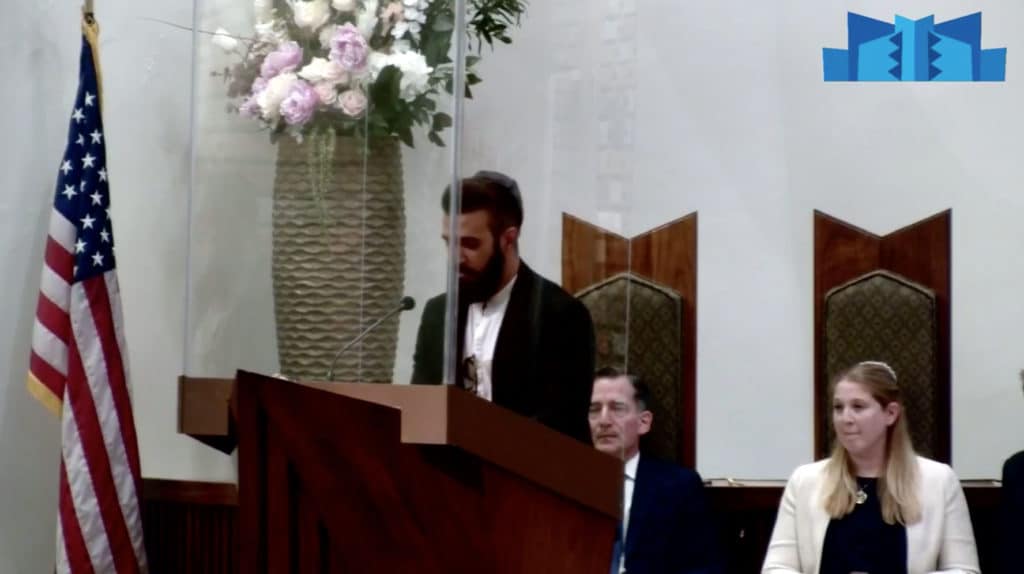
Hagopian was one of several speakers this past Friday night at Sinai Temple’s Israel solidarity Shabbat. Standing on the bimah, appearing shy in front of the crowd of a couple hundred people, Hagopian, 36, said he did not feel like a hero but believed God had placed him at the restaurant the night of the attack for a reason.

Hagopian said he did not feel like a hero but believed God had placed him at the restaurant the night of the attack for a reason.

“I don’t think I was there just to have dinner with my friends; I was there for a purpose—God put me there for a purpose,” he said, eliciting multiple standing ovations from the worshippers in the pews.

Sinai Temple Rabbi Erez Sherman told the crowd how much the Jewish community needed friends like Hagopian and announced that Hagopian would be visiting Israel for the first time this summer.

Additional speakers at the service, held in-person and streamed online, included Sinai Rabbi David Wolpe and Orna Wolens, general campaign chair at the Jewish Federation of Greater Los Angeles and a lifelong congregant of Sinai.

“It is hard to appreciate how improbable and miraculous it is we have a [Jewish] state because we were not alive when it was impossible,” Wolpe said during an impassioned sermon.

Wolens, meanwhile, highlighted L.A. Federation CEO Jay Sanderson’s recent visit to Israel on a Jewish Federations of North America (JFNA) mission, during which Sanderson met with communities and families directly impacted by the more than 4,000 rockets Hamas fired on Israel.

“The trauma and fear from this constant barrage is profound,” Wolens said, speaking about the Federation’s partnership with the Israel Trauma Coalition, a coalition of trauma management NGOS in Israel.

“During these complicated and painful times, we are united by Ahavat Israel—our love of Israel and the Jewish people,” Wolens added. “We stand with Israel, we pray for peace.”

According to the L.A. Federation, the JNFA trip was the first mission to Israel since the start of the COVID-19 pandemic.

Pastor John Paul Foster of Faithful Central Bible Church and over 15 partnering organizations, including StandWithUs and UCLA Hillel, participated in the service. During the height of the recent conflict, Foster reached out to Sherman and conveyed his support for the Jewish community at a difficult time.

The musical service blended liturgy and contemporary music and featured Rabbis Sherman and Nicole Guzik’s daughter singing a rendition of “A Million Dreams,” from the film, “The Greatest Showman,” Sinai Cantor Marcus Feldman leading services, and a performance of “Jerusalem of Gold.” The evening concluded with everyone reciting the “Hatikva,” Israel’s national anthem.

Attendees of the in-person service were asked to bring proof of vaccination, and those who had been fully vaccinated were allowed to sit in the Sinai sanctuary without a mask.

Sinai Temple, LA Leaders Gather for Israel Solidarity Shabbat Read More »

Sergio Della Pergola

Sergio Della Pergola: A Demographer’s Take on the 2020 Pew Research


Shmuel Rosner and Sergio Della Pergola discuss the latest Pew research results.

Sergio Della Pergola is an Italian-Israeli demographer and statistician. He is a professor and demographic expert, specifically in demography and statistics related to the Jewish population.

Follow Shmuel Rosner on Twitter.

Sergio Della Pergola: A Demographer’s Take on the 2020 Pew Research Read More »

Intersectional Rally Draws Pro-Palestinian and BLM Supporters, Denounces Israel

A couple hundred supporters of the Palestinians, Black Lives Matter and other social justice movements attended a rally on May 29 at Pan Pacific Park.

Carrying Palestinian flags and signs with anti-Israel and anti-racism messages– from “Defend Gaza! The New Warsaw Ghetto” to “Racism Sucks More than the Cats Movie”—demonstrators gathered at the park in view of the Holocaust Museum LA and listened as multiple speakers criticized Israel, linking the hardships endured by Palestinians living under occupation to the police-involved brutality facing African-American communities in the U.S.

“We have to be reminded of the power of joint struggle, of standing side-by-side, walking together through the fight,” said a speaker from a group called Palestinian Youth Movement (PYM). “In this way when we stand against police brutality here in the U.S., we are standing against police brutality worldwide, including in Palestine.”

PYM is a self-described “transnational, independent, grassroots movement of Palestinian and Arab youth struggling for the liberation of our homeland and our people.”

The PYM speaker – this reporter was unable to learn his name – said his organization two weeks ago participated in a demonstration against Israel that “shut down the streets of Los Angeles to stand with Palestine and against the Zionist’s regime all-out assault on the Palestinian people. We expected a crowd of about maybe 2,000 to show up, and instead … we were met with a historic turnout of 25,000 people in Los Angeles.

“The growing number in our movement is a testament to the changing tide of public opinion as Palestinians regain control of our narrative and Israel becomes increasingly unable to hide the reality of settler colonialism and ethnic cleaning upon which the Zionist state was created and upon which it continues to be built everyday,” he said.

Lulu Hammad, an organizer with Yalla Indivisible, also spoke. Her group describes itself as “a grassroots group committed to fighting for progressive values, centering Palestinian rights, the Black, Indigenous, and people of color communities.”

During her remarks, Hammond accused Israeli soldiers of perpetrating sexual violence against Palestinian women in 1947 and 1948 and singled out the academic, Mordechai Kedar, for arguing in favor of rape against Palestinian women as a deterrent against Palestinian terrorism.

“Just as they occupy the land, they think they can occupy our bodies,” she said.

She also denounced “the dominant patriarchal culture in which we live in Palestine. So, yes, when we are talking about settler colonialism, we are talking about sexual abuse, we’re talking about all these concepts—the supremacy, patriarchy, they are all interconnected, and the root to that is to sort of bring it down, all down!”

Protestors waved Palestinian flags during the rally on Saturday. Photo by Ryan Torok.

Rather than questioning Hammond’s claim about Israeli soldiers committing acts of sexual violence against Palestinian women—Kedar’s statements were taken out of context—the crowd of people applauded after she was finished speaking, with one person in the crowd even yelling “F-ck Israel!”

The demonstration—which was nonviolent—was an example of intersectionality, a phenomenon of communities with seemingly little in common coming together and building coalitions through a feeling of similar oppression and shared struggle.

The event was promoted in a flyer distributed in the days leading up to it as “Abolish State Terror: From Colombia and L.A., to Palestine and Beyond. Fight like Colombia, Resist like Palestine, Abolish like BLM.”

While there was no pro-Israel counter-protest on Saturday at Pan Pacific Park, father and daughter Barry and Hannah Poltorak turned out with homemade signs saying Hamas was anti-LGBT, anti-women and against peaceful coexistence.

In an interview, Barry Poltorak said it was hypocritical to support a movement like Black Lives Matter and not stand up against anti-Semitism.

“The Black Lives movement stands up for race, stands up for religion and yet they stand up for everything except Jews and Zionist or Israel, and I think it’s just a ridiculous hypocrisy,” he said.

“The Black Lives movement stands up for race, stands up for religion and yet they stand up for everything except Jews and Zionist or Israel, and I think it’s just a ridiculous hypocrisy.”

Hannah, 18, who attended Shalhevet High School and will be starting at Louisiana State University in the fall as a sophomore, said she was frustrated by how so many of her peers on social media have stood with Black Lives Matter and Asian-Americans in response to hate against those communities but how few of them have spoken in support of Jews despite recent increases in anti-Semitism.

“When kids my age are posting on their [Instagram] stories about being active and BLM and Asian hate and things like that and these movements, I’ve never seen the Jewish sentiment, because Jews are minorities, and so when people are standing for these other movements, I am missing that part in that free speech,” Hannah said. “I want to see people stand up for Jews as well because, of course, there is anti-Semitism, and so I want to see that change because no one is standing up for Jews except for Jews.”

Intersectional Rally Draws Pro-Palestinian and BLM Supporters, Denounces Israel Read More »

How To Better Inspire Innovation Within Your Business

Out-of-the-box thinking and ideas are necessary for any business to excel and grow. These result in change and help to outsmart other brands in the same industry.

According to research, innovation is essential for businesses to succeed, and 84% of executives admit it is true. However, only 6% have clarity on the issues and understand how to deal with them to improve their innovation performance.

As a result, if you want innovation to drive change in your organization, you must first create a work environment that supports this approach to motivate employees.

Read ahead to see how you can better inspire innovation within your business.

1. Support Creative Risk-Taking

If you want to encourage innovative thinking, ensure your employees never feel afraid or discouraged by taking creative risks. Instead, create an office culture of risk taking that rewards this behavior for promoting out-of-the-box thinking.

Employees generally hold back and suggest safe ideas in fear of rejection or making mistakes. Constantly emphasize the importance of innovation in your organization and the value of creativity. Communicate this by being supportive of risk-takers and the new ideas they bring to the table.

One of the best ways to encourage employees to be innovative and help your business grow is to listen to their suggestions and feedback, either through open discussions and meetings or anonymous outlets.

2. Promote Cross-Team Collaboration

An organization with dedicated teams working on their expertise areas tend to be more productive. However, this division among the staff members leads to the teams being isolated from one another. For instance, IT doesn’t know what marketing does, and the latter has no idea about HR’s work.

It could be highly beneficial to create a collaborative culture and overcome these barriers for teams to work together and discuss similar issues that they can solve collaboratively. Sharing ideas also results in more creative solutions. For instance, an online whiteboard enables easy collaboration among teams to work at once even while being physically away from each other.

However, it is also essential not to foster a work environment that is too complex or entirely team-less, making everything chaotic. Instead, create a vertical structure where every team has the relevant expertise and resources for innovation and is accountable for its results. With each team being motivated and committed to its task individually, innovation and collaboration can bring about fruitful results.

3. Workspace Design

A good workspace inspires employees to work better. Office setting, cubicles, paintings on the walls, task lighting, and other decorative pieces can bring an aesthetic look to the place. Additionally, fresh plants and huge windows to incorporate natural light into the area can make the place feel lively and calm.

Furthermore, you can encourage the employees to bring personal things like family pictures, small decoration objects, or printed quotes to personalize their cubicle or desk space and feel at ease. You can also provide sit-stand desks throughout the office. While it will be an additional cost, it is worth investing in to prioritize your employees’ health. Flexibility and good health with no backaches will not hinder the creative process.

A comfortable and relaxed environment helps employees to feel more inspired and creative by their surroundings.

4. Provide Useful Resources To Employees

Innovation requires tools, and you can’t expect employees to be creative without giving them the relevant tools to bring their ideas and thoughts to life. But first, you need to give them the space to explore ideas. You have to give time to your employees to come up with quality solutions instead of overworking them.

Furthermore, hear your team out and understand their requirements to provide them the technological tools they need to work on a project or idea. Cooperation from the company’s end can create a highly encouraging environment for innovation and consequent business growth.

5. Encourage Self Reflection

While your business has people who share countless similarities, they are individuals with their unique communication styles, talents, and work styles. People usually work best when their individuality is not hindered and can produce more creative solutions by being themselves instead of following each other.

Generally, employees get so buried under work pressure and deadlines that they forget their core purpose. Encouraging employees to self-reflect and focus on their achievements inspires them to keep up their work of introducing innovative and successful solutions.

Conclusion

What business doesn’t want to stand out and introduce something new to the market? With the rapidly evolving environment, it is essential to recognize how innovation can transform a business and take it to another level.

However, you have to foster a workplace environment that supports creativity and encourages employees to voice their ideas. Whether it is team collaboration or workplace design, you have to make your employees feel comfortable.


Jay T. Ripton is a freelance business, technology, and lifestyle writer out of Scottsdale. He loves to write to inform, educate and provoke minds. Follow him on Twitter @JTRipton.

How To Better Inspire Innovation Within Your Business Read More »

Mia Khalifa Tweets “My Wine Is Older Than Your Apartheid ‘State’”

Former pornography star Mia Khalifa caused a stir on social media when she tweeted, “My wine is older than your apartheid ‘state’” on May 29.

Various Twitter users excoriated Khalifa, a Lebanese-American, in the replies and quote tweets, noting that the wine she was drinking–Charles Heidsick champagne–was produced in Nazi-occupied France in 1943.

“Mia Khalifa has 3.7 million followers,” American Jewish Committee Managing Director of Global Communications Avi Mayer tweeted. “Here she is mocking Israel’s age (note: Israel is older than two-thirds of the world’s countries, including most countries in the Middle East) by showcasing champagne produced in… Nazi-occupied France.”

International human rights lawyer Arsen Ostrovsky similarly tweeted, “Peak wokeness. @miakhalifa tries to have a go at #Israel, but happily poses drinking wine from Nazi era France!”


Former Miss Iraq Sarah Idan tweeted to Khalifa, “I remember reading about you once, you described one of your life decisions as exploiting degrading and low. Well let me tell you girlie; posing with Nazi wine and promoting genocide of people is probably the lowest thing you’ve ever done in your life.”


British investigative journalist David Collier also tweeted to Khalifa, “These viral ‘my gran is older than Israel’ type tweets are rather amusing. A sneeze may only exist for a second – but this is still a second longer than any Palestinian state has ever been in existence.”


Tablet Magazine Associate Editor Noam Blum tweeted, “Wine is illegal in Gaza.”

Khalifa doubled down on her tweet. In response to a New York Post article noting that she posed “with Nazi-era champagne,” she tweeted out a video of her pouring orange juice and “enjoying what would be classified as ‘nazi-era’ music according to the NYPost’s logic on things produced in 1940’s France.”

She added in a subsequent tweet, “Let’s keep this same energy in 78 years with people who support Israeli brands and products funding apartheid.”

The Daily Wire’s Ian Haworth argued in a June 1 piece that Khalifa would be imprisoned if she were in the Gaza Strip, as porn and same-sex relationships (one of Khalifa’s porn scenes involved her engaging in “same-sex activities”) are illegal in Gaza. Khalifa responded on Twitter, “I’m sorry your mental capacity can’t fathom issues past your own personal agendas. Ban me from all Arabic speaking countries and I’ll still be screaming ‘free Palestine’ and ‘pray for Beirut’ in every other language under the sun.”


Khalifa was in the porn industry for three months before leaving in 2015 after receiving death threats from ISIS for wearing a hijab during a sex scene.

Mia Khalifa Tweets “My Wine Is Older Than Your Apartheid ‘State’” Read More »

Rutgers Denies Apologizing for Condemning Antisemitism

Rutgers University-New Brunswick issued a statement on May 29 denying that it had apologized for condemning antisemitism a couple days earlier.

Rutgers had initially put out a statement on May 26 denouncing “hate and prejudice against members of the Jewish community and any other targeted and oppressed groups on our campus and in our community.” After Rutgers’ Students for Justice in Palestine (SJP) chapter posted an Instagram statement criticizing the university’s statement, Rutgers put out a statement on May 27 apologizing for failing “to communicate support for our Palestinian community members. We sincerely apologize for the hurt that this message has caused.”

A backlash ensued over the apology. Rutgers President and Professor Jonathan Holloway responded to the backlash in a statement that read, “Rutgers deplores hatred and bigotry in all forms. We have not, nor would we ever, apologize for standing against anti-Semitism.

“Neither hatred nor bigotry has a place at Rutgers, nor should they have a place anywhere in the world. At Rutgers we believe that anti-Semitism, anti-Hinduism, Islamophobia and all forms of racism, intolerance and xenophobia are unacceptable wherever and whenever they occur.”

George Mason University Law Professor David Bernstein wrote in Reason Magazine that Holloway’s statement was “a bit strange” given that “the [May 27] statement apologizing for it literally had the heading, ‘An Apology.’ It included, ‘We sincerely apologize for the hurt that this message has caused.’”

KC Johnson, a history professor at Brooklyn College and the City University of New York Graduate Center, similarly tweeted, “The Rutgers statement was entitled ‘an apology’!! It’s not as if this issue required a tortured interpretation of the president’s language.”

Rutgers Hillel said in a statement that “identifiably Jewish students [at Rutgers-New Brunswick] have been verbally assaulted, some report having their car tires slashed. This follows, of course, on the heels of vandalism at the AEPi House, a Jewish fraternity, on Yom HaShoah, Holocaust Memorial Day.” They added that there has been a “social media pogrom” against Jewish students and that “the lack of support from the media, political leaders, celebrity influencers, and our university, has compounded our sense of isolation.”

“What SJP and the Chancellor have said, in effect, is that NO condemnation of hatred against Jews, of attacks on Jews, of threats against Jews, is legitimate in and of itself. Such bizarre moral logic is twisted, wrong, and must be condemned. One only has to compare the University’s statement in March, condemning anti-Asian prejudice without qualification or reference to any other minority group, to realize just how grossly prejudiced the University’s attitude toward its Jewish community has been.”

Rutgers Hillel praised Holloway’s statement “as an important first step in rebuilding the trust which is essential and desired by all. But the still relatively new Rutgers Administration needs to face the fact that the University has an established pattern of minimizing antisemitism.” They pointed to the university’s failure to mention antisemitism or Jews after the 2019 Jersey City attack at a kosher supermarket and the omission of antisemitism from the university’s “Unpacking Hate” symposium in March 2021.

“The University has demonstrated a pattern: when it comes to recognizing prejudice and bias, Jews don’t count,” the statement read. “The University seems unable to recognize that Jews are a vulnerable minority and that anti-Jewish prejudice is real. This repeated erasure of Jewish concerns and identity is painful and bewildering to every member of the Rutgers Jewish community.”

The American Jewish Committee tweeted, “It’s unacceptable and disturbing that its administration apologized for condemning antisemitism. We stand by our friends at @RutgersHillel working to ensure Rutgers is safe for Jews.”


The Simon Wiesenthal Center similarly tweeted that the statement is a “powerful indictment of tolerated Jew-hatred on major US campuses. Where are American corporations? US Congress members to denounce the hate emanating from their colleagues?”

[/speaker-mute]

Rutgers Denies Apologizing for Condemning Antisemitism Read More »

Israel’s PR: Time for a Change

Operation Guardian of the Walls once again generated significant criticism of Israel’s military actions in Gaza, on the one hand, and frustration with the presumed inability of Israel to explain and justify what it has been doing, on the other hand. Supporters of Israel are now calling to improve the public relations of the Jewish state. However, if Israel uses the same old methods that have failed repeatedly it will be a big mistake. Israel needs to fundamentally change how it uses public relations to educate the world.

Unfortunately, the reason Israel’s PR keeps failing is quite simple. As is the case with every country when attacked, Israel has the unequivocal right to fully defend itself against its enemy. The problem is that both Hamas or Hezbollah have been known to viciously and without morality operate from among civilians. No one watching the conflict unfold on television cares about the fact that Israel, bound by moral and ethical norms, goes out of its way to target militants only. The scenes of crumbling houses speak louder than any learned explanation. To compound this problem, social media then moves in to add its anti-Israel and antisemitic poison to the conversation.

The way to roll back this tsunami is not by playing the victimization game, where each side claims it has suffered more. Rather, if Israel wants to change the tide it must embark on a totally new path. It must set its sights on changing the dominant media portrayal of itself as a country that consistently causes problems in the region. Instead, Israel must be seen as a country that is committed to providing solutions to global problems.

But first, let’s take a closer look at how the world views Israel’s brand today. The U.S. News & World Report Survey of Best Countries of the World gathers data from a survey of 20,000 people across the globe. It presents a list of nine attribute—adventure, citizenship, cultural influence, heritage, entrepreneurship, movers, open for business, power and quality of life—to participants who assess how closely they associate an attribute with a nation. In 2016, Israel ranked 25 out of 60, a fair place in the center.

In 2021 Israel moved to number 30 out of 78, below Greece, Russia, the UAE and China, still a decent ranking except for an alarming trend: In the same five years, Israel dropped in all attributes except Power. In the attributes with which Israel prefers to be associated–Cultural Influence and Adventure–the results were particularly disappointing (39 and 64 out of 78, respectively). And even in the criterion of openness for business, which the Start-up Nation brand was supposed to deliver, Israel proved to be one of the worst countries in the world (65 out of 78, similar to Turkey and Kazakhstan).

In deciding which new story Israel should be telling the world, a story that the world will buy, we must consider the following questions: What does the world need most? And how can Israel contribute to fulfilling these needs?

Answering the first question is quite simple. The United Nations has defined 17 Sustainable Development Goals (SDGs), “A blueprint to achieve a better and more sustainable future for all by 2030,” among them No Poverty, Zero Hunger, Good Health and Well-Being, Clean Water and Sanitation and more. These are extremely ambitious goals that have become even more difficult to accomplish since the beginning of the COVID-19 pandemic.

This is exactly where Israel has a golden opportunity to rebrand itself as a Land of Sustainability, capable of addressing the SDGs and leading the world in providing innovative solutions. Israel, with its advanced technologies and proven record of assisting countries in need, should step in easily to this new branding. And Millennials and Zoomers, who care about these issues more than their predecessors, will surely appreciate it.

Israel, with its advanced technologies and proven record of assisting countries in need, should step in easily to this new branding.

An easy place to start is providing relevant deliverables to the Palestinian people, not Hamas, in Gaza.

Addressing the ongoing consequences of the pandemic in the region is one way to meet immediate needs as well as one of the broad concerns (Good Health and Well-Being) of the United Nations’ initiative. Israel should immediately assist with the vaccination of all the people of Gaza and work with the Palestinian Authority to ensure that Palestinians in both the West Bank and Gaza have access to vaccinations.

Once pressing health and pandemic needs have been met, Israel should design a proposal similar to the Marshall Plan—a blueprint created by the United States in 1947 to help re-build a war-torn Europe— that would improve the deteriorating living conditions of Gazans while ensuring that Hamas cannot use the aid to re-arm itself.

Additional SDGs that can be addressed by Israel involve clean water and clean and affordable energy. Israel can provide unique technical know-how with those items, and since Gaza’s coastal aquifer will soon run dry, Israel should start working on solving that issue as well, given that one way or another it will also become Israel’s problem.

These are not small undertakings, but in order to counter the dominant media narrative of Israel as oppressor, it’s imperative that the country commit to them.

Israel will undoubtedly have to defend itself against more terrorist attacks in the future, but once it is recognized primarily for its contributions to humanity as opposed to its military prowess, images of destruction from Gaza will be seen as an uneasy necessity rather than proof of Israel’s excessive use of power.

Finally, since support of the United States for Israel is critical, it must pay attention not only to the perspectives of American Jews, but also to those of liberal non-Jewish Americans, whose impressions of Israel will play an increasing role in shaping the way it is seen across the world..

The Israeli government, instead of pouring good money after bad money, should invest heavily in this new strategy. Surely there are many supporters of Israel, who have long been yearning for a change in Israel’s PR operations, who would be willing to support that initiative.


Uri Dromi was the spokesman of the Rabin and Peres governments. Chuck Lichtman, the author of “The Last Inauguration” and “The Sword of David,” is a lawyer living in Florida. 

Israel’s PR: Time for a Change Read More »

An Israeli App That Pays You to Walk

(The Media Line) As malnutrition and obesity rates skyrocket around the world, an Israeli mobile app is encouraging people to prioritize their health by paying them to walk.

Yuvital (formerly UVTAL) Health’s flagship app Rumble converts steps users take into coins that can then be redeemed in order to purchase products or get discounts at stores and restaurants.

We can save a lot of money by reducing health care costs and by improving employee retention, productivity and so on.

More than 800,000 Israelis use the app to stay in shape and that number is quickly growing each month, Yuvital Health’s CEO and co-founder Alon Silberberg said.

“By the end of the year we’re going to hit 1.3 million members, not including those outside of Israel,” Silberberg told The Media Line. “We are creating and developing a platform that helps us to incentivize positive behaviors within specific populations.”

Founded in 2017, Yuvital Health is based in the central Israeli city of Yavne. The company is named after Yuval (Yuvi) Dagan and Tal Yifrach, two fallen Israel Defense Forces soldiers who served under Silberberg in the 2014 Israel-Hamas war, called Operation Protective Edge in Israel.

While Rumble is currently only available in Israel, Silberberg and his fellow Yuvital co-founders Lior Klibansky and Yaron Levi are hoping to launch it in Canada and the United States by the end of the year.

According to Silberberg, the app mainly has been deployed in three industries: retail, corporate wellness and digital health. In the corporate sphere, companies are using the app to motivate their employees to maintain a healthier and more active lifestyle.

“We can save a lot of money by reducing health care costs and by improving employee retention, productivity and so on,” he said. “You can convert 1,000 steps into 1 health coin and 1 health coin is equal to roughly 1 NIS ($0.31).

Those coins can then be exchanged for gifts, discounts and other benefits with participating retail partners, similar to a credit card rewards program. The amount that one can earn might not sound like a lot at first, but it adds up.

“By the end of this year we’re going to be somewhere between 120-150 million NIS ($36.9-46.1 million) that was spent using our coins,” Silberberg said.

The company is working with the General Federation of Labor in Israel Histadrut, insurance companies, hospitals and Clalit, Israel’s largest HMO.

Rumble can also be integrated into a variety of wearable devices.

It is not the only app that pays its users to exercise. In fact, a growing number of tech companies have ventured into the health and wellness incentives market in recent years.

One of them is Vitality Group, an international wellness firm that is a subsidiary of Discovery Limited, an insurance and financial services provider. Vitality works with leading global insurers in 26 markets and boasts more than 20 million users. Members receive Discovery Miles that can be exchanged for online purchases in partner stores for taking steps to promote both their physical and mental well-being.

Another notable player in the market is a mobile app known as Sweatcoin, which rewards users for healthy behaviors with a digital currency that can be spent on a range of products and services, such as Amazon gift cards. The app was initially launched in London in 2016 and has over 40 million registered users in 42 countries.

“We’re swimming in the same pool but each one of us is a little bit different,” Silberberg said, asserting that Rumble’s approach was more holistic in nature because it focuses on incentivizing a wide variety of healthy habits outside of walking, such as content consumption, drinking, mindfulness and going to the gym.

However, the app does not only use financial incentives to encourage healthy habits. It also relies on behavioral psychology in the form of goal-setting and encouraging users to compete against friends, loved ones and co-workers.

We’re swimming in the same pool but each one of us is a little bit different.

Yaron Levi, chief architect and co-founder of Yuvital Health, told The Media Line that the company’s strength more specifically lies in its use of the cloud-based technologies and its ability to garner data-driven insights into its users.

“We use cutting-edge technologies to make this platform possible,” Levi said. “We use Snowflake, which is a kind of data warehouse, and Rockset, which is another data warehouse but it’s in real-time.

“Both of these technologies allow us to give users a really great experiences,” Levi said.

An Israeli App That Pays You to Walk Read More »

A Blessing Found in Hebrew Hell

In a valley not far from Jerusalem, called Gehenna,
a place where atrocities committed there once made it hell
on earth, they found a copy of the blessing written by a priestly penner,
who copied words from Numbers which record the splendid spell
which priests are all commanded to recite in order to bestow
a blessing on their fellows. That a copy of this priestly text
was found close to Jerusalem in a valley known as hell, should blow
the mind not just of lovers of the Bible but by everyone who’s vexed
by the tragic transformation of parts of the promised land into
a hell on earth, as was Gehenna where the priestly text was found.
Peace is the priestly holy blessing’s bottom line, and its date is well past due,
all seekers of its spell compelled to wait, by thoughts of it spellbound.

In the 5/28/21 New York Times, Rabbi David Wolpe writes “The Jewish History of Israel Is Over 3,000 Years Old. That’s Why It’s Complicated”:

In 1979, archaeologists began excavating in the area that is believed to be ancient Gehenna. Not far from the walls of the Old City of Jerusalem, they found what is considered to be one of the oldest bits of scripture that exists in the world, more than 400 years older than the Dead Sea Scrolls. It dates from the time just before the destruction of the First Temple, the Temple of Solomon, in 586 B.C. The scorched ground yielded two rolled-up silver amulets that are on display to this day in the Israel Museum. When painstakingly unfurled, the text was almost verbatim to the Bible verses:
“May God bless you and keep you.
May God’s face shine upon you and be gracious to you.
May God turn His face toward you and give you peace.” (Numbers 6:24-26)


This is the priestly blessing, one parents recite for their children each Friday night, a fervent prayer for the future. In other words, the oldest bit of scripture that exists in the world is a blessing of peace that was snatched from hell. In that beleaguered and beautiful land, the prayer endures.


Gershon Hepner is a poet who has written over 25,000 poems on subjects ranging from music to literature, politics to Torah. He grew up in England and moved to Los Angeles in 1976.  Using his varied interests and experiences, he has authored dozens of papers in medical and academic journals, and authored “Legal Friction: Law, Narrative, and Identity Politics in Biblical Israel.” He can be reached at gershonhepner@gmail.com.

A Blessing Found in Hebrew Hell Read More »