
fbpx

May 21, 2021

GoFundMe Campaign for Non-Jewish Diner Who Protected Jews in L.A. Attack Raises $36,000

On Tuesday evening, a pro-Palestinian mob attacked a group of diners at the Sushi Fumi restaurant on La Cienega Boulevard. Video footage showed the assailants shouting racial slurs and throwing glass bottles before physically assaulting several diners, three of whom were young Jewish men; the fourth, a local photographer, was a young man who identifies as an Armenian-Lebanese Christian. The group was at the restaurant to discuss planning a wedding. A witness told CBSLA that dozens of assailants stepped out of their vehicles and asked diners, “Who’s Jewish?”

When he witnessed other members of his group being physically assaulted, the non-Jewish diner tried to defend them. He was taken to the hospital and treated for his injuries, and has since been released. But in the span of two short days, word of his bravery has spread across the world, from the United States to Israel. The Los Angeles Police Department is investigating the incident as an antisemitic hate crime.

When Michael Yadegaran, a Santa Monica-based attorney specializing in labor and employment law, heard that the diner had been hospitalized, he decided to help. Though he didn’t know the man personally, Yadegaran was able to speak with him and, hours after the assault, received his permission to create a GoFundMe campaign for his recovery, which has currently raised $36,000 in less than 48 hours.

Yadegaran’s family escaped Iran on the eve of 1979 Islamic Revolution, in hopes of raising their future children in a democratic society free of antisemitism. He is a co-founder of 30 Years After, a non-partisan, non-profit local organization which promotes the participation and leadership of 30 Years After in American civic, political and Jewish life. The Journal spoke to Yadegaran about his recent actions.

Jewish Journal: What motivated you to create a GoFundMe campaign on behalf of someone you had never met?

Michael Yadegaran: My brother sent me a viral video of the attack soon after it happened Tuesday night. I know one of the diners personally; the three Jewish diners were all Iranian American Jews. Initially, I was furious and disturbed when I watched the video, and I wanted to make sure this sort of attack didn’t metastasize. At first, I didn’t know who he [the non-Jewish diner] was.

The next morning, I saw posts that he was Armenian-Lebanese, and that’s what really stood out [to] me, the fact that someone else was really standing up for us [Jews], that it wasn’t just us alone. I watched more of the video and saw how brutally the attackers came and tried to beat him. That part really got me. I just wanted to make sure he knew that we support him and appreciate what he did.

JJ: How were you able to reach this young man?

MY: I asked my friend who was part of the group of diners to put me in touch with him. I messaged him directly, and we connected on Wednesday afternoon [less than one day after the attack]. He was out of the hospital and sounded really tired and overwhelmed.

JJ: What did you tell him?

MY: I told him that he did something that was touching people on both sides and was especially bringing together our community.

JJ: How did he respond?

MY: He just kept saying, “I didn’t do this for money. I just saw my friends getting attacked. One was on the pavement and about to get kicked, so I had to do something to take attention from the others.” He basically sacrificed himself. I believe he understands exactly what his actions have meant to us.

“I didn’t do this for money. I just saw my friends getting attacked.”

I told him that I wanted his permission to create a GoFundMe campaign and that his information and picture would be anonymous to protect his safety. I wanted to raise funds as part medical expenses and part gratitude. I’m not sure if he has medical insurance, and these sorts of injuries don’t fully present themselves until a little while after the fact. I just want to make sure that all the victims have more than enough to cover any medical expenses, though the vast majority of the funds will go to the fourth diner.

JJ: How can others help?

MY: There are always ways to help. We made an initial fundraising goal of $10,000. When we met that, it became $26,000. We’re going to stop the campaign at $36,000. For my part, I just clicked a couple of buttons. Someone needed to take the initiative to do it. It was clear how touched people were by his actions. We haven’t had many people by our side for one reason or another, and it was wonderful to see that he just leapt into action. It was one of the very few moments in this recent conflagration that things were very black and white.

I think it would be nice to patronize his business. What he did should serve to rehabilitate the connection between our community and the Armenian community, because a lot of my Armenian friends in Los Angeles felt betrayed that Israel seemed to take sides with Azerbaijan over the summer…

JJ: What kind of person is this young man?

MY: He’s just a very humble, decent guy. He wants to basically push away any recognition of what he did. It’s probably very overwhelming, but he said he’s getting hundreds of messages of gratitude. I told him that once he’s recovered, I want to come over with some friends and a box of pizza and to make sure he’s okay. He agreed and said that he’ll make the baklava.


Tabby Refael is a Los Angeles-based writer, speaker and activist. Follow her on Twitter @RefaelTabby. 

GoFundMe Campaign for Non-Jewish Diner Who Protected Jews in L.A. Attack Raises $36,000 Read More »
Antisemitic Twitter Is Trending As Violence Against Jews Escalates

For centuries, the dissemination of anti-Jewish conspiracy theories has led to Jews being persecuted, tortured and murdered across the globe. Now modern versions of old antisemitic conspiracy theories are being circulated online while violent anti-Jewish demonstrations escalate in Europe and North America.

Antisemitic tweets talk of “the distorted Jewish books (Old Testament books)” and the idea that “Zionist Israelites” kill indiscriminately because “the blood of the Jews is in their veins.” Both tweets have been reported, but neither has been taken down. Adeel Raja, A CNN contributor, tweeted “The world today needs a Hitler.” He will no longer be working for CNN, and that anti-Jewish tweet was deleted, as were other antisemitic tweets, but his account was not terminated. A tweet purportedly quoting Hitler has been deleted for violating Twitter’s rules. The account, however, which has over 1.2 million followers, was not suspended.

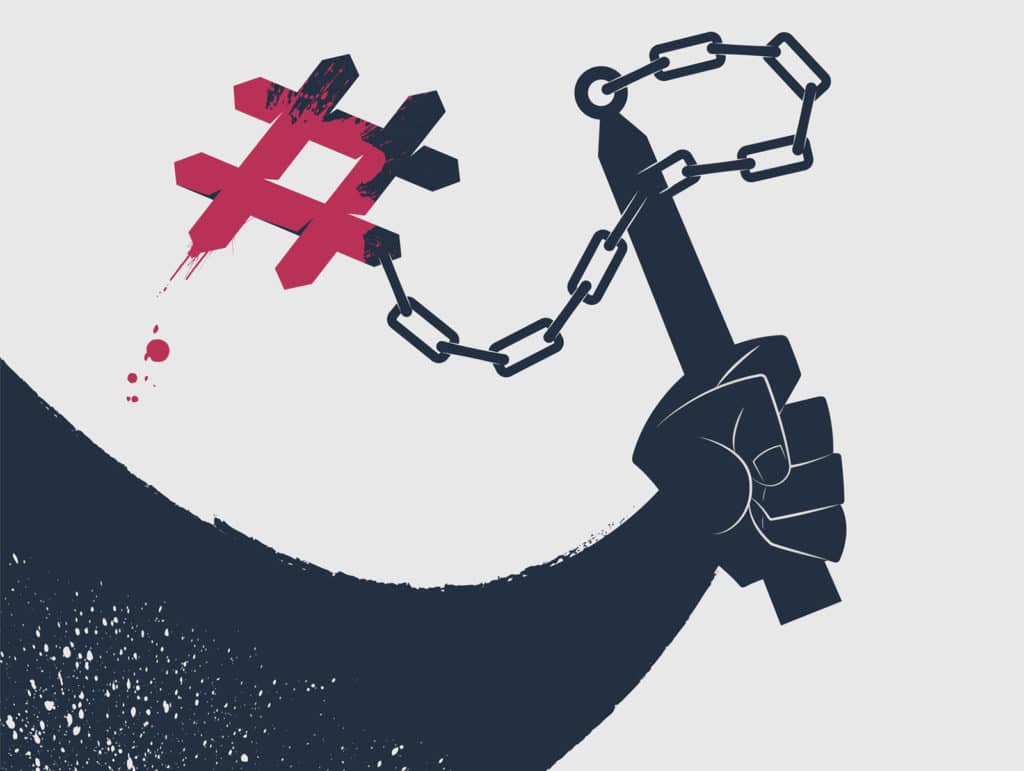
According to the Network Contagion Research Institute (NCRI), where both authors are affiliated, “extremist hashtags and slogans are upstream predictors of real-world violence and unrest.” In a disturbing example, the antisemitic hashtag #Covid1948 has been trending on Twitter in several countries, including the United States. Often accompanied by nakedly anti-Jewish content, the hashtag likens the birth of the state of Israel in 1948 to the COVID-19 virus. According to the NCRI, the hateful hashtag was shared up to 175 times per minute for over 4 hours on May 13. It often appears alongside #FreePalestine and is associated with other antisemitic hashtags like #Hitlerwasright and #Zionazi.

The antisemitic hashtag #Covid1948 has been trending on Twitter in several countries.

The #Covid1948 hashtag coincides with an offline global surge of anti-Jewish rhetoric and violence. In London, Palestinian demonstrators drove through the city, chanting “fuck the Jews, rape their daughters.” In Germany, Palestinian demonstrators gathered in front of a Synagogue, throwing rocks and shouting “shitty Jews” (“scheisse Juden”). Synagogues in Spain and the United Kingdom have also been vandalized. In Brussels, London and Paris, Palestinian demonstrators chanted “Khaybar, Khaybar, ya yahud, Jaish Muhammed sa yahud” (“Jews, remember Khaybar, the army of Muhammed is returning”), a reference to a battle led by Muhammed in which Jews were massacred. Threats against Jews in Britain have risen 400% since the recent conflict between Israel and Hamas began.

In Los Angeles, Palestinian demonstrators asked a group of diners if they were Jewish and attacked those who identified as Jewish. Also in California, an Orthodox Jewish man on foot was pursued by cars waving Palestinian flags. In New York, a Jewish man was struck on the head by Palestinian demonstrators and escorted to safety by police. In Florida, a van that read “Hitler was right,” “Rabbis rape kids,” “Holocaust never happened,” “We hate kikes” and other neo-Nazi slogans drove in circles around a group of Jews at a peace rally.

On Twitter, meanwhile, antisemitic posts insinuate that Jews are responsible for COVID-19 and have nefarious plans regarding the vaccine. Blaming Jews for pandemics has a long history. In the fourteenth century, Jews were accused of causing the bubonic plague by poisoning wells. Violent anti-Jewish riots and massacres broke out all over Europe, and surviving Jews fled to Eastern Europe. In the 1890s, Jewish immigrants, escaping persecution and pogroms in Eastern Europe, arrived in New York only to be blamed for an outbreak of cholera. Today’s version of the idea that Jews carry or represent illness is reflected in tweets that refer to Hamas rockets launched at Israeli citizens as “a vaccine.”

Other tweets regurgitate versions of additional historical anti-Jewish disinformation. This month, a verified account belonging to the Iranian outlet “Press TV” tweeted an article that promotes familiar antisemitic lies, including that for Jews, “violence is a ‘sacramental’ act or ‘divine duty,’” and “The goal of Zionist terrorism is to unite all Zionists into one state and dominate the world.” That article combines versions of the antisemitic blood libel (the idea that Jews use the blood of non-Jews in religious rituals) with the insidious conspiracy theory that Jewish overrepresentation in fields like media, finance and government is part of a covert Jewish plot of global domination.

“The Protocols of the Elders of Zion” is still used by antisemites as “evidence” of this alleged Jewish plot to take over the world. The Protocols, written by Russian Jew-haters at the turn of the twentieth century, purports to be notes from a secret Jewish global domination planning session. Translated into multiple languages and circulated internationally for decades –– including in the United States –– The Protocols has convinced untold numbers of people that through establishing a “Super-Government,” Jews conspire to take “command of the world.”

Analysis by the NCRI has determined that the most prolific accounts amplifying antisemitism with the #Covid1948 hashtag are self-identified Iranian accounts, the majority created in April 2020. Similar content tweeted by multiple simultaneously-created accounts often represents coordinated online activity and can even suggest the involvement of state actors. In this case, it would not be surprising. Iran, a designated state sponsor of terrorism, funds Hamas terrorist attacks, and is known for disseminating disinformation online. Twitter suspended several of the accounts after their most recent antisemitic activity, but a tremendous amount of antisemitic content remains. And Jews across the globe are asking themselves if this is just the beginning.


Pamela Paresky, PhD, is a writer for Psychology Today, author of A Year of Kindness and was the chief researcher and in-house editor for the New York Times bestseller, “The Coddling of the American Mind.” She serves as Visiting Senior Research Associate at the University of Chicago’s Stevanovich Institute on the Formation of Knowledge and Senior Scholar at the Network Contagion Research Institute, where she researches extremism and anti-Semitism. Follow her on Twitter @PamelaParesky

Alex Goldenberg is the Lead Intelligence Analyst at the Network Contagion Research Institute, focusing on misinformation, disinformation, online extremism and the intersection of technology and hate. His recent research has appeared in NBC News, The Atlantic, The Brookings Institute, NPR, Forbes, Vice News and other media outlets.

Antisemitic Twitter Is Trending As Violence Against Jews Escalates Read More »

It’s Time for the Anti-Selfie

The selfie has an elevated pedigree. For much of history, people did not have the ability to look carefully at their own image. One could see their reflections in water or on polished piece of metal or stone, but those reflections were imperfect and offered only a partial glimpse of what the person truly looked like.

The mass production of the mirror at the beginning of the fifteenth century revolutionized how people saw themselves. In “Millennium: From Religion to Revolution: How Civilization Has Changed Over a Thousand Years,” Ian Mortimer explains that the mirror played a critical role in the Renaissance and enabled people to recognize their own individuality. This new appreciation for one’s unique appearance impacted the world of art, which shifted its focus from religious scenes to portraits, often commissioned by the painting’s subject. By the mid-fifteenth century, the mirror gave rise to the self-portrait, which was adopted by distinguished artists like Albrecht Durer, Jan Van Eyck and Rembrandt. That first “selfie” was the expression of a budding appreciation for the individual.

Jewish practice was also impacted by the mirror. The first discussions about them in the Talmud relate to crude mirrors that were blades used to trim unwanted hair; for this reason the Talmud prohibits its use on Shabbat. In the Middle Ages, some rabbis prohibited men from using mirrors because they were too feminine, an exotic item that only women would use for grooming.

But as the mirror became commonplace, Halacha saw it as a symbol of human dignity. People would cover the mirrors in a house of mourning. This, according to Rabbi Moshe Sofer, is because the mirror contains the reflection of man’s divine image; and the Talmud says that with death, this Divine image is “overturned,” and all humans are reminded of their failures and frailty.

Looking at one’s reflection is nothing short of intoxicating. But that can lead to a situation where that image starts to control us. In Greek mythology, Narcissus, a beautiful but arrogant young hunter who spurns the love of others, is cursed. One day he drinks from a pool of water and immediately falls in love with his own reflection, which he tries to hug and kiss. He remains frozen until death, in pursuit of his own reflection. The legend of Narcissus is an allegory about self-love; but it’s also an allegory about the dangers of substituting an image for reality. Ovid, when narrating this story, says to Narcissus, “this that holds your eyes is nothing save the image of yourself reflected back at you.” An image isn’t reality, and when we take the ideal image too seriously, it can destroy us.

An image isn’t reality, and when we take the ideal image too seriously, it can destroy us.

Rabbinic literature offers its own meditation on the Narcissus myth in a story told about “the Nazir from the South.” Nazirites would make a vow of holiness to not drink wine, avoid contact with dead bodies and let their hair grow out (At the end of one’s term as a Nazir, one must shave off all of their hair in the Temple). The Nazir’s long hair was meant to foster a sense of independence; Rabbi Samson Raphael Hirsch explains the long hair symbolizes being insulated from society. The Nazir is meant to tune out all the noise around him and take a mirror to their own soul.

Yet even this holy ritual became more about image than substance. King David’s son Absalom is a lifelong Nazir; yet he takes pride in his long flowing hair, which becomes a symbol of his arrogance and rebellion. The institution of being a Nazirite was corrupted by those entranced with the dashing image of the outsider.

It is in this context that Talmud tells the story of the Nazir from the South, whose entire goal is to cut off his hair. The Talmud recounts:

One time, a man who was a Nazirite came from the South (who) had beautiful eyes and was good looking, and the fringes of his hair were arranged in curls. (The High Priest said) to him, “My son, what made you decide to destroy this beautiful hair of yours by becoming a Nazirite (who would have to cut off his hair at the conclusion of his vow)?” (The Nazirite) said, “I was a shepherd for my father in my city, and I went to draw water from the spring, and I looked at my reflection in the water. My evil inclination quickly overcame me…(and) I said to myself, ‘Wicked one! Why do you pride yourself in a world that is not yours? Why are you proud of a body fated to be worms and maggots? I swear… that I shall shave (my hair) for the sake of Heaven.’”

This young man offers a sharp contrast to the ordinary Nazir. For him, cutting his hair off is an act of holiness; he refuses to be intoxicated by a self-image that will destroy his soul. Unlike Narcissus, the Nazir from the South looks beyond the beautiful image in the water and remembers that life is short, there are promises to keep, and there’s more to life than having perfect hair. The Nazir from the South steadfastly refuses to fall in love with his own image.

The contemporary selfie is no artistic self-portrait, no profound exploration of self; it is usually just a form of image management. Instagram stars faithfully photoshop their photos before posting, and ordinary people go to great lengths to get the perfect shot, sometimes endangering their lives in the process. These selfies deceive others and distort the lives of their subjects. Too often, people live for their selfies, making themselves miserable in order to project an image of being absolutely happy.

It is time for the anti-selfie. As a child, I loved “The Wizard of Oz.” At the end, when Dorothy and her friends visit the great wizard, they find a grand man on a large screen who has nothing to offer. But as they discover the actual man behind the curtain, this simple man becomes a wizard, helping all of them with their problems. This is the lesson of the anti-selfie: we are best pulling back on all the layers of fake imagery to see what the person truly is; even if that looks less impressive, authenticity is far more inspiring.

Rabbi David Bashevkin has written about the importance of embracing one’s failures and notes in his biography that he “has been rejected from several prestigious fellowships and awards.” This should be the motto of the anti-selfie. Our greatest self is when we are someone who is real, warts and all. Authenticity and vulnerability, failures and struggles don’t project a perfect image, but they certainly make one into a better person. And that is the lesson of the Nazir from the South: We need to stop perfecting our image and start perfecting our souls; we need to embrace the anti-selfie.


Rabbi Chaim Steinmetz is the Senior Rabbi of Congregation Kehilath Jeshurun in New York.

It’s Time for the Anti-Selfie Read More »

There Already Is a Palestinian State

In the current round of fighting against Hamas, Israelis are also combatting the misconceptions, half-truths and outright falsehoods bandied about by politicians, media pundits and cable comics, who fancy themselves experts on a conflict of which they are woefully uninformed.

The falsehoods begin with the conflict’s origins in the “expulsions” of Palestinians by Jewish “settlers.” In reality, there were no expulsions. There were eviction notices given to a handful of Palestinian families after a decades-long court battle to get them to pay rent to the trust, which, Israel’s courts have ruled, are the rightful owners of the dwellings.

Because Israeli laws regard these Palestinian families as “protected tenants,” all the residents had to do was pay rent in order to stay in their homes. This they have refused to do. Not for months or years, but for decades. This was a landlord/tenant dispute which has been in court for thirty years. Not a “gross human rights violation,” “expulsion” or ethnic cleansing in Jerusalem. (That is not to say that expulsions and ethnic cleansing have not taken place in Jerusalem. In 1948, when Jordan conquered the Old City and East Jerusalem, they did indeed expel Jewish residents, many of whose families had been there almost a thousand years).

Indeed the six Palestinian families facing eviction notices were given what amounted to squatters’ rights to the land seized by the Jordanians from its Jewish owners in 1948. Jordan occupied East Jerusalem for only 19 years. The fact that those families were able to live in their homes for decades is due to the protections provided them by Israeli courts.

Another aspect of the conflict that is misconstrued is the concept that the residents of Gaza are homeless refugees living under a harsh Israeli occupation, thus precluding any possibility for a viable “Two State Solution.”

This unfortunately ignores the fact that there has already been a de facto Palestinian state for over fifteen years. It is called Gaza.

Gaza has a defined population, territory and government. While Gaza is being contained by Israel due to the threat of rocket and missile attack, it is obviously not under the control of either of its neighbors, Israel or Egypt, since it has been free to go to war against Israel four times in a little over a decade.

It maintains a standing army and possesses a rocket arsenal larger than that of any European

NATO member. It has a charter, levies and collects taxes and exercises (poorly) all the functions of government, from health care and education to sewage management.

More than just the trappings of a state, Gaza possesses all the blessings any state could possibly hope for. It has a mild climate, thriving agriculture and an industrious people. It has a Mediterranean port and some of the best beaches in the region. It is geographically blessed as the gateway between Europe and the Arab world. It could, and indeed, should be the Singapore of the Middle East. All it would have to do is admit that that Israel has as much right to exist within its borders as any other country in the region.

The only thing Gaza doesn’t have, which is keeping it from becoming a virtual paradise, is a government that strives for the success of its own people, rather than the annihilation of its neighbor.

The only thing Gaza doesn’t have is a government that strives for the success of its own people.

The way in which Hamas chooses to bring its people to Paradise is by forcing upon them the role of the martyr. Hamas’s most expensive weapons — their rockets and terrorist tunnels — are designed for one purpose: to kill Jews.

One of Israel’s most expensive weapons systems, Iron Dome, is designed for one purpose: to neutralize the rockets launched to kill Jews. Therein lies the difference.

The bottom line is there already is a de facto Palestinian State. Maybe there should be a second one in the West Bank. But the question needs to be asked: What have they done with the first one?


Dan Gordon is a screenwriter and served in the IDF as a sniper in an armored infantry unit, an officer in the Military Spokesperson Brigade and as the Documentary Officer of the Givati infantry Brigade. He served in six of Israel’s armed conflicts.

There Already Is a Palestinian State Read More »

Rosner’s Torah Talk: Nasso with Margaret Hughes Robinson

Margo Hughes-Robinson will graduate from the Jewish Theological Seminary in 2021. Prior to studying at JTS, Margo graduated from Clark University in Worcester, MA, where she graduated with degrees in Theatre and Jewish Studies, and at the Year Program at the Conservative Yeshiva in Jerusalem. She is a passionate interfaith organizer and educator, teaching Jewish-Christian Bible classes and working with groups like the New York Muslim-Jewish Solidarity Committee and Standing UPtown for Justice.
This Week’s Torah Portion – Parashat Nasso (Numbers 4:21-7:89) – begins with the completion of the head count of the people of Israel. God then gives Moses instructions concerning the purification of the camp, ‘wayward wives’ (wives which are suspected of being unfaithful to her husband) Nezirim (Jewish ascetics who take a vow to devote themselves to God), and the Priestly Blessing. Toward the end of the parasha the tabernacle is consecrated and the chieftains of the different tribes bring their offerings. Our discussion focuses on the meaning of the Nazir.

Previous Torah Talks on Nasso

Rabbi Abraham Cooper

Rabbi Josh Feigelson

Rabbi Mark Borovitz

Rabbi Rona Shapiro

Rabbi Thomas Gardner

Rabbi Burt Siegel


Rosner’s Torah Talk: Nasso with Margaret Hughes Robinson Read More »
