fbpx

March 23, 2021

Brandeis University Celebrates Passover for First Time

(JTA) – To prepare for Passover, Sam Greene is deep-cleaning his dorm room in keeping with the standards of his Orthodox Jewish family.

Lena Ben-Gideon is compiling readings about immigration to supplement her haggadah.

And Juliana Sherer is casting her friends in a dramatic performance of “Had Gadya,” the song that plays a prominent role in her family’s Seders.

In a typical year, the three Brandeis University students would be heading home to spend Passover with their families in Cleveland, North Carolina and Seattle.

But this spring, with the COVID-19 pandemic ongoing, Brandeis is keeping students on campus — and hosting Passover celebrations for the first time in its 73-year history.

Since it was founded in 1948 by the American Jewish community, Brandeis has scheduled its spring break to overlap with Passover. The tradition was pragmatic, according to Brandeis professor Jonathan Sarna, a historian of American Judaism: In addition to allowing students to celebrate with loved ones, closing campus during Passover allowed the school to steer clear of the daunting and costly undertaking of converting its kosher dining hall to meet the holiday’s standards.

But last year, Brandeis shuttered its campus in mid-March as the coronavirus pandemic descended on the United States. In the fall, and again in February, students returned to campus — with steep restrictions on their travel and a schedule designed to dissuade it. That meant no Passover break.

“I know how important this holiday is for families and for getting together,” said Brandeis president Ronald Liebowitz. But, he said, the college had a responsibility to minimize students’ travel off campus, “even for something as important as Passover.”

Gearing up to host Passover for the first time ever has required an all-out effort by Brandeis Hillel, which serves the university’s Jewish students. About a third of Brandeis’ 3,700 undergraduate students are Jewish, according to a college guide compiled by Hillel International.

Brandeis Hillel contracted with a seasoned local kosher caterer to prepare kosher-for-Passover meals, including individual Seders-to-go that 400 students registered to pick up.

Its rabbinic intern, Ilana Sandberg, a student at the Jewish Theological Seminary in New York City, is creating a commemorative Brandeis haggadah supplement that includes writing by students.

There’s even a four-day campus-wide Afikomen hunt, when students are invited to scour the hilly suburban campus for a hidden piece of matzah, inspired by the Seder ritual.

“We are trying to make all options available so students can have the most meaningful experience as possible,” said Rabbi Seth Winberg, Brandeis Hillel’s executive director and senior chaplain for the university’s Center for Spiritual Life.

About half of students celebrating Passover have opted for small in-person, student-led Seders. (Gatherings of more than 10 people are currently prohibited on campus.) Others will join their families on Zoom. Hillel staff will host a few small virtual Seders — including for non-Jewish students seeking to celebrate with their Jewish friends and learn more about the holiday, according to the school’s website.

“COVID presents an opportunity to empower students to learn how to lead a Seder and to be the producers of their Jewish experience,” said Winberg, who has made four how-to videos for students about preparing for Passover.

Sarna said he was worried about all of the logistics required to meet the needs of religiously observant students. In addition to eliminating leavened foods during the holiday, Jews who observe the full span of dietary laws associated with the holiday use different cooking vessels and dishes, ensure that ingredients are certified kosher for the holiday and, depending on their family’s traditions, may also not eat a host of associated foods known as kitniyot.

But Sarna said the school’s decision to contract with Andrew Wiener, who runs the respected Boston-area kosher caterer Catering by Andrew, alleviated those concerns.

“Once it was in Andrew’s hands, a lot of us who were worried breathed a sigh of relief,” said Sarna, who volunteered for a committee charged with making sure the university had a positive Passover experience.

Students who were invited to help craft the Seder menu at a tasting this spring gave high marks to Weiner’s brisket, grilled eggplant roulade, potato kugel, Moroccan salmon and chocolate mousse. Those dishes will appear on the Seder menu.

Beyond the Seders, Weiner is on deck to deliver 3,500 kosher-for-Passover meals during the holiday, which he’ll prepare offsite and distribute at a small kitchen on campus that has been made kosher for Passover. The school’s main kosher dining hall will be closed.

The cost of the Passover meals runs into the six figures, Winberg said, and is being shared between the college and Hillel.

Students say they are embracing the unusual holiday, even as they grieve a school year and a holiday disrupted by the pandemic.

“There’s a bit of mourning that loss. We have had to adjust to a lot out of our comfort zone during COVID and this is one of them,” said Sherer, a sophomore who is Hillel’s vice president. But she added, “It’s a special opportunity that we have to get to plan Seders with our friends.”

The historical nature of Brandeis’ first Passover is not lost on Ben-Gideon, the daughter of two Conservative rabbis from Greensboro, North Carolina, whose twin sister is also a first-year student.

“This is a once-in-a-lifetime opportunity,” she said. “What can we do to make it super exciting and awesome because it may be the only time this is going to happen?”

Brandeis University Celebrates Passover for First Time Read More »

MA High School Investigating Football Team’s Use of Anti-Semitic Slurs

A Massachusetts high school is investigating their football team’s reported use of anti-Semitic slurs as part of their play calling during games. The Boston Globe reported that the words used during Duxbury High School’s March 12 football game were “Auschwitz,” “rabbi” and “dreidel.” John Antonucci, the school superintendent, told the Globe that the school is “investigating the use of anti-Semitic and potentially other inappropriate and derogatory language.”

Antonucci released a statement with Assistant Superintendent Danielle Klingaman and Principal James Donovan stating that “while the players clearly demonstrated poor judgment, the responsibility for this incident also lies with the adults overseeing the program. In short, this was a systemic failure.”

The coach, Dave Maimaron, apologized in a statement, saying that the language used “was careless, unnecessary and most importantly hurtful on its face — inexcusable.” He later added that “as a special education teacher and a coach, with a multi-racial family, I have a lengthy record of helping students and athletes of all races, religions and capabilities to become the best they can be. I view the football field in particular to be the largest classroom in the school and have developed an inclusive program that welcomes, and makes part of the team, any student who wishes to participate.”

The Boston Herald also reported that Maimaron was suspended for the team’s March 19 football game. The school declined to provide details on disciplinary matters when asked by WCVB; Maimaron told Boston.com that he didn’t know if he would be coaching the team’s March 26 game.

Robert Trestan, head of Anti-Defamation League New England, told the Globe, “It’s deeply hurtful to the Jewish community to learn that the plays somehow connect to the Holocaust and Judaism. This is a really serious situation. There are indications of a systemic failure both on and off the field.”

The Stop Antisemitism.org watchdog also tweeted that it was “outrageous” that Maimaron has only been reportedly suspended for one game.

MA High School Investigating Football Team’s Use of Anti-Semitic Slurs Read More »

Netanyahu Ahead, But Coalition Results Too Close to Call

1. Exit polls predict a Netanyahu government of 61. Or a tie. It is very close. As close as an election can get. And the night is long. It is quite possible that we will not know for sure if Netanyahu is king or if a fifth election is more likely. Whatever the case, the parties who wanted nothing to do with Netanyahu do not have a coalition.

2. In Israel, we do not elect prime ministers; we elect parties that must form coalitions. The more parties we have, the more complications we must overcome. The more our leaders vow not to sit in this or that coalition, the less likely it becomes that a functioning coalition could be formed. That’s why Netanyahu is the only candidate with a real option to form a coalition. The parties against him cannot form a coalition. Too many of them vowed not to sit together. He can form a coalition (if exit polls are to be believed) — a very narrow one. A coalition in which each member can make trouble and force the hand of the prime minister. A coalition that most voters did not want — and may still get.

3. Israel is a country that leads the world in COVID-19 vaccinations and is basically in the process of going back to almost regular life. Under such circumstances, Netanyahu should have won the election hands down. The fact that he didn’t tells you something about the way Israelis feel (most of them did not want him to continue). The fact that he prevailed tells you that sometimes the important things (vaccines) can tip the scales in favor of a relatively unpopular politician.

The important things (vaccines) can tip the scales in favor of a relatively unpopular politician.

4.  Voter turnout was relatively low. Not historically low — just relatively low. It was low mostly because many Arab voters decided not to bother voting. This is significant for several reasons. One, because it signals to the Arab leadership that its constituency isn’t happy with its performance. Two, because it follows a split: the main Joint List was not able to stay intact and Islamist Raam ran a separate campaign. The voters tend to prefer unity over splits. Three, because recent election cycles brought to the fore the dilemma of Arab voters and leaders, many of whom seem to tire of the old formula of we-vote-but-it-has-no-impact. Arab voters want their parties to have influence, and that can only happen if Arab politicians drop their focus on the “Palestinian issue” and begin to focus on local concerns of Israeli Arab voters.

Is this change forthcoming? The low Arab turnout — and expected representation — could be a sign that it is.

5. A narrow coalition is not necessarily a fragile or unstable coalition. Sometimes, the small advantage can be an effective glue for the parties who take part in the coalition, because while each of them knows that he has the power to force the hand of the partners, they also knows that forcing the hand of the partners could mean the end of the coalition.

So, if the polls are accurate, and Netanyahu gets to stay in power (after tough negotiations), don’t bet on a short-lived government. It can be a long lived, stable and coherent. Is it better than a fifth election? Stability is important, but other things are also important. I guess the answer depends on one’s like or dislike of the outcome.

Stay tuned.

Netanyahu Ahead, But Coalition Results Too Close to Call Read More »

Israel Employs High-Tech Solutions for Elections During Pandemic

The election for the 24th Knesset, similar to the three before it over the past two years, poses many challenges to the Central Elections Committee, mainly due to the trauma of the coronavirus, which some experts fear could see a surge in its wake. The committee has prepared for this round, as the previous ones in 2020, albeit with slight changes.

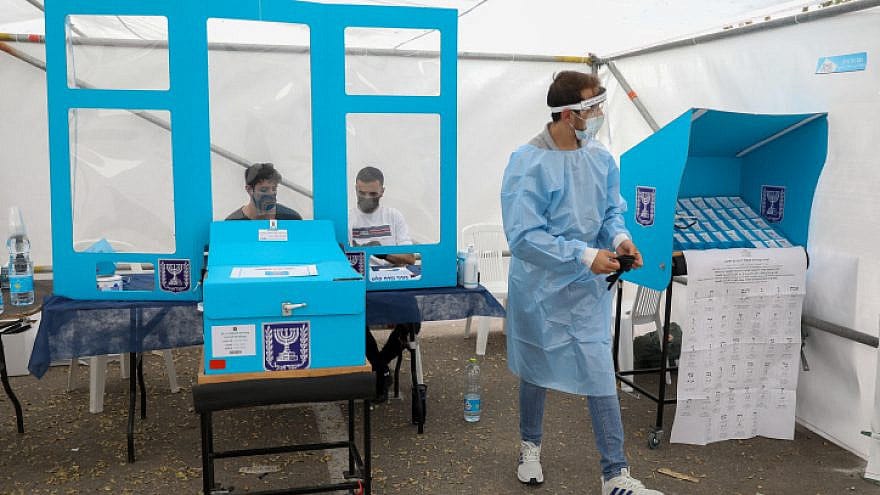
Far more double envelopes: In the election for the 23rd Knesset, the number of voters using double envelopes was some 330,000. These included soldiers, police, inmates and guards, official Israeli emissaries abroad, residents of battered women’s shelters, patients in hospitals, those with disabilities, and this year, people who have contracted the coronavirus and are in isolation.

“Vote and Go” stations:Making their election day debut, these stations cater to people with the coronavirus and in isolation. They will be dispersed in 500 tent facilities across the country.

Confirmed cases in taxis: Some 12,000 confirmed cases will arrive at the special “vote and go” stations in Gett taxi cabs, their rides funded by the Central Elections Committee. The cabs will have plastic barriers between the driver and passenger, who will only be allowed to sit in the back seat.

People in isolation: Around 39,000 individuals in isolation will be allowed to enter the “vote and go” stations in their own cars. Those who don’t have a car at their disposal can, as stated, order a Gett taxi funded by the Central Elections Committee.

Drones: The Central Elections Committee has rented aerial drones to keep tabs on the traffic situation at the “vote and go” stations. If a station becomes too congested and people have to wait in line too long, officials can divert incoming voters to other stations.

Voting stations at Ben-Gurion Airport: For the first time in the country’s history, four voting stations will operate at Israel’s main international hub, to allow Israelis arriving from abroad to vote via double envelope. The stations will be placed before the border-control check. Israelis arriving from abroad will have to undergo a Health Ministry inquiry, a COVID-19 test and enter isolation if they haven’t been vaccinated twice.

Coronavirus patients in hospitals: Corona patients hospitalized in any of the 38 medical centers across the country are also able to vote in the election, as with all other patients confined to hospital grounds.

Vote counting: Due to the large increase in the use of double envelopes, the Central Elections Committee has hired some 6,500 vote counters.

A tight schedule: The Central Elections Committee must finish the vote count and calculate the distribution of mandates by the commencement of Shabbat on Friday evening. In other words, it will have less than three days from the time voting stations close at 10 p.m. on Tuesday until Friday evening. This is a tough task, mainly due to the large number of double envelopes, which take longer to count.

This article first appeared in Israel Hayom.

Israel Employs High-Tech Solutions for Elections During Pandemic Read More »

Passing Over Melted Snow

What is not passed on now is lost,
and it is not enough to borrow
the past, for it must be embossed
in order to have a true tomorrow.

That’s why Jews choose to celebrate
at winter’s end, first nights of Passover,
our past to which we must relate,
passed on to all, and not passed over,
by wise ones or the ones who’re wicked,
and not just foolish offspring, even
ones who do not own a ticket,
not asking: “What’s this web we’re weavin’?”
not understanding just how vital
is asking about long ago,
on Passover, despite its title,
not passing over melted snow.

In “Past Imperfect,” WSJ, 3/19/21, Liesl Schillinger, reviewing “The Art of Losing” by Alice Zetiner, a book about the exploration of the past of her ancestral home, writes “What is not passed on is lost, that’s all there is to it.” This reminds me not only of the French poet François Villon’s “snows of yesteryear,” but of the haroset that causes the bitterness of maror to melt in our mouths. It also reminds me of the third cardinal rule that Menahem Begin said he had learned while growing up in Brisk, one recalled by Rabbi Meir Soloveichik in a Tikvah lecture on 3/22/21: “Happy is the man who is able to bear the yoke of his childhood.”

Gershon Hepner
Erev Pesach, 5781


Gershon Hepner is a poet who has written over 25,000 poems on subjects ranging from music to literature, politics to Torah. He grew up in England and moved to Los Angeles in 1976.  Using his varied interests and experiences, he has authored dozens of papers in medical and academic journals, and authored “Legal Friction: Law, Narrative, and Identity Politics in Biblical Israel.” He can be reached at gershonhepner@gmail.com.

Passing Over Melted Snow Read More »

London Man Arrested Following Attack of Pregnant Jewish Woman

A London man was arrested on March 22 in connection with the March 18 attack on a pregnant Jewish woman. The attack, which was caught on camera, showed a man repeatedly punching the 20-year-old Jewish woman in the stomach and attempting to suffocate her with a pillowcase. The woman was treated for minor injuries at a hospital.


The suspect is reportedly in his late 50s; the police have yet to establish a motive. Rabbi Herschel Gluck, president of the Shomrim neighborhood watch, told The Guardian that the victim was “deeply traumatized” by the assault. Shomrim has also said that the attack was one of five attacks against Jewish women in the area in March.

Jewish groups condemned the attack. “This is an incredibly troubling attack,” the Anti-Defamation League tweeted. “A young, Jewish pregnant woman is stalked, suffocated and repeatedly punched in London.”


The American Jewish Committee similarly tweeted: “We are horrified by the vicious assault on a pregnant Jewish woman in London. The attacker repeatedly punched and tried to suffocate her.”


The Stop Antisemitism.org watchdog also tweeted, “Thank Gd this monster has been arrested. We hope he is prosecuted to the fullest extent of the law!”


Israeli-based writer Hen Mazzig tweeted that although he has seen some articles about it in British media, it hasn’t been at the top of their news sites. “Shame on all of you,” he wrote. 

London Man Arrested Following Attack of Pregnant Jewish Woman Read More »

Passover Special: A Moral Obligation to Cut Food Waste

As annual food waste around the world inches closer to reaching one billion metric tons, what can Passover teach us about our responsibilities in correcting this issue and other environmental issues like it?

With Passover, or Pesach, swiftly approaching, millions of Jews all over the world will soon be commemorating the biblical story of Exodus, in which God freed the Israelites from slavery after sending ten different plagues down onto Egypt. Like the ten plagues, ongoing environmental and climate crises are afflicting our planet at an unprecedented rate, and the cost of ignoring them only grows more severe. However, unlike the biblical plagues, the climate crisis is a product of our own making, in which our industry, economic activities, and human behaviors accelerate the rate of climate change.

In the 40 years following their deliverance from slavery, the Israelites had to conserve and refrain from wasting any of their food as they traversed through the desert before reaching the promised land. Today, however, the polar opposite is occurring on a global scale. Food waste has become a monumental problem, which one could interpret as a self-inflicted plague—one that should not be ignored.

A new report published by the UN Environment Programme (UNEP) this March shows that in 2019 alone, 931 million metric tons of food waste was generated worldwide, in which household waste made up 61% of this total. Waste from the food service industry made up 26%, and the retail industry made up 13%.

This amount of food waste is the equivalent of 23 million trucks weighing 40 tons each, which if arranged in a line, would orbit the earth seven times.

In Israel alone, 2.4 million tons of food is wasted every year, of which 50% is edible and can be salvaged. Furthermore, an average Israeli family throws away just over NIS 8,000 worth of food per year while 300,000 families suffer from food insecurity.

Rich and Poor Alike

The negative economic and social implications of waste generation on such a huge scale are clear. Last year, the World Bank estimated 150 million people across the world would fall into poverty by 2021 due to both changes in personal employment status and global instability.

“The pandemic and global recession may cause over 1.4% of the world’s population to fall into extreme poverty,” said World Bank Group President David Malpass in an official statement. Therefore, throwing away food as more people become desperate for it has become an even larger problem.

The report also reveals that the global average of 74 kg per capita of food wasted annually is remarkably similar from lower-middle income to high-income countries, suggesting that most countries have room to improve. This means that the amount food waste generated is surprisingly similar among all socioeconomic classes.

The latest data that appeared in the report is twice as high as data in other similar reports published only a decade ago, indicating the significance of the problem did not hold much value. The authors of the report stressed that this is a phenomenon relevant to the whole world, and that this is an opportunity that needs to be addressed not just in poor and developing countries.

Warming Food Waste

 Beyond the economic implications, the authors of the report stressed the need to consider the environment impact food waste is contributing to. According to the IPCC’s latest report, 8-10% of greenhouse gas emissions responsible for global warming between 2010 and 2016 were caused by food waste, or unconsumed food-borne emissions.

According to the American nonprofit, ReFED, in the US alone, more than a third of the food produced is never eaten—about $408 billion worth of food. Although, Recycled Track Systems (RTS) estimate this value to be closer to $161 billion. In addition, the carbon footprint created by the US food industry is almost equal to that of the global transport industry, accounting for about 8% of all carbon emissions in the country.

This data presents the significant effects enabling climate change: the energy consumed during the food production process, which contributes to atmospheric carbon dioxide emissions and the food that is thrown away and left to rot, which produces methane—a greenhouse gas with a 100-year global warming potential 2530 times that of carbon dioxide.

The rise in atmospheric concentrations of both these gases continues to disrupt the heat balance on Earth and contributes to rising temperatures and accelerating climate change.

Don’t Pass Over No-Waste Initiatives

Passover teaches us an important lesson, one that goes hand in hand with our modern tendency to throw away food: one does not give up their moral obligations just because they are free. Yes, freedom gives one the choice of not doing something, but with freedom comes opportunity, and with opportunity comes possibilities. In our case, we have the opportunity to correct our mistakes, especially those that have harmed our vulnerable environment. Thus, the possibilities to restore the health of our environment are numerous.

With regard to food waste and the problems it causes our environment and society as a whole, there are a variety of strategies we are free to adopt and strengthen to make our world a far better place.

The report notes that there are quite a few strategic actions that can be applied, including raising the priority of the issue among international organizations and funds. In addition, the UN intends to establish special missions to address the problem in Africa, Asia, Latin America and the Caribbean.

Alongside global actions, there are those who have chosen to take the reins and act to improve the situation within their own community like Haifa-based restaurant, Robin Food. The association that runs the restaurant works to cultivate relationships with farmers and suppliers in order to get produce before they are thrown away for various reasons, such as their potential unattractiveness. After being purchased the products are then transferred to the restaurant where they are prepared into delicious dishes for customers.

Even project Food Rescuers Jerusalem is working to change food consumption patterns in Israeli private households, markets, restaurants. As part of the project, the activists also carry out educational activities and organize community meals based on food that they have managed to “save.”

The Israeli organization, The Natural Step, is also working to improve the complex situation by offering services and managing processes in the field of sustainability in Israel. Dr. Michal Bitterman, CEO and founder of the organization, says that the issue reflects a problematic mindset.

“The whole reference to food is distorted. The Israeli consumer gives in to this mindset for many reasons: the culture of abundance, confusion due to unclear expiration dates leading to improper food waste, excessively large packages of products, promotions that push us to buy items we don’t need, and also a lack of dynamic pricing, that is, the lowering of prices before a product expires—a successful waste reduction policy that is currently being pursued among other places, in Italy and France.”

The most significant problem, Bitterman argues, lies in the low level of awareness and lack of policy. “There is a need for regulation that will require a national goal of food reduction, which does not exist in Israel,” she explains, adding that this can be achieved through prioritizing local agriculture, reducing the expiration date range, restricting food wasting by chains and introducing a food donation procedure.

According to Bitterman, these actions should come alongside various moves at the business level, such as streamlining the packaging field and making it more economical, and of course more educational.

Last week, TNS led the “Food Waste Reduction Week” in Israel, in which Bitterman called for the integration of the younger generation in finding solutions to the problem. “Children tend to indulge and want variety. They also tend to not understand how difficult it is to grow a tomato, for example. Therefore, they must be integrated into the process of change.

ZAVIT – Science and Environment News Agency

Passover Special: A Moral Obligation to Cut Food Waste Read More »

A Eulogy for My Catholic Grandmother

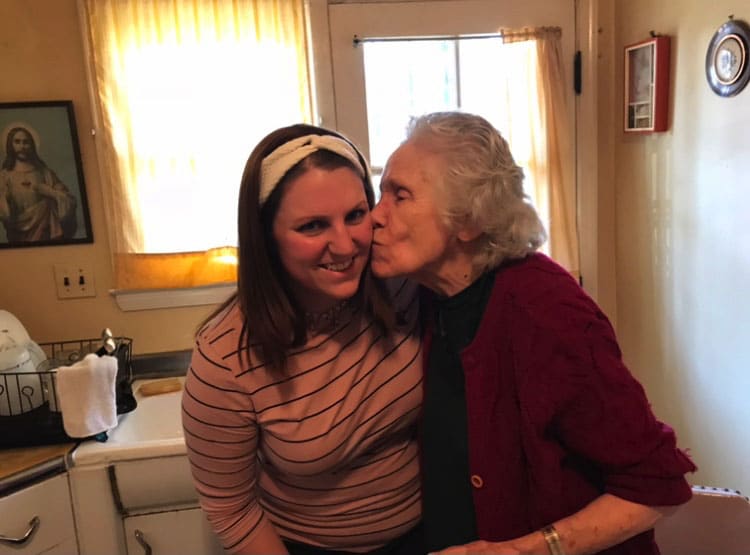
When I was a kid, I was always disappointed when my parents told me that my Grandma Riggle was going to babysit. She wouldn’t let me watch TV or eat junk food. Instead, she’d take me to boring church or make me sit down at her dining room table and learn Catholic prayers with a creepy portrait of Jesus watching me from behind.

I distinctly remember a time when I was 14 and depressed, and my grandmother came over to check on me. She walked into the computer room, where I spent most of my time, and looked at my screen, which had a picture of the piano player Ben Folds on it. In the picture, he seemed contemplative, perhaps even a little bit melancholy.

“He looks depressed and sad,” my grandma said. “You need a picture of happy, smiling people. Take that off.”

“Um,” I said, not quite knowing how to respond.

“Do you feel like crying?”

“No.”

“Well, you should really change that picture to a happy one.”

At the time, I was incredibly angry, as evidenced by the expletives I wrote about the incident on my online diary, my Deadjournal. I just didn’t understand my grandma. So what if I was sad? I was punk rock. An atheist. At least I wasn’t like her, believing in a G-d that didn’t exist. Once she said she tried to baptize me in the sink when I was a baby, and it “didn’t work.” What did that even mean? Did I splash the water away because I was some kind of heathen?

When my other grandma, Grandma Wakefield, and her husband, my grandpa, died when I was a teenager, Grandma Riggle became my only living grandparent left. She was never the stereotypical grandmother like Grandma Wakefield, who loved to bird watch, make Christmas cookies and spoil me with all the craft supplies and coloring books I could ask for.

However, as I grew up, I learned to appreciate Grandma Riggle for who she was. Whenever I came home from college, I’d visit her and she’d ask me if I was going to church. I was still an atheist and would dodge the question because I felt guilty that I wasn’t living up to her standards.

As I grew up, I learned to appreciate Grandma Riggle for who she was.

By that point, I didn’t want to let her down. She was always encouraging. She told me how good it was that I was majoring in journalism. No matter what I did, she said it was good. I got an internship? Good. I made the dean’s list? Good.

“You’re smart,” she said. “You’re going places.”

She was the only family member to consistently give me a hug and tell me, “I love you” out loud. I came to truly see her as a grandmother, that source of warmth and comfort I craved and needed.

Years after I graduated college, I converted to Judaism and began living an Orthodox Jewish life with my husband, Daniel Lobell. I never got the courage to tell my grandmother that I converted — not that it mattered so much since she started getting dementia and wouldn’t remember it anyway. When she asked me if I was going to church, I said, “Yes,” counting shul as church.

“Good,” she said with a smile.

Every year, Daniel and I would visit our families on the East Coast around Thanksgiving, and one of our favorite parts of our trip was visiting my grandmother. I’d cry when I left her house because she was getting into her 90s and forgetting my name. I wasn’t sure if I’d see her again the following year.

This past Thanksgiving, Daniel and I visited my grandma and took Sophie, our 17-month-old daughter, with us. Sophie walked around my grandma’s house, following her up the stairs and picking up all sorts of knick-knacks to play with. The sight of this baby thrilled my grandmother.

“I can’t believe it!” she kept saying, watching Sophie walk. “That’s a baby! She’s good.”

A little over a month ago, my grandmother fell in the night. After hip surgery and a bout of COVID-19 in a nursing home, she was sent home. The outlook was not good. It was all too stressful for her. Her condition got worse and worse.

I flew home to see her as soon as I could, praying on the plane that she wouldn’t pass before I got to say goodbye. Thankfully, she held on.

While I was there, I spent one of the best days of my life with her. I knew it was the best as it was happening. It’s strange because it was such a sad moment, but I was just so happy I could be there at the end. That I could take care of her, if only for a day.

I fed her melted ice cream, one little spoonful at a time. I played Catholic songs for her and brushed her hair. I Facetimed with Daniel and Sophie so my grandma could hear Sophie’s voice. I took some photos with her and told her to hang in there and that I’d see her again. I prayed to G-d I’d see her again.

Exhausted, I cried myself to sleep on the plane ride back home.

She died a few days later.

As a kid, I misunderstood my grandmother. I didn’t know the tragedy she had gone through, losing two siblings and a son and ending up divorced with five children to take care of.

But when I became an observant Jew, I felt a special kinship with her. We were both the most religious people in our family, even though we were of different religions. In a way, maybe all of her teachings worked. I inherited her passion for spirituality and G-d. It was the greatest gift she could have given me.

Because of her, my life is meaningful. My life is fulfilling. My life is good.


Kylie Ora Lobell is a writer for the Jewish Journal of Los Angeles, The Forward, Tablet Magazine, Aish, and Chabad.org and the author of the first children’s book for the children of Jewish converts, “Jewish Just Like You.”

A Eulogy for My Catholic Grandmother Read More »

Children’s Book Ponders How “Moses Could Have Been Selfish”

Ten days ago, a deranged man shoved a 25-year-old woman onto the subway tracks. Last month, a Filipino American man was stabbed as he rode New York City’s L Train. And in February 2020, a 23-year-old woman from Bangladesh was attacked while riding a Bronx subway train. Although all three survived, no one helped. No one interfered.

It’s not entirely fair to blame witnesses in these situations; there’s a high probability that they considered helping the victims but rightly feared for their own safety, especially if the attacker was armed.

Three thousand years ago, someone saw a man being cruelly beaten and decided to stop the attack. The man who intervened was Moses.

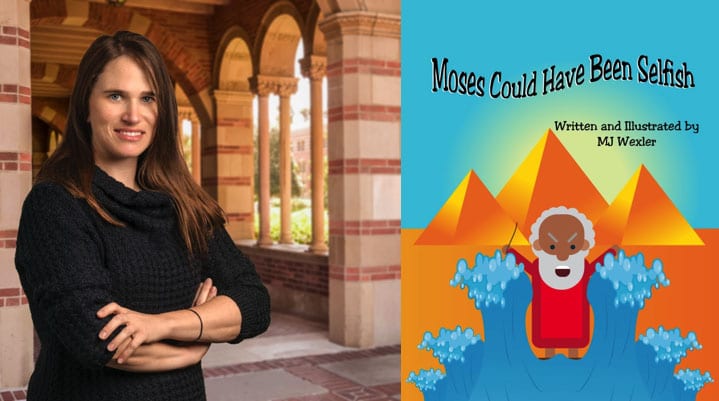
MJ Wexler, a Chatsworth-based children’s book author, was always drawn to Moses’s intervention, which she understood as a call to action. “While it is important to teach the story of Passover, most stories are based on the miracle of G-d,” she told the Journal. “But my favorite part of many Jewish holidays is the lesson of standing up against injustice.”

To that end, Wexler recently published a children’s book titled “Moses Could Have Been Selfish,” which tells the Passover story in charming rhymes and illustrations. But through one simple but powerful observation, the book compels readers to pause and contemplate a seldom-asked question: What if Moses had never aided the Israelite who was being beaten viciously by an Egyptian taskmaster?

“He (Moses) could have been selfish,” the book observes, “He could have said, ‘well at least I’m well off,’ but when seeing the injustice, it really made him scoff!”

“That moment of helping the Israelite was a turning point,” said Tal Sessler, Senior Rabbi at Sephardic Temple. “Before that, Moses hadn’t done anything for his people in an active way.” In fact, Moses had reached great stature and comfort in Pharaoh’s palace, and he simply could have walked away.

Like most children’s book authors, Wexler is skilled at summarizing complicated events into relatable (and digestible) content for kids. Parashat Shemot describes the incident as: “Moses grew up and went out to his brothers and looked at their burdens, and he saw an Egyptian man striking a Hebrew man of his brothers.” The next line seems simple but is deeply profound: “He [Moses] turned this way and that way, and he saw that there was no man; so he struck the Egyptian and hid him in the sand.” The simple meaning is that Moses looked back and forth for Egyptian guards, but he “also wanted to see if anyone else was doing anything to help,” Sessler said.

“It is so easy to do the right thing when you have nothing,” said Wexler. “There’s nothing to lose! But Moses was raised as royalty. He didn’t have to step up. But he saw something wrong, and he did the right thing. I would love for more people to focus on Moses’s wonderful action of standing up against injustice.”

“I would love for more people to focus on Moses’s wonderful action of standing up against injustice.”

Wexler has a diverse background, having taught Hebrew school and run synagogue youth groups. She currently teaches digital analytics at UCLA, does web design and cares for her four-year-old son. “I [also] work to get women elected to office,” she said.

For Wexler, there was a glaring lack of illustrated characters in children’s Passover books who actually resembled those who lived in Egypt and the Levant. “Moses, the Israelites — and often even Pharaoh — are typically illustrated as Caucasian,” she said. “But we know as a fact that thousands of years ago, people in the Mideast were, at the very least, brown. But it is important that we provide children with an accurate description of people in the Torah.”

Wexler is right. A few years after I arrived in America from Iran and saw a drawing of Moses on a synagogue wall (forget even in a children’s book), I couldn’t believe my eyes: Moses had white skin, thin, blondish eyebrows and green eyes. This was the man who wandered under the desert sun? I wondered. I always thought Moses would have looked like one of my thick-eyebrowed, dark uncles.

I asked Wexler how parents can teach their children the difference between healthy and harmful selfishness. “There are times when it’s okay to be selfish,” she said. “We all have different mental/emotional/physical needs. Sometimes my son needs to only be with my husband. And that’s okay. He lets us know when he needs ‘special Daddy time’ or ‘special Mommy time.’ It’s important to acknowledge the emotional needs of all children instead of labeling them as ‘selfish.’ Sometimes their need is just to be heard.”

Wexler also sees complexity in selfishness: “What we often find selfish in children is really due to the fact that they do not have the language to express their needs,” she said. “A child who hogs all the toys at school might just not have toys at home and doesn’t know how to talk about their feelings. It is important to differentiate between this sort of selfishness and a child who has literally everything and still expects the world to be about them.”

Rather than simply giving orders, Wexler prefers to ask her son how a nice child would respond to parents, teachers and friends. “This has actually made a huge difference in his behavior,” she observed. “I get him to set the expectations. And while having these conversations, he often tells me why he doesn’t behave or why he might be selfish, and we come up with a plan together on how he can improve.”

The book includes an important and engaging series of discussion questions for parents to ask their children, including “What would you do if you saw someone mistreating someone else?” and, in light of the Israelites’ strife and difficult journey, “Why do you think they kept going? What would you do to stay positive?” For Wexler, such questions “help children draw a connection between Passover and current-day situations and are designed to get kids to think about their actions.” Her son loves the book so much that he stated he wants to be an author.

Although it was written for toddlers to eight-year-olds, “Moses Could Have Been Selfish” inspires adults to really imagine the spiritual and historical implications of Moses’ singular decision: Had he not aided the slave, would he ever have achieved the kind of “supernal empathy,” which, according to Sessler, elevated him to the status of a national leader, toward a “cosmic responsibility to all of humankind”?

The book is a thought-provoking addition to the seder table, particularly in light of recent disturbing upticks of racist hate crimes against Jewish American and Asian American communities.

“We’re talking about something from thousands of years ago that can be so abstract for a child,” Wexler said. “I wanted an age-appropriate Passover story for my son that covered the basics. And my passion for social justice led me to this version of the Passover story.”


Tabby Refael is a Los Angeles-based writer, speaker and activist. Follow her on Twitter @RefaelTabby

Children’s Book Ponders How “Moses Could Have Been Selfish” Read More »