fbpx

February 23, 2021

Disastrous Mediterranean Tar Spill ‘Could Take Years to Clean Up,’ Experts Warn

A major tar spill off Israel’s coast has drenched much of its scenic Mediterranean shoreline in black refuse that could take years to clean up, environmental experts have warned.

According to the Israel Nature and Parks Authority, some 170 km (105 mi) out of 190 km (118 mi) of Israel’s beaches have been damaged by the offshore oil spill, marking one of the worst ecological disasters in the country in over a decade.

Once this is in the food web, it takes even years to remove and to clean. It’s really a long-term issue.

“It’s awful,” Prof. Maoz Fine, a marine biologist at Bar-Ilan University and the Inter-University Institute for Marine Sciences in Eilat, told The Media Line.

“I’ve just received a few calls from the people who are helping with the cleaning,” he said. “They were in tears; they were crying and saying that it’s so awful over there.”

Fine said that volunteers were regularly finding dead animals and that the spill will be deadly to many organisms. Even more concerning, once the oil reaches the intertidal zone – an area filled with marine wildlife – they will be “suffocated,” have no food to eat and the “entire zone will be lost.”

A sea turtle covered in tar. (Shlomi Ben Shimul/Israel Nature and Parks Authority)

The toxins will eventually also reach the marine food web and affect the entire ecosystem for a very long time.

“Once this is in the food web, it takes even years to remove and to clean,” Fine warned. “It’s really a long-term issue.”

Thousands of volunteers are working on a daily basis to remove clumps of sticky tar from the country’s sandy beaches, which are popular with tourists and locals. The Israel Defense Forces announced Sunday that it would deploy thousands of soldiers to help with the cleanup.

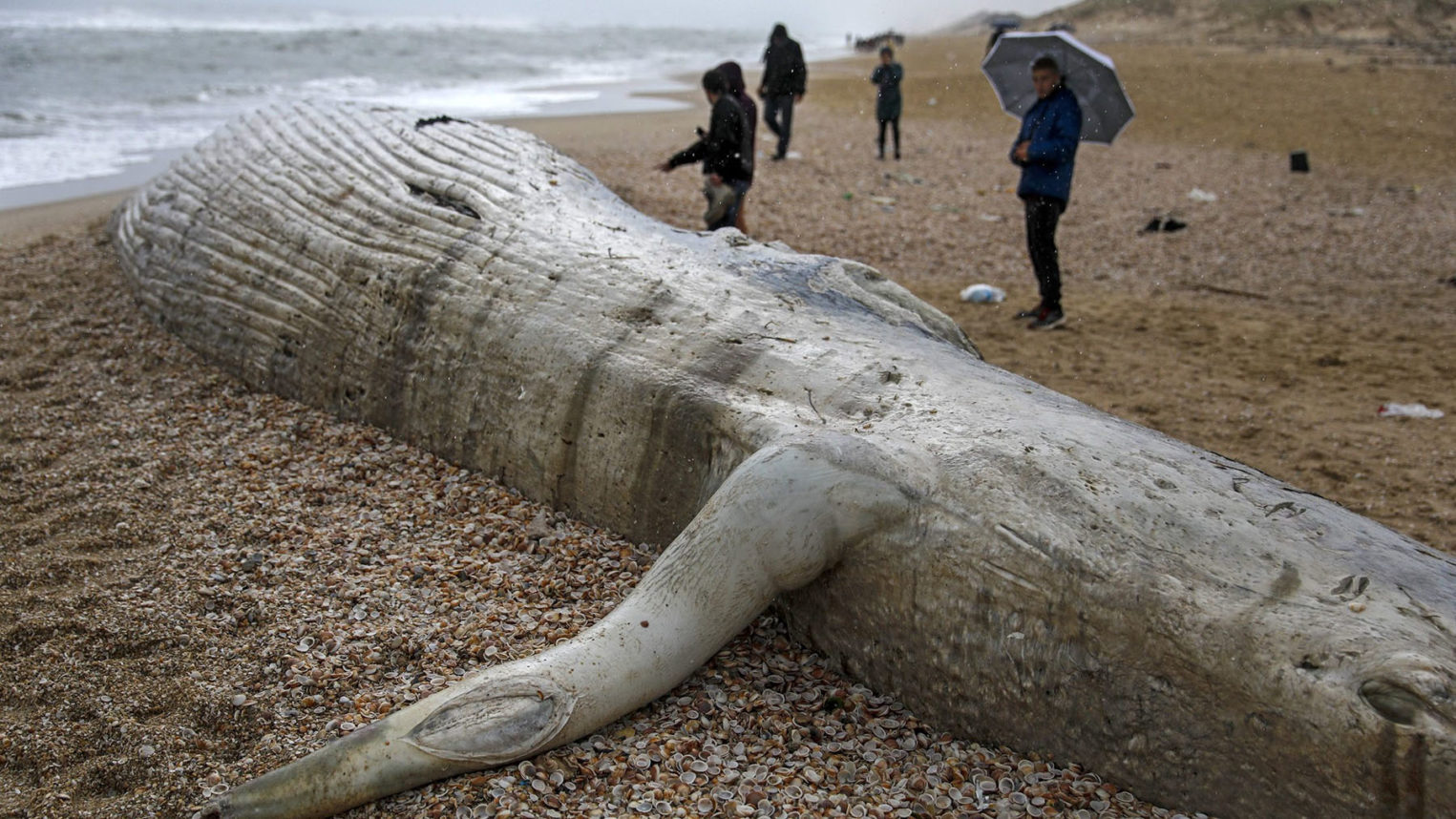
Evidence of the tar spill first emerged last week, when a 17-meter (55-foot) baby fin whale was found dead, washed up on the coast, in addition to other marine wildlife.

The authorities have warned everyone to stay away from the beaches and avoid swimming.

“With that new agreement to bring oil to Eilat from the UAE, this [event] just highlights the risk to the coral reefs in the Gulf of Aqaba,” Fine said, referring to a recent agreement to transport Emirati crude oil by tanker to a pipeline in the Red Sea port city of Eilat, which was signed after the two nations normalized ties last year.

Over 200 scientists from Israel and around the globe have cautioned the Israeli government against the plans.

Cleaners work to remove tar at Tel Dor beach, Israel. (Yossi Ozen/Israel Nature and Parks Authority)

Michael Raphael is the national coordinator of the Mediterranean People Campaign, a nonprofit coalition of Israeli environmental organizations that is pushing for the establishment of regulated marine-protected areas (MPAs) in the Mediterranean Sea. MPAs help preserve marine life by restricting human activity and fishing, as well as industrial and commercial activities.

Like Fine, Raphael qualified the oil spill as “disastrous” and believes that it will take years to undo the damage.

“The oil on the beach and on the sand, you can clean it,” Raphael told The Media Line. “But the oil that gets spread on the rock bed – where a lot of the ocean ecosystems are – destroys the rock bed and it can be permanent damage.

“This is disastrous and it’s going to impact our coast for a long, long time and we don’t even know in what ways,” he stressed, arguing that the only way to prevent a re-occurrence of such events is to ultimately move away from fossil fuels.

Other ecological organizations lamented the lack of government preparedness.

“The issue is the fact that a law that needs to be passed to give Ministry of Environmental [Protection] the funds and the power it needs to be fully prepared for these kinds of catastrophes has not been passed,” Arik Rosenblum, CEO of EcoOcean, asserted to The Media Line.

Tar found on an unspecified beach in Israel. (Israel Nature and Parks Authority)

EcoOcean, a nonprofit organization, is leading ongoing cleanup efforts and has established a national network of volunteers. So far they have helped activate close to 7,000 volunteers across the country and have provided professional training to an additional 250 volunteers.

Despite the untold damage to marine wildlife, Rosenblum believes that swimmers will be able to return to the beaches in April or at the end of March.

“It’s hard at this point to guess how long this will take,” he related. “The use of volunteers is important because the tar needs to be removed as quickly as possible before it sinks into the sand and onto the rock.”

In response to the disaster, the Israeli government is currently trying to find the ship that may be behind the oil spill. Working together with international agencies and with the help of satellite data, they have so far ascertained that nine ships were passing in an area 50 km (21 miles) from shore on Feb. 11 and that one was likely leaking.

Israeli Prime Minister Binyamin Netanyahu and Environmental Protection Minister Gila Gamliel on Sunday toured the beach in Ashdod to survey the damage.

Israeli Prime Minister Binyamin Netanyahu and Environmental Protection Minister Gila Gamliel tour Ashdod beach to assess the ecological damage of the tar spill. (Koby Gideon/GPO)

“Tomorrow, Minister Gamliel will submit to the Cabinet a plan with a budget in order to clean the beaches,” Netanyahu said in a statement.

Gamliel revealed that the country would need to raise tens of millions of shekels to clean the beaches and that the government is committed to open bathing season on time.

“We have the possibility of suing the insurance company of the ship that is responsible for the pollution and we will do everything to locate it,” Gamliel said. “Our moral obligation to the public is to locate those responsible for the event.”

Disastrous Mediterranean Tar Spill ‘Could Take Years to Clean Up,’ Experts Warn Read More »

Critical Race Theory Is What’s Still Wrong With California’s Ethnic Studies Model Curriculum

Jewish organizations are patting themselves on the back for eliminating egregious anti-Semitism from California’s Ethnic Studies Model Curriculum (ESMC) and for making sure that the Jewish experience is appropriately included in it. They have indeed done a great job. So are we done here?

Unfortunately, no.

The curriculum began its career as a California political football in 2016, when the Legislature required the state Board of Education’s Instructional Quality Commission to create the ESMC. In due course the Instructional Quality Commission’s Advisory Committee turned in its draft and, as the saying goes, the hummus hit the fan.

The curriculum excluded the Jewish experience. It contained a definition of Islamophobia but not of anti-Semitism. The draft called the Boycott, Divestment and Sanctions (BDS) movement a “freedom movement” while describing the resurrection of the Jewish state only as the “Naqba” (“catastrophe” in Arabic).

Not only Jews were upset. Armenian American and Sikh American groups, among others, complained that they ought to be included in a curriculum about California’s ethnic diversity. Consequently, Californians submitted thousands of outraged public comments.

In August 2019, the Los Angeles Times, voicing broader concerns, editorialized,  “California’s proposed new ethnic studies curriculum is jargon-filled and all-too-PC . . . . We have no objection to a course that broadens students’ thinking about race and gender and sexuality and history and power. But too often the proposed ethnic studies curriculum feels like an exercise in groupthink, designed to proselytize and inculcate more than to inform and open minds.”

Reacting to this controversy, Governor Gavin Newsom promised to strangle the draft in its cradle, saying it “will never see the light of day.”

Back to the drawing board. This time Jewish groups, including StandWithUs, Progressive Zionists of California and JIMENA made their views known. As Tyler Gregory of the San Francisco Jewish Community Relations Council wrote on January 27, 2021, “Thanks to a diverse statewide coalition of Jewish Organizations . . . the plan’s original denigrating content about Jews and Israel, such as anti-Semitic rap lyrics, has been removed.”

Nevertheless, the model curriculum remains toxic, and not just to Jews.

The worm in the apple is critical race theory. This has been defined by Professor Derrick Bell as “a body of legal scholarship . . . ideologically committed to the struggle against racism, particularly as institutionalized in and by law. Those critical race theorists who are white are usually cognizant of and committed to the overthrow of their own racial privilege.”

The key ideas here are “institutionalized racism/systemic racism” and “racial privilege/white privilege.” Importing these concepts into ethnic studies yields “critical ethnic studies.” Critical ethnic studies, because it’s a species of critical race theory, is a form of radical activism which teaches that the essence of American history and culture is settler colonialism and white supremacism.

In critical ethnic studies, students are divided by race into oppressors and oppressed, in an immutable hierarchy of victimhood. Students with “white privilege” are identified and made to feel guilty before other students. It thereby creates a discriminatory, hostile and disempowering educational environment.

It creates a discriminatory, hostile and disempowering educational environment.

Of course, critical race theory isn’t 100% wrong. America does have elements of systemic racism, better understood as “residual” or “legacy” racism. For example, today’s de facto housing segregation and the resulting wealth gap between whites and Blacks can be traced in part to government redlining in the mid-twentieth century. Certainly this should be taught.

But the larger claim of critical race theory — that racism is the master key that unlocks the meaning of American society — is pernicious nonsense. The majority of California parents would be horrified to find this neo-racism in their children’s classrooms, because it is incompatible with the liberal democracy that the United States strives for and stands for. It would teach our children that America is a cartoonish villain.

This can’t be fixed simply by further amending the model curriculum. Even if critical race theory was eliminated from the curriculum, that would solve nothing, as it is merely a model curriculum. No school district is required to use it. In fact, some of the drafters of the original version are writing a “liberated ethnic studies model curriculum.” This version can be expected to restore everything repulsive in the original draft of the model curriculum. They plan to peddle it to individual school districts. Every school district in the state will become a battleground as proponents of conflicting visions of ethnic studies slug it out.

What is the solution? The Legislature can end the ethnic studies wars. It should create a statutory definition of ethnic studies that eliminates any critical race theory underpinnings. Doing so would engender a curriculum designed to increase students’ appreciation of diversity without instilling racial animosity.

The ethnic studies professors will gripe, “But that’s not what ethnic studies really means.” This will merely prove that if you ask the wrong question, you can’t get the right answer. The question isn’t, “Does the ethnic studies guild approve of the curriculum?” Rather, the question is, “What do we want to teach our children?”

We can mandate a humane and inclusive ethnic studies in order to foster a more welcoming and tolerant society. The alternative — ethnic studies infested with critical race theory — would teach California’s children to view themselves and each other not as individuals but through the prism of race, in a country they would come to believe is historically, unalterably unjust and contemptable.

The Legislature should act swiftly to rescue ethnic studies from critical race theory.


Paul Kujawsky is a former president of Democrats for Israel, Los Angeles and a member of the California Democratic Party Central Committee.

Critical Race Theory Is What’s Still Wrong With California’s Ethnic Studies Model Curriculum Read More »

Iran Negotiations: America’s Inherent Disadvantage

Israel’s leaders in Jerusalem are “not rushing toward an Obama-like public spat with the Biden administration over Iran policy,” writes Brig. Gen. Michael Herzog of the Washington Institute. Jerusalem “is preparing for dialogue.”

“Wars begin when aggressive powers believe that their targets are weaker, or give the false impression that they are weaker, or at least stay inert in the face of provocation,” warns Victor Davis Hanson of the Center for American Greatness and Stanford University’s Hoover Institution.

The Iran issue is back on the table. The Biden administration is looking for a way to return to the nuclear agreement. Iran is looking for a way to return to it on its own terms and with no additional conditions attached. Israel is seeking to either disrupt the return to the old deal or verify that a new deal, much stricter, is implemented. Saudi Arabia is looking for a way to work alongside Israel without being dragged into a public spat with someone else.

The implied conclusion of what we know is this: Not all parties will get what they want. To make it even more complicated, some players are seeking a compromise solution on a topic that, for some players, there can be no compromise.

America is stepping into this field with an inherent deficiency: In tough negotiations, the party with higher stakes has a natural advantage. Nuclear Iran is much more important for Iran, Israel and Saudi Arabia than it is for Biden and his team.

This prioritization makes the Americans more likely to accept compromise and makes Iran and Israel less likely to do so. Is dialogue itself a show of weakness? No, not always. But in this case, all parties can easily identify an American weakness. The United States cares about Iran — but not as much as Iran or Israel do.

The United States cares about Iran — but not as much AS Iran or Israel do.

Under such circumstances, America must compensate, in some fashion, for its weakness. Of course, it has the means to do such a thing because it is a superpower, unlike Iran and Israel. If countries in the Middle East suspected that the United States is fully invested in getting a workable agreement, they’d have no other choice but to pay close attention to its priorities. Almost two decades ago, Libya’s leader Muammar Gaddafi agreed to eliminate his country’s weapons of mass destruction. He agreed because, at the time, America seemed fully committed to the elimination of such means in the region.

Today, we do not yet see a similar commitment. Not even close. For obvious reasons (many of which are easy to sympathize with), America seems more committed to restoring the agreement than to achieving the ultimate goal of making sure that Iran does not become a nuclear weaponized aggressive regime. This makes Iran more emboldened and makes Israel more nervous. Herzog writes, “the option of taking military action against Iran’s nuclear program… is not mere posturing.” So Jerusalem is preparing for a quiet dialogue, alongside preparations for other things.

Iran Negotiations: America’s Inherent Disadvantage Read More »