fbpx

February 16, 2021

LA Jewish Film Festival Hosts Exclusive Screening and Q&A of ‘Thou Shalt Not Hate’

In a political climate where neo-Nazi white supremacist groups are an increasing worldwide threat, the release of “Thou Shalt Not Hate” (“Non Odiare” in Italian) is particularly well-timed. Co-presented with the Italian Cultural Institute in Los Angeles in partnership with the Anti-Defamation League, the Los Angeles Jewish Film Festival will stream the film from Feb. 18-21 in advance of a virtual Q&A with director Mauro Mancini and actor Alessandro Gassmann on Feb. 21 at 11 a.m. PST.

As the story opens, Dr. Simone Segre is living a quiet, comfortable, physically active life in the beautiful Northern Italian city of Trieste, but his world upended when he comes to the aid of an accident victim with a large swastika tattooed on his chest. Segre, the son of a Holocaust survivor, leaves the man to his fate. But guilt over his decision causes him to insinuate himself into the lives of the children who bear the white supremacist scars of their late father, putting his own life in danger.

Several years ago, inspired by a news report about a Jewish surgeon at a German hospital who refused to operate on a patient with a similar tattoo, first-time director Mauro Mancini and his co-screenwriter Davide Lisino saw great possibilities to expand the narrative and tell a current, urgent and necessary story and explore the human contradictions within it.

“We started from the hypothetical consequences that the same gesture could have caused if that doctor had been placed in a condition of choice between life and death,” Mancini said. “For this reason, we decided to dramaturgically force the ethical dilemma of our protagonist, Simone Segre, by putting him on the edge. Simone Segre is overwhelmed by a moral dilemma that clouds his conscience and he ends up making a choice that will trigger in him an enormous sense of guilt, which guides the whole film.”

Alessandro Gassmann (Credit: Menemsha Films)

The overarching theme, he noted, is the hatred and intolerance that has become a constant presence in our lives, and that posed a challenge. “We knew that we were going to deal with a theme that is still an open wound, so the difficulty was entirely in erasing any form of judgment or, worse, prejudice about all our characters,” Mancini said. “This is also why I tried to put an ‘empathetic distance’ between the camera and the characters to observe them from afar without judging them, ever. This film, like all the cinema that I love the most, does not aim to provide answers to the viewer but to push him to think about the issues it touches and the questions it poses. Like this one, for example: How difficult is it today to break the chain of hatred?”

Practically speaking, Mancini’s greatest challenge was to shoot the entire movie in five weeks. “I had a certain atmosphere in mind, based on silence, which can be difficult to obtain if you are short on time,” he said. “But I work better under stress. I am more creative. I always try to find the positive side even when things don’t go as I planned, for reasons that are often not dependent on anyone–the weather for example. You have to know how to adapt.” Otherwise, Mancini has no complaints. “The mood on the set was truly magical. [It was] a miraculous set where everyone contributed by rowing in the same direction.”

Alessandro Gassmann, a well-known comedy star in Italy and son of the late Vittorio Gassman (who dropped the final N from the German family name) was Mancini’s first choice to play Segre. He recalls seeing the actor, who is Jewish on his mother’s side, in several roles with dramatic tones and was impressed. He sent him the script, and they met at a bar in Rome. “The first thing he said to me was ‘This is a necessary film. I loved the script very much. there are very few words, let me talk even less, if possible.’ It was love at first sight.

“I wanted the basic grammar of this film to be represented by the silence, by the looks, by the pauses between one line and the other, by the secret thoughts of the protagonists,” he continued. “Alessandro outdid himself in this. I think that this role, compared to those in which we are used to seeing him more often, was also a very interesting bet for him, and that, without a doubt, he won.”

Passionate about photography from childhood, Mancini began to see the world as “a series of shots, an endless series of stories to tell. I think that what drove me to make films is ultimately the need to understand human beings better,” he said. Influenced by the photographic work of Mario Giacomelli, Luigi Ghirri, Gianni Berengo Gardin and Henri Cartier Bresson and filmmakers Ernst Lubitsch, Walter Hill, Steven Spielberg, Roberto Rossellini and Elio Petri and more recently Jaques Audiard and Yorgos Lanthimos, he has also looked to literature and graphic novels for inspiration.

Mancini is elated by the reception “Thou Shalt Not Hate” received in Italy, where it won best Italian Film and Gassman, Best Actor at the 2020 Venice International Film Festival. It was a critical and fan favorite in its theatrical run before the pandemic cut it short. “Since then, there have been many other festivals and various awards,” he said. “I am very proud of the road ‘Thou Shalt Not Hate” is taking.”

Going forward, “I hope there will be many other films. I have a lot of stories to tell,” he continued. “I have just finished writing a new script that I hope to be able to shoot by the end of this year. I can’t say much, but it is again a story inspired by a news story–this time it happened in Italy–that struck me hard a few months ago. It is, again, a story that I consider urgent.”

Mancini said that he favors movies “that deal with important social issues without pointing the finger, without judging. I like the directors who make their cinema an instrument of civil commitment without the arrogance of those who think they know what is right or wrong. These are the kinds of films that I want to continue shooting: movies that aren’t just entertainment but are able to ask the viewer intelligent questions on important issues, without boring them.”

One question that immediately comes to mind involves the incident that sets the story in motion. Would you do what Segre does, letting the white supremacist die? “This is a very difficult question. I had to make a film to understand it, but I think I would have tried to save that man,” Mancini said. “I strongly believe in second chances. And I believe in listening, in dialogue. I’d really like it if one day we stopped building walls and dividing the world into ever smaller boundaries and if we started to recognize us as human beings. This is also why I chose the title.”

Would you do what Segre does, letting the white supremacist die?

In crafting an ending for the film, “I liked the idea of ​​playing narratively with an anticlimax and not with a climax. The resolution of the protagonists is not yet complete at the end of the film,” Mancini points out. “They are all struggling with a new beginning. I like to leave to the viewer the last word on what their life will be like after the end titles.” He also hopes that it will inspire audience to ponder the story’s titular commandment. “Thou shalt not hate: is it really possible? I would love it if they tried to answer this question.”

Tickets for the screening and Q&A cost $12 per household and can be purchased here. Visit LAJFIlmFest.org for more information.

LA Jewish Film Festival Hosts Exclusive Screening and Q&A of ‘Thou Shalt Not Hate’ Read More »

World Values Network Launches $2.5 Million Fund To Spread Shared Values Message

The World Values Network (WVN) announced on Feb. 16 that it will launch a global multi-media project, funded by Hope and Robert F. Smith. The project will involve short-form videos featuring world leaders, influencers, celebrities and sports heroes, who will discuss the core values that have motivated their work. The videos will be distributed initially via social media platforms.

The initiative will be introduced on Feb. 18 at the organization’s annual gala, which —this year – highlights African-American and Jewish-American fellowship. The kickoff video will feature Baptist Minister and Civil Rights legend Dr. Virgil Wood.

The initial funding comes through a grant of $2.5 million from mega-philanthropists Hope and Robert F. Smith. Both Smith and WVN are committed to education, African-American entrepreneurship and social and economic justice. Smith’s The Fund II Foundation has supported education organizations including NAF and UNCF. The Foundation’s support of the National Park Foundation allowed the organization to buy Martin Luther King Jr.’s home for preservation in 2019.

“The idea is to get the world’s most influential people to zero in on the core value or set of values that have animated their actions, that have inspired their courage because we believe we have to return to our values,” Rabbi Shmuley Boteach, executive director of WVN, said.

Boteach said the “brand new initiative” will begin immediately and partner with African-American and minority-owned businesses and technology platforms to produce inspirational content that unites families, promotes strong communities and inspires selfless giving.

Boteach said the “brand new initiative” will begin immediately and partner with African-American and minority-owned businesses and technology platforms to produce inspirational content that unites families, promotes strong communities and inspires selfless giving.

He noted that after speaking to multiple leaders around the world, they love sharing what inspires them to get out of bed every morning. The rabbi added the collaboration between WVN and Smith will allow for a “values renaissance” on a global scale that will directly impact Jewish and Black Americans. The Global Values initiative seeks to inspire others to follow the leads of those featured in the videos. Inspired by the friendship and collaboration between Rabbi Abraham Joshua Heschel and Martin Luther King Jr. during the Civil Rights movement, Boteach hopes that this grant will help make the Black and Jewish communities more united.

“If you look at the friendship and collaboration between Rabbi Abraham Joshua Heschel and Martin Luther King Jr., it was very values focused. Ending segregation, violence and Jim Crow, it was all based on shared values,” Boteach said. “We are trying to crystalize [our values mission] with short-form technologically advanced videos that are compelling and that can God-willing help hundreds of millions of people.”

The gala will take place virtually and will begin at 4:00 p.m. PST. For more information and to order tickets, visit the website.

World Values Network Launches $2.5 Million Fund To Spread Shared Values Message Read More »

Haggadot.com Offers Expert Advice as Second Pandemic Passover Approaches

As a second pandemic Passover holiday approaches, Haggadot.com knows there is a dramatically-increased interest in creating innovative Jewish ritual at home.

Whether people decide to host an in-person, all-video or hybrid Passover seder in 2021, haggadot.com will continue offering curated Passover experiences on its website.

This year, Haggadot.com is hosting a series of webinars open to the public to help those embrace virtual Passover storytelling.

On Feb. 24 at 10 a.m. the site is hosting “How to Host a Seder in 2021,” where users can learn and integrate practical tools and creative insights from the past year to tell the Exodus story. On March 2 at 10 a.m. users can learn about breaking the conventional structure of a seder and utilize the alternatives with Breaking the Seder Rules.

While many Jewish institutions felt the weight of the pandemic in 2020, the online ritual website saw exponential growth. The website traffic increased over 300 percent, received 465,550 unique users and reached more than seven million people. Known for its unique personalized Haggadah creations, 84,550 Haggadahs were created on the website’s platform. 

In a statement to the Journal, Eileen Levinson, founder and CEO of haggadot.com, said that the haggadot.com team spent the last year trying to invent new ways users could create meaningful experiences online for all Jewish holidays.

“We spent the last year inviting our users to explore new at-home rituals, including home altar making for Rosh Hashanah and designing outdoor light sculptures for Hanukkah,” Levinson said. “Our work gives people permission to make the holiday their own. We may feel fatigued, but our site keeps people spiritually nourished.”

“Our work gives people permission to make the holiday their own. We may feel fatigued, but our site keeps people spiritually nourished.”

On haggadot.com‘s free Passover 101 guide, users can find almost everything they need to host a seder. From learning the basics, the history and what is Kosher for the holiday to creating your own themed haggadah for the occasion, the guide covers all the bases.

If creating a haggadah is too overwhelming this year (even after following their step-by-step outline), you can choose one from a plethora of Haggadah templates in their library. Whether you want a traditional template, a comedy seder template or a coloring book template, haggadot.com has thousands to choose from for every person at your seder.

“We’ve been through a year of virtual Shabbat services, virtual weddings, virtual shofar blowing and virtual shiva,” Rebecca Missel, Haggadot.com’s director of partnerships and operations told the Journal. “In the absence of our traditional ways of gathering, technology has the power to connect us to our most ancient rituals – and to do so in a way that feels authentic to our personal values and experiences.”

Since 2011 the nonprofit design lab has utilized technology, art and new media to imagine new formats for engaging with ancient traditions. While many Jews around the world were scrambling to understand the art of a Zoom seder, this year haggadot.com plans to offer its services to more families who want a more meaningful and accessible seder. Like everything else this year, the pandemic forced Jews to adapt the way they observe holidays, attend services and Jewish gatherings as a whole. haggadot.com plans to lean into the adaptability of Passover this year.

“Jewish DIY was the trend even before COVID struck,” said Rabbi Dan Horwitz, CEO of the Alper JCC in Miami. “Now, when gathering in person is a challenge, Haggadot.com continues to empower folks to delve deeply into the structure and form of the Seder, crafting a storytelling evening that is inspired, relevant, meaningful and personal. It’s a powerful way to ensure that the core story of the Exodus passes from generation to generation.”

More webinar workshops can be found here. To watch webinars from the previous year click here.  The first night of Passover begins March 27.

Haggadot.com Offers Expert Advice as Second Pandemic Passover Approaches Read More »

Israel OKs Plan for Lockdown Exit

Israel’s Cabinet on Monday approved in principle a Health Ministry outline for the second and third stages of the exit from the country’s COVID-19 lockdown.

The second stage is slated to begin on Sunday at 7 a.m. with the opening of malls, outdoor shopping centers and markets, street stores, museums and libraries. Synagogues and other houses of worship will be permitted to open their doors, with a limit of 10 worshippers inside or 20 outside.

Classes will begin opening as well for some grades, depending on the status of the city (or neighborhood) in terms of COVID-19 cases and the level of vaccinations.

Gyms, pools, cultural and sports events, as well as fairs, will be open to those with a “Green Passport,” issued to those for whom seven days have passed since receiving the second dose of the Pfizer-BioNTech vaccine.

The third phase, which is scheduled to begin on March 7, will involve more classes opening back up, with cafes and small restaurants being allowed to serve those without Green Passports, while larger restaurants (with advance registration), event halls, attractions and conferences will be open to those with Green Passports.

Indoor gatherings will be restricted to 20 people, while the figure for outdoor gatherings will be raised to 50.

The Cabinet approved a special outline for the Purim holiday, which begins on the evening of Feb. 25. As per the second phase of the exit plan, gatherings will be restricted to 10 indoors and 20 outdoors, but holiday meals will be limited to immediate family members only. All parties, parades and mass events will be prohibited, and the tomb of Rabbi Shimon bar-Yochai will be closed from Feb. 18 to Feb. 21.

In an interview with Channel 12 on Monday, Israeli Prime Minister Benjamin Netanyahu said that the 570,000 people over 50 who have not yet been vaccinated will determine whether or not the current lockdown is Israel’s last.

“Go and get vaccinated! Not just for your health but for all of our health,” said Netanyahu. “Our victory over the pandemic depends on you.”

The prime minister stressed that “nearly 100 percent” of the serious cases and deaths from the virus are in this age group. To date, 58 percent of those between the ages of 50-59; 72 percent of those between 60-69; 89.3 percent of those between 70-79; 82 percent of those between 80-89; and 83 percent of those over 90 have been fully vaccinated, according to the Health Ministry.

The last week has seen a significant decrease in both the number of new daily cases and the number of serious cases. On Monday, fewer than 5,000 cases were diagnosed, down from nearly 8,000 on Feb. 8., according to Health Ministry data. Currently, 962 people are listed in serious condition, down from 1,129 on Feb. 8.

Israel OKs Plan for Lockdown Exit Read More »

Asian-American Jews Explore Their Identities in New Video Project

(JTA) — When Maya Katz-Ali saw the ad on Facebook recruiting Asian Jews to participate in a new video project about identity, she scrolled through her list of friends to figure out who might be a good fit.

The daughter of a Jewish mother from New York and a Muslim father from India, it didn’t occur to Katz-Ali that she fit the bill herself. Though she grew up connected to both parents’ cultures — especially the food — she always saw them as distinct. When her mother wanted to hire Indian dancers for her bat mitzvah, she shot the idea down.

“I remember specifically saying, ‘Mom, no, that’s Indian. That’s not Jewish,’” said Katz-Ali, who now works for the Shabbat programming organization OneTable. “So obviously, in my head, I had this big kind of divorce of these two identities.”

After her epiphany that she would be a good candidate for the video initiative she saw advertised on Facebook, Katz-Ali reached out to its founders. That’s how she ended up in “Taste of Connection,” the food-focused first episode of Lunar: The Jewish-Asian Film Project, a series of videos of young Asian American Jews in conversation with each other that launched this week, to coincide with the lunar new year, a holiday celebrated in multiple Asian cultures. The series — which is on YouTube and also lives on the website of Be’chol Lashon, a group promoting Jews of color that helped support the project — will tackle a new theme in each episode.

“[It’s] really fun to break the stereotype of ‘You want Jewish food? Ok, it’s a bagel,’” Katz-Ali says in the video, after describing how she blends Indian cuisine with Jewish tradition.

The series is the brainchild of two recent college students who found themselves craving a way to get to know other people whose identities overlapped with their own.

One of them is founder Gen Slosberg, who was raised without religion in China and moved with her Ashkenazi father and Chinese mother to the U.S. as a teenager. As an undergraduate at the University of California, Berkeley, she joined multiple groups for students of color — where to her surprise she discovered Jews of color like herself.

“Everybody I knew who was Jewish was white,” said Slosberg. But even after learning from those student groups, she had never been in or heard of a space for Asian American Jews in particular.

“I would for example hear one of the people at one of my JOC [Jews of color] Shabbats go ‘Oh yeah, my Chinese grandmother, this, this and this,’” Slosberg said. “And I’m like, what if we were in a space and we could all understand what it’s like to have an Asian grandma. Wouldn’t that be cool?”

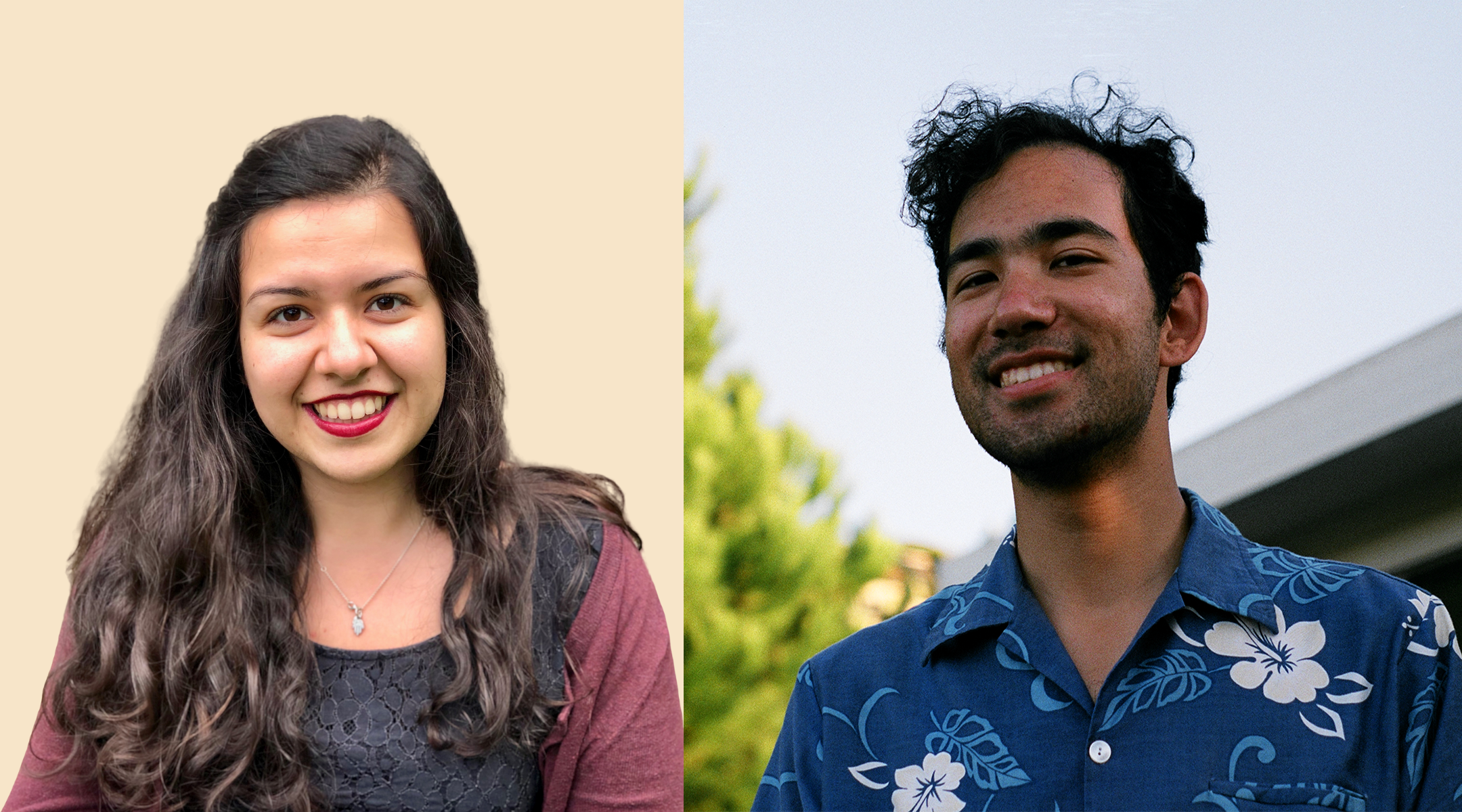
Gen Slosberg, left, and Jenni Rudolph are the project’s founders. (Courtesy of Lunar)

So last spring Slosberg reached out to a few other Chinese Jews through connections and social media, hoping to create that space for herself. She found Jenni Rudolph, a Berklee College of Music graduate who was featured in a widely viewed YouTube video about interracial identity.

Rudolph had grown up in Huntington Beach, a predominantly white city in southern California’s Orange County, where she struggled to feel at home in white, Asian or Jewish spaces. She had attended a Jewish preschool, but after it closed, her two younger sisters didn’t get the same Jewish foundation, and her family wasn’t very religious.

“That was just a really exciting moment for me,” Rudolph said of her initial virtual meet-up with Slosberg’s group, “of meeting others and being able to talk in a group and decide — so this is a community, what do we stand for? Who are we? And what does it really mean to be these things?”

Slosberg and Rudolph decided to take the concept — bringing Asian American Jews together to talk openly and casually about their identities and experiences — and branch out with it. Beyond just Chinese-Americans, they found Jewish people with what was for them an unexpectedly diverse array of different Asian backgrounds, from Indian to Thai to Filipino and more.

One thing they quickly realized was that all of them felt that they had not seen their identity represented in American Jewish spaces.

The American Jewish community has begun to pay more attention to the experience of Jews of color in recent years, as highlighted by the rise and expanded profile of groups such as Be’chol Lashon and the Jews of Color Initiative, and the increasing number of Jews of color in organizational leadership roles. An analysis by researchers from 2019 found that Jews of color have been slightly undercounted in broad surveys on American Jews.

But there has not been much research done on Asian American Jews in particular. Sociologists Helen Kim and Noah Leavitt — who are also a married couple — have published two landmark research papers on Asian Jewish families, one in 2012 and another in 2015. Besides that, Slosberg and Rudolph did not have previous projects like theirs to turn to for inspiration.

“We saw a gap in the media that could be filled,” Rudolph said.

Maya Katz-Ali, left, and Jacob Sujin Kuppermann learned about Asian American Jewish diversity through the project. (Courtesy of Katz-Ali and Kuppermann)

She and Slosberg remained mindful throughout their project of how broad the term “Asian American” can be a flattening term.

“The Asian diaspora is just so huge and diverse that it feels weird to kind of lump ourselves in, but also — white America lumps us all in together anyways,” Rudolph said. “So that’s kind of a common thread that we’re all relating on. We have a lot of very common experiences.”

For participant Jacob Sujin Kuppermann, born to a Brazilian Ashkenazi father and Thai mother, the project’s diversity was an important selling point.

“That’s kind of what made me excited about this project — that there was a very diverse range of different Asian experiences,” Kuppermann said. “Obviously there’s not a huge amount of discussion about mixed race Jews [in American society]. But usually when it comes up, it’s tiny. It’s Chinese American.”

In the inaugural video, participants talk about how their knowledge of both Jewish and Asian foods helps them feel like they “have stake in” each broader cultural community, in the words of one person. Another said that that knowledge helps her “prove” her Jewishness in Jewish spaces that are predominantly white. Some pointed out the ways in which Asian and Jewish flavors go well together, while others talked about the difficulty of eating Asian dishes while trying to keep kosher — stemming from the fact that multiple Asian staples, such as shellfish and pork, are not allowed in Jewish dietary law.

Katz-Ali shares in a clip that Ashkenazi Jewish food doesn’t always “feel like home” for her, but she’s always excited when finding Indian restaurants that are kosher. After participating in the project, in December she inaugurated “pakoras and menorahs,” her name for a new Hanukkah tradition that incorporates a traditional Indian fried food into the Jewish holiday that celebrates oil.

Now she’s trying to keep the Lunar group together, in part by planning OneTable Shabbat events for them.

“I’m so excited that this is taking off,” she said. “I think this is also going to give more permission to people to create and find that place of belonging and community that they can gather within.”

Asian-American Jews Explore Their Identities in New Video Project Read More »

Federal Appeals Court Sends Arkansas Anti-BDS Law to Lower Court

A United States federal appeals court sent Arkansas’ anti-Boycott, Divestment and Sanctions (BDS) law back to a lower court on February 12.

The case in question stems from 2018, when one of the advertisers for The Arkansas Times, the University of Arkansas-Pulaski Technical College ceased ties with the Times after the paper refused to sign a pledge to not boycott Israel as part of the state law. The Times, which does not currently endorse a boycott of Israel, argued in court that the law violates the First Amendment.

Israel Hayom reported that in a 2-1 decision, the Eight Circuit Court of Appeals agreed with the Times, concluding that the law “prohibits the contractor from engaging in boycott activity outside the scope of the contractual relationship ‘on its own time and dime.’ Such a restriction violates the First Amendment.”

Jewish groups criticized the decision.

“The court chose to read the statute as prohibiting the state from contracting with people who are participating in a boycott of Israel even if that participation was wholly unrelated to their state contract,” the American Jewish Committee (AJC) said in a statement. “AJC does not read the Arkansas statute, or BDS statutes in other states, as reaching such unrelated conduct. Rather, the statutes constitutionally reach only boycott participation that does, or is likely to, adversely affect the state’s interest in the contract in question.”

The AJC argued that a drug manufacturer couldn’t refuse to sell medicine to Israel under the law, but allows the manufacturer’s executives to support Israel boycotts on their own time. “Arkansas can easily remedy the flaws in today’s decision both legislatively and administratively by limiting the statute and required contractor compliance certificate accordingly. AJC has already put into motion efforts to facilitate such changes.”

StandWithUs CEO and co-founder Roz Rothstein similarly said in a statement, “StandWithUs is confident that the desire of the state of Arkansas — to refuse to use taxpayer dollars to enter into contracts with companies that discriminate against Israel — will ultimately prevail despite the recent appellate court decision.”

On the other hand, Jack Saltzberg, president and founder of The Israel Group, doesn’t think the court’s ruling is particularly significant. “These anti-BDS laws and resolutions don’t work and, in fact, can be harmful by giving the pro-Israel community a false sense of security. While people unwisely think that a city or state law will help, hundreds of thousands of students are being taught and believe the lies and propaganda of the BDS movement.”

George Mason University Law Professor Eugene Kontorovich argued in a Twitter thread that the ruling was actually a victory against the BDS movement.

“Two judges (incorrectly) read ‘other actions’ as including pure speech, ie verbal support, and struck down those two words,” Kontorovich wrote. “But state anti-BDS laws have always been about refusals to deal, not pro-BDS speech, so the decision upheld much more than it rejected.

“Thus 8th Circuit ruling leaves intact not just the principal part of Arkansas’s anti-BDS law, but also provides a strong precedent for the constitutionality of such laws across the country, which quite clearly target pure business conduct, not merely ‘supporting’ boycotts.”

Holly Dickson, the executive director of the American Civil Liberties Union (ACLU) of Arkansas, which represented the Times in the lawsuit, said in a statement, “Arkansas politicians had no business penalizing our clients for refusing to participate in this ideological litmus test.”

A spokesperson for Arkansas Attorney General Leslie Rutledge said in a statement that she is “disappointed” in the decision and is currently exploring options on the matter.

This article was updated on February 19.

Federal Appeals Court Sends Arkansas Anti-BDS Law to Lower Court Read More »

The Mental Weight of Environmental Calamities on Children

Unsurprisingly, the level of depression and anxiety in Israel rose following the difficult year that was 2020. According to recently published data, nearly 1 in 3 Israelis (29%) suffered from symptoms of high or very high anxiety during the second wave of the coronavirus pandemic, compared to about 1 in 10 in 2018 (12%).

After this virus is fully behind us, however, we will still have another looming catastrophe hanging over us––the climate crisis, whose negative impact is not just limited to the natural environment but extends to the human psyche as well. Thus, according to a recent survey conducted by psychiatrists in the UK, many children and adolescents now suffer from anxiety and depression due to the climate crisis and its effect on our environment.

The new survey was conducted by the Royal College of Psychiatrists with the additional help of psychiatrists working within the public health system in the country. Nearly half of the psychiatrists surveyed (46.7%) reported that in the past year they have treated patients who have experienced distress due to environmental and ecological issues. Among the psychiatrists who specialize in children and adolescents, the figure clocked in higher at 57.3%. In comparison, the number was lower among psychiatrists who specialize in the elderly, which stood at 33%. Although, it is important to note that the size of the survey was small as only a total of 176 English psychiatrists participated.

Climate-Induced Distress

According to the respondents, the patients’ distress was mainly expressed in the form of bad moods, feelings of helplessness, anger, and lack of sleep.

Although Environmental distress is a relatively new phenomenon and not yet officially defined as a mental disorder in the DSM (the manual of psychiatric diagnoses) mental health professionals have been warning of its increase in recent years. Two main ways in which the distress may manifest are through anxiety and depression.

Climate anxiety is a term describing feelings of excessive nervousness and fear in response to the seemingly irreversible damage brought onto the world and the environment due to the climate crisis as well as feelings of helplessness due to its advancement. Solastalgia, on the other hand, is the term denoting the depressive expression of distress; feelings of sadness and even mourning following instances of environmental destruction that have or might occur. This feeling can be the result of losing a specific beloved place like a grove, spring, or beach to construction or urban developments. It can also manifest from simply being aware of the sprawling and increasing tendencies of environmental damage throughout the world.

“Children who suffer from these symptoms exhibit fears and anxieties that result from uncertainty and loss of confidence in the world and in the future,” says Dr. Ahuva Windsor, a psychologist who also specializes in environmental issues.

“Adolescents often feel disappointed. They feel that the adults around them are cynical and that political decisions don’t address critical environmental needs, so they have a perception that there is no reason to invest in anything because they feel the world is going to be destroyed anyway,” she elaborates.

Feelings of Helplessness

According to Windsor, children who suffer from climate anxiety are often those who have been affected by extreme climatic events such as storms, fires, or floods and who also understand they were caused by the climate crisis.

“Children affected by California fires, for example, are able to understand that they were not necessarily a one-time event and that they may happen again––and that scares them because their home was destroyed as a result of these disasters,” Windsor explains.

According to data from the UK Environment Agency, exposure to extreme climatic events could increase the risk of developing mental health problems such as anxiety and depression by 50%. Further, a quarter of the people affected by severe flooding continue to suffer from mental problems for as long as two years following a particular incident.

However, indirect exposure to environmental destruction through media and social networks can also spark mental distress in children. “Some kids are exposed to articles, facts, and discussions that scare them, which can make them feel helpless,” says Windsor.

“Many times, they also see that the adults around them are themselves threatened by the phenomenon, and sometimes the adults don’t have enough knowledge to reassure them.”

Too Much to Comprehend?

But to understand why this phenomenon is observed more in children, outstanding social and behavioral factors must be taken into consideration.

“There is a theory that adults are just less likely to talk about personal difficulties stemming from environmental issues because it isn’t socially accepted or legitimate to feel mentally distressed by this topic,” says Windsor. “Therefore, adults are less likely to address these issues during psychiatric treatment. Children do not have this ‘problem’, and if they internalize these issues as threatening, they will not tend to hide it, and therefore, we encounter these distresses more in them.”

Another possible explanation is that compared to adults, it is more difficult for children to grasp the climate crisis and understand what is taking place. “They feel like there’s something threatening and unclear, and they don’t quite know how to deal with it. It’s too much for them,” she explains.

Because the extent of the climate crisis is oftentimes unclear to children, possible climate solutions seem detached from the problem itself. For example, they may find it difficult to understand cycling instead of driving a car or why reducing the use of electrical appliances can curtail the frequency of extreme weather events.

“They’re happy to have tools to deal with the problem and happy to take action, but many times they suffer an emotional crisis because of that disconnect and a feeling that what they are doing won’t really help,” says Windsor. “Even adults don’t fully understand the contribution of various measures against climate change, but it is easier for adults to live with. By contrast, children are fearful and have a larger lack of awareness.”

In terms of this situation in Israel, the effects of environmentally tied anxiety and depression are seemingly less severe than elsewhere in the world, according to Windsor. Although, she emphasizes it is still a cause for concern.

“It does not seem like this is a real trend in Israel, but I do hear from time to time about such cases,” she says. “Regardless, this is a phenomenon that is being noticed more and more, and we need to be prepared for it.”

Arm the Children with Answers

So, what can be done if a child or adolescent exhibits distress due to environmental issues? “First of all, it’s important that the adults around the child don’t disregard or dismiss their feelings, and say ‘hey, why are you worried about it, there are worse things,’ but instead treat the distress the child expresses respectfully,” says Windsor.

Windsor also recommends that children not be exposed to content they are unable to handle like stories and reports broadcasted through media. “It’s important to be exposed to content in a measured way,” she says. “A sight like a forest fire, for example, can be very scary for children.”

Beyond that, adults can provide children with solutions that will make it easier for them to deal with the distress. “Especially when it comes to our children and our homes, we as adults need to demonstrate ourselves that the steps we are taking for the environment can really help,” she says.

With this, proper environmental education should have a more firm place in school curriculum in order to facilitate youth’s appreciation for nature and to better familiarize them with problematic climate issues and how to deal with them in a safe and controlled space.

“It’s important to arm the child with answers and show the connection between the problem and the solutions. Beyond that, we should act together with our children and take actions that are beneficial to the environment as a family, for example, and not merely pretend to do so,” Windsor concludes.

ZAVIT – Science and the Environment News Agency 


The Mental Weight of Environmental Calamities on Children Read More »

First COVID-19 Vaccines Denied Entry to Gaza

The Health Ministry in Gaza was expecting the arrival of the Strip’s first COVID-19 vaccines on Monday, but after more than 18 hours of waiting, Israel denied permission for the shipment to enter the coastal enclave.

“The vaccine shipment, which was expected to arrive via the Kerem Shalom crossing, is part of the Russian aid for Palestinians to face the pandemic,” Majdy Dhair, deputy chief of primary care at Gaza’s Health Ministry, told The Media Line.

“Today, 2,000 doses of the Russian Sputnik V vaccine was to have been transferred to the Gaza Strip, but the occupation authorities prevented their entry,” Palestinian Authority Health Minister Dr. Mai al-Kaila said on Monday evening.

The shipment was returned to Ramallah so it could be kept in cold storage, a Palestinian official said.

Kaila held Israel responsible for the obstruction, describing it as “contrary to all customs, laws and international agreements.”

Israeli officials said the vaccine shipment was stopped because the PA did not supply the necessary paperwork.

In response to the Israeli measure, Kaila stressed that “the Palestinian government and the Ministry of Health are communicating with international organizations to bring vaccines to the Gaza Strip as quickly as possible.”

Assuming the Russian medicine arrives, certain groups will be prioritized for vaccination, given the limited quantity involved, according to Ashraf al-Qedra, the spokesperson of Gaza’s Health Ministry.

“The shipment [which was expected to arrive on Monday] is enough to inoculate 1,000 individuals, two jabs for each. So the first batch will probably go to transplant patients and those with kidney failure, and not to medical staff, who will receive inoculations when we receive more vaccines in the coming shipments,” Qedra told The Media Line.

Without giving precise dates, he said, “We are expecting an additional amount of vaccines from COVAX [a global collaboration aimed at equitable access to COVID-19 vaccines] that might reach 20,000 doses.”

Also on Monday, PA Prime Minister Mohammad Shtayyeh said the start of inoculations in the West Bank would be postponed, because “a delay occurred in the arrival of the required quantities of vaccine.” A new start date will be announced once the requisite quantities of vaccine arrive, he said.

First COVID-19 Vaccines Denied Entry to Gaza Read More »

Love or Loyalty? A Syrian Jewish Woman Faces a Difficult Choice in ‘Leona’

From “Romeo and Juliet” to “Titanic,” “West Side Story,” “Brokeback Mountain” and “The Notebook,” star-crossed love stories have been a staple of cinema, focusing on romances thwarted by such forces as societal customs, tragedies, cataclysmic events like war or disaster that keep the lovers apart–or separates them permanently by death. While the circumstances in “Leona” aren’t quite as dire, it’s an absorbing drama about a young woman torn between her family and and community on one side and her forbidden relationship, independence, and personal expression on the other.

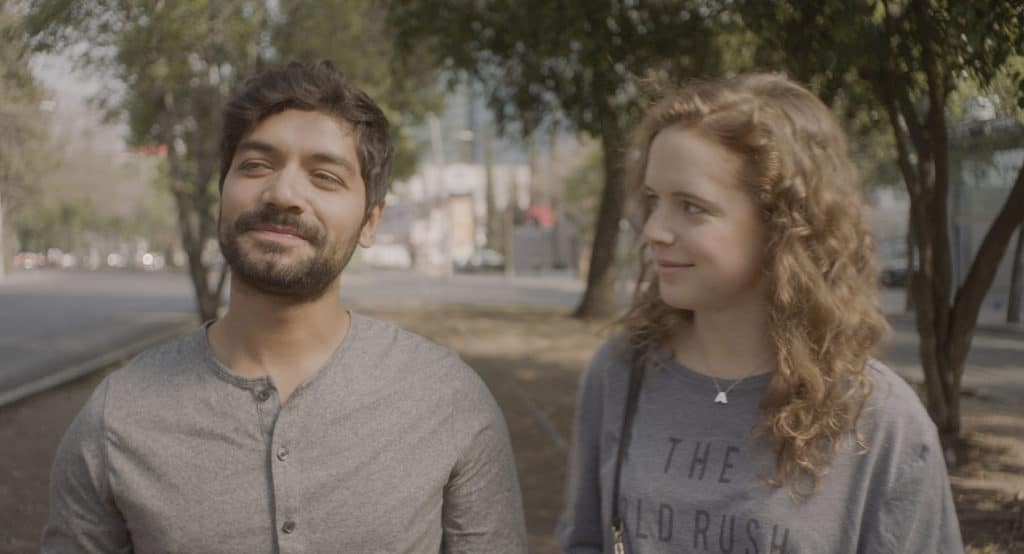
A talented artist who paints murals on the walls of buildings in Mexico City, Ariela (Naian González Norvind) is a Syrian Jew from an Orthodox family, one that’s eager to marry her off to a suitable man from her community. But she has an instant connection to Ivan (Christian Vázquez), a non-Jewish Latino charmed by her and her mural. The film follows Ariela—whose name is Hebrew for “lioness of God”—as she begins a relationship in secret, risking the wrath of her family and shunning by the community as she struggles between loyalty and asserting herself and following her heart.

Isaac Cherem, also a product of the Syrian Orthodox community in Mexico City, brings his authentic perspective to the film, the first feature he directed. “For previous generations it was important to stay together because as refugees they needed each other for economic reasons and general support. I value myself and my individuality more than a community that suppresses free will,” he said of what he refers to as an insular “self-made ghetto. It wasn’t until I went outside the bubble and started making decisions for myself that I saw how blind I was. I’m glad I could see something else and was able to break out of there.”

He notes that he attended Jewish schools from kindergarten through high school graduation, and grew up fasting on Yom Kippur, going to shul on Rosh Hashanah with his family, but is no longer observant. “It was not what I wanted. But I’m at peace with it now because I know that I can still feel like a Jew without having to observe. Nobody can tell me if I am a Jew or not,” he said.

Cherem concedes that his mother was apprehensive about a film that’s critical of the community she lives in, “But she slowly understood what I was trying to convey.” His father was always the rebellious type who didn’t care what people thought, which gave him license to break away. In the end, “My family supported me and still do,” he said, and although his film did face criticism for the community patriarchy, “I found a lot of women and young people who thought that it was a relatable movie and they were glad this was being spoken about and discussed,” he added. In identifying with its heroine, “It helped them reflect on their lives and how community oppression works and has done so for many years.”

In casting the film, Cherem chose to hire “non-actors but people who are very close to the characters and who could speak their minds” in supporting roles, improvising the dialogue. But Norvind, his leading lady, is an established star from a Mexican family of actors and collaborated with him on the script.

Naian Gonzalez Norvind (Photo: Menemsha Films)

“I initially wanted to be a writer, but my manager started persuading me to try acting when I was around 16 years old. I did my first film at 17 and I haven’t stopped since,” Norvind said. “I do realize now how much choosing this profession has kept me close to my family, but I’m also happy I’m able to make writing a part of my career. I studied literature and have always loved writing so this was my first opportunity to co-write a script and I’ve kept on doing it since.” Her varied acting credits include appearances in American dramas “Blue Bloods” and “Chicago Med.”

“What drew me to ‘Leona’ was first and foremost the conundrum that Ariela is battling with: the difficulty she experiences making a decision for herself, knowing what she wants,” Norvind continued. “I remember telling Isaac after I had read his original version of the script that I loved Ariela’s silences, and I think it’s those silences that moves the action forward. I relate–and I’m sure so many people can as well–to the pains of growing, to the fear of disappointing those you love as you start to choose things for yourself. And ultimately to the uncertainty behind any decision.”

Her biggest challenge, she said, was “to faithfully portray Ariela’s sense of wonder as she starts discovering this new world around her, which is in fact the world she grew up in but with no relationship to it.” Having learned more about herself, she signs her mural ‘Leona’—Spanish for lioness—which reflects her new-found fierceness and independence.

Cherem originally wanted to be an actor and started acting in school plays and enjoyed it, but was concerned about his ability to make a living and support a family. He still acts occasionally, and cast himself in “La Rey de la Fiesta,” a movie he produced. “I have a lot of things to say and I want to write and direct,” he said, noting that he draws influence from French and Korean cinema as much as Hollywood classics and Woody Allen films. He graduated from the Los Angeles Film School in 2011.

During COVID-19 quarantine, Cherem made a documentary about his family, “even though I thought I was done with Jewish-themed movies because it was hard and very deep and I was kind of exhausted by it. But I realized I had to do this because a family secret was revealed to me and I had to explore it,” he said. “It explores similar themes to ‘Leona’ but it’s extremely specific and intimate.” He hopes to premiere it at a festival this year. His next fiction film is a romantic comedy that “explores themes of growing up, making decisions and making a life on your own. That’s what’s surrounding my work now,” he said.

Norvind shot two films last year: “Sexo, Pudor, y Lágrimas 20 Años Después” and “Good Savage,” which tentatively slated for release at the end of this year. She’s also looking forward to the U.S. release of “New Order,” which won the Venice Film Festival Grand Jury Prize. She’s currently in Uruguay, working on a new project for HBO Max. She hopes “Leona” “can spark a conversation not only between people of different cultures but also of different generations, and in doing so remind us how our individuality is just as precious as our ability to be a part of a group.”

Cherem, who views “Leona” as more of a coming of age story than a love story, hopes that it conveys the “overwhelming feeling of uncertainty” of not knowing what’s going to happen.” When he broke away from his community and the life that was expected of him, he felt relief and uncertainty at the same time. “That uncertainty is what the character is trying to understand or cope with,” he said. “It’s uncomfortable to make decisions for oneself, but life is so much better when you do.” 

“Leona” is currently playing on VOD and select live theaters nationwide in advance of its streaming premiere on ChaiFlicks.

Love or Loyalty? A Syrian Jewish Woman Faces a Difficult Choice in ‘Leona’ Read More »