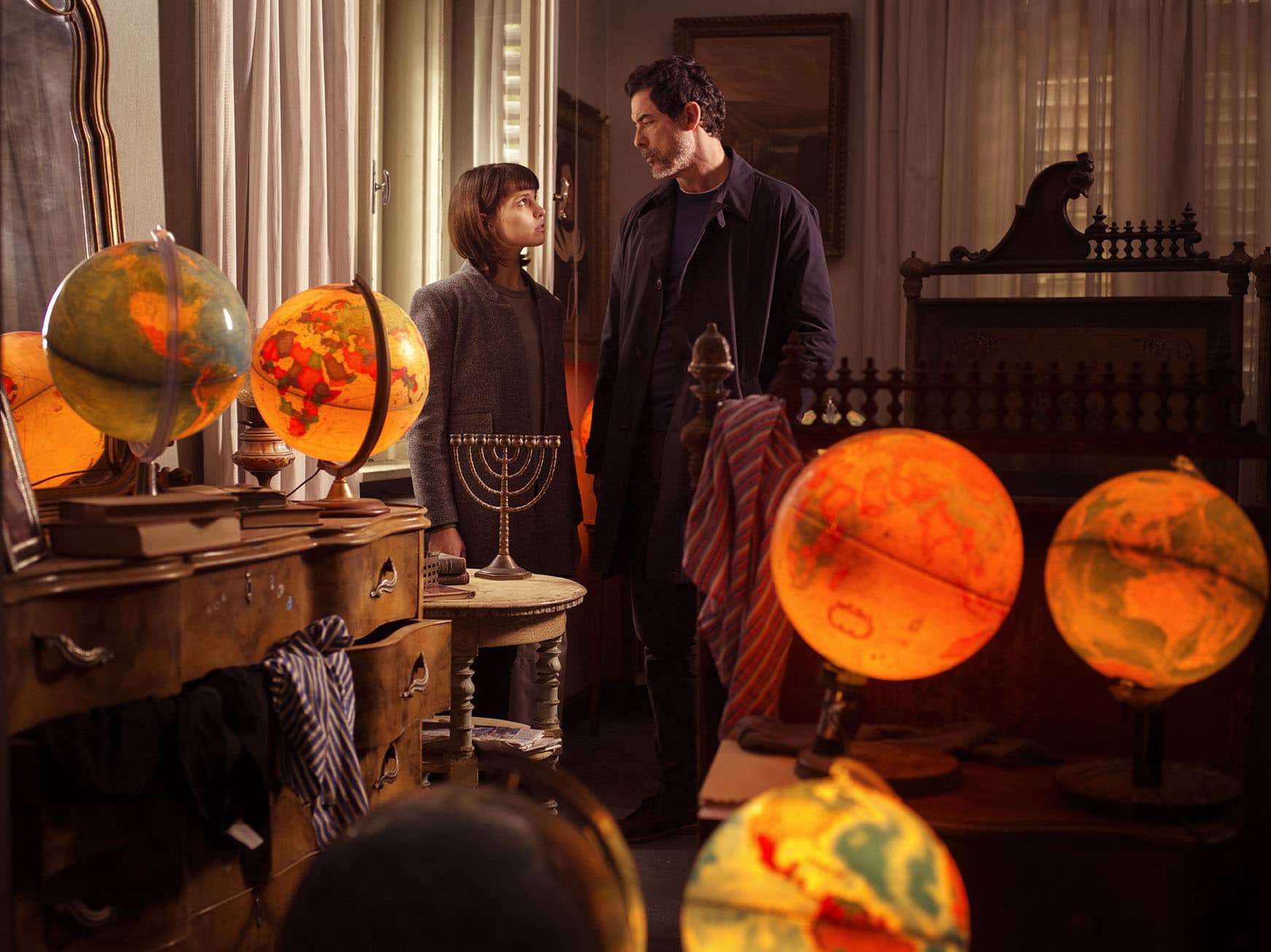
In a political climate where neo-Nazi white supremacist groups are an increasing worldwide threat, the release of “Thou Shalt Not Hate” (“Non Odiare” in Italian) is particularly well-timed. Co-presented with the Italian Cultural Institute in Los Angeles in partnership with the Anti-Defamation League, the Los Angeles Jewish Film Festival will stream the film from Feb. 18-21 in advance of a virtual Q&A with director Mauro Mancini and actor Alessandro Gassmann on Feb. 21 at 11 a.m. PST.
As the story opens, Dr. Simone Segre is living a quiet, comfortable, physically active life in the beautiful Northern Italian city of Trieste, but his world upended when he comes to the aid of an accident victim with a large swastika tattooed on his chest. Segre, the son of a Holocaust survivor, leaves the man to his fate. But guilt over his decision causes him to insinuate himself into the lives of the children who bear the white supremacist scars of their late father, putting his own life in danger.
Several years ago, inspired by a news report about a Jewish surgeon at a German hospital who refused to operate on a patient with a similar tattoo, first-time director Mauro Mancini and his co-screenwriter Davide Lisino saw great possibilities to expand the narrative and tell a current, urgent and necessary story and explore the human contradictions within it.
“We started from the hypothetical consequences that the same gesture could have caused if that doctor had been placed in a condition of choice between life and death,” Mancini said. “For this reason, we decided to dramaturgically force the ethical dilemma of our protagonist, Simone Segre, by putting him on the edge. Simone Segre is overwhelmed by a moral dilemma that clouds his conscience and he ends up making a choice that will trigger in him an enormous sense of guilt, which guides the whole film.”

The overarching theme, he noted, is the hatred and intolerance that has become a constant presence in our lives, and that posed a challenge. “We knew that we were going to deal with a theme that is still an open wound, so the difficulty was entirely in erasing any form of judgment or, worse, prejudice about all our characters,” Mancini said. “This is also why I tried to put an ‘empathetic distance’ between the camera and the characters to observe them from afar without judging them, ever. This film, like all the cinema that I love the most, does not aim to provide answers to the viewer but to push him to think about the issues it touches and the questions it poses. Like this one, for example: How difficult is it today to break the chain of hatred?”
Practically speaking, Mancini’s greatest challenge was to shoot the entire movie in five weeks. “I had a certain atmosphere in mind, based on silence, which can be difficult to obtain if you are short on time,” he said. “But I work better under stress. I am more creative. I always try to find the positive side even when things don’t go as I planned, for reasons that are often not dependent on anyone–the weather for example. You have to know how to adapt.” Otherwise, Mancini has no complaints. “The mood on the set was truly magical. [It was] a miraculous set where everyone contributed by rowing in the same direction.”
Alessandro Gassmann, a well-known comedy star in Italy and son of the late Vittorio Gassman (who dropped the final N from the German family name) was Mancini’s first choice to play Segre. He recalls seeing the actor, who is Jewish on his mother’s side, in several roles with dramatic tones and was impressed. He sent him the script, and they met at a bar in Rome. “The first thing he said to me was ‘This is a necessary film. I loved the script very much. there are very few words, let me talk even less, if possible.’ It was love at first sight.
“I wanted the basic grammar of this film to be represented by the silence, by the looks, by the pauses between one line and the other, by the secret thoughts of the protagonists,” he continued. “Alessandro outdid himself in this. I think that this role, compared to those in which we are used to seeing him more often, was also a very interesting bet for him, and that, without a doubt, he won.”
Passionate about photography from childhood, Mancini began to see the world as “a series of shots, an endless series of stories to tell. I think that what drove me to make films is ultimately the need to understand human beings better,” he said. Influenced by the photographic work of Mario Giacomelli, Luigi Ghirri, Gianni Berengo Gardin and Henri Cartier Bresson and filmmakers Ernst Lubitsch, Walter Hill, Steven Spielberg, Roberto Rossellini and Elio Petri and more recently Jaques Audiard and Yorgos Lanthimos, he has also looked to literature and graphic novels for inspiration.
Mancini is elated by the reception “Thou Shalt Not Hate” received in Italy, where it won best Italian Film and Gassman, Best Actor at the 2020 Venice International Film Festival. It was a critical and fan favorite in its theatrical run before the pandemic cut it short. “Since then, there have been many other festivals and various awards,” he said. “I am very proud of the road ‘Thou Shalt Not Hate” is taking.”
Going forward, “I hope there will be many other films. I have a lot of stories to tell,” he continued. “I have just finished writing a new script that I hope to be able to shoot by the end of this year. I can’t say much, but it is again a story inspired by a news story–this time it happened in Italy–that struck me hard a few months ago. It is, again, a story that I consider urgent.”
Mancini said that he favors movies “that deal with important social issues without pointing the finger, without judging. I like the directors who make their cinema an instrument of civil commitment without the arrogance of those who think they know what is right or wrong. These are the kinds of films that I want to continue shooting: movies that aren’t just entertainment but are able to ask the viewer intelligent questions on important issues, without boring them.”
One question that immediately comes to mind involves the incident that sets the story in motion. Would you do what Segre does, letting the white supremacist die? “This is a very difficult question. I had to make a film to understand it, but I think I would have tried to save that man,” Mancini said. “I strongly believe in second chances. And I believe in listening, in dialogue. I’d really like it if one day we stopped building walls and dividing the world into ever smaller boundaries and if we started to recognize us as human beings. This is also why I chose the title.”
Would you do what Segre does, letting the white supremacist die?
In crafting an ending for the film, “I liked the idea of playing narratively with an anticlimax and not with a climax. The resolution of the protagonists is not yet complete at the end of the film,” Mancini points out. “They are all struggling with a new beginning. I like to leave to the viewer the last word on what their life will be like after the end titles.” He also hopes that it will inspire audience to ponder the story’s titular commandment. “Thou shalt not hate: is it really possible? I would love it if they tried to answer this question.”
Tickets for the screening and Q&A cost $12 per household and can be purchased here. Visit LAJFIlmFest.org for more information.