fbpx

February 2, 2021

God, College Education and the Pandemic

How God, in his perversity,
ties knots sometimes, unties when time
seems right to him, we learn through rhyme.

But in a university,
where everything is deconstructed,
we learn it isn’t God who ties
and unties knots; it lays out lies
concerning Him as reconstructed:
logic superseding Logos.

Logos made, we thought, the world,
and, far more hokey, hocus-pocus
of girls and boys when boyed and girled,
for which you need no college education,
which has become as obsolete
as God, who’s lost His reputation;
with boys-girls-they He can’t compete.

In Genesis we see He dared
to change His mind, thus proving He
is academically prepared

to see the world as we it see,
respecting our opinions when
religiously correct, provided
to Him by some righteous men,
and changing plans He had decided,
influenced not just by Noah
but by Abraham and Moses.

He did not do this in the Shoah,
for reasons no one now supposes
could justify this heinous crime,
but the corona-caused pandemic
should make Him use the paradigm
of learning, no less academic
about what He’s obliged to learn
than we.

We all need to correct
mistakes, and He, too, will not spurn
the ones He’s made – which we detect –
but join us in the learning process,
saving lives that need defending.

Where, when we need him, is the Moses
with this message I am sending?

Gershon Hepner
2/1/2021


Gershon Hepner is a poet who has written over 25,000 poems on subjects ranging from music to literature, politics to Torah. He grew up in England and moved to Los Angeles in 1976.  Using his varied interests and experiences, he has authored dozens of papers in medical and academic journals, and authored “Legal Friction: Law, Narrative, and Identity Politics in Biblical Israel.” He can be reached at gershonhepner@gmail.com.

God, College Education and the Pandemic Read More »

Rep. Bowman Criticized for Saying Israel is Excluding Palestinians from Vaccinations

Representative Jamaal Bowman (D-N.Y.) is being criticized by some pro-Israel Twitter users for accusing Israel of excluding Palestinians from the COVID-19 vaccine rollout.

Bowman posted a letter to Twitter on February 2 to Israeli Acting Consulate General in New York Israel Nitzan, stating that while he was “heartened” that the Israeli government is providing 5,000 doses of the COVID-19 vaccine to the Palestinians in the West Bank, there are still “millions of Palestinians living in occupied territory under Israeli military rule” that have been excluded from the vaccine rollout.

“Israel, as an occupying power, has a responsibility to provide vaccines to the Palestinian people,” Bowman wrote. “It is therefore concerning that Israeli settlers in the occupied West Bank will be receiving the vaccine from the Israeli government, but Palestinians in the West Bank will not.” He added that herd immunity in the region is impossible without Palestinians also being vaccinated.

“As a Black man living in American, I know the feeling of being neglected by my government and society, of feeling like a second-class citizen or not a citizen at all, in my own home,” Bowman wrote. “I can understand the feelings of hopelessness and despair that Palestinians living in the West Bank might feel, reading in the news that the Israeli government has no plans to vaccinate them from a deadly disease wreaking havoc around the globe.”

Pro-Israel Twitter users criticized Bowman’s letter.

“Dear Congressman, I suggest you may care to also read the Oslo Accords, which make clear [the Palestinian Authority] has responsibility for health matters,” international human rights lawyer Arsen Ostrovsky tweeted. “Furthermore, I suggest you write to Palestinian leadership, asking how they have money to pay terrorist salaries, but not vaccines.”


The Jewish Policy Center similarly tweeted, “PA [Palestinian Authority] leaders said they wouldn’t take a vaccine from Israel – preferring a Russian one paid for by EU. OK, fine. Israel is NOT legally required under the Oslo Accords. Israel vaccinates ALL Israeli citizens without regard to race, religion or origin.”

The Elder of Ziyon blogger similarly tweeted that Bowman didn’t have a full grasp of the Geneva Convention, which the congressman had cited as a reason for Israel to ensure that the Palestinians are vaccinated. The blogger pointed to a January 6 post about how the Geneva Convention actually states that the occupying power has to work with local authorities on medical matters.

“The bottom line is that international law of belligerent occupation says that if Israel is the occupying power, it must act with the local authorities to ensure the health of the population,” the post stated. “Which is exactly what Israel has been doing since the initial outbreak. The only party that refused cooperation was the Palestinian Authority from around June to November. If they ask for help, they will get it.”

The progressive Jewish groups IfNotNow and Jewish Voice for Peace Action, on the other hand, praised Bowman.

“Thank you for fighting on behalf of Palestinian public health and dignity. We have your back in this fight,” IfNotNow tweeted. “This is the sort of moral leadership that every member of congress should embody.”

“Thank you so much for speaking out for the safety of Palestinians and of all people, @JamaalBowmanNY,” Jewish Voice for Peace Action tweeted. “This is a powerful letter.”


The Israeli Consulate in New York did not respond to the Journal’s request for comment.

Representative Rashida Tlaib (D-Mich.) had previously been under fire for calling Israel a “racists state” over the COVID-19 vaccine rollout in a January 19 interview on Democracy Now!.

Rep. Bowman Criticized for Saying Israel is Excluding Palestinians from Vaccinations Read More »

Small Network of Ultra-Orthodox Jewish Israelis Offers COVID-19 Treatment To All Sectors

(The Media Line) — The Chasdei Amram organization – a private initiative in one of Israel’s most conservative Haredi (ultra-Orthodox Jewish) enclaves – is providing at-home treatments for thousands of Israelis who have been diagnosed with COVID-19.

With more than 71,000 cases per million population, Israel is among the countries hit hardest by the coronavirus pandemic. The current wave of infections is spreading particularly rapidly in the country’s Haredi sector, which comprises approximately 10% of the population but a far higher percentage of its COVID-19 patients. Many Haredi communities report test positivity rates of 20-30%.

Israel is in the midst of an inoculation drive that has made it a world-leader in COVID-19 vaccination rates, with more than 3 million citizens having received their first dose. Despite this and a nationwide lockdown, the number of daily cases is only decreasing slowly, and thousands of new cases continue to be diagnosed daily.

Meanwhile, tensions between the Israeli government and the Haredi public have reached a new peak over limitations imposed to limit the spread of the virus. While battling the pandemic, the government has had to cope with the unwillingness of some in the ultra-Orthodox sector to abide by regulations.

The community’s opposition to the government decrees has mostly centered on the closure of the Haredi education system, which is considered by many in the community to be of vital religious importance. Violent riots have broken out in several cities over the issue, and the police are hard-pressed to get control of the Haredi street.

These elements are the unlikely backdrop for the development of Chasdei Amram’s initiative to help Israelis from all backgrounds care for their COVID-ridden relatives at home, thus allaying some of the pressure experienced by the health system.

Chasdei Amram co-founder Aharon Heimlich told The Media Line that the group, which operates with the help of 12 volunteers, reinforced by an additional 17 “on reserve for emergencies,” has helped more than 5,000 patients with home consultations and equipment. An additional 12,000 cases have received phone guidance regarding treatment from the organization’s help desk.

The organization grew out of what is arguably Israel’s most extreme ultra-Orthodox community, Edah Haredit – vehemently anti-Zionist and anti-government – which has been at the forefront of battles with the government both in the past and in recent months.

“He works 24 hours [a day] and he simply walks from house to house. So nowadays, he has a few helpers because he can’t keep up. They currently have 350 oxygen concentrators. … It isn’t just the oxygen concentrators – you need to bring each person a doctor, and [explain] what pills to take.”

Yoel Krois, who frequently acts as a community spokesperson, told The Media Line that it all started with a resident of the Haredi Mea Shearim neighborhood who studied nursing and took it upon himself to care for his sick relatives. “So, when the corona story began, he had two oxygen machines and he started. When he heard that someone wasn’t breathing properly, he brought them an oxygen [machine]. And then someone gave him another [machine], and slowly [it grew] – at first there weren’t that many … and that is Chasdei Amram.”

Since the beginning of the crisis, Israel’s health system has recorded 2,934 cases in which oxygen support was required.

Chasdei Amram stores oxygen concentrators and other medical equipment at its Jerusalem headquarters. (Courtesy Chasdei Amram)

“My father-in-law was sick, OK? Someone from Chasdei Amram came to the house, bringing a doctor with him and everything you need. He took care [of him] as if he was the US president’s private physician,” journalist Yehoshua Rudnik told The Media Line. Rudnik, who manages a popular Haredi news site, continued: “You can call them at all hours of the day and they’ll be there for you.”

Both Rudnik and Krois explained that members of the larger ultra-Orthodox community currently prefer to avoid hospitalization. Rudnik said that people try to avoid hospitalization “as much as possible, they prefer to treat at home if at all possible. … People are afraid of hospitals.” Krois said no one in the neighborhood had been hospitalized in recent months, and, referring to hospitalization in the present situation, added, “It’s terrifying … not because the hospital is bad and wants to kill and other conspiracies – it [simply] can’t cope.”

Heimlich highlighted an additional advantage to the organization’s home treatment. “Here, the family is with them, the family helps us treat the patients,” he said. The family is involved in the treatment right from the beginning; it can follow the doctor’s actions during their first visit and then continue to care for their relative fairly independently. This lessens the workload on the health professionals involved significantly.

A home visit by Chasdei Amram volunteers includes training for family members who are managing their relatives’ treatment. (Courtesy Chasdei Amram)

The organization’s reach is not limited to the ultra-Orthodox sector. Heimlich said, “We aimed at the general public right from the start. … We wanted to help any person [who contacted us].” But the organization wasn’t widely known at first. Now, Chasdei Amram has counted more than 2,000 patients outside the Haredi community who have been guided over the phone. On top of that, “we treat more than 20 non-Haredi patients a week,” Heimlich said.

Tehila Ben Zaken, a Haredi woman whose husband was treated at home with the assistance of the organization, told The Media Line, “We felt in safe hands. They knew what they were doing and had complete confidence. They have a lot of experience. … When they arrived, they instantly started treatment and we saw an immediate improvement – immediate.”

“It truly is incredible,” Ben Zaken added. “They really are in the business of saving lives.”

Small Network of Ultra-Orthodox Jewish Israelis Offers COVID-19 Treatment To All Sectors Read More »

Why “Valley of Tears” Brought Me to Tears

During these long months of quarantines and lockdowns, and with my days filled with hard news and commentaries on the chaotic and divisive times we’re living in, I’ve been craving escape. Sometimes it’s a simple hike or a walk on the beach; other times, it’s watching a show on Netflix or other streaming platforms.

My favorite shows are those that take me far from my daily reality, like “Blacklist,” “Big Little Lies,” “Goliath,” “Lupin” and others. Many of these shows were recommended by friends.

I didn’t know much about “Valley of Tears,” a new show from Israel that came highly recommended. I like surprises, so I dove right in.

I got more than I bargained for. I knew that it dealt with the Yom Kippur War, but I’ve seen intense Israeli war shows and movies in the past, and they didn’t shake me like this one.

First, let’s get the expected out of the way. Like many great war films, “Valley of Tears” dramatizes the human dimension of war. What carries the show through the harrowing battle scenes are singular human stories, stories of love, regret, betrayal and brotherhood.

But it was the faces of the soldiers that brought me to tears.

So many of those faces reminded me of my uncles and cousins who have been fighting wars in Israel since the War of Independence in 1947. They rarely spoke of their war experiences when we would meet at family functions, but I would sometimes hear from others about their exploits.

So many of those faces reminded me of my uncles and cousins, who have been fighting wars in Israel since the War of Independence in 1947.

When I saw scenes of extraordinary bravery in “Valley of Tears,” I was imagining one of my uncles commandeering a tank in enemy territory. When I saw the horrific casualties, I thought of the enormous risk they took. I also imagined the constant anxiety of my grandparents, whose sons — my uncles — were engaged in fierce battles to save their country.

I’m hardly alone in my reaction. In its coverage from Israel, The New York Times wrote, “The high-impact series pried open a collective national wound and led to a cathartic outpouring of emotion.”

I can only surmise that every Israeli who watched the series can identify with the faces of the soldiers. The faces were real, almost too real. The battle scenes were real, almost too real. The ethnic tension, the dead and wounded, the impossible decisions — it all felt overwhelmingly real.

This was the very opposite of escapist entertainment. It was more like a deep dive into a uniquely traumatic war many of us would rather forget.

What’s odd, though, is that the opening credits in all ten episodes don’t focus on war. Rather, we see several scenes of Israelis enjoying life. This is rare; opening credits usually focus on the main subject. But in “Valley of Tears,” the first image that hits you is of Israelis partying on the beach.

The opening credits scene of “Valley of Tears” (screenshot)

Maybe the filmmakers wanted to make a connection between fighting in a war and partying on a beach. The more you love life, the more you will fight for it. The soldiers in “Valley of Tears” fought to save their country; they fought so that their brethren could party on beaches.

This also choked me up — seeing how soldiers who loved life would risk theirs for the life of others, and how so many who survived lost their innocence. If anything can capture the never-ending drama of the Israel story, the conflict between haunting memories and an instinct to move forward, the daily dance between life and death, perhaps it is “Valley of Tears.”

For those who live in Israel, there’s no escaping any of that.

Why “Valley of Tears” Brought Me to Tears Read More »

Al Jazeera and the Art of Deception

When I was a little girl in Tehran, my family and I took advantage of the temporary lulls in air strikes during the Iran-Iraq War (1980–1988) to have dinner at various local restaurants. At one of those restaurants, the waiters had a practice of misinforming non-Iranian diners that they were out of tahdig, the gloriously crispy fried Persian rice. And the Iranian diners? They got tahdig by the barrelful because the restaurant felt the need to keep the locals happy. My family made a special request and ordered the tahdig “half and half” so that it was topped with two types of Persian stew, rather than one.

The non-Iranian diners never quite understood they were being duped, allowing the restaurant to ensure there was always enough tahdig for Persian customers. In recent years, I’ve come to see audiences of Al Jazeera English as some of those same duped patrons.

Last week, Al Jazeera Plus (AJ+) English, the Qatari-based network’s online news and current events channel, which primarily caters to younger audiences, tweeted a message in support of International Holocaust Remembrance Day on January 27 that read, “Today is #HolocaustRemembranceDay. The Nazis murdered over 6 million Jews, including over 1 million people at Auschwitz. A 2020 study found over 50% of U.S. Gen Z and millennial adults could not identify Auschwitz, and 63% did not know how many people died in the Holocaust.”

How very decent.

Like AJ+ English, AJ+ Arabic tweeted the same message last Wednesday. But in 2019, AJ+ Arabic tweeted something different about the Holocaust: “Gas ovens killed millions of Jews…that’s how the novel says. What is the truth of the #holocaust and how did the Zionist movement benefit from it?” The tweet also included a video rife with Holocaust denial.
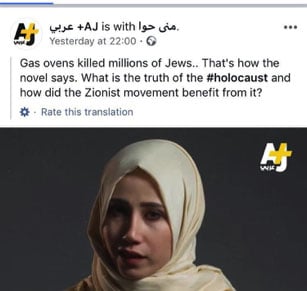
Clearly, someone had poisoned the tahdig.

The same day that AJ+ Arabic posted that disgusting video, AJ+ English, expressing sympathy for victims of the Holocaust, tweeted an interview with a Holocaust survivor. Between the Arabic and English messages, it was like an anti-Semitic Dr. Jekyll and Mr. Hyde.
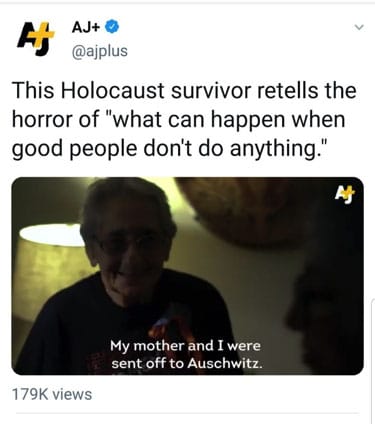
“Between the Arabic and English messages, AJ+ was like an anti-Semitic Dr. Jekyll and Mr. Hyde.”

A woman who claimed she helped create the AJ+ Arabic video tweeted, “Did Hitler kill six million Jews? And how did Israeli occupation benefit from extermination?” The video was posted on a Friday night during Ramadan. AJ+ Arabic was counting on huge audience turnout, and that’s just what it got; Israeli journalist Shimrit Meir tweeted that an estimated 750,000 people saw the video within a few hours of it being posted. Emmanuel Nahshon, then spokesman for Israel’s Ministry of Foreign Affairs, called the video “the worst kind of pernicious evil.”

Once the U.S.-based non-profit organization Middle East Media Research Institute (Memri) translated the tweet and video for non-Arabic speakers, the duplicity was inescapably out in the open.

The link to the 2019 tweet has since been deleted, and the network suspended two of the journalists who made the video. Even prominent Al Jazeera journalists, like Medhi Hassan, said he was happy that disciplinary action was taken against the “ridiculously offensive and dumb video.” The video was taken down hours after it was posted, but nearly one million people had already seen it.

On its website, AJ+ English describes itself as “a social justice lens on a world struggling for change.” Through social media sites like Twitter, Facebook and Instagram, AJ+ reaches millions of readers and viewers. On Twitter, it touts itself as “a unique digital news and storytelling project promoting human rights and equality, holding power to account, and amplifying the voices of the powerless.”

There are two problems with Al Jazeera English versus Al Jazeera Arabic. The first, and most obvious, is the glaring difference between the supposed messages of support for freedom, social justice and reform espoused by the English version versus the long history of anti-Semitism, anti-Americanism and sympathetic coverage of terrorists from the Arabic channel. The second, which involves AJ+, is a lesser known problem.

To say that Al Jazeera Arabic is problematic is an understatement. Between its friendly coverage of terrorist groups like the Muslim Brotherhood and its recent sympathetic coverage of Iran, it’s no surprise that in September 2020, the Department of Justice ordered Al Jazeera to register as a foreign agent, describing it as “an agent of the Government of Qatar.”

A 2008 Jewish Journal op-ed titled “Al Jazeera and the Glorification of Barbarity” by Dr. Judea Pearl, father of slain Wall Street Journal reporter Daniel Pearl, described how the network had effectively thrown a birthday party for notorious Lebanese terrorist Samir Kuntar upon his release from an Israeli prison. In 1979, Kuntar killed an Israeli father before his daughter’s eyes before bashing the four-year-old’s head in with the butt of his rifle. According to Pearl, Al Jazeera even provided jovial orchestral music and a birthday cake for Kuntar, and a network bureau chief (and master of ceremonies) announced, “Brother Samir, we would like to celebrate your birthday with you. You deserve even more than this…. Happy birthday, brother Samir.”

With Al Jazeera Arabic, anti-Semitism is more or less expected. But with AJ+, it’s complicated. The platform amplifies progressives’ messages, from racial discrimination to poverty and climate change. That’s good. But that’s also why AJ+ can get away with disseminating anti-Israel propaganda.

“I follow AJ+ regularly,” said one of my Jewish friends, a self-proclaimed “leftist, but strong supporter of Israel,” who spoke on the condition of anonymity. “They [AJ+] put out a lot of left-wing content, which younger people especially love, but then they side-sweep you with anti-Israel content, too. And if you speak up and say this is not okay, others on the left argue and say, ‘But the rest of AJ+ content about progressive issues is really, really good, so we can trust it.’”

Last week, AJ+ tweeted on issues ranging from immigration to racial inequality. It sympathetically described the struggles of anti-ICE protesters in Portland as they encountered police armed with tear gas; it interviewed young people from Generation Z about what they’d like from President Joe Biden; and it posted concerned messages about climate change. Amid such a progressive backdrop, it becomes almost too easy to add anti-Israel content under the guise of social justice and get away with it.

Case in point: the platform’s June 2016 response to New York governor Andrew Cuomo’s announcement that the state would no longer do business with anyone who participates in the Boycott, Divestment and Sanctions (BDS) campaign against Israel. AJ+ tweeted a video accusing Cuomo of preventing free speech and called the governor’s legislation unconstitutional. In the video, AJ+ is depicted as an altruistic defender of free speech while negative images of Israel appear left and right.

That same year, AJ+ made a video highlighting the return of Dima al-Wawi to her hometown after serving two-and-a-half months in an Israeli prison. Al-Wawi is Palestinian girl who tried to stab an Israeli, but the video doesn’t even discuss why she was sent to prison. Instead, it chronicles the experiences of a young girl at the hands of seemingly brutal Israeli oppressors. The title of the video? “Palestinian Girl Freed From Israeli Prison.”

For progressive viewers who aren’t familiar with Al Jazeera’s propagandist agenda, there’s seemingly nothing off-putting about that headline. In fact, it oozes with redemptive survival against oppression without offering a grain of context. The seemingly innocent girl mentioned in the headline, by the way, was so disappointed that the Jew she tried to stab didn’t die.

It’s easy to see why the channels were segmented into English and Arabic in the first place. This allows the respecting versions the ability to strategically overreport some stories over others. It also gives Al Jazeera Arabica chance to throw birthday parties for murderers.

Censorship is out of the question. No one can shut down Al Jazeera but the Qataris themselves. Perhaps one day, if Israel and Qatar ever establish diplomatic relations, the United States and Israel can exert pressure on Qatar to curb the network’s anti-Semitic and anti-American content. But Qatar is nowhere close to recognizing Israel.

However, Western audiences (including social media followers) can hold both the Arabic and especially the English channels accountable and tweet, tweet, tweet the duplicity until it’s fully exposed.

The Al Jazeera problem begs a simple question: Can you present yourself as altruistically liberal to one audience and hatefully conservative to another audience? Like that tahdig, Al Jazeera remains deceptively half and half.


Tabby Refael is a Los Angeles-based writer, speaker and activist.

Al Jazeera and the Art of Deception Read More »

David Suissa Podcast Curious Times

Curious Times Episode 1: Can Blacks and Jews Come Together to Fight Racism and Anti-Semitism?


One of the most fascinating chapters in the American Jewish story is the relationship between Jews and Blacks. It’s a complicated story, with many ups and downs.

In today’s “Curious Times” podcast, we focus on a promising development in this long story: a new initiative called the Black-Jewish Entertainment Alliance. More than 170 leaders of the entertainment industry have signed on to help counter both racism and anti-Semitism.

One of them is our special guest, well-known Hollywood executive Ben Silverman, chairman and CEO of Propagate Content and an Emmy-award winning producer of such shows as The Office.

This is the first episode under our new name “Curious Times,” after nearly a year as “Pandemic Times.” Since this podcast began three years ago, our content direction has always been to satisfy curious minds, with an emphasis on a Jewish take. Our niche is wherever our curiosity leads us– whether it’s in politics, culture, philosophy, religion, Hollywood or a field we have yet to discover.

Enjoy the conversation.

Listen on Apple Podcasts

Listen on Spotify

Listen on Stitcher

Follow David Suissa on FacebookTwitter and Instagram

Curious Times Episode 1: Can Blacks and Jews Come Together to Fight Racism and Anti-Semitism? Read More »

Professor Pushing Conspiracy Theories at University of Leeds Has Got to Go

In 2018, fellow Leeds Jewish Society committee members recommended that the University of Leeds adopt the IHRA definition of anti-Semitism. It refused.

The consequences of this decision have never been more evident than over this past week. Ray Bush, a professor of African studies and development politics, has been found to have shared multiple anti-Semitic posts, and the university has no clear or binding checklist to use to investigate and discipline him accordingly, nor have they yet stated any intention to do so.

A scroll through Bush’s Twitter (@raymondobush) account quickly reveals a history of anti-Semitic tropes and remarks. Bush believes that there is a “Nazi-Zionist alliance,” has claimed that the “Zionist entity shapes U.S. Middle Eastern policy” and has stated how “the anti-Semitic campaign against former British Labour Party leader Jeremy Corbyn is run by the Israeli embassy among others.” Can anyone really deny that this is anti-Semitism?

Well, apparently yes. Many students leaped to Bush’s defense after his comments were made public in a separate article for The Tab, claiming that he expressed anti-Zionism rather than anti-Semitism. But these people need to brush up on their definitions, as the two are quite clearly interchangeable. The definition of Zionism is simply the belief that the Jewish people have a right to self-determination and a homeland of their own. To oppose Zionism alone and not any other form of self-determination worldwide is anti-Semitism.

Nevertheless, Bush’s comments go far beyond criticism of Israeli policy. Under the IHRA definition, which the university claims to be “guided by,” they are deemed anti-Semitic.

Why has the University of Leeds not officially adopted this definition? The definition is already used by the British government, the Labour Party and more than 30 universities in the United Kingdom. With 1,000-plus Jewish students on campus, Leeds has a duty to make each and every one of those students feel safe and protected.

This situation reinforces the need for the IHRA definition of anti-Semitism on campus. Jewish students should not have to sacrifice their education because of the bigoted beliefs of academics such as Bush.

Nor is this latest incident an isolated one. Last semester, the university failed to publicly condemn an event hosted in conjunction with the Leeds Palestinian Solidarity Group in which terrorist Leila Khaled, was given a platform to express the need for “armed struggle” when campaigning for Palestinian rights. The student group’s leader, Adam Saeed, who has attempted to smear The Tab article exposing Bush’s history of hate as itself “anti-Semitic,” predictably nodded along to Khaled’s incitement of violence.

The university remained silent after student society leaders hosted a convicted terrorist and continued that silence after one of its employees was shown to have publicly espoused anti-Semitic ideals. It’s simply not right. And it needs to change.

There are previous examples of university lecturers in other areas of the country losing their jobs due to their anti-Semitic views being shared on social media. In 2019, the BBC reported that the University of Essex sacked a lecturer, Dr. Maaruf Ali, after he referred to the creation of a Jewish society on campus as “Zionists wanting to create a society there at our university” and sharing Holocaust-denial posts on social media.

If dismissal is the punishment for anti-Semitism at the University of Essex, then we should expect the same retribution from the University of Leeds in response to Professor Ray Bush. This is a man who believes the anti-Semitic conspiracy that Israel has influenced the racially motivated deaths of black Americans at the hands of U.S. police officers. He should not be given the opportunity to educate thousands of students with his discriminatory views, and he should not be holding such a high-profile position at such an esteemed university. Bush must be immediately penalized by the university, which should also issue an apology to Jewish, Israeli and Zionist students for having had to endure this educator’s continued harassment.


Elliot Bloom is a student at Leeds Beckett University and a CAMERA on Campus Fellow.

Professor Pushing Conspiracy Theories at University of Leeds Has Got to Go Read More »

COVID-Fatigued Communities Prepare for a Distanced Purim

(JTA) — In any other year, the mask-decorating party planned for later this month at Congregation Beth El Ner Tamid in Broomall, Pennsylvania, would make perfect sense: Costumes are part of the ritual for festive Jewish holiday of Purim, which begins Feb. 25.

This year, though, the masks being decorated aren’t meant for a carnival — they’ll be appropriate to use as personal protective equipment as long as the coronavirus pandemic lasts. The gathering, and the subsequent synagoguewide celebration, will take place on Zoom.

The party represents Beth El Ner Tamid’s effort to preserve the spirit of the holiday, even as its very celebration offers a cruel reminder that an entire year has elapsed since COVID-19 turned life upside down, seemingly overnight.

“There’s a lot of grief in the fact that we’ve lost almost an entire year of synagogue life and our personal lives,” said Rabbi Janine Jankovitz of Beth El Ner Tamid. “I know people are tired and sad, and we’re trying to bring them just a little bit of joy.”

In 2020, Purim began on the evening of March 9, just before the country shut down to stop the spread of the coronavirus. For some Jewish communities, the holiday was the first celebrated over Zoom. In others, the typical parties gave way to more somber, hand sanitizer-soaked services, stripped of the raucousness that characterizes the holiday. By the following Shabbat, they had canceled in-person services, too.

But in other communities, traditional Purim celebrations appear to have turbocharged the spread of the virus, resulting in a brutal toll in the following weeks.

A year later, the holiday is symbolic of one thing for everyone: an entire Jewish calendar year in which the holidays, the Shabbats and all the rituals in between have been adapted under the burden of the pandemic and its restrictions.

For non-Orthodox synagogues, that means a Zoom production that builds on a year of expertise.

Temple De Hirsch Sinai, a Reform congregation in Seattle, Washington, located near an early outbreak, canceled last year’s “Star Wars”-themed Purim programming but vowed that its annual Purim spiel would be “back next year, bigger and better than ever.” This year, its schedule boasts multiple online events, including a spiel inspired by the viral video app TikTok.

But some elements of the celebration — including the reading of the Megillah, the scroll containing the Purim story — do not lend themselves to the practicalities of pandemic broadcasting. Listeners typically use groggers, small noisemakers, to cancel out the name of Haman, the villain who tries to destroy the Jews, whenever it’s mentioned in the story.

“How do you do the groggers on Zoom?” Jankovitz wondered, bemoaning the fact that the experience for little kids, for whom the silliness on Purim is a special treat, won’t be the same. “The sense that we’re going to have to mute people in between really does take away from the joy and festivity of Purim.”

At the Orangetown Jewish Center, a Conservative congregation in Rockland County, just north of New York City, this year’s Purim costume parade will be replaced by a car parade through the town, with congregants decorating their cars for the occasion and the fire department leading the way. For the Megillah reading, congregants will gather in the parking lot to hear the story on their car radios.

While the synagogue did host its services in person last year, the crowd that assembled for that Megillah reading was smaller than usual as the coronavirus was spreading in nearby Westchester County. The very next day, the synagogue notified its members that someone who attended that service had tested positive for the coronavirus.

This year, with congregants able to safely distance from one another in their cars, Rabbi Craig Scheff hopes the setup will be an opportunity to feel connected as a community while staying safely distanced.

“We’ve been playing with the idea of drive-in movie-style programming of some kind where people could be in their cars but safely apart,” Scheff said, noting the Jewish legal issues with a drive-in service on Shabbat. “Purim seemed like the perfect opportunity.”

The Leffell School, a Jewish day school in Westchester County, an early epicenter of the pandemic in New York state, had already switched to online learning by Purim last year.

“Because everything was so new on Zoom, there was this excitement of what Purim would look like online,” Rabbi Yael Buechler of the lower school recalled.

This year the school, like many other Jewish day schools, has operated in person since September, so Purim celebrations will morph yet again. Students will listen to a streamed Megillah reading from their classrooms. But they won’t be able to sing or shout — behaviors that add risk by propelling air particles more forcefully — and there will be no all-school assembly.

“This whole year has been a bit of a ‘v’nahafoch hu’ experience,” Buechler said, using a Hebrew phrase from the Megillah meaning “it will be turned upside down” that symbolizes the topsy-turvy nature of the Purim story.

For Rabbi Shaanan Gelman, this Purim will in some ways be more normal than last year.

Gelman, who leads the Modern Orthodox Kehilat Chovevei Tzion in Skokie, Illinois, attended last year’s AIPAC convention in Washington, D.C., where he came in contact with someone who later tested positive for the coronavirus. So while his congregation met in person, he was in quarantine at home and listened into the synagogue’s phone line to hear the Megillah reading while reading along from a scroll on Purim night.

The next morning, a colleague read the Megillah for him from outside his house while he listened from his bedroom upstairs in a scene that played out across the Orthodox world, where it is considered preferable to hear the Megillah read in person, even though Purim is the rare holiday where technology is permitted.

This year, Gelman’s synagogue will host multiple services and provide a livestream option for those who are not able to attend, though Gelman stressed that the streaming option is not an ideal way to fulfill the obligation to hear the Megillah. Depending on the weather, the synagogue may even host an outdoor service in a tent where they have held Shabbat services for months.

“A lot of what has become synonymous with Purim is not going to be happening this year,” Gelman said. “Hopefully next year we’ll get back to the bigger celebration of Purim.”

While Gelman noted the fatigue that had set in around continued pandemic restrictions on daily life, he said being able to attend services in person this year should not be taken for granted.

“I am appreciative that I can, God willing, come to shul and hear the Megillah live,” Gelman said. “I think we’ve all become grateful for the little things.”

COVID-Fatigued Communities Prepare for a Distanced Purim Read More »

Gil Troy, Natan Sharansky Explain Jewish Unity at StandWithUs Conference

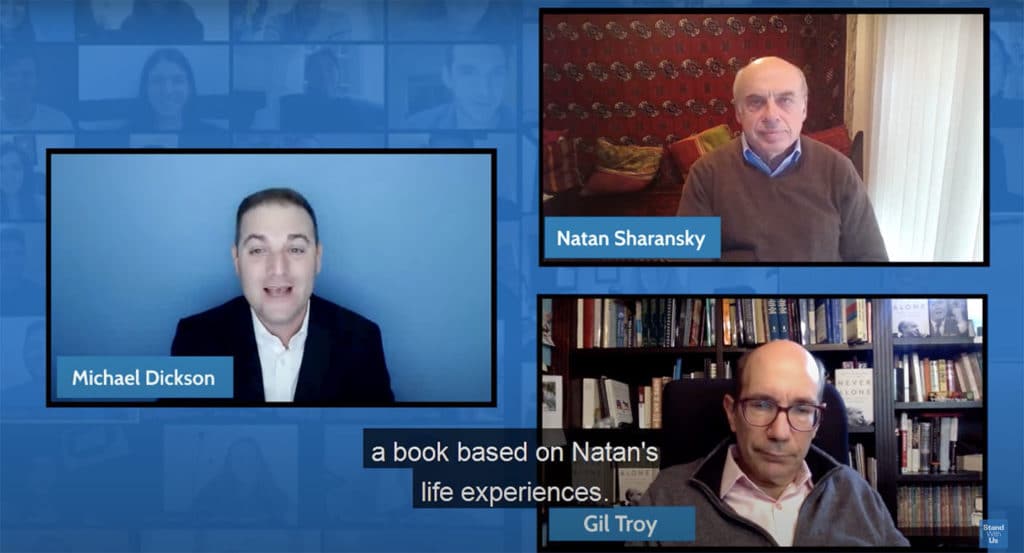
Former Jewish Agency Chairman Natan Sharansky and McGill University Professor Gil Troy explained the meaning of Jewish unity on January 31 at the virtual StandWithUs 2021 International Conference.

Sharansky, who recently co-authored a book with Troy titled “Never Alone: Prison, Politics and My People,” said that when he was imprisoned in a Soviet Union gulag for nine years, he never felt alone because he knew that the Jewish people were with him. During his time serving in the Israeli government from 1996-2005, Sharansky knew that despite all of the various disagreements that went on, they all had the same goal of fighting for the principles of Judaism.

“You are never alone once you’re part of a Jewish family,” Sharansky said.

Troy said that in a recent conversation with Journal Editor-In-Chief David Suissa, he realized that the Jewish people now have a positive message: It’s no longer about simply being on the defensive against anti-Semitism and anti-Zionism; “We do what I call the Jew-jitsu… from never again to never alone, and that’s our message,” Troy said, adding that “we’re all together in this fight.”

Sharansky proceeded to explain how he came up with the 3Ds — demonization, delegitimization and double standards — to determine when criticism of Israel veers into anti-Semitism. He said he had heard accusations of Israel committing war crimes at U.S. universities during the Second Intifada; he even heard European politicians say that accusations of anti-Semitism are being used to censor criticism of Israel. Sharansky argued that he wants there to be plenty of room to criticize the Israeli government since “we are a democratic society which is full of self-criticism” and that he just wants to ensure that the “red line” isn’t crossed into anti-Semitism.

He added that demonization, delegitimization and double-standards are the main tools that anti-Semites have used for thousands of years, and he analogized it to how people need 3D glasses when watching a 3D movie in order for the movie to make sense.

Demonization, delegitimization and double-standards are the main tools that anti-Semites have used for thousands of years.

“If somebody is criticizing our policy of checkpoints or that there is disproportionate response, we can argue about it,” Sharansky said. “But if someone says that the life of Palestinians is [like] Auschwitz today or that Israel is the worst war criminal in history or if Israel is singled out for international condemnation… you can know that there is anti-Semitism.”

Troy changed the focus to college campuses, arguing that more professors need to be called out for the “educational malpractice” of propagandizing instead of encouraging critical thinking.

He added that at college campuses, both the university administrators and the student body at large are creating the problem of the “double thinker” — someone who feels compelled to say something to tow the party line despite having a differing point of view. Troy also said that more and more people generally don’t feel comfortable publicly supporting Israel, and that while anti-Zionist Jews tend to get a lot of attention, they’re a minority within the Jewish community.

Additionally, Troy stated that 63% of Americans are afraid of publicly voicing their political opinions out of fear of being shamed. “That is toxic for a democracy. We need to sit down with one another and say ‘Hey let’s agree to disagree. But also let’s agree to agree. Let’s remember there is certain things on which we agree and other things on which we’ll disagree.’”

On Zionism, Troy said that it shows that Jews are a people, not just a religion. “The Jewish people have been tied to the same homeland, reading from the same Bible, thinking about the same place for thousands of years,” he said.

Troy added that Zionism is a movement to “perfect [the Jewish] state and defend the state” but also provides “a sense of community, a sense of connectedness, and a sense of purpose which often is missing in modern life.”

Other speakers at the conference including StandWithUs CEO and co-founder Roz Rothstein, Deputy Mayor of Jerusalem Fleur Hassan-Nahoum and United Arab Emirates author Omar Basaidy.

Gil Troy, Natan Sharansky Explain Jewish Unity at StandWithUs Conference Read More »