fbpx

February 2, 2021

With a New U.S. Administration, Jews Must Advocate to Pass the Equality Act

For four years, I began each day holding my breath and dreading what the news would bring. The previous president assailed our country’s humanity, from jeopardizing the safety of trans kids within days of taking office to separating immigrant children from their parents. Since noon on January 20, I have been breathing a bit more easily — both as the CEO of Keshet, a national organization that works for LGBTQ equality in Jewish life, and as a U.S. citizen. The fleet of executive orders that President Biden signed that day started to reverse the damage and suffering that the previous administration inflicted on millions of people, including many of us in the LGBTQ community.

I know that the work of repair — and the journey toward progress — has barely begun. As Biden declared in his inaugural speech, he and Vice President Harris must tackle the pandemic, systemic racism and white supremacy, poverty, economic uncertainty and climate change. Along with these urgent priorities, I hope the Biden-Harris administration will make good on another pledge: passing the Equality Act and, at long last, mandating federal protection from discrimination for LGBTQ people. And I look to Jewish communities nationwide to join Keshet and our partners in this campaign.

Despite cultural and political progress for LGBTQ equality, it remains critical that we pass this federal legislation. Although the recent Supreme Court decision in Bostock v. Clayton County and certain interpretations of the fourteenth amendment support some civil rights protections for LGBTQ people, we need the Equality Act to make these rights clear and unequivocal and to ensure that the Religious Freedom Restoration Act cannot be misused as a license for discrimination under the guise of religious liberty. Without the Equality Act, LGBTQ people will still face the threats of harassment and bias in employment, education, housing, public spaces and government services in more than half the states in the nation.

David W., a 25-year-old gay Jewish man now living in Boston, told me, “I experienced the pain of discrimination at my first corporate job. What happened to me would have been illegal in a state like Massachusetts, but it wasn’t where I lived then. The Equality Act is about protecting LGBTQ people in Mississippi as much as in Massachusetts. We’re one big mobile nation, and LGBTQ people shouldn’t worry if we’re protected in a place we move to, travel through or visit.”

This sweeping Act, extending to all states, would amend existing civil rights law to explicitly prohibit discrimination on the basis of sexual orientation and gender identity. Numerous polls have shown that 70% of Americans — including a majority of Democrats, Republicans and Independents — support a bill like the Equality Act. Yet, for decades, we have been unable to make these basic protections federal law. With Biden’s stated commitment to passing the Equality Act, we hope this legislative session will deliver on a long-awaited promise.

The voices of pro-equality faith groups, including the Jewish community, will be critical in this fight. Historically, many religious groups have played a powerful role in opposing LGBTQ rights.

The voices of pro-equality faith groups, including the Jewish community, will be critical in this fight.

Rabbi Menachem Creditor, the Pearl and Ira Meyer Scholar in Residence at UJA-Federation of New York, joins us in this call to Jewish communities: “As Jews, we are called to pursue justice, to treat our neighbors as ourselves. It is therefore incumbent upon us to stand publicly for LGBTQ rights. I champion, as a rabbi, the public recognition that my LGBTQ neighbors are created in the divine image no less than I am, and that their rights and dignity, manifest through laws both national and heavenly, are as inalienable as my own.” Simply put, the Equality Act is central to justice, equality and human dignity, which are not only fundamental American ideals but also core Jewish values.

We know that legal change is far from the only change we need to achieve LGBTQ equality, but we also know that legislative progress propels social and cultural advancements. Many trans and non-binary people, in particular, experience pervasive and persistent social discrimination that is reinforced by legal inequality.

The Equality Act alone will not transform our society, but it will be a major step in the right direction. After four years of fighting to preserve our hard-won civil rights, we thankfully can now get back to the work of advancing our rights in partnership with our elected officials.

More than four years ago, on the morning of November 9, 2016, my day began with a text from the mother of a trans teen who was terrified about what the future held for her child. “What can I do to protect my son? What can I do so he knows that his life has value and that he deserves to live in safety and dignity?”

Today, I say to her and to every American who believes in human dignity: demand that the Equality Act become law and help build a more just nation.


Idit Klein is the CEO of Keshet, a national organization working for LGBTQ equality in Jewish life.

With a New U.S. Administration, Jews Must Advocate to Pass the Equality Act Read More »
There’s Now Ice Cream with “Everything Bagel Gravel.” Here’s What Might Come Next.

Ever since Jews read about the new Jeni’s “Everything Bagel” ice cream flavor last week, we’ve been debating whether to attack it with our spoons or with our newfound space lasers. The news spread due to clever marketing — or maybe it was a schmear campaign — so I knew had to get the scoop lickety-split.

The Jeni’s website describes the pint as “Cream cheese ice cream with everything bagel gravel,” prompting me to wonder whether someone on their marketing team had just reached into a bucket of nouns. Picturing gravel in ice cream evokes a crying toddler who accidentally dropped their scoop on a rocky road. The “gravel” is actually from sweet rice flour mixed in with the garlic, onions, poppy seeds, sesame seeds, etc. — but I just picture breaking my teeth on rocks.

Maybe a judge needs to bring down the g(r)avel before someone adds chrain-bow sprinkles. There are so many reasons to des(s)ert this flavor. Topping the list: although savory and sweet flavors combine well, just thinking about the incongruity of adding onions and garlic and seeds to sweet ice cream makes my brain freeze. It’s like getting your ice cream sandwich on rye.

Jeni’s new ice cream flavor is why we have Facebook groups with names like “Doing this to bagels is incredibly offensive to my people.” I’ve kvetched about bagel-related matters here before, so no surprise that my initial reaction is to put this ice cream in the doghouse, wearing a cone of shame. I’m not likely to waffle on this, but I admire Jeni’s for the dairying gamble; it wasn’t a sher-bet.

The ice cream has prompted me to wonder what other Jewish-adjacent flavors might pop up in odd places. A search revealed something called “falafel pops,” which I was relieved to learn were not popsicles containing fried garbanzo balls — no need to defrost! –– but you can never be sure. A friend also told me about the fawaffle, which is falafel batter cooked in a waffle iron, and I would 100% devour that.

Maybe these economic times call for innovation. I suppose we could accept that this might be the start of a trend, then get ahead of it by brainstorming the next hot (or cold) mashup of Jewish savory flavors with unexpected desserts. Maybe schmaltz-malts? Shakshuka shakes?

Maybe these economic times call for innovation.

Here are some other products we might see soon. Influencers, work up your appetites and — if not your gravel — your grit.

Future products inspired by everything bagel ice cream:

Gefilte Frozen Yogurt

The first dessert to follow suit will be that other sweet treat in a cone. Would the gefilte fish be broken up into pieces throughout the yogurt or itself dispensed from a soft-serve machine? Could it have a catchy name, akin to “fro-yo?” Potentially “woe yo” or “hit a new low-yo” or “I could have had ice cream; now I feel like a schmo-yo.”

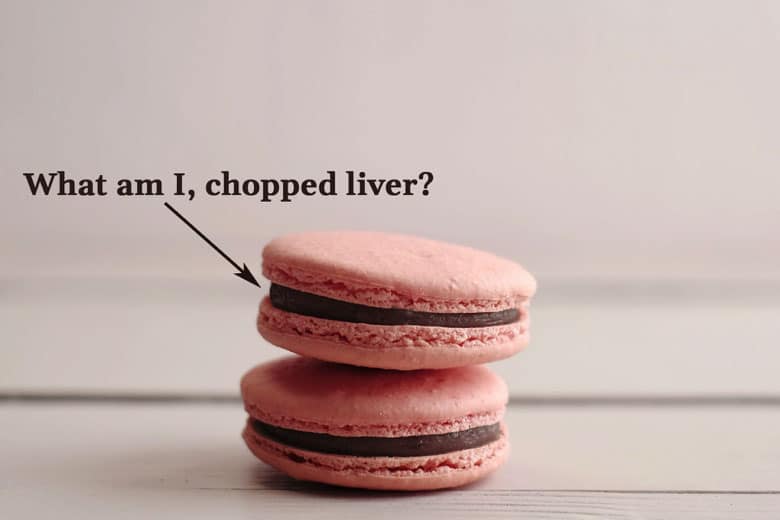
Chopped-Liver Macarons

Instead of a layer of chocolate ganache or pistachio filling, these sweet cookies would be filled with your bubbe’s favorite chopped liver. Chopped liver could appear in other desserts too, such as cocoa-dusted liver truffles. And remember those trendy black-bean brownies from a few years back? Although “brisket brownies” has alliteration, replace the black beans with chopped liver for a smoother protein. “You’ll never guess the secret ingredient,” you can tell friends. Or the chopped liver itself could just ask, “What am I…”

Pickled-Herring Meringue Pie

The meringue on a traditional pie looks a bit like ocean waves. Why not have pickled herrings swimming around among them? (Don’t answer that.)

Kasha Varnishkes Cupcakes

Get more fiber from your cupcakes, now full of healthy buckwheat groats and sautéed onions. Frost cupcakes as usual, but add a little bowtie pasta noodle on top. Adorbs.

Flanken’ Donuts

If all these products go well, we could open a chain to challenge the donut competition with some trendin’ tendon. Dunkin’ Donuts? Meet Flanken’ Donuts. We’d specialize in frosted fleishig — glazed or iced donuts, but they’re filled with stew. Is it too much to do to a poor donut? To our stomachs? I could think of cruller ideas.

Look, progress can’t be stopped. If there’s a market for everything bagel ice cream, that’s the way the gravel crumbles. I just hope they’ll adjust the ingredients for Passover, maybe with little bits of broken matzah instead. A month ago, I couldn’t have pictured it. Now, it might not seem so farfe(l)tched after all.


Deborah (Debs) Gardner is a public health professional, writer and semi-snarky Jew living in Seattle, WA. Our “pundemic correspondent,” she is a multi-time winner of Pundamonium Seattle, a local pun slam.

There’s Now Ice Cream with “Everything Bagel Gravel.” Here’s What Might Come Next. Read More »

Returning to Work When You’re Still at Home

In the darkness and exhaustion of 3 A.M. feedings as a new mom, I would often dream about being back at work: sitting at my desk, sipping iced coffee with my headphones on and even wearing a dress!

And yet, the first time I went back to work from maternity leave, I cried all the way to work on the train the first day. I cried all the way home on the second day, and I didn’t cry at all on the third day… until I randomly cried again over the weekend.

All of this is to say, working motherhood and returning to work has always been an all-the-feels situation. As mothers of pandemic babies know, returning to work when we’re still at home has only brought new challenges and more feelings. It’s never been harder to be a working mom, so here are five tips for returning to work when you’re still at home:

  1. Get serious about scheduling. One of the best things you can do is create a schedule and stick to it. What is your care arrangement like, and what hours, accordingly, will you be working? Pumping? Caretaking? Get clear about when you’re available and not available, and educate colleagues through conversations and visible calendar blocking.

Creating a schedule is important for two reasons: First, it puts you in control. Second, in our stretched-too-thin world, structure is our conduit to agility. It’s a lot easier to regroup from a plan that got sidetracked than to reinvent the plan every single day from scratch. Importantly, if you want people to respect your schedule, then you need to respect your schedule. If you’re joining calls and writing emails when you said you’re not available, people will continue to expect you to be on-call at that time. People respect your schedule when you respect your schedule.

  1. Rethink self-care time. I’m not trying to stress you out if you’ve been bottle feeding and changing diapers for months instead of reading the news, but it’s kind of bleak out there for working parents. Working moms are burned out, and an estimated 2.2 million of us have left the workforce. That’s why I need you to rethink your self-care time, and I won’t mince words: daily self-care is not a luxury; it is an urgent professional priority if you care about your career and well-being. Research from the Harvard Business School shows that those who take even “micro-moments” of self-care — 30-60 seconds at a time — have both higher performance and higher happiness ratings.

Daily self-care is not a luxury; it is an urgent professional priority.

Here’s where self-care gets especially tricky: you have to work for this and plan for this. Pre-pandemic, we working moms used to gripe about our commutes, daycare drop off, getting home to meet the nanny… But nearly a year later, the #1 thing I hear from moms about self-care is that they miss that time in their car or on the train to listen to music and podcasts, read, catch up with friends or just sit in silence. You will not take this time if you do not schedule this time. Make it just as important as every other meeting on your calendar, even if it’s five minutes a day.

  1. Have catch-up coffees … and bring your little one for a cameo appearance. Without watercooler moments, we all have to be more thoughtful than ever about connecting —and reconnecting — with our colleagues. Although it’s tempting to jump back into the actual work of working, don’t underestimate the impact of carving out social time with colleagues you haven’t seen in a few months.

Gallup research shows that workplace friendships reduce our stress levels, increase our productivity, enhance our performance and increase our fulfillment work — four things absolutely essential for moms returning to work. As an added bonus, asking people how they’ve been doing over an informal catch-up is actually a great way to get up to speed informally: you’re likely to get much better intel on both the mood and moves inside the organization. Lastly, working parenthood has never been more humanized or normalized, so do consider bringing your little one for a cameo appearance. If you’re like 99% of parents out there, he or she will probably make a cameo sooner or later on a future call anyway, so might as well make the first one on your own terms.

  1. Set mini goals. As working moms, we’ve been fed a story that if we’re not doing it all, we’re doing it wrong. As one of my clients recently said to me, “I feel like I’ve been waiting for my working-mom-superpowers to kick in, and I just realized that’s never going to happen.”

We can’t humanly do it all, so what do we want to do? Let’s focus less on being perfect-on-paper and more on doing the things that will grow our careers while growing our families in ways that are authentically meaningful to us. That requires taking time to set intentional goals and then getting crystal clear about your mini goals: what we will say “yes” to and what we will say “no” to. Bonus points if you can make these mini goals really simple. For one of my lawyer-mom clients, her mini goal when returning to her demanding and unpredictable job was as simple as “yes” to kissing her kids goodnight. Consider what you need to say “yes” and “no” to at home and at work to achieve your goals. At times, these may come into conflict, but when you keep them mini and specific, you’re much more likely to avoid falling down the existential, mom-guilt rabbit hole.

  1. Cut yourself some slack — but actually. This one sounds so simple, but as working moms, we are so hard on ourselves. Being a working mom has always been hard, returning to work has always been a challenging and emotional transition and the pandemic has been crushing. Put them all together, and it’s a recipe for stress and self-doubt.

We know we should cut ourselves some slack, but how do we actually do it? I recommend asking yourself a simple question: where am I judging myself in a COVID-19 world by pre-COVID-19 metrics and expectations? One of the biggest ways we can cut ourselves slack is to first recognize where we’re heaping on the self-judgment. This is the difference between surviving and thriving.

As working moms, we often think about ourselves in relation to others. Just look at our name, working moms. We’re defined as a group by our relationship to our work and our kids. As you look back over this list, you’ll notice that each of the five tips puts you at the center. As you return to work, remember that prioritizing your needs and reclaiming your goals will make you a less stressed, more impactful and more fulfilled working mom.


Randi Braun is an executive coach, consultant, speaker and the founder of Something Major

Returning to Work When You’re Still at Home Read More »

Once Proud Labor Party Seeking to Regain Momentum

(The Media Line) — Israel’s rejuvenated Labor party held its primary elections on Monday, exactly 50 days before voters across the country head to the polls for the fourth time in two years in the hopes of finally ending Israel’s ongoing political stalemate.

One week after electing its new chairwoman, former TV personality and eight-year member of Knesset Merav Michaeli, the oldest party in politics formed its list of candidates for the upcoming parliament, amid cautious yet growing enthusiasm.

“I’m optimistic about Labor, because it has deep roots. Trees may fall from time to time, but roots stay in the ground and eventually grow new trees,” Nachman Shai, a Knesset veteran of 10 years who ran in Monday’s primary, told The Media Line.

“Israel is in a deep financial, social and moral crisis. Anyone who believes in this country and its future, who wants Israel to be a home for their kids and grandkids, must enlist in this battle,” he added.

Shai finished the primary in the eighth spot, which is likely not a realistic slot unless Labor merges with another party, which could also push him further down on the candidates’ list. Shai also was pushed back due to Michaeli’s commitment to using the “zipper system” for drawing up the party list, which alternates between men and women to ensure equal representation.

“I’m optimistic about Labor, because it has deep roots. Trees may fall from time to time, but roots stay in the ground and eventually grow new trees.”

Lawmaker Ram Shefa, a former member of Alternate Prime Minister Benny Gantz’s Blue and White party, also competed for a spot on the Labor ticket.

“I’ve returned to the Labor movement, which has been my home my entire life. I’m from a kibbutz, these are my roots,” he told The Media Line.

Shefa finished in the sixth slot on the candidate’s list after the primary.

Shefa, who last month essentially voted to disband the struggling coalition he was a part of and hold new elections, later left Blue and White for Labor. He explained Michaeli’s presence is a big factor in the party’s current face-lift.

“Obviously her victory creates a major positive momentum. It helps, and women leadership in the center-left wing is something we haven’t had in a while either. People are joining, we have thousands of new registered members. Today is a celebration,” Shefa said.

More than 45,000 party members, who as late as Sunday evening could still register to vote, on Monday compiled lists of their seven preferred candidates out of 62 nominees. In light of the growing spread of the coronavirus, nearly all voting was done electronically and remotely, via voters’ cellphones and computers.

The long list of candidates battled it out over a limited number of potential seats, as the party, despite its renewed vigor of late, is still considered a long shot to net even double digits in the March 23 elections.

Israelis vote for parties, not individual candidates, with the chair of the largest party usually tapped to establish a majority coalition with other parties, thereby becoming prime minister.

Labor, once the proud home of the nation’s founder, David Ben-Gurion, and legendary leaders such as Yitzhak Rabin, Shimon Peres and Golda Meir, has in recent years shrunk to dismal proportions. After decades of dominating the political scene and nearly single-handedly ruling Israel, it has been reduced to a shell of its former self.

The last time the party was a meaningful force in government was in former Prime Minister Ehud Olmert’s coalition of 2006. The last prime minister to come out of the party was Ehud Barak in 1999.

Years of wilting away on the opposition benches led former party chairman Amir Peretz to join Prime Minister Binyamin Netanyahu’s government last May, despite his explicit promise to the contrary. That decision seemed to have put the final nail in the Labor party coffin.

“This was a long process, you can’t blame it all on Peretz,” Omer Barlev, a Labor lawmaker since 2013 who ran for a seat on the ticket Monday, told The Media Line.

“This trend of voters moving to shinier new options has been going on for decades. It’s not new. The past few chairmen have also contributed to it. Our current situation doesn’t surprise me at all,” said Barlev, who will have the second place on the candidate’s list behind Michaeli.

Yet, immediately following Michaeli’s victory last week, Labor’s revival began, as polls showed it gaining momentum, netting four seats, then five, and surpassing momentary upstarts in the left-wing bloc.

Michaeli has vowed not to enter a government headed by Netanyahu, who is facing criminal charges of bribery, fraud and breach of trust.

“Merav, to her credit, is undoubtedly a warrior, a brave woman whose values totally align with the party,” Barlev said. He added that if Michaeli had not prevailed last week, he would not have joined the race himself.

Shai said he is “very pleased” with the current situation, “and believe the public will come back to us.”

On Monday, before the primary results were announced, the new Labor leader received several additional boosts, as key figures in parliament announced their premature departure.

Avi Nissenkorn, until last month Israel’s justice minister and a prominent member of the government-partner Blue and White party, said he would take a hiatus from politics. Nissenkorn recently jumped ship from the foundering Blue and White to join Tel Aviv Mayor Ron Huldai’s new left-wing party, only to realize it was in even worse shape.

Several hours later, another Blue and White defector, former Defense Minister Moshe Ya’alon, announced his flailing party also would not run due to disappointing poll numbers.

“I don’t think we should necessarily sacrifice ourselves for the good of the bloc, especially when other parties don’t have the tradition and history of the Labor movement.”

Both men were Michaeli’s competitors, seen as threats to Labor’s chances of forming a unified left-wing bloc.

The splintered Israeli center-left, still shattered into a handful of tiny parties, will now have until Thursday to coalesce into two or three large parties that have a viable chance of receiving the minimum four seats needed to enter the Knesset.

They will then hope to unseat Netanyahu by gaining a 61-seat majority, a feat both sides have failed to do in the last three rounds of elections, leading to the quagmire still haunting the nation today.

“It’s obvious these splits aren’t helpful, but last time when we merged with other parties, we actually lost seats,” Barlev said. “I don’t think we should necessarily sacrifice ourselves for the good of the bloc, especially when other parties don’t have the tradition and history of the Labor movement. There probably will be some merges, but perhaps not by us.”

Shefa, meanwhile, cautioned not to hitch the cart before the horse.

“Now is the time to win primaries, not talk about future coalitions,” he said. “I trust Merav’s leadership and judgment, after we finalize the list, we’ll talk.”

The challenger most likely to threaten Netanyahu’s 13th consecutive year in office is Yesh Atid chair Yair Lapid, currently leading the largest party in the center-left. A former prominent member of Blue and White, he too split once the decision was made by party chair Gantz to form a government with Netanyahu’s right-wing Likud party.

After Monday, it seems Lapid has at least one party he can count on to be by his side after March 23. A party only recently left for dead.

Once Proud Labor Party Seeking to Regain Momentum Read More »