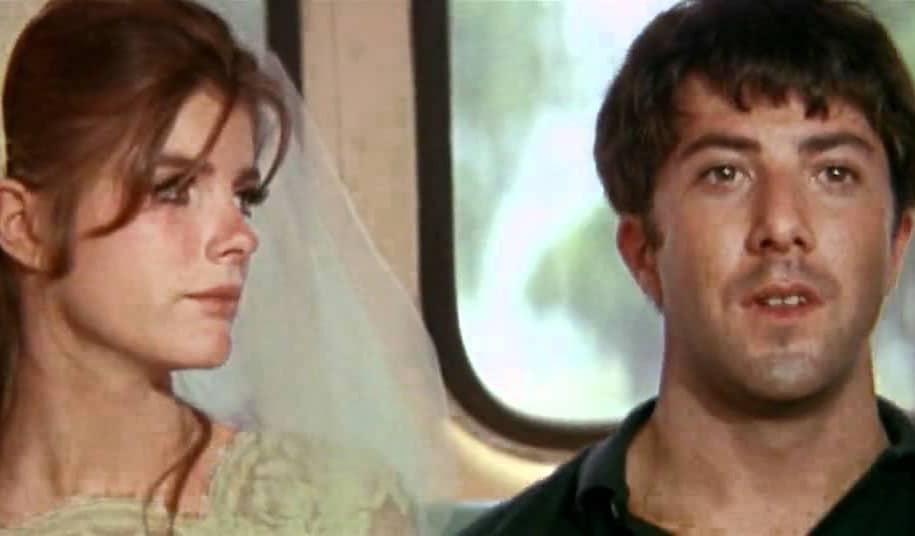
In the final scene of “The Graduate,” as the giddy runaway lovers Elaine and Benjamin take their seats at the back of a bus, we are plunged into a moment of sudden stillness that interrupts the breathless speed of the previous sequence.
While moments ago life swelled to epic proportion, now it is small again. Where there was riotous, loud commotion, there is now dull white noise.
For Benjamin, this stillness marks the end of his swerving, sprinting, leaping race to disrupt Elaine’s wedding. For Elaine, stillness presents the first opportunity to reflect on a choice — that of leaving her groom at the altar —made in unimaginable haste.
In this quiet thrum, we are left to guess what the two are thinking as their smiles falter and fade from their faces. Perhaps they are thinking of the wreckage they have left behind. Perhaps they are also wondering what they really know about one another.
The ending scene from “The Graduate” (Screenshot from YouTube)
Had the movie ended sooner, we would interpret its final sequence as one of triumph. As it is, however, we are left to reflect on a future in which uncertainty and openness stymie the impulse to imagine that life, for the heroes of any great story, freezes at the moment the credits roll.
So it is with Parashat Beshalach. Like the sea that split before the Israelites, we find ourselves at a point of division, in which ending and beginning tower on either side of us like walls.
The parasha first announces itself as a conclusion. The enemy, Pharaoh, is vanquished. The hero, Moses, is vindicated. Led by Miriam, the women take out their timbrels and sing the triumphant “Song of the Sea.” All that’s left is to march away into the horizon and let us, the readers, savor the moment.
But Beshalach quickly reveals itself to be a beginning as well. The music of the timbrels dies away. The sea, former site of miracles, now laps placidly upon the shore. The impressive built environment of Egypt, that place of shimmering gold and manmade mountains, has been traded for the empty monochrome soundstage of the Sinai Desert.
Suddenly, the Israelites are alone. Alone with God. Alone with Moses. Alone with themselves.
They had been running, but now they are still. They had been filled with faith, but now they are unsure. It had felt like a choice, but now they can’t remember.
We are quickly introduced to the dynamics that will become the central tension of the Israelites’ sojourn in the wilderness. The people complain, and Moses tries to assuage them. Moses is exasperated by the people’s restlessness, and he cries to God for help. God issues a command, and the people disobey Him.
Had the Torah ended before all this, we could have imagined that the Israelites made it to the promised land with the joyful “Song of the Sea” still on their lips, but such endings are inauthentic. In Torah, as in life, every ending blooms into a new beginning. Order flows into chaos, into tohu va’vohu, which in time returns to order.
In Torah, as in life, every ending blooms into a new beginning.
Trapped together in the desert, Moses and the Israelites are beset by claustrophobia, yet paradoxically it is a claustrophobia agitated by the very openness of their surroundings. Though the decree that they must wander for forty years has not even been issued yet, the Torah announces it to us here, as if to emphasize that we are in a place of unbearable structurelessness, both spatial and temporal.
The neatly ordered epic of Exodus, with its moral clarity and carefully plotted drama, is gone. In its place is a void where nothing has proportion. Great miracles seem small and small troubles loom large. The mighty wonders with which God delivered the Israelites no longer seem so impressive, while each instance of the peoples’ grumbling against Moses grates on the ears as he imagines enduring this stiff-necked people day after day after day.
At the end of “The Graduate,” as they speed down the highway, Benjamin and Elaine look at each other but never at the same time. In Parashat Beshalach, Moses, God and the Israelites examine one another, but do not meet each other’s gaze.
Do we see their breathless smiles fading from their faces?
Matthew Schultz is the author of the essay collection “What Came Before” (2020). He is a rabbinical student at Hebrew College in Newton, Massachusetts.
Daniel Pearl was beheaded by Islamic militants 19 years ago, but his parents’ drawn-out efforts bring their son’s murderer to justice keeps reopening the never-healed wound.
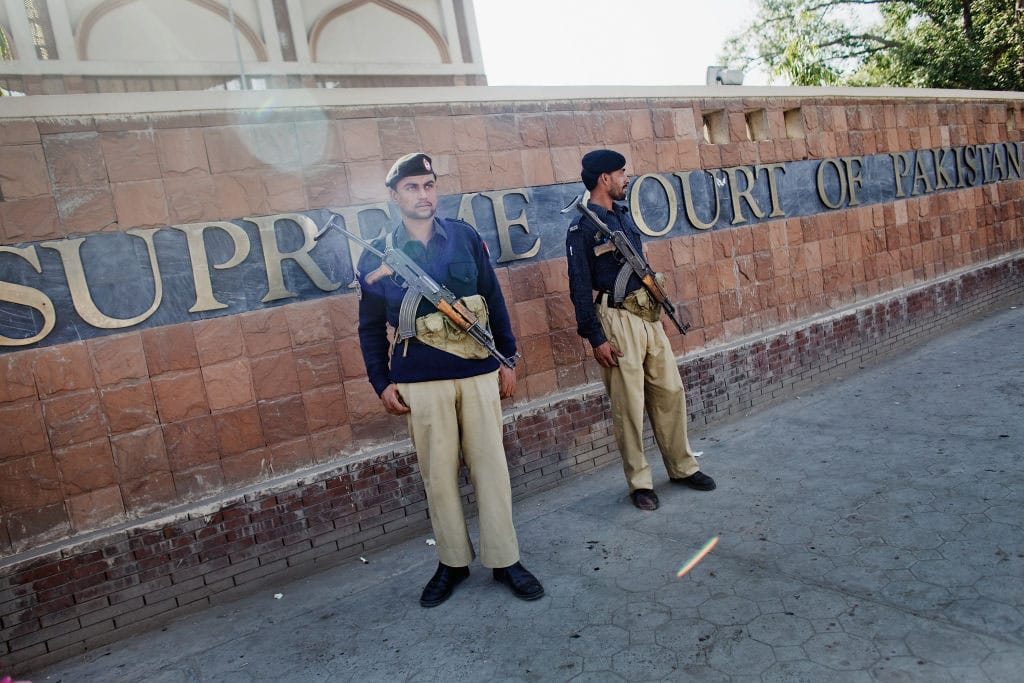
The latest setback was announced Thursday (1/28) when the Pakistani Supreme Court ordered the release from jail of the man charged with master minding and carrying out Pearl’s kidnapping and murder.
London-born Ahmed Omar Said Sheikh was sprung from prison by a 2:1 decision of the Pakistani Supeme Court.
At the time of his death, Pearl, then 38 and the South Asia Bureau chief for the Wall Street Journal, was investigating a link between the Islamic militant group Al Queda and an attempt by the so-called “shoe bomber” to blow up a trans-Atlantic American Airline flight the previous year.
The U.S. government joined the Pearl parents — Prof. Judea and Ruth Pearl — in protesting the decision of Pakistan’s highest court.
Acting U.S. Attorney General Monty Wilkinson issued a statement, which said in part “Ahmed Omar Said Sheikh has long been indicted in the United States and must be held accountable for his crimes… the United States stands ready to take custody of Sheikh to stand trial on the pending charges against him. He must not be permitted to evade justice for his charged role in Daniel Pearl’s abduction and murder.”
“He must not be permitted to evade justice for his charged role in Daniel Pearl’s abduction and murder.” – Acting U.S. Attorney General Monty Wilkinson
In a statement to the Jewish Journal, the Pearl parents emphaiszed that “When a killer is behind bars, responsibility is absorbed by one deranged individual. When a killer is freed, society as a whole assumes responsibility for the crime.
“Today, the Supreme Court of Pakistan has handed an indictment to an entire nation, institutionally, culturally and morally, for one of the most horrifc crimes of the century, which forever will stain the moral standing of that nation. We urge the US Department of Justice to vigorously pursue a request for extraditing Omar Sheikh to stand a trial in the US, and we hope Pakistan responds positively to such a request to rectify the injustice brought about by two of the three justices.”
In memory of their son, the Pearl parents established the Daniel Pearl Foundation, which — rather than seek revenge — is dedicated to cross cultural understanding between East and West. Its emphasis is on three fields in which Daniel excelled – journalism, music and dialogue.
Though relucantly cast into the public spotlight, both parents enjoy distinguished professional careers of their own. Judea Pearl, born in Israel, is a UCLA professor emeritus in computer engineering and is recognised as a path-breaking authority in the field of artificial intelligence.
He is also a frequent contributor to the Jewish Journal.
Pearl met his wife while both were studying at the Technion in Israel. Ruth Pearl subsequently pursued a notable career in software engineering and as editor of the book “I Am Jewish: Personal Reflections Inspired by the Last Words of Daniel Pearl.”
The son is also commemorated by his alma mater, Birmingham High School in Lake Balboa, near Van Nuys, which has been renamed the Daniel Pearl Magnet High School.
UPDATE: In a late development, Ahmed Omar Said Sheik, who for 18 years has denied any part in the murder of Daniel Pearl, acknowledged in a 2019 handwritten letter that he played a “minor part” in the killing of the American journalist, according to an Associated Press report.
In light of this new factor, lawyer Faisal Siddiqi, who represents the Pearl family, demanded that the Pakistani Supreme Court reinstate the conviction and death penalty for Sheikh.
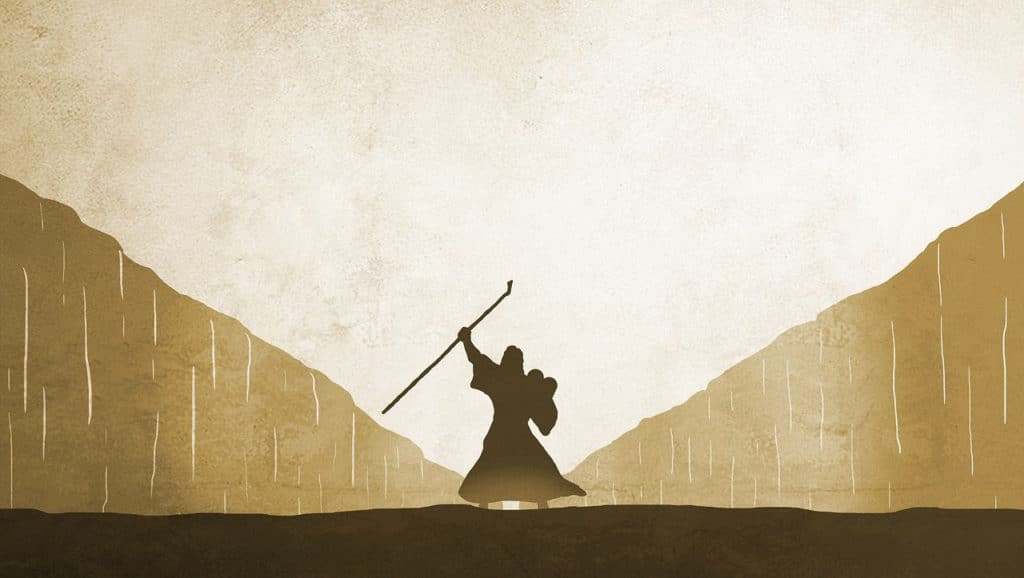
“and the waters were to them as a wall from their right and from their left.” Exodus 14:22
I like to visit places that have the biggest things.
If a city has a wall, or a tower or a building with
an observation deck, if I can go up a funicular
or there’s a trip to a mountain available where
I can see things, previously only available in
the eyes of birds, then count me in.
A natural wonder, a person-made spectacle –
I get giddy looking at pictures of the Earth
from outer space, not to mention the infinity
of the other direction.
Have you been to Chicago, New York City,
Paris, the belfry in Brugges? They change
the names of the buildings sometimes,
but the views are the same – a seeming
forever in your eyes. It’s magic. It’s the Divine
possibility of the work of hands.
It’s two walls of water making
an impossible path possible.
They had seen it all by then –
Blood, frogs, death, maybe giraffes.
But this moment, our biggest moment
(we hadn’t seen the mountain yet)
when nature was upended to
rescue us from 430 years of building
someone else’s pyramids.
This is the moment we’d be talking about
This is the moment we’d be trying to recreate
This is why we climb the tallest buildings
gaze over the edges to the limits of our vision –
To capture the smallest glimpse of these
ancient walls of water, that took us away
from the narrow place.
(JTA) — Even if you never pay attention to stock market news, you have probably gotten the sense that something unusual is happening right now, and it has to do with something called GameStop.
The video game store sits at the center of a dramatic “short squeeze” that has market watchers wondering whether stock trading could forever be changed. Multiple prominent Jewish money managers are involved in the saga, on both the winning and losing sides. Online anti-Semites have noticed, seizing the opportunity to connect it all to age-old stereotypes about Jewish manipulation of the financial world.
And like there was in the Bernie Madoff scandal, there’s a connection to the New York Mets.
Here’s what you need to know.
What went down (in plain English)
On Tuesday, GameStop’s stock price rocketed up over 90% of its previous price, sending shock waves through the entire stock market and the broader world of finance.
But the company, which has been hurt badly during the pandemic, did not suddenly change its business model or win the lottery — online groups, mostly on the social media site Reddit, rallied to the company’s defense, buying GameStop shares in an enormous spree. In their view, they were attempting to save the company from being “shorted” by hedge funds, which were betting big on the retail chain’s eventual demise.
The movement behind the stock jumps didn’t start on Tuesday. Bloomberg reported that chatter surrounding GameStop in particular began last October. But years before that, an entire internet subculture has built up around watching stocks (referred to by those in the know as “stonks,” a purposefully comic misspelling), on sites such as Reddit and 4chan.
These so-called Reddittors — many of them with more time on their hands as sports betting has decreased during the pandemic — saw an opportunity in the case of GameStop to do several things: to financially dent the hedge funds that make billions of dollars by regularly betting on the failure of faltering companies; to “troll” the industry in what they view as a humorous way; to support a company they feel a special affinity for; and to show the collective power of those without huge sums of investment money to spend.
Here are the nuts and bolts of what they did, in the simplest terms possible, thanks to a Vulture article:
Say your friend has a book worth $10. You ask to borrow that book and promise to give it back to them in ten days. You then sell that book to someone else for $10. You are betting that, in ten days, you will be able to buy that book for cheaper. So in ten days, you buy the book for $4 and return the book to your friend. You have made $6. Now imagine that book is actually the stock of a company. (This is a highly reductive and possibly inaccurate description of what short sellers do.) But if, in that span of ten days, that book’s value goes up to, say, $1,000, you will have to buy the book for $1,000 before you return it to your friend. What the redditors are doing is basically pumping the price of that book/stock to astronomical amounts so that the short sellers are, as the saying goes, “squeezed.” Only it’s not $10 we’re talking about but billions of dollars.
After the soaring success of the GameStop squeeze, masses of online traders moved on to other companies with similar troll and nostalgia values that were also in danger of being shorted, such as the flailing movie theater chain AMC Entertainment Holdings and even Tootsie Roll Industries Inc.
The main Jewish players
The main squeeze victims in this story are Steve Cohen and Gabe Plotkin, two Jewish investors who are also two of the most successful hedge fund chiefs on Wall Street. Cohen, the new owner of the New York Mets baseball franchise, had a net worth of over $14 billion as of last year. Plotkin, who once worked under Cohen, manages close to $8 billion in assets under his Melvin Capital firm. Plotkin has been honored by the Chabad Hasidic movement and worked with the Young Jewish Professionals networking group.
The effects on their assets have been huge. So far this month, Cohen’s Point72 hedge fund has lost 15% of its value. Melvin Capital has lost as much as 30% — a bill so steep that Plotkin asked Cohen and investment firm Citadel LLC, run by Dan Sundheim, for an emergency influx of cash (which they provided, to the tune of $2.75 billion).
Steve Cohen speaks on stage at the Lincoln Center Alternative Investment Gala at The Rainbow Room in New York City, April 10, 2019. (Dave Kotinsky/Getty Images for Lincoln Center)
But they aren’t the only Jewish characters involved. Ryan Cohen, CEO of the successful pet products company Chewy, is the largest stakeholder in GameStop, with about 9 million shares, making him the big winner of the week. As of Wednesday, he had made $3 billion from the fallout.
Then there’s Jewish troll extraordinaire Dave Portnoy, founder of the hugely popular blog and social media company Barstool Sports, who has emerged as one of the leading public advocates for the mass of small investors who mostly remain anonymous on sites like Reddit. More on his reaction below.
The Robinhood response
Many of the rebellious traders use Robinhood, an app that allows users to trade stocks without fronting huge minimums of money. Its mantra: “Let the people trade.”
But on Thursday, Robinhood shut down the trading around GameStop, AMC and other companies that the small-money investors had given a bump in an effort to curb market “volatility.” GameStop and other stocks predictably plummeted without the Redditors to keep them afloat.
That move has enraged a wide spectrum of observers, especially since Robinhood is partially funded by Citadel. That fact has sparked claims that the hedge funds involved colluded to unfairly stop the bleeding.
Portnoy has been out in front on the issue, displaying his anger on Twitter.
“I will burn @RobinhoodApp to the ground if they shut down free market trading,” he wrote in one tweet that garnered nearly 100,000 likes.
So @RobinhoodApp is saying they are protecting their users from over leveraging and getting burned. But somehow it’s okay when hedgefunds literally do the same exact thing. Nobody had a problem then until the hedge funds lost. Now speculating is a huge issue. #frauds
All of the above has made the whole scenario ripe for anti-Semitic exploitation. Some of the most common age-old anti-Semitic tropes include the idea that Jews secretly manipulate the world’s money.
In reaction to the Robinhood shutdown, anti-Semitic memes about the situation have cropped up on a sub-group of the main Reddit thread, r/wallstreetbets, and on 4chan, a site known for being full of crude anti-Semitic images.
(Screen shot)
Observers of the online far-right have also noticed that anti-Semitic groups are latching onto the moment, trying to sneak their beliefs into something that is snowballing into a wider “David vs. Goliath” movement.
Anyone who's not noticing literal Nazis and far-right disinfo grifters like Mike Cernovich rabidly tweeting in support of the GameStop squeeze is a fucking dumbass, and as usual, @lilsarg is correct.
Nazis will try to co-opt *any* movement that's mostly disaffected white people. https://t.co/2KQ6QXqdjs
As a bonus to all of this, New York Mets fans are worried that the financial hit Cohen is taking could mirror the disaster that the team’s previous Jewish owners, the Wilpon family, went through after the Bernie Madoff scandal (which affected so many Jewish investors and institutions).
Cohen has earned praise throughout New York and around the sports world for committing to spending highly on top players and promising to turn the team into a perennial competitor.
Asked on Twitter — where he frequently interacts with fans — if the GameStop squeeze was going to impact the team, he bluntly said no.
One fan wrote: “Is this Gamestop business effecting[sic] the Mets payroll? I mean that’s the main story in all of this.”
“Why would one have anything to do with the other,” Cohen responded.
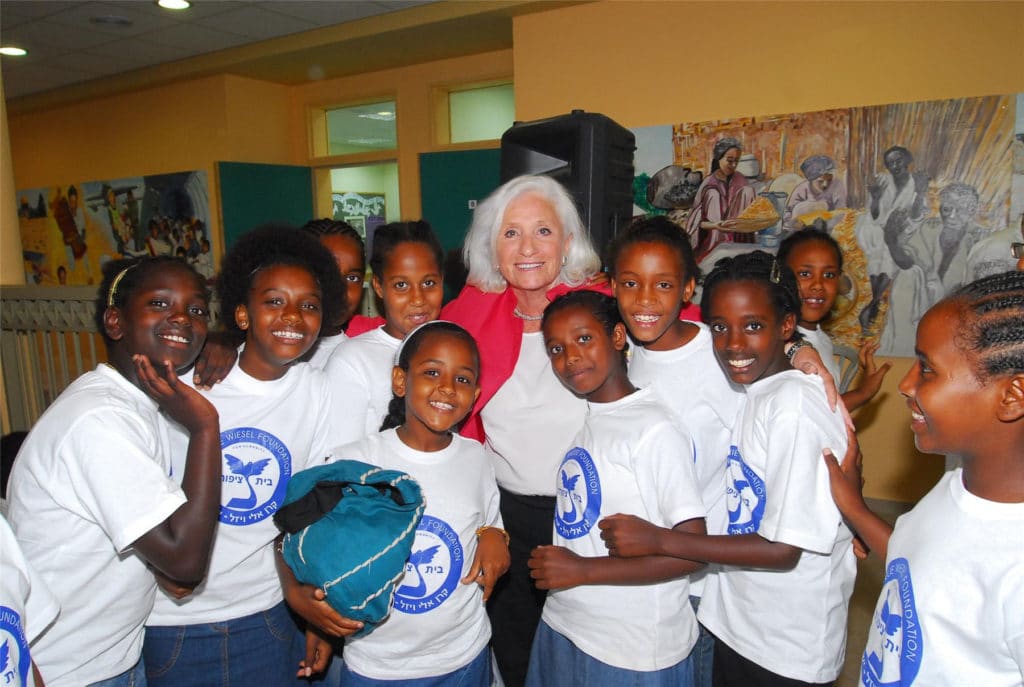
Jewish leaders, politicians and celebrities across the aisle virtually gathered on Jan. 27 to celebrate Marion Wiesel’s 90th birthday. The virtual gathering, hosted by The Elie Wiesel Foundation for Humanity and Women’s International Zionist Organization (WIZO), honored Wiesel and her legacy, which includes establishing The Beit Tzipora Centers as part of the Wiesel family’s longstanding commitment to civil rights in America and Israel.
Former President Bill Clinton, former Secretary of State Hillary Clinton, Prime Minister Benjamin Netanyahu, Oprah Winfrey, George Clooney, former Secretary of State Colin Powell, Mayim Bialik, Ted Koppel, Natan Sharansky, Joseph Ciechanover, and Ronald S. Lauder all shared remarks about Weisel. Israeli singer-songwriter Idan Raichel performed.
Also coinciding with International Holocaust Remembrance Day, the celebration honored Marion’s living legacy, including her visionary work alongside her late husband and Nobel Peace Prize winner Elie Wiesel to establish the Beit Tzipora Centers in Israel that educate and empower Ethiopian-Israeli children.
“On this milestone birthday, we thank you for being one of the greatest truth-tellers of our time,” former President Bill Clinton, said. “You’ve touched so many millions of lives, you’ve changed the world for the better.”
Prime Minister Benjamin Netanyahu also joined in celebrating Marion and recognizing her work, saying, “it’s a pleasure to join you all this evening to celebrate the life and work of Marion Wiesel and to wish you a very happy 90th birthday. Tonight we want to recognize your…work, especially your efforts to change the world for the better.”
Through The Elie Wiesel Foundation for Humanity, the Wiesels founded the Beit Tzipora Centers in the mid-1990s in memory of Elie’s sister Tzipora, who perished in the Holocaust.
Both centers support the education of Ethiopian-Israeli children and families and provide opportunities for them to participate fully in Israeli society. Now managed by WIZO, the Centers provide a range of educational services and enrichment programs for over 700 children annually.
“The work that The Elie Wiesel Foundation and WIZO are doing together to support the Ethiopian-Israeli community is nothing more than an extension of the values that we are trying to convey to our children—about taking care of Am Israel and the world, being proud to be Jewish and Zionist, and having a real hope and belief in where we go from here,” Elisha Wiesel, Marion and Elie’s son, said.
After arriving in the United States as a refugee, in the early 1950s, Marion joined the NAACP, marching for civil rights and speaking out against discrimination in the segregated South. Four decades later, she became deeply involved in supporting the growing community of Ethiopian refugees in Israel. An ardent Zionist, Wiesel wanted to ensure that the Jewish state served as a model of racial equality and equal opportunity. The Centers are a key highlight of Marion Wiesel’s more than six decades of social and racial justice work.
After arriving in the United States as a refugee, in the early 1950s, Marion joined the NAACP, marching for civil rights and speaking out against discrimination in the segregated South.
“After coming to the United States, Marion focused on moving forward—establishing a life, career, and family. But she never forgot what she’d seen and experienced as a child in Europe,” Oprah Winfrey said during her remarks. “With Elie Wiesel, she had a partner who shared her passion. Together they became preeminent voices for social justice and peace around the globe.”
“The Marion Wiesel we celebrate today inspires us with her seemingly bottomless heart and her endless energy in giving voice to the voiceless. Her commitment to embracing others and fighting bigotry is grounded in what she witnessed as a young girl in Europe,” George Clooney said.
When speaking about Marion’s impact, neuroscientist, actress and podcaster Mayim Bialik said she’s always had a love for social justice and Israel.
“Her life is proof that the two go hand in hand,” Bialik said. “Her experiences both as a refugee and as an activist in the United States left an imprint on her to never take tolerance for granted.”
Wiesel told the virtual group that “as a refugee who spent her childhood fleeing violence and persecution, I learned firsthand the great challenges of finding your footing in a new land.”
“My husband and I founded the Beit Tzipora Centers to provide support and educational opportunity for Ethiopian children and families in Israel,” she added. “I was honored to spend my 90th birthday sharing the stories of these families—and highlighting the remarkable impact that this program continues to make year after year.”
(The Media Line) — In a landmark decision, Israel’s Supreme Court has unanimously held that there are limits to the police’s power to stop people and ask for identification.
The decision announced on January 26 was hailed by the Ethiopian community in Israel as well as by rights activists and organizations, who say the police disproportionally stop minorities such as Ethiopian Israelis and Arab Israelis. Their elation over the decision, however, is tempered by loopholes in the law and other police policies that will allow the practice of racial profiling to continue.
The court’s decision was based on a merger of two similar cases, one brought by The Association of Ethiopian Jews (AEJ), along with the Association for Civil Rights in Israel (ACRI) and The Public Committee Against Torture in Israel, and the other by Tebeka, a group that provides legal assistance for Ethiopian Israelis. The cases argued that the police policy of stopping anyone for any reason and asking for their government-issued identity card is against the law and that the current law enforcement practice is being applied in a discriminatory matter.
The Court held that, under Section 2 of the “ID Possession and Presentation Act,” authorities can only ask for ID if there is objective reason to do so, and prohibits the police from using the occasion to look further into the stopped person’s police records.
“This decision completely changes the way the police are supposed to act toward people who are not suspected of anything,” Anne Suciu, the ACRI attorney who wrote the Supreme Court petition, told The Media Line. “Until now, the police used to ask people to show their ID without any suspicion in any circumstance without any limitation.” Now, she said, the court has decided that police are allowed to ask to see an identity card, “but only in limited circumstances.”
“The police are no longer allowed to stop people based on a hunch that a person is doing something wrong, which usually only happens to minorities in Israel, and now they have to have objective ground,” she said.
Police are only allowed to ask for ID to determine that the stopped person actually possesses an identity card, for example, where they suspect that a person is not in the country legally, Suciu said.
Police also are allowed to ask for ID if they need to obtain information that is contained on the card.
“If they see someone drinking alcohol, they’re allowed to ask for an ID to see the person is over 18 or, for example, during corona to see where the person lives and check if they’re violating lockdown,” she said.
“The police are no longer allowed to stop people based on a hunch that a person is doing something wrong, which usually only happens to minorities in Israel, and now they have to have objective ground.”
Now when a person is stopped, Suciu says there are limits to what the police can probe. The practice of stopping someone for ID will be considered a detention.
“You are not allowed anymore to ask for an identity card and check the criminal background of the person in the police files, which is the practice that was used until now,” she said.
“The police claimed that the power to ask someone to show an identity card is not detention; the court decided it is a detention and the law that is relevant to detention is supposed to be adapted in cases like that, which means that the police cannot ask someone to show an identity card without explaining why and without first saying their name,” Suciu said.
This classification is important because the police have not kept track of the numbers of people stopped for ID because it was not considered a detention.
The Israel Police spokesperson’s department told The Media Line in response to the ruling: “This is a legal proceeding and we will continue to conduct it in court and not in the media. It should be noted that with regard to this issue and any other issue, the Israel Police acts in accordance with the provisions of the law and police procedures.”
The police now have 90 days to write new regulations to implement the ruling and detail the protocol involved in stopping people.
The Supreme Court’s decision has been welcomed by the Ethiopian community in Israel.
Shlomit Bukaya, executive director at AEJ, applauded the high court’s decision.
“For me, it’s a new beginning for all the Ethiopian teenagers … I know from my experience with teenagers, even my brothers, that’s it a new day for them,” she told The Media Line. “They can now say to those policemen who stop them and ask for ID: ‘I know there is a new decision from the Supreme Court that you cannot ask me for ID whenever you want. You need to explain why you are stopping me.’”
Bukaya says that the Court’s decision empowers the community.
“They now have tools to deal with the police. Now they can go wherever they want without being as afraid when they see a policeman,” she said.
“I was in the army and I’m a good guy. I have a good job, but I’m a Black man and that is the reason why they stop me.”
Shahar Mola, a 45-year-old Ethiopian Israeli activist from Kfar Saba, knows that experience all too well.
He has been stopped for an ID at least six times, and described one encounter near his home.
“When I was running one day like everyone else, they stopped me.” he told The Media Line. “While it is not pleasant to think about, if you are a Black man in this country and the police see you in … a wealthier area, they’re likely to stop you. Maybe you live there, but the police assume you don’t.”
“I was in the army and I’m a good guy. I have a good job, but I’m a Black man and that is the reason why they stop me,” he said. “I know not everyone is like that but a lot of police officials are not open-minded to understand why Black men are in good neighborhoods” for reasons that are not nefarious, he said.
Mola says that his relatives experience this frequently.
“My brother lives in a good a neighborhood with his children, and they get stopped all the time. Even the nine-year-old gets stopped,” he said.
Mola is happy about the Supreme Court decision, because he does not want anyone else to go through what he has experienced.
“When it first happens, you get angry. This is my country and I give everything for my country. I would die for Israel, but it makes you feel bad when someone stops because of your color,” he said. “It’s the worst feeling.”
The Supreme Court ruling “is not just only for me, but for my children and my brother’s children. I hope [this treatment] won’t happen again,” he added.
However, Mola’s wish is unlikely to be realized.
ACRI’s Suciu points out that while the Supreme Court’s decision limits the ability of authorities to racially profile, it does not entirely abolish the practice.
People who are likely to be suspected of not being in the country legally are usually going to be minorities, and they are still going to be stopped.
“The danger of profiling is not completely eliminated,” she said.
Bukaya agrees that there will be still be apprehension in the Ethiopian community over interaction with the police and that work still needs to be done by the police to combat racial bias.
“We are half-way there” to equal treatment by the authorities, she said. “There is still a disproportionate amount of arrests and criminal profiles among Ethiopian Israelis, and police violence needs to completely stop.”
Bukaya contends that one way the police can do this is through relieving of duty officers who disproportionately arrest minority groups.
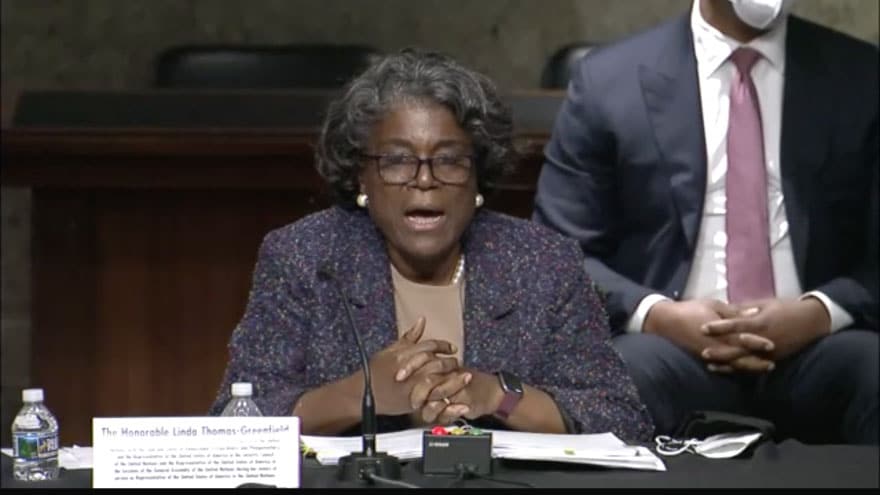
(JNS) U.S. President Joe Biden’s nominee to be U.S. ambassador to the United Nations pledged on Wednesday to combat the anti-Israel bias at Turtle Bay.
“I look forward to standing with Israel, standing against the unfair targeting of Israel, the relentless resolutions proposed against Israel unfairly,” said Linda Thomas-Greenfield at her nomination hearing in front of the U.S. Senate Foreign Relations Committee. “I look forward to working with Israel to develop a strategy with them for engaging with countries that would appreciate having Israel’s expertise to support their development efforts.”
Thomas-Greenfield, a 35-year diplomat, expressed hope that those countries that have normalized ties with Israel under the Abraham Accords—the United Arab Emirates, Bahrain, Sudan and Morocco—“will also see some opportunities to be more cooperative at the U.N. and more supportive of Israel’s presence there.”
On Iran, Thomas-Greenfield assured that the Biden administration will work to prevent the regime from getting a nuclear weapon.
“We’ve seen a tremendous amount of backtracking since” the United States withdrew from the 2015 Iran nuclear deal, she said. The withdrawal in May 2018 was followed by reimposing sanctions lifted under it, along with enacting new sanctions as part of what the Trump administration called a “maximum pressure” campaign.
Thomas-Greenfield said America would work with its allies and other members of the U.N. Security Council to “ensure that we hold Iran accountable.”
Additionally, she noted that the United States would rejoin the U.N. Human Rights Council and the United Nations Educational, Scientific and Cultural Organization, or UNESCO.
The United States withdrew from the UNHRC in June 2018 after then-U.S. Ambassador to the United Nations Nikki Haley cited the world body’s “chronic” bias against Israel as one of the primary factors for the withdrawal.
The United States defunded UNRWA in September 2018, claiming that the refugee agency, which serves Palestinians, inflates the number of Palestinian refugees and furthers the Palestinian refugee problem. Critics have also said that UNRWA has inspired violence against Israel.
Finally, Thomas-Greenfield expressed opposition to the BDS movement against Israel, saying that it is “unacceptable” and “verges on anti-Semitic,” and “it’s important that they not be allowed to have a voice at the U.N., and I intend to work against that.”
On the evening of January 27, NBC News retracted a story that questioned a Biden administration appointee’s donations to AIPAC.
The story, which was first reported by Mother Jones, centers on Anne Neuberger, who President Biden appointed to the Deputy National Security Adviser for Cyber and Emerging Technology position earlier in the month. Neuberger’s family foundation — the Anne and Yehuda Neuberger Foundation — donated $559,000 to AIPAC from 2012–18. The report quotes several anonymous officials and experts, as well as a Washington University law professor, arguing that the donations raise questions about Neuberger’s “impartiality” when it comes to matters involving Israel.
NBC News ran a similar story, featuring a quote from the National Security Council stating that “Neuberger will abide by the Executive Order on Ethics Commitments By Executive Branch Personnel.”
Jewish groups denounced the story.
“This article and its baseless claims against Anne Neuberger are incendiary,” Anti-Defamation League CEO Jonathan Greenblatt tweeted. “They have no bearing on her field of expertise or her new responsibilities. The donations of her family foundation to AIPAC don’t preclude her from public service.”
He alleged in a subsequent tweet that the story promulgated the dual loyalty “that Jewish-Americans are more faithful to a foreign power. It’s a tired antisemitic trope that should have been retired long ago, not recycled on a day when we mourn [6 million Jews].”
This article and its baseless claims against Anne Neuberger are incendiary. They have no bearing on her field of expertise or her new responsibilities. The donations of her family foundation to AIPAC don’t preclude her from public service. https://t.co/1u2ebS6coH
These breathless insinuations play into age-old accusations of dual loyalty, that Jewish-Americans are more faithful to a foreign power. It's a tired antisemitic trope that should have been retired long ago, not recycled on a day when we mourn 6M. More: https://t.co/5x6VV2YLWF
The American Jewish Committee (AJC) similarly tweeted, “.@AIPAC is an American organization that supports an alliance critical to American [national] security—as do a majority of Americans. Questioning the loyalty of a public servant for supporting it is not just offensive, it reeks of bigotry. @MotherJones owes Anne Neuberger an apology.”
.@AIPAC is an American organization that supports an alliance critical to American nat. security—as do a majority of Americans.
Questioning the loyalty of a public servant for supporting it is not just offensive, it reeks of bigotry.@MotherJones owes Anne Neuberger an apology. https://t.co/TgTqhyIZvm
The Conference of Presidents also tweeted, “We call on @MotherJones to withdraw its attack on Deputy National Security Adviser Anne Neuberger for her family’s support for @AIPAC. She has served the American people with distinction. This attack on her character smacks of age-old antisemitic canards.”
We call on @MotherJones to withdraw its attack on Deputy National Security Adviser Anne Neuberger for her family’s support for @AIPAC. She has served the American people with distinction. This attack on her character smacks of age-old antisemitic canards.
AIPAC itself called out NBC News, tweeting that the news outlet should “retract this offensive story. Charges of dual loyalty are anti-Semitic and insult millions of Americans—Jewish & non-Jewish—who stand by our ally Israel. We will not be deterred from exercising our rights as citizens to advocate for a strong US-Israel relationship.”
.@NBCNews must retract this offensive story. Charges of dual loyalty are anti-Semitic and insult millions of Americans—Jewish & non-Jewish—who stand by our ally Israel. We will not be deterred from exercising our rights as citizens to advocate for a strong US-Israel relationship. https://t.co/Jof9sIKXX7
Emily Horne, a spokesperson for the White House National Security Council (NSC), also tweeted that they “are appalled by recent spurious accusations against our staff. We welcome oversight and scrutiny, but there is no justification for false and ad hominem attacks based on ethnic, racial, or religious identity.”
She added: “The women and men of the NSC are patriotic, dedicated, and serve their country with distinction. Being forced to endure public smear campaigns should not be part of working on behalf of the American people.”
We are appalled by recent spurious accusations against our staff. We welcome oversight and scrutiny, but there is no justification for false and ad hominem attacks based on ethnic, racial, or religious identity. 1/2
The women and men of the NSC are patriotic, dedicated, and serve their country with distinction. Being forced to endure public smear campaigns should not be part of working on behalf of the American people. 2/2
In an editor’s note on the article, NBC wrote that after various readers raised concerns about it, they decided to retract it because “it fell short of our reporting standards. In order to warrant publication, it needed on-the-record quotes from critics, rather than anonymous ones. The article should have also included more views from those who believe that donations to AIPAC do not represent a conflict.” NBC has kept the story in their archives for the sake of transparency.
Mother Jones, on the other hand, is continuing to stand by their reporting. An editor’s note at the bottom of the story states that they gave Neuberger two days to respond and that their story “cited both named and unnamed sources.”
David Corn, the author of the Mother Jones story, denied that the piece invokes the dual loyalty trope, tweeting in response to the AJC that his article and the NBC News article simply “reported that national security and government ethics experts consider these donations problematic.”
In other tweets, Corn cited a passage from former President Barack Obama’s 2020 book “A Promised Land” stating that “AIPAC is aligned with the Israeli right and on policy disputes has sided with Israel when it ‘took actions that were contrary to US policy.’” Another tweet of his stated, “We’re not judging her based on the AIPAC contributions. The piece notes she is highly regarded. But it also quotes top intel officials saying it’s problematic for a sr. intel official to give big $$$ to a lobby closely ties to a for. govt.”
Not implying dual loyalty or AIPAC is “foreign.” It’s about policy. Look at what @BarackObama writes in his new book: AIPAC is aligned with the Israeli right and on policy disputes has sided with Israel when it “took actions that were contrary to US policy.” https://t.co/0aVwodKfDypic.twitter.com/jfPkyOdHZc
I'll take the first two observations….We're not judging her based on the AIPAC contributions. The piece notes she is highly regarded. But it also quotes top intel officials saying it's problematic for a sr. intel official to give big $$$ to a lobby closely ties to a for. govt. https://t.co/oWwEPxI97v
Noah Pollak, who heads the foreign policy advocacy organization Democratic Alliance Initiative, countered: “You or I can find ‘experts’ to say anything we want, so pegging a piece like this to some mythical consensus of ‘experts’ is both stupid and dishonest. As is your overall lame attempt to link donating money to AIPAC to cyberespionage on the US.”
You or I can find "experts" to say anything we want, so pegging a piece like this to some mythical consensus of "experts" is both stupid and dishonest. As is your overall lame attempt to link donating money to AIPAC to cyberespionage on the US. Very, very smelly. https://t.co/p5iiup3HAw
I grew up in Los Angeles, California and then Miami Beach, Florida in the 1970s. Nearly all of my friends from school ended up leaving the beautiful retirement community and moving to greener business pastures in the Northeast, particularly New York and New Jersey. (I personally started living in Yeshiva dormitories around the world when I was a teenager, going to Los Angeles, Jerusalem, New York, Sydney, Australia, Oxford, England and then to the Northeast).
Perhaps we should have stayed. Then, at least, we might have been able to afford a house in Florida as a mass wave of émigrés now takes over the sunshine state.
It’s not just the coronavirus that is decimating the northeast, particularly the densely populated areas of New York and New Jersey. Even after, God willing, the population is inoculated with the vaccine and we, God willing, push this disgusting and deadly virus out of our lives, New York and New Jersey will continue to hemorrhage vast numbers of citizens, particularly from the Jewish community.
I’m in shock to see how many of my friends and neighbors are leaving to move, mostly to Florida but also to Texas and Nevada.
Nor can the weather alone account for the tsunami of émigrés from the Northeast, since huge numbers are now moving out of California — and Los Angeles, in particular — where the year-round climate is arguably better than Florida, without the sticky, muggy summers. California used to be the state everyone moved to. No longer.
Why the exodus? People in New York and New Jersey have seen the arbitrariness with which governors and legislators can control their lives, lock down businesses and schools with almost no reference to infection rates and science and tax them up the wazoo. They feel they have far fewer rights in California, New York and New Jersey, so they’re moving to states that have no state income tax and have fewer virus restrictions. From California, most say the reason is unaffordability.
And if Governors Gavin Newsom, Andrew Cuomo and Phil Murphy of California, New York, and New Jersey don’t wake up soon, they’re going to see vast numbers depart to the sunshine state causing massive income tax and Congressional representation losses to their states that will not be made up.
Don’t get me wrong. I believe in lockdowns where the coronavirus is raging. I believe in protecting and safeguarding lives. I just don’t believe in stupid lockdowns that unfairly discriminate and destroy jobs, business and undermines the people’s freedom. For example, why did Cuomo decide that bicycle stores, alcohol outlets and acupuncture clinics can operate with zero restrictions but prayer services at certain synagogues and churches — including those built to house hundreds and where there could be ample social distancing — were shut down? Despite Cuomo’s justification that the measure was intended to slow the spread of the virus in high-case zip codes, his discriminate targeting was government overreach, pure and simple. It caused many religious Jews to think of moving to Governor Ron DeSantis’ Florida instead.
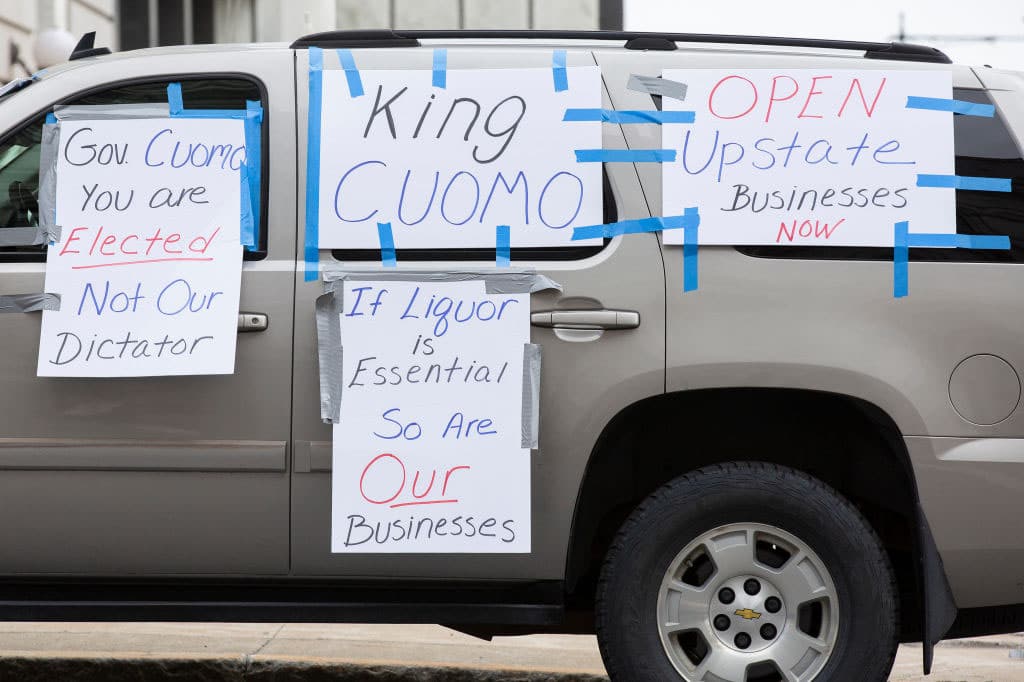
A vehicle is covered in signs criticizing New York State Governor Andrew Cuomo during an Operation Gridlock protest outside of the New York State Capitol Building on April 22, 2020 in Albany, New York. (Photo by Stefani Reynolds/Getty Images)
Thankfully, the United States Supreme Court stepped in and struck down the governor’s order. Now, as vaccinations proceed and cases slowly decline, restaurants in New York are back to outdoor dining, and in New Jersey, mercifully, you can still eat indoors but at a restricted capacity. In Los Angeles, up until a few days ago, even outdoor dining was forbidden amid the beautiful, sunny climate.
Are these measures necessary? Are they merited? Sometimes yes and sometimes not. But when you go to Florida and see that there are the most minimal restrictions amidst a pretty similar infection rate, it makes you wonder. California has imposed the most restrictive laws of all states. Yet its infection rate, tragically, is going through the roof, which just goes to show you that the rules should be based on science — not a government’s arbitrary right to simply extinguish some businesses and institutions.
But that’s not the reason I’m penning this column as scientists and statisticians far more knowledgeable than me have already addressed these issues all over the country.
Rather, I’m writing as someone who loves New York City, its diversity, its museums, its theater and performing arts, and its vibrant Jewish life. And I’m writing as someone who loves New Jersey, its green spaces, its rivers, its parks and bike paths — and as someone who was born in Los Angeles and loves the beaches, bike paths, and mountains of the City of Angels. I’m in shock that no one seems to give a damn about how rapidly they are losing residents.
I’m in shock that no one seems to give a damn about how rapidly the states are losing residents.
In 1963, when he gave his famous “Ich Bin Ein Berliner” speech at the wall dividing the German capital, President John F. Kennedy famously said that the East and West have long argued as to who has a better system. But, Kennedy concluded, the debate was adjudicated by the Soviet need to build a wall to keep their people in.
JFK was right: people vote with their feet. And if they’re abandoning New York, New Jersey and California in large number because they can’t handle the government restrictions and the absolutely insane taxes, then the matter has been decided. These states will suffer unnecessarily.
I know, everyone believes that New York, New Jersey and especially California will bounce back, as they always have in the past. I hope so, God willing. New York is currently the world financial capital , the world media capital, the world diplomatic capital and, arguably, the world performing arts capital. Yet so much is now closed, and no one knows when they will reopen.
And then you have Jewish life. New York and New Jersey are easily the places of greatest Jewish vibrancy in the country, with the massive Jewish communities of Brooklyn, Crown Heights, Williamsburg, Manhattan, Monsey, Lakewood and countless others, comprising the largest Jewish community outside of Israel. Incredible Yeshivas, day schools and shuls have long served as a magnet for a fulfilling Jewish existence exceeded only by the eternal Jewish homeland of Israel. Los Angeles has the incredibly vibrant communities of the Pico-Robertson and Hancock Park, and California has arguably more Chabad Houses than any state in the Union.
But go to Florida, and you’ll see it’s really beginning to seriously compete. When I grew up in Miami Beach, there was only the Hebrew Academy, which I attended, and Chabad day schools. Today, there are too many to count, along with massive concentrations of shuls and Chabad Houses throughout the Sunshine State.
That just leaves the job market as the principle reason to be in New York. But the Wall Street Journal recently reported that between federal, state, and city taxes, New York is pushing the highest tax rates to some 68% of total income, with New Jersey not far behind. California is right up there with them. Good luck trying to keep anyone there when Zoom, along with broadband, has dramatically changed the calculus of where one must live in order to do one’s job. Indeed, in New York City, the Upper West Side is mostly alive because it’s residential. But a few blocks south of Columbus Circle? Mid-town resembles a ghost town.
It really makes me sad.
I’m someone who sees in New York City — easily the most diverse metropolis on earth — as almost something Messianic in its diversity. During the summer’s racial unrest and ensuing riots, I lamented that New York was being targeted. It didn’t make sense. Yes, there is racial injustice everywhere and it must be strongly and robustly challenged. And I believe the Jewish community must be at the forefront of joining our African-American brothers and sisters in protesting injustice, which is why our Annual Champions of Jewish Values International Awards Gala will this year focus on African American and Jewish brotherhood.
But attacking New York? New York is what all of America should look like: citizens, Jewish, Christian, Muslim, atheist and everything in-between, living together as family. America needs to be more like New York in its complexion, not less.
Thank God, the violent protests have passed. But what has not passed is the damage being done to America’s greatest city and the state of New Jersey by government edicts and insanely high taxes. To many émigrés, these policies say that their voices doesn’t matter, that lockdowns can often be determined not by science but by pressure groups, like teachers unions, which in November pushed to shut down all of New York City’s schools even when the science showed that the rate of infection at schools was incredibly low.
So more and more people are moving south, where the taxes are more reasonable, where citizens seem to have more rights, and where, yes, the weather doesn’t require putting on fifteen layers before you move outside.
The last can be remedied with warm clothing. But the first two can only be remedied with good governance.
Rabbi Shmuley Boteach, “America’s Rabbi,” whom the Washington Post calls “the most famous Rabbi in America,” is the author most recently of “Lust for Love,” co-authored with actress Pamela Anderson. Follow him on Twitter and Instagram @RabbiShmuley.
Clergy note the coinciding of International Holocaust Remembrance Day and Tu Bishvat, the holiday celebrating the “new year” of the trees. Many themes run between the two calendrical landmarks, but the connection seemed obvious.
I have visited Poland three different times. My nightmares usually come from the Belzec death camp. Belzec, located close to the railroad to logistically maximize the number of Jews killed in a day, was built with the sole purpose of extermination. Jews would leave the trains and march straight into the gas chambers, meeting their death within minutes of arrival. Imagine the psychological horrors as Jews were sometimes handed a rock instead of soap as they entered the “showers.” There were almost no survivors from this killing machine.
I distinctly remember the pine trees camouflaging Belzec, intricately woven around its perimeter. Those trees called to me, tearfully whispering the stories they witnessed. Very few humans were able to share the messages of the men, women and children murdered at Belzec. But the trees. The trees heard the screams. The trees sagged and heaved with pain as they watched innocents killed day after day. The same trees hold lifetimes of memories, begging us to share in the responsibility of hearing and seeing the ravaged souls ripped from their earth. Trees swaying through stormy nights and cloudless days, promising that in this darkest moment of history, the Jewish people would not be uprooted.
When we put the Torah away, we pray the words, “Etz Haim Hee…” It is a tree of life. We hold tight to the lessons of Torah, drinking its nourishment, the sustenance of Torah flowing from generation to generation. Like a tree, we pray to stay grounded and allow our branches to grow and extend, offering protection, comfort, embrace and life to those in need.
But unlike the trees at Belzec, we do not merely witness stories with silence and pain. We have the holy ability to scream and be heard. To point out injustices and gain attention. To take action with our souls and with our voices.
For the trees that endured the thundering of our people: I pray that you only hear prayers of peace and cries of joy. And the stories of the Shoah will continue with us, planted deep within our hearts, urging us to plant seeds of truth, humility, justice, and love.
Shabbat Shalom
Rabbi Nicole Guzik is a rabbi at Sinai Temple. She can be reached at her Facebook page at Rabbi Nicole Guzik.


 Los Angeles poet Rick Lupert created the