fbpx

January 13, 2021

End Jew Hatred Protests Outside of Twitter CEO’s Home

Various Jewish activists involved with the organization End Jew Hatred, which describes itself as a Jewish grassroots civil rights movement, drove by Twitter CEO Jack Dorsey’s home in California and played audio recordings of Holocaust denial tweets through megaphones.

Some of the tweets that were read out loud included “Joe Biden’s win is as fake as the Holocaust” and “the holohoax never happened but I want to do it again every single time,” among several others.

Brooke Goldstein, one of the founders of End Jew Hatred and executive director of The Lawfare Project, said in a statement, “Dorsey has banned the voices of political leaders he deems hateful. Yet he leaves on neo-nazi material. What kind of message does that send? That he endorses Jew hatred? That Jew hatred is socially acceptable? If denying [COVID-19] and its 1.6 million victims is wrong – then denying the Holocaust and its 6 million victims is wrong.”

She added: “Jack Dorsey: it’s time for you to end Holocaust denial and end Jew hatred on Twitter.”

During an October Senate hearing, then-Senator Cory Gardner (R-Col.) asked Dorsey what Twitter’s policy regarding Holocaust denial content.

“We have a policy against misinformation in three categories, which are manipulated media, public health, specifically COVID, and civic integrity, election interference and voter suppression,” Dorsey replied at the time. “We do not have a policy or enforcement for any other types of misleading information that you’re mentioning.” He added that Holocaust denial is “misleading information, but we don’t have a policy against that type of misleading information.”

Twitter did not respond to the Journal’s request for comment.

End Jew Hatred Protests Outside of Twitter CEO’s Home Read More »

The Jewish Lawmaker Leading the Trump Impeachment Charge

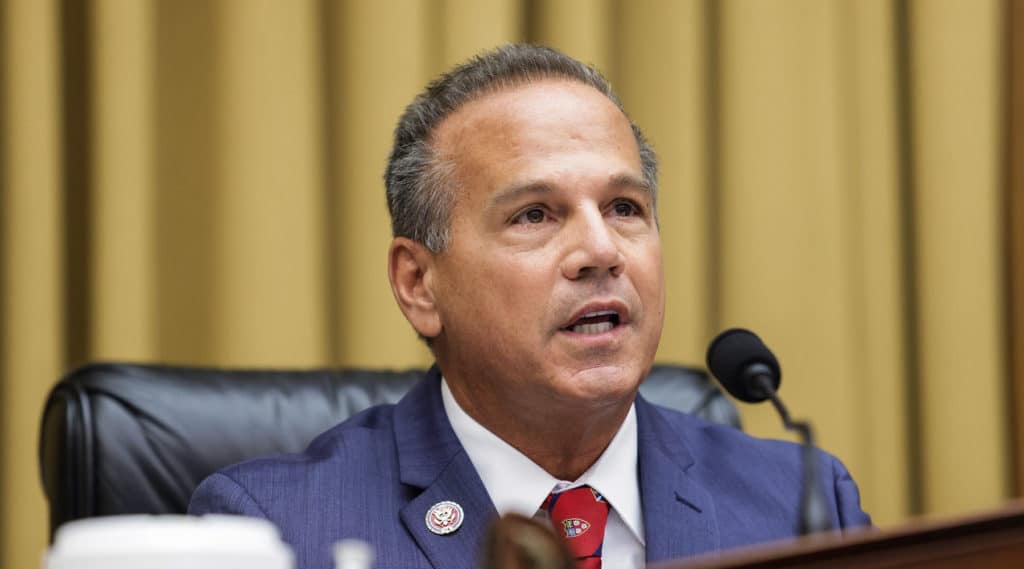
(JTA) — The House of Representatives began its impeachment debate on Wednesday — the second of Donald Trump’s presidency. Rep. David Cicilline, a Jewish Democrat from Rhode Island, helped lead the charge and formally submitted the impeachment resolution to Congress.

Cicilline also co-sponsored the document with Reps. Ted Lieu of California and Jamie Raskin of Maryland, a fellow Jewish representative. In a New York Times op-ed, Cicillineoutlined the Democrats’ reasons for pursuing impeachment. Additionally, along with his co-sponsors, the New Englander will be one of nine managers of the impeachment process named by House Speaker Nancy Pelosi.

It’s a pivotal moment in the spotlight for the former Providence mayor, who has represented the state in Congress since 2011. Here’s what you need to know about Cicilline and his quietly pioneering career.

His father defended mobsters.

Cicilline, born to an Italian father and Jewish mother, grew up in Providence, where his father was a prominent attorney. Jack Ciciline was an aide to Mayor Joseph Doorley Jr., but also helped defend members of the local mafia.

“We have a system of justice predicated on certain constitutional rights, which make this country different from every country in the world,” the younger Cicilline told the alumni magazine of his alma mater, Brown University, in 2002.

He then defeated a mobster.

After becoming a lawyer and spending time working for the public defender’s office in Washington, D.C., and as a member of the Rhode Island House of Representatives, Cicilline challenged the notorious figure Vincent “Buddy” Cianci in the 2002 Providence mayor’s race. Cianci was known for his two mayoral stints, which each ended in scandal: In 1984, he pleaded “no contest” to being involved in the assault of a man he believed was having an affair with his wife, and in 2001 he was indicted on a slew of corruption charges in an FBI investigation called Operation Plunder Dome.

Cicilline, then 41, defeated Cianci in a November 2002 landslide.

He was the first openly gay mayor of a state capital city.

Cicilline publicly came out in 1999 while a member of the state’s House. He was the only gay mayor of a capital city in the U.S., according to The Advocate.

He said he ran for mayor “as a candidate who happens to be gay rather than a gay candidate.”

“During my campaign the gay issue was irrelevant,” Cicilline told The Advocate in December 2002.

He celebrates Jewish holidays.

Cicilline adopted the religion of his mother, Sabra, even as his brother embraced the Catholicism of their father. (Sabra’s confirmation announcement appeared in the Rhode Island Jewish Herald in 1955.)

Cicilline calls himself a “practicing Jew” and noted in 2017 that he celebrates Jewish holidays, such as Rosh Hashanah, with family and friends. He also has done events with the Reform Providence congregation Temple Beth-El.

He’s leading the big tech crackdown.

Cicilline has represented his state’s 1st Congressional District since winning a tight race against a Republican in 2010. He has been touted by insiders and colleagues as a rising starand earned spots on two prestigious House committees, Judiciary and Foreign Affairs. He is also vice-chair of the Congressional Progressive Caucus and co-chair of the LGBT Equality Caucus.

But in 2017, Cicilline became the top Democrat on the Judiciary’s antitrust subcommittee and has helped bring issues of corporate oversight back into the public spotlight, thanks in large part to a watershed investigation launched in 2019 into whether tech giants such as Google and Facebook have unfairly stifled competition. Many of those companies, specifically the social media ones, are back in the news this week for banning Trump and thousands of his supporters for fomenting violence. Expect Cicilline to be on the front lines of these issues as they continue to heat up.

He is a Biden-style centrist pro-Israel Democrat.

The page of Cicilline’s website about the U.S.-Israel relationship reads like a piece out of the official Democratic platform. There is support for a “robust relationship with Israel,” for Israel’s right to defend itself in a hostile region, for a nuclear deal that curbs Iran’s powers and for a two-state solution. Notably, Cicilline says he believes Jerusalem to be Israel’s capital but believes President Donald Trump’s decision to move the U.S. Embassy to Jerusalem from Tel Aviv absent a full Israeli-Palestinian peace agreement was “ultimately detrimental to the achievement of lasting peace.”

He thinks both Ilhan Omar and Trump have used anti-Semitic tropes.

Here’s Cicilline reacting in The Times of Israel to the controversy that swirled around Rep. Ilhan Omar, who was widely criticized for the way she called out the AIPAC Israel lobby: “I think Ilhan Omar has strong disagreements with Israeli policy, which she’s entitled to have and share, but I think to the extent that she uses language, whether intended or not, that is heard by people as anti-Semitic, that’s a problem. And I think she recognizes that.”

On the flipside, he told The Times of Israel that he believes Trump has explicitly used anti-Semitic tropes.

“This is a president whose campaign sent out an image with a depiction of money falling from the skies with the Star of David and Hillary Clinton’s picture, who went before Jewish audiences and said, “You guys don’t like me cause I don’t want your money, you’re good dealmakers,” playing into all these anti-Semitic tropes. The president has said racist, homophobic, anti-Semitic things,” he said.

He reacted quickly to the Capitol insurrection.

It didn’t take long for Cicilline to draft a response to the Jan. 6 violence — he helped draft the articles of impeachment while in lockdown, as the rioters raged through the Capitol building, and he and his co-sponsors formally introduced their impeachment resolution on Monday, five days after the chaos.

It argues that Trump committed “high crimes and misdemeanors” and cites the address that Trump gave to supporters outside the Capitol on Jan. 6. According to the resolution, the president “willfully made statements that, in context, encouraged — and foreseeably resulted in — lawless action at the Capitol, such as: ‘if you don’t fight like hell you’re not going to have a county anymore.’” It also cites Trump’s Jan. 2 call to Brad Raffensperger in which he urged the Georgia secretary of state to help overturn the November presidential election results.

“We cannot let this go unanswered,” Cicilline wrote in The Times. “With each day, Mr. Trump grows more and more desperate. We should not allow him to menace the security of our country for a second longer.”

The House is expected to follow through with the impeachment on Wednesday.

He has received threats in response to his call for impeachment.

The day after the Capitol rioting, Cicilline reported already having a deluge of threatening phone calls to his office. He shared some of the details of those calls with the Boston Globe.

“They want to make you afraid to do the things you know are right,” Cicilline said on MSNBC. “We can’t allow that to happen. It doesn’t change in any way the work that I’m doing and the efforts that are currently underway, and it won’t for any of my colleagues.”

The Jewish Lawmaker Leading the Trump Impeachment Charge Read More »

Hospital Strike Looms in Israel

The Media Line — Seven Israeli hospitals will close their doors to nonessential treatments in one week if the government does not find a way to forge a budgetary agreement that will enable them to operate.

Hadassah Medical Center and Shaare Zedek Medical Center in Jerusalem; Laniado Hospital in Netanya, the seaside city north of Tel Aviv; Mayanei Hayeshua Medical Center in Bnei Brak, just east of Tel Aviv; and, in the Galilee, Holy Family Hospital, Saint Vincent De Paul French Hospital and Nazareth Hospital EMMS, will all pare down their activities to only emergency and essential health care next week.

The seven nonprofit hospitals hold roughly 3,200 beds.

This stark move is in response to inequitable funding from the government as compared to other hospitals in the country.

“We are orphans of the system. We will not be able to pay our staff or our suppliers and contractors at the end of the month. This must stop,” Prof. Zeev Rotstein, director general of Hadassah Medical Organization, told the media gathered outside the Finance Ministry in Jerusalem on Wednesday.

Israel has 44 general hospitals.

Nineteen of these are owned and operated by the state (“government hospitals”) and treat close to 50% of all patients. Nine are owned by the four national health funds (think HMOs), with the largest being Clalit Health Services, which treats 30% of hospital patients.

These seven nonprofit private medical centers – those going to emergency operations next week – treat 20% of those hospitalized.

Finally, there are other privately owned hospitals, some of which are for-profit institutions.

According to a 2019 State Comptroller’s Report, Israeli hospitals suffered from a combined deficit of NIS 5.6 billion (about $1.8 billion). During the last year, the state covered NIS 3 billion for the government sector’s hospitals, whereas Clalit received NIS 2.3 billion to cover its hospitals, as well as other payments for its other operations. The seven nonprofit hospitals shared a NIS 200 million “stabilization payment.”

Because the state owns and runs its own hospitals, their deficits are cleared up first, whereas the other hospitals are left fighting for funding to stabilize their operations.

“There is a very clear, inherent conflict of interest in the Israeli health care system. The government regulates all of the hospitals and to some extent helps finance them. However, government hospitals are in direct competition with the nonprofit ones,” stated Prof. Avi Weiss of the Economics Department at Bar-Ilan University, near Tel Aviv.

“This differential treatment has been [the subject of] an ongoing discussion for the last 30 to 40 years already. Everyone talks about this inherent imbalance that leads to the government hospitals having their deficits covered by the government, while others are not,” Weiss, who is president of the Taub Center for Social Policy Studies in Israel, told The Media Line.

Weiss also noted that hospital treatments for most patients are funded through the health funds, another structural imbalance in the system.

Ibrahim Harbaji, medical director at Holy Family Hospital in Nazareth, bitterly complained that he has to work within the health fund payment system. “If a treatment costs NIS 1,000 and the health fund will only pay NIS 600 or NIS 700, we have to take what they give us, on their terms.”

“Yet, the system is absolutely underfunded,” he said.

Waseem Dibbini, chief financial officer and deputy CEO of the Nazareth Trust, which operates EMMS Nazareth Hospital, described the imbalance to The Media Line.

“The government hospitals that handle close to 50% of all patients received NIS 3 billion (which also covers pension payments) in payments from the government. We [the seven hospitals] treat 20% of the patients and expect to receive an equitable amount. We are entitled to receive a 20% share, at NIS 1.2 billion,” said Dibbini.

This linear, equitable division, he posited, is not occurring.

Though operating in the same economic and regulatory environment, there is no equality, Dibbini argued.

The coronavirus pandemic is exacerbating the situation. The seven nonprofit hospitals are handling 35% of all corona ward beds, creating even more difficult operating conditions for the institutions.

For instance, each corona patient entails extra expenses for the hospital compared to a patient in a general admissions bed. First, more staff members are required to treat a corona bed than a general bed. In addition, the hospital is required to add extra treatments and medicines plus enlarge its supply of ancillary – yet necessary – items for the staff such as personal protection equipment including gloves, masks and gowns.

This situation not only adds to the workload and shifts for burdened staff but also aggravates the payments imbalance.

“There is less revenue coming in from regular patients, because we accept more corona patients for which we also accrue more expenses for their treatment. This increases our already existing deficit even more,” said Dibbini.

The Finance Ministry said, in response to The Media Line’s questions: “In a meeting that took place today between the public hospitals, the deputy finance minister and his staff, Deputy Finance Minister Yitzhak Cohen reported that he hoped it would be possible to push forward the CAP law [the accounting mechanism between the health funds and the hospitals] that is expected to bring a significant improvement in the public hospitals’ budgets.

“As such, it was agreed that the Finance Ministry, together with the Health Ministry, will work to draft support criteria so as to quickly provide payments to the public hospitals. This, in order to enable them to receive immediate funding and to provide certainty in budgetary planning,” the ministry said.

Hospital Strike Looms in Israel Read More »

Anti-Academia at San Francisco State University

Fresh off the heels of their failed attempt to host convicted Palestinian terrorist Leila Khaled for an online event, the Arab and Muslim Ethnicities and Diasporas Studies Department (AMED) at San Francisco State University (SFSU) held a November 29 panel titled “From Colonization to Solidarity: Narratives of Defeat and Sumoud.” The event, led by AMED Professor Rabab Abdulhadi, included a panel of speakers promoting numerous falsehoods about Israel and tarnishing the integrity of academia.

Although this event did not feature any convicted terrorists, many of the panelists have deeply concerning affiliations with terrorism. First, Eyewitness Palestine, a cosponsor of the event, has been documented bringing American peace activists to Israel and housing them in the homes of members of the Popular Front for the Liberation of Palestine (PFLP), a U.S.-designated terrorist organization. Two of the panel’s speakers, Omar Barghouti and Dr. Haidar Eid, are members of the Palestinian BDS National Committee (BNC), whose members include the Council of National and Islamic Forces in Palestine, itself comprised of five U.S.-designated terrorist organizations. A third panelist, Mahmoud el-Ali, also has connections to the PFLP.

This is nothing new. For years, university campuses have opened their doors to a bevy of terrorists and terror supporters, including the PFLP’s Rasmeah Odeh, Khaled, Palestinian Islamic Jihad spokesperson Khader Adnan and scores of other individuals.

What was striking about this SFSU event, however, was the overt attempt to inject radicalism onto campuses under the patina of academia. There was no intellectual exchange of ideas nor exchange of facts; it was all narrative, no substance. Witness, for instance, when Eid boasted that he participated in the First Intifada. At the onset of the event, Professor Abdulhadi invited students to submit academic assignments based on the ensuing discussion. But when the discussion is presented without counterarguments, the assignment becomes a form of encouraging students to adopt the panel’s point of view.

The most recurring point raised by the panel was the insistence that Israel is an apartheid state. Yet, none of the panelists offered any evidence of this. Indeed, Barghouti’s claim that “apartheid is alive and kicking in Tel Aviv” did not address the Israeli Declaration of Independence’s guarantee of equality rights to “all its inhabitants irrespective of religion, race or sex,” the fact that the Joint Arab List is the third-largest party in Israel’s parliament and that Arabs, Christians and Druze serve in the military and judiciary. Likewise, Israel is not imposing an apartheid in the West Bank. While Palestinians certainly have a different status than Israeli-Arabs, the distinction is based on national lines, not racial ones; definitionally, this is not apartheid. Inaccurately labeling Israel an apartheid state belittles those who did suffer the horrors of apartheid, as was South Africa until the 1990s.

The panel eventually descended into anti-Semitism. Towards the end, co-moderator Saliem Shehadeh implied the anti-Semitic canard that Israel is somehow responsible for police brutality in the United States. Panelist Samia Khoury also veered into anti-Semitism when she alluded that Israel merely invokes the Holocaust in order to make its detractors feel guilty and deflect criticism. Barghouti accused Israel of promulgating a new version of anti-Semitism that allows hatred of Jews as long as people still love Israel.

This type of radicalism is not relegated to a single classroom; it spills over onto the rest of campus. At SFSU, Jewish students are demonized for their membership in Hillel, a Jewish campus organization with no affiliation to Israel. Moreover, in November 2020, SFSU’s student government passed a resolution demanding the university divest from more than 100 companies that operate in the West Bank.

Beyond her participation in the panel, Professor Abdulhadi has continued to promote this hatred. In 2018, she stated that Zionist students should not be permitted to study at SFSU. On December 8, 2020, she retweeted a post supporting the First Intifada, and on January 5, 2021, she retweeted the libel about Israel’s vaccine distribution. She took action beyond Twitter on December 21, when she filed a claim against the California State University system arguing that by not providing an alternative platform for her webinar with Khaled (which Zoom deplatformed), the CSU system was infringing on her academic freedom and right to free speech.

Professor Abdulhadi has continued to promote this hatred.

Of course, neither of these freedoms apply to supporting terrorism, which is why Zoom admirably nixed the event. Furthermore, Professor Abdulhadi routinely violates another type of academic freedom, one she seems to care far less about: the freedom of students from political indoctrination by their professors. Is it just a coincidence that one of the most notoriously anti-Israel campuses in the country is also home to one of the most notorious anti-Israel professors? Maybe, but not likely.

Oftentimes, these anti-Israel become radical professors themselves, as was displayed during SFSU’s panel by co-moderators Saliem Shehadeh and Omar Zahzah, both Ph.D. candidates who were active in groups like Students for Justice in Palestine and the Palestinian Youth Movement during their studies.

People have the sacred right to speak freely as individuals — that is nonnegotiable. But teachers also have a sacred duty to provide their students with the best education they can get, devoid of political prejudice. When public universities like SFSU allow professors to brainwash students by creating academic assignments based on their own political activism, they violate this sacred duty. The academic community must demand that Professor Abdulhadi and her department are held responsible for polluting their classrooms with such anti-academic activity and break their cycle of indoctrination.


Eitan Fischberger is a campus adviser at the Committee for Accuracy in Middle East Reporting and Analysis (CAMERA) and veteran of the Israeli Air Force. Follow him on Twitter @EFischberger.

Anti-Academia at San Francisco State University Read More »

Sheldon Adelson: the Battler

In an astonishing life that spanned almost nine decades, Sheldon Adelson rose from Depression-era poverty to become a business mogul who made his fortune, in part, by breaking into Communist China; a casino legend who didn’t particularly enjoy gambling; and an American conservative political donor who prioritized, above all, his commitment to Israel.

Fiercely determined in his pursuit of business success, political principles and wide-ranging (but consistently focused) philanthropy, Adelson was the ultimate battler. With many fans and many critics, he won far more than he lost.

Started From Zero

Sheldon Adelson was born into a struggling, immigrant Jewish family in the Dorchester neighborhood of Boston. He revealed that as a baby, he slept in a clothes drawer in his parents’ one-room tenement.

His maternal grandfather had been a Welsh coal miner. His father drove a taxi, and his mother ran a small knitting shop.

As a kid, Adelson borrowed enough money ($200) to buy the rights to sell newspapers on a small street corner and then moved on to selling candy vending machines.

He briefly attended City College of New York before dropping out to be a court reporter. Self-assured even as a late teen, Adelson vividly recalled taking down the testimony in a big case involving prominent scientists who all asked themselves why they were here on earth.

“And I said to myself, ‘These guys are… the greatest scientists in history, and they’re asking themselves, Why are they here on earth?… This is the most ridiculous thing I ever heard of. There have been countless billions of people that have lived since the Neanderthal man, and not one person has ever found out why they’re here on earth, with any degree of certainty — don’t they know that?’”

Adelson next served in the U.S. Army during the Korean war and, upon discharge, began his business career by selling toiletry kits and windshield de-icing chemicals; he then moved on to running a tour business. He started dozens of enterprises as a serial entrepreneur, with his big hit being COMDEX, the computer trade expo he began hosting in 1979 that dominated the tech industry in the 1980s and 1990s. He sold COMDEX for a $500 million fortune in 1995.

Not done yet, in his late sixties, Adelson bought the famous Sands Hotel and Casino property from the legendary Las Vegas investor Kirk Krekorian for $128 million, officially entering the gaming resort business. Adelson revolutionized the industry by adding convention space to create additional revenue streams. His lasting impact on the Las Vegas skyline is also significant. He tore down the Sands resort and built the world’s largest hotel, the 7,000 room combined Venetian/Palazzo, which was inspired by his wife Miriam’s dream of a resort property based on the art and beauty of Venice, Italy. He also led the rise of casino resorts in Macao and Singapore.

One might ask: Is not the most clever man in the gambling hall the one who owns “the house?” Once he took the Las Vegas Sands Corp. public, Adelson reached almost unique wealth, only to see huge swings in his net worth long after most business people have retired.

In fact, Adelson likely gained, lost and re-gained more money than anyone else in history, but he was consistent in his stated view that the ups and downs of his financial statement might cause him concern, but never fear. It was all part of being an entrepreneur who took big risks for big rewards.

Adelson did see his net worth drop $25 billion during the great recession of 2008. His response? “I started with zero.” He got it all back and more, continuing his extraordinary philanthropy.

Generous Philanthropy

With his largesse, Adelson committed himself to extraordinary financial support for causes such as education, substance abuse and rehabilitation, medical research and, of course, many Jewish causes, from Holocaust remembrance to Birthright Israel’s successful effort to bring hundreds of thousands of young American Jews to visit and connect with Israel.

I asked Adelson which cause meant the most to him, and he said, “being a Friend of the Israel Defense Forces is very important.” He also hosted numerous U.S. military service members as his vacation guests in Las Vegas.

He enjoyed the growth of the impressive Dr. Miriam and Sheldon G. Adelson Educational Campus, the only PK-12 Jewish community school in Nevada, which he funded and which his younger sons attended.

With homes in Malibu, California, and the Summerlin community of Las Vegas, Adelson traveled the globe, attending to business interests in Asia and to his charitable commitments in Israel, where he owned the country’s most widely-read and free daily newspaper, Israel Hayom. In fact, Adelson once set a distance record, flying in his corporate jet directly from Tel Aviv to Honolulu, Hawaii.

Political Heavyweight

Adelson’s life was a wild ride, and even more so in his public affairs activity. In fact, the young court reporter frequently returned to the legal arena, where he faced off against regulators and defended multiple business claims from former employees.

His media battles were famous, too, including winning a libel suit in a London court (the proceeds went to charity). And like his ownership of the Israeli newspaper, his purchase of the Las Vegas Review-Journal stirred controversy (it was among only a half dozen major city daily newspapers in the country to endorse President Donald Trump for re-election).

Adelson famously fought off an effort to unionize his employees, a rare feat along the Vegas Strip. But he was admired for being unusually generous to his 50,000 employees, paying salaries and benefits during the long COVID-19 pandemic, which sharply cut his resort revenue.

He also took on the internet poker community (believing gambling at home on the computer was a risk to young people) and the cannabis industry’s effort to legalize marijuana.

Favoring free enterprise but always advocating for his company’s best interest, Adelson sought to leverage his political donations and relationships on Capitol Hill. He supported dozens of GOP candidates, particularly former Speaker of the House Newt Gingrich and U.S. Presidents George W. Bush and Donald J. Trump.

He maintained cordial relations with former Senate Majority Leader Harry Reid (D-NV) but feuded for years with former Congresswoman Shelly Berkley (D-NV) and casino competitor Steve Wynn. Adelson later appreciated Wynn’s growing leadership in the Republican party, where Sheldon himself was the most significant donor for many years. He didn’t actually like the idea of wealthy donor influence in politics, but he believed someone had to take on the financiers on the other side.

He was a major supporter of the Israeli-American Council and encouraged its growing influence and efforts to bring “Israeliness” into the American Jewish community. He was a huge advocate for Israel and lobbied for policies such as moving the U.S. Embassy to Jerusalem.

The Adelson I Knew

I knew Adelson during the last couple decades of his life and greatly admired his humanitarianism. I also saw him bravely battle his own health issues, which, for many years, limited his ability to stand and walk well. He would smile, however, as he tooled around in his electric wheelchair.

He was passionate about the rise of Jewish Republicanism and got a kick out of the surprised looks on the faces of Jewish Democrats who had owned the political playing field for so long. He felt sympatico with those who said. “I didn’t leave the Democrat party; it left me.”

A true rags-to-riches American success story and patriot, Adelson was a key funder of the conservative movement, and proud of its positive impact in the pro-Israel community, its promotion of Jewish-Christian friendship and alliance and its education and empowerment of many leaders and activists.

A true rags-to-riches American success story and patriot, Adelson was a key funder of the conservative movement.

A man with a twinkle in his eye, he could be gruff on the outside and a tough competitor but unusually kind to the many people he met. He was deeply devoted to his beloved partner and soulmate, his wife Miri.

He was humored by those who thought they could truly discern life’s ultimate meaning, yet he became deeply meaningful to the lives of very many others.

Mr. Adelson’s departure came during the week we read the Torah portion Va’era in the book Sh’mot. In English, we say “Exodus,” which means “departure,” but the word “Sh’mot” actually means “names.” The tradition teaches that our individual names describe our natures and give us the identity to stand out in the world.

I once asked Sheldon (as he welcomed everyone to call him) if he was annoyed when so many frequently mispronounced his last name. He said, “you’re right, it’s funny, it’s Adelson, like the word ‘add’ or ‘Nevada.’ I like that.”

Mr. Sheldon Adelson.

May his Name be a Blessing.


Larry Greenfield is a Fellow of The Claremont Institute for the Study of Statesmanship & Political Philosophy.

Sheldon Adelson: the Battler Read More »

Glenn Beck Criticized for Comparing Deplatforming to the ‘Digital Ghetto’

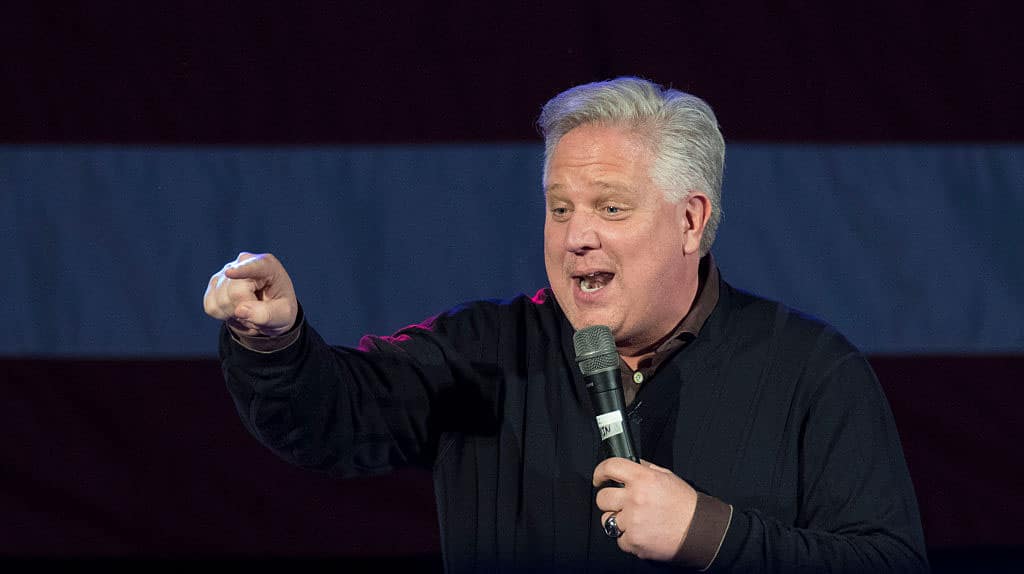
Conservative radio and television host Glenn Beck compared the deplatforming of conservatives to the “digital ghetto” in a January 12 appearance on Fox News.

Speaking on “Tucker Carlson Tonight,” Beck, who founded the conservative website The Blaze, said, “This is like the Germans with the Jews behind the wall, they would put them in a ghetto. Well this is a digital ghetto. You can talk all you want, Jews, do whatever you want behind the wall. That’s not meaningful.” Beck later clarified in the segment that his analogy is “not to compare it to the Germans. It’s not to do anything but warn if you don’t stand up for free speech, you will be the one that loses it as well.”

Jewish groups denounced Beck’s remarks.

“Nazis forced Jews (my family included) to live in squalor in the ghettos, on the brink of death & starvation,” Anti-Defamation League CEO Jonathan Greenblatt tweeted. “100s of thousands died OR were sent to concentration camps. @glennbeck it’s disgraceful to even attempt this comparison.”

American Jewish Committee Managing Director of Global Communications Avi Mayer similarly tweeted, “Ghettos were sections of European cities to which Jews were confined under brutal conditions before being shipped off for mass murder. Countless thousands died of starvation and disease. Being banned from Twitter isn’t that. Apologize, @GlennBeck.”

The Stop Antisemitism.org watchdog also tweeted, “Reality from an ACTUAL ghetto during the Holocaust: – 25 people living in a 1 bedroom apartment with a loaf of bread to eat for a WEEK – Parents murdered, leaving 12 year olds to raise 2 year olds – Suicide all around Glenn Beck’s digital ghetto: – not being able to tweet.”


Beck responded to the controversy by bringing on investigative journalist Edwin Black, the son of Holocaust survivors, onto his January 13 show. Beck asked Black if he crossed the line with his remarks; Black argued that Beck didn’t. The journalist explained that he was the one to coin the term “digital ghetto” and that the word “ghetto” may be derived from the Hebrew word ghet, which means “being put aside from or separated from.”

“During the nineteenth century, the ghettos became much, much worse and during the Holocaust they became the first step along the way toward annihilation for the Jews,” Black said. “This of course was facilitated by IBM and its 12-year alliance with the Nazis.”

He also said that the term is “digital ghetto” is used to describe “people who wish to silence you, we’re talking about people who wish to marginalize others, we’re talking about corporations that are trying to follow the most awesome steps of marginalization. …That does not mean that [IBM] is a Nazi regime or Twitter is part of a Nazi regime, but what it does mean is that high tech was involved in the worst crime in the history of humanity.”

Beck concluded the segment stating that he was sorry if he said something that was out of line in his January 12 Fox News appearance, although he didn’t think he did

Black replied, “We need to look at the steps and we need to understand that right now, people are following the step of identification, exclusion and confiscation, and that is where we want it to stop,” Black said. “The purpose of the historian is to look ahead and over the horizon based on what he has seen come before. That is why we are here.”


Beck tweeted out the YouTube clip of his segment with Black and tagged some of those of those who were criticizing him. Mayer responded: “I find the term ‘digital ghetto’ bizarre, but as others have noted, ‘ghetto’ is a word used in various contexts. What made your remarks particularly offensive was your explicit reference to Germans and Jews, alluding to the Holocaust. Beyond the pale, Glenn. You should apologize.”


Glenn Beck Criticized for Comparing Deplatforming to the ‘Digital Ghetto’ Read More »

Author Highlights the Horrors – and Hope – in the Spanish Inquisition in New Novel

For Gil Troy’s review of “The Poetry of Secrets,” click here.

In 2016, author Cambria Gordon, her husband and their youngest child left Los Angeles to take a yearlong sabbatical in Madrid. She fell in love with Spain and became fascinated with the history of the Jewish people there, traveling to the old communities where they used to live like Toledo and Segovia and going to synagogue with Ashkenazi transplants who had moved there. Though Gordon is Ashkenazi, her stepfather was Sephardic so she’s familiar with the traditions.

“I was raised with a lot of cultural Sephardic food and Ladino speaking in the home,” she said, in a phone interview with the Journal. “I found myself drawn to it.”

Gordon started reading fiction and non-fiction books on the Spanish Inquisition since she never learned about it growing up. Though she’d never written a novel – her first book was about global warming and co-written with Laurie David – she knew she had to create one about this time in Jewish history.

“The Inquisition weighed heavily on me,” she said. “I wanted to do a forbidden love story set during that time and my [former] agent said I should.”

Now, Gordon is releasing her new young adult novel, “The Poetry of Secrets,” on February 2. The book takes place in 1481 on the eve of the Inquisition and centers on Isabel Perez, a girl who sneaks out to poetry readings and falls in love with Diego Altamirano, a young nobleman whose family would not approve of Isabel. Her family members are conversos, or Jews who converted to Catholicism to avoid prosecution, but they still practice Judaism in secret in their home.

While in Madrid, Gordon learned Spanish. She wanted to make the book as true as possible, so she throws in Spanish words and tried to write like how a teenager from 1481 would talk. She uses phrases like “goose pimples” for “chills” and “a load of rotten posset” for “crap.”

“I wanted Isabel to be this feisty character and she couldn’t speak in slang or like a modern teenage girl would speak,” she said. “I really tried to be authentic.”

That meant putting herself in Isabel’s place. “I imagined what it would be like to be a 16-year-old girl who fell in love with the wrong man,” Gordon said. “Would I be proud of my heritage or hide it? Would I be a practicing Jew who never converted or a converso? I found that I identified with Isabel.”

One of the reasons Gordon said she felt the need to write her novel is because young people typically learn about the Holocaust, but not the Inquisition. She said that when doing her research, she realized there was a direct line between the Inquisition and the Holocaust. During the former, the church would make Jews wear a badge identifying themselves. Jews could not cut their hair, work in certain lines of business or even talk to Christians.

When doing her research, she realized there was a direct line between the Inquisition and the Holocaust.

“Nazism didn’t come out of the ether,” she said. “There are historical precedents and I think it’s really important to understand that when you dehumanize someone, you can do anything to them.”

In one point in the book, this happens to Isabel when she is tortured. “I didn’t want to hide the truth of what happened to people, even if they were female and they were young,” Gordon said. “It wasn’t just men being tortured.”

Despite the fact that “The Poetry of Secrets” reveals a tragic time in Jewish history, Gordon thinks the book will resonate with young people today who are finding their own voices and figuring out what they believe in.

“The book has hope,” Gordon said. “The main character has so much agency in her choices that it’s something that young people as well as adults will not be afraid of and be inspired by.”

“The Poetry of Secrets,” from Scholastic Press, is available for pre-order on Amazon

Author Highlights the Horrors – and Hope – in the Spanish Inquisition in New Novel Read More »

Tel Aviv-Yafo Top Destination for New Immigrants

The Media Line — For the third year in a row, Tel Aviv-Yafo was the city of choice for new immigrants to Israel.

According to the Tel Aviv-Yafo Municipality, some 2,305 new Israelis, known as olim, settled in Tel Aviv-Yafo in 2020, which accounts for more than 10% of the 21,109 new immigrants to Israel.

Amir Dor, director of the department of immigration and absorption at the Tel Aviv-Yafo Municipality, told The Media Line that Tel Aviv is a “living” city that draws new residents attracted to its culture, night life and “tolerance for everyone to live how they want to live,” as well as its status as an economic hub.

“It’s very much a ‘you do you’ type of city where individuality is embraced and welcomed.”

Those are some of reasons why Julia, a Montreal native in her 20s who arrived in Israel in 2019, made Tel Aviv her home.

“Coming from Canada it was too difficult to resist the opportunity to live right by the Mediterranean Sea. Also, having spent some time in Tel Aviv in the past, I always loved the people and the social scene,” she told The Media Line. “It’s very much a ‘you do you’ type of city where individuality is embraced and welcomed.”

A little under half of the olim, or 1,140, who settled in the city hailed from Russia. The second most common countries of origin were the North America bloc of Canada and the United States at 359. France followed with 339.

Over the last ten years, 30,038 new citizens have made Tel Aviv-Yafo their new home.

Simcha Brodsky, a music producer who immigrated to Israel from Monsey, New York on Oct. 27, 2020, was the 16,000 new immigrant to Israel in 2020. He says he chose to live in Tel Aviv because of its geographic convenience.

“It’s a great central location. It’s easier to move around, set things up, meet people. It seemed like a good fit,” he told The Media Line.

“It’s a great central location. It’s easier to move around, set things up, meet people. It seemed like a good fit.”

“We give a lot of support for olim in six languages in everything they need to make a better aliyah to Israel,” he said. Among those languages are  Russian, English, French and Spanish, as well as Hebrew.

While Tel Aviv is the most popular city for new arrivals, the number of immigrants was much smaller than the approximately 4,450 olim who settled in the city in 2019.

Dor says that this is result of overall lower 2020 immigration numbers, and that the 21,000+ olim who arrived last year is down from a record-breaking 2019 high which, according to the Jewish Agency, was 34,000.

Elsewhere in Israel, Jerusalem was the second most popular destination for new immigrants, followed by the coastal city of Netanya.

Tel Aviv-Yafo Top Destination for New Immigrants Read More »

Politician Sorry She Yelled ‘Heil Hitler’ At Protest

(JTA) — A Republican politician in the New York City borough of Staten Island has apologized for yelling “Heil Hitler” during an on-camera tirade at a protest last month.

Leticia Remauro, a Republican consultant running for borough president, was protesting the closing of a bar last month for violating coronavirus restrictions, according to the New York Daily News. In the wake of the news emerging, she resigned from the Staten Island Hebrew Public Charter School’s board of trustees, according to SILive, a local news site.

At the December protest, after saying small businesses should be opened, Remauro appeared to call for law enforcement officers to resist orders to close down private establishments.

“[They] are only doing their jobs, but not for nothing, sometimes you gotta say ‘Heil Hitler, not a good idea to send me here,’” Remauro said. “‘We’re not going to do it.’” The phrase traditionally signifies loyalty to Adolf Hitler.

Remauro told the Daily News that she meant to say “Mein Fuehrer,” which means “my leader.” The implication, she said, was supposed to be that New York Gov. Andrew Cuomo and Mayor Bill de Blasio were fascists. In her apology, she also defended the intent of her statement.

“I apologize profusely that the words I used in trying to create an analogy were offensive,” she told the Daily News. “But when you think about in Nazi Germany, in Cuba, with Mussolini it starts the same way. They come for your business, your religion, your property and then for you.”

Remauro was following the lead of President Donald Trump in comparing New York’s mayor to the leader of Nazi Germany. In October, Trump also shared a tweet comparing de Blasio to Hitler following a city crackdown on Orthodox Jewish gatherings in Brooklyn.

Speaking Wednesday in Washington, D.C., ahead of the insurrection at the Capitol, U.S. Rep. Mary Miller, an Illinois Republican, said “Hitler was right on one thing” regarding the importance of reaching out to the youth. She later apologized.

Politician Sorry She Yelled ‘Heil Hitler’ At Protest Read More »

At Least 23 Iranian, Syrian Troops Killed in Israeli Strikes in Syria

At least 23 members of Iranian and Syrian-regime forces were killed in Israeli air strikes in eastern Syria early Wednesday, and more than 28 militiamen wounded, some seriously, according to a U.K.-based war monitor.

The Syrian Arab News Agency (SANA) reported that Israel had struck targets in Deir ez-Zor Governorate, quoting a military source as saying that the strike occurred just after 1 a.m. but providing no further details.

The Syrian Observatory for Human Rights (SOHR) reported that the area between the city of Deir ez-Zor and the Syria-Iraq border, in the al-Mayadin and al-Bukamal districts, had been hit no fewer than 18 times. The targets included warehouses used to store weapons, according to the report.

Iranian Islamic Revolutionary Guard Corps (IRGC) forces, Lebanese Hezbollah and “Fatemiyoun”—aka Hezbollah Afghanistan—are known to be stationed in this region, which hosts a center for training fighters, according to SOHR.

AP quoted a senior U.S. intelligence official with knowledge of the attack as saying that the airstrikes were carried out with intelligence provided by the United States and targeted a series of warehouses in Syria that were being used as a part of the pipeline to store and stage Iranian weapons. The official said the warehouses also served as a pipeline for components that supports Iran’s nuclear program.

The war monitor reported on Tuesday that Fatimeyoun militia forces had unloaded a shipment of Iranian missiles that entered the country from Iraq into warehouses rented from civilians in the Kua Ibn Aswad area, between al-Mayadin city and the town of Mahkan in eastern Deir ez-Zor.

Wednesday’s airstrikes follow attacks on targets south of Damascus on Jan. 6 that Syrian state media also attributed to Israel. According to Step News Agency, an outlet identified with Syrian rebel groups, the target of the strikes was a facility, belonging to pro-Iranian militias, in Sahnaya village in the Syrian Golan Heights. SOHR reported several casualties in the strike.

On Jan. 7, SOHR reported that four people were killed and one wounded when an unidentified drone targeted a vehicle belonging to the Iraqi Popular Mobilization militia that had been attempting to enter Syria through an unofficial border crossing near the town of al-Bukamal.

At Least 23 Iranian, Syrian Troops Killed in Israeli Strikes in Syria Read More »