fbpx

January 11, 2021

The Capitol Riot Proves We Need to Educate

Elections have consequences, as people on all sides of the political spectrum like to point out. When we choose our leaders, we are choosing to live with the consequences. And a lesson from history is that we must choose our leaders carefully.

The events of last week made this lesson painfully clear. Four years ago, the United States elected a man who has indicated, through word and deed, that he does not believe in the fundamental tenets of democracy. And last week, that man, true to form, encouraged his supporters to storm the U.S. Capitol, assault our Congressional leaders and undermine the solemn process of certifying the will of the people.

In many ways, it was shocking. In other ways, it came as no surprise at all. What happened in Washington last week has happened before.

I am a scholar of the Holocaust, and I want to be very clear that I do not equate President Donald Trump with Hitler, nor do I believe that his supporters are Nazis (although there are certainly neo-Nazis among them). But I learned long ago that a democracy can be destroyed from within. And I am reminded once again why it is so important that we continue teaching history, continue learning its lessons and continue educating people about how to treasure the privilege that is democracy.

It is easy to forget that Adolf Hitler first came to power through a free and fair democratic election. Germans voting in 1932 weren’t voting for war and genocide; they were voting for a populist leader who spoke to their anger and grievances. And then they lived with the consequences of that vote: in February 1933, Hitler’s alliesburned down the Reichstag, Germany’s parliament. It was a physical attack on the seat of government, horribly echoed last Wednesday.

Just as right-wing media tried to pin last week’s riot on Antifa, the Nazis tried to obscure their involvement in the Reichstag fire by blaming communists. But unlike last week’s riot, 1933’s putsch was a success: The attack provided Hitler with the excuse to dissolve parliament and assume emergency powers. That same year, he created a new court system, all in the name of security.

A Capitol Police officer was killed in last week’s insurrection, and we’ve all seen the videos of offices ransacked, property stolen and other officers assaulted and overrun. Since the attack, bombs have been located and firearms recovered. Had those bombs gone off or had those weapons been fired, we could well have had our own Reichstag fire.

Protesters interact with Capitol Police inside the U.S. Capitol Building on January 06, 2021 in Washington, DC. (Photo by Win McNamee/Getty Images)

We didn’t, of course. Our democracy continues to function — as evidenced by the Electoral College certification that was delayed but not halted. Our courts have stood strong and independent. Our decentralized, federal system makes it nearly impossible for one individual or faction to usurp control, a testament to the enduring wisdom and foresight of the Founding Fathers.

Last week’s insurrection was powered by conspiracy theories, which spread with near-impunity on social media. Conspiracies about voting machines. About rampant pedophilia. About Jewish power. In one widely seen photograph, one Trump supporter wore a t-shirt emblazoned with the horrific words, “Camp Auschwitz.”

I am always amazed at how the survivors of the Holocaust, in spite of all they saw, remind us to be alert. “Just because the Nazis are gone does not mean that evil is gone in this world,” said the survivor George Papanek in 1996. “Take seriously what is happening in the world now and be engaged.”

What’s the best way to fight surges in hatred? I believe last week’s events remind us of the need to educate, to stand up for truth, to build bridges of understanding. There may not be much that can be done to change the minds of those already pursuing extremist ideals, but education is the strongest antidote to the fever sweeping across too much of our country. Education has the power to mitigate the spread of radicalization and even prevent it from taking hold.

Education has the power to mitigate the spread of radicalization.
On the day of President Trump’s inauguration in 2017, the USC Shoah Foundation launched an educational project called “100 Days to Inspire Respect.” Each day for more than three months, USC published new educational resources on themes including racism, xenophobia and civic responsibility. Such lessons are crucial — regardless of the party or president in power — because who we choose to lead us is based on the values we hold dear. The 100 Days to Inspire Respect will run again beginning January 20, 2021.

When our Capitol is under attack, we are all under attack. It is up to all of us to teach history, teach democratic values, teach civics. It is up to all of us to keep our democracy alive.


Stephen D. Smith is Finci-Viterbi Executive Director Chair of the USC Shoah Foundation. He is also the UNESCO Chair on Genocide Education.

The Capitol Riot Proves We Need to Educate Read More »

A City Girl in the Country

One thing I find really interesting about living rurally is how people are sincerely curious about you.

In a city you’re anonymous, and I know that for some people, that can feel like freedom, like relief, like spaciousness.

But even as a native city girl, I’ve always preferred the sweetness of smaller places and the curiosity that comes with it.

I like being known and I like knowing.

Yesterday, Tank and I met the neighbor.

We were going on our morning walk/hike and were trekking over on one dusty dry mountain, she was watering her plants on her dusty dry mountain.

“HELLO THERE” she bellowed.

“GOOD MORNING” I bellowed back.

Tank barked at her.

“SORRY,” I called. “ TANK THAT’S ENOUGH.”

“NO, NO HE’S JUST DOING HIS JOB!”

We bellowed to each other for a while, and I learned that she lived there for 40 years. I think I told her I’m from LA and sing. We said Merry Christmas. The sun was making me sweat and my sunscreen stung my eyes.  I had stickers in my socks from the brush. Christmas in CA.

I like the grocery store here, too.

It’s different buying groceries in a small place. It’s slower and also a couple days ago the grocer looked me in the eyes, smiled and told me he liked my overalls.

“Very country,” he added approvingly.

“That grocer just said he liked my overalls.” I whispered proudly to Max on the way out. He patted my hand.

The town has a few boutiques, some wineries, bakeries, a country western apparel store, hardware store, a feed shop for the animals, and a paint shop. My favorites are the animal feed shop and the bakery.

At night here, it’s cold, so cold you can’t feel your hands or the tip of your nose. But the stars are really bright and even though the coyotes wail and the wind howls I feel a sense of belonging here.

A City Girl in the Country Read More »

A Dog Named Tank

“Sara, you don’t drink wine,” a friend once accused. “You *hold* wine”

She wasn’t wrong.

If you know me in real life, you might be amused to learn that Sara, Queen of the Lightweights, is together with a winemaker.

Because that’s what my sweetheart does when he is not playing banjo.

He makes wine.

The good Lord knows my people have their issues, what family doesn’t?

But a propensity towards drink ain’t one of them.

Most my kin, including your girl here, get flushed, dizzy and sick after more then a half glass. Sometimes a half glass is even too much. We aren’t drinkers.

This is especially ironic considering three generations ago, my ancestors were bootleggers. After prohibition, my maternal grandparents opened up a liquor business in Los Angeles. A liquor business, in a family where no one drinks. But I digress.

Because my sweetheart makes wine, we get to live at a place where the grapes grow—in the wild dusty vineyards of the Santa Ynez Valley.

And in this vineyard there are animals we get take care of.

As of this writing there are:

4 Nubian goats with beautiful amber eyes

3 Dexter cows with fur the color of Irish Setters

3 horses one that looks like stracciatella ice cream, the other two a rich beautiful bay, and

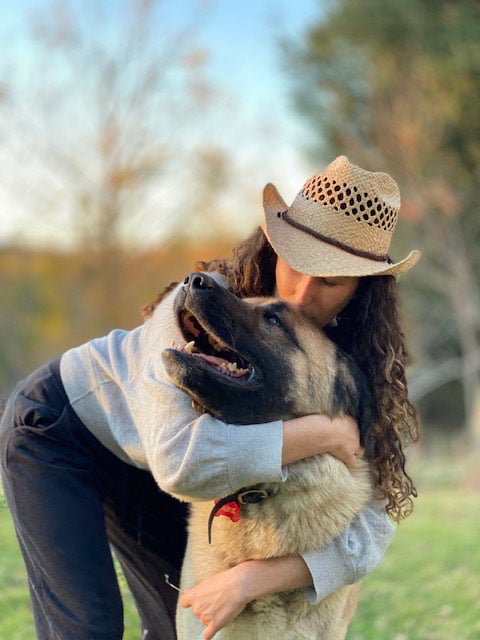
1 Anatolian Shephard called Tank.

Tank is a Livestock Guardian Dog.

That means his gig is full-time babysitter for the goats, to protect the herd from coyotes. (Which are plentiful in these parts. You can hear them howling and cackling at night, they are no joke; they’ll kill your goats in a NY minute if given the chance.)

So Tank is a very important person around here (yes I said person and I said what I said because dogs are people too.)

Tank arrived 3 weeks ago from a breeder in Tennessee,  who specializes in livestock guardian dogs.

I was still in quarantine in LA at that point, so my sweetheart greeted Tank alone.

“Tank will sleep outside” Max explained to me over the phone.

“Anatolians really like guarding others animals. They really like their job.”

“But… won’t he be scared and lonely in a new place sleeping outside with no bed?”

“Sweetheart, the lady said Anatolians don’t like to be in the house or even in dog beds or huts…they like sleeping outside on the earth, with their herd.”

“But…” I spluttered. “ Won’t he need love and hugs? He’s a puppy….”

“Darling, Tank is going to be happy with his new job and I don’t think we should distract him too much.”

Reader, I struggled with this information.

A dog I wasn’t supposed to love on?

When I finally got out of quarantine and could come up to see my human love in Santa Ynez, I had wrapped my head around the concept of meeting a work dog.

I’ll be gruff and formal with him, I told myself. I will treat Tank like the bodyguard he is.

I mean, Jesus, his name is Tank. You try saying ‘Tank’ in a cutesy voice.

When Tank first met me, he barked, a kind of deep roaring gruff bark, but one with zero animosity in it.

I rubbed his ears, he licked my hand. He was clearly a gentle soul.

For about three days, I began a campaign to win his love, but he was indifferent to my affections.

If Max was out riding Peanut, his horse, Tank was more interested in hanging out with them. I tried not to take it personally.

Max suggested I try putting him on a leash, but Tank weighs 150 pounds which is officially more than I do. If he didn’t want to walk, nothing could make him.

“Tanky boy! Tanky baby! Come boo-boo lets have a walk.”

But he’d just stared blankly at me.

Until finally on day 5 something happened. I ignored all of my instincts, and decided to just ignore Tank.

I mean totally ignore him.

And guess who stayed right by my side on a 90 minute walk.

Like a cat, Tank seemed to be saying “ I come with you because I want to and not because you tell me too. Also, human, please be so kind as to cut out that emasculating baby voice. My name is Tank, not Tanky-boy, not Tankini, not Baby.”

3 weeks in, Reader, I am pleased to tell you that the more I ignore Tank, (and give him chicken bits every morning) the more he loyally shadows me on my walks, guards me when I sit outside the trailer, and licks my face happily when I let him out of the goat pen in the morning.

As the Germans say, “eins nach dem anderen.“ Tank and I are training each other, and it is very fine.

A Dog Named Tank Read More »

Sarah Jessica Parker to Star in ‘Sex and the City’ Revival

There will be a new chapter in the lives of New Yorkers Carrie Bradshaw, Charlotte York and Miranda Hobbes. HBO Max is updating the iconic comedy “Sex and the City” with the new series “And Just Like That…,” with Sarah Jessica Parker, Kristin Davis and Cynthia Nixon reprising their roles. The ten-episode series will follow them as they navigate life and friendship (and presumably, sex) in their fifties. All three actresses will executive produce with Michael Patrick King.

Kim Cattrall, who played Samantha Jones in the original series, is not returning, which comes as no surprise in light of the long, very public history of animosity and discord between her and Parker.

Based on a bestseller by Candace Bushnell, “Sex and the City” premiered on HBO in 1998 and ran for six seasons, followed by two feature films in 2008 and 2010. Parker, Davis, and Nixon announced the series’ revival in an Instagram post, writing, “I couldn’t help but wonder… where are they now?”

“I grew up with these characters, and I can’t wait to see how their story has evolved in this new chapter, with the honesty, poignancy, humor and the beloved city that has always defined them,” Sarah Aubrey, Head of Original Content, HBO Max, said in a statement.

“And Just Like That…” is scheduled to begin production in New York late spring.

Sarah Jessica Parker to Star in ‘Sex and the City’ Revival Read More »

Zac Posen, Andy Cohen Explore Jewish Ancestry on ‘Finding Your Roots’

Designer Zac Posen and “Watch What Happens Live” host Andy Cohen learn about their Ashkenazi Jewish heritage this month on episodes of “Finding Your Roots with Henry Louis Gates, Jr.” Both knew little about their immigrant roots other than they originated in the Eastern European Pale of Settlement in greater Russia. But forensic genealogy research reveals several generations of ancestors and some unexpected surprises.

Posen discovers that the apparel business runs in his family: his paternal great-grandfather was a shoemaker and paternal great-grandfather was a tailor, as was his great-great-great grandfather. Cohen’s lineage is traced back six generations on his mother’s side, and he’s shown photographs of ancestors and the synagogue in their town, Bialystok in what is now Poland. “It gives me goosebumps,” he tells Gates. “It’s like you’re among these ghosts that paved the way for you.”

DNA tests confirm that both Posen and Cohen have 100% Ashkenazi roots, and in Cohen’s case, reveal a famous cousin. He’s elated to find out that he shares DNA with Scarlett Johansson, whose mother is Jewish.

Posen appears on the Jan. 12 “Coming to America” episode and Cohen on the Jan. 26 episode, “Against All Odds.”

Zac Posen, Andy Cohen Explore Jewish Ancestry on ‘Finding Your Roots’ Read More »

Mass Protests Sprout New Political Party in Israel

The Media Line — With just over 70 days left before voters head to the polls to vote in national elections for the fourth time in two years, new political parties are cropping up on the Israeli landscape like mushrooms after the rain. The latest platform, officially launched on Saturday night, promises to be disruptive, if not unique.

The Israeli Democratic Party claims to be a truly grassroots organization, hatched over the past six months during the continued mass demonstrations that have at times overwhelmed the country.

Its members, leaders of the protest movement that has called for Prime Minister Binyamin Netanyahu’s resignation, vow to introduce a new way of electing officials, crafting a platform and even voting on bills, things never before tried in Israel.

“We are first and foremost a fully democratic party, which in Israel these days is extremely rare,” Eran Etzion, a candidate running for a seat in the new party’s primaries and the former deputy head of Israel’s National Security Council, told The Media Line.

“We are first and foremost a fully democratic party, which in Israel these days is extremely rare.”

“It’s a participatory democracy, [with] constant and meaningful connections between its members and the Knesset members and ministers that represent it,” Etzion said.

The party, which plans to give a voice to anyone who joins it and is willing to abide by its core principles of equality, freedom, solidarity and democracy, soon will hold primaries mostly via digital platforms and private smartphones, a far cry from the paper ballots still used in Israel’s general elections.

Tens of thousands of protesters have in recent months taken to the streets on a weekly basis, demanding Netanyahu step down for his alleged failed pandemic response and his standing trial on charges of bribery, fraud and breach of trust.

Having been consolidated and forged in these rallies, the candidates and party members unsurprisingly espouse nearly identical beliefs and ideologies, stressing the need for transparency, voicing anti-corruption views and advocating values such as trust and decency in politics.

“We want new politics. We believe we can deliver it,” Sadi Ben Shitrit, another candidate running in the party’s primaries and one of the more outspoken leaders of the movement, told The Media Line.

“My agenda is simple – bringing back truth to the public discourse. Right now, everyone is lying to everyone, all the time, the criminal at the top more than anyone,” he said, alluding to Netanyahu.

Pledging that at least half of its parliamentary candidates will be women, the Democratic Party also boasts a varied list of members, including Arab, Bedouin, ultra-Orthodox and other Israeli minorities.

“The protest is multifaceted, and so are we,” said Meli Polishuk-Bloch, a former member of Knesset and the only politician, past or present, currently in the party.

She notes that no other party in the country will hold primaries before the upcoming elections. “It may seem like a given to those abroad, but people in Israel have forgotten what democracy looks like,” she said.

The newest party is certainly not the only one hoping to draw voters to the polls on March 23.

Beyond the familiar parties such as the Likud, Yesh Atid, the Arab Joint List, and the ultra-Orthodox parties, a slew of fresh and not-so-fresh faces alike have formed new platforms and presented their candidacies on an almost daily basis since parliament was dissolved and elections called last month.

Longtime Likud lawmaker Gideon Saar left his political home to start a new party, accusing Netanyahu of fostering a personality cult inside the right-wing party. Also on the right, Naftali Bennet’s Yamina party seems poised for a split between its moderate wing and its more extreme faction.

Over on the left, Tel Aviv Mayor Ron Huldai recently formed a party claiming to pick up the pieces left by Blue and White and its leader, Alternate Prime Minister Benny Gantz, who still remains in the race. Ofer Shelach, a former prominent member of opposition leader Yair Lapid’s Yesh Atid party, split to form his own list, as did another of Lapid’s partners, Moshe Yaalon.

Add to that a new “economic” party established by the former accountant general of Israel’s finance ministry, Yaron Zelicha; the left-wing Meretz; and the once-proud Labor party currently in tatters – and the muddled picture of Israeli politics is nearly complete.

“My agenda is simple – bringing back truth to the public discourse. Right now, everyone is lying to everyone, all the time, the criminal at the top more than anyone.”

“None of us want to waste a single vote that could go toward ending corruption,” said Polishuk-Bloch, acknowledging a concern shared by millions of center-left voters who fear the multitude of parties will lead to many of them not reaching the required threshold to enter the Knesset.

“Polls don’t reflect the truth. The majority of voters don’t have anyone to vote for, and are undecided yet,” she said.

Etzion explains that due to his new party’s “democratic architecture,” party members can in the coming weeks simply vote to halt the party’s current bid, if they deem it a futile effort, or can elect to merge with other lists.

According to Polishuk-Bloch: “We can connect with all of [the center-left parties]. There is no substantial difference between them and us, except our democratic mechanisms. And if eventually we don’t run till the end – there is always next time.”

Ben Shitrit, who says he has turned down requests by several other parties to join their ranks, rejects the notion that forming yet another party is detrimental to the center-left’s cause.

“I won’t join any [other list], because they’ve all betrayed their duty. The whole lot of them. Who are they to lecture us about wasting votes, after they took millions of our votes and sat with Netanyahu despite their promise not to?” he said.

As to what they plan to do if they manage to enter parliament, the Israeli Democratic Party candidates did not hesitate to respond.

“I would want to enact a comprehensive anti-corruption law, that would ban anyone from running for public office once the police recommend to indict them,” Etzion said, referring to Netanyahu’s unprecedented status last year as under investigation, which has since evolved into a formal criminal indictment.

Polishuk-Bloch replied that, if elected, she intends to pass bills promoting transparency in government work, separation of state and religion, and a return to the abandoned peace process.

“Simply put – it’s time we do democracy, not just talk democracy,” she said.

Mass Protests Sprout New Political Party in Israel Read More »

Being a Black Jewish Woman in America on January 6

The first day I moved back to my college campus, I, a Black Jewish woman, watched the news as the U.S. Capitol building was overtaken by white supremacists and Nazis. For a brief moment that day, my heart had fluttered with excitement about the news of a Black man and an Ashkenazi Jewish man representing Georgia in the Senate for the first time in history.

Even though I was born and raised in California, I come from Southern folks who fled the pervasive racism of the Confederacy. Senators Warnock and Ossoff represent the legacy, pain and triumph of hardworking, multiracial coalitions in the South demanding equality. I hoped, even if just imagined, that my ancestors would let out a sigh of relief, twinkles of pride would glisten in their eyes, and we would sense that we finally made them proud.

Yet, the news coverage quickly shifted to another unbelievable picture, one filled with no cheers of progress and long-deserved representation. The Capitol was captured, and all I could do was continue to unpack my suitcase. I saw images of white men wearing gigantic animal horns upon their heads, paint smeared on their faces as if they viewed themselves as warriors. A noose hung, and a Confederate flag waved in the air. My social media feed became plastered with individuals wearing shirts printed with anti-Semitic phrases.

I got up to stick my little mezuzah on the doorpost of my new room, adding to my magen david necklace around my neck, impressive afro and skirt that goes past my knees. I recited the traveler’s prayer before the plane took me to the side of the country where individuals — claiming to be patriots — invoked violence and terror onto my nation.

I thought that if any minority committed even a fraction of these acts, they would have not even made it to the steps — security would have taken them down. But I wasn’t surprised or shocked. America was watching America being shown who it truly is. I was simply witnessing the underbelly of this country become exposed to the entire world.

I was witnessing the underbelly of this country become exposed to the entire world.

I spent the rest of the day and the following scrolling through social media to distract and occupy my mind during a numbing quarantine. I eventually came across fellow friends and accounts posting about the importance of language when describing what occurred on January 6, how this insurrection threatened marginalized Americans and how to donate to various social advocacy organizations and individuals in need.

As a Jewish woman, I wondered why the only people acknowledging the blatant anti-Semitism demonstrated on the steps of our Capitol were other Jewish people. Jewish content creators, activists and everyday individuals were posting about the traumatizing experience of seeing Nazis parading in the revered halls of our Capitol. I became deeply upset that the Jewish community was being ignored, disregarded or, at the very least, not considered during these acts of terror.

As I watch the aftermath, I am still angry that individuals and accounts on social media speak about violence and discrimination in America without mentioning the real harm days like January 6 represent for Jewish people. I understand that Jewish people in this country do not neatly fit into the People of Color versus white binary or any one political affiliation. We are an incredibly diverse community with many different skin colors, cultures and stories.

Yet Americans tend to reduce us to being white and having experienced one traumatic event in Europe, which is taught in schools here and there. These perceptions contribute to the erasure of our identities as Jewish people and the discrimination we have experienced for thousands of years.

To speak plainly, everyone is an activist for equal rights until they have to support Jewish people. Nazis attack us and have always attacked us first and foremost. Jewish stories deserve to be taken seriously by social advocacy movements, and we deserve to live in peace.

I sit in a Black, observant, Jewish, female body that loves Israel, and I prepare for the world to attack me every day. I want the Jewish community to be listened to, I want Jews of color to be heard, and I want to not fear for my life each waking moment.

I say Am Yisrael Chai with the greatest pride, Black skin and a honey voice.


Tova Ricardo is a senior at Columbia University studying English and Sociology. She is also the Communications Intern at the Jews of Color Initiative.

Being a Black Jewish Woman in America on January 6 Read More »

A Kitchen Fussbudget’s Pandemic Perspective

The other day, I may have been a tad overzealous in giving kitchen directives to my husband. “You have so many rules,” he observed. Guilty as charged, I thought.

But I pointed out that his mother, Elaine (of blessed memory), was looking down in approval. Elaine and I bonded in the kitchen, where we both were fussbudgets. In the beginning of our relationship, I was a lightweight compared to her: When my husband and his brother were kids, Elaine would wait each morning until she heard their approaching footsteps before squeezing oranges, lest some of the Vitamin C be dissipated before the boys drank their juice.

I learned the fine art of safe food storage and preparation from Elaine. Everything that she brought into her home from the grocery store was sanitized in some fashion — and this was in the days before disinfecting wipes. I admit that from time to time I overstep, as when I advised a young relative to scrub the avocados before cutting into them.

My food fretting has even seeped into my enjoyment of cooking shows, especially during the pandemic. One of my favorite shows, Food Network’s “The Pioneer Woman,” has been stressing me out. The show’s star, Ree Drummond, who started out as a popular blogger and now runs an empire of eateries, cookbooks, merchandise and a hotel, still creates new shows at her family’s Oklahoma ranch. Her current film crew is comprised of her kids, a nephew and sometimes the kids’ friends.

In one episode, Drummond remarked that her younger daughter and a pal, both in the kitchen, were going to the lake that day with some other kids. I speculated that no masks or social distancing would be involved. But what made me totally verklempt was an episode in which Drummond cooked lunch for more than a dozen cattle workers and family members. I figured the meal would take place outside, but it was served buffet style inside, with everyone seated around one table. “What a crowd,” one participant observed.

Most alarming was that Drummond’s elderly father-in-law, Chuck, was part of the mix. I feared the misguided message this episode was sending to Drummond’s many fans, especially with coronavirus cases surging everywhere. Clearly, Food Network needs a CFO — a Chief Fussbudget Officer.

Clearly, Food Network needs a CFO — a Chief Fussbudget Officer.

These days, a lot of us have changed our approach to food. I’ve had to cede some control: Because I’m high-risk for COVID-19 complications, I’ve been using curbside pickup or delivery services. But I don’t fret at all about someone else doing my shopping. Rather, I feel extreme gratitude for the men and women providing this essential service. (And, of course, the best way to express thanks to these folks is to give a generous tip and a high rating in the after-shopping survey.)

I’ve heard more than one fellow fussbudget say that they don’t like the idea of other people touching their groceries. But let’s get real — most items in a market have had close encounters with many hands and pesticides, used to deter rodents and bugs. Never mind COVID-19, there may be other matters you don’t want to eat on your groceries! That’s why fussbudgets suggest washing off cans, bottles, milk and juice cartons and glass and plastic containers. It’s also smart to clean all produce, even things with inedible skins, such as bananas. And the best food safety advice is to wash your hands frequently in the kitchen, especially when handling raw meats and eggs.

But experts advise we’re not likely to get coronavirus from, say, a box of cereal, because the disease is a respiratory illness, spread by airborne droplets. However, you will be at risk of infecting yourself and others if you go out and about without a mask.

Lately, I’ve wondered how Elaine would have responded to the pandemic. In all the years I knew her, I never once heard her swear. But I am certain she would have cursed Donald Trump for harming her family and all Americans by rejecting the guidance of scientists and health experts. And she would have wasted no time in establishing a new fussbudget routine — setting up her sewing machine on the kitchen table. I can picture her now, making masks for the family, reminding us to cover up whenever we leave home.


Emily Dwass is the author of “Diagnosis Female: How Medical Bias Endangers Women’s Health.”

A Kitchen Fussbudget’s Pandemic Perspective Read More »