fbpx

January 11, 2021

Violins of Hope Debuts Virtual Musical and Theatrical Performances

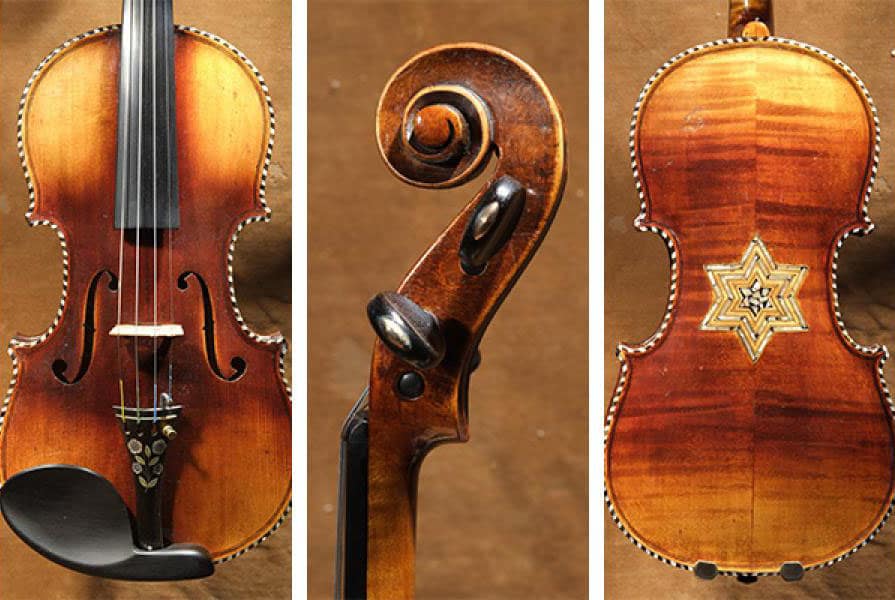
The long-awaited Violins of Hope concert celebrating instruments rescued from the Holocaust and restored by father and son Amnon and Avshalom Weinstein will finally take place virtually Jan. 14.

Postponed in March because of the COVID-19 pandemic, the multi-format Violins of Hope project was initially set to take place at concert venues, synagogues and the Los Angeles Museum of the Holocaust in a spring concert tour.

Since the collection of instruments had to return to Tel Aviv, Violins of Hope Los Angeles is presenting a reimagined opening night performance. Unlike a standard opening night, each performance brings a tapestry of musical and cultural experiences from around the world.

Susanne Reyto, chair of the Violins of Hope Project in Los Angeles, and herself a Holocaust survivor told the Journal, especially now in this current political climate, it is her mission to educate the next generation about the Holocaust. Before the pandemic, Reyto would speak at the Holocaust Museum L.A. and now on Zoom. She said students need to learn stories of the Holocaust in unique ways because they aren’t being taught in school. She says Violins of Hope is a great educational resource.

“The violins are survivors. Their restoration demonstrated our ability to rise from the ashes and succeed,” she said. “After we are gone, the violins will remain and keep speaking to the world the language of music. Hopefully, people will understand the importance of music in our lives as well as in the lives of Holocaust victims, where music either saved or prolonged their lives.”

“The violins are survivors. Their restoration demonstrated our ability to rise from the ashes and succeed.” — Susanne Reyto

During the virtual concert, audiences will hear from the New West Symphony Orchestra from Thousand Oaks, The Los Angeles Lawyers Philharmonic and The Legal Voices choir. One of the students Reyto has worked with at the Holocaust Museum L.A. will be playing the theme from “Schindler’s List” on his violin.

Audiences will also see the family workshop in Tel Aviv. This inside look presents the father-and-son’s perspective on the importance of this project. For decades the Weinstein’s have used their private collection of more than 60 violins, violas and cellos— all restored since the end of World War II— to tell the story of the instruments’ previous owners, each with their personal stories from the Holocaust. They aim to teach future generations of Jews to be informed strong citizens and to stand up against hatred, bigotry and anti-Semitism.

“It is such a key instrument of learning and creating a better world,” Reyto said. “Everybody should be part of it and everybody should be embracing the Violins of Hope program because of what it stands for and symbolizes.”

Reyto is also the producer of the new theatrical production of “Stories From the Violins of Hope.” On Jan. 31, The Braid (formerly Jewish Women’s Theatre), the Los Angeles Jewish Symphony Chamber Players (LAJSCP), and Temple Isaiah will honor International Holocaust Remembrance Day with the world premiere virtually.

The theatrical production, which will be available live on Zoom, is the first to tell the story of the famed collection of stringed instruments that survived the Holocaust and were brought back to life by the family of violin makers. Virtuoso violinist, Niv Ashkenazi, will play the only violin from the Violins of Hope collection currently in the United States. The play was written by The Braid’s Advisory Council member Lisa Rosenbaum and directed by The Braid’s Producing Director Susan Morgenstern.

Temple Isaiah Rabbi Jaclyn Cohen and Cantor Tifani Coyot will open the production with a song of remembrance, setting the tone for International Holocaust Remembrance Day.

“Stories from the Violins of Hope” came about through the efforts of Gail Solo, a principal underwriter of the event and Temple Isaiah congregant.

“I am honored to be the matchmaker for this collaboration. I have spent my life living with the mantra, `Never Forget and Never Again,’” Solo said in a statement to the Journal. “This production fulfills that commandment, and is particularly poignant as the last survivors of the Shoah are leaving our world.”

Dr. Noreen Green, artistic director of the LAJSCP, curated the music that will be performed by LAJSCP throughout the play. Green said, “The violins will outlive Holocaust survivors and be there to tell the story to the next generation.”

The Violins of Hope performance is on Jan. 14 at 7 p.m. PST. The program is presented free of charge, but registration is required. To RSVP click here. Tickets for “Stories From the Violins of Hope” start at $36. The performance is on Sunday, Jan. 31 at 2 p.m. PST. For ticket information click here.

Violins of Hope Debuts Virtual Musical and Theatrical Performances Read More »

“Free Palestine” Graffiti Found on Three Israeli Oregon Restaurants

On January 9 and 10, three Israeli restaurants in Portland, Oregon were vandalized with graffiti, which included the words “Free Palestine.”

The Oregonian reported that two branches of the restaurant Shalom Y’all as well as the vegan hummus restaurant Aviv were the targets of such graffiti. The graffiti at Shalom Y’all also included statements like “Falafel is from Palestine,” “Yuppie Scum” and “Hummus is not Israeli.”

The Sesame Collective, the group that owns the Shalom Y’all restaurants, said in a statement, “We are incredibly disheartened by these actions. We are committed to operating inclusive spaces, and do not tolerate messages of hate or racism in any form. We are so thankful for the outpouring of support we have received from the community over the last 24 hours. We encourage you to help us in supporting the Oregon Coalition Against Hate Crime.”

Jewish journalist Eve Barlow tweeted that the incident was an example of anti-Semitism from the left, arguing that “this is what movements such as BDS [Boycott, Divestment and Sanctions] create on the ground. This is who the targets are. Now you know.”


George Washington University student Blake Flayton, an avowed progressive Zionist, similarly tweeted, “This is the left-wing antisemitism some on this app claim is not real. And it’s getting worse.”

In November 2019, Shalom Y’all’s voicemail system was targeted by hackers who changed the restaurant’s answering machine twice to state “Hi, you have reached the stupid Jewish restaurant” and “You have reached the Jewish restaurant. If you b—— want to eat our s—– food, just come here and f— yourself.”

Jamal Hasson, the restaurant’s managing partner, told KGW8 at the time, “Unfortunately, because of the region of the world of the food that we serve, often times we do get lumped in with politics or religious differences, when really, we’re celebrating the cuisine from all of the Mediterranean and Middle East.”

“Free Palestine” Graffiti Found on Three Israeli Oregon Restaurants Read More »

Holocaust Survivor Freda Gleitman Goldstein, 94

October 10, 1926 – January 8, 2021

Beloved wife, mother, grandmother and great-grandmother Freda Gleitman Goldstein, born Freda Weinstock, passed away on January 8, 2020 from complications related to Covid-19.

Freda grew up in Poland in a home filled with love, song and laughter. She lived with her parents, four siblings and grandparents. Freda was the only member of both her immediate and extended family to survive the Holocaust. After the war, she returned home to Poland where she met her husband, Sheldon Gleitman. They emigrated to the United States, had two sons, and built a thriving business providing opportunities for future generations. They had a wonderful marriage of 44 years until Sheldon’s passing in 1989.

Freda was never embittered by her experiences in the concentration camps; even in her darkest hours, she always dreamt of surviving so that she could create a family filled with love, kindness, and Jewish tradition. In her fifties she joined a Child Survivor group, and had a B’nai Mitzvah with six other women.

In 1994, Freda married Irwin Goldstein. Together they shared a marriage filled with love and devotion for 27 years. They enjoyed exercising, cooking, and socializing with friends and family. They remained side by side, always holding hands, until she passed. Freda will always be remembered as a beautiful person who radiated warmth and goodness. Freda is survived by her husband Irwin Goldstein, her loving children Steven Gleitman (Margo), Richard Gleitman (Ellen); her grandchildren Lauren (Norbert), Justin (Lizi), Ashley (Benjamin), Zachary (Lindsey), Sam and Gina; great-grandchildren Akiva, Talia Mindy, Rena, Ethan, Noah, Avi, Liam and Oliver. Donations in Freda’s memory can be made to Jewish Family Service of LA; https://www.jfsla.org/our-work/donate/. A private family burial will be held in the near future.

Holocaust Survivor Freda Gleitman Goldstein, 94 Read More »

Shechter Finds the Holiness Within the Mundane

Jack Shechter has had two careers in his lifetime and performed very well in both of them. He was a pulpit rabbi in Pittsburgh, where he made his congregation one of the most vital in the country; he then went on to become the Dean of the Whizin Center of Continuing Education at the American Jewish University, where he made that school one of the most successful centers of adult education in the country.

Now, in his retirement years, Shechter has taken on two more projects. One is working with his hands, making exquisite ritual objects out of scraps and trinkets. And the other is working with his mind and seeing the spiritual potential in rituals that no one else would pay attention to.

Friends have told me that they have seen Shechter walk into a store, notice a butter dish for sale and see a spice box waiting to be born. People tell of having seen him walk into a store and see nine wineglasses for sale and realize that if they were turned upside down they would make lovely candle holders for a menorah.

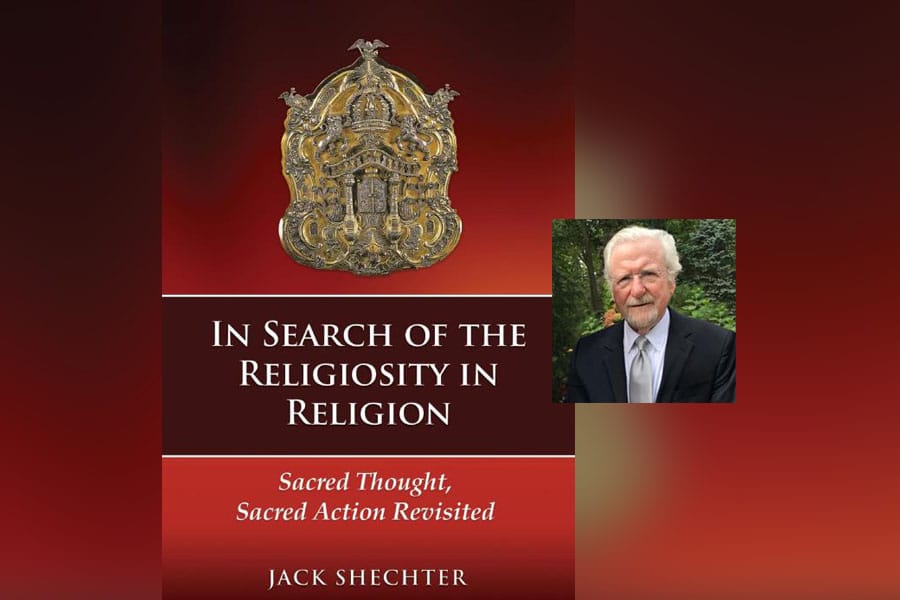
Shechter’s latest book, “In Search of Religiosity in Religion,” testifies that what he does with his hands, he also does with his mind. Shechter wanders among the neglected parts of the Jewish tradition, seeing the potential spiritual truths that lie hidden within these rituals and practices.

Cynics have often maligned the rituals of the Jewish tradition as being outmoded and irrelevant. But Shechter goes through some of these neglected rituals and finds there are profound potential spiritual meanings hidden within them — if only we take a look.

Where did Rabbi Shechter derive this awareness of the holiness hidden within the mundane? I suspect that it came to him in his childhood, when he lived among pious people who had no interest in anthropology or in comparative religion, but who knew what it means to serve the Lord in joy.

In this book, Shechter sometimes writes in the style of a participant-observer or social scientist, but it is clear that he is really a person who writes from the soul as well as from the mind. For example, the first chapter deals with six words that we all know — the Shema. For many of us, it means rattling off six words that we know by heart but seldom stop to think about. Shechter asks: is that really all that it means?

It is clear that Shechter is really a person who writes from the soul as well as from the mind.

Specifically, Shechter notes that the Shema means to declare oneself a believer in the One True God — but is that really all that it means? He says that to say the Shema means to affirm the unity of the universe, declare the unity of mankind and affirm the unity of all morality — but is that really all that it means?

Rabbi Shechter discusses each of these affirmations, and he explains them very well, but it seems that these affirmations are only abstract and theoretical for him. Beneath them all, he states, is his childhood memory of the pious who closed their eyes as they meditated on God, who was, for them, above and beyond words.

The book contains more essays that deal with, for example, the meaning of the Grace after Meals, the Kaddish and the Amen through the eyes of Jewish thinkers and through the souls of those who observed these rituals. He analyzes the meaning of the Jewish dietary laws, the meaning of the Havdalah, the laws of forgiveness, and even the meaning of the mikveh. The book includes a fascinating report on a field trip to the headquarters of the Lubavitcher movement in New York and a report on how he learned that even a coke bottle can be turned into a sacred object.

The last essay in this collection deals with Jewish unity. Despite the topic — which lends itself to other oxymorons such as “military intelligence,” “postal service” and “jumbo shrimp” — Shechter takes this concept seriously. He raises three examples of how mutual respect and dignified debate have occurred in Jewish life in ways that surprise us and make us realize that some values transcend our individual beliefs. The first example we know — or think we know. The second and the third probably will surprise us all.

The first example is the story of the House of Hillel and the House of Shamai. The Talmud records that these two groups disagreed with each other in matters of Jewish Law no less than three hundred and fourteen times! And yet, the Talmud says that they ate with each other, observed holidays with each other and even married their children to each other. These two groups surely cared about Jewish law, and yet they were able to unite because they both believed that mutual respect transcended their disagreements.

Rabbi Shechter’s second example is the relationship between Martin Buber and Franz Rosenzweig. Buber was Rosenzweig’s mentor, but the two differed sharply on many issues, including the binding nature of Jewish Law and the content of divine revelation. At one point, Rosenzweig wrote to Buber, setting forth the differences between them on these issues. Most people would have reacted with anger at such a letter. But Buber did not do that. Instead, he asked Rosenzweig for permission to publish his letter in his magazine, Der Jude. Whatever you think of Buber’s philosophy, you have to be impressed with this act of respect and his willingness to put the search for ultimate truth above his personal pride.

Shechter’s third example about unity is perhaps the most surprising of them all. It is about the relationship between the two most important Jewish thinkers of the last century, Mordecai Kaplan and Abraham Joshua Heschel. Kaplan was actually the one who was most instrumental in bringing Heschel to the Jewish Theological Seminary. During the years that they were together there, they were good friends despite being worlds apart in their philosophies. And it was Kaplan who first introduced Heschel to the English reading public by publishing his meditation on faith in his own periodical.

In reading this last chapter of Shechter’s book, we come away surprised and impressed at how great spiritual leaders of the past and present were able to maintain the unity of the Jewish people by placing the search for ultimate meaning over their own personal egos. And we realize that Jewish unity is more of a reality than we thought it was.

“In Search of Religiosity in Religion” is a book in which subjects we thought we knew are seen in a whole new perspective. This is a book to treasure for the new light that it sheds on parts of the Jewish tradition that we had not sufficiently appreciated before.

In Search of the Religiosity in Religion: Sacred Thought, Sacred Action Revisited
by Jack Shechter, Oaks Press, Thousand Oaks, Ca. 2020, 383 pages 


Rabbi Jack Riemer is the author of two new books: “Finding God in Unexpected Places” and “The Day I Met Father Jacob at the Supermarket.”

Shechter Finds the Holiness Within the Mundane Read More »

ADL Calls for Trump’s Removal from the Presidency

(JTA) — The Anti-Defamation League became the first major mainstream Jewish organization to call for Donald Trump’s removal from the presidency for his role in instigating an armed insurrection at the Capitol.

“In our over 100 years of history, ADL has never called for the president of the United States to be removed from office, but what occurred on Wednesday was inexcusable,” Jonathan Greenblatt, the ADL CEO, said in a letter to the civil rights group’s membership. “It will forever be remembered as one of the darkest days of American democracy and it makes unambiguously clear: President Trump is unfit for office and needs to be removed.”

The mob that stormed the Capitol sought to stop Congress from affirming that Joe Biden won the election. Trump is less than two weeks away from leaving the presidency, but his urging on of the marauders, whose raid left five people dead, has led to calls from Democrats and some Republicans for his removal, either through resignation or constitutional means.

The ADL monitors extremist movements, and Greenblatt attached to his memo reports from his organization about ties between the insurrection and the far right, including anti-Semitic groups. Greenblatt also included petitions calling on social media companies to remove Trump from their platforms, an extension of the ADL’s recent campaign to press Facebook to act more aggressively against hate.

Democrats are reportedly ready to launch impeachment proceedings against Trump next week. It would be the second time Trump is impeached.

ADL Calls for Trump’s Removal from the Presidency Read More »

Fox News Host Compares Deplatforming to Kristallnacht

Fox News host Jeanine Pirro compared the recent deplatforming of the app Parler to Kristallnacht (Night of the Broken Glass) on January 11.

In response to the January 6 riot against Congress certifying President-elect Joe Biden’s victory, social media platforms started clamping down on what they viewed as extremist rhetoric. Twitter banned President Donald Trump. Apple and Amazon deplatformed Parler, an app designed to be a conservative alternative to Twitter from their servers, citing concerns that the platform wasn’t screening out extremist content.

This prompted Pirro to remark on “Fox and Friends” that the deplatforming of Parler as “the kind of censorship that is akin to a Kristallnacht, where they decide what we can communicate about.”

Pirro was subsequently condemned for her analogy.

“Members of my family were taken to concentration camps on Kristallnacht, our synagogue was burned to the ground, and my grandparents and their families were forced to flee for their lives,” American Jewish Committee Managing Director of Global Communications Avi Mayer tweeted. “This is nothing like that, @JudgeJeanine. You owe us an apology.”

The Stop Antisemitism.org watchdog similarly tweeted, “Kristallnacht was a 2 day pogrom that: – destroyed 7000 Jewish owned businesses – burned 267 synagogues – murdered 91 Jews – deported 30,000 Jews to concentration camps PLEASE stop using it as a comparison to anything that’s listed above.”

On January 10, actor Arnold Schwarzenegger released a video comparing the January 6 riot to Kristallnacht. The former California governor said that Kristallnacht “was a night of rampage against the Jews and carried out in 1938 by the Nazi equivalent of the Proud Boys.” He called the D.C. riot “the Day of the Broken Glass” and said that the rioters “shattered the ideas we took for granted.” Schwarzenegger recalled how growing up in Austria, he saw men get inebriated over their guilt for what the Nazis did, including his father. Schwarzenegger said his dad would come home and “scream and hit us and scare my mother. I didn’t hold him totally responsible because our neighbor was doing the same thing to his family.”

The actor also expressed optimism that “America will come back from these dark days and shine our light once again.”

Jewish users on Twitter condemned both Pirro and Schwarzenegger for their Kristallnacht comparisons.

“It is absolutely right to call out @JudgeJeanine for the misplaced analogy to #Kristallnacht. It was similarly wrong to be used in the @Schwarzeneggerviral video,” Joel M. Petlin, superintendent of the Kiryas Joel School District in New York, tweeted. “Forced comparisons to the Holocaust are inappropriate, regardless of which political party is doing it.”


Former New York Democratic Assemblyman Dov Hikind similarly tweeted, “CAN EVERYONE STOP WITH THE TERRIBLY IGNORANT HOLOCAUST COMPARISONS?!?! If you didn’t lose anyone to Hitler’s death machine then KEEP YOUR MOUTH SHUT! That includes you @Schwarzenegger.”


George Washington University student Blake Flayton also tweeted, “People on the Left have compared the insurrection at the Capitol to Kristallnacht. People on the Right have compared the shutting down of conservative social media to Kristallnacht. Neither of these events is like Kristallnacht. Stop appropriating our trauma for politics.”

Fox News Host Compares Deplatforming to Kristallnacht Read More »

What Do You Do For the Man Who Saved Your Life Again and Again?

“Turn on the cold water and give me room!”

That was the last thing I heard before I passed out in my father’s arms, after my small body slammed into a dozen scalding cups of hot tea during a dinner party back in Iran.

I was five. And if being burned over half my body wasn’t bad enough, there was a war going on outside.

“I thought tonight was supposed to be clear! They just announced a curfew!” my mother shrieked when she saw my father throw me over his shoulder and run outside into the street, in search of any open hospitals or medical facilities. It was nighttime, and Iraqi warplanes were getting ready to bomb Tehran again during the height of the Iran-Iraq War (1980-1988).

The poor woman. She didn’t know whether to scream in fearful pain over the prospect of losing her youngest daughter or her husband. Or both.

My body hurt. I looked down to see tender areas of pink and red flesh near my legs and abdomen. There almost seemed to be smoke emanating from my skin. But it felt good to wrap my thin arms around my father’s thick neck and close my eyes. The air was cold, and the wind dried my tears as soon as they began to trickle down my cheeks.

After 15 minutes of being carried by my father as he ran through the streets, I saw it. As if placed there by G-d himself, it was an oasis in the middle of a warzone, seemingly enshrined in a golden halo of divine providence and healing: An open urgent care facility.

“If you’d gotten here five minutes later, I don’t know what we could have done for her,” I overheard the doctor say to my father. I lay on the hospital bed and smelled rubbing alcohol throughout the room. The lightbulb over my head flickered on and off with the arrival of each Iraqi warplane above. Then, the room went black. Per the government’s orders, nearly every home and office in Tehran turned out the lights so as not to be detected by the Iraqis — as if targets couldn’t be hit in the dark. The doctor held a small flashlight and approached me with a bright orange salve.

As it turned out, wrapping my arms around my father’s neck as he darted out of the house became the norm in the years after that accident. One autumn, during the worst night of Iraqi aerial bombardments against our neighborhood, I wrapped my arms so tightly around his neck that I almost choked him.

Earlier that night, as if by instinct, he’d used a staple gun to attach our thickest wool blankets over every large window in the house because the radio had warned us of another imminent attack. In the middle of the night, we all ran out of our bedrooms from the sound of a horrifying sonic bloom, and I tripped and fell beneath a three-foot-tall window. My father swept down and threw me over his shoulder the second before glass shattered where I’d fallen. The sound was deafening; the wool blanket caught most of the deadly shards of glass.

Stories like this set the tone for how my family views my father: A protective, quick-thinking and, above all, resilient Papa Bear, not just for my sister and me but also for most of my cousins (and even some of my friends) as well.

Last week, that same, seemingly unsinkable man was taken to the hospital due to low oxygen levels from COVID-19 and…pneumonia. The rock of our lives fell ill. We haven’t even been allowed to set foot on the same floor as his hospital room. Suffice it to say, we’re all losing our minds. And that includes relatives who aren’t even related to my father by blood. Through his likeability and reliability, the man means something to everyone.

In the past week, I’ve learned that for refugees like my family, there’s an added level of processing the pain and fear of having a father fall ill. In addition to all the unconditional love and helpless fear, you also feel something others might not experience: a sense of personal responsibility toward someone who saved your life.

I view my father as someone who gave me not just one or two, but four or five metaphoric kidneys. Yes, he saved me from physical death, but by deciding to escape Iran with his wife and two young daughters, he also saved me from something else: perishing in the oppression of post-revolutionary Iran, a death of the spirit and a death of dreams.

He also saved me from something else: perishing in the oppression of post-revolutionary Iran; a death of the spirit and a death of dreams.

In America, I came to life again. So did my sister and my mother. That’s not to say life was easy. At times, it was really, really hard. But unlike many of those whom we left behind and who continued to endure dictatorship in Iran, as long as we were in America, we counted ourselves among the living.

What do you do for the man who’s saved your life on every level? I’ve been pestering doctors and nurses for every single detail of my father’s condition. I’ve also been doing everything I can to ensure he’s comfortable.

“What can we get you?” my sister asked him the other day, in response to the less-than-savory hospital food at his disposal, which, given his decreased appetite, he’s barely touched. We smiled profusely when he responded, “A skewer of kabob would be nice.” It was classic Persian Papa Bear.

I find it extraordinary that until now, my father hadn’t realized how much he means to others. When I called him at the hospital and told him that my close friends were losing sleep over his condition, he said, “Really?! Wow. I can’t believe it.” I continue to tell him, clearly and frequently, that he’s our rock, that we derive our strength from him and that, above all, he is needed.

It’s amazing what feeling needed can do for the body as well as the soul. The Dalai Lama once said that the root of all anxiety is the fear of feeling unneeded. In the past few years, I’ve seen this anxiety and sadness firsthand with older relatives who were once indispensable but who now are seen as almost irrelevant.

This morning, one of my paternal uncles in Los Angeles called to see how my father was doing (as he does every day) and confessed that his “whole world had been turned upside down” in the days since hearing my father had been in the hospital. He has a wife and children (and grandchildren) of his own, but he seemed to feel as much worry and stress over my father as I did.

And then, my cousin called. And then another cousin. And another.

And that’s when I realized: Over 30 years ago, once he’d made it safely out of Iran, my father had worked desperately with HIAS (then known as the Hebrew Immigrant Aid Society) to secure my uncles’, aunts’ and cousins’ escape from the country, too, by applying for visas to Italy — where, besides Austria, Iranian Jewish refugees were temporarily resettled for months before being granted protected admission into the United States. In this way, he not only saved my life but theirs too. Bound by an unshakeable responsibility toward family, he had stepped up to the metaphoric plate.

And now, it’s our turn to be there for him and to ensure his cup runs over with the knowledge that he’s deeply loved and deeply needed. Of course, some kabob on a paper plate doesn’t hurt, either.


Tabby Refael is a Los Angeles-based writer, speaker and activist.

What Do You Do For the Man Who Saved Your Life Again and Again? Read More »

The Capitol Riots and the COVID-19 Vaccine Both Strengthen Our Immune System

After weeks of browsing through scientific literature, and speaking this morning on my podcast to an expert from Shaare Zedek Medical Center in Jerusalem, I think I’ve finally found an extremely simple way to explain the complex mRNA mechanism of the COVID-19 vaccine.

The key is the “spikes.” We’ve all seen them. They’re those ominous proteins that protrude from the lethal cell of the virus. These are the “weapons” that enable the virus to enter the good cells and wreak havoc. Our immune system doesn’t have much practice fighting these spikes.

Enter the vaccine.

In essence, what the vaccine does is create “practice spikes” that prompt our immune system to fight them off. The mRNA molecule that is actually the vaccine is engineered to produce the practice spike protein. These practice spikes are virtually identical to the COVID-19 spikes, only they’re not connected to a virus. They’re safe. They’re basically target practice, so when the bad spikes ever do show up, our immune system will be ready for combat.

The criminal mob that ransacked the Capitol Building on January 6 was not attached to a “cell” that would enable a takeover, such as an army. There were no commandos with a plan to, say, kidnap our elected leaders. As horrible and shocking as the attacks were, this was not an army-backed coordinated plan to take over our government.

Just like the vaccine, the rioters were target practice that will help strengthen our immune system. That system utterly failed us on January 6. Our security preparations around the Capitol were disgracefully inadequate. We will learn more about the security breakdown as we go, but one thing is certain: We’ll be much better prepared in the future.

WE WILL LEARN MORE ABOUT THE SECURITY BREAKDOWN AS WE GO, BUT ONE THING IS CERTAIN: WE’LL BE MUCH BETTER PREPARED IN THE FUTURE.

Two of the darkest events in recent memory — the COVID-19 pandemic and the riots at the Capitol — offer a similar lesson. We must be better prepared. We can’t wait for threats before we act. When our bodies are healthy, we must do all we can to keep them healthy, including taking a vaccine that prepares us to fight a virus.

When our government bodies are secure and standing, we must do all we can to preserve them, including being more vigilant to all threats, disseminating civic education and instilling tougher security that will prevent the kind of horror show we saw on January 6.

The vaccine and the riots have concentrated our minds and delivered a key message for our time: We must never take for granted the most valuable things we own — our lives and our precious country.

The Capitol Riots and the COVID-19 Vaccine Both Strengthen Our Immune System Read More »

New Online Learning Platform Aims to Bridge Gap Between US Jews and Israel

When the first wave of coronavirus infections reached the American South, Rabbi Charlie Cytron-Walker of Congregation Beth Israel in Colleyville, Texas, knew the religious school’s classes at his synagogue would have to move online.

But he also knew his institution was ill-equipped to make that change.

“We are a small congregation – 170 households – and our religious school is generally run by volunteer teachers,” Cytron-Walker said. “We don’t have a paid religious school director. When COVID hit, we literally had no clue what we were going to do. We did not feel that parents without education training would be able to create a safe environment or teach online.”

Searching for options Amy Hamilton, chair of Beth Israel’s education committee, discovered the Ofek Learning Hub, an Israel-centered, Jewish distance learning program taught by experienced educators and accessible to students of all ages in North America and beyond.

Launched in the spring by the Israeli American Council, or IAC, the program offers classes on an array of topics related to Judaism, Jews and Israel in Hebrew or English (or both). The idea is to maintain and cultivate American Jews’ connection to Israel even at a time when travel to Israel is not possible because of the coronavirus.

Ofek Hub’s development is part of the IAC’s general approach to identifying needs in the American Jewish community and coming up with innovative ways to meet them. Founded by Israeli Americans living in California, the IAC has made this sort of startup mentality part of the organization’s DNA.

In this case, Ofek Hub was created to meet the urgent needs of North American Jews left without an educational framework when COVID-19 suddenly forced them to shutter their schools, synagogues and Jewish community centers. Its small virtual classrooms (10-15 students) encourage interaction between students and teachers, as well as among students. The program’s mostly Israeli-American teachers have been trained to utilize the latest online learning tools specifically suited for distance learning. Most of the classes run for five sessions and cost $65.

While many of the classes are directed at young children, teens and adults use Ofek Hub, too. So far, more than 1,600 students have taken over 100 courses through the program.

“We saw a community in need,” said Shoham Nicolet, IAC’s co-founder and CEO. “When the pandemic struck there was confusion. Everything stopped in one day. People weren’t clear what education would look like.”

Although the hub was born in response to the pandemic, it’s not just for the pandemic, Nicolet said, highlighting Ofek Hub’s broader mission to help Jews in the Diaspora strengthen their ties with Israel, Israelis and the Jewish people as a whole.

“Ofek will be here for many years,” Nicolet said. “We said there is a crisis, but what opportunities can the crisis bring to the Jewish community? This is an opportunity to make Israel-focused Jewish education affordable and cutting-edge for individuals and institutions.”

For the IAC, creating Ofek Hub is a natural progression. The organization was founded 13 years ago to help Israelis living in North America feel more anchored to both Israel and their local Jewish communities.

“We saw a threat,” Nicolet said. “They weren’t connected to the American Jewish community and were integrating into larger American society at a high rate. For the most part, they were ignored by both the American Jewish community and Israel, and as a result got disconnected from everything.”

IAC’s outreach has helped an entire generation of young Israeli Americans feel connected to their Israeli roots and one another, he said. The organization’s events also draw large numbers of young Jews whose families are not Israeli.

Ofek’s online community is similarly helping people feel more connected at a time when Jewish institutions have had to scale back or eliminate in-person gatherings due to COVID-19, Nicolet said.

The courses include Hebrew ulpan language learning (beginner to advanced) as well as classes on Israeli innovation, Israeli culture, food, music and diversity, the Israeli martial art of Krav Maga, the effects of technology on children, a course geared to bar- and bat-mitzvah kids, book clubs and more.

Michelle Levin, 55, and her daughter Gabriella Levin-Meer, 16, of Marin, California, decided to study Hebrew with Ofek because they wanted to maintain and improve the level of Hebrew they attained while living in Israel a few years ago.

“Taking this class online is such a game changer,” said Michelle Levin, who enrolled in consecutive Level 2 Hebrew classes for adults. Gabriella took Hebrew with other high school students.

“The flexibility of being able to take a class from home means that I can just sign in and go,” Levin said. “You also can’t beat the price. The teachers are all very professional and devoted. They truly want to provide a class that meets all of the students’ needs.”

Levin said she felt a growing sense of Jewish community thanks to the interactions with her classmates, who hailed from Los Angeles to Las Vegas to Brooklyn.

“The instructors are very innovative in using technology to bring the Hebrew language alive,” she said. “They often use short videos of songs and conversations which show natural language and then we discuss. The classes are very well organized.”

On the class WhatsApp group, students and teachers continued to chat during the week.

“We are truly creating an online community of learners – something that I wasn’t sure would be possible,” Levin said.

Bobbi Feinstein from Las Vegas enrolled her 12-year-old granddaughter Sari and one of Sari’s friends in an Ofek baking class for tweens.

“The kids loved the class and the recipes,” Feinstein said. “Sari isn’t fluent in conversational Hebrew, so the teacher used the cooking class to teach Hebrew in a fun and engaging way. The amazing thing was that my granddaughter did not even notice she was learning Hebrew.”

Thanks to the class, Feinstein said, when she and Sari are baking together, her granddaughter enthusiastically teaches her what she has learned.

“It’s been a win-win,” Feinstein said.

When Beth Israel partnered with Ofek, the synagogue worked with the program to create content customized to the congregation’s needs. Today, all of its Hebrew school classes are run by the hub.

In one Sunday school class, teacher Mor Cohen taught the seven days of creation with an animated video and game that required her young charges to match words (sky, animals, fish, birds, day, night, rest) with days one to seven. The students chatted not just with Cohen but with one another.

Hamilton, the synagogue’s education committee chair, said Ofek’s classes have exceeded expectations.

“My bar for success was not hearing complaints,” Hamilton said. “In reality, the students are saying they’re getting a lot out of the experience. They’re continuing their Jewish education while feeling part of something. What more can we ask?”

New Online Learning Platform Aims to Bridge Gap Between US Jews and Israel Read More »

Schwarzenegger: Capitol Raid was Kristallnacht

(JTA) — In an impassioned video, Arnold Schwarzenegger said the deadly mob violence in the U.S. Capitol last week recalled Kristallnacht, the Nazi attack on Jews that is considered the beginning of the Holocaust.

Schwarzenegger, the former Republican California governor and actor, posted the video to social media on Sunday and framed his remarks as coming from “an immigrant to this country.”

He began by describing Kristallnacht, the “Night of Broken Glass” — a 1938 Nazi pogrom across Germany and Austria, Schwarzennegger’s homeland. He described the stormtroopers who carried out the attacks on Jews and Jewish sites as “the Nazi equivalent of the Proud Boys,” the violent far-right group that backs President Donald Trump and that Trump has encouraged.

“Wednesday was the day of Broken Glass right here in the United States,” Schwarzenegger said. “The broken glass was in the windows of the United States Capitol.”

Marauders on Wednesday raided and looted the Capitol after Trump called on them to march on the building to protest Congress affirming that President-elect Joe Biden had won the election. Trump has for months peddled the falsehood that Biden won by fraud. Some of the mob sought out lawmakers who were in hiding, and broke through windows to enter the Capitol. At least five people died as a result of the raid.

The Capitol mob included people who bore anti-Semitic and racist symbology, though there is no evidence that it was specifically anti-Semitic in its intent.

“They did not just break down the doors of the building that housed American democracy,” Schwarzenegger said. “They trampled the very principles on which our country was founded.”

Schwarzenegger also recalled disturbing memories from his Austrian childhood that stemmed from the Nazi era. He spoke about growing up in post-war Austria surrounded by “broken men” driven to drink by guilt at having enabled the Nazis. He described his drunk father terrorizing his family with verbal and physical abuse.

Schwarzenegger, as his career was taking off in the 1990s, asked the Simon Wiesenthal Center to research his father’s background. It found that his father had been a member of the Nazi Party but had not participated in its atrocities.

“It all started with lies, and lies and lies, and intolerance,” Schwarzenegger said in the video, describing the Nazi era.

“President Trump sought to overturn the results of an election, and of a free election. He sought a coup by misleading people with lies,” Schwarzenegger said. “I know where such lies lead. President Trump is a failed leader. He will go down in history as the worst president ever.”

Schwarzenegger called on fellow Republicans to disown Trump, and to support Biden. “We need public servants who will serve higher ideals,” he said.

Schwarzenegger: Capitol Raid was Kristallnacht Read More »