fbpx

January 7, 2021

Smile Although Your Heart Is Aching

Smile although your heart is aching,
forget about the fact you’re faking.
You’re making too much of life’s tsimmes
every time you make a grimace
instead of seizing each day’s tsorres
diurnally with grace, as Horace
suggested. Every time you govern
your feelings and say, when you daven,
“Thank you God for never making
me a goy,” smile. Forsaking
the vast majority of men
and women, like the early hen
responding to the wise old rooster,
you give yourself a major booster,
your head raised over all your tsorres,
as if you’re shlogging your kappores;
for though your heart is aching, you
are smiling since you are a Jew,
and those who smile once they have prayed
have very truly got it made.

However much the heart may ache,
you’ve gotta smile, for heaven’s sake;
your shot on candid camera taken
by God, if I am not mistaken.

Inspired partly by my young granddaughter who once said what she called “the boy’s brakhah” by mistake, thanking God for not having made her a man, instead of thanking Him for “making me according to His will.” Even after her mother reassured her, she said that she was worried, in case God thought she was mocking him. Also inspired by Deborah Voigt who sang “Smile As Though Your Heart Is Aching” in a recital which Anthony Tommasini praised highly (NYT, 8/1/11). The opinions expressed here are waiting for counter arguments, though please continue to smile!


Gershon Hepner is a poet who has written over 25,000 poems on subjects ranging from music to literature, politics to Torah. He grew up in England and moved to Los Angeles in 1976.  Using his varied interests and experiences, he has authored dozens of papers in medical and academic journals, and authored “Legal Friction: Law, Narrative, and Identity Politics in Biblical Israel.” He can be reached at gershonhepner@gmail.com.

Smile Although Your Heart Is Aching Read More »

Obituaries: January 7, 2021

Jack Adelstein died Dec. 27 at 84. Survived by wife Natalie; daughter Cheryl; sons Martin, Gary; 7 grandchildren; 2 great-grandchildren; brother Harvey. Hillside

Juliana Aslan died Dec. 15 at 90. Survived by sister Evelyn. Hillside

Judith Atlas died Dec. 8 at 83. Survived by husband Mitchell; daughters Karla, Kathy, Karen. Hillside

Mony Bonavida died Oct. 9 at 71. Survived by wife Kristin; daughter Amanda; sons Victor, Ethan, Zachary; sisters Ermine, Esther, Leonie; brothers Benjamin, Nisso. Chevra Kadisha

Naomi Jean Bowman died Dec. 17 at 100. Survived by daughter Susan Schway (Barry); son Ron; 4 grandchildren; 3 great-grandchildren.

Beatrice Breslow died Dec. 23 at 85. Survived by daughters Susan, Karen; son Charles; 5 grandchildren. Hillside

Hermine Cantos died Dec. 8 at 83. Survived by daughter Shari (Mark) Manculich; son Steven (Holly); 4 grandchildren. Malinow and Silverman

Judith Catz died Dec. 1 at 69. Survived by sisters Sarah, Dinah (Rob). Hillside

Marc Churgel died Dec. 22 at 80. Survived by daughter Marcy; son Michael (Shara Newman). Malinow and Silverman

Francine Cohen died Dec. 20 at 86. Survived by daughter Cynthia; son Steven (Melina); 3 grandchildren. Malinow and Silverman

Morris Cohen died Nov. 29 at 93. Survived by daughter Rose; sons Elliott (Logan), Robert; 2 grandchildren. Hillside

Shlomo Elkriaf died Nov. 9 at 62. Survived by wife Rachel; sons Eliran, Gal, Daniel; mother Pnina; father Yosef; sister Hefi Hagag; brothers Yoram, Yaniv. Chevra Kadisha

Margaret Epstein died Dec. 4 at 70. Survived by mother Lucille; sister Katherine; brother John (Sarah). Malinow and Silverman

Roselyn Feldman died Dec. 25 at 90. Survived by husband Burton “Burt”; daughter Sherry (Herb) Rettinger; 3 grandchildren; 8 great-grandchildren. Malinow and Silverman

Carole Freeman died Dec. 7 at 76. Survived by daughter Alisa. Malinow and Silverman 

Myron Funk died Dec. 21 at 84. Survived by sons Dennis, Loren; 12 grandchildren; 4 great-grandchildren. Hillside

Lynne S. Gilberg died Jan. 1 at 79. Survived by daughter Suzanne Gilberg-Lenz; son Jay; 4 grandchildren. Mount Sinai

Melvin Glick died Dec. 11 at 82. Survived by daughter Robin (Mitch) King; son Adam (Stacy); 3 grandchildren. Malinow and Silverman

Henry Harris died Dec. 2 at 74. Survived by sons Kerry, Edward. Malinow and Silverman

Randall Harvey died Dec. 7 at 69. Survived by brothers Larry, Brian. Malinow and Silverman

Samuel Haveson died Dec. 12 at 92. Survived by wife Sandra; daughter Susan; sons Joseph, Steve; sister Nonie; brother Alvin. Hillside

Andrew Innes died Dec. 5 at 78. Survived by wife Barbara; daughter Lisa (Alex). Hillside

Michael Jacobs died Dec. 7 at 84. Hillside

Edward Lewis Jotkowitz died Jan. 3 at 74. Survived by daughters Amy (Mark) Scop, Wendy (Peter) Maher; sons Joseph (Marcy), Michael, Jon (Michelle) Alpert; 8 grandchildren; sister Janice (Emanuel) Perlman. Conejo Mountain Funeral Home

David Kamberg died Dec. 5 at 71. Survived by sister Linda; brother Larry. Hillside

Sanford Kaplan died Dec. 15 at 93. Survived by wife Rita; daughter Karen (Michael) Krahelski; sons Steve (Susan), Robert; 5 grandchildren; brother Robert. Malinow and Silverman

Jeffrey Klein died Jan. 2 at 56. Survived by wife Patti; daughters Katie Berry, Valerie, Maggie Reiker, Anna Scobie; sons; Patrick Edwards, Bradley; mother Fay Kerneen.

Malinow and Silverman 

Howard Korman died Dec. 16 at 78. Survived by wife Dale; daughter Diane Neumark. Malinow and Silverman

Heidi Kosberg died Dec. 28 at 61. Survived by sister Iris. Hillside

Irving Leemon died Dec. 12 at 83. Survived by son Jeffrey. Malinow and Silverman

Ronald Leiter died Dec. 2 at 75. Survived by wife Betty. Malinow and Silverman

Annette Melva Leve died Dec. 6 at 84. Survived by husband Alan; daughters Laura (Larry) Leve Cohen, Elise (Robert); 2 grandchildren; sister Janice (Stanley). Hillside

Jack Mandel died Dec. 24 at 84. Survived by wife Judith; sons Joshua (Michelle), David (Lisa), Jeremy (Victoria); sister Nancy Barnett. Malinow and Silverman

Dorin Mathis died Dec. 7 at 95. Survived by daughters Hannah (Steven), Renee (Michael), Tina; 3 grandchildren. Hillside

Pouli Mollazadeh died Oct. 29 at 90. Survived by daughter Talla Akhounzadeh; 3 grandchildren. Chevra Kadisha

Rae Ruth Moss died Dec. 3 at 87. Survived by husband George; daughter Karen (David); sons Richard (Bettina), Steven (Janet); 4 grandchildren; 3 great-grandchildren. Hillside

Leslie Nathan died Dec. 7 at 90. Survived by daughter Lisa; son Robert (Cathy); 4 grandchildren; 1 great-grandchild. Hillside

Sylvia Oppenheim died Dec. 28 at 88. Survived by brother Manny. Malinow and Silverman

Sophia Poster died Dec. 5 at 101. Survived by daughter Maxine Leichter; 2 grandchildren; 5 great-grandchildren. Hollywood Forever Cemetery

 Nimtaj Nobandegani Rafailzadeh died Nov. 19 at 91. Survived by daughters Homa Sarshar, Mojgan Sasson; sons Homayoon, Bijan Raphael; 10 grandchildren; 11 great-grandchildren; brother Yousef Levy. Chevra Kadisha

Ruth Rosen died Dec. 27 at 87. Survived by husband Lawrence; sons David, Brant (Hallie), Ian; brother-in-law Martin; 2 grandchildren. Hillside

Nathan Rosenblatt died Dec. 13 at 89. Survived by daughter Debra Kray. Malinow and Silverman

Sherman Rosenblum died Dec. 8 at 84. Survived by daughters Cheryl Honig, Sandra; son Greg; 2 grandchildren. Malinow and Silverman

Murray Rucker died Dec. 9 at 95. Survived by wife Beverly; daughter Nicole; sons Clifford (Susan), Michael (Yurika), Jeffrey; 10 grandchildren; brother Jack. Hillside

Jonathan Sacks died Dec. 28 at 39. Survived by mother Irene (Irwin) Chapnick; father Jeffrey (Beverly); brother Elliot. Malinow and Silverman

Irving Schalman died Dec. 21 at 94. Survived by daughter Carla (Sandy); 2 grandchildren. Hillside

Rosalyn Sher died Nov. 29 at 87. Survived by daughters Lisa (Scott) Miller; Mindy (David) Paskil; son Lawrence “Larry” (Elainne). Malinow and Silverman

Victoria Siegel died Dec. 25 at 92. Survived by daughter Bella (Andrew); son Robert. Hillside

Joyce Soronow died Dec. 6 at 86. Survived by daughter Karen; son Frank (Lisa); 3 grandchildren. Malinow and Silverman

Robert Steinberg died Dec. 3 at 83. Survived by wife Elaine; daughters Jodie (Eric), Lisa (Kenny); son Keven (Melissa); 6 grandchildren; sister Joy (Mike); brothers Bruce (Pauline), Bill (Peter). Hillside

Blossom Trustman died Dec. 22 at 103. Survived by 3 grandchildren; 8 great-grandchildren; sister Naomi. Mount Sinai

Jerold Venick died Dec. 22 at 89. Survived by wife Donna; sons Robert (Kristen), Lawrence, Jon (Jessica); 8 grandchildren. Hillside

Margit Wachtenheim died Nov. 28 at 93. Survived by daughter Beverly (Jack) Deutsch; 5 grandchildren; 15 great-grandchildren. Chevra Kadisha

Doris Waldman died Dec. 9 at 92. Survived by husband Harold; daughters Sheryl, Linda, Marla. Hillside

Libby Wein died Dec. 12 at 86. Survived by daughter Michelle (Scott); 4 grandchildren. Hillside

Jacob Weisman died Dec. 12 at 82. Survived by wife Judith; daughter Julie (Eric) Kramer; 2 grandchildren; sister Beverly Litke. Malinow and Silverman

Sidney Weiss died Dec. 24 at 87. Survived by cousin Donald. Hillside

Anna Wilman died Dec. 26 at 88. Survived by niece Rita; nephew Leo. Hillside

Obituaries: January 7, 2021 Read More »

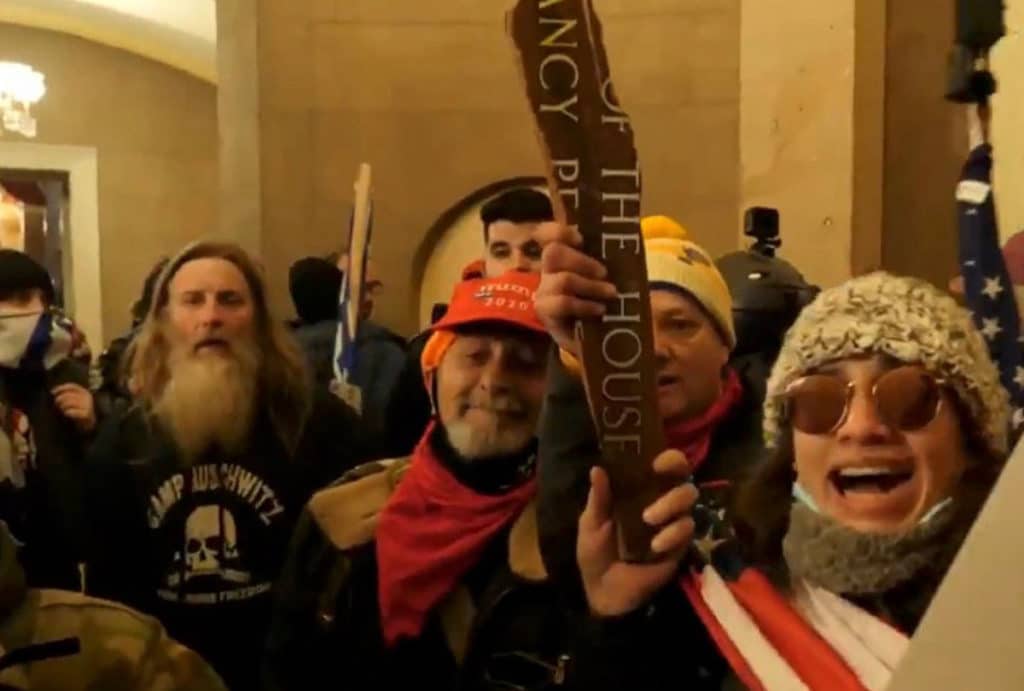
D.C. Rioter Pictured Wearing “Camp Auschwitz” Shirt

A rioter who was pictured at the January 6 violent protest in Washington, D.C. was pictured wearing a shirt stating “Camp Auschwitz.”

The shirt also had a skull and crossbones on it with the words “Work Brings Freedom,” an apparent paraphrase of Auschwitz’s “Arbeit Mach Frei,” German for “Work Sets You Free.”

The Simon Wiesenthal Center tweeted out a photo of the man, writing: “Our Nation’s Capitol was attacked and our democracy desecrated yesterday by violent extremists. Among those gathered by the Capitol was this Nazi.”

The man was also among those that stormed into the Capitol Building, according to The Forward.

There have also been several other documented instances of anti-Semitism during the riots. Jewish Telegraphic Agency (JTA) reported that at least one person at the riot was waving a Nazi flag and members of a neo-Nazi group were there as well. There was also various individuals wearing paraphernalia supporting the QAnon movement, which JTA describes as a conspiracy “laced with anti-Semitism” that “falsely alleges that an elite cabal of pedophiles, run by Democrats, is plotting to harvest the blood of children and take down [President Donald] Trump.”

The Anti-Defamation League (ADL) also chronicled various instances on social media in which “antisemitic ideologues, activists and conspiracy theorists have attempted to implicate Jews and Zionists in the violence” at the riots. ADL CEO Jonathan Greenblatt tweeted separately that the ADL has found a white supremacist channel and other extremists who claim to be ready to storm the Capitol again on January 20, when President-Elect Joe Biden will be sworn in as president.

D.C. Rioter Pictured Wearing “Camp Auschwitz” Shirt Read More »

Extremism Watchdogs on Violence in D.C.

(JTA) — They warned us. And warned us. And warned us.

Extremism watchdogs said there could be violence in the streets. They said minority communities — Jews among them — could be put at risk. They said that the incessant, false claims of a rigged election, of a fraudulent vote, of a conspiracy to bring down the president, could all lead to violence on or after Election Day.

All year, and especially after President Donald Trump said he would not accept the election results in November, people who monitor the far right in America warned about where America could be headed. Officials and analysts worried openly about attacks on police or threats to synagogues or polling places in Black neighborhoods.

One dire document, produced by the New Jersey Office of Homeland Security and Preparedness, predicted, among its more extreme scenarios, that conspiracy theorists may “threaten and target federally elected representatives [and] government institutions.”

That language came to life on Wednesday when a mob of Trump supporters stormed the U.S. Capitol. Congress, in the middle of a hearing about the election results, escaped into hiding. Extremists, carrying the symbols of their hate, sat at the dais in the Senate chamber and peered into government computers, abandoned by staffers who fled in haste. The vice president was rushed to a secure location while the president said “we love you” to the people who forced him to flee.

And someone — so far unnamed — was shot and killed in the middle of a crowd that was forcibly occupied the halls of government.

“Yeah, this is it,” said Heidi Beirich, who’s been monitoring extremists for 20 years, when asked if Wednesday’s chaos is what she worried about before the election. “This is our worst fears realized.”

“Everyone in my world has been warning of this exact thing,” she added.

Watching their predictions come true on TV, people in the anti-extremism world on Wednesday all said they got no pleasure from saying “I told you so.”

“This seems to be a logical conclusion to so much of what we have seen throughout the year, whether it’s reopen protests and efforts to delegitimize state governments, whether it’s conspiracy theories,” said Oren Segal, vice president of the Anti-Defamation League’s Center on Extremism. “These things have consequences. People pay attention, and they animate those who could care less about their democracy.”

Like everyone else, extremism watchdogs used the word “unprecedented” a lot. That word also kept coming up three years ago, when white supremacists marched in Charlottesville, Virginia, in an event that Joe Biden said inspired him to run for president, because he didn’t want to live in an America that tolerated “the same anti-Semitic bile heard across Europe in the ‘30s.”

The chaos at the Capitol resembled what happened in Charlottesville in certain ways. Both were rallies with a lot of extremist groups that included violence. Someone was killed then, too. Back then, Trump called the extremists “very fine people.” Today, in a video also urging the mob to disperse and “go home,” he told them, “We love you.”

But the analysts said they should not be equated. After all, said Michael Masters, the CEO of the Secure Community Network, a Jewish security agency, “why the protest is occurring is different.” Brad Orsini, the group’s senior national security adviser, said, “I look at all these incidents at face value, as they stand alone.”

In other words: Neo-Nazis marching with swastikas and chanting “Jews will not replace us” is somewhat different than pro-Trump extremists (including neo-Nazis) storming the Capitol and fighting with police officers. They’re both really bad, according to these watchdogs, but they’re each bad in their own way.

What unites them, Segal said, is what unites all extremists: a sense of grievance. They feel that something has been taken away from them, and they want to fight the people who took it. In Charlottesville, the neo-Nazis wanted to fight the Jews for taking away their imagined white societies. On Wednesday, the mob wanted to fight the government for “stealing” Trump’s (imaginary) victory.

“Today wasn’t about Jews not replacing us,” he said. “Today it was about something else being taken away: the America that they want, but that’s something that animates extremists all the time — this concept that something is being taken away from them by somebody.”

And unlike Charlottesville, the violence today wasn’t really about the Jews — though Orsini said Jews might be more attuned to it than other people. “This resonates more so because we’ve seen this uptick, this rhetoric of anti-Semitism. We’ve seen violent attacks,” he said.

The difference now is that Wednesday’s mob affected everyone in the country.

“What folks are seeing today, it’s not just a problem for Jews, it’s an American problem,” Segal said.

Extremism researchers aren’t sure what comes next. They want order to return to the Capitol, and they want the new administration to do what this one has not — to urge calm, to call out hate unequivocally.

But mostly, they want people to listen.

“I hoped I’d be out of a job years ago,” said Beirich, who co-founded the Global Project against Hate and Extremism only at the beginning of 2020, after a long career studying hate. “I didn’t want this to keep metastasizing and growing.”

Extremism Watchdogs on Violence in D.C. Read More »

Israel Launches $25M Seed Investing Program

The Media Line — Very early-stage technology startups’ fundraising potential will get a boost from a new 80 million shekel ($25 million) Israel Innovation Authority program following three years of stagnation in seed funding, the independent public agency said.

The new Hybrid Seed Incentive Program created by the Economy and Industry Ministry’s Israel Innovation Authority (IIA) encourages seed investors by limiting their investment risk in early ventures after a funding slowdown was exacerbated by the pandemic.

Since 2017, figures show an average annual decrease of about 25% in the number of startups formed in Israel, a trend that the coronavirus crisis has intensified.

“New startups are the future of the Israeli innovation ecosystem, and supporting them during their early stages is critical for their progress. This reality risks causing long-term hardship, limiting the ability of our innovation ecosystem to flourish,” IIA Chairman Dr. Ami Appelbaum said in a news release.

Dr. Ami Appelbaum, chairman of the Israel Innovation Authority. (Shlomi Amsalem/GPO)

The program’s timing, amid the pandemic, is not accidental.

“It is the government’s task to invest in areas not currently attracting private investment, to invest against the cycle so to speak, so now is the right time,” IIA Vice President Anya Eldan told The Media Line.

“We have seen fewer seed rounds over the last three years, so we are preparing the pipeline for growth in the years coming out of the crisis. This program will increase the number of seed-funding rounds in diverse sectors and will motivate veteran VCs [venture-capital funds] to invest in seed rounds,” said Eldan, who heads the IIA Startup Division.

Anya Eldan, vice president and head of Startup Division at the Israel Innovation Authority. (Shlomi Amsalem/GPO)

The initiative is not targeting specific industries. Instead, it is seeking the most innovative, disruptive and high-risk startups.

“The IIA is looking to support startups involved in deep technology [such as quantum], new sectors [like foodtech], sectors where there is a paucity of VCs [such as climatetech], and sectors with high regulation” like bio-convergence,” she said.

Seed investing is difficult and relatively risky because funding comes before the product stage and before anything has been marketed to customers. Seed funding can enable the entrepreneur or team to develop a beta-product or prototype and potentially take the idea to a pilot program, depending on the industry.

Often seed is the first institutionalized funding in an idea or company and follows angel investors or families and friends who invest.

Because entrepreneurs have an idea but not always a track record or history with other companies, seed investors tend to be wary. Thus, there are generally fewer seed than later-stage venture-capital investors.

“There is a long time horizon for seeing results from seed funding. Investors can easily go five to 10 years without knowing whether they will recoup their initial investment or succeed in receiving more value,” Oded Caspi, co-founder of Cyrus Ventures seed-investment firm, told The Media Line.

Since its founding in 2011, Cyrus has been the first investor in 25 seed-stage companies.

The new program, Caspi said, “is an amplifier,” enabling funders to see increased returns from a small, early investment. “They will see their investment be larger than it actually was, thereby qualifying them to reap higher rewards if the company succeeds.”

Caspi likes the new program, telling The Media Line, “We will be happy to try to participate in this.”

Seed rounds took a big hit during the first half of 2020 because of financial-market uncertainty; however, by the end of the year investments picked up, according to the Israel Venture Capital Research Center.

Whereas median seed-round investment fell 80% to a low of $120,000 in Q2 2020, it jumped to $1.5 million by Q4 2020, the report said. Median-seed investment was $900,000 to $1 million in 2019, it added.

If successful, the Hybrid Seed Incentive Program will increase the number of startups established in Israel and help nurture companies so that within three years, close to 65% of the participants reach a further funding stage.

Moti Elyashiv, co-founder of NewRocket, a startup developing environmentally friendly “green propulsion” rocket engines based on gel propellant technologies, also likes the new IAA program.

“This is very good for ‘deep-tech’ startups, those that take more time for their technologies to reach certain milestones,” Elyashiv told The Media Line.

He should know. NewRocket founded in 2014 is a “deep-tech” space-industry startup backed by Incubit Ventures, an incubator owned and supported by Elbit Systems that has backing from the IIA. In late November, the company secured a $1 million investment from UK-based Consensus Business Group, led by investor Vincent Tchenguiz.

“We are happy that we had the backing of the IIA and Incubit in our long R&D track. This enabled us to develop our technology and brought us to point that we now have $6 million in backlog orders.”

The IIA said that with this new program, the public will see more successful startups within a few years.

Israel Launches $25M Seed Investing Program Read More »

This Way and That – A poem for Parsha Shemot

He turned this way and that way, and he saw
that there was no man; so he struck the Egyptian
and hid him in the sand.
Exodus 2:12

Once in a Kmart in DeWitt, New York
while my mother was grocery shopping
at the Price Chopper next door

I came across the Nerf Football section.
Before I tell you more, I want you to know
this was at least forty years ago

so the statute of limitations on
whatever it is that happened, has
long since run out.

And if it isn’t, please note
this is fiction, a fantasy in a poem
as some also regard the Torah to be.

I picked up the Nerf Football.
I turned this way and that and saw
there was no man, or parent.

I threw the football as hard as I could
over the aisle towards, I think,
where the photo studio was.

I heard a crash and a scream.
Maybe. It was so long ago,
I might have heard nothing

and have been embellishing
my memory of these events, like
some say we do with the Torah

I walked briskly back to the
Price Chopper where I met my mother
in the cereal aisle.

Nothing has been said about this
incident since then, unlike Moses’ act
when he turned this way and that

unsure, unlike me who knew, whether
what he was doing was right or wrong.
He took a life in defense of a life.

This act has been spoken of
ever since, immortalized in films,
glossed over at Passover.

I admit to having no convictions
that day in DeWitt…But that day in Egypt
when Moses crossed his line

it started the process
which brought us
home.


God Wrestler: a poem for every Torah Portion by Rick LupertLos Angeles poet Rick Lupert created the Poetry Super Highway (an online publication and resource for poets), and hosted the Cobalt Cafe weekly poetry reading for almost 21 years. He’s authored 25 collections of poetry, including “God Wrestler: A Poem for Every Torah Portion“, “I’m a Jew, Are You” (Jewish themed poems) and “Feeding Holy Cats” (Poetry written while a staff member on the first Birthright Israel trip), and most recently “The Tokyo-Van Nuys Express” (Poems written in Japan – Ain’t Got No Press, August 2020) and edited the anthologies “Ekphrastia Gone Wild”, “A Poet’s Haggadah”, and “The Night Goes on All Night.” He writes the daily web comic “Cat and Banana” with fellow Los Angeles poet Brendan Constantine. He’s widely published and reads his poetry wherever they let him.

This Way and That – A poem for Parsha Shemot Read More »

How Do We Describe Madness?

When emotions run high, it’s hard to find the right words. I’ve received hundreds of emails and seen countless social media posts trying to describe the horror show at the Capitol yesterday. People are outdoing themselves in expressing outrage. I’ve been especially interested in how people describe the actual event.

Is there a difference between a “mob,” a “riot” or an “insurrection”? Is “protest” too mild? Is “coup” too strong?

Is there a difference between a “mob,” a “riot” or an “insurrection”? Is “protest” too mild? Is “coup” too strong?

It turns out that the folks at the Associated Press Style Guide have been thinking about this, and they have some answers.

In a staff memo yesterday titled, “How to describe the events at the U.S. Capitol,” they wrote:

“We are being questioned about the correct language to apply to the protesters backing President Donald Trump in Washington and the dramatic events taking place today at the U.S. Capitol.”

So far, the memo explains, their coverage has spoken of a “chaotic protest aimed at thwarting a peaceful transfer of power,” a “melee” and a “raucous, out-of-control scene.”

But because armed protesters broke into the building and overwhelmed Capitol police, “protest” on its own is too mild. The AP guide suggests “surrounding it with strong adjectives and context, such as ‘violent protest’ or ‘rioting protesters.’”

Taking it a step further, the memo adds, “Calling it a ‘mob’ or a ‘riot’ would also be appropriate, especially when the protesters’ actions were wild, widespread, violent and uncontrolled. The term ‘insurrection,’ meaning the act of rising up against established authority, could also be justified.”

However, the Style Guide draws a line at the word “coup,” which they describe as “a sudden, organized seizure of political power or an attempt by a faction or group to seize political power suddenly outside of the law.”

The reason “coup” goes too far is that there’s no “conclusive evidence that the protesters’ specific aim was to take over the government.”

This is what you get when you gather a group of word nerds on a day when all hell broke loose. They stay calm. They look at every word with a cold eye.

But it was their final instruction that got my attention:

“Finally, reiterating our recent Standards message: Please refrain from expressions of personal opinion about these political events in your social media or contacts with others. Let’s let the facts in AP’s reporting speak for themselves.”

Refrain from expressions of personal opinion? Let the facts speak for themselves? Describe madness without emotion? For us mere mortals, that world doesn’t exist.

Still, it’s worth taking a moment to appreciate the singular meaning of individual words, even when all hell breaks loose and all we want to do is scream.

How Do We Describe Madness? Read More »

Jewish Groups Condemn Violent Protests at the Capitol

Various Jewish groups have issued statements condemning the violent mob at the Capitol building in Washington, D.C., on January 6.

Jewish Telegraphic Agency (JTA) reported that those who are protesting the certification of the Electoral College vote for President-elect Joe Biden stormed the United States Capitol Building, causing members of Congress to evacuate their offices. At least one person has been shot, according to JTA, and that person has reportedly died.

Jewish groups condemned the violence.

“The right to protest is sacrosanct in American life,” Simon Wiesenthal Center Founder and Dean Rabbi Marvin Hier and Associate Director of Global Social Action Agenda Rabbi Abraham Cooper said in a statement. “But the very values and rights bestowed by our democracy are degraded and diminished when police officers have to draw their guns to protect our duly elected officials in the heart of our nation by violent protesters who have stormed Congress and by their reckless and dangerous behavior have inflicted grievous wounds on our nation.”

They added: “Nothing, not even the emotional charges of voter fraud in a presidential election, can ever legitimize or excuse such behavior. For as the Talmud warns, ‘Pray for the welfare of the government, for without it… man would swallow his fellow man.’ Today is a dark day for all Americans.”

The American Jewish Committee (AJC) tweeted, “The peaceful transition of power is the bedrock of our democracy. We are shocked and horrified by the violent riots taking place on Capitol Hill at this time. We urge @POTUS to call for an immediate end to the riots and respect the certification process currently underway.”

AJC President David Harris also blamed Trump for inciting the riots in a tweet, stating, “You’ve undermined democratic values by a refusal to accept the election results. You’ve encouraged folks to reject a peaceful transfer of power. I represent a nonpartisan org., but never when it comes to acts of violence & insurrection.”


A few hours after his supporters broke into the Capitol, Trump said in a Twitter video, “I know your pain, I know you’re hurt. We had an election that was stolen from us. It was a landslide election and everyone knows it. Especially the other side. But you have to go home now. We have to have peace. We love you. You’re special.” He also tweeted for protesters to “remain peaceful.”

But Anti-Defamation League CEO Jonathan Greenblatt tweeted that such tweets are “too little too late” and called for Twitter “to suspend @realDonaldTrump until his account stops promoting disinformation and inciting violence.” The Trump tweet was flagged by Twitter because “This claim of election fraud is disputed.” Twitter also prevented the the tweet from being liked, replied to, or retweeted “due to a disk of violence.”


The Republican Jewish Coalition also called for the violence to stop. “We support peaceful protest, but storming the halls of Congress and the Capitol building is unacceptable,” they tweeted. “We condemn these actions. G-d bless the @CapitolPolice.”


Jewish Democratic Council of America CEO Halie Soifer also tweeted, “Where are the arrests? Every person who entered the Capitol without permission should be arrested. Now. What took so long to deploy the National Guard and other federal forces? Unknown.”


The Jewish Community Relations Council said in a statement that they condemn “the anti-democratic mob and its violent actions, and we call for an end to the inflammatory rhetoric driving civil unrest. Make no mistake, if order, decency and rational decision making do not prevail, the underpinnings of our social fabric are in jeopardy. We call on all elected officials, regardless of party or ideology, to unequivocally condemn this violence and allow Congress to uphold their constitutional duty by affirming the state certified, electoral college ratified results of the November 3 presidential election.”

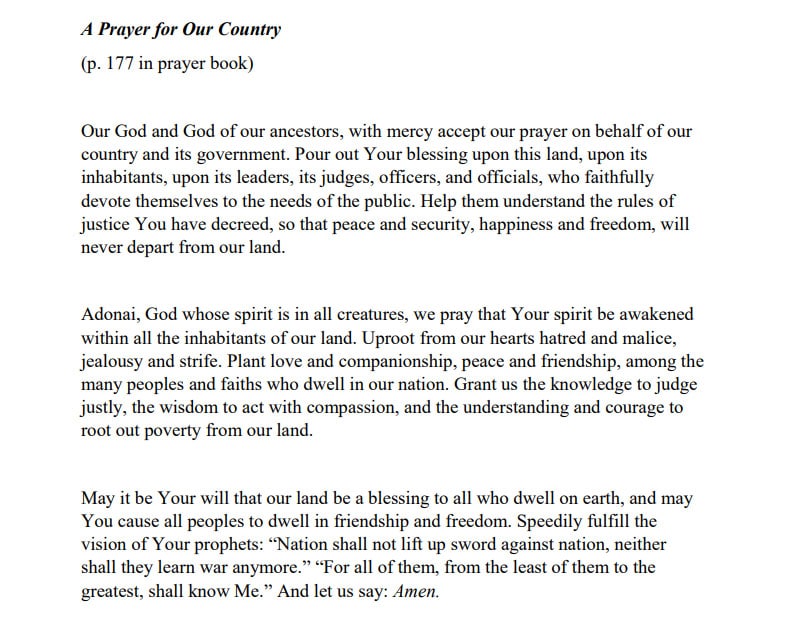
The Rabbinical Assembly issued a prayer for the country in response to the violence.

Read Ron Kampeas’ reporting at JTA for coverage on the protests from members of congress themselves here.

Jewish Groups Condemn Violent Protests at the Capitol Read More »

WATCH: D.C. Rioter Harasses Israeli Reporter With Anti-Semitic Slurs

During the violent protests in Washington, D.C., on January 6, a participant harassed an Israeli reporter with anti-Semitic on video footage.

The Jerusalem Post reported that the protester asked the Channel 13 reporter why Israel keeps accepting aid from the United States. The reporter replied that he didn’t represent the Israeli government. The protester then calls him a “yid” and asks him what a “goy” is; the reporter said he didn’t know.

“Yes you do, you lying Israeli,” the rioter responded. “They play the pilpul game. You are all goy. Goy are cattle.” According to the Post, “pilpul” is a reference “to analytical or hairsplitting discussion, usually in the context of Talmudic study.”

The footage ends with the reporter proceeding to ignore the harasser and starts talking in Hebrew to the camera. The harasser then starts trying talk to the camera as well, but it’s unclear what he’s saying. He then leaves.

The Anti-Defamation League condemned the incident as “absolutely despicable” in a tweet. “A rioter was harassing an Israeli reporter with vicious, grotesque #antisemitism,” they wrote. “This is sadly not shocking considering the violence we saw from extremists at the Capitol.”

Jerusalem Post columnist Emily Schrader similarly tweeted that the incident was “horrifying antisemitic harassment.”


During the riot, several people stormed the Capitol Building. Four participants died, including one who was shot by Capitol Police. Later in the evening, Congress reconvened and certified Biden’s Electoral College victory.

WATCH: D.C. Rioter Harasses Israeli Reporter With Anti-Semitic Slurs Read More »

Finding the Glimmer of Hope Amongst Chaos

If your head wasn’t spinning on Wednesday, January 6, when our Capitol was besieged, that must mean you never got out of bed that day.

If you were able to make sense of anything that happened throughout those daylight hours, your capacity to understand that which is incomprehensible is probably greater than most humans.

If you woke up still celebrating the victory of the Democrats in Georgia the night before and kept that happy feeling going — even as our legislators were evacuated from the Senate floor that same day — you probably don’t mind it when you go to the beach and the kids bury you in the sand, including your head.

If political PTSD hasn’t set in yet, though the “T” is technically over, maybe you’ve already used up your stress allotment during these months of COVID-19 restrictions.

As for me, I feel like I’ve gone into a disco where the music is deafening, everyone is talking, but I can’t decipher a word. The strobe lights are blinding, my eyes are smarting from the smoke, there’s nowhere to sit, my head is pounding, and I can’t wait to go home.

With only a few days until the inauguration of Joe Biden, it’s like two opposing teams are tied in the last inning of the game. Our team is up with two outs, two strikes and the bases loaded. The very next pitch decides the game and the series, and it will determine all that will follow for the team, for the players and for the fans. The stakes couldn’t be higher.

I’m not sure who the real experts are any more. I am not confident that the pundits we have designated to be our eyes and ears, and often our brains and hearts, are necessarily better qualified than I am to interpret the constant eruption of unsettling information before we can process what happened only a short time ago.

Highly charged words like coup, insurrection, sedition, lies and conspiracy have lost their potency. They are intertwined in a macabre dance with words like democracy, values, truth and loyalty. Everyone speaks. Everyone hears. Few people listen. And no one understands.

I expected to exhale on the stroke of midnight as 2020 became 2021, and then I expected to inhale on January 1 as singer-songwriter Keith Urban’s lyrics suggest: There’s a new wind blowing like I’ve never known, I’m breathing deeper than I’ve even done. And it sure feels good to finally feel the way I do…  But it hasn’t stopped — the unease, the foreboding, the anticipation of I don’t know what’s coming next.

But throughout it all, I remind myself not to confuse anxiety with despair. In my usual way, I continue to look for the light at the end of the tunnel and think I see a glimmer. I see it in the words we use.

I almost missed it, though, on January 6, when President Trump concluded his hour-long address to adoring supporters by saying, “So we’re going to walk down Pennsylvania Avenue, and we’re going to the Capitol and we’re going to try and give… [Republicans] the kind of pride and boldness that they need to take back our country.” You know what happened next.

The glimmer reappeared a short time later, when Biden addressed not just his supporters but the entire nation when he said, “America is about honor, decency, respect, tolerance. That’s who we are. That’s who we’ve always been.” I don’t think he mentioned a political party, an enemy or a betrayer in that speech.

President-elect Biden repeatedly reminds us that words matter. The words of the President matter. If, when he takes office, Biden acts as he speaks, the tunnel may become shorter and the light at the end of it brighter.

I really believe that. Words do matter. Not how many. Not how loud. They matter because of the intent of those who intone them and they matter because of the ears of those who hear them. They matter because of the actions that follow them. Words have the power to incite or to inspire. They have the power to tear down or to restore.

Words have the power to incite or to inspire. They have the power to tear down or to restore.

All of our words matter. I try to be a careful listener and choose to listen to the words that inspire and restore with the belief that the person who uses them also believes and will stand behind them.

Undoubtedly, if the past predicts the future, the next days will reveal people, personalities and events we haven’t anticipated. There may be surprises. Some may be distressing, others encouraging. Our heads will continue to spin until January 20 and probably beyond. Words will be the currency of our transition.

The words that come to mind right now are from the poem “If” by Rudyard Kipling, which I was required to memorize in the seventh grade and have never forgotten.

If you can keep your head when all about you

Are losing theirs and blaming it on you,

If you can trust yourself when all men doubt you,

But make allowance for their doubting too;

If you can wait and not be tired by waiting,

Or being lied about, don’t deal in lies,

Or being hated, don’t give way to hating,

And yet don’t look too good, nor talk too wise:

If you can dream—and not make dreams your master;

If you can think—and not make thoughts your aim;

If you can meet with Triumph and Disaster

And treat those two impostors just the same;

If you can bear to hear the truth you’ve spoken

Twisted by knaves to make a trap for fools,

Or watch the things you gave your life to, broken,

And stoop and build ’em up with worn-out tools:

Yours is the Earth and everything that’s in it,

And—which is more—you’ll be a Man, my son!

When I was in the seventh grade, none of us gave much thought to the gender allocation in the closing lines. But my English teacher, Miss Howell, knew that words matter and she chose wisely the words that would be imprinted on our young minds. Letting us know that life would challenge us all along the way, she gave us this poem that promised us “the Earth and everything that’s in it…” Good words to remember on these head-spinning days when I’m aiming to keep my head about me. Not bad to keep the light shining at the end of the tunnel. Only “if…”


Rochelle Ginsburg, educator, facilitates book group discussions for adult readers.

Finding the Glimmer of Hope Amongst Chaos Read More »