fbpx

January 5, 2021

Report Reveals More Anti-Semitic Tweets from UC Merced Professor

A new report has revealed more anti-Semitic tweets from UC Merced Professor Abbas Ghassemi.

The conservative website Washington Free Beacon reported on January 5 that the Stop Antisemitism.org watchdog has compiled a dossier on Ghassemi’s tweets. Among them included a retweet hailing the Iranian Shiite terror proxy Hezbollah as “protector of our goals” and a tweet referring to Secretary of State Mike Pompeo as “Pimp-eo” and a “criminal thug. Nothing you say will change that, not $$$ from petro-monkeys support for Zionists and IsraHell…. You are nothing and soon will join the trashcan of history!!!”

Another Ghassemi post highlighted by the Free Beacon included him tweeting in December, “The little Zionist puppies were many times on the same page with the criminal Americans, but now with the election of Biden, they will go out of their holes to kiss the feet of their masters.”

Stop Antisemitism.org tweeted, “Hey @ucmerced Abbas Ghassemi doesn’t just hate Jews- he hates America and idolizes Iranian ayatollahs and Hezbollah!  Fire him ASAP!”


StandWithUs co-founder and CEO Roz Rothstein said in a statement to the Journal, “We are not surprised to find that more antisemitic tweets from Professor Ghassemi are surfacing. Professor Ghassemi appears to traffic obsessively in antisemitic conspiracy theories and a diabolical hatred for Israel. We hope the university incorporates these new findings in their ongoing investigation.”

Anti-Defamation League Central Pacific Regional Director Seth Brysk also said in a statement to the Journal, “The conspiratorial lies found in multiple entries and retweets, appear to violate the social media platform’s rules for directing hate against a group. Several messages provide textbook examples of crude, antisemitic canards; mendacious allegations about Jewish power and control, attempts to dehumanize and demonize Jewish people, denial of Jewish peoplehood and the right to self-determination, Holocaust trivialization, insinuations about Jewish greed, and more. It is deeply offensive.  ADL urges anyone encountering such vulgar expressions to confront and roundly reject the brazen bigotry.”

AMCHA Initiative Director Tammi Rossman-Benjamin said in a statement to the Journal, “Although Professor Ghassemi’s blatant and reprehensible antisemitic posts occurred ‘off-campus’, there is an undeniable and valid concern that he will bring his hate and bigotry into the classroom and lecture halls, if he hasn’t already. If a professor were to denigrate, harass, or express intolerance in the classroom, regardless of the identity of his or her targets, that must be addressed promptly and vigorously by the administration. While we are pleased that the UC Merced Chancellor has recognized that Ghassemi’s anti-Zionist tweets are a form of antisemitic intolerance, we believe that universities should fight all intolerance and protect all students equally.”

StandWithUs also highlighted in a January 5 letter to the university that some of Ghassemi’s other tweets included him quote-tweeting a post that denied that Iran ever had a nuclear weapons program; Ghassemi accused the United States of “doing criminal acts under this cover is prescribed from the Zionist masters!” Another tweet from Ghassemi states that “claiming to be a Jew in the west gives them media attention!” and another states “Love it” in response to a tweet claiming that “the end of the Zionist regime is near” with a photo of a large Jewish Star of David in a cemetery.

Jim Chiavelli, Assistant Vice Chancellor of External Relations at the university, told the Journal that the university has no new information on the matter at this time. Ghassemi did not respond to the Journal’s request for comment.

On December 29, the university announced that they will be investigating Ghassemi after a report from the Jewish News of Northern California (the J) highlighted some anti-Semitic tweets from his since-deleted Twitter account, including an image of “The Zionist Brain” featuring a “Holocaust Memory Centre” and a tweet stating that “the Zionists and IsraHell interest have embedded themselves in every component of the American system.” Ghassemi has hired a First Amendment lawyer to represent him in the matter, according to the J.

Report Reveals More Anti-Semitic Tweets from UC Merced Professor Read More »

Holocaust Survivor Receives One of the First Moderna Vaccines at LA Jewish Home

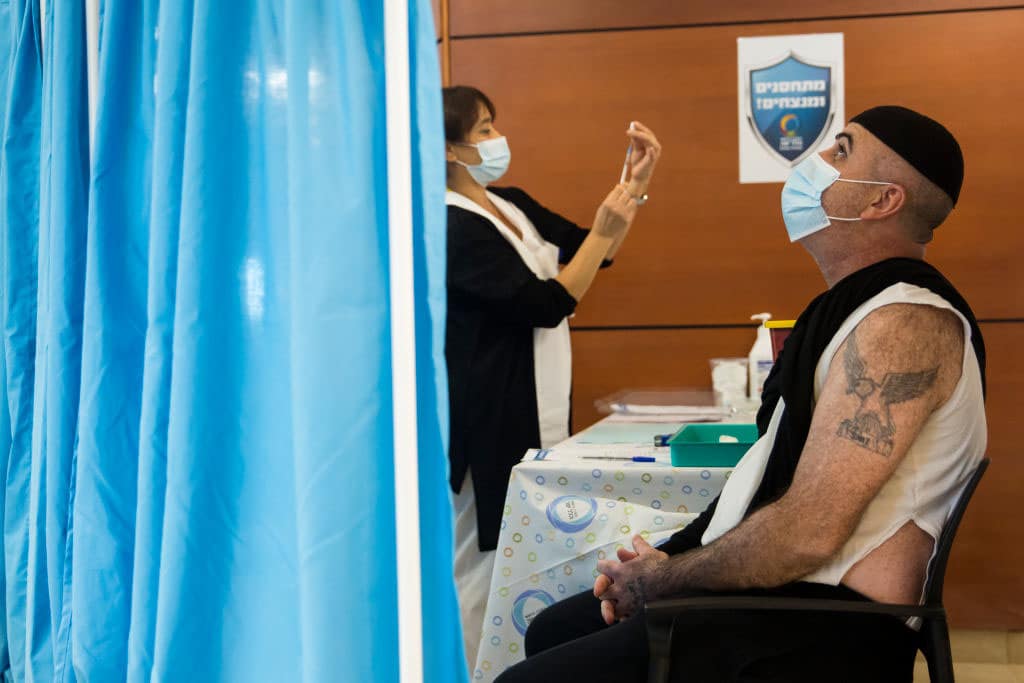
Los Angeles Jewish Home resident and Holocaust survivor Edith Frankie was one of the first to receive her first dose of the Moderna vaccine on Jan. 4. The first dose of vaccines is currently being administered to nursing residents and staff following the government mandates.

Frankie, 94, was the second of four children who grew up in Hungary-occupied Transylvania until Germany invaded in 1944. A survivor of Szilágysomlyó ghetto, Auschwitz concentration camp, a labor camp in Riga, Latvia and Stutthof concentration camp, she was 13 when she was liberated.

Edith Frankie

Speaking on the pandemic after receiving the vaccine, she posted on Facebook that “This shall pass.”

The Los Angeles Jewish Home received their first shipment of the Moderna vaccine from the Los Angeles County Department of Public Health on Dec. 30. Others who received their first dose were Chief Medical Officer Dr. Noah Marco, who has been on the front lines caring for residents and overseeing COVID-19 medical care management for the Home, and Dale Surowitz, the Home’s president and CEO.

The Jewish Home is the largest single-source provider of comprehensive senior healthcare services in Los Angeles serving nearly 4,000 people per year. There are approximately 1,650 staff members working at the facility.

As of Jan. 5, 1 in 5 people in Los Angeles County have tested positive for the coronavirus. As of publication, The Los Angeles Times recorded that there are 829,549 confirmed cases in Los Angeles County, with 10,852 deaths.

Frankie pointed out that too many Los Angeles residents are not social distancing and disregarding safety restrictions. If she can stay inside and wait patiently for the vaccine, she hopes others can do the same.

“People don’t like restrictions,” she said. “Me? I’m used to it. Staying in our rooms is not so hard in comparison.”

Holocaust Survivor Receives One of the First Moderna Vaccines at LA Jewish Home Read More »

Spanish Saffron Arroz Con Pollo

Arroz con Pollo is a classic Spanish chicken and rice recipe. It is a fragrant, flavorful dish that can be found throughout Latin America, with minor variations of ingredients. Like the famous Spanish paella, the rice is subtly infused with the flavors of the spices and tomatoes. But unlike paella, no shellfish or pork sausage feature in the ingredients, making it perfect for the Jewish home.

An uncomplicated recipe that includes lots of vegetables, Arroz con Pollo makes for an easy and nutritious weeknight meal. The first step is to sear the chicken till it is lightly browned, which ensures that the juices are sealed in. The onions and vegetables are gently sautéed and the rice is glazed until golden. Diced tomatoes and liquids are added to cover the rice and then the chicken is gently nestled in the pot. The steaming process softens the rice and fuses the flavors making for a one pot wonder.

The dish adapts to whatever spices and ingredients the chef has on hand. While saffron and paprika are the trademark spices of this dish, turmeric and red chili powder or coriander and cumin can easily stand in. Nowadays, even Trader Joe’s sells an affordable, quality saffron, an indispensable ingredient in the Sephardic kitchen. Rachel’s family recipe calls for carrots, celery, zucchini, peppers and peas, but when she wants to make the arroz really special, she adds canned or frozen artichoke hearts. You can also add vegetables like cauliflower and asparagus for a delicious change.

Whatever you decide to include, don’t leave out the green olives—they give it that signature tangy Spanish flavor.

Arroz con Pollo is the perfect dish for this time of the year when we crave homemade comfort foods.

Arroz con Pollo is the perfect dish for this time of the year when we crave homemade comfort foods. An added bonus is that the leftovers store easily and taste even better the next day!

Rachel’s Family Arroz Con Pollo Recipe

6 tablespoons olive oil, divided
1 3 1/2-4lb chicken, cut into 8 pieces
1 large onion, diced
2 garlic cloves, finely diced
1 cup finely sliced celery
2 medium carrots, diced
1 medium zucchini, diced
1 red or yellow bell pepper, sliced
1 cup long grain rice, rinsed and drained
1 1/2 cups saffron water (or 1 teaspoon turmeric and 1 1/2 cups water)
1 8oz can diced tomatoes
1/2 cup sliced green olives
1 cup frozen baby peas
2 teaspoons paprika
1 teaspoon salt
1 teaspoon pepper
1 bay leaf

Sear chicken in 3 tablespoons of olive oil over medium heat till lightly browned, about 5 minutes each side, then set aside.

Sauté onion in the remaining olive oil till it becomes translucent.

Add garlic, celery, carrots, zucchini and pepper until the vegetables are lightly glazed.

Add rice and saffron water and bring to a boil.

Stir till the rice has a golden color and reduce heat.

Add tomatoes, olives and peas and all the spices and stir well.

Nestle the chicken pieces into the rice.

If rice appears too dry, add a little water.

Cover tightly and simmer for twenty minutes.

Turn off the heat and let sit for ten minutes.

Fluff with a fork and serve.


Rachel Sheff and Sharon Gomperts have been friends since high school. They love cooking and sharing recipes. They have collaborated on Sephardic Educational Center projects and community cooking classes. Follow them on Instagram @sephardicspicegirls and on Facebook at Sephardic Spice SEC Food.

Spanish Saffron Arroz Con Pollo Read More »

The Guardian Criticized for Vaccine Article about Israel

The British newspaper The Guardian was criticized for a headline stating that Palestinians have been “excluded” from Israel’s COVID-19 vaccination rollout. The January 3 headline states in full:Palestinians excluded from Israeli Covid vaccine rollout as jabs go to settlers,” which was tweeted out from The Guardian’s Twitter account.

American Jewish Committee CEO David Harris tweeted that the headline was “malicious.” “Palestinians aren’t ‘excluded from Israeli Covid vaccine rollout,’” Harris wrote. “They rejected Covid cooperation w/ Israel. They’re in charge of own health care under Oslo Accords. They spurned UAE’s [United Arab Emirates] Covid aid -They’re awaiting millions of doses of Russian vaccine. An apology?”

The Simon Wiesenthal Center similarly tweeted that the allegation that Israel is excluding Palestinians from obtaining COVID-19 vaccines is a “new anti-Israel libel.” “@guardian newspaper buries one inconvenient fact: Palestinian Authority is in charge of Palestinians in their territory,” they wrote. “It made NO request for #Israel for vaccine. Any doubt Israel would help if asked?”

In a subsequent tweet, the Wiesenthal Center added: “Corrupt PA’s [Palestinian Authority] official policy no cooperation with Jewish state ever – bars sick [Palestinians] from Israeli treatment except top sick PA and Hamas officials.”


International human rights lawyer Arsen Ostrovsky tweeted that those criticizing Israel for not giving COVID-19 vaccines to the Palestinians should know that the “PA specifically asked [Israel] not to, as they want to themselves” and noted that “perhaps if PA wasn’t paying hundreds of millions $$$ in terrorist salaries, they could do this faster.”

The Guardian article does state later on that the PA “has not officially asked for help from Israel. Coordination between the two sides halted last year after the Palestinian president cut off security ties for several months.” It continues to say that “Israeli officials have suggested they might provide surplus vaccines to Palestinians and claim they are not responsible for Palestinians in the West Bank and Gaza, pointing to 1990s-era interim agreements that required the authority to observe international vaccination standards.”

The article also quotes an Israeli human rights NGO named Gisha stating that Israel still has an “ultimate responsibility toward Palestinians under occupation.”

A spokesperson from The Guardian said in a statement to the Journal, “The story in question reported the concerns of human rights groups, including an Israeli human rights group.”

The Jerusalem Post’s Lahav Harkov noted in a January 4 article that several media outlets have repeated the claim that Israel is excluding the Palestinians from the COVID-19 vaccine rollout, including PBS, NPR and Al Jazeera. Harkov also noted that The Guardian didn’t mention that the PA cut off dialogue with Israel on the matter until about “halfway through” the story.

“Israel had been willing to help before the Palestinians cut ties,” Harkov wrote. “Health Minister Yuli Edelstein last month told The New York Times it is in Israel’s interest to help stop the virus from spreading among Palestinians, adding that he has ‘no doubt it will be done.’”

Harkov also noted that the 1993 Oslo Accords state that the PA is responsible for all healthcare-related matters — which would include vaccinations — in the West Bank and that Israel has already been vaccinating Palestinians in East Jerusalem and plans to vaccinate Palestinians that are currently in Israeli prisons.

“It looks like some reporters are being led by the nose by activists with a certain point of view,” Harkov wrote. “The accusation that Israel is to blame for the PA’s slower vaccine rollout has trended on activist and NGO social media in recent weeks. The reporters follow these activists, and the seed gets planted in their minds.”

She later stated, “It should be reporters’ and editors’ jobs to see through people who are looking for any way to portray Israel in a negative light, rather than amplify their biases.”

The Guardian Criticized for Vaccine Article about Israel Read More »

Living While Others Are Dying

Just as I was settling into the promise of a liberated post-vaccine world, reality intruded.

I read on CNN.com that things have gotten so bad in Los Angeles County that ambulance crews have been told not to take patients with little chance of survival to hospitals.

“Hospitals are declaring internal disasters and having to open church gyms to serve as hospital units,” County Supervisor Hilda Solis said. “Our health care workers are physically and mentally exhausted and sick.”

According to the report, more than 7,600 people are hospitalized with COVID-19 in just Los Angeles County, and 21% of them are in intensive care units. Every 15 minutes, another person dies from the virus.

I’m getting this weird sense of déjà vu.

I’m thinking back to the early days of the pandemic, when fatalities were rising by the day and hospitals were barely able to keep up. Now, after many months of hard-earned progress, it seems we’re back where we started. Our hospitals are declaring “internal disasters.”

After many months of hard-earned progress, it seems we’re back where we started. Our hospitals are declaring “internal disasters.”

Let’s put aside the issue of why the virus is peaking. That’s for another column. I’m more interested in the human impact of this latest resurgence.

There’s a thick red line between those living through the horror and those comfortable at home, between those dying and those living. That red line has been there since time immemorial, in one form or another — between rich and poor, powerful and weak, happy and depressed, healthy and sick.

It just seems that at the moment, the divide feels more visible.

While the lucky ones are making the best of the quarantine, learning how to bake zucchini muffins and going on nature hikes, a few miles away, emergency patients are praying for a hospital bed. These unlucky ones are braving what L.A. Director of Public Health Barbara Ferrer says is “likely the worst conditions … that we’ve faced the entire pandemic.”

This virus is obviously oblivious to time. It doesn’t care that this is the first week of the year, when our optimism is at a peak, when we still believe we will follow through on our New Year’s resolutions. The promise of the vaccine has turbocharged that optimism.

But reality finds a way to get in the way.

In this (hopefully) final chapter of the pandemic, we are reminded of the limits of optimism. Even in the best of times, there is human suffering that lies just under the surface, suffering that is hard to see and easy to ignore.

As our New Year’s optimism meets the “disaster” zones of overflowing emergency rooms, it’s not enough for the lucky ones to “stay safe” and count their blessings. We need to think of the unlucky ones, as well as the nurses, doctors and first responders fighting on the front lines.

They need to count on our blessings, too.

Living While Others Are Dying Read More »

Religious Observance Redux

(JNS) — The U.S. Supreme Court precedent that has, for the past 43 years, doomed Shomrei Shabbos (those who observe Shabbat and do not work on that day) who have been denied jobs or whose employers have refused to respect their religious observance is about to be overruled. Here is the story of my role in this historic development.

At about 1:30 in the afternoon of March 30, 1977, I rose to present an oral argument in the Supreme Court in support of Larry Hardison. Hardison had been fired from his job at TWA’s Major Overhaul Base in Kansas City because, as a member of the Worldwide Church of God, he refused to work on Saturday because it was his Sabbath. Was TWA obliged to accommodate his religious observance by offering premium pay to an employee who had greater seniority under a labor contract to have him volunteer to substitute for Hardison’s Saturday shifts?

I had drafted the 1972 amendment to the Civil Rights Act that directed employers to make a “reasonable accommodation” for an employee’s “religious observance and practice,” except if the employer could prove “undue hardship” to its business. (My text was sent to West Virginia Sen. Jennings Randolph, a Seventh-Day Baptist, who, in a remarkable initiative, successfully presented it as an amendment on the floor of the Senate.) I drafted and filed a friend-of-the-court brief for national Orthodox Jewish organizations supporting Hardison’s claim that TWA had violated the act’s prohibition against religious discrimination in employment by refusing to incur the expense of incentivizing a more senior union member to substitute for Hardison on Saturdays. The Supreme Court agreed to hear TWA’s appeal and permitted me to share the 30 minutes allotted for an oral presentation of Hardison’s case.

Hardison’s Kansas City lawyer had never before presented an oral argument in the Supreme Court. I squirmed in my on-deck chair as Justices Lewis Powell, Byron White, William Rehnquist and Thurgood Marshall peppered him with questions that he answered stumblingly. When my turn came, Chief Justice Warren E. Burger kindly said, “We will restore two minutes of the time to your presentation.”

The highly respected labor lawyer who had brought TWA’s case to the Supreme Court had persuasively argued that TWA was bound by its labor contract. The union contract, he said, permitted Hardison to avoid Saturday work only if he had enough seniority, and TWA is not obliged to pay for violation of its terms. When asked why TWA must do more than the agreement with the union prescribed, I replied that TWA had no greater right to bargain away Hardison’s rights under federal law than it had to sell the Brooklyn Bridge. The Washington Post reporter who covered the argument headlined my Brooklyn Bridge analogy in the Post’s report the following day.

Two-and-a-half months later, over dissents by Justices Brennan and Marshall, the court ruled for TWA. The majority opinion by Justice Byron White held that TWA was not obliged “to carve out a special exception to its seniority system in order to help Hardison to meet his religious obligations.” White gratuitously went on to declare that TWA did not have to incentivize substitutes with “premium wages” because the 1972 “reasonable accommodation” amendment to the law required nothing more than the most minimal (de minimis) adjustment. He added, “To require TWA to bear more than a de minimis cost in order to give Hardison Saturdays off is an undue hardship.”

The Americans With Disabilities Act directs employers to accommodate physically handicapped employees unless the employers prove that the required accommodation creates “undue hardship,” the same term as is used to define the limit for reasonable accommodation to religious observance in the Civil Rights Act. Federal courts have required accommodation for physical disability even if it is expensive. But because of the de minimis limitation that Justice White grafted onto the religious accommodation provision of the Civil Rights Act, such lawsuits have been dismissed, claiming religious discrimination when the required accommodation for ritual observance comes with a cost. This de minimis gloss on the statutory language has, over the past four decades, buried scores of legal claims by religiously observant Sabbath-observers who were fired or demoted because they were unwilling to violate the tenets of their faith.

Today’s Supreme Court is more receptive to claims of religious minorities than the 1977 court. The justices who decided Hardison’s case sought to protect American society from religion; a majority of today’s court emphasizes the protection granted by the constitution for religion. Justice White formulated the de minimis standard (which had not been proposed by any brief in the case) because the court majority in 1977 feared that requiring an employer to incur expense to accommodate religious observance would violate the First Amendment’s Establishment Clause. Chief Justice Burger and Associate Justices White, Powell, Rehnquist and John Paul Stevens mistrusted religious observance. Chief Justice John Roberts and Associate Justices Clarence Thomas, Samuel Alito, Neil Gorsuch, Brett Kavanaugh and Amy Coney Barrett respect it.

The first hopeful sign that a majority of the current court might reconsider the Hardison ruling came in January 2019. The court refused to hear the religious-liberty claim of a public high school football coach who was fired because he kneeled in prayer on the 50-yard line after each game. A published opinion by Alito (joined by Thomas, Gorsuch and Kavanaugh) agreed that there were valid procedural obstacles to deciding the constitutional issues. Alito’s opinion gratuitously added that the court had “not been asked to revisit” the Hardison decision’s statement that an employer need not “make any accommodation that imposes more than a de minimis burden.” This implied that if the four justices were “asked” to do so, they would overrule the Hardison standard.

A case (Patterson v. Walgreen Co.) claiming a failure to accommodate a Seventh-day Adventist’s observance of Sabbath was on the court’s docket last year. In March 2019, the Justices followed a course they sometimes take in a lawsuit between private parties that raises issues of federal law. They asked the Department of Justice to recommend, through the solicitor general, whether the court should accept Patterson’s case.

The solicitor general did not respond for more than eight months. During that time, his staff was lobbied by the lawyers for both sides. I was invited by Patterson’s lawyers to join their discussion on the telephone. Whether the Hardison standard should be “disavowed or overruled” was one of three legal issues raised in Patterson’s request that the court hears the case. Before the conversation ended, I argued vehemently that, regardless of the merit of the other two claims made in Patterson’s petition, the federal government should not miss the opportunity to eradicate the damaging Hardison standard that Justice White had conceived.

On Dec. 9, 2019, the solicitor general finally expressed his opinion. The Department of Justice recommended that the court not consider the first two legal issues presented in Patterson’s petition, but that it agree to hear the case to decide whether to overrule the Hardison standard. Not until three months later did the court announce what it would do. It accepted the argument made by Walgreen that because of flaws in the record the case was not “a good vehicle for revisiting Hardison.” Alito wrote an opinion, joined by Thomas and Gorsuch, declaring that the court should “reconsider” the case.

Two cases on the Supreme Court’s current docket (Small v. Memphis Gas Co. and Dalberiste v. GLE Associates, Inc.) again ask the court to repudiate the de minimis standard. This time the court has not asked the solicitor general for the government’s opinion, though it has signaled that it is likely to issue a substantive ruling on this controversial issue. The two cases have been listed for discussion at the justices’ conferences three times and then “rescheduled.” I think the court is working on an opinion that would be joined—possibly by all the current justices—burying the ill-conceived Hardison ruling.

An assist comes from an unexpected source. Gorsuch was severely criticized by originalist court-watchers when he authored a 6-3 opinion that interpreted the Civil Rights Act’s 1964 language prohibiting employment discrimination on account of “sex” to include discrimination based on sexual orientation. By parallel reasoning, discrimination on account of an employee’s “religion,” also forbidden in 1964, should include discrimination based on religious observance. The liberal wing of the court—Justices Stephen Breyer, Elena Kagan and Sonia Sotomayor—agreed with Gorsuch’s expansive understanding of the word “sex.” They should similarly read “religion” as covering not only whether an employee identifies with faith but also conduct dictated by the rituals of religious belief.


Nathan Lewin is a criminal defense attorney with a Supreme Court practice who has taught at Georgetown, Harvard, University of Chicago, George Washington and Columbia law schools.

Religious Observance Redux Read More »

What Do Pearl Harbor, the Fall of Communism and 9/11 Have in Common?

We’re only one week into the new year, but I have yet to think of 2021 as simply following a bad year. Calling 2020 a “bad year” is like saying Jeffrey Dahmer had bad eating habits. Dahmer was a cannibal who killed and ate 17 men and boys. Imagine being the sibling who came after him? The bar is set pretty low for an improvement.

That’s what 2021 must feel like, as it follows the most hated year in recent memory.

But many people don’t realize that 2021, however it ends up, will have the difficult task of recalling some other dark and epic events. This year, we’ll mark the anniversaries of three of the most important stories of the twentieth century — stories we’d do well to remember but which younger generations, including mine, have completely pushed to the backburner.

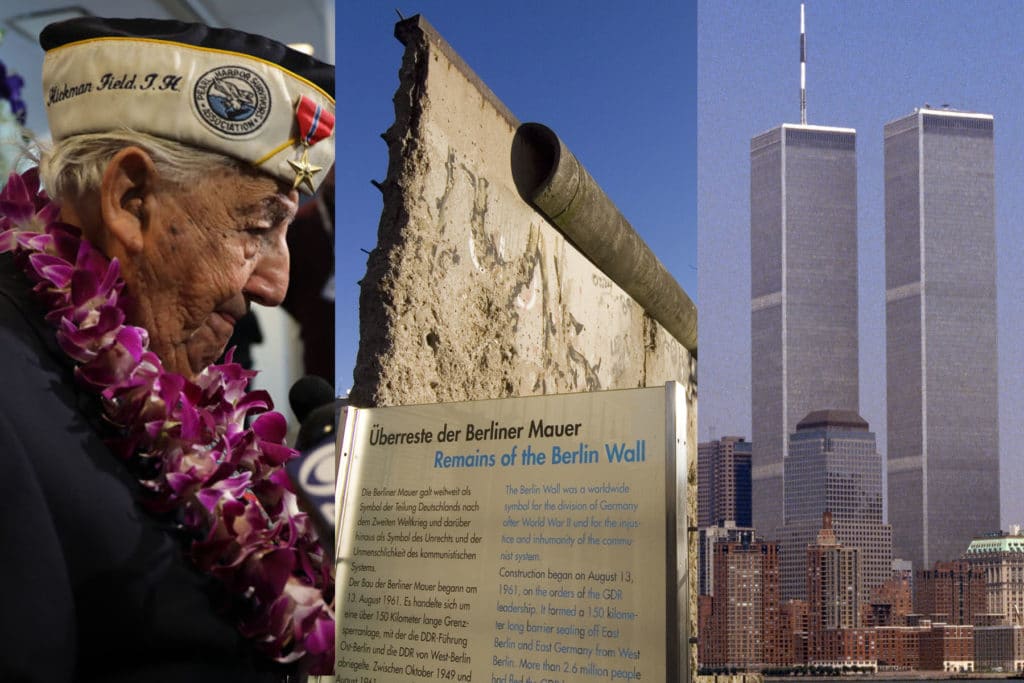
Eighty years ago this year, in December 1941, the United States entered World War II after the Japanese killed 2,403 servicemen and women at Pearl Harbor.

Eighty years. That’s a long time.

That means that some of the youngest American troops to have served in that war are now in their late nineties (the actual youngest soldier was Calvin Graham, who enlisted in the navy at age 12. He died in 1992). Yes, that means that all of the remaining Americans who fought Nazis, liberated starving Jews from death camps and celebrated the triumph of courageous good over cowardly tyranny are now almost 100. All of them.

Most of us who’ve ever shaken hands with a veteran, especially an older veteran, know they’ve been in the presence of someone special. What has this person seen? What does he or she think of me? I’ve always felt a sense of awe upon seeing much older veterans, whether at the bus stop or a museum (in pre-pandemic days). Some of them wear special caps letting us know when and where they served. I always thank them for their service. These veterans remind me of Argentine writer José Narosky, who said, “In war, there are no unwounded soldiers.”

But they’re dying quickly. Soon, there’ll be no World War II veterans left. According to the United States Department of Veteran Affairs, only 325,574 of the 16 million Americans who served in that war are still alive. That means roughly 80% of them are gone.

Here’s some perspective: there were exactly eighty years between the start of the Civil War (in 1861) and when America entered World War II. That means that in 1941, if you were lucky, you’d still be able to speak with a member of the Union Army, though, like today’s WWII veterans, he would have been very, very old. Oh, the questions I would have wanted to ask him.

Of course, the fact that this year marks the eightieth anniversary of the attack on Pearl Harbor also means that all of the world’s remaining Holocaust survivors also are in their eighties and nineties, but the race-against-time significance of that merits its own series of columns.

How much can we identify today with something that transpired 80 years ago? Before I can even ponder that question, I find myself wondering how much or how little we can relate to something that happened 30 years ago.

This year also marks the thirtieth anniversary of the fall of communism and the disintegration of the former Soviet Union in 1991. This memorialization is where it gets tricky for me. Naturally, I wasn’t alive during World War II, but I did live through the historic downfall of one of the most murderous regimes of the last century.

The only problem? I was nine and remember virtually nothing. In fact, I’m pretty sure that while my parents were watching the television in shock as the Soviet sickle and hammer flag was lowered for the last time, I was in the other room, dancing to “Good Vibrations” by Marky Mark and the Funky Bunch on our big stereo.

I belong to the generation that sort of remembers the tyranny of the USSR, though, I’ll be honest: I personally remember none of it. But that’s only because I was face-to-face with tyranny as a child in post-revolutionary Iran in the 1980s, and there are only so many dictators one can handle. When we came to the United States in 1989, I thought “Gorbachev” was the name of a Russian cocktail.

What does it mean to be among the generation of those in our thirties, for whom the thought of an omnipresent, “evil empire” (what President Ronald Reagan called Russia in 1983) is almost cartoonishly comical and oh-so black and white? It means we dismiss much of the concerns our parents’ generation has over the censorship of words and, yes, even thoughts that are ravaging American society today like fast-spreading mold. It also means millions of younger people are openly and passionately embracing the economic policies of Democratic Socialism and its charismatic leaders in America.

I’m not saying that every young person who voted for Bernie Sanders dismisses the economic and social havoc wreaked by socialism during the past 100 years. And there are plenty of older Americans who identify as Democratic Socialists. But what I am saying is that there isn’t a single 25-year-old champion of Sanders who was even alive when that miserable flag was lowered over the Kremlin in December 1991.

Ever the overachiever (did it have a choice?), 2021 will also mark the anniversary of another milestone in not just American history but also world history itself: This September will mark 20 years since that hideous Tuesday in 2001, when, whether in person or on TV, we watched in horror as two airplanes slammed into the World Trade Center, bringing the very foundations of our American lives to their terrified knees.

I remember that morning. Twenty years later, I remember my exact feelings and inescapable fears. I was two weeks shy of starting college, which means I was old enough to really take everything in. And rather than missing everything by dancing to music in the other room, I was on the kitchen floor, glued to the TV alongside my horrified mother and father. There are some moments in one’s life — moments that occur completely outside of you — whose terror confirms that nothing will ever be the same again.

By contrast, those entering their freshman year of college in 2021 weren’t even alive on September 11, 2001. And most of those graduating this year were only one during the worst terrorist attack on U.S. soil in history.

Their age doesn’t mean they don’t understand what happened that day (or the aftermath of it, which still reverberates today). It just means there’s no frame of reference, no semblance of the feelings — the visceral, fearful, confused, nation-in-mourning feelings — that those of us who still remember that day will never forget. And when it comes to personal identification and collective memory, feelings are everything. (Whether all of this affects the voting habits of younger generations is also best reserved for another column.)

When it comes to personal identification and collective memory, feelings are everything.

If I was one on 9/11, I wonder whether a veteran of Iraq or Afghanistan who served in 2003 would seem as ancient to me as someone who served in the Civil War. In contemplating 9/11, would I feel a sense of personal repulsion at the thought of politicized religious fanaticism? (In truth, I already hold such views as a result of those charming years back in Iran). Would the history of that time fit into the oversimplified and cartoonish categories of “good vs. evil,” of feeling like anyone older than me had been fed a handful of lies about an angelic America versus an “Axis of Evil” (according to President George W. Bush in 2002)?

It’s possible. Many of my friends, who, like me, actually lived through 9/11, still haven’t forgiven Bush and cringe at the thought of another American-led war in the Middle East. Me? I take a more nuanced approach. I study American history, grow wide-eyed from the truth and ask questions about the lies. More than anything, I try to learn from the lies. And I practically wish I could kiss the hand of every American serviceman and woman who fought in the Middle East after 9/11, even if he hated Bush and other American leaders more than he hated Saddam Hussein, or even if she were to look at me like I’m a naive, rosy-eyed simpleton. Maybe that’s precisely what I am.

This December, pandemic lockdowns pending, we’ll gather one way or another to commemorate the eightieth anniversary of Pearl Harbor. Want to contemplate something strange? In September 2081, we (and, I’m assuming, our robot masters) will gather to remember the eightieth anniversary of 9/11. I’ll be 99 years old by then. And if my mental faculties will still be sharp enough to share memories of that ominous day, I’ll speak with anyone who has questions. I just ask that someone hands me a Gorbachev cocktail beforehand.


Tabby Refael is a Los Angeles-based writer, speaker and activist.

What Do Pearl Harbor, the Fall of Communism and 9/11 Have in Common? Read More »

All the Jewish Drama from the GA Senate Runoff

(JTA) — Tuesday’s two runoff elections in Georgia won’t just decide control of the U.S. Senate. They’ll also be significant symbolic wins for one or both of the polarized sides of the American Jewish community.

Thanks to several dramatic developments, including an infamous campaign ad, a year-old letter about a trip to Israel and a controversial photo taken with a white supremacist, the races have become a microcosm of big national Jewish political narratives. The Republicans in the races have cast the Democrats as part of the anti-Israel and socialist left. The Democrats have cast the Republicans as part of the white supremacist and anti-Semitic far right.

Here’s a recap of the Jewish drama in both races, which are going down to the wire.

The nose ad 

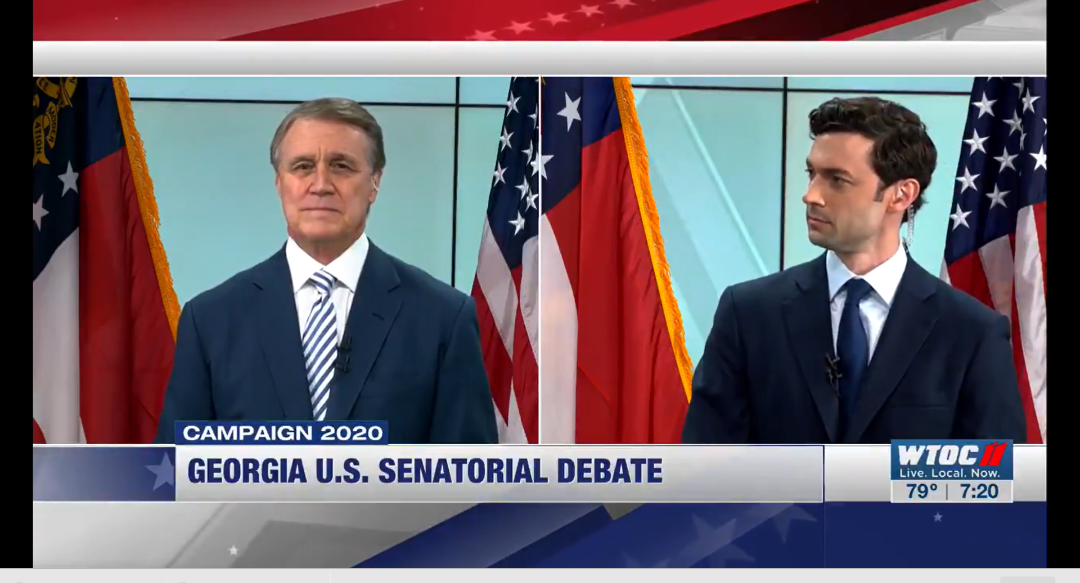
Jon Ossoff, right, debates Sen. David Perdue in a broadcast by WTOC, a station based in Savannah, Ga., Oct. 28, 2020. (Screen shot)

In July, the campaign of the Republican incumbent, Sen. David Perdue, ran a Facebook ad for five days before observers noticed that it featured an image of Jon Ossoff, his Jewish opponent, with his nose digitally enhanced to appear longer than it is. The ad also featured Jewish Sen. Chuck Schumer and the phrase “Democrats are trying to buy Georgia!” (Jewish political donors such as George Soros and Michael Bloomberg have figured prominently in Republican attack ads that critics argue echo anti-Semitic tropes about Jews and money.)

Ossoff quickly pounced on the opportunity to call his opponent anti-Semitic. He has made the ad a centerpiece of his campaign’s attack against Perdue. In October, Ossoff brought the incident up at a debate with Perdue, accusing him of “lengthening my nose in attack ads to remind everybody that I’m Jewish.”

“Instead of leading and inspiring, he stoops to mocking the heritage of his political opponents,” Ossoff added. A clip of his impassioned jab went viral, and Perdue dropped out of their final debate.

Perdue has since appeared in multiple online meetings with the Republican Jewish Coalition but has not mentioned the ad.

Warnock’s Israel stance

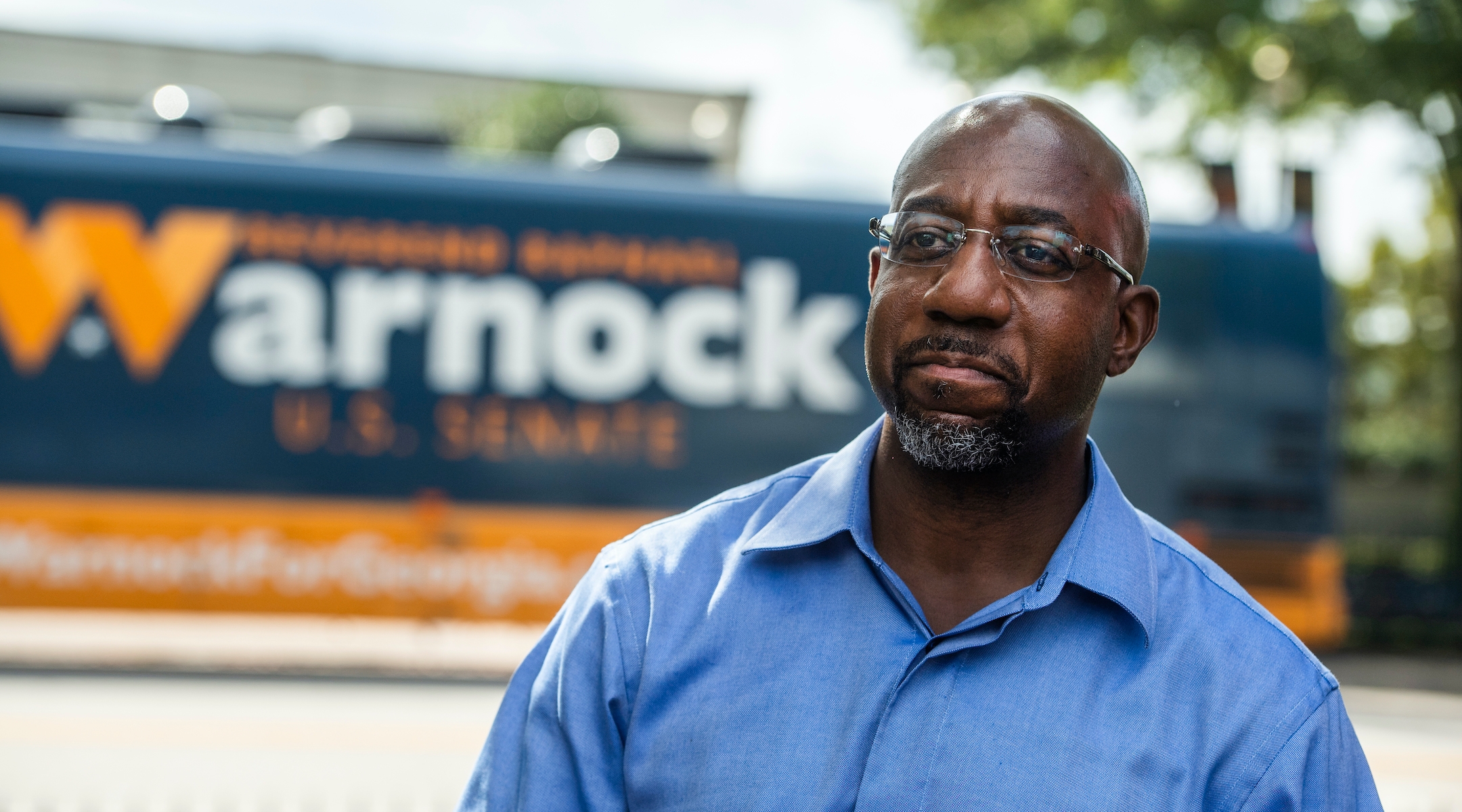
Rev. Raphael Warnock

Rev. Raphael Warnock seen after a campaign rally in LaGrange, Ga., Oct. 29, 2020. (Tom Williams/CQ-Roll Call, Inc via Getty Images)

The Rev. Raphael Warnock’s record on Israel came under scrutiny after Jewish Insider published an article about a visit the Democratic candidate made to the country with other Black clergy members In 2019. A pastor who helms the same Atlanta church that Martin Luther King, Jr. led for years, Warnock signed a letter that included — among several conclusions, including a renewed commitment to a two-state solution — a description of “the heavy militarization of the West Bank,” saying it was “reminiscent” of the way apartheid South Africa governed Namibia, its colony.

Jewish Insider also reported on a sermon Warnock gave in 2018, in which he criticized Israel: “We saw the government of Israel shoot down unarmed Palestinian sisters and brothers like birds of prey,” he said, in reference to Israel’s clashes with Hamas-led protesters at the Gaza border. “It is wrong to shoot down God’s children like they don’t matter at all. And it’s no more anti-Semitic for me to say that than it is anti-white for me to say that Black lives matter. Palestinian lives matter.”

The Republican incumbent, Sen. Kelly Loeffler, amplified the narrative, tweeting that Warnock has “a long history of anti-Israel extremism.”

She also claimed that Warnock “defended Jeremiah Wright’s anti-Semitic comments,” referring to the controversial Chicago pastor who counted Barack Obama as a congregant. But Warnock has only cited Wright’s call for greater racial justice, not the pastor’s slight against “them Jews” who he claimed in 2009 were responsible for keeping him away from Obama.

Warnock has since publicly clarified his stances on Israel-related issues. He has come out against the boycott Israel, or BDS, movement, and stated his support for defense aid to Israel and a two-state solution.

Warnock, who is Black, also lauded the historical Black-Jewish alliance in a campaign ad with Ossoff. Ossoff has called him a “beloved” ally of the state’s Jewish community. The Democratic Majority for Israel’s political action committee, which reflects centrist pro-Israel views, gave him a noteworthy endorsement. And multiple local Jewish organizers came to Warnock’s  defense.

“He has been a friend to Atlanta’s Jewish community throughout his tenure at the Ebenezer Baptist Church and a regular speaker and visitor to Atlanta’s synagogues,” Valerie Habif and Joanie Shubin, who founded Jewish Democratic Women’s Salon, Atlanta, an activist group that helps elect Democrats in Georgia, said in a statement. “His support for Israel is unequivocal.”

Warnock hasn’t convinced everyone of his Israel support, including two prominent Orthodox rabbis in Georgia and Rabbi Avi Weiss, an Orthodox rabbi in New York who has been an outspoken pro-Israel activist for decades. But a group of over 200 rabbis and other faith leaders signed a statement in late November defending Warnock’s Israel comments.

Loeffer’s photos

Kelly Loeffler

Sen. Kelly Loeffler speaks at a campaign event in Columbus, Ga., Dec. 17, 2020. (Elijah Nouvelage/Getty Images)

Loeffler,  a former business executive, raised eyebrows on the campaign trail by supporting Marjorie Taylor Greene, a Republican candidate for the House who boosted the QAnon conspiracy theory and signed a post that accuses Jews such as George Soros of being involved in it. Greene is now a member of Congress.

Loeffler courted more controversy when she appeared smiling in a photo with Chester Doles, a white supremacist convicted of beating a Black man whom he saw accompanying a white woman. Bend the Arc, a liberal Jewish activist group, helped the image go viral on Twitter.

Loeffler’s campaign quickly disavowed the photo and condemned Doles, saying “she had no idea who that was.”

Soon after, Bend the Arc surfaced another photo of Loeffler, this time posing with another member of Doles’ Georgia-based group, American Patriots USA (APUSA). The Southern Poverty Law Center calls APUSA a “white nationalist” group.

And Huff Post reported last month that Loeffler has also posed with members of the anti-government militia group Georgia III% Martyrs and gave an interview to Jack Posobiec, an OANN host who has past ties to white supremacist and neo-Nazi groups.

In a December debate, Loeffler brought up her criticisms of Warnock’s Israel comments and Warnock hit back on her photo ops.

“She says she is against racism and that racism has no place, but she welcomed the support of a QAnon conspiracy theorist and she sat down with a white supremacist for an interview,” Warnock said. “I don’t think she can explain that.”

Three Jewish letters — and one independent statement

Last month, the Atlanta Jewish Times asked all four candidates to submit statements making their cases to the state’s Jewish community. Ossoff, Perdue and Warnock published theirs in the Jewish newspaper — but Loeffler decided to publish her essay on her campaign website instead.

Ossoff mentioned his family’s Holocaust history. Purdue praised President Trump’s Israel policy. Warnock mentioned the historic ties between his church and the Atlanta Jewish community. Loeffler said Warnock would “add yet another voice to the anti-Israel cadre in Congress,” mentioning Reps. Ilhan Omar and Rashida Tlaib, who unlike Warnock support the BDS movement.

Read their full letters here (and in Loeffler’s case, here).

All the Jewish Drama from the GA Senate Runoff Read More »

Iranian Games 2021: the First Act

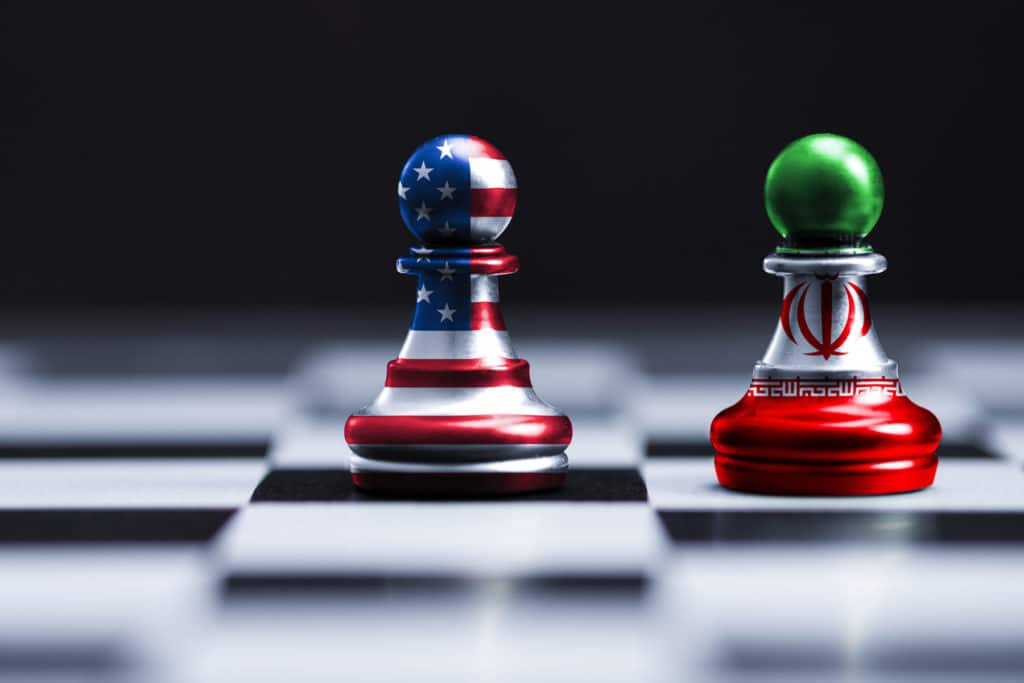
Heraclitus, a Greek philosopher (544 B.C.), is famous for saying that “no man ever steps in the same river twice, for it’s not the same river and he’s not the same man.” It is a good quote to use as we think about the next attempt to revive the Iran nuclear deal, more formally known as the JCPOA (The Joint Comprehensive Plan of Action).

No man ever steps in the same river twice, and no country can sign the same agreement twice. Why? For it’s not the same situation, and it’s not the same country. I am not the only one citing this wisdom; the head of the U.N. atomic watchdog (IAEA) effectively said the same when he stated, “I cannot imagine that they are going simply to say, ‘We are back to square one’ because square one is no longer there.” The river is not the same river, and as President-elect Biden takes office and prepares to renegotiate with Iran, reentering the Obama-era agreement will not be available to him.

We are reminded of this aphorism because even though the year just started (President Trump is still trying to keep his job and President-elect Biden is still polishing his inaugural speech), Iran is already sending signals — lest anyone forget that it is there, waiting, and has expectations. Iran announced that it began enriching uranium to levels unseen since it signed the nuclear deal. The deal had capped the fissile purity to which Iran can refine uranium at 3.67%. Iran breached that cap in 2019, and its enrichment level remained steady at up to 4.5% since then. It is now moving to restore its 20% level enrichment.

What are these? These are signals.

Trump is no longer a threat. Negotiations with Biden are on the horizon. The Iranians must play as many cards as they have when they renegotiate a deal. If they enrich uranium to a higher level, giving up on enrichment is something they can trade for something else. If negotiations become difficult, they can up the ante and move from 20% enrichment to an even higher level.

The pressure is on the other side, namely, Biden. After the new president is inaugurated, he will have only a narrow window of time to reignite a process of negotiations. In March, Iran begins its new year and has a long holiday. When the holiday is over, the Iranian presidential campaign begins. So, from January to June, there is very little time to talk.

The pressure is on the other side, namely, Biden.

The United States wants Iran “to roll back its recent breaches, especially on uranium enrichment.” Iran wants U.S. sanctions lifted. Parties also need to consider Europe, not always unified, and China, whose reaction to Iran’s recent breach was: “China urges all sides to exercise calm and restraint, to stick to the commitments of the agreement and to refrain from taking actions that might escalate tensions, so as to make space for diplomatic efforts and a change in the situation.” There’s Israel, supported by the Saudis, Egypt and other Gulf states, who want any deal — the new deal because you can’t step into the same river twice — to correct some of the many flaws of the previous deal.

One question for Biden is this: Does he see the flaws? Would he be willing to acknowledge — not publicly for people to gloat but rather as a policy directive — that the previous agreement was flawed? The agreement was signed when he was the vice president, so admitting errors would be complicated for him and possibly embarrassing. Luckily, it has been a long time since the agreement was finalized, and Biden can also use Heraclitus to tell the Iranians that what they want is no longer available, neither for him nor for them.

True, Persians and Greeks did not always see the world in the same way. But Heraclitus is special. He lived in the city of Ephesus when it was part of the Persian Empire. At least some origins of his philosophy can be traced to Persian sources.

Iranian Games 2021: the First Act Read More »