The Media Line — Elections cost money. And Israel’s upcoming election, the fourth in two years, will cost much more than previous ones.
The financial burden of the election on state coffers is compounded by the fact that the government has not passed national budgets for 2020 and 2021.
The cost of holding Israel’s upcoming election, scheduled for March 23, 2021, is estimated at close to 500 million NIS ($155.4 million). This is at least 20% higher than the last elections in March 2020 and higher by as much as 40% than the first election in the last two years that took place in April 2019.
“There is a price for everything, and a democracy requires spending money,” Giora Pordes, spokesman for Israel’s Central Election Commission, told The Media Line.
One reason for this cost increase is arrangements needed to hold elections during the coronavirus pandemic. Adding extra voting sites and poll workers, taking precautionary measures and dealing with the unknown are major factors driving up those costs.
The Knesset, Israel’s parliament, disbanded itself in late-night votes on Monday that stretched into early Tuesday morning, once again sending the country to the polls.
But economic uncertainty and instability are the real cost to Israel’s economy of holding new elections.
Israel is suffering from a lack of governing decisions, with not passing national budgets for 2020 and 2021 among the most major. The economic situation has been made even more difficult during the past year for the country, and the entire world, due to the coronavirus pandemic.
“Clearly, under normal conditions, Israel as an advanced economy with 14% unemployment and in a recession due to the pandemic should have a well-functioning government with a well-defined budget and a set of reforms. Unfortunately, we are not there,” Leo Leiderman, professor of comparative economics at Tel Aviv University, told The Media Line.
“I think clearly that going to the fourth elections in two years is not something to be applauded by anyone. On the other hand, we have to realize that the existing government has not been performing. It is in paralysis in its decision-making processes,” said Leiderman, who is the chief economic advisor to Bank Hapoalim, Israel’s largest commercial bank, and formerly served at the Bank of Israel as head of the research department and a senior director.
“There is a price for everything, and a democracy requires spending money.”
Not having an annual national budget is a major factor in the uncertainty that Israel currently is facing.
On the cusp of the new year, the government is still running itself based on the 2019 budget, alongside certain emergency pandemic- and defense-related allocations. Because of this, government ministries cannot prepare for 2021.
“We don’t know what to do. We don’t know whether to prepare cuts in our budget or not. We are in a period of uncertainty,” said a source in one ministry who asked not to be named.
The finance ministry told The Media Line on Wednesday that it will provide instructions to the ministries in the coming days.
Only after the election and the formation of a new government can a budget be planned, passed and implemented.
“In perspective, 2021 seems like it will be a very challenging year for the political system and we need to have a budget as early as possible, by mid-year or later,” Gil Bufman, chief economist for Bank Leumi, Israel’s oldest banking corporation, told The Media Line.
“Government policies have longer-term impact, especially regarding structural changes in the economy, for instance with tax breaks or with policies directly connected to the country’s social fabric,” Bufman said.
(December 24, 2020 / Israel Hayom)JNS – Israeli Labor Party leader Amir Peretz announced on Wednesday that he would be stepping down as party chairman after overseeing the political faction’s worst-ever performance in the last election.
Opinion polls show that Peretz, who currently serves as the country’s economy minister, as having lost the support of many Labor Party voters after breaking his campaign promise not to join a government led by Israeli Prime Minister Benjamin Netanyahu.
In a first since its inception in the 1960s, Labor is not expected to secure the four Knesset seats required to pass the electoral threshold.
“Out of a sense of responsibility, I am announcing that in the upcoming elections, I won’t lead the Labor Party, and I won’t head the party in the Knesset,” Peretz wrote on Facebook. “At this time, the Labor Party needs renewal and must choose a new chairman and leadership.”
Shmuel Rosner and Ohad Hemo discuss the views of the Palestinian people and their hope for the future.
Ohad Hemo is the Palestinian Affairs Correspondent for the Israeli Television News Company. He has worked in the three Israeli main channels, where he has been covering the Palestinian field for the past 15 years. He holds a Bachelor’s degree in Political Science from Tel Aviv University, and a Master’s degree in Orientalism from the Hebrew University of Jerusalem.
Imagine a Los Angeles where the neediest among us have nowhere to turn for food and other critical human needs, where the rate of people experiencing homelessness spirals further out of control and where already-limited access to healthcare ceases to exist because community clinics shutter.
Sound implausible? Think again.
COVID-19 has pushed vulnerable populations further to the margins and dealt a punch to nonprofit organizations across the nation. According to a recent study by the Center for Effective Philanthropy, 81% of nonprofits surveyed have reduced services, and 90% reported delaying the fundraising activities that make those very programs possible.
The 2020 Greater Los Angeles Homeless Count, released in June, found that the number of people experiencing homelessness jumped nearly 13% from the prior year to 66,000. Those figures were compiled pre-pandemic and are likely to be higher now.
Food insecurity poses an even greater dilemma. The Los Angeles Regional Food Bank estimates one in five residents of the county (approximately two million people) do not know where their next meal will come from. Countywide, demand at the 600 local agencies under the Food Bank’s umbrella has risen by 80% during the pandemic; but donations dropped steeply from traditional sources such as restaurants and grocers.
Is the outlook entirely bleak? Not necessarily. But as we speed toward 2021 with infection rates at record levels, action is needed. Los Angeles has always risen to meet its challenges, but unprecedented demand requires adaptability. As John Chamness, a divisional commander for the Salvation Army’s Southern California branch, stated, “Any organization that’s going to survive this pandemic is going to have to pivot and find new ways to serve people.”
One thing is certain: nonprofits are going to retrench and require as much assistance as possible along the way.
Nonprofits are going to retrench and require as much assistance as possible.
Fortunately, we are seeing bold measures from the region’s bellwether funders. The Annenberg Foundation announced in June that it would close the Annenberg Space for Photography to concentrate its philanthropy on pandemic recovery and expand its commitment to social and economic justice. The Jewish Community Foundation of Los Angeles (which I proudly lead), has redirected the entirety of our 2020 institutional grantmaking — $8.3 million in total, the largest amount ever to a single cause — to COVID-19 response. We provided an initial $2.5 million to 22 local nonprofit organizations addressing food and financial insecurity, homelessness and access to healthcare. Another $3 million was awarded this week, $1.5 million of which went to sustain 16 local Jewish causes and programs; $1 million also went toward day-school tuition assistance and summer camp scholarships to ensure meaningful Jewish experiences.
In an unprecedented move, five of the nation’s largest private foundations aligned to sharply increase their funds available for giving now. These funders are borrowing billions of dollars in the form of 30- and 50-year bonds, financing instruments historically limited to governments and corporations. The debt issuances will enable these foundations — The Ford Foundation, Doris Duke, W.K. Kellogg, John D. & Catherine T. MacArthur and Andrew Mellon — to keep their endowments intact while increasing payouts by $1.7 billion within the next two years.
We must encourage individuals with means to step up and contribute now, including those with donor-advised funds (DAFs), the nation’s fastest growing charitable-giving vehicle. Several hundred generous Jewish Community Foundation donors have contributed $5.5 million to COVID-19-related causes to date primarily through DAFs administered by our institution. Other high-profile national campaigns are propelling giving, as well. Californians David and Jennifer Risher — the drivers behind #HalfMyDAF — along with three other families, committed $1.4 million in matching grants of up to $10,000 for each philanthropist that halved their donor-advised funds by the end of September. This bold initiative generated $8 million in donor giving, in addition to its matching grants.
We cannot discount the prospect that, despite these extraordinary measures, an untold number of organizations and programs could still shutter. Venerable nonprofits elsewhere are in jeopardy. Southern California, despite its impressive record of social innovation, is no exception. Taking a page from the corporate world, nonprofits need to consider absorbing smaller programs and initiatives into larger, more viable social enterprises.
Hard choices are inevitable but necessary. Finite resources must be directed to nonprofits with the capacities and best prospects for delivering their programs and services to the greatest number of Angelenos, at a time when they have never been more needed.
Marvin I. Schotland is president and chief executive officer of the Jewish Community Foundation of Los Angeles, which manages $1.3 billion in charitable assets and, in 2019, distributed $128 million in grants locally, nationally and around the world.
My inbox is flooded with people searching for hope: those that are physically ill, the bereft and mourning, some lonely with distancing getting harder and harder. My usual remedies of hospital visits and communal gatherings can’t be provided. And so this rabbi tries to muster the only offering one can gift at this moment: heartfelt prayer and genuine supplication.
What is the power of prayer? The Psalmist shares that God is close to the broken-hearted. Master of the Universe, do you hear the cries of humanity? The Psalmist ventures that God delivers the righteous from their troubles. Holy One, haven’t the righteous suffered enough? Dear God, reveal the purpose behind our tears, the meaning behind the sharing of woes.
I’m not a believer that one prayer changes the course of medicine. Meaning, my one prayer will not convince God to alter the fate of another human being. I’m not that powerful.
But I do believe that one prayer may give another the strength to keep fighting, the will to see the sunset and rise to witness morning. One prayer is a reminder that you’re not facing a road of unpredictability alone or forgotten. One prayer is God using us as an agent to lift the spirits of someone who may not have known they needed spiritual care. One prayer teaches someone else they matter.
One prayer. And then another. Just one more. A few others. Words of prayer transcends the heavens and weaves a blanket of comfort, vigor, fortitude and love.
We may not be able to offer an embrace or show our deepest emotions through physical presence. But prayer finds a way.
Dear God, may my prayer find the broken-hearted and reach the suffering. Armed with faith, surrounded by prayer, together, we will greet a new year lifted by the spirit of another. May our prayers find each other, holding us close, breathing in a better tomorrow.
Amen. Shabbat Shalom
Rabbi Nicole Guzik is a rabbi at Sinai Temple. She can be reached at her Facebook page at Rabbi Nicole Guzik.
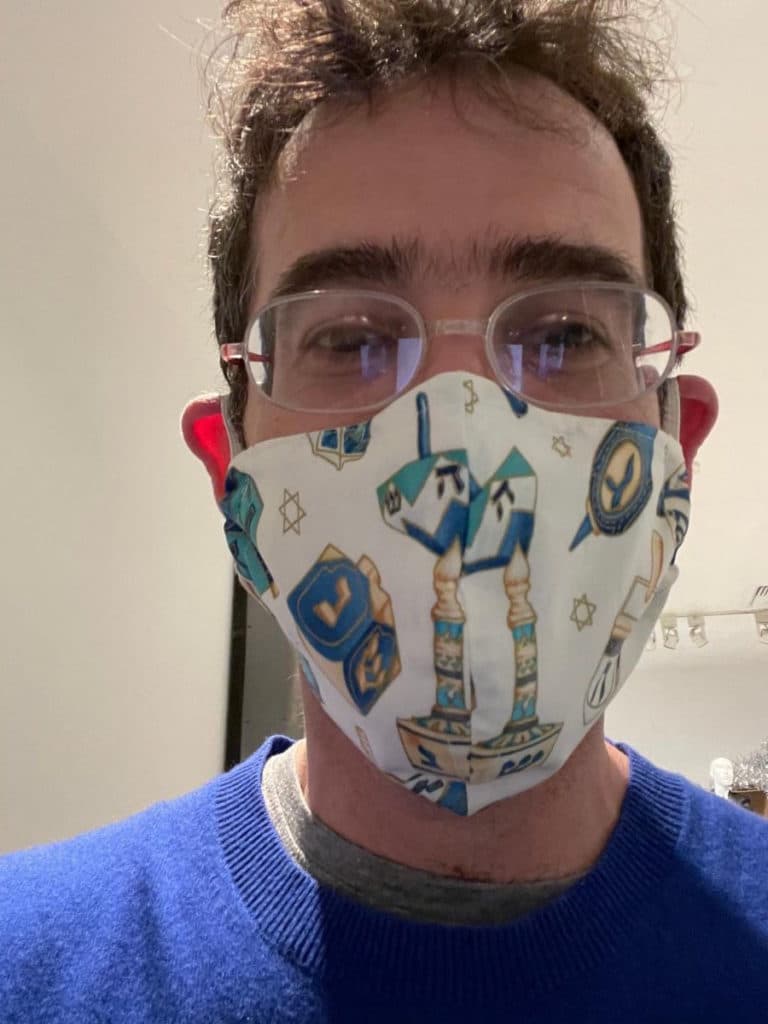
Ron and I were checking out of the grocery store when the cashier wished me a “Happy Hanukkah.”
I looked to Ron and asked, “How did she know I was Jewish?” Ron responded, “Have you looked in the mirror recently?”
(Yes … I had forgotten I was wearing this dreidel mask!)
But it made me think … For those who are Jewish: how does your being Jewish manifest itself during this season? What thoughts are deepened? What traditions are nurtured? What cultural ties are more visible?
This season offers a moment in time to allow your Jewish light to shine. We come from an awesome and unique history. Our time on earth is a milestone in the journey of our people. It’s one thing to just fit in. It’s another to be a landmark on the roadmap of Judaism!
This year has been devastating for the world and for the Jewish community of Los Angeles. COVID-19 closed summer camp, synagogues and businesses. It also left many Jewish families struggling to meet even their most basic needs.
Jay Sanderson, president and CEO of the Jewish Federation of Greater Los Angeles, said this crisis has been unlike any the Los Angeles Jewish community has ever seen. The need for funds to pay for rent, childcare, utilities and medical expenses skyrocketed. The closure of food pantries exponentially increased the need for food deliveries. Holocaust survivors’ need for necessities and grocery deliveries heavily increased. Hunger among Jewish students sharply increased. The mental health toll has also been widespread.
Jay Sanderson
“I’ve restructured the organization three times in the 10 years I’ve been here,” Sanderson said. “To be an organization that deals with these issues, you have to continually evolve and constantly adapt. Very few could have predicted this pandemic; we’ve never worked harder to deal with it.”
Sanderson and the Federation team wanted the entire Jewish community to lean on them for help this year, as they have for the last 100 years. So the Federation rose to the occasion to secure their community and protect its most vulnerable while also innovating new activities to keep people engaged and connected.
Addressing Economic Struggles
Becky Sobelman-Stern, executive vice president and chief program officer at the Federation, said the first thing the organization did was launch the COVID-19 Response Plan to deal specifically with the damage caused by the pandemic.
The Federation launched new programs to provide food to synagogue members, college students, young adults, Holocaust survivors, seniors and other community members in Los Angeles and Israel. West Hollywood residents Sarah and Aaron (names changed for confidentiality) were just one example.
The couple, who are Ukrainian Holocaust survivors, were overwhelmed when COVID-19 first hit. The Federation provided Sarah and Aaron with comprehensive services, including a Russian-speaking in-home care worker who helped with cleaning, cooking, shopping, driving, bathing and dressing Aaron. It also arranged for weekly deliveries of frozen meals, funds for a new freezer and virtual socialization opportunities.
“I’m blown away by our Jewish leaders,” Sanderson said. “They have enough strength to tackle these issues, and if Jewish leaders are capable of looking beyond their own institutions to see how to collaborate for the end-user, rather than just their institution, we’ll get out of this. We’ll find light out of death.”
In August, the organization helped young adults form a Serve the Moment L.A. chapter to provide food and other resources to those in need. In September, the Federation also launched the CARES Fund, which provided 55 community partners — synagogues, early childhood centers, day schools, museums, summer camps and JCCs — with guidance on reopening in compliance with COVID-19 protocols. These funds helped pay for Personal Protective Equipment (PPE), ventilation upgrades, facility and classroom upgrades (plexiglass panels, desk shields and fully equipped touchless restrooms) and staff training on COVID-19 safety measures.
Assembling food and supplies for Serve the Moment. Photo courtesy Jewish Federation of Greater Los Angeles
Dr. Sarah Shulkind, head of Milken school, told the Journal that if the school didn’t receive relief from CARES fund, it would have dipped into the school’s tuition assistance fund to cover the costs of virtual and in-person learning. CARES helped fund Milken’s nursing stations, receptionist areas, teaching units, washing stations and outdoor pods.
“There’s just been so much to worry about in such an operational way” Shulkind noted, but to “have the Federation really making sure the basic needs are provided for…has been valuable personally and professionally.” “There are all kinds of things that seem small but they were really essential to the operation to the school,” Shulkind said.
Providing Emotional Support
The Federation has also recognized emotional wellness as an integral part of surviving the pandemic. For more than 10 years, the Ezra Network provided community members in crisis with access to a range of services including government programs, medical insurance, unemployment benefits, pro bono legal services, job search assistance and mental health counseling.
Calls to the Federation from struggling community members doubled as a result of the pandemic’s toll on mental health. The Federation has been receiving the voicemails and directing callers to resources that provide counseling and emotional, legal and financial support.
Anastasia Shostak started her job as program coordinator at the Federation’s Caring For Jews In Need project the week the pandemic hit. For the past 10 months, she has been overseeing the Community Call Line((323)-761-8305) and directing hundreds of people to professionals so they seek the care they need.
“There are so many people struggling in our Jewish community financially and emotionally,” Shostak said. “A lot of callers come to us as a last resort. People have called in a vulnerable state… you can’t even compare the influx of requests we [are getting] to what it was before. It’s one of our top priories.”
In the first half of 2020, the Federation’s partner social workers helped 880 clients, over 400 more clients than they serviced in the first half of 2019. By April 2020, the Federation increased staff hours and hired an additional social worker to the Ezra Project, allowing them to serve more than 200 clients since August.
“We try to share what is available from the city, from the state [and] at the national level, we put it all in one place,” Shostak added. “We try to keep up with what the community needs, and I think we have been in the right direction so far.”
Bringing People Together
The Federation thrives on bringing people together for various events yearly. When in-person gatherings couldn’t happen, the Federation focused on Zoom and Facebook Live. From rabbi roundtables to cooking presentations, the annual Tour De Summer Camp fundraiser and comedy shows, the Federation put on a range of virtual and semi-virtual events for every age group in the community.
Michael Fritzen, the Federation’s PJ Library program manager, realized that for many families, this would be the first time everyone was under one roof 24/7. He and his team equipped families with free books, at-home activities, virtual events and parent sessions. Before the pandemic, Fritzen said, PJ Library L.A. served around 13,500 families. That number has jumped to more than 14,000.
One-and-a-half year-old Poppy enjoys PJ Library’s Hanukkah goody bag. Photo courtesy of the Iwamoto Family
Fritzen noted that this year, PJ Library wanted to diversify their content. “The Jewish family is changing and looking a lot different,” Fritzen said. “We made a concerted effort to reach out to the Persian community, the LGBTQ community, Jews of Color and offer them PJ Library as a resource and ask them how we can best serve them at this time…We want the books to represent everybody. In 2021, you’re going to see more books with different faces and different stories.”
The Federation also had to respond rapidly to killings of George Floyd, Breonna Taylor and Ahmaud Arbery, which prompted protests among the Jewish and greater Los Angeles community. The Federation was among the growing group of organizations calling for ‘immediate action’ from government officials to hold police officers accountable.
Sanderson said all Jewish spaces need to be inclusive so that Jews of Color feel safe and valued. “This is about the whole Jewish community and Jewish institutions creating environments that everybody wants to walk into and eliminating as many barriers to entry as possible,” Sanderson said. “This isn’t something that is anywhere near resolved at this moment.” But he emphasized that organizations need to “reach out to those who don’t feel welcomed, and we need to find out what the concerns are and what the barriers are and eliminate them… I’m very proud that the Federation has made it a priority.”
Adapting the Holidays
Jewish holidays are an essential time for families to gather and observe Jewish traditions. The Federation knew this year would be different, so they worked with the community to keep the holidays meaningful. On the second day of Rosh Hashanah, the Federation partnered with IKAR for the first annual Shofar Wave — bringing together synagogues, rabbis and congregants throughout Los Angeles to sound the shofar simultaneously outside. During Hanukkah, the Federation’s young adult network, NuRoots, adapted their annual Hanukkah lighting party “Infinite Light” into a virtual party featuring Mayim Bialik, Stephanie Butnick, Jackie Tohn, Alex Edelman and Joshua Silverstein.
Beth Shir Shalom during the Shofar Wave.
As 2020 comes to a close, Sanderson noted that although he is proud of the efforts the Federation did this year, he’s more proud of “the Federation for building an infrastructure that allowed us to pivot,” Sanderson said. “We need to be able to deal with big challenges and new challenges… We’re not going to solve every problem every day. But at the end of the day, the Jewish Federation’s relationship with the community of Los Angeles and globally is getting stronger, and we will continue the work we do into 2021.”
The Jewish Community Foundation of Los Angeles (JCFLA) announced Dec. 21 it has awarded $3 million in grants to 19 organizations as part of the institution’s comprehensive COVID-19 relief efforts.
The distributions are part of the foundation’s effort to sustain local Jewish non-profits experiencing economic hardship because of the pandemic.
“The human suffering and economic toll on our communities – which we are closely monitoring locally, nationally and in Israel – are devastating,” Foundation President and Chief Executive Officer Marvin I. Schotland said in a statement to the Journal. “As the pandemic rages on, those with the capacity to give must continue to step up. The Foundation and our 1,300 generous donor families remain steadfast in our commitment to ensuring the viability of programs and organizations as they navigate through these difficult times, including a precipitous decline in fundraising.”
The latest round of grants builds upon $2.5 million awarded this past July to 22 Los Angeles-area non-profits to address vital needs, including food and housing insecurity, financial assistance and access to health care.
To date, The Foundation has awarded $5.5 million in grants to 41 non-profits. The remaining dollars that are part of this second phase will be distributed in early 2021. The grants are all under the previously announced COVID-19 Response Grants initiative, where the Foundation directs $8.3 million of its 2020 institutional giving for pandemic response and relief. This amount, coupled with The Foundation’s institutional giving, brings grants committed for COVID-19 relief to nearly $14 million in total.
This amount, coupled with The Foundation’s institutional giving, brings grants committed for COVID-19 relief to nearly $14 million in total.
Of this $3 million, $1.5 million will be awarded to 16 current and former Foundation grant recipients including university Hillels, the Pico Union Project, Silverlake Independent Jewish Community Center, Builders of Jewish Education, Friendship Circle, JQ International, Jewish Big Brothers Big Sisters of Los Angeles, The Miracle Project, Fuente Latina, 30 Years After, Honeymoon Israel and Moving Traditions.
One million will also be awarded to Jewish day schools and summer camps to help with tuition assistance and camp scholarships.
The remaining $500,000 will be distributed to organizations helping address critical needs in Israel. This includes unemployment, food insecurity, paramedical care and the welfare of at-risk youth. The grants will be made out to two organizations: the American Jewish Joint Distribution Committee and Latet.
Asher Gellis, executive director of LGBTQ Jewish non-profit JQ International shared how grateful he and the JQ community are for the Foundation’s investment.
“JQ International can meet the needs of our most vulnerable community members and provide life-affirming support services, educational outreach and training, and connection for LGBTQ+ Jews and allies during this challenging time,” Gellis said. “We extend our sincere thanks to The Foundation and all our supporters.”
Rabbi Michy Rav-Noy, executive director of the Friendship Circle of Los Angeles also shared his thanks.
“We are deeply honored and so grateful to be a COVID-19 Response Grants recipient,” Rav-Noy said. “The Foundation funds will help us meet the challenges ahead as we continue to provide ongoing support and vital programs to the Jewish special needs population we serve during the pandemic.”
Established in 1954, the Jewish Community Foundation of Los Angeles manages charitable assets of more than $1.3 billion entrusted to it by more than 1,300 families and ranks among the 10 largest Los Angeles foundations. In 2019, The Foundation and its donors distributed $129 million in grants to 2,700 non-profits with programs that span the range of philanthropic giving. Over the past 13 years, it has distributed more than $1 billion to thousands of non-profits across a diverse spectrum.
2020 may have brought biting loneliness, economic hardship and major pressure, but we can still end on a high note. It is time to make good on Irving Berlin’s dream of a white Christmas and turn Los Angeles into a ski resort.
There is a justification for this, and it is hidden in plain sight. The original first verse of the famous song usually gets edited out, and it is actually about some guy in Los Angeles dreaming of snow: “The sun is shining, the grass is green/ The orange and palm trees sway/ There’s never been such a day/ In Beverly Hills, L.A.,/ But it’s December the twenty-fourth/ And I am longing to be up North. I’m dreaming of a white Christmas…”
It sounds like Irving Berlin had never lived in a Northern climate, where a snowy winter can come with months of cloud cover, short days, rain, precipitation, accompanying head colds and mopey faces. Berlin may dream of being up North, but I’m dreaming of winter in my spiritual home on the Malibu shores.
Ironically, Berlin lived in Europe until the age of 5, where he was originally named Israel Beilin. Some accounts say he was born in Tyumen, Siberia, others say he was from the shtetl of Tolochin in Imperial Russia (now Belarus). Berlin lived the rest of his life in New York, so it sounds like he got the freezing Decembers he dreamed of. Personally, I’d still choose Malibu. Although with the song royalties, Berlin’s descendants could buy up half of southern Florida and enjoy the sun while Northerners freeze.
Some modifications will have to be made if we are to adapt Los Angeles into a fully-functioning or even partly-functioning ski resort, although this may be welcomed as a pleasant distraction whilst the city is in dysfunction. To make up for Los Angeles’ lack of snow — it hasn’t snowed in the city since January 1962 — perhaps we can entice Elon Musk to re-route his underground hyperloop so it connects New York to Los Angeles, allowing us to ship in snow from the East Coast. This should ease up their harsh winter, but failing that, we can send some Ubers on a round trip to Northern California and stuff their cars with snow. A great choice would be to retrieve some from freezing Yosemite, or as a friend once printed on her range of t-shirts, “Yo, Semite!”
A key feature of every decent ski resort is a run of moguls, the large mounds that have to be navigated as you descend the mountain. In lieu of these naturally-occurring oversized bumps, we can use the other naturally-occurring mogul — disgraced Hollywood executives — and tie them down to the mountain to serve as an obstacle for people to avoid (which conveniently serves as an accurate metaphor for the dark side of their careers). The first strapped-down mogul run can be called “Weinstein’s Regret.”
We can use the other naturally-occurring mogul — disgraced Hollywood executives.
The entire Santa Monica mountain range will suffice for a spacious ski resort, with the Mulholland ridge reserved for cross-country skiing and the Malibu mountains converted into more perilous high-octane slopes. Covering Malibu with snow will also provide residents with an impenetrable fire barrier. To make space for the resort, residents will also have to forcibly relocate. Apart from that, and the fact that a freezing Malibu will lose billions of dollars’ worth of property value, it is a win-win.
There may be problems to overcome, but Los Angeles is a city of possibility and a place of creative results. It is a city of angels, a city of dreams and could be a city of ski lifts. Fairfax Avenue’s steep incline will make for a great straight downhill run from Hollywood Blvd down to Santa Monica Blvd, although skiers may prefer to walk back up after their energy boost from a cold-pressed green juice.
Obviously, we will have to adjust certain terminology around the ski slopes. The potentially offensively-titled song “White Christmas,” for example, will have to be renamed. Instead, we’ll hire a lot of unemployed actors and have them give hourly renditions of “there’s no business like snow business.” Thank you, I’m here all season.
Marcus J Freed is an actor & filmmaker. www.marcusjfreed.com and on social @marcusjfreed




 Los Angeles poet Rick Lupert created the