fbpx

December 11, 2020

Club Z: Anti-Zionism is “Most Potent Form of Anti-Semitism”

Club Z, a Jewish education organization for teens, hosted a webinar on December 10 arguing that anti-Zionism is the “most potent form of anti-Semitism today.”

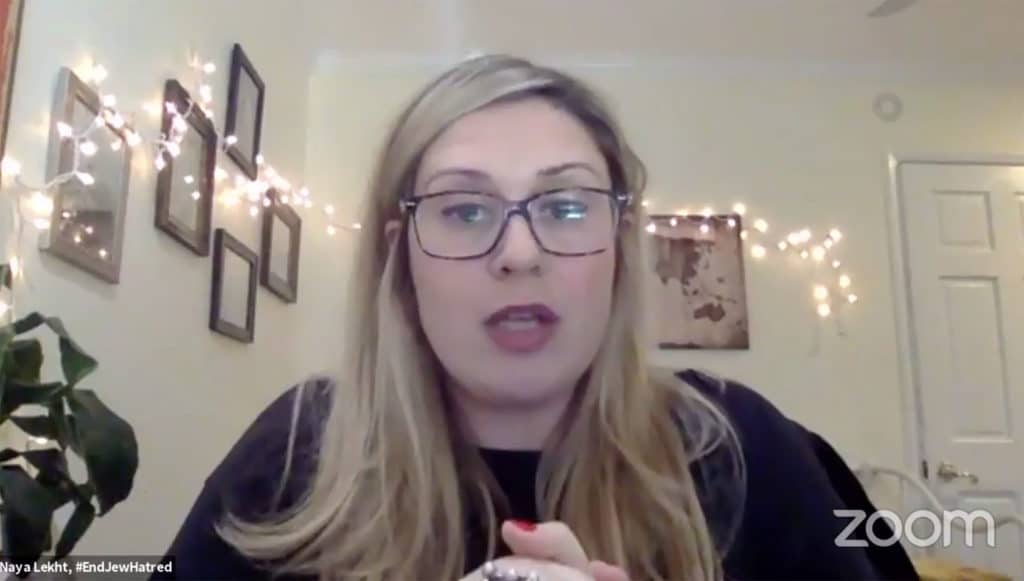
The webinar featured Dr. Naya Lekht, Club Z’s director of education, as well as Los Angeles Israeli Counsul for Public Diplomacy Jonathan Bar-El and Club Z Regional Director Odin Ozdil. Lekht gave a presentation during the webinar explaining the history of anti-Semitism and its various iterations. She explained that the term “anti-Semitism” was first coined by German publicist Wilhelm Marr in 1878 and that Marr had used that term because he was arguing that he didn’t hate Jews for their religion, he hated Jews for their race.

“In each iteration of Jew hatred, the Jew was seen as a violator of the tenets that the society at that time held into esteem,” Lekht said. “In Medieval Europe, the esteem was Christianity guided by Christian principles. Post-Enlightenment Europe, guided by science, reason, age of Darwinism, and today, our society is guided by social justice, human rights. And in each one of these cases, we are violators, according to the anti-Semite.”

She then explained that anti-Semitism tends to take the form of blood libels, world domination, demonization, dual loyalty, dehumanization and avarice. In the case of blood libels, Jews were accused during Medieval Europe of killing “Christian babies in order to make matzah from their blood” which was a “pernicious lie so powerful it spread like wildfire,” according to Lekht. As an example of a modern-day blood libel, Lekht pointed to a cartoon of a Jewish man drinking a Palestinian child’s blood. Lekht said that when she taught at UCLA, she showed such cartoons to students and they initially thought that they were just criticism of Israel until she pointed out that such blood libels only apply to Jews.

anti-Semitism tends to take the form of blood libels, world domination, demonization, dual loyalty, dehumanization and avarice.

“Once again, we’re seeing old tropes, old accusations being applied to the Jewish state,” Lekht said.

For world domination, she pointed to a cartoon from a German newspaper depicting Israel as a spider ensnaring various Arab nations in a web. Lekht said that this trope of demonization stemmed from Jews being accused in the third and fourth centuries of acting as demons. Modern-day examples of this trope include a cartoon of the devil bowing before Israeli Prime Minister Benjamin Netanyahu and Representative Ilhan Omar’s (D-Minn.) 2012 tweet that Israel is hypnotizing the world, according to Lekht.

The dual loyalty trope stems from the emancipation of the Jews during the French Revolution, Lekht said, when it was said that “the Jews should be denied everything as a nation but granted everything as individuals.”

“It shows us that the non-Jews, the outsider, always understood that Jews a constitute a people, a nation, and inserted in the minds of their neighbors, ‘Can you really trust the Jew? Where does the Jew’s loyalty lie?’” Lekht said.

A more recent iteration of the dual loyalty trope could be seen in 2014, when UCLA student Rachel Beyda was asking during a hearing for a student council position if she could be unbiased on Israel-related matters because she’s Jewish, according to Lekht.

“As Jews, we historically have to prove our loyalty,” Lekht said, arguing that it would be the equivalent of asking Black students if they can be unbiased on race relations matters.

Examples of the dehumanization trope include a cartoon from the infamous Nazi publication Der Sturmer depicting a Jewish man as a spider ensnaring an Aryan woman. And for avarice, Omar’s “It’s all about the Benjamins” tweet is an example, Lekht said.

“It’s so interesting to me that Jews are accused at the same time of being subhuman and superhuman,” Lekht said, arguing that the same contradiction can be seen in accusations of Jews being both communists and capitalists.

No matter the form of anti-Semitism, it all shares the same goal of annihilation of the Jewish people, Lekht argued.

“If you can indeed prove that a people is an evil people, an illegitimate people and an untrustworthy people, you can deny their right to exist,” Lekht said, pointing out that today it manifests in calling for the destruction of Israel.

To show how anti-Zionism is anti-Semitism, she pointed to various quotes, like Omar’s “Israel has hypnotized the world” tweet, and replacing the word or “Zionist” or “Israel” with “Jew.”

She believes that anti-Zionism is the most potent form of anti-Semitism today because “it is weaponized by Jew haters as a cause for human rights” and it is institutional, arguing that it permeates throughout the media, academia and the United Nations.

Lekht encouraged Jewish students to report instances of anti-Zionism and anti-Semitism to campus administrators.

“If you are experiencing an attack on your history on your identity and you’re not saying anything, there’s not anything anybody could do,” Lekht said, adding: “it is your duty as Jews to do this.”

The full webinar can be seen below:

Club Z: Anti-Zionism is “Most Potent Form of Anti-Semitism” Read More »

HSM Series’ Julia Lester, Larry Saperstein Perform Classics for Disney+ Holiday Special

We’re all in this together this holiday season because Disney+ is gifting us with a Hanukkah “High School Musical” crossover.

In honor of the festival of lights, Julia Lester— who plays Ashlyn on the musical-reboot series, “High School Musical: The Musical-The Series”— is performing Hanukkah favorites with a pop-twist.

Titled, “Hanukkah Medley,” the song is part of the Disney+ holiday show, “High School Musical: The Musical: The Holiday Special.” In the music video, Lester, who is Jewish, jams out to “Dreidel, Dreidel, Dreidel,” “Hanukkah, Oh Hanukkah,” and “Hanukkah (Festivals of Lights).”

Lester, who grew up in Woodland Hills, spoke about her inspiration for the Hanukkah medley during the special, along with Hanukkah traditions she and her family would partake in every year.

“I could definitely sing you a hundred different Christmas songs off the top of my head,” Lester says during the special. “But, where’s the Mariah Carey version of a Hanukkah song? So, I thought [in the special] I would add a little bit of music video flare to Hanukkah.”


View this post on Instagram


A post shared by Juj (@julialester)

Larry Saperstein, who plays Big Red on the show, also shares his Hanukkah traditions and pride for Jewish roots. He also shares photos of him dressed as a menorah when he was five-years-old.

“Sometimes I did feel embarrassed that I celebrated Hanukkah and not Christmas,” he said during the special. “Now that I’m an adult I’ve taken real ownership over the fact that I am Jewish and that I do celebrate a holiday that might not be what everybody celebrates and it makes me unique and I’m so proud of that.”

While he doesn’t sing a Hanukkah song per se, he breaks out his musical theatre hat and tap shoes to perform “White Christmas,” written by Jewish legendary composer Irving Berlin.

Disney+ first introduced “HSMTMTS,” to the world last November along with the launch of the Disney streaming platform. Following in the footsteps of Disney’s 2006 musical phenomenon “High School Musical,” the series follows the students from East High, the school where the HSM films were shot and stage a musical production based on the franchise.

While fans are awaiting Season 2, which was delayed due to COVID-19, they can now enjoy seeing the cast reunite for the holidays.

“High School Musical: The Musical: The Holiday Special,” is available to stream on Disney+.

HSM Series’ Julia Lester, Larry Saperstein Perform Classics for Disney+ Holiday Special Read More »

How to Adapt Dating to COVID-19

When COVID-19 first appeared, a slew of coronavirus-related love stories populated our news feeds. There were clever “Love in the Time of Corona” references, a modern-day play off of Gabriel García Márquez’s “Love in the Time of Cholera.” The news covered socially-distanced weddings and sweet stories of couples in relationships meeting for dates along Europe’s country borders when they were closed to travelers.

There were also stories of couples breaking up after being cooped up with a partner that they never had to spend so much time with before. On the other end of the spectrum, some singles stayed with people they weren’t that into just for company or jumped into relationships with those they otherwise might not — maybe even after just a date or two — to avoid sheltering in place alone.

Some couples, where one works in a high-risk job, are temporarily living separately or staying in separate parts of their home. If couples are dating and don’t live together, many are only seeing each other outside at a distance and wearing masks.

Three seasons have passed, and despite a vaccine on the horizon, there seems to be no end in sight, and people are as isolated and lonely as ever. As a matchmaker and dating coach, I still get a lot of questions as to how to find or maintain love amidst a pandemic. Many want to know if it is even possible to date during COVID-19.

Although the stakes are higher and dating is more dangerous than it used to be, the overall idea is still the same: Where there’s a will, there’s a way!

Although dating is more dangerous than it used to be, where there’s a will, there’s a way!

When I advise individuals on dating, I always encourage them to take things slowly and to be safe. But people will make their own decisions and use their judgment to do what they feel is best for them, as with anything else in life. Those who are generally cautious and careful will be so with dating during the pandemic. Those who have never been concerned with safer sex are not likely to worry about catching COVID-19, either.

Many of the cautious people had put off trying to meet someone new to stay safe and because it became seemingly complicated to date. As the months dragged on, though, most people have found ways to adapt. I’ve had to adapt my dating advice, as well.

Before COVID-19, I usually asked my clients to meet in-person as soon as possible and not spend much time or emotional energy emailing, texting or talking on the phone so as to not develop attachments before an actual date. If you don’t have in-person chemistry, it can all be over in a few minutes. For my matchmaking clients, I usually encouraged blind dates, unless it was a long-distance match and people had to travel for hours to meet.

But now, after consulting with several doctors, I suggest talking by phone several times and maybe even exchange photos to see if there’s an attraction before meeting. I also usually recommend a brief first date, like a walk in a park or beach, to see if there is chemistry in person. That way, no one invests too much time or money on the first date — which they would have done if they were having a meal together. That much still applies, but to minimize the risk of COVID-19, I suggest a socially-distant walk with masks as a first date.

After several socially-distanced dates, if you like each other, you can essentially isolate for 14 days, still talking on the phone and even adding video calls to get to know each other better. I suggest not doing video calls at first since people tend to look bad on web cameras. Moreover, conversation usually flows better on the phone when you are not distracted by how you look on the screen.

If all goes well after the two weeks and you still like each other, then have dates without masks a few times to determine if you want to become each other’s “pod” and turn it into a relationship. As with normal times, after a few weeks or months, it’ll become clear if this has the potential to turn into something serious. If the two of you can successfully navigate a relationship during the trying times of COVID-19, you probably have a pretty good chance of making it long-term.

Good luck, stay healthy out there, and I wish you love!


Judith Gottesman, MSW, is the West Coast Jewish Community’s Matchmaker and Dating Coach. She founded Soul Mates Unlimited®️ in 2009 to help Jews of all ages find lasting love. Her companion book set on finding your soul mate and dating tips is soon to be released. For more info and free dating tips, go to www.SoulMatesUnlimited.com


How to Adapt Dating to COVID-19 Read More »

The Bagel Report

The Big Bagel Theory with Mayim Bialik

All of our Hanukkah dreams come true for this conversation with the prolific and brilliant Critics’ Choice Award winning actress, neuroscientist, author, mom and mogul-in-the-making Mayim Bialik. Mayim tells the Bagels about filming her new show “Call Me Kat” (Jan. 3 on FOX) during the pandemic and her “Breakdown” (new mental health podcast). Later they get into a conversation about non-Jewish actors playing Jewish roles and breaking down gender and body stereotypes in Hollywood.

Plus, we ask Mayim a question she’s never been asked in an interview before! Here’s a hint: it’s about her characters and Bat Mitzvah themes!

Tune in for one interview with enough content to last all eight days of Hanukkah! Happy Hanukkah to all, and to all a good night. 🙂

Follow Mayim Bialik on Twitter, Facebook and Instagram @missmayim. Also check out her Youtube page.

Follow Erin, Esther and The Bagel Report on Twitter! 

The Big Bagel Theory with Mayim Bialik Read More »

I Have Questions About the NYT’s “Saying Goodbye to Hanukkah.”

I have questions about the New York Times’ parenting article, “Saying Goodbye to Hanukkah,” published on December 4, 2020.

The piece was written by children’s book author Sarah Prager, a self-described non-Jewish woman whose Jewish father and Catholic mother raised her Unitarian. Throughout her life, she has never observed any Jewish holidays. She recounts how she (like the rest of her extended family) has chosen not to continue her family’s holiday tradition of eating latkes, lighting a menorah on Hanukkah, reciting Hebrew prayers (which, as she explains in her piece, she experienced as meaningless) and decorating their Christmas tree with Jewish symbols. She and her non-Jewish wife and their two non-Jewish children, she writes, will not be celebrating Hanukkah — only Christmas and Easter (though in a secular way), because that’s what her extended family celebrates.

I’m curious about the thinking that went into publishing that piece. I’m not offended by someone choosing not to celebrate a holiday from my religious tradition. And I’m not offended that the opinion was published. I am a fan of publishing controversial opinions. I just don’t get it. I need help understanding what important insight about this Jewish holiday, or about giving it up, warranted an article in the venerable New York Times.

Given the ideological leanings at the paper, I could almost understand the reasoning if the thesis of the piece had been about treating Hanukkah less as a religious observance than a form of what’s now called cultural or religious “appropriation” (the adoption of elements of a minority’s culture by members of a more dominant group). This particular appropriation doesn’t bother me. As long as it is done with a respectful intention, it’s fine with me for non-Jewish people (whether or not they have Jewish family members) to use Jewish stars on their Christmas trees, eat latkes, light menorahs or even say Hebrew prayers without understanding them or finding them meaningful. But strictly speaking, that is not a religious observance, even if it feels less “secular” than the other ways in which a person celebrates the holidays.

More to the point, it strikes me that if a writer had pitched an identical piece that substituted any other non-Christian religion for Judaism, it would have been received differently by the New York Times’ editors.

Imagine, for example, if the piece had revolved around a non-Hindu woman who was raised Unitarian by her Hindu father and Catholic mother and never celebrated any Hindu holidays. As a child, her family’s holiday traditions included, among other things, eating vegetable pakoras, lighting the oil lamps used in celebrating Diwali and decorating her family’s Christmas tree with images of Ganesha. Would the Times have thought she had the standing to write a piece about her choice not to celebrate Diwali with her two non-Hindu children and her ex-Catholic wife? And would the paper have published such a piece, titling it “Saying Goodbye to Diwali”?

A paper that is sensitive to indignities suffered by people of almost every non-majority background is oddly insensitive to people from a particular one.

If the answer is yes to both, then, although I still don’t understand the thinking, I have no problem with the choice to publish “Saying Goodbye to Hanukkah.” I suspect, however, that had such an alternate piece been suggested, it would have immediately been rejected as absurd. And that is what concerns me. A paper that is exquisitely sensitive to indignities suffered by people of almost every non-majority background is oddly insensitive to people from a particular one.

It’s not that I think that Jews (or anyone else) need to be treated with kid gloves. It’s a question of a double standard. When the New York Times treats Jews with less sensitivity than it treats members of other minority groups, it sends a message that there is something about Jews that is less deserving of concern and care.

Too easily, this double standard can descend toward anti-Semitism –– something the Times can have trouble even recognizing. So I have questions.

I hope the paper of record has them, too.


Pamela Paresky, PhD, is a writer for Psychology Today, author of A Year of Kindness and was the chief researcher and in-house editor for the New York Times bestseller, “The Coddling of the American Mind.” She serves as Visiting Senior Research Associate at the University of Chicago’s Stevanovich Institute on the Formation of Knowledge and Senior Scholar at the Network Contagion Research Institute, where she researches extremism and anti-Semitism. Follow her on Twitter @PamelaParesky

I Have Questions About the NYT’s “Saying Goodbye to Hanukkah.” Read More »

The Marriage of Hanukkah and Shabbat Brings a Special Light

Once a year, we do a double, magical lighting. The candles of Shabbat meet the candles of Hanukkah. In a year when we’ve seen so much darkness, this marriage of lights holds a special significance.

The Shabbat candles are inward; they represent the warmth and holiness of the home. They remind us to bring the peaceful light of Shabbat into our sanctuary during the week. They are a blessing, a halo for peace in the home.

Hanukkah candles are outward. We light them near a window, where they can be seen from the outside. They represent the Jewish ideal of spreading light throughout the world. Once we feel secure and peaceful in our home, we go out and help repair the world. That is Hanukkah, the imperative to look beyond our own confines.

In the year of COVID-19, however, we’ve been stuck in our homes. It’s been more difficult to look beyond, to help out, to engage with others. We’ve been physically distanced. We’ve been in permanent Shabbat mode, looking inward, wary of the darkness outside.

For this one night, we can remind the world and ourselves that peace in the home is the first step to peace in the world.

But this darkness presents an opportunity. A flame is more visible when it’s dark. The flame of Hanukkah will be especially visible in this year of darkness. So tonight, when the Hanukkah light meets the Shabbat light, can we do something different?

Yes — we can make both lights visible at our windows. We can use the outward light of Hanukkah to spread the inward light of Shabbat. Right now, in these trying times of quarantine, that inward light is the one we need most.

For this one night, we can remind the world and ourselves that peace in the home is the first step to peace in the world.

Shabbat shalom and happy Hanukkah.

The Marriage of Hanukkah and Shabbat Brings a Special Light Read More »

Hanukkah Entertainment: Celebrate Virtually with Movies, Music and Other Events

In this pandemic year, staying safe and apart from loved ones makes for a less festive Festival of Lights, but if you have an internet connection, there are fun ways to celebrate Hanukkah virtually.

The Jewish and Israeli streaming service ChaiFlicks is hosting its first Hanukkah Film Festival, offering its subscribers eight days of specially selected movies including “The Mover” and “The Shabbos Goy.” During this time, new subscribers can get a lifetime subscription for $18. Sign up at ChaiFlicks.com.

Israel Film Center Stream has added 10 new films to its collection, just in time for Hanukkah. Titles include the Ophir Award-winning “The Cakemaker” and “Baba Joon,” multiple Ophir nominee “The Kind Words,” and festival favorites “The Other Story,” “The Last Suit,” “Wedding Doll,” “A Borrowed Identity,” “Cupcakes,” “Yossi” and “Zaytoun.” Each film costs 5.99 to stream at IsraelFilmCenterStream.org.

Foo Fighters frontman and founder Dave Grohl isn’t Jewish, but he has teamed up with Grammy-winning producer and MOT Greg Kurstin on “Hanukkah Sessions,” eight songs written by Jewish artists that will be released one per day during the holiday.

“Greg and I were kibbitzing about how we could make Hanukkah extra-special this year. Festival of Lights?! How about a festival of tasty LICKS! So hold on to your tuchuses…we’ve got something special coming for your shayna punims,” Grohl posted on Twitter. “[We] decided to celebrate Hanukkah by recording eight songs by eight famous Jewish artists and releasing one song each night of Hanukkah–for you, so we hope you enjoy.” Night one’s honoree: The Beastie Boys. Visit https://twitter.com/foofighters to watch.

Can a Jewish woman from Mexico City find acceptance in a small town in Oregon? Does giving up Jewish foods on a diet mean giving up your Jewish identity? These stories and other funny, poignant, and meaningful tales about sibling rivalry, parents and children, and Jewish life will be told in The Braid/Jewish Women’s Theatre’s salon show “Arise My Friend My Beautiful One and Go Forth,” Dec. 14 at 7 p.m. PST.  The performance will be followed by a Q&A with the cast. Tickets are $18. Click here for reservations.

Hanukkah Entertainment: Celebrate Virtually with Movies, Music and Other Events Read More »

david suissa podcast curious times

Pandemic Times Episode 111: How Important is Self Love to Joy and Success?

New David Suissa Podcast Every Tuesday and Friday.

A conversation with Melody Godfred, the self-love philosopher, author and poet.

How do we manage our lives during the coronavirus crisis? How do we keep our sanity? How do we use this quarantine to bring out the best in ourselves? Tune in and share your stories with podcast@jewishjournal.com.

Listen on Apple Podcasts

Listen on Spotify

Listen on Stitcher

Follow David Suissa on Facebook, Twitter and Instagram. 

Pandemic Times Episode 111: How Important is Self Love to Joy and Success? Read More »

Oil Vey: What to Do about Hanukkah This Year?

In normal years, I have a favorite Hanukkah tradition. I invite over a bunch of friends, light menorahs with them, put cast-iron pans on all four of my stove’s burners and fry more latkes than anyone can possibly eat. Sometimes, I combine this celebration with a Shabbat dinner if it’s Fry-day. Because I go through enough layers of oil to supply a few temples — and re-season the cast iron — I call it “Spa Night for Cast-Iron Pans.”

This Hanukkah, I might make myself a few latkes, but there will be no such spa night. Even my cookware is affected by a pan-demic.

Avoiding gathering is the responsible choice, and one I hope we’re all making. However, convincing people to do the right thing and have a lockdown-ready Hanukkah to prevent anyone from transmitting the coronavirus might require some catchy, schmaltzy branding.

Let’s call it a Latke-down. But it’s not like the only culinary way to mark the holiday involves frying a lot of shredded potatoes, as comment-taters agree. For those inclined toward jelly-filled sufganiyot: Do-nut spread it. If bimuelos are your tradition: Avoid a sticky situation. Cheese pancakes? They’re a spud-alternative that’s fun for dairy lovers to make — even if you don’t lack-taters. But for COVID-19 safety, this still isn’t a Gruyère-area, so: Avoid getting a queso the virus.

Sure, I feel wistful about yet another holiday without company. I miss filling my home with friends. I’d love the warmth of a house smelling like oily potatoes and onions — though it turns out that’s less charming by the time the scent has lingered for eight days. Holidays this year are particularly challenging for the millions of us who live alone, especially when most public health messaging encourages us to celebrate with our “household” — as though everyone has one. My houseplants aren’t fans of latkes, it turns out.

Still, staying home solo is a choice I’m glad to make. I’ve always appreciated how Judaism values health and saving lives above all. Especially as coronavirus case numbers rise and break records, I’d rather light candles alone, since it’s kind of wick-ed to risk lives for a Hanukkah party. That includes the lives of anyone that guests interact with later. Having people over is a gamble for fools: a shel [Hanukkah] game. Just the thought of taking that chance makes me say oil vey.

Having people over is a gamble for fools: a shel [Hanukkah] game.

I know lot of us are burning out faster than the cheapest Hanukkah candles left over from last year — minus the few you used in a pinch on a birthday cake back in January. And we’re burning out right when we need to be more cautious than ever. If you, like I do, cope with life’s challenges through terrible puns — managing a pandemic with a pundemic — you may be thinking by now, “I can’t candle it any longer! I’m filled with a sense of dreid-al the time. I can’t take the constant political spin.” You’re tired of living in the present, and you’d rather we give the virus a wrap.

Maybe you’re even ready to give in and let your kids get a pet kangaroo for Hanukkah. But mostly because you want to name it Anthony Pouchy.

Close that browser tab for Marsupial Marketplace. I’m here for you. If you need a few ideas to manage Hanukkah 2020, I candelaborate further:

    1. Rewrite the Hanukkah Story

While we’re re-writing the story of how we celebrate the holiday, why not update the actual Hanukkah story to something that resonates in 2020? Whether you live with kids, have nieces or nephews you’re in charge of confusing or have friends with kids you can video-chat with, maybe it’s time to tell them a tale with a few creative liberties and a healthy dose of wishful thinking:

Once upon a time, nearly two centuries BCE (“Before COVID-19 Existed”), King Anti-Lockus decreed that all residents must worship certain gods and goddesses, including Artemisinformation. Anyone caught following other traditional rituals — such as anointing hands for 20 seconds with warm, soapy water –– would be subjected to the stormiest of tweets.

However, a scrappy band of fighters called the Maskabees stood up for their right to practice their own culture and follow basic public health directives. After a fierce battle, the Maskabees prevailed — although King Anti-Lockus spent many weeks insisting they didn’t. He tried to hold onto control— raging like a schmucky potato, a.k.a. acting like a dick-tater.

 As news of the win spread, people wanted to rip off their masks immediately, hop the next flight to the temple, then celebrate with indoor dining and casual dating. However, the Maskabee leaders reminded everyone that festivities had to wait until Fryzer prepared a vaccine and enough of the population was immunized.

 Maskabee leaders were worried. They knew the people had only enough patience to last one night.  

 But a miracle happened. The people’s patience lasted for eight nights (which some scholars interpret as “weeks” or “months”) until the vaccine was widely available. This was attributable partly to the fact that they had a bunch of oil sitting around, and they distracted themselves by using it to fry everything in sight. 

    1. Fry Everything In Sight

Frying: It’s not just for latkes, fritters and donuts anymore. Fry everything. Every single thing.

Fry your feelings. Fry the news. Breakfast cereal? Fryer. Salad? Oil isn’t just for dressing, baby. Beans you bought back in March? Forget refried; on Hanukkah, go for re-refried. Fry them as many times as you want. By the eighth night, they should be re-re-re-re-re-re-re-refried.

It’s the Festival of Lights. It’s the Festival of Oil. It’s not the festival of “Go light on the oil.”

Incidentally, this is what we public health types call “harm reduction.” It may not be the healthiest solution, but if it’ll keep us home, it’s worth the trade-off. And it’s a nice antidote to feeling fried.

    1. Awkward Zoom Dreidel

I’ll probably end up assembling friends and family virtually to light our candles together over Zoom. Maybe we’ll each make latkes and eat them while chatting. But why miss out on the chance to make an already awkward platform even more so by playing a game that falters even when you play in person?

The best part: you get to make up the rules. Does gimel mean you get to eat that bag of gelt you bought at the last minute and were starting to eat anyway? Does shin mean your friend has to tell their conspiracy-theorist uncle to wear a mask? Do you choose the letter that lands face up or the one that’s showing when their screen freezes? You decide!

Hey, I know nun of the possible variations will make dreidel fun. What, you wanted another miracle?

Much like the Maskabees or anyone playing dreidel, we hope this will end soon –– though we don’t know precisely when or how it will play out. We’re getting a better idea, though. Plus, we have some collective control over the situation. We can encourage each other to maintain our altruism, be cautious and get vaccinated when it’s an option — even though we’re stretched thinner than the flimsy mask your uncle wears under his nose.

Hopefully, 2021 will bring more coordinated national efforts and funding. But right now, in this candle-filled season, coronavirus cases may wax (and wane). As we’re waiting for January and Biden our time, the goal is to have patience — not patients.

And Hanukkah? It’ll be fine, even though I won’t get to make a lot of latkes. I’m happy to wait it out. I know my friends will understand, and that next year we’ll be grate-ful.

But how am I going to tell my cast iron pans? Oil vey, I feel gelt-y just thinking about it.


Deborah (Debs) Gardner is a public health professional, writer and semi-snarky Jew living in Seattle, WA. Our “pundemic correspondent,” she is a multi-time winner of Pundamonium Seattle, a local pun slam.

Oil Vey: What to Do about Hanukkah This Year? Read More »