Dr. Emmanuel Navon is an International Relations expert who teaches at Tel-Aviv University and at the Herzliya Interdisciplinary Center. He is a Senior Fellow at the Jerusalem Institute for Security Studies and at the Kohelet Policy forum (two Jerusalem-based conservative think tanks) and a Senior Analyst for I24News (an Israel-based international TV channel).
The Media Line — Israeli Ambassador to the United Nations Gilad Erdan on Tuesday informed the body’s secretary-general, António Guterres, that he will soon present a draft resolution recognizing Jews that were forced to flee Arab and Muslim countries following the creation of Israel as refugees.
“The establishment of the Jewish state was one of the most important decisions made by the UN,” Erdan wrote to the UN chief. “The Arab leaders chose to reject this decision and instead launched a widespread attack against the State of Israel and the thriving Jewish communities that lived within [these Arab states].”
“I urge you to … begin sharing the story of 850,000 Jewish refugees deported from Arab countries and Iran in all of the organization’s forums,” Erdan added, noting the importance of promoting “in-depth research on the tragedy of Jewish refugees” and backing “the study of the subject in various UN forums.”
On Monday, Israel observed the official Day to Mark the Departure and Expulsion of Jews from the Arab Countries and Iran, one day after commemorating 73 years since the passing of the historic November 29 UN resolution adopting the partition plan for Palestine and the de facto establishment of the State of Israel.
According to varying estimates, approximately 850,000 Jewish men, women and children were expelled from Syria, Iraq, Yemen, Egypt, Tunisia, Morocco, Libya, Algeria and other countries in the 1930s-1960s. While some communities were forced to flee after falling victim to repeated deadly terror attacks and violence, some were urged to leave by increasingly restrictive government decrees or were even officially deported.
Most emigrated to Israel, with tens of thousands arriving in France and in the United States as well.
“Jews left their homes with only the clothes on their backs.”
“Jews left their homes with only the clothes on their backs,” Miriam Gez Avigail, chair of the Center for Organizations of Arab Countries’ and the Muslim World Jews, told The Media Line.
“And the people who held these states’ economies usually were Jewish,” she adds, noting the vast wealth some refugees had accumulated over the years.
“Their whole property was taken, confiscated by the authorities. They left never to return. We’re talking about a huge sum,” says Avigail, who oversees 11 groups whose stated missions are to help retrieve the communities’ wealth.
Monday’s memorial day, passed into law in 2014, represents Israel’s recently growing recognition of the plight of the Jewish communities in the years leading up to – and immediately after – the nation’s birth.
Israel passed its first laws recognizing some citizens of Arab descent as refugees in 2002, and in 2010 passed a bill protecting Jewish refugees’ rights to receive reparations for their property left behind.
“In any future Middle East peace negotiation, the government shall include the issue of lost property reparations for refugees of Arab countries and Iran, including property owned by the Jewish community in these states,” the law reads.
“After the 2014 law’s enactment, the interest in this historical subject from researchers in Israel and around the world has grown noticeably. Jewish organizations in Israel and abroad have begun dealing with the issue,” Prof. Haim Saadon, who heads the documentation center at the Ben Zvi Institute for the study of Jewish communities in the East, told The Media Line.
As for ambassador Erdan’s latest UN proposal, Saadon said the institute “welcomes any step that will grow the research, documentation, publication and bequeathing of the legacy of Jews emigrating from Islamic countries. We believe the scope of subjects worthy of research regarding the communities in these areas is wide and the institute will be happy to offer its resources and academic reputation to advance the issue.”
The institute has worked for 70 years to document, preserve and publish the stories of Jewish immigrants from the Arab world, offering scholarships and grants, publishing books and hosting academic conventions.
“My parents came from Tripoli, after years of strife,” Albert, a 62-year-old descendant of Libyan-born Jews, told The Media Line. “After the 1945 riots, they realized it was no good. It took them a few years but eventually, they emigrated to Israel.”
The November 1945 pogrom left over 140 Jews dead in Libya, with hundreds injured and several thousand homeless. Synagogues and Jewish places of business were looted and razed.
“They didn’t have much when they came. They weren’t penniless but there was definitely property they left behind,” Albert says.
The exact modern-day worth of property owned by Arab Jewish communities is under dispute, as estimates range from a few billion dollars to $300 billion.
“The exact sum is privileged, because we don’t want to reveal private people’s details and net worth, and we also don’t want to hurt our coordination with Arab governments and future negotiation starting points,” a spokesperson for the Ministry of Social Equality, which is in charge of the issue for the Israeli government, told The Media Line.
Minister Meirav Cohen, who heads the office, met with Ambassador Erdan via Zoom in recent days to discuss the issue prior to his drafting the letter to Guterres, the spokesperson added.
In his statement, Erdan, recently a right-wing MP, also compared Jewish refugees to Palestinian ones, admonishing the UN for dealing “extensively” with the latter while “completely [ignoring]” the former.
“It is infuriating to see the UN mark a special day and devote … resources for the issue of ‘Palestinian refugees,’ while abandoning and ignoring hundreds of thousands of Jewish families deported from Arab countries and Iran,” Erdan wrote, purposely placing Palestinian refugees in quotes.
Though the US House of Representatives has passed essentially symbolic resolutions recognizing Jewish refugees’ rights, most recently in 2008, many in academia and in the international arena believe the comparison between Jewish and Palestinian refugees is misguided.
While thousands of Jews living in the Muslim world were forcefully pushed to leave their homes, they were received in Israel by a Jewish state and were often encouraged to emigrate by Zionist organizations, experts point out.
In contrast, the estimated 700,000 Palestinians forced to flee their homes during the 1948 war did not have a nation-state to go to; most of them and their descendants have since remained in limbo, including many under Israeli control.
During the coronavirus pandemic, theater’s famous catchphrase — “The show must go on” — has taken a new, elevated meaning, as physical performance spaces remain closed to the public. But two British theater companies, Kneehigh Theatre Company and Bristol Old Vic, have managed to bring their latest collaboration, “The Flying Lovers of Vitebsk,” to home audiences around the world.
“Flying Lovers of Vitebsk,” written by Daniel Jamieson, tells the story of turbulent lovers Marc Chagall — born Moishe Zakharovich Shagall in the town of Vitebsk, Belarus — and his wife, Bella Rosenfeld. Their 29-year marriage, marked by both intense passion and Chagall’s single-minded focus on his art, ended with Bella’s death.
Yet, the most loving of marriages has its glitches, such as when Bella gave birth to the couple’s daughter and realized that her husband had disappeared for four days to work on a new painting.
On Chagall’s canvas, the two lovers flew in the air, unencumbered by earthly concerns. But as an undercurrent, their marriage from 1915-1944 spanned World War I and II, the Communist revolution, the rise of Hitler and the Holocaust, during which Nazi troops slaughtered the 50,000 Jews in Vitebsk.
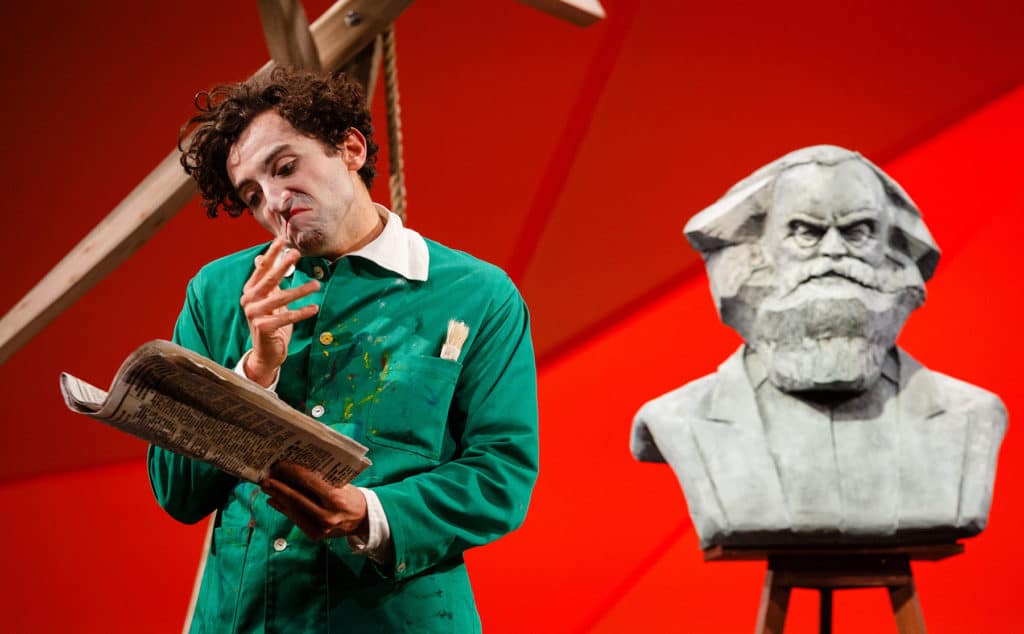
Marc Antolin as Marc Chagall in “The Flying Lovers of Vitebsk”; PHOTO CREDIT: Steve Tanner
The play was first performed in 2016 in London, with Jamieson doubling in the role of Chagall. Some 5437 miles to the west, the Wallis Center for the Performing Arts in Los Angeles staged the play in 2018 and scored a critical and commercial success.
However, with the global COVID-19 outbreak, the traditional staging of the play was no longer possible. Fortunately, British impresario Emma Rice, who directed the Wallis run and helms the upcoming production, had an innovative idea.
Rice, who is the former artistic director at the Shakespeare Globe Theater in London and now the founder and artistic director of the Bristol-based Wise Children touring company, suggested an international collaboration to beam the play to subscribers around the world.
Preparing for the live-streamed production called for extensive safety measures, according to Rice. The play’s two principals, Marc Antolin as Chagall and Audrey Brisson as Bella, plus two on-stage musicians, each took a coronavirus test before forming a “bubble” — also known as a “social pod” or “quaranteam” of rule-abiding members.
Audrey Brisson as Bella Chagall in “The Flying Lovers of Vitebsk”; PHOTO CREDIT: Steve Tanner
Rice noted in a press release that “While nothing will ever replace the thrill of a night out at the theater, this broadcast — fresh, fun and intimate — is a wonderful adventure.”
Noting the challenges facing the arts in a pandemic world, Wallis artistic director Paul Crewes observed, “In a world that is suffering at the moment in many ways, it is becoming clear to many the importance of culture in defining who we are as human beings. As Marc Chagall said, ‘If all life moves inevitably towards its end, then we must, during our own, colour it with our colours of love and hope.’”
Although Chagall, who died in 1985 at the age of 97, was not a devoutly religious Jew, his paintings and stained glass windows, found in synagogues and museums around the world, reflected his encompassing Jewish spirit and soul.
Art critic Robert Hughes referred to Chagall as “the quintessential Jewish artist of the 20th century,” and art historian Michael J. Lewis noted that Chagall “remains the most important visual artist to have been born within the world of East European Jewry.”
To contemporary theater and moviegoers, Chagall may be best known indirectly through his painting “The Fiddler” (Le Violoniste, 1912-13), which is generally considered the inspiration for the title of the enormously successful musical “Fiddler on the Roof.”
Tickets for viewing “The Flying Lovers” on a Smart TV, computer, smartphone or tablet can be obtained by visiting TheWallis.org/Lovers, by email to Tickets@The Wallis.org or by phoning (310) 746-4000 on Thursdays and Fridays between 9:30 a.m. and 2:30 p.m.
Ticket holders can view the show 24/7 on demand from Friday, December 11, starting at 8 p.m. through December 18, starting at 7:59 p.m.
A British company, which is in charge of ticketing, has set the price per ticket at £16, equal to $21.38 at the current exchange rate (credit cards will be charged in U.S. dollars).
Vilma Aarons died Oct. 27 at 83. Survived by husband Julius; daughters Ashley, Allison Stridh; sons Marc (Sam), Abba (Chubi); 4 grandchildren. Malinow and Silverman
Gail Alcott died Nov. 24 at 68. Survived by sister Tamara. Hillside
Evelyn Allen died Nov. 15 at 81. Survived by daughter Eva (Tom); son Paul (Rebecca); 4 grandchildren. Hillside
Irvin Arthur died Nov. 5 at 94. Survived by daughter Corby (Bob); son Adam (Wang); 3 grandchildren; 2 great-grandchildren. Hillside
Dora Baytman died Nov. 17 at 83. Survived by daughters Jane (Alex), Marina (Boris); 4 grandchildren; 1 great-grandchild. Hillside
Rubin Bercovici died Nov. 15 at 83. Survived by wife Rica; daughter Aviva Sax; son Ben (Susan); 4 grandchildren; 1 great-grandchild. Sholom Memorial
Reuben Bercovitch died Nov. 14 at 97. Survived by wife Blanche; sons Stephen, Fred (Denise), Saul (Jodi Struck), Marc (Amy); 3 grandchildren; 1 great-grandchild. Malinow and Silverman
Anne Stern Berkovitz died Nov. 4 at 94. Survived by daughter Karen; sons Glenn (Jane Paul), Joel (Jeanette Stampfli); 5 grandchildren. Pierce Brothers Westwood Village
Lawrence Bretter died Oct. 29 at 92. Survived by wife Dahlia; son Marc (Simone); sister-in-law Beverly; 2 grandchildren. Hillside
Evelyn Buckspan died Nov. 22 at 96. Survived by daughters Andrea (Stephen), Kathryn (Michael); son Kenneth (Carol); 6 grandchildren; 7 great-grandchildren. Hillside
Helen Buff died Nov. 4 at 91. Survived by husband Lawrence; daughter Hillary; son Michael. Malinow and Silverman
Martin Carlin died Nov. 28 at 89. Survived by daughter Annette Carlin. Hillside
Rita Carp died Nov. 17 at 88. Survived by daughter Melanie (Art) Coble; 4 grandchildren. Malinow and Silverman
Moira Chalom died Nov. 11 at 86. Survived by daughter Susan; sister Geraldine. Hillside
Robert Cohen died Nov. 3 at 96. Survived by daughter Janice (Loren) O’Connor; son Lewis (Gayle); 1 grandchild. Malinow and Silverman
Pearl Denner died Oct. 14 at 96. Survived by daughter Sharon (Franklin) Horowitz; son Arthur; 1 grandchild; 1 great-grandchild. Mount Sinai
Michael Bruce Dubey died Oct. 17 at 95. Survived by wife Stella; daughter Cheri (Fred) Dubey Warner; sons Stuart (Sally), James; 5 grandchildren; 3 great-grandchildren. Chevra Kadisha
Betty-Lou Einstein died Nov. 13 at 100. Survived by daughter Susan; son Daniel (Marcia); 1 grandchild. Hillside
Rhonda Engber died Nov. 6 at 69. Survived by brother Seth. Malinow and Silverman
Hank Etess died Oct. 21 at 59. Survived by mother Barbara; father Edward; sister Lori. Hillside
Fred Fuhrman died Nov. 8 at 93. Survived by sons Joe (Adrienne), Mallory (Ryan); 3 grandchildren. Hillside
Sharon Gillerman died Nov. 20 at 60. Survived by husband Mark Quigley; mother Roberta; daughter Maya; brother David.
Reva Goro died Nov. 3 at 97. Survived by son Zinovy; 2 grandchildren; 1 great-grandchild; sister Maria Stezherinsky. Chevra Kadisha
Elaine Grove died Oct. 29 at 93. Survived by daughter Gale (Eliot) Swartz, Robin; sons Alan (Vicki Dodd), Gary (Diane); 8 grandchildren; 15 great-grandchildren. Malinow and Silverman
Florine Irani died Oct. 24 at 91. Survived by daughters Carmella, Vera; sons Moshe, Abraham, Edward; 8 grandchildren; 6 great-grandchildren; sisters Serah, Dezi, Gladis; brothers Isaac, Helali Saraf. Chevra Kadisha
Reva Isaacman died Nov. 19 at 93. Survived by daughters Lynne (Tim), Lisa (Allan), Laurie (Larry); 6 grandchildren; 12 great-grandchildren. Hillside
Edwin Jacobson died Nov. 5 at 73. Survived by daughter Emily Ghimire. Malinow and Silverman
Anna Khoussid died Oct. 26 at 83. Survived by son Boris Abramovich; 1 grandchild. Malinow and Silverman
Lawrence Klein died Nov. 14 at 81. Survived by wife Esther; daughter Laura; son Kevin. Malinow and Silverman
Esther Levitt died Oct. 30 at 96. Survived by sons David, Alan, Danny; 3 grandchildren; 6 great-grandchildren. Hillside
Mary Mallen died Oct. 26 at 95. Survived by son Michael (Rochelle); 2 grandchildren. Hillside
Herman Meyerdierks died Nov. 18 at 90. Survived by nieces Patricia, Barbara, Lesley. Hillside
Sylvia Mines died Nov. 23 at 98. Survived by daughter Terri (Scott); son Steven (Paula); 4 grandchildren; sister Regina. Hillside
Ruth Perlmutter died Nov. 19 at 90. Survived by husband Avraham; sons Michael (Pam), David (Wendy); daughters Sharon (Andy), Keren; 5 grandchildren. Sholom Chapel (services), Hillside (location)
Hayley Rosenberg died Nov. 13 at 32. Survived by mother Marcia; father Steven; brother Matt (Sara). Malinow and Silverman
Reuben Rosloff died Nov. 14 at 97. Survived by daughters Judy, Kate (Craig), Sally (Cooper); 3 grandchildren. Hillside
Rose Salzman died Nov. 11 at 105. Survived by son David (Sonia); 8 grandchildren; 18 great-grandchildren. Eden Memorial
Matthew Seidman died Nov. 3 at 86. Survived by wife Kimberly; son Anthony (Nylsa); 2 grandchildren. Hillside
Ronald Simon died Oct. 27 at 64. Survived by son Adam; brother Steven. Hillside
Bella Sokoloff died Oct. 31 at 95. Survived by son Mark. Hillside
Helene Sussman died Oct. 24 at 88. Survived by daughter Ann (David) Steinberger; son Jan (Patty); 3 grandchildren; 1 great-grandchild. Eden Memorial
Elaine Thomas died Nov. 24 at 92. Survived by daughter Angie (Tom); sons Steven (Colleen), Gary (Kathryn); 2 grandchildren; sister Gloria. Hillside
Samuel Urcis died Nov. 11 at 86. Survived by wife Marion; sisters Julie, Berta; brother Ruben. Hillside
Lawrence Waxman died Nov. 16 at 75. Survived by wife Georgia; sons Matthew, Cory; 3 grandchildren; sister Arley. Hillside
Fritzie Wernig died Oct. 29 at 97. Survived by daughter Candi (Karl); 1 grandchild. Hillside
Celinda Wittlin died Nov. 6 at 89. Survived by daughters Debra (Glen) & Caroline; 2 grandchildren. Hillside
Nancy Wolf died Oct. 30 at 96. Survived by husband A. Robert; daughter Janice “Jan” (Harris) Shultz; Walter “Wally” (Jean); 4 grandchildren; 8 great-grandchildren. Malinow and Silverman
Robert Zweibel died Nov. 3 at 79. Survived by sister Evelyne. Hillside
Julianna Margulies has joined Apple TV+’s Emmy Award winning newsroom series “The Morning Show” for its second season, playing a news anchor opposite Jennifer Aniston, Reese Witherspoon, Steve Carell and Billy Crudup.
Now in production after a COVID-19 shutdown, season two of “The Morning Show” will premiere in 2021.
Margulies, known for her roles in “The Good Wife,” “ER,” “Billions,” and “The Hot Zone” is a ten-time Emmy nominee and won three times, for “ER” and “Good Wife.” She’ll add published author to her list of credits this spring with the release of her debut memoir “Sunshine Girl: An Unexpected Life,” titled after the childhood nickname her mother gave her. It will be released May 4.
Israeli Knesset Member Naftali Bennett warned that Israel approving a Palestinian state would be the “biggest mistake” of the country’s history during a December 2 Zionist Organization of America (ZOA) webinar.
Bennett, a member of the New Right party, said during the conclusion of his remarks: “It would be [the] biggest mistake in Israel’s history to approve a Palestinian state.” Prior to that, he had stated that the recent peace agreements between Israel and the United Arab Emirates and other Gulf Arab nations showed that the Arab world has gradually understood that “the Jewish state is here to stay.” Additionally, the peace agreements showed that the “Palestinians first” mindset has been “proven wrong,” Bennett argued.
He also argued that prior peace efforts that failed resulted in bloodshed, pointing to the First and Second Intifadas.
“There is a price to pay for failed peace efforts,” Bennett said.
The Knesset member proceeded to condemn the Palestinian Authority’s monthly payments to terrorists who murder Jews and their families, saying that it’s “unbelievable that in the year 2020 an actual entity, the Palestinian Authority, which some people in the world consider as an actual state, actually pays right now… monthly salaries to people who murder Jews or their families based on the amount of time that they’re sitting in jail.” Bennett added that the amount of money increases for each murder, especially if the murders take place in Jerusalem.
Bennett said that during his tenure as Israeli Defense Minister from 2019–20, he took action to designate any bank that touches the PA’s terror payments as a terror affiliate, which helped stem the spread of PA money to terrorists. However, the new Israeli government has since ended this policy, “so the money continues flowing,” Bennett said. He called for the Israeli government to pass legislation to stop banks from touching the money.
“There’s no way to defend terror money,” Bennett said. “It’s not a matter of ideology. Just stop paying these freaking terrorists and it will be ok.”
Regarding annexation, Bennett said that Israel needs to continue to “build our land.” He recalled that when he was defense minister, he went forward with plans to build a new Israeli neighborhood in Hebron despite “doomsday” warnings that such actions would result in a third intifada.
“These doomsday scenarios didn’t materialize,” Bennett said, adding that “you can’t not do the right thing because of threats of violence… otherwise you’re giving up on what’s important to you.”
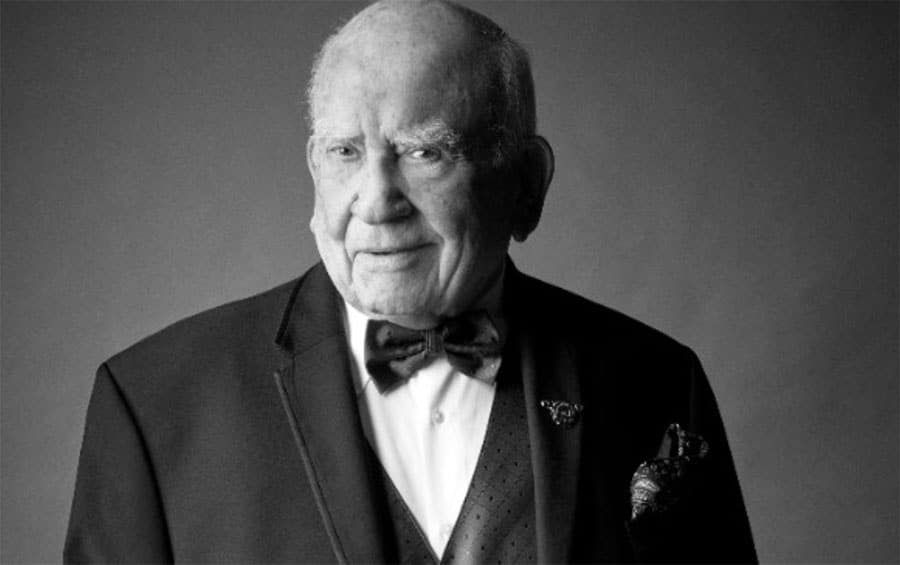
Based on the children’s book of the same name by Marvell Ginsburg and narrated by Ed Asner, “The Tattooed Torah” is a beautifully animated short film that tells the story of a small torah that was confiscated by the Nazis in Czechoslovakia but survived the Holocaust.
On Dec. 7 at 4 p.m. PT, the Los Angeles Jewish Film Festival will present a free virtual screening of the film via Zoom and Facebook Live, followed by a Q&A session with Asner, director and screenwriter Marc Bennett, producer Melinda Goldrich, screenwriter Brett Kopin, and composer Daniel Alcheh. Stephen D. Smith, Executive Director of the USC Shoah Foundation (https://sfi.usc.edu/), will moderate. Click here to register.
Asner will also take part in a virtual table read of the holiday classic “It’s a Wonderful Life,” alongside Maude Apatow, Carol Kane, Pete Davidson, Bill Pullman, Mia Farrow, Ed Begley Jr., Diedrich Bader, Richard Kind, Ellie Kemper and others, taking place on Dec. 13 at 5 p.m. PT. Tom Bergeron will host the event, benefitting the Ed Asner Family Center, which supports mental health and enrichment programs for special needs children and their families.
“By gifting tickets to the table read, people are giving their friends and family that unique, once in a lifetime gift that everyone is searching for…an experience they can share together that will be unforgettable while helping scores of families living with special needs,” said Asner’s daughter-in-law, Navah Paskowitz-Asner, the nonprofit’s co-cofounder. Tickets cost $50 and up and are available at edasnerfamilycenter.org.
Later in December, Asner stars in “Tiger Within” as a Holocaust survivor who befriends a troubled teenage runaway (Margot Josefsohn), resulting in an unlikely but life-changing relationship for both of them. The film will be released via Laemmle Virtual Cinema on Dec. 18.
JERUSALEM — Rebecca Wernick, a graduate of YULA Girls High School and the daughter of JJ and Rachael Wernick, is studying this year in Midreshet Lindenbaum, of the Ohr Torah Stone educational network, in a capsule.
Did she have a dilemma about coming to midrasha this year, in the midst of the COVID-19 pandemic? “My parents were definitely concerned about how this year would end up looking,” she said. “But I decided to come anyway because I knew if I didn’t come this year, there wouldn’t be another chance to come and I didn’t want to miss this opportunity. Also Zoom college didn’t sound so great.”
Fortunately for Wernick, Rabbi Shlomo Brown of Midreshet Lindenbaum found a way to accommodate studying during a pandemic.
A Hobby Becomes a Lifeline
Rabbi Brown has been the executive director of Midreshet Lindenbaum, of the Ohr Torah Stone educational network, since 1998, where he also teaches Tanakh and Jewish Thought. He’s taught at the school since 1986, with a four-year break for shlichut in Canada.
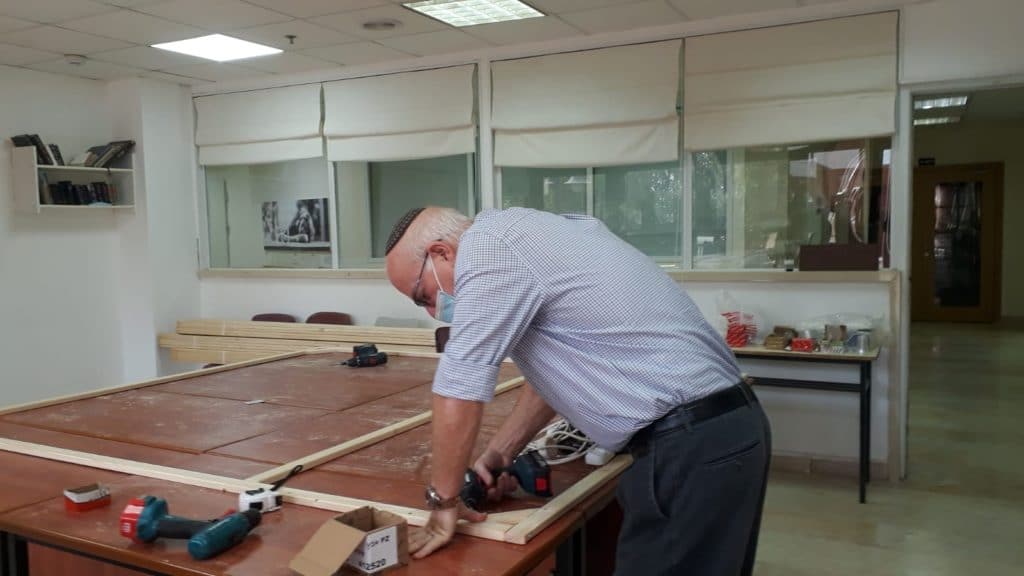
When COVID-19 struck, he, like all midrasha and yeshiva directors, had new challenges to face. But unlike other directors, Rabbi Brown, who studied at Yeshivat Har Etzion and received his teaching degree from Herzog College, has a beloved hobby — carpentry. To be specific, Rabbi Brown and his team have built more than forty capsules to allow for COVID-safe study, for use in the dining hall, and for other areas, as well.
“When we started to deal with the COVID situation, about nine months ago, no one knew exactly what to expect; we were sent many files of instructions” he told the Journal. “We built capsules then but it wasn’t clear how we would use them, or for how long, so at the beginning of this school year, we waited ‘till the last minute, as the guidelines of the government kept changing.
Rabbi Brown working on a capsule. (Credit: Sara Bedein)
“After the chagim, we realized that [COVID-19] will probably be [here] for the whole year, so we decided to rebuild everything, using wood frames and very thick nylon that can be fixed or replaced if it tears.
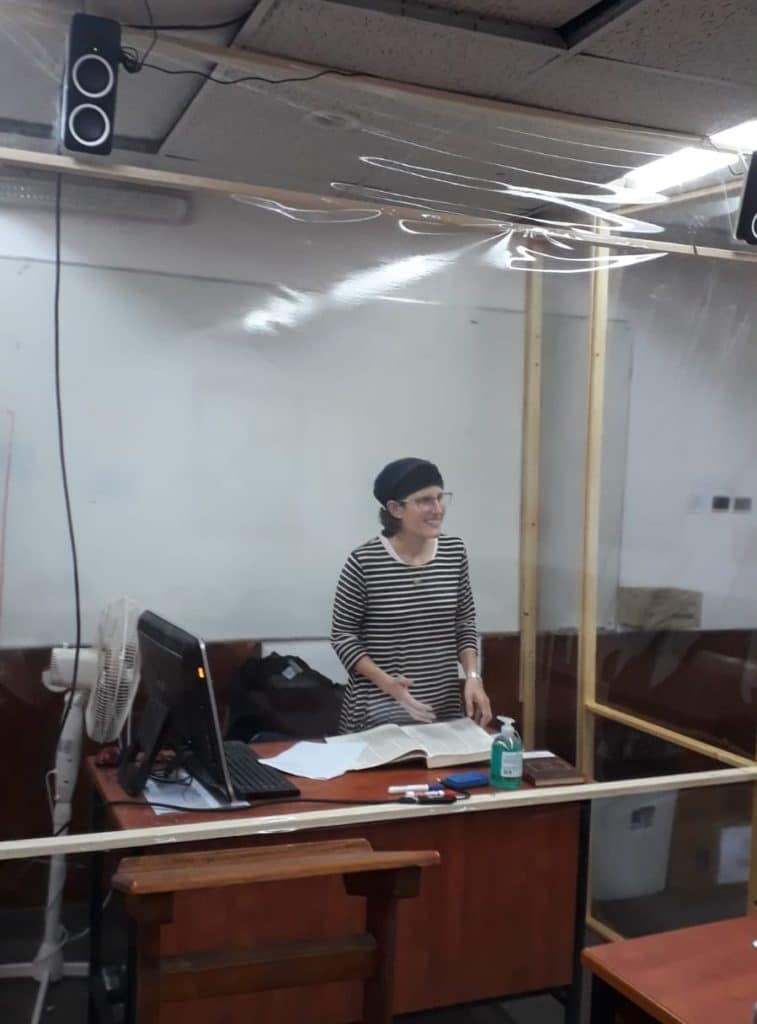
“We also discovered that if we want to protect the lecturers and the students, we should build a separate capsule for the lecturer. I consulted with an epidemiologist who said it should go all the way up to the ceiling, so if anyone is discovered to have been sick — the teacher or a student — the other side won’t need [to] quarantine. The lecturers teach without a mask.
“We built four or five capsules in each classroom. Then we redid the Beit Midrash, which is really the pearl of Lindenbaum. We built eight capsules in the Beit Midrash and when we finished, all the students said you don’t feel like you’re in a capsule… It is a great success.”
Within the Beit Midrash, the students wear masks when students from other capsules outside of their capsule are present. The students also wear masks in all public areas.
Brown pointed to his carpentry as one reason for his involvement. He also “was helped by Ada Leshem, our Logistics Coordinator, and by two maintenance people, who did most of the work.” Brown took his carpentry tools and created “a carpentry workshop on the lower floor of the building.”
“It took us almost a month to finish,” he noted. “Each of the workers gave advice; it’s successful because it is a team effort. We needed to invent methods, like how to attach the nylon. We change the capsules based on the different rooms and the size of the study groups, and we don’t want the parts to be connected permanently, so we will be able to attach and detach and rebuild in a different way, as the necessity arises.
Capsules in the Beit Midrash. (Credit: Sara Bedein)
“We were the first ones doing the first version of capsules and other schools came to see it. When we have a good idea, we let people know, and we also learn from other schools. All the schools help each other.” But even though schools compete for students, Rabbi Brown said, “there is no competition about making life good for the students, and that has been the same way for years; we share information … I see this as a tikkun to the machloket (a repair of the disagreements) in Israeli society — the fact that we are all helping each other now. Being divisive is the main problem, so at least in our small world, we can do the opposite. May this be a small tikkun for Am Yisrael.
“All the schools help each other. There is no competition about making life good for the students.”—Rabbi Shlomo Brown
According to Rabbi Brown, “In the midrasha, each program had to think about how to be supportive and sensitive to the other programs, which total more than 200 students. We have six students in a Special Ed program called ‘Darkenu,’ have 44 English-speaking students (from the United States, Canada, England, Australia, France), 12 in the ‘AmLat’ program, who speak Spanish and Portuguese, from Latin America, Argentina, Mexico, Brazil. We have 100 students from Israel, including our Hadas (pre-army program). We also have ten students in a specialized leadership program. Each student has her assigned capsule, which demands a lot of coordination, we stagger ten groups who go to lunch according to a schedule.”
The Israeli students live with four to six girls in a room. This room is their “family” unit, meaning they do not have to wear masks in their room. They go home approximately every 17 days.
Rabbi Brown explained that, “Since the beginning of this pandemic I haven’t missed one day of work, thank God. We had permission to keep the school open during Pesach, and throughout July and August, as the students from Latin America stayed. We worked very hard but I am grateful to God that I have work, and that it is interesting. Though I don’t like Zoom, I feel very lucky that I can give classes on Zoom.”
Midreshet Lindenbaum applied the capsules beyond the classroom. “We have a social worker, so we built a room divided into two sections, with nylon in between, with room for the social worker on one side and a student on the other. We are now building places where regular students can learn havrutawith ‘Darkenu’ students. I built capsules in the lobby and we are trying to find a way to create places for students to do exercises. As soon as there is a challenge, you find a way. The last thing we want is for someone to get sick, because then we have to close the school.
“I think that [the government] should give guidelines to the people who are out in the field, and let them find the solutions, obviously assuming that they are committed to doing everything in the most serious way to protect the teachers and students. The solution was simple — just nylon, wood and creativity.”
The Time of Ezra
Rabbanit Sally Mayer has been teaching at Midreshet Lindenbaum since she made aliyah more than sixteen years ago, and for the last three years, she has been the Rosh Midrasha. Rabbanit Mayer told the Journal that, “We have to be very creative this year to make sure that the girls have the wonderful experience of learning, growth and experiencing Israel that they have every year.
“The overseas girls are a closed group who went through two weeks of quarantine upon their arrival, with no contact with outside people, and are therefore considered one family. They are with us every Shabbat, and for all the chagim, unlike the Israeli girls, who go home for Shabbatot. We are their home and we are responsible for them.
“Baruch HaShem, we’ve been able to learn in person, using teacher capsules. We go on trips and Shabbatot to places such as Susia, Tzfat, and Ein Gedi, all while strictly adhering to the regulations to keep everyone safe. We are blessed with an amazing team who work day-and-night to care for the students and make this year the incredible experience it is.”
Rabbanit Dena Rock teaching in a capsule. (Credit: Sara Bedein)
When asked how the students reacted to this atypical year, where travel is limited, Rabbanit Mayer responded, “It’s like the story of Ezra, who came back to Eretz Yisrael to rebuild the Beit Hamikdash. They were overjoyed at being able to rebuild this center for worship of God and the symbol of HaShem’s presence amongst us! But the returning exiles who had seen the first Beit Hamikdash cried when they saw the new one, since it wasn’t as majestic as the one King Solomon had built. Whose reaction was more powerful?
Just like at the time of Ezra, the challenges of this year are overcome by joy and the fulfillment of their dreams.” —Rabbanit Sally Mayer
“Our students are having an incredible year in Israel, not exactly the same as a normal one, but one filled with meaningful learning and growth in Midrasha, close friendships, and deep connections to the Land and State of Israel. Just like at the time of Ezra, the challenges of this year are overcome by joy and the fulfillment of their dreams.”
Toby Klein Greenwald is an award-winning journalist and theater director, and the editor of WholeFamily.com.
Two days ago, I wrote a longer article on the Blue and White party and why they decided to vote against the government in favor of new elections. This piece is more of an update, as the vote is today, and its aftermath begins tomorrow.
The Vote
The Knesset is voting today on a bill that calls for new elections. This is a preliminary vote. A Knesset committee has to debate it and set a date for the next election. This means that there is still time to prevent new elections. It also means that we do not yet know when the election is going to happen. It can occur between 90 days and half a year after the final vote (March to June).
The Timetable
The Knesset can decide on a date more convenient for everyone or wait until the end of December. If by the end of December the 2020 budget does not pass (Blue and White are not likely to vote for it if Prime Minister Netanyahu doesn’t give them something big in return), the Knesset automatically dissolves, and a new election will be scheduled for March 23.
The Politics
Blue and White leader Benny Gantz made an aggressive speech on Tuesday but did not close the door on compromise. This will not be easy to achieve, as Gantz wants Netanyahu to fix any loophole that can let Netanyahu dismantle the government before Gantz is made prime minister in the pre-agreed-upon rotation. No one assumes that Netanyahu is ready to do such a thing. Either Netanyahu or Gantz must accept a compromise that is less than ideal, and at this point, they seem not to be in a mood for that.
Either Netanyahu or Gantz must accept a compromise that is less than ideal, and at this point, they seem not to be in a mood for that.
The Joint List
The most interesting development today is a decision made by the Islamic faction Raam not to vote for a new election. The unlikely political romance between the head of Raam, Mansour Abbas, and Netanyahu has been the talk of the town for quite some time. Abbas’ strategy, as an Arab Knesset member, is as follows: “most of the time, the Arab parties automatically are part of the Left… this approach is mistaken, and … we need to reposition ourselves toward the entire Israeli political spectrum.” Abbas’ decision has one certain outcome and one less likely outcome: The likely outcome is the end of the Arab Joint List because Abbas will run separately. The unlikely outcome is for Netanyahu to find 61 Knesset members that agree to oppose a new election. Abbas does not have enough votes to get Netanyahu there, but he does get him closer to such a goal. Netanyahu needs three to four more votes.
The Crucial Matter
Israel is about to have a fourth election in two years. This is all because of one man — Netanyahu. Love him or hate him, it is clear that had he not been there, politics would be simpler.
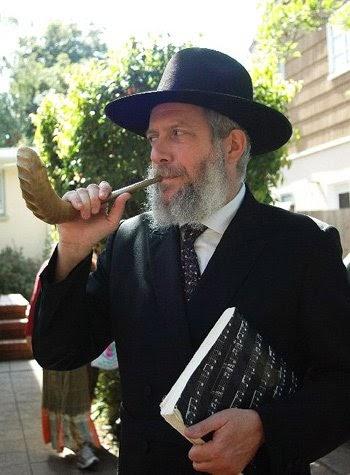
Rabbi Yehuda Ferris is the tallest rabbi I’ve ever known. Not because he’s six foot three with an Abraham Lincoln-esque black coat and physique, but because the older I get, the taller this man of character grows in my mind.
One of the most transformative character traits is the ability to express gratitude. In the spirit of Thanksgiving, I’d like to share the reason why this tall rabbi was and is a role model whom I feel grateful to know. (For those asking, “why now?” I’ll answer, “why not?” In other words, why do so many of us wait until later to eulogize and show gratitude for those people who have changed our lives?)
As a boy, I looked up to Rabbi Ferris because my father — the superhero of my world — looked up to him. As an adult, I continue to look up to him because I’ve come to realize that what is louder than evanescent charisma is often the quiet beats of spiritual stamina. As Rabbi Yossy Goldman, senior minister of Sydenham Synagogue in South Africa, once taught me, “The greatest sermon you can give is how you lead your life.”
But unlike Goldman, Ferris doesn’t lead a large and prestigious synagogue. He doesn’t have the massive membership, the gorgeous cathedral or even the choir. But he’s never left his post at Chabad of Berkeley since the day he stepped foot there in 1981.
An Enigma of Contradiction
“Behind every great Rabbi is a woman laughing,” Rabbi Ferris once said to me, his face completely deadpan but his eyes exuding humor. Always deferential to his wife and co-director of Chabad Berkeley, Rebbetzin Miriam Ferris, Rabbi Ferris never exuded a pretense of greatness. On the contrary, the words “self-deprecating humor” are an apt description of his clerical style. And yet, I consider him one of the greatest rabbis I’ve ever met and the role model for my own ministry.
Why? Because he is a nuanced enigma of contradiction. Humble, but unfailingly tenacious. Humorous, but soberingly solemn. The court jester who is really the king.
In other words, Rabbi Ferris is whatever the people need him to be. A camp bus driver, radio show host, college campus activist, stand-up comedian, teacher, scholar and, most importantly, friend. I remember watching him one day serenading Holocaust survivors at a local Jewish nursing home with his operatic baritone. His long, piano-trained fingers strummed his acoustic guitar, the shoulder strap threadbare from overuse. This man, who spent seven years immersed in the intense, intellectual academia of Hadar HaTorah Yeshiva — starting with a cursory Jewish education and graduating with rabbinical ordination and knowledge of copious amounts of Talmud — was smiling as a woman tapped her fingers to the Israeli folk song he was playing. He has the intellectual rigor to master the intricate theological puzzles of Kabbalah, yet he was proud simply to bring another person joy.
“People helping people,” is a catchphrase I rarely heard Ferris say but witnessed him live. A foot-soldier of the Lubavitcher Rebbe (z”l), Ferris and his wife offer prayer and Shabbat services, Friday night dinners, holiday programming, lectures, young adult events, a popular Jewish summer camp, women’s circle, Bikur Cholim visitation, prison chaplaincy, food distribution, counseling and more.
The Jester
One of Rabbi Ferris’s spiritual weapons is his skilled deployment of jocosity. I remember my father’s face turning red from laughter during his sermons. Puns, sarcasm, knock-knock jokes — nothing is off-limits. Hundreds of his students around the world (including myself) fondly speak of the “Rabbi Ferris jokes” they heard from this incorrigible quipster.
“I have a photographic memory,” Ferris says. “Unfortunately, it’s currently out of film.” Or, “What does the dyslexic, agnostic, insomniac do? He stays up all night wondering if Dog exists.” Or, “There are three things that happen when you get to my age. One, you start forgetting things. And the other two…darn it, I forgot!” The sheer irreverence of Ferris’ humor is enough to make Ferris Bueller proud. I guess it makes sense that an East Coast Chassidic rabbi shepherding “Berserkeley” has a certain “Frisco Kid”-esque sense of playfulness to survive the “wild, wild West” of the Bay Area.
One time, when I was in elementary school, I stood outside the Chabad House with Ferris as we stopped people on the street and asked them if they were Jewish. “Yes, I am,” one man walking his black Labrador replied. “Would you like to join us for a Minyan (prayer quorum)?” Rabbi Ferris asked gently. The man looked us up and down. He seemed duly unimpressed with the tall, lanky Rabbi and the wide-eyed kid who stood loyally beside him. “Yes,” he responded, “but on one condition. My dog has to join us for the prayers.” Even a child like myself knew that bringing a dog into the sanctuary was sacrilege. I could almost hear the gears in his brain moving as Rabbi Ferris quickly pondered the situation. Then, smiling smoothly, as he always did, he said, “Sure. After all, weren’t dogs given special mention in the Torah, Exodus 11:7?”
Another time, I joined my rabbi as he officiated an outdoor wedding for a young Israeli couple at the Oakland Zoo. I kid you not. Rabbi Ferris concluded the prayers preceding the Ketubah ceremony. As he uttered the last word, the nearby chimpanzees began to howl. “Perfect timing,” Rabbi Ferris grinned. Then, during his sermon on the semi-private plaza across from Reptile World, Ferris cracked a joke. “Eve complained to Adam, ”Do you really love me? Adam replied, “Who else?” Silence. I scanned the crowd — oh no, they’re not laughing. Then, 3.5 seconds later, after the crowd translated the joke in their minds from English into Hebrew, everyone burst out in a loud guffaw. Thank G-d, I sighed to myself.
He seems to be able to make anyone laugh — even the dean of my high school Yeshiva, Rabbi Ezra Schochet, who is the most solemn rabbi I’ve ever known. Rabbi Schochet, a respected Talmudist and scholar, runs Yeshiva Ohr Elchonon Chabad with the stern disciplinary pedagogy of a military general. “He does this in order to give his students the fearless heart of an elephant,” my friend Paz Shusterman (z”l) once explained to me. I’ll never forget seeing Rabbi Schochet laughing like my father laughs during Rabbi Ferris’ sermons. (The joke was the one about the son who tells his mother he doesn’t want to go to school because all the kids hate him. The mother replies, “Honey, you have to go for two reasons. First, you’re 45 years old. And, second, you’re the principal.”)
Many people, even his own Rabbinic colleagues, know Rabbi Ferris as “the funny man.” But the humor is just a tool, masking his steadfast staidness. One time, Steve Harris — a local homicide detective — came across a gruesome crime scene. Two Jewish couples had been celebrating their Shabbat meal. One of the women was pregnant. Criminals crept in through the windows and beat and tied up the men. Then, they dragged the women down to the basement, where their screams wouldn’t be heard. “There was only one Rabbi I knew I had to call,” Harris told me. “Rabbi Ferris.” When I asked Rabbi Ferris where he found the wisdom to counsel the victims, he said simply, “HaShem brings us to where we need to be and gives us the words we need to say.”
Harris wasn’t the only “macho man” who could see the iron-clad ethical resolve beneath the rabbi’s comedic veneer. There was once a sniper in the United States military who was given special permission to attend Shabbat services for just a few hours on Friday nights. Where would he choose to go? The Chabad House of Rabbi Ferris. (Eventually, he became a lawyer. As Rabbi Ferris says, “Killing people for a living? Not the best job for a nice, Jewish boychik.”)
My favorite story about Rabbi Ferris begins with a man appearing at the Chabad House one day, demanding to convert to Judaism. Rabbi Ferris, ever the gentleman, stopped what he was doing and invited the stranger inside his office for tea.
The man proceeded to tell Ferris that just a few weeks prior, he wanted to kill himself. Everything in his life had soured. He bought a thick rope and decided he would hang himself in the last place his life had been fully happy — his elementary school. On a Friday night, when school was out, he drove over to Emerson School. As he got out of the car, it suddenly dawned on him that the children would return to school on Monday and might see his dead body before the cops would arrive. “I couldn’t do that to them,” he told Ferris. “So, I began walking aimlessly about the neighborhood looking for a secluded place where I could end my life without traumatizing the children.”
Eventually, he found the perfect place. “A small dog park in a residential neighborhood, with a large oak tree in the corner.” As he tied the rope around the branch, his ears suddenly heard the angelic sounds of happiness. He looked up. The entire neighborhood was dark, it was late and all the lights were off. “But there was this one house across from where I stood that had light and life streaming forth from its open windows. As I peered closer, I saw they were Hassidic Jews. The table was laden with all sorts of delicious-looking food. The guests were singing, laughing and smiling. At that moment, I felt something shift inside my heart.” The man began to cry. He leaned forward to Rabbi Ferris and stated, “Rabbi, it was a miracle. At that moment, G-d told me that there was still happiness and light waiting for me in my life. ”
Rabbi Ferris replied, “Was that house on Claremont Boulevard?” The man stopped crying, his face blank with shock. “How did you know that? I never approached the house. I ran away that night and never told anyone what happened. No one in the world knows which block that happened on. How do you?”
Rabbi Ferris, the man I’ve only seen cry once, clasped the man’s hands in his own while a tear rolled down his cheek. “Well, that’s because I live on Claremont Boulevard, across from a dog park called ‘Monkey Island,’ which has a wide, strong oak tree. You were standing in front of my house. And, every Friday night, we leave our windows open in the hope that the world hears the sweet sounds of Shabbat.”
One year later, Rabbi Ferris danced hand in hand with that man as they celebrated his Jewish wedding.
Rabbi Ferris taught me that laughter can be like that open window on Friday night. Opening hearts and opening minds. I watched him as a child, and no one feels the need to impress a child, and what he impressed upon my psyche for all time was what it means to be a Chassid. Like his Rebbe, he loves all people and wants the world to do a few more random acts of goodness and kindness.
Rabbi Ferris taught me that humility means openness. When he’d walk regally down the street, I’d try to keep up with his long stride. He’d wave and say hello to everyone we passed. When I asked him why, he replied, “Didn’t Shamai teach that we must greet everyone with a warm, cheerful, and pleasant countenance?” (Pirkei Avot 1:15)
I’ll never forget when the “Hate Man” of Berkeley, Mark Hawthorne, an American philosopher, activist and former reporter for The New York Times whose beliefs centered on people being radically honest about their negative feelings, pursued Rabbi Ferris up and down Telegraph Avenue, demanding that the Rabbi say, “I hate you.” But Rabbi Ferris, with his smooth smile, simply refused.
In today’s day and age, I believe we need spiritual leaders like Rabbi Ferris. In my childhood city of Berkeley, a place proud of being different, he taught me that people are not so different after all. As he once quipped, “Labels are for T-shirts.”
In the days of Moshiach, I pray that I am standing tall beside my family.
And, in front of me, will be the tallest rabbi I have ever known.
Rabbi Levi Y. Welton is a pulpit Rabbi, medical professional, and officer in the United States Air Force. Raised in the San Francisco Bay Area, he holds degrees in science, education and film. His dream is to help bring Moshiach and follow in the footsteps of his mother and father, Dr. Sharonah & Rabbi Benzion Welton who are proud, Chassidic Jews.