fbpx

October 29, 2020

david suissa podcast curious times

Pandemic Times Episode 100: Who’s Better for Israel, Trump or Biden?

New David Suissa Podcast Every Tuesday and Friday.

A conversation with political editor Shmuel Rosner on the upcoming U.S election, a new survey on anti-Semitism and the continuing crises in Israel.

How do we manage our lives during the coronavirus crisis? How do we keep our sanity? How do we use this quarantine to bring out the best in ourselves? Tune in and share your stories with podcast@jewishjournal.com.

Pandemic Times Episode 100: Who’s Better for Israel, Trump or Biden? Read More »

Trump’s Jewish Outreach Point Man Makes His Pitch

Boris Epshteyn, a senior adviser to President Donald Trump and co-chair of Jewish Voices for Trump, shared the Trump campaign’s pitch to the Jewish community in a phone interview with the Journal on October 28.

Epshteyn began the interview by stating that he felt “very optimistic” about Trump’s reelection chances on November 3 because “the polls are all going our way across the country.” He touted Trump as “the champion of the Jewish community” and “the champion of the state of Israel.

“Everything he has done for our greatest ally, Israel, in terms of moving the U.S. embassy to Jerusalem, recognizing Jerusalem as the capital of Israel, recognizing the Golan Heights as Israeli territory, killing the terror mastermind Qassem Soleimani, ripping up the terrible, no good Iran nuclear deal, getting the Abraham Accords signed, which have now moved three Arab countries toward Israel and away from Iran ­— so major and so groundbreaking,” Epshteyn said. “This president has been a huge, huge champion of the state of Israel.”

He also said that Trump “has fought anti-Semitism anywhere and everywhere,” citing the executive order Trump signed in December 2019 applying Title VI of the Civil Rights Act to anti-Semitism, thus allowing federal agencies to combat anti-Semitism. Additionally, Epshteyn pointed to Trump signing the Never Again Education Act, which provided more federal funding toward Holocaust education, and the Justice for Uncompensated Survivors Today (JUST) Act, which mandates that the State Department provide annual reports on the  47 countries that pledged in 2009 to provide restitution for Holocaust survivors and their descendants who had their property stolen by the Nazis.

“You compare that to Joe Biden, who met with Jacob Blake Sr., an avowed and rabid anti-Semite,” Epshteyn said. “Kamala Harris met with Jacob Blake Sr. the anti-Semite and said that he was a member of an incredible family. They had Linda Sarsour speak at their national convention. They demean the Holocaust by ludicrously comparing Donald Trump to the terrible, no-good, disgusting Joseph Goebbels.”

Jacob Blake Sr. is the father of Jacob Blake, who was shot by police in Kenosha, Wisconsin in August and is paralyzed from the waist down as a result. Biden and Harris met with Jacob Blake Sr. following the shooting, with Biden saying in a Twitter video that he told Blake Sr. and his family that “justice must and will be done.” Among Blake Sr.’s past remarks that came under scrutiny include Facebook posts expressing support for Nation of Islam leader Louis Farrakhan and posts about the “Jewish-controlled media.”

As for Sarsour, she spoke during the Democratic National Convention’s Muslim Delegates and Allies Assembly’s virtual panel; a spokesperson for the Biden campaign subsequently condemned Sarsour and said “she has no role in the Biden campaign whatsoever.” A few days later, Middle East Eye reported that the Biden campaign apologized to Arab and Muslim activists in an off-the-record phone call for “‘the pain’ that the campaign had caused to Arabs and Muslims by disavowing Sarsour.” Biden senior adviser Symone Sanders claimed that the campaign was merely affirming “Biden’s unshakeable commitment to working with Arab, Palestinian and Muslim Americans and to make clear that we regretted any hurt that was caused to these communities. We continue to reject the views that Linda Sarsour has expressed.”

The “Goebbels” remark is a reference to Biden saying in September that Trump is “sort of like [Nazi propagandist] Joseph Goebbels,” arguing, “You say the lie long enough, keep repeating it, repeating it, repeating it, it becomes common knowledge.”

When the Journal asked Epshteyn on why polls have shown that 70-75% of American Jewish voters say they’re going to vote for Biden over Trump, Epshteyn pointed to a September poll from the Jewish Electorate Institute finding that 67% of American Jews plan to vote for Biden and 30% plan to vote for Trump. The 67% would be the lowest percentage of the Jewish vote for a Democrat since Michael Dukakis in 1988 and the 30% figure is 5% higher than what Trump received in 2016, Epshteyn argued. Biden currently has an estimated 7.4 point-lead in the RealClearPolitics national polling averages.

“There’s no doubt that the Jewish vote is moving toward President Trump and it’s going to continue to do so,” he said.

Regarding Trump’s infamous “very fine people on both sides” comments following the 2017 neo-Nazi riots in Charlottesville, Epshteyn argued that Trump’s remarks were taken out of context.

“What he was saying about fine people was that on the question of Confederate monuments, there’s fine people on both sides of that argument, which has been an argument and a discussion going on for years,” Epshteyn said. “This president has repeatedly and unequivocally condemned anti-Semitism and white supremacy.”

If Trump were to win re-election, the administration would continue its efforts to combat anti-Semitism and support Israel, Epshteyn said, pointing to New York University’s settlement with the Department of Education on September 15, which requires that the university adopt the International Holocaust Remembrance Alliance definition of anti-Semitism.

“You will continue to see a major focus on that internationally,” Epshteyn said.

Additionally, he said that more Arab countries would form peace agreements with Israel under a second Trump term.

Epshteyn stated that while there are anti-Semites in both the far-left and the far-right, Representatives Ilhan Omar (D-Minn.) and Rashida Tlaib (D-Mich.) show that only the far-left gets elected to Congress.

“When Steve King, who is a Republican congressman who has said disgusting things, he was ostracized and taken off all committees by Republican leader of the House Kevin McCarthy,” Epshteyn said. “When Ilhan Omar says that Jews in Israel have hypnotized the world and ‘it’s all about the Benjamins,’ there’s a completely watered down resolution that doesn’t even mention her anti-Semitism barely, and she gets to stay on the House Foreign Affairs committee, which oversees relations between the U.S. and Israel.”

He also argued that Jews are being targeted under New York City Mayor Bill de Blasio and Governor Andrew Cuomo — both of whom are Democrats — and the latter is reportedly being considered for attorney general in a Biden administration.

“That is what Jews will have to fear [under a Biden administration]: the continuation of targeting of Jews by the far-left radical anti-Semitic Democrats,” Epshteyn said.

Trump’s Jewish Outreach Point Man Makes His Pitch Read More »

Neighbors – a poem for Torah portion Lech Lecha

Please let there be no quarrel between me and between you…
Please part from me; if [you go] left, I will go right, and if [you go] right,
I will go left.

It is election season and I have yet to put up
my election season decorations, though
my neighbor has and, suffice it to say,
they are not the ones I would have chosen.

I won’t tell you the name on their signs so
you can exist in a world where this poem is
relatable to you, no matter what side of
the aisle you live on. But there were a lot of them.

They have a corner house and there were
two facing each street, and a special banner
hanging from the garage. I had no choice but
to see these signs when I head to the store

with the red circle logo (which I won’t tell you
the name of in case you prefer the one with
the yellow sunburst…I don’t want to turn you off)
or head on my walks around the neighborhood

which is as close as we can get to going to
an amusement park since the plague descended
on our land. It was reported to me, by my wife,
who does much more of the neighborhood walking

that bandits stole all of the signs from their yard.
The only evidence, yet another neighbor, whose
only public signs are the ones congratulating their
sons for graduating elementary school,

claimed to have seen a car speeding away.
It’s a crime. It’s theft. I can’t claim to be unhappy
about it, but these are the same neighbors who
open up their pool unconditionally to our

elementary school graduates when the sun
beats down upon our roofs. The same neighbors
who wrote music that has probably put smiles
on your faces. Let there be no quarrel

between them and us. We may go left,
while they go right, but the land is watered enough
for all of us. Like Abraham and Lot before us.
This is how we live together.


God Wrestler: a poem for every Torah Portion by Rick LupertLos Angeles poet Rick Lupert created the Poetry Super Highway (an online publication and resource for poets), and hosted the Cobalt Cafe weekly poetry reading for almost 21 years. He’s authored 23 collections of poetry, including “God Wrestler: A Poem for Every Torah Portion“, “I’m a Jew, Are You” (Jewish themed poems) and “Feeding Holy Cats” (Poetry written while a staff member on the first Birthright Israel trip), and most recently “The Tokyo-Van Nuys Express” (Poems written in Japan – Ain’t Got No Press, August 2020) and edited the anthologies “Ekphrastia Gone Wild”, “A Poet’s Haggadah”, and “The Night Goes on All Night.” He writes the daily web comic “Cat and Banana” with fellow Los Angeles poet Brendan Constantine. He’s widely published and reads his poetry wherever they let him.

Neighbors – a poem for Torah portion Lech Lecha Read More »

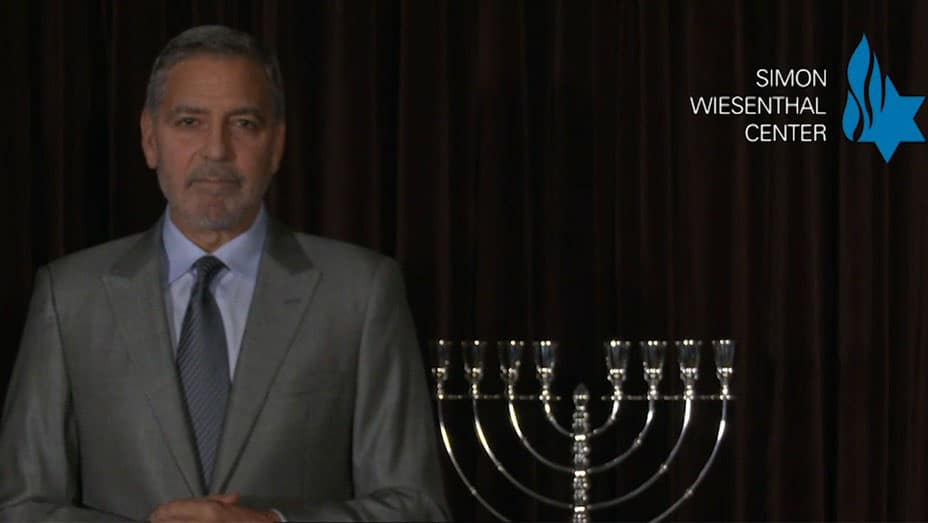
Amal and George Clooney Honored at Simon Wiesenthal Center Museum of Tolerance 2020 Gala

The Simon Wiesenthal Center and Museum of Tolerance honored Amal and George Clooney with the 2020 Humanitarian Award at its virtual gala on Oct. 28. 

Hosted by film producer and Wiesenthal Center board of trustees member Jeffrey Katzenberg and Rabbi Marvin Hier, founder and dean of the Simon Wiesenthal Center, the 40th anniversary event honored the couple for their service to humanitarian causes worldwide.

Jeffrey Katzenberg

Clooney recently narrated the Wiesenthal Center’s latest documentary from its Oscar-winning Moriah Films’ division, “Never Stop Dreaming: The Life and Legacy of Shimon Peres.” The film, acquired by Netflix, is set to stream later this year.

“Amal and George Clooney have shown the world what it means to make a difference,” Katzenberg said. “For them, fame and celebrity are not means to themselves but means to giving voice to the voiceless.”

The couple established the Clooney Foundation for Justice, which focuses on holding accountable those responsible for human rights abuses around the world. The couple also has fought to end global poverty and supported organizations including Feeding America, World Food Programme, UNICEF, March for Our Lives and the Southern Poverty Law Center, among others.  

George accepted the award on behalf of himself and his wife, noting the importance of the word tolerance when it comes to the Simon Wiesenthal Museum of Tolerance.

“I think that’s right, that word. Tolerance,” he said. “That is the most important word. Then I think about Rwanda, Armenia, Bosnia, Myanmar, Darfur and South Sudan, Yazidis. We’ve said time and time again ‘Never again,’ and we mean it. But the truth is we’re not very good at it. We fail more often than we succeed, and that’s part of the problem…Doesn’t mean we don’t try. But if we remember the word tolerance, that’s the key. Tolerance for all races. Tolerance for all religions. That’s what matters. So, I thank you very much for this.” 

Hier spoke about the center’s years-in-the-making relationship with leaders in the UAE, Bahrain and other Gulf and Arab countries. He also discussed his trip to the Vatican Jan. 20 to meet Pope Francis to address anti-Semitism and hate that continues around the world.

Rabbi Marvin Hier

Medals of Valor were also presented to Dame Louise Ellman, the late Douglas Miguel Rodriguez, Francesco Lotoro and Grazia Tiritiello, for their work fighting anti-Semitism and promoting Holocaust education around the world.

Ellman was awarded for her decades-long commitment to fighting anti-Semitism in the United Kingdom. Rodriguez’ wife and daughter accepted the award on his behalf. Rodriguez was shot and killed while trying to protect others from anti-Semitic domestic terrorists who stormed a Jersey City kosher supermarket in December 2019, where he was the grocery clerk.

Lortoro and Tiritiello are husband and wife musicologists from Italy who received medals for collecting, preserving and performing the music of Jewish musicians who were in captivity during the Holocaust.

“Just as it is important to point out the haters and bigots, so it is important to record and honor the good deeds of exemplary individuals who honor mankind,” Hier said, quoting the late Wiesenthal. “That is why each year at our tribute dinner, we present medals of valor to those individuals whose courage and bravery shine a light in the darkest of places.”

Amal and George Clooney Honored at Simon Wiesenthal Center Museum of Tolerance 2020 Gala Read More »

Armenia’s deadly attacks on Azerbaijani civilians must stop

It is difficult to put into words how I am feeling today, a day that follows several weeks of indiscriminate shelling of bullets and missiles that have claimed so many innocent lives. For me, a survivor of Armenian torture camps, a mother and a spokeswoman for peace and for other survivors around the world, these recent attacks hit too close to home.

In only the last 2 days, in violation of U.S.-brokered ceasefire, Armenia fired dozens of Russian-made SMERCH missiles at Azerbaijani civilians in the city of Barda, using cluster munitions, with the clear intention of unleashing the kind of terror and bloodshed that Azerbaijan faced 30 years ago during the first Karabakh war. At least 26 lives were taken, including a 7-year-old child playing in her backyard, lost forever for the sake of a criminal war. And there were important witnesses. NY Times team was present during the attack on Barda, barely escaping the missiles, and saw with their own eyes that Armenia is deliberately attacking civilian population, and one that is situated far from the frontline, a place where the residents would not expect such danger and would be easier to murder. For the same reason, the reporters were not expecting or prepared for incoming missiles, and ran for shelter amidst the wounded and the dead, like everyone else in Barda.

The attacks on Barda were preceded by several missile strikes on Ganja, Azerbaijan’s second largest city, which resulted in entire residential areas erased within seconds and scores of civilians killed and injured. And attacks were purposefully carried out at night to ensure the maximum death toll!

Since Armenia started a new war against Azerbaijan on September 27, its missiles and artillery fires have murdered 92 innocent Azerbaijani civilians, including 11 infants and children. The youngest victim, named Narin, was only 10 months old. Over 400 Azerbaijanis have been wounded by the attacks, including 36 children.

Armenia’s deliberate targeting of civilians and use of prohibited weapons stands in direct violation of the Geneva Convention and every international legal norm, and what is happening today are war crimes and crimes against humanity, and it must be stopped. Amnesty International has just reported on these violations, and its Regional Director of Eastern Europe and Central Asia Marie Struthers stated that “The firing of cluster munitions into civilian areas is cruel and reckless, and causes untold death, injury and misery”.

In 1992, I was just out of high school, and had taken my first job as a telephone operator before I was captured by Armenian troops, tortured and eventually released in exchange for gasoline. To my captors, my life had no meaning but to be used and brutalized and discarded. Today, the same ideology propels the invasions and attacks, which have been condemned by the international community, yet continue as if Armenia is immune to basic laws and human rights. Few can understand this level of depravity, although leaders from Israel have compared our experiences. This week, Arthur Lenk, former Israeli Ambassador to Azerbaijan, who also served at the Israeli Consulate to Los Angeles in the late 1990s, tweeted in response to aforementioned The NY Times coverage with “Israelis from Sderot, Ashkelon and Beer Sheva will recognize this story. Rockets shot at civilians to “balance” losses on the battlefield. We need to share #IronDome system with our Azerbaijani friends.”

For nearly 30 years I and 800,000 of my fellow countrymen have waited for justice, to return to our homes in Karabakh, where Armenian soldiers stole our land, our homes and thousands of lives.

Today, Armenia has the audacity to bring brutality and criminal warfare back into the open, with daily assaults and illegal weapons used to take the lives of any Azerbaijani, even babies. It is remarkable that this is even happening in the year 2020, amid a global pandemic. But that is the nature of injustice; it has no respect for humanity or for the world. Armenia has invaded and continues to attack Azerbaijan on a near daily basis, yet to the world and especially the West, they feign victim. When so many lives are on the line, as Jewish, Muslim and Christian Azerbaijani soldiers fight to defend the innocent lives and the land of their nation, Armenia is playing politics and media games. As a survivor I say – this is outrageous. This must be stopped. Azerbaijan is a land of peace, flourishing diversity and home to tens of thousands of Jews, Christians and many others, with a vision for global harmony that stands as a beacon to the world. The world must now stop Armenia from this attempt at our genocide.

Armenia’s deadly attacks on Azerbaijani civilians must stop Read More »

Why I Get Out the Vote for My Patients

My patients probably don’t notice that I’m out of the office the first week of November every four years. It’s not a coincidence nor a rite of Fall. It’s Get Out the Vote (GOTV). Every year since 2000, my cousin Scot and I make quadrennial pilgrimages to “battleground states” for GOTV. We went to Colorado in 2008, Toledo in 2012, and Tampa in 2016.

But why would a 63-year-old doctor with sore feet and aching knees walk neighborhoods thousands of miles from home? My family and my career would not be affected much by the outcome of an election. What gets me out and knocking on doors are the healthcare needs of my own patients and millions like them across the country.

Throughout my thirty-plus years in medicine, I’ve seen many harmed and some die from lack of medical care. Understandably fearful of sky-high costs, the uninsured often wait, hoping that their problems will go away. But in so doing, they often get diagnosed late and end up needing care that’s more extensive, more costly, and sometimes too late to make a difference. Most developed nations in the world recognize healthcare is a basic right and provide universal healthcare coverage for all citizens. I’ve always believed that Americans deserve similar access to quality care, regardless of their employment or financial status.

My efforts and those of millions seemed finally to bear fruit with the passage of the Affordable Care Act (ACA) in 2010. The ACA’s insurance exchanges provided enrollees with group purchasing power and subsidies for those that could not otherwise afford it, thus making acquiring health care more affordable for many. The ACA also prevented enrollees from being excluded for pre-existing conditions like diabetes or hypertension.

The opposition to the ACA offered no surprise. Many republicans previously opposed government action in healthcare — more Senate Republicans voted against the 1965 Medicare Act than for it. A handful of Congressional Democrats also opposed the ACA. Yet, once the insurance program for seniors took effect in the 1960s, both parties were able to cooperate to make it work. Unfortunately, unlike seniors, the approximately 20 million Americans dependent on the ACA for coverage don’t pack the political punch needed to protect their benefits from partisan politics.

That stark reality, coupled with the more polarized political climate of 2016, augured poorly for the ACA when President Trump took office. In his 2016 campaign, Trump vowed to “repeal and replace” the ACA with something “much better.” In May 2017, Congress voted to repeal key provisions of the ACA, which, according to Congressional Budget Office estimates, would have left fifteen million more without insurance. The repeal failed in the Senate due to votes cast by Senators Lisa Murkowski, Susan Collins, and, most influentially, John McCain. “Stuck” with the ACA, the Trump administration took actions to undermine it, such as defunding insurance subsidies and reducing advertising for enrollment opportunities.

Before 2016, opponents of the ACA had already taken their best shot at overturning it in the courts. In 2012, the Supreme Court found the ACA’s individual mandate constitutional and only weakened a single feature — the requirement that states expand Medicaid coverage. The Trump administration now supports a second court challenge of the ACA on the dubious theory that if the individual mandate is found to be unconstitutional, the entire ACA must be invalidated.

In witnessing these efforts to overturn the ACA, I can’t help but think of the ACA as a program that provides a lifeline to health care for 20 million Americans during a pandemic. I can’t help but think of those who have lost jobs due to COVID-19 and now lack health care.

Every vote we secure is another small step toward protecting my patients and those that need care and cannot pay for it without the ACA.

Like much else in 2020, GOTV efforts will be affected by the pandemic. My original plan to travel to Arizona, the largest battleground state within a reasonable car ride, is in doubt due to concerns about the safety of door-to-door contacts. We may be phone-banking instead. Regardless, I realize that the efforts of my cousin and me will be unlikely to make a difference in this election. Nonetheless, like voting itself, we are making a small contribution to the collective efforts of hundreds of thousands of other volunteers across the country. Every vote we secure is another small step toward protecting my patients and those that need care and cannot pay for it without the ACA.

The abolitionist William Lloyd Garrison once said of his anti-slavery efforts, “I have need to be all on fire, for I have mountains of ice about me to melt.” Like the abolition of slavery, healthcare access is a matter of human rights. So, early this November, Scot and I will once again light a small candle to melt the ice that threatens the care of millions.


Daniel Stone is Regional Medical Director of Cedars-Sinai Valley Network and a practicing internist and geriatrician with Cedars Sinai Medical Group. The views expressed in this column do not necessarily reflect those of Cedars-Sinai.

Why I Get Out the Vote for My Patients Read More »

Digital Platform Blends Technology and Spirituality for Easy Online Services

In 2011, Rabbi Daniel Medwin had an idea to digitize prayerbooks and project them onto a screen using a PowerPoint slideshow format. He never imagined the resource, titled Visual T’filah, would thrive during the pandemic.

Medwin, who is now the current Director of Digital Media at the Central Conference of American Rabbis (CCAR), says the platform now allows congregations to digitize religious texts and display them on Zoom or other live streaming services. Like PowerPoint, each Visual T’filah slide can be personalized to include specific prayers in addition to creative backdrops such as a synagogue, nature scenes, artwork and other images that create a meaningful and engaging service.

Understanding that technology could be a strong force in uniting people for a religious experience, Medwin devoted his time, energy and rabbinical thesis to creating Visual T’filah and the uses it could give to a community.

“Part of my work is possible because of my affinity for technology, but part of it is my rabbi side where I want to help people who have trouble using technology and also don’t know where to start and are resistant,” he said. “I want to help them see how they can lead the community using these tools, which is why I became a rabbi in the first place.”

The son of a rabbi and mechanical engineer, Medwin used what was passed down to him, spending nearly a decade perfecting his concept. He said its original purpose was to enhance in-person services through the use of projection. Now, it has become an essential service, compliant with almost every live-streaming provider that screen shares or splits the screen. Working with the CCAR, he shares this service with any Jewish organization who needs it.

Temple Menorah Rabbi Leah Lewis did what most clergy did at the beginning of the pandemic and transitioned her community into safe, virtual, online services.

The Redondo Beach synagogue serves around 200 families. Lewis said because their community doesn’t have a predominantly Jewish presence, they needed to figure out a way to bring families together without using their campus as home base. Through CCAR, she learned about Visual T’filah.

“CCAR was so helpful in knowing what rabbis and congregations were gonna need to be thinking about,” Lewis said. “In a time where everything was so stressful, to be able to have an answer before I even needed it was the best.”

Since March Lewis has used Visual T’filah for Shabbat services, weekly programming, daily minyanim and religious school. Because many of the Visual T’filot templates are based on existing print literature, congregations don’t have to spend time digitizing their own prayer books. They can also select templates and personalize them with backgrounds that are creative, fun and visually meaningful. In preparation for the High Holy Days, Lewis chose to utilize Visual T’filah to make the experience more engaging for her community. The clergy changed the host of the service so various families could lead in prayer in front of the virtual congregation. Even if they had a prayer book at home, they could still follow along using the prayers on the screen.

Because many of the Visual T’filot templates are based on existing print literature, congregations don’t have to spend time digitizing their own prayer books.

Now she feels her Temple Menorah team can “create community with less emphasis on the physical space” until they’re able to join together in person. She is also looking ahead. As part of the religious school curriculum, students will be able to personalize their own Visual T’filah slides for a presentation used when they have their bar and bat mitzvah service.

“As we learn to adapt and live with it, I see numerous benefits,” Lewis said.

Chief Executive of CCAR Rabbi Hara Person told the Journal the goal was to make virtual services special when in-person is not possible. To date, Person said more than 333 communities were given free access to templates, hundreds of templates were purchased, and more than 1 million households utilized Visual T’filah in North America during the High Holy Days. Many of the shiva minyanim and service templates are free, with some pre-made Visual T’filah presentations available for a discounted rate.

“It was made for this moment,” Person said. “We knew this was going to be an issue, How do you keep congregants involved? How do you do services remotely? How do you meet people’s needs? We have these electronic resources available. We are going to offer them to congregations so they can function. Our mission is to support rabbis and by supporting rabbis, we’re supporting their communities.”

Before Medwin worked for CCAR, he was an intern for Congregation Or Ami in Calabasas. Senior Rabbi Paul Kipnes, whose congregation serves around 400 household communities, told the Journal that his congregation was one of the early adopters of Visual T’filah in 2011. Visual T’filah has been a resource to Or Ami to engage with congregants who couldn’t always attend services, especially in the last few years when the space had to close and evacuate because of wildfires. Now it’s used even more during the pandemic.

“We have known for years there is a community that can’t get to the synagogue but wants to worship with us,” Kipnes said. “However, since March, I have delved more deeply into Visual T’filah’s offerings and it has been amazing. We live in a visual culture, different from the past. The congregants love the artistry, they also love the flexibility. We change up versions of the prayers all the time so with some clicks and creativity to change the service from one to another, we don’t have to send more pages, you don’t have to download them, it’s all there.”

He added with virtual services, congregants can walk into the virtual synagogue by logging on and with Visual T’filah congregants can participate. He said “it’s an indispensable prayerbook,” that transforms the praying experience.

Medwin hopes that more people continue to utilize Visual T’filah services and technology in their services. He has devoted his time to teaching Jewish leaders and clergy how to become more technologically savvy.

Kipnes and Lewis feel the use of technology in services is not going anywhere. Instead of thinking about technology and in-person services as a “this or that,” Kipnes encourages others to view it as a hybrid of “this and that.”

“When we go back, we are not going to be fully back. People have tasted the ability of praying without schlepping into the synagogue and they’re going to want to keep that,” Kipnes said. “Screens are an essential part of our existence now. Some would say we should move away from that for certain pursuits of prayer and religious community. I would argue that we need to embrace that technology and use it to promulgate Jewish values, and inspire Jewish souls.”

While Medwin agrees nothing can replace in-person communal experiences, he says technology and faith go hand in hand and remain a crucial progression in religious experiences. Medwin is even looking into how virtual reality (VR) and 360-degree cameras can be utilized to enhance services.

“As Jews we have always used technology we just don’t think about it like that,” Medwin said. “Carving into stone tablets is a technology that was invented at some point and writing on parchment scrolls was a technology, and the printing press, all of these things were new technologies that we adopted at some point for religious text. Now we are continuing that tradition with the new technology that we have today.”

For more information about Visual T’filah, visit CCAR’s website.

Digital Platform Blends Technology and Spirituality for Easy Online Services Read More »

Adherents to Faith-Based Diplomacy See Political Boost for Israel

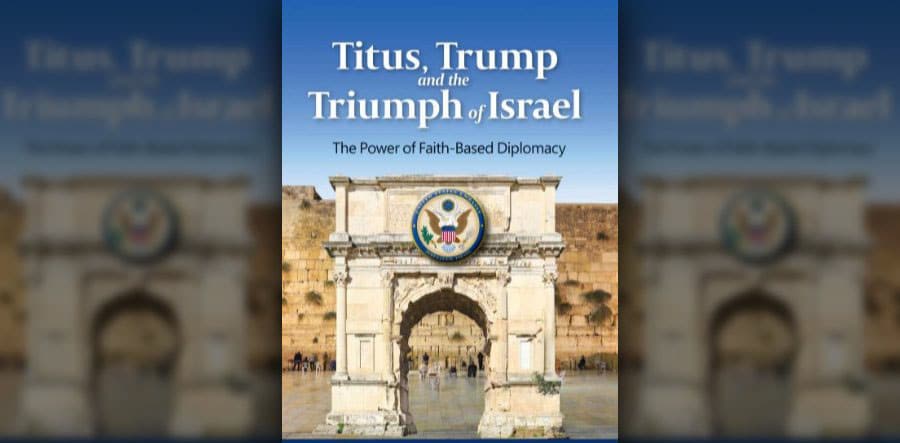
The Media LineJosh Reinstein is the author of Titus, Trump and the Triumph of Israel, a new book just out on the power of faith-based diplomacy. Thank you for joining us at The Media Line.

Josh Reinstein: Thank you for having me.

TML: Pleasure! Almost identical quotes are attributed to both Albert Einstein and Mahatma Gandhi. Quoting the Einstein version, these great thinkers admonished that those who believe that politics and religion do not mix, understand neither. Is the modern State of Israel a political or religious concept?

JR: Well, I think as you read the book, we start off with a case study; so the case study is Titus, the emperor who declared victory over the God of Israel. He destroyed the Second Temple. He kicked the Jewish people out of the land of Israel. He actually built the Arch of Titus, which depicted the carrying of the menorah out of the destruction, because he thought he beat the God of Israel, but what we know was that was the beginning of biblical prophecy. So, just like with Titus – he didn’t really understand what’s going on because he didn’t look at Israel through a biblical view – we see that happening today as well. So, people who don’t look at Israel through a biblical lens – typically men – often miss the real story.

TML: This book that’s just been released looks at those who support or oppose the modern State of Israel as being a function of religion, but are you looking at religious affiliation or religious doctrine?

JR: Well, if you look at the books you start by making the legal case, the historic case, the archaeological case, but all of them pale in comparison to the biblical case for Israel. And the more you’re more likely to believe in the Bible – Jews and Christians – people who believe in the Bible, the more you are willing to support Israel, the more you are wanting to stand with the State of Israel. Now, people who don’t believe in the Bible, they don’t necessarily don’t like Israel, but there’s also a third category of people who hate the God of Israel and the Bible and they are those who almost always stand against Israel. So, the book goes through who’s standing with Israel, who’s standing against Israel and why.

TML: Well, how would you explain the “why” very quickly?

JR: Well, I think if you express through a factual point of view there are a lot of people who are standing against Israel which you wouldn’t understand why they would stand against Israel. For example, we see extreme atheists or extreme liberals on the university campuses. They have Apartheid Week against Israel. Yet, Israel is the only free democracy in the Middle East. It is the only place that has equality of men and women. It is the only place that has freedom of religion; freedom of election; freedom of the media. So, you would think people on university campuses would be for these freedoms, for these universal freedoms, for these universal rights, yet they stand against Israel. If you look at it from only a practical point of view, it doesn’t make much sense. But if you look through a biblical point of view, it makes perfect sense. It’s the same people who are saying that there is no God – that the Bible is just a made up storybook – that are staring at the State of Israel because Israel is proof that the God of Israel exists and that the Bible is true, and you can see it through the fulfillment of prophecy in Israel. That’s just one example from Titus, Trump and the Triumph of Israel, but we go through other people who are standing against Israel, people who have a real interest in trying to show that the God of Israel is not real. And that’s really where we are seeing this clash of civilizations between those who believe in Judeo-Christian values on the one [hand], and those who are actually fighting Judeo-Christian values on the other side.

TML: But isn’t it so that virtually all religions – including Judaism – have adherents that support the State of Israel and those who deny its right to exist?

JR: Well, we’re seeing that there’s a lot of people who are atheists, there’s a lot of people who believe in other religions who still stand with the State of Israel. They do it because of the issues that I mentioned before. It’s the only free democracy in the Middle East. It’s a great ally in a [difficult] world. But when you look at people who are very much against biblical values, very much against the God of Israel, then most likely they stand against Israel. At the same time, if you look at us who believe in the God of Israel, who believe in biblical values, they almost always stand with Israel, so we are seeing a diverting of who is standing with the State of Israel and who’s not.

TML: Is it always the difference of religion or religious tenet that is that differential?

JR: No, I’m just talking about one divide, this clash of civilization that we’re seeing between those who believe in the Bible and those who don’t, but as I mentioned before, we’re seeing other people who stand with Israel for a variety of different issues, some of them for social-political issues; some of them are religious freedoms; some of them because of geopolitical concerns; some of them because of political interests. For example, there are some people who stand against Israel because we only have one vote in the UN and there are 22 Arab votes. There are many more Muslim votes, so politically it’s not a smart move to stand with the State of Israel, so that’s a different interest. But this book examines the power of faith-based diplomacy, the power of those who are standing with Israel against those who are standing against the fulfillment of our prophecies.

TML: Half of Israel’s own population chooses religion. I recall vividly the days you refer to when Jewish supporters of Israel who embraced Christian Zionists were mocked and left outside the religious establishment, both in Israel and the United States. What was the turning point?

JR: I think people understood that the turning point happened during the Second Intifada. We were seeing that one-by-one the nations of the world were turning against Israel, but Christians were standing their ground, and they were standing up with Israel. And people started asking themselves, “Why?” Why are these Christians standing up with us when no one else will? They realized that if you put values and beliefs ahead of economic and political concerns, you’re almost always going to stand with Israel, and when we realized that in 2004 the Knesset, our parliament, established the Christian Allies Caucus which works to develop this new relationship between Jews and Christians in the 21st century. I think once that started, it started a pattern of cooperation that grew and grew year-in and year-out, and then it just exploded under the Trump Administration when they took this Christian support and they turned it into real political actions, which is what we call faith-based diplomacy.

TML: When the Christian Caucus was created in the Israeli parliament, I distinctly remember there was at least as much confusion and ignorance as there was animosity. Now, more than 20 years later, are there parties involved that were previously opposed?

JR: Well, the beauty of the establishment of the Knesset Christian Allies Caucus is [that] we made it the first caucus in Israel. Before that, there were things called lobbies, but there was a lot of worry that Christians would use this to try to lobby the government to do things for them. So, we needed a caucus that you have to be a member of Knesset to be in and then they felt a lot more comfortable with starting this dialogue with Bible-believing Christians around the world. So, even when we established in 2004, when almost every party in the caucus from Shas all the way to Meretz… And we still do that today, we have seven political parties from left to right, religious to secular. We’re the largest and most influential caucus in the Knesset, but the secret to our success in Israel is that it’s always broad-based support.

TML: Do you see a change or a problem if there’s a change of [US] administration? Will you lose the clout that you have in the Israeli parliament?

JR: Well, I think in the Christian Alliance Caucus, we can prove it. The caucus was around and grew under the Obama Administration. It’s a bipartisan thing. Our sister caucus, the Congressional Israel Allies Caucus, is both made up of Republicans and Democrats. All of our work is multi-partisan if not bipartisan depending on the political system, so I think our caucus will be strong. The real question is, will some of these successes that we’ve seen go away? I think the biggest concern of everyone is what’s going to happen with Iran. Iran is our only existential threat. It’s a security threat. We can’t allow Iran to get nuclear weapons. We know that the Democrats are going to go back to the Iran deal which we are very much against, so I think that really becomes the big question. What happens to Iran? What happens to the Middle East? Do we continue with the Abraham Accords or do we go to war with Iran? I think that that’s where people are anxious, but there’s always going to be broad-based support, I think, between Republicans and Democrats for the State of Israel. So, even if you see that going down a little bit between different parties, I think the mainstream will always be fond of Israel.

TML: Israel is a nation that loves its politics, but we’ve heard Israelis express annoyance at political campaigns funded by nonresident Christian organizations and activists. What would you say to those offended Israelis who rile at partisan campaign posters and oversized, expensive banners adorning the highways?

JR: Well, I think that the people doing these campaigns have freedom of expression. I think that they have a right to do it. There are campaigns that will evolve on both sides of the political divide. I think what’s interesting about the Christian groups that are doing that is that they’re doing this from a biblically correct perspective, [and] not a politically correct perspective, so I think that the majority of Israelis will appreciate it. I also think this is a dividing thing. The campaigns that we’re seeing whether it be for Judea and Samaria, or the Golan Heights or recognizing Jerusalem as a capital, I don’t think these are distancing campaigns. I think these are uniting campaigns.

TML: Josh, sometimes an author writes a book because he or she wants to write a specific chapter and needs the whole book to do so. What chapter of Titus, Trump and the Triumph of Israel gave birth to the project?

JR: The project is really a combination of the last 16 years as director of the Knesset Christian Allies Caucus and president of the Israel Allies Foundation. What I did in the book is that I broke it down into four parts. I think that each part has something very unique about it. I can’t really put my finger on a factor, but I would say the first part is probably the most interesting to people who want to learn about the power of basic diplomacy, where it comes from, [and] what are our rights to the land. The last part is probably more important to people who want to see it in action and want to see what the future faith-based diplomacy is.

TML: How do you gauge the change in the Christian market and beyond in the last years that you’ve been involved in these projects?

JR: Well, I think that one of the most important changes is that they’ve put Israel as one of their main issues when voting in elections. If you look at the United States of America and the Republican party, you cannot get elected to the House of Representatives, the Senate or the presidency if you don’t stand with Israel, because the basis is Bible-loving Christians, and this is one of their main issues now. For the first time, we are seeing this from Latin America, from which the Guatemalan Embassy has moved to Jerusalem. It’s why the Honduran Embassy is going to be in Jerusalem. We’re seeing this in Africa. We have caucuses in 12 countries in Africa that is the Christian bloc for Israel. We’re seeing this in Egypt. We’re seeing this in Eastern Europe. So, I think that the global phenomenon is what’s so exciting about this, because this is just the beginning of faith-based diplomacy, and that’s why I think that the book Titus, Trump and the Triumph of Israelis an important read. It’s not only important to understand what was done and where we are today, but it gives you a road map of where faith-based diplomacy is [headed].

TML: What do the Abraham Accords tell us about the next book?

JR: Well, I think that the Abraham Accords are just a function of the faith-based diplomacy that I wrote about. In fact, I predicted in the book some of this happening in the near future, even though the book was written six months ago. The idea is, when Israel is strong, when you’re at peace through strength, then anything is possible, and that when Israel is weak, then very bad things happen. And it’s this idea that Christians are strengthening the State of Israel and making it strong that will lead to real peace. It’s also the fact that the president of the United States is following their political line from Christians who love Israel. So, we’re seeing who’s doing things that are biblically correct instead of politically correct. They see that the biblically correct solution often leads to peace, whereas the politically correct solution often leads to war.

TML: What do you think the Palestinian people are thinking? When they see the Christians uniting with Israel, what do you think has been the response?

JR: I think they think the same thing as what they think when they see the peace accords with the United Arab Emirates or with Bahrain, or most recently with Sudan. Israel is really a peace-loving, successful, vibrant country, and they want a part of that. They want to be a part of that story, and I hope that reaction will lead us to peace, because look, we can’t just hold onto this grudge forever. We have to come to the negotiation table and I think that that is where this all leads to. I think in the end we all believe there will be peace in Israel. The question is how? I think what President Trump and [Prime Minister] Benjamin Netanyahu are showing us is that peace through strength is the way forward.

TML: Josh, you provide a concise history for reference if you’re looking for milestones of the conflicts, or the central themes of historic hostilities. Is it your belief that those opposed to the State of Israel will learn from your book?

JR: Yes! Of course. One of my goals is not just to speak to those who already love Israel. I want to make a case for Israel, and I want to make a case for people who may be against Israel to take a look again at Israel. We examine your belief in Israel, because the truth is that Israel is an amazing place and that being against Israel is just another form of anti-Semitism. It’s a hatred that has no basis and it spreads like a virus and that’s why it’s so important that people understand that the BDS [Boycott, Divestment and Sanctions Movement] is anti-Semitism. [It] is that anti-Israel or Apartheid Week, or calling for Israel to be pushed into the sea – that’s all anti-Semitism. And when people realize that, then they would shun it and they would look at Israel from anew. I try to go into the historic basis for anti-Semitism; where it comes from [and] how it spreads and show how that is done today through these movements like BDS and modern, anti-Israel [movements].

TML: So, at the end of the day, Josh, how do you get those who might not agree with you to actually read Titus, Trump and the Triumph of Israel?

JR: Well, I think that’s the challenge. I think it’s up to people who read it and enjoy it to talk to their friends about it. Look, people’s beliefs on Israel around the world are not something that is a dividing factor. There are people who are friends and some like Israel and some don’t like Israel, so I think those who do like Israel and read the book will say, “Hey, this was another way of looking at it. Maybe you can take a look at it and take a lead.” Ultimately, you need to get the person to read the book, and I hope they do. We’ve seen tremendous success so far, and I hope that continues. And I think that if people actually read the book, they would understand the exciting story of this tiny, nation of Israel.

Titus, Trump and the Triumph of Israel by Josh Reinstein is available from Gefen Publishing House.


 

Adherents to Faith-Based Diplomacy See Political Boost for Israel Read More »

U.K. Labour Party Suspends Jeremy Corbyn Over Anti-Semitism Report

The United Kingdom’s Labour Party suspended former party leader Jeremy Corbyn on October 29 following the release of the Equality and Human Rights Commission’s (EHRC) report stating that the party broke the law in how they handled complaints of anti-Semitism.

The report, which was published earlier that day, concluded that the Labour Party violated the country’s Equality Act during Corbyn’s tenure as party leader. The law states that the party “must not discriminate against, harass or victimise members, associates, guests, or those wanting to become members, on the basis of a number of protected characteristics,” according to the report. The EHRC found that Labour inadequately handled complaints of anti-Semitism and that the party is responsible for “unlawful acts of harassment and discrimination.”

In total, the EHRC found 23 instances of Corbyn’s office engaging in political interference over complaints of anti-Semitism and charges that the party failed to provide proper training on how to handle anti-Semitism, the BBC reported. The EHRC recommends that the Labour Party provide “a comprehensive policy and procedure” on how to handle anti-Semitism as well as regularly audit its complaint system and ensure that there’s independent oversight over the process in the long-term. The EHRC also recommends that Labour establish an education and training program on anti-Semitism in conjunction with Jewish stakeholders.

After the report was released, Corbyn said on his Facebook page that while anti-Semitism was an issue during his tenure as leader of Labour, it “was dramatically overstated for political purposes.”

In response to his remarks, Labour suspended Corbyn.

“In light of his comments made today and his failure to retract them subsequently, the Labour Party has suspended Jeremy Corbyn pending investigation,” the party said in a statement. “He has also had the whip removed from the Parliamentary Labour Party.”

Corbyn responded to the suspension by tweeting: “I will strongly contest the political intervention to suspend me. I’ve made absolutely clear those who deny there has been an antisemitism problem in the Labour Party are wrong. I will continue to support a zero tolerance policy towards all forms of racism.”

Jewish groups praised Labour for Corbyn’s suspension.

“Over the course of Mr. Corbyn’s leadership, the Labour Party became known for its antisemitism and its cynical approach to the Jewish community of Great Britain,” World Jewish Congress President Ronald Lauder said in a statement. “Today’s findings, as well as the party’s decision to suspend Mr. Corbyn from its ranks, are a much needed and welcome step in ridding the British political system of his brand of hatred and contempt. We commend Labour’s new leader, Keir Starmer, for his proactive approach to combating antisemitism within the UK’s political leadership.”

The American Jewish Committee similarly tweeted, “We welcome today’s decision by @UKLabour to suspend @JeremyCorbyn for deflecting blame from himself after the @EHRC report found that under his leadership Labour was responsible for unlawful harassment and discrimination of Jews. There must be zero tolerance for antisemitism.”


Anti-Defamation League CEO Jonathan Greenblatt also tweeted, “Thank you @Keir_Starmer for taking a principled stance and making clear #antisemitism, and its whitewashing, have no place in @UKLabour or politics in general.”


Jewish Agency chairman Isaac Herzog said in a statement, “During my tenure as Chairman of Israel’s Labor Party and Leader of the Opposition, I invited then-Chairman of the UK Labour Party, Jeremy Corbyn, to visit Yad Vashem in order to learn more about the Holocaust and its lessons. I emphasized to him the importance of such a visit for the Chairman of a leading party in Britain. He never responded to me. Nor did he respond to my appeal to him, as Chairman of The Jewish Agency, to eradicate his party of antisemitism. The lack of his responsiveness was glaring.

“Today’s decision by the UK Labour Party marks an important milestone in eliminating the scourge of hatred and antisemitism from a historic and important party in Britain. The Labour Party is setting an example to the entire world in removing antisemitism from the political game.”

British researcher David Collier tweeted, “People keep asking me if I feel vindicated. Vindicated? No! There is just anger. Anger that British Jews had to go through this at all.”


In August, Corbyn aide Andrew Murray was quoted as saying that Corbyn couldn’t empathize with Jews over anti-Semitism because Jews are “relatively prosperous.” In 2019, several Labour members left the party, mostly citing Corbyn’s handling of anti-Semitism. Corbyn lost to Prime Minister Boris Johnson in the December 2019 election for prime minister.

U.K. Labour Party Suspends Jeremy Corbyn Over Anti-Semitism Report Read More »

60 Years of Voting, 60 Years of the American Way

First came the sample ballots. Then the Official Voter’s Guide. Then the avalanche of glossy, four-color ads, and the barrage of TV ads, and pleas and warnings through social media, emails, texts, and irritating robocalls. Finally, I received the mail-in ballot. A thick envelope with detailed instructions for how to fill it out and return it. There were so many options: Return by mail — no stamp required; Take to an official ballot drop box; Wait until the voting centers open and leave your ballot there; Drop your ballot off at any voting center on election day; Vote in person.

This year marks the 16th presidential election in which my vote will be counted. The first was the year of Kennedy versus Nixon — 1960. It was a big year for me. I became a wife. I began my career as an educator. I turned 21. And I voted. My vote was an official confirmation that I transitioned into adulthood. And I remember it all.

For the first time in my life, I went to the neighborhood polling place on my own. I entered the canvas-enclosed cubicle and marked my ballot. I emerged with pride and wore my “I Voted” sticker for the remainder of the day. I remembered the messages of my history and civics classes: “We may support different candidates, but the beauty of our democracy is that the majority rules. Whichever candidate gets the most votes wins and, on that day, we accept the results as a single nation with a peaceful transition of power. This is the American way.”

Fast forward to the 2020 election. As I filled out the sample ballot one candidate and one issue at a time, I consulted piles of accumulated recommendations and endorsements collected over the preceding weeks. So many individuals and institutions are seeking my one single vote! And I felt the urgency. The choices are not subtle. Each vote points in the direction of a distinctly different future for my children, for my grandchildren, for every one of us. Each vote is nuanced, with complex meaning and critical potential. But lines have to be drawn and selections have to be made.

Each vote points in the direction of a distinctly different future for my children, for my grandchildren, for every one of us.

So I decided on candidates and issues one by one. I finalized my decisions as I transferred the pencil markings on the Sample Ballot to the little circles on the Official Ballot with black ink. Finally, folding the heavy sheets into the mailing envelope, I sealed the flap and carefully signed my name, entered the date and my address as instructed, checked it over numerous times to make sure that I hadn’t omitted anything or made any errors, and made my way to an official ballot drop box.

I got out of the car and walked the few steps to the box. I stood in front of it for a few minutes as I held the ballot between my thumb and my index finger and then finally let it slide into the small dark slot. As it left my hand and disappeared, my heart literally turned a little emotional somersault. I slowly got back into the car and, as I turned the ignition key, I thought back to the election of 1960. Light-hearted then, my heart felt heavy on this day, its chambers pulsing with the echoes of vitriol and fear that have invaded our collective spirits throughout these past months.

This year, three of my four grandchildren are first-time voters. I think that they are feeling the gravity of this election as I do. I wish that I could gift them the exaltation of that day in 1960, when I first voted with pride, with complete faith in our system and in the future. But I know in my heart that the exaltation of casting my first vote is a gift that is not mine to give. In my heart, that is still capable of turning somersaults, is a prayer that they, as was I, will also be granted faith in an America to which they proudly pledge their allegiance … as one nation, under God. This is the American way.


Rochelle Ginsburg, educator, facilitates book group discussions for adult readers.

60 Years of Voting, 60 Years of the American Way Read More »