fbpx

October 26, 2020

Ignoring the Facts, De Blasio and Cuomo Paint Targets on the Backs of Jews

In 2019, hate crimes against Jews in New York City had increased by 64% from the prior year. This monumental spike in hate crimes against Jews, particularly against the Orthodox and Ultra-Orthodox, occurred as overall crime in New York City had decreased by 6%.

At the end of 2019, there were attacks on Jews in New York on almost every night of Chanukah. One such attack was a home invasion at a Chanukah party in Monsey by a madman with a machete. In that attack, the madman — who expressed his belief in many anti-Semitic conspiracy theories — stabbed and slashed at four Jews. He ultimately killed one attendee, Rabbi Josef Neumann.

The problem of anti-Semitic hate crimes was so acute that on February 17, 2020, the New York Times published an article titled “Most ‘Visible Jews’ Fear Being Targets as Anti-Semitism Rises.” In this article, the Times noted that in 2019, attacks against Jews accounted for over 50% of the city’s hate crimes — even though the visibly Jewish (Orthodox Jews) are barely 3% of the city’s population.

Then, in March of 2020, the coronavirus pandemic added another risk to Jews — conspiracy theories blaming Jews for causing the pandemic. And in July of 2020, the British Commission for Countering Extremism published a widely discussed report detailing how Jews were facing five dangerous categories of conspiracy theories blaming them for the virus.

Per the Commission’s report, the main conspiracy theories targeting Jews were:

  1. The virus is fake and part of a Jewish plot to mislead the public.
  2. The virus is real and was deliberately created by Jews for malevolent purposes.
  3. Jews are the primary spreaders of the virus.

This phenomenon of blaming Jews for the virus, in line with medieval anti-Semitism blaming the bubonic plague on the Jews, was also noted by the U.S. Special Envoy for Monitoring and Combating Antisemitism, Elan Carr, in his July 11, 2020 report to the pro-Israel organization CUFI. In that report, Carr provided the following:

“We’ve seen a tsunami of antisemitic hatred on the Internet and social media that baselessly blames Jews for having invented the coronavirus, for intentionally spreading it, profiting from it or using it as a tool for global control… The only thing new or novel about this absurd allegation is the coronavirus itself. Blaming Jews for the world’s maladies has been a standard feature of antisemitism for centuries.”

Given this backdrop of conspiracy theories and hate, one might reasonably expect politicians in New York, particularly those who purport to care about minority rights and fighting bigotry, would be careful about even implying that Jews were to blame for the spread of the pandemic.

But New York’s governor and New York City’s mayor proved otherwise. Indeed, the level of disregard Governor Andrew Cuomo and Mayor Bill de Blasio have shown for the Jewish community’s safety or for the power (and danger) of their words has been staggering.
At the end of April 2020, in response to hundreds of Orthodox Jews attending their rabbi’s funeral in Williamsburg, de Blasio tweeted: “My message to the Jewish community, and all communities, is this simple: the time for warnings has passed. I have instructed the NYPD to proceed immediately to summons or even arrest those who gather in large groups. This is about stopping this disease and saving lives. Period.

Incredibly, de Blasio seemed to see no issue with sending a “warning” to the entire community of over 1,000,000 Jews in New York over the actions of a few of its members. Despite the ever-increasing violent anti-Semitism under his watch, de Blasio plainly felt comfortable singling out an entire community of Jews for some Jews violating the city’s social distancing rules.

Many of the responses to his tweet were appropriately angry. After first defending his Tweet singling out Jews, de Blasio issued a pseudo-apology (for writing “something that was in any way hurtful”).

One would have hoped this episode would have led to a realization among New York’s leaders that they need to be more careful with their words and avoid even the appearance of discrimination. Sadly, the last two months have demonstrated that the only real lesson Mayor de Blasio and Governor Cuomo learned is that Orthodox Jews make a convenient scapegoat.

When the summer ended, and more people started congregating indoors, it was expected that many states in the northeast, just like many countries in Europe, would experience a “second wave” of coronavirus infections. And as those infections increased this autumn, Cuomo and de Blasio picked up the centuries’ old game of casting blame on the visible Jewish minority.

On October 7, 2020, Governor Cuomo announced more lockdown restrictions, referencing primarily religious Jewish neighborhoods in New York City as the “hot spots.” Two days beforehand, Cuomo said in a news briefing thatOrthodox Jewish gatherings often are very, very large and we’ve seen what one person can do in a group.” Cuomo then issued an order at the request of de Blasio, requiring the temporary closure of public and private schools in areas of the city with large Orthodox Jew populations.

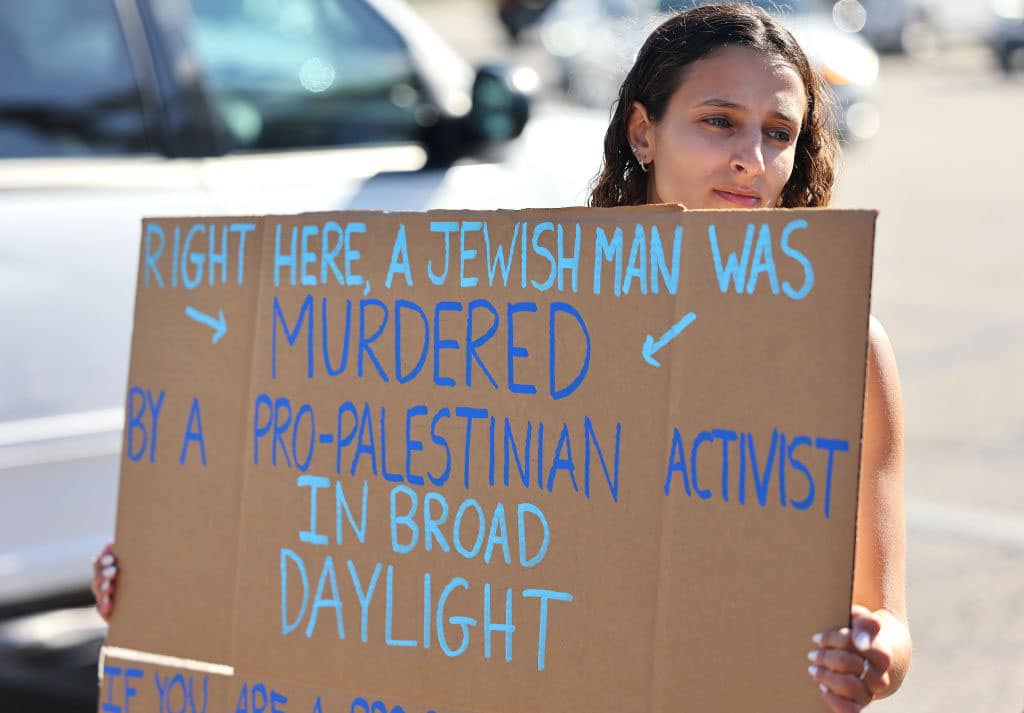
A protester carries a sign featuring New York Governor Andrew Cuomo’s quote about Jewish gatherings. (Photo by Spencer Platt/Getty Images)

Then, as part of an apparent media campaign to justify his focus on the visibly Jewish, on October 14, 2020, Governor Cuomo, in an interview with PBS News Hour, blamed “Jewish religious practices” for spreading the virus in NY.  In a separate news conference that same day, Cuomo made arguably even more outrageous and irresponsible claims when he said, “the enforcement from the local governments is very uneven especially when it’s politically sensitive. And that’s what we’re running into with lot of these ultra-Orthodox communities, who are also very politically powerful, don’t kid yourself.”

Governor Cuomo, Mayor de Blasio, and their defenders argue that they are only addressing the fact that ultra-Orthodox communities have been holding large gatherings, often with many people without masks, and that the infection rates within these ultra-Orthodox neighborhoods are higher than the state and city average.

But New York’s leadership failed to apply this exacting scrutiny or standard to the other large gatherings, many of which had maskless attendees. Witness, for instance, the large number of protests in New York this summer. Or look at the silence of New York’s leadership at large religious gatherings by other faiths and ethnic groups, such as the thousands of men (many maskless) who crowded together in the streets of New York City on August 23, 2020, to celebrate the Shia holiday Ashura. Or witness a similar gathering of thousands of largely unmasked Shia men in Queens on October 5, 2020, to conduct the Arbaeen. New York’s leadership also ignored how a large concert in Manhattan honoring Breonna Taylor might spread the Coronavirus. Instead, Cuomo used a centuries-old trope about “very powerful” Jews to imply that he is politically courageous when he scapegoats Jews for the spread of a pandemic.

The reality is that it takes no courage for either de Blasio or Cuomo to scapegoat ultra-Orthodox Jews. Cuomo and de Blasio know that the ultra-Orthodox in New York are largely conservative, unlike their liberal constituencies. Given these political realities in New York, it would take real political courage, on the other hand, for either Cuomo or de Blasio to call out their supporters’ concerts, protests, rallies, or other religious practices as being dangerous.

It takes no courage for either de Blasio or Cuomo to scapegoat ultra-Orthodox Jews.

This is why politicians like Cuomo and de Blasio focus on the politically easiest minority for them to blame, the visibly Jewish. This is also why, when other minority groups in the United States have higher infection or mortality rates than the rest of the population; politicians like Cuomo and de Blasio correctly depict them as victims of the pandemic. But they instead cast the visibly Jewish, not as victims, but as vectors of the disease.

This is why they largely ignore other potential super-spreader events and focus on visibly Jewish events. This is why they focus on visibly Jewish neighborhoods and ignore the fact that as of mid-October (at the height of their anti-Semitic invective about “powerful” Jews and their “religious practices”), the ultra-Orthodox neighborhood of Borough Park and most Brooklyn neighborhoods (except East New York), were well below many other Queens and Bronx neighborhoods with respect to per-capita cases and mortality rates. (Borough Park was only the 49th highest zip code in New York mortality rates, while Williamsburg, home to over 60,000 ultra-Orthodox Jews, was 79th.)

Of course, all of this irresponsible scapegoating of the visibly Jewish is likely to have consequences. In a city, where before the pandemic, hate crimes targeted Jews at a rate of over 50%, it is only a matter of time before someone is inspired to attack Jews based on the false notion that they are uniquely to blame for the coronavirus.

The attacks have already happened. On October 13, someone on Facebook posted a video of him harassing a Jewish man in Borough Park for not wearing the facemask he had in his pocket (he was on his cell phone, and no one was within at least 8 feet of him). That video has already received millions of views and thousands of “likes,” as far too many people get a kick out of seeing a bully frighten a Jewish man. One week later, shots were fired at a synagogue located on 18th Avenue and East 9th Street, in one of the ultra-Orthodox “red zones” called out by Cuomo and de Blasio.

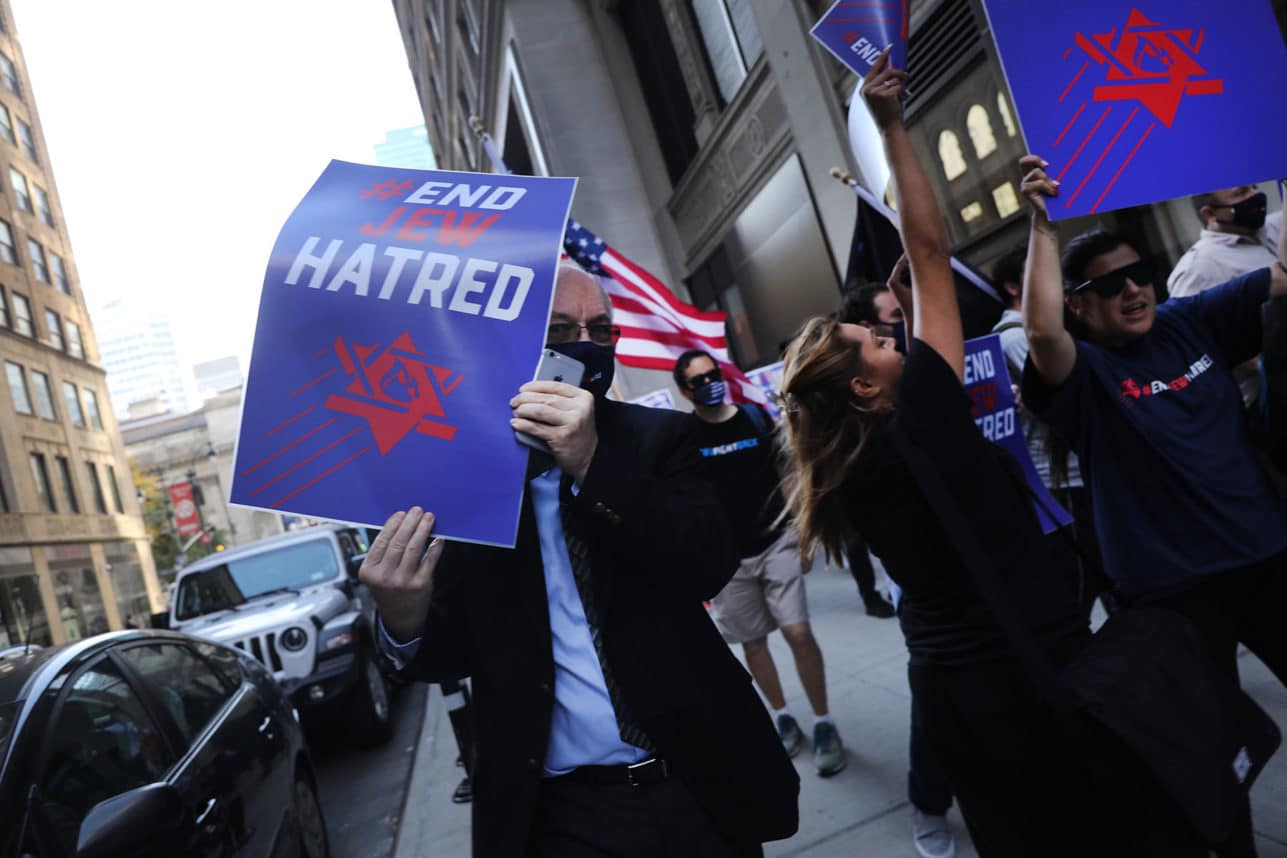
On October 15, 2020, the #EndJewHatred movement staged a rally in Manhattan to protest de Blasio and Cuomo’s cynical and inaccurate scapegoating of the visibly Jewish. The central message of that protest — and the demand that the marchers delivered in writing to the Governor’s office — was that although we should not expect perfection from government leaders when dealing with a pandemic, we can expect (and should demand) that our leaders treat all communities equally, and not focus blame on one of New York’s most targeted and vulnerable minorities.

We should also expect and demand that no political leader in the United States use medieval tropes about “politically powerful” Jews spreading diseases in order to deflect from their own failures. Cuomo and de Blasio have been doing exactly that for months now. Unfortunately, far too few people appear to care.

Ignoring the Facts, De Blasio and Cuomo Paint Targets on the Backs of Jews Read More »

Sacha Baron Cohen Exposes Anti-Semitism, Skewers Trump in ‘Borat Subsequent Movie Film’

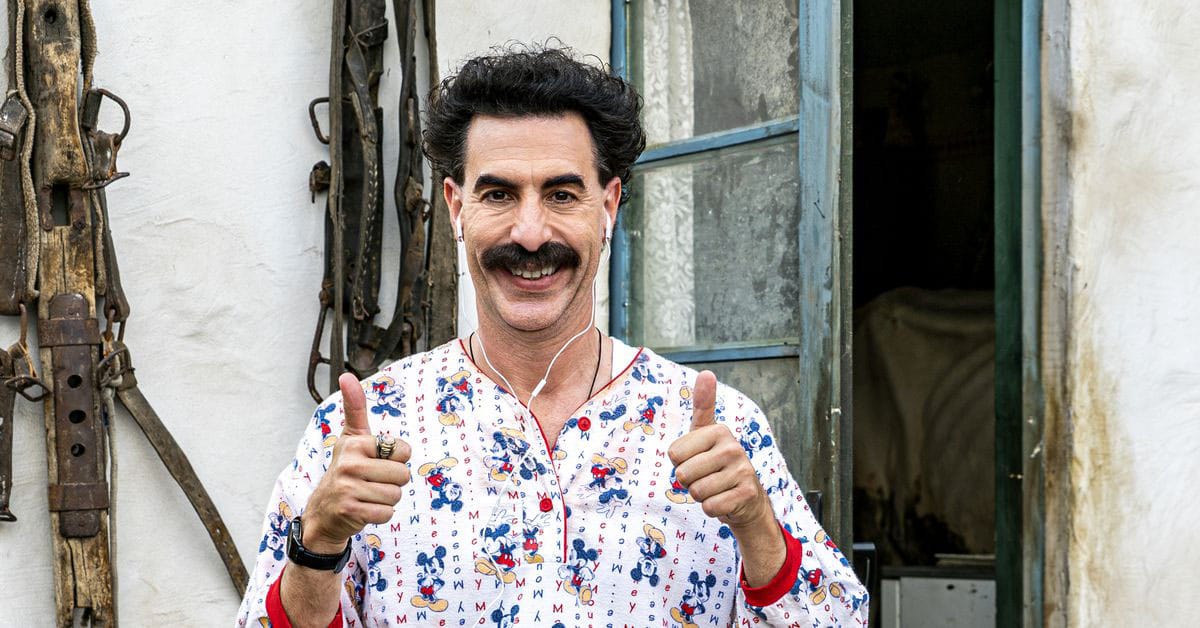
Fourteen years since first punking unsuspecting Americans and exposing their prejudices in “Borat,” Sacha Baron Cohen returns to the role of Kazakh journalist Borat Sagdiyev in the sequel “Borat Subsequent Movie Film: Delivery of Prodigious Bribe to American Regime for Make Benefit Once Glorious Nation of Kazakhstan” with hilarious envelope-pushing results.

Cohen, who won a Golden Globe and earned an Oscar nomination for his screenplay for the 2006 original, continues to use irony and parody to expose anti-Semitism, homophobia, and racism while skewering the current administration in the sequel, now streaming on Amazon Prime Video. In the plot, Borat is freed from the gulag and sent back to the United States with a gift designed to win favor with the White House for the Kazakh dictator. Things go ridiculously awry, but every outrageous stunt, disguise and elaborate set piece makes a point.

“My aim here was not to expose racism and anti-Semitism,” he said of the sequel. “The aim is to make people laugh, but we reveal the dangerous slide to authoritarianism,” Cohen told the New York Times. He can be heard speaking gibberish amalgam of Polish and Hebrew in his version of the Kazakh language in the film.

“My aim here was not to expose racism and anti-Semitism. The aim is to make people laugh, but we reveal the dangerous slide to authoritarianism.” — Sacha Baron Cohen

Shot in secrecy during the coronavirus pandemic and fast-tracked to be released before the election, the movie required Cohen to stay disguised even when the cameras stopped rolling. “The hardest thing I had to do was I lived in character for five days in this lockdown house. I was waking up, having breakfast, lunch, dinner, going to sleep as Borat when I lived in a house with these two conspiracy theorists,” he said. “You can’t have a moment out of character.”


Cohen also puts his comic talents to use as Abbie Hoffman in the Netflix miniseries “The Trial of the Chicago 7,” about the uprising at the Democratic National Convention in 1968. “Essentially, he was trying to be a stand-up comedian,” Cohen said about the Yippie leader. “He was very influenced by Lenny Bruce and he realized that if he could make people laugh, he could get them engaged in the cause.”


Sacha Baron Cohen Exposes Anti-Semitism, Skewers Trump in ‘Borat Subsequent Movie Film’ Read More »

In a Post-Pandemic World, We’ll Need to Reimagine Jewish Spaces

It boggles the mind to think that thousands of Jewish buildings, from synagogues to museums, are still sitting empty, paralyzed by a tiny virus that has turned physical structures into risky infection zones.

Leaders of these Jewish spaces have scrambled to adapt, mostly through the remarkable saving grace of online technology. For any physical gathering, the magic words are “small” and “outdoor.” Orthodox communities, which don’t use technology on Shabbat, offer modest outdoor prayer services, and so on.

The underlying assumption behind all these efforts is that they’re temporary measures until we can get back to “normal.” This is human nature. When life throws us radical disruption that creates anxiety and uncertainty, our first instinct is to long for a return to what we’re used to.

For the Jewish communal world, however, this longing for the status quo would be a major mistake — or, I should say, a major missed opportunity.

Instead of hanging on as best we can until our spaces are safe again (whenever that will be), we can take advantage of this timeout from the ordinary to reimagine something extraordinary that would better serve the whole community.

We can take advantage of this timeout from the ordinary to reimagine something extraordinary that would better serve the whole community.

If we can agree, for example, that a primary objective for our community is to strengthen Jewish connection and Jewish identity, especially among the younger generation, what should we try to improve above all?

Most Jewish leaders would say Jewish education.

And yet, that’s not where most Jewish money goes. Instead, so much of our philanthropic dollars have been poured into elaborate buildings that have little to do with formal Jewish education. Now that physical structures have diminished in value during the pandemic, we have a unique chance to rethink the role of real estate in Jewish communal life.

The key question: How do we make the Jewish structures of the twenty first century work better for everyone?

We know, for example, that we will always need synagogues, which are crucial gathering places to build and nurture communities. But this cannot come at the expense of Jewish education, which, remember, is a primary pillar of our future.

In that spirit, one idea would be to create “hybrid” structures that could house both synagogues and Jewish day schools. In other words, a multi-use space where communities would gather on Shabbat and holidays, and Jewish students (K—12) would go to school during the week.

I can see your eyes rolling: “That’s not practical! Our buildings are not built for that!” To which I respond: Correct, but that’s why I’m writing this column— to challenge the status quo and lay out an aspirational vision for the future.

There’s hardly anything more aspirational than making Jewish education more affordable. Hybrid spaces offer significant savings and economies of scale. Yes, this may require some sacrifices, such as holding services in a school gymnasium. But if it means drastically reducing the cost of Jewish education and attracting thousands of new Jewish day school students across the nation, wouldn’t it be worth it?

Isn’t there also an intrinsic value with students and communities at large sharing a common space? And isn’t that sharing itself a statement of Jewish unity?

It’s true, there’s long been an obsession in the Jewish world to “have our own building.” I get that. Buildings define communities. They are a symbol of accomplishment and a source of pride. But in this new pandemic era when everyone’s been tightening their belts, fancy buildings may be a luxury some communities may no longer afford.

The upshot is that hybrid spaces open up new possibilities. A synagogue that is forced to sell its building can gather on Shabbat in a school gym and use the proceeds of the sale to subsidize tuition for Jewish families who can’t afford it.

The reimagining of Jewish spaces need not stop with shuls and schools. Cultural museums are important places of learning, while community centers are important places of connection. Why not create spaces that marry both? Connecting with others in a learning environment would stimulate both impulses.

Another communal imperative for Jewish spaces is more and better housing for the elderly and those with special needs. Instead of more stand-alone museums and synagogues, why can’t we take some of those resources and allocate them to more urgent housing needs?

Even kosher restaurants can play a role in building Jewish connection by hosting regular classes on Torah, Israel and Jewish culture.

We’re entering a new world. The pandemic has humbled us and forced us to be more creative, economical and strategic. Our limited resources will need to put a greater emphasis on the “software” of Judaism rather than the “hardware” of costly real estate. If we can create more multi-use Jewish spaces that better serve the whole community, the post-pandemic era may well trigger a Jewish renaissance.

For well over a century, the Jewish approach to physical spaces has been linear and predictable, dominated by determined leaders who attracted major donors to help build singular structures. Overnight it seems, COVID-19 has turned this model upside down and compelled us to re-examine our priorities.

Instead of bemoaning our fate, we can use this unprecedented moment to develop new, more flexible models that better fit our changing world. A good place to start is the creation of multi-use spaces that would increase communal engagement while making Jewish education more affordable.

If we build that, more will come.

In a Post-Pandemic World, We’ll Need to Reimagine Jewish Spaces Read More »

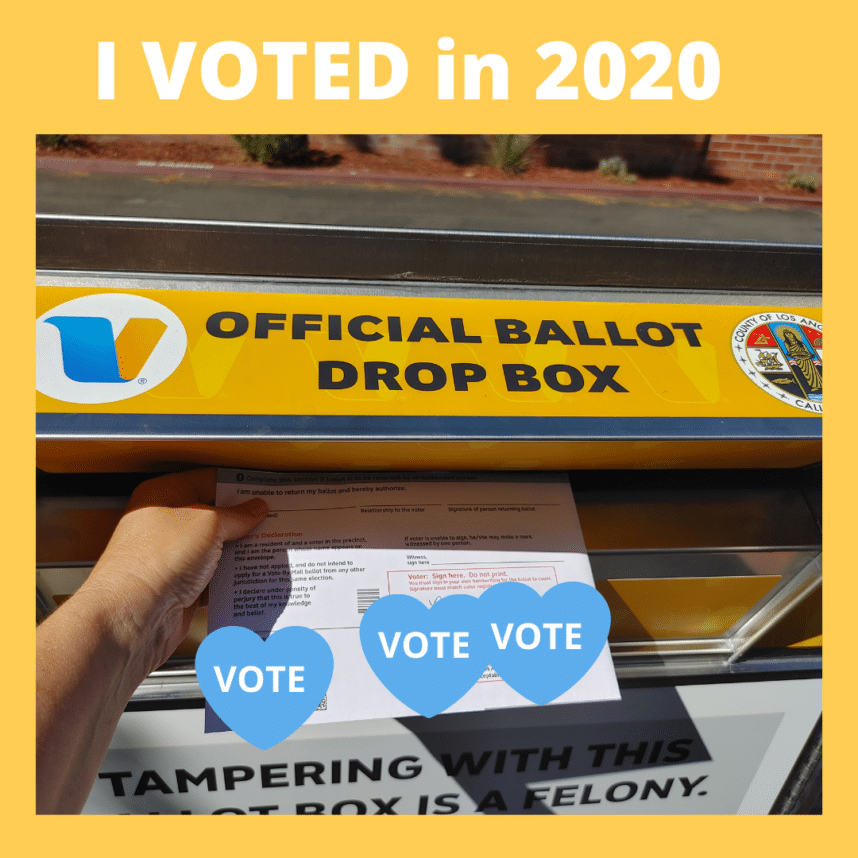
PLEASE VOTE NOW 2020

Make your voice count and be heard. VOTE NOW in the USA Presidential Election. It is important to participate and exercise your right to choose.

As @VisitLA4Locals says: ‘You may not love the choices, but you don’t have to. It’s not your soul mate or life partner. It is your obligation as a citizen to take part in the process. Speak up and make your voice heard! If you live in LA County you can find a list of official drop boxes (and also how to vote by mail) at https://locator.lavote.net 🗳

From my editor, Carmen Rios (#vbadgrl): “Looking for critical guidance in battleground states? Check out @v4eusa. Looking for answers in los Angeles? I’m using the @blmlosangeles guide to fill out my ballot. Have questions about Voter ID laws? Ask @thevoteriders. Need to make a plan? go to iwillvote.com.

More from @VisitLA4Locals: “This year, voters in LA County are able to go to ANY Vote Center and no longer need to be assigned to a specific polling place 🎉. In addition to the official drop boxes open 24-hours a day, 118 vote centers are now open where you can cast your ballot (or drop off a pre-filled one.) While most of these locations aren’t available for exploring yet, it is a good way to get a very small taste of what they offer. Landmarks where you can #getyourvoteon include @hammer_museum @hollywoodbowl @skirball_la @staplescenterla (where you can get special #ivoted stickers!) @theforum @thewiltern and @dodgerstadium* (For more information on #votecenters#dropboxes or other #votinginformation you can go to https://locator.lavote.net/ or https://www.headcount.org/livenation/ Fill out your ballot, wear a mask and VOTE! 🗳 *some in person locations, including Dodger Stadium open Oct 30th. Let’s do this, L.A.!


My ballot is in and ready to be counted! Is yours?

I tracked my ballot with BallotTrax. Check if your county is using it here.

PLEASE VOTE NOW 2020 Read More »

Anti-Semitism in the United States: New Facts About (Mostly) Feelings

Last week, the American Jewish Committee released only half of its annual survey of American Jewish opinion. It was mostly about American politics, Trump vs. Biden and Israel. Today, the second half was published — the one that deals with anti-Semitism. A similar survey was taken last year, from which we earned that Jews in America are worried. Today we learn that they are still worried. 88% of those surveyed believe anti-Semitism in America is a problem (37% say it is a serious problem). 82% of them believe this problem is trending up. 43% of them believe that they are less safe today than they were last year.

One cannot look at such numbers without concern. One cannot argue with how people feel. And yet, one ought to wonder about what these numbers truly mean. Many feel unsafe, and still, 97% of respondents say that they were never physically attacked. Many Jews feel that anti-Semitism is growing, and still, 75% did not have to cope with an anti-Semitic comment. Not even on the web (77%). And most of those who did encounter such comments did not bother reporting the incident (76%).

Surveys can teach us something about anti-Semitism. They can tell us what people feel and what they experience. They can show us — as in this case — that feelings and experiences aren’t always compatible. They can also reveal puzzling discrepancies. For example, AJC surveyed both Jews and non-Jews. Among the non-Jews, AJC found a significant number of people (46%) who aren’t sure what anti-Semitism is. It also found a significant number of non-Jews (63%) who believe that anti-Semitism is a problem in the United States today.

Where’s the problem? Here it is: according to this survey, there is a not-insignificant share of Americans who 1) Don’t know what anti-Semitism is, and 2) Still think that anti-Semitism is a serious problem in America today. Think about it this way: Do you know what global warming is? “No.” Do you think global warming is a serious problem? “yes.” You get the paradox.

The AJC survey also raises the question about expectations: should everyone know what anti-Semitism means? The AJC press release calls the ignorance of almost half of all non-Jewish Americans “concerning.” I could easily see a reverse argument that this fact is calming. If many Americans do not even know what it is — maybe that’s at least half-proof that anti-Semitism isn’t such a big problem.

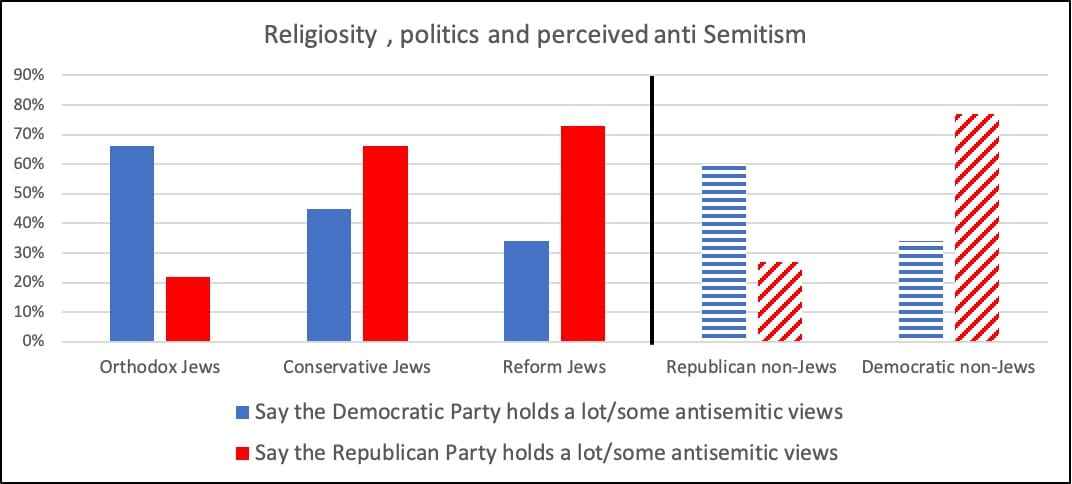
So Why do Jews and non-Jews see anti-Semitism as a growing problem? Maybe it is because they are expected to see it as a problem. Maybe it is because there is more talk about it being a problem. Maybe it is still the effect of the murderous Pittsburgh attack exactly two years ago. And of course, there’s the general atmosphere of partisanship and bad feelings. But the survey’s question, “do you think the Democratic/Republican Party holds antisemitic views,” feels awkward. What are they asking: that the platform is anti-Semitic, the leaders of the party, the voters? Regardless of the question’s vagueness, most Jews had an answer. About half of all Americans believe that two main parties hold anti-Semitic views (42% Democratic party, 52% Republican party). Among Jews, the distribution of blame is somewhat more one-sided. About a third believe that the Democratic party is somewhat anti-Semitic (37%), more than two-thirds (69%) see such a problem with the Republican party.

Jews are much more worried about right-wing extremism than about left-wing extremism, even though AJC tries to obfuscate this fact by mixing the responses for “very serious threat,” “serious threat,” and “somewhat of a threat.” In so doing, the AJC presents 88% for the level of threat from the right and 61% for the left. That is different, but not as stark as the result you get if you stick with just “very serious” and “serious.” In such case, it is 75% for the radical right and 32% for the radical left.

What do we learn from all this? When we measure anti-Semitic levels, there are three important layers to consider: what is the actual situation of attacks and discrimination, what non-Jews are feeling towards Jews, and what Jews are feeling. The AJC survey gives us a clear answer on the third component. Jews feel less safe; they feel threatened. About a quarter of them even change their behavior because of it. They will avoid wearing Jewishly-themed jewelry or posting Jewishly-themed content on social media (24%).

As for the first and second layers — what is the actual situation, and how non-Jews feel towards Jews, we get only partial answers. Most Jews were not attacked in any way. Most Jews do not know anyone that was attacked. Most Jews say their institutions were never attacked (59%). Not even with graffiti or a threat. If they are worried, it is maybe because of discrepancies between what they see as anti-Semitism and what other Americans see as anti-Semitism. A clear majority of Jews see a comment such as “the U.S. government only supports Israel because of Jewish money” as anti-Semitic (84%). Many non-Jewish Americans (close to half) do not feel the same.

More from shmuel Rosner about anti-Semitism in the US:

10 Simple Rules for Thinking About Anti-Semitism in America

Let’s Talk About Trump’s Executive Order

Podcast: Shmuel Rosner and Yaacov Lozowick, an Israeli historian, discuss the history of antisemitism and the possibility of its return to the United States.


Anti-Semitism in the United States: New Facts About (Mostly) Feelings Read More »