fbpx

October 26, 2020

More Speech, Not Enforced Silence Is the Answer to Anti-Semitism

In 2020, an arsonist torched the Chabad Center for Jewish Life at the University of Delaware. At the University of Southern California, Jewish student Rose Ritch resigned as student government president after students launched a social media campaign to “impeach her Zionist a**” and accused her of being a racist on the basis of her support for Israel.  At Arizona State University, posters appeared announcing, “Hitler was right.”

And this was just in August.

Also in August, Hillel International announced the launch of a new Campus Climate Initiative (CCI). The CCI will “provide measurement tools, best practices, education, and training designed to empower university leadership to understand the threats of antisemitism, take proactive steps to minimize them, and directly address them when they occur.” We hope this initiative will go a long way toward eradicating anti-Semitism on campuses.

What we hope the initiative does not do is encourage administrators and students to censor speech.

Too often, when faced with anti-Jewish sentiment on campus, the impulse is to silence it — either with administrative authority or through other means. A new study conducted by the Foundation for Individual Rights in Education (FIRE), with data on close to 20,000 students at fifty-five of America’s largest and most prestigious campuses, found that college students overwhelmingly choose to censor themselves and others. And on first blush, Jewish students appear to support censorship more than non-Jewish students.

When asked if it is ever acceptable to remove flyers or advertisements for an upcoming speaker or campus event, 71% of surveyed Jewish students said that this could be acceptable, versus 63% of non-Jewish students. Blocking an entrance to a talk was also endorsed by a higher proportion of Jewish students (42% versus 37%), as was shouting down a speaker to prevent others from hearing (69% versus 61%). The small consolation is that only 18% of Jewish students believed that using violence to stop a speech or event on campus was ever acceptable. That even 18% of Jewish students approve of such violence is extremely troubling (though non-Jewish students are equally approving).

There are certainly types of speech that are unacceptable: The First Amendment, for example, does not protect defamation, vandalism, incitement, true threats, or assault. But while in most cases removing flyers, blocking entrances, shouting down speakers, and engaging in violence in order to prevent a speaker from being heard is not protected by the First Amendment, many forms of anti-Semitism fall into the category of protected speech. Nonetheless, according to these data, both Jewish and non-Jewish students express a significant impulse to silence views they don’t like.

But Jewish students are often the targets of this silencing. So, shouldn’t we expect Jewish students to be advocates of open and rigorous debate –– especially since these are foundational to Jewish culture?

The FIRE data reveal that politically liberal students are generally less tolerant of speech they find offensive than moderate or conservative students are. And although the proportion of Jewish students in college is small relative to non-Jewish students (they make up only 2.5% of the survey’s sample), the proportion of Jewish students who are liberal (71%) is far higher than among non-Jewish students (51%).

But liberal Jewish students appear slightly more willing to censor than their liberal, non-Jewish peers. Forty-seven percent of liberal non-Jewish students say that it is sometimes acceptable to block an entrance to an event, compared to 51% of Jewish liberal students. Roughly three-quarters of non-Jewish liberal students say that it is sometimes acceptable to remove flyers (76%) and to shout down a speaker (76%), whereas 82% and 80% of Jewish liberal students (respectively) say that it is sometimes acceptable to do those things.

Maybe one reason these liberal Jewish students support these tactics is because self-identified liberal students increasingly believe that their campuses should be a place where they are not exposed to intolerant or offensive ideas. And liberal Jewish students have been exposed to plenty. 2019 saw the highest level of anti-Semitic incidents across the country in the forty years since tracking such incidents began.

Students whose Jewish identity includes Zionism have been subjected to an increasingly hostile campus climate. According to AMCHA, in 2019, incidents involving public shaming, vilifying, or defaming a student or staff member because of their perceived association with Israel increased by 67%; shutting down or impeding Israel-related speech, movement, or assembly increased by 69%; the unfair treatment or exclusion of students because of their perceived association with Israel increased by 51%. And challenges to the International Holocaust Remembrance Alliance (IHRA) definition of anti-Semitism increased by 370%. This movement to diminish what counts as anti-Semitism is rapidly gaining momentum on campus, and according to the report, is strongly linked to the harassment of Jewish students. It is no coincidence that this is happening at a time of rising leftist illiberalism on campus, which too often accepts anti-Jewish bigotry –– either out of anti-Semitism or ignorance. This puts the physical safety of Jews on campus at risk.

Historically, economic downturns and pandemics are associated with increased anti-Semitism. Just this month, Morton Schapiro, the Jewish president of Northwestern University –– who has in the past praised even violent student protesters–– became the target of ugly and potentially anti-Semitic protests. Student protesters, some of whom had engaged in vandalism and arson earlier that evening, stood outside his home in the middle of the night chanting, “f*ck you, Morty” and calling him “piggy Morty.”

“The latter comes dangerously close to a longstanding trope against observant Jews like myself,” he wrote in a letter on Northwestern’s website. “Whether it was done out of ignorance or out of antisemitism, it is completely unacceptable.” The question of ignorance or anti-Semitism was also raised this month, when the New York Times chose to publish an op-ed that mentioned Louis Farrakhan by name no less than seven times without a single mention of his virulent anti-Semitism.

Glossing over anti-Semitism encourages anti-Jewish bigotry. Consider what happened in Durham in 2018, when the city propagated the anti-Jewish conspiracy theory that U.S. police are being trained in inhumane policing tactics by the Israeli army (IDF). Despite there having been no discussions about –– much less plans for –– the Durham police to interact in any way with the military of Israel or any other foreign countries, the city proposed and then passed a resolution banning the Durham police from training with the Israeli military.

They are banned from training with no other country’s military.

Minister Rafiq Zaidi Muhammed, a self-proclaimed “follower of the honorable Minister Farrakhan in the Nation of Islam,” thanked the Durham City Council “because the move that you have made to approve this petition was one against forces that are unseen. There’s a synagogue of Satan,” he explained, “that’s always lingering in the background.” Toward the end of his speech, he expressed that his words might be criticized “by some.” But, he added, “I am obligated to point out the inordinate control that some Jews have over the political system in this city.”

Two weeks later, anti-Jewish posters began appearing in Durham.

The marriage between supporters of the Boycott, Divestment, and Sanction (BDS) movement and Black Lives Matter supporters plays on old anti-Jewish conspiracy theories: secret Jewish control (“forces that are unseen”) and hidden, evil power (Israeli military training police to behave in inhumane ways). This leaves Jewish targets of anti-Semitism and non-Jewish bystanders afraid to speak up for fear of being labeled racists –– as Rose Ritch was. When even the New York Times is silent about the bigotry of one of the world’s most notorious anti-Semites, the ability to silence anti-Jewish sentiment can seem very tempting.

But we must not give in to that temptation.

There are some bright spots. Perhaps because of the Talmudic tradition of written disagreement, a higher proportion of liberal Jewish students are willing to write articles expressing their views (70%) than non-Jewish liberal students (61%). And a slightly higher proportion of non-liberal Jewish students are willing to write op-eds than are non-liberal non-Jewish students (53% compared to 51%).

What is most striking, however, is how non-liberal Jewish students relate to freedom of expression. This is the group most likely to self-censor. Seventy-three percent of non-liberal Jewish students said that they could recall a time during college when they did not share their perspective for fear of how others would respond (compared to 66% of non-Jewish non-liberal students, 60% of non-Jewish liberal students, and 51% of liberal Jewish students). Non-liberal Jewish students were also the least likely to endorse censoring behaviors. Only 12% thought it was ever acceptable to use violence, 24% thought blocking an entrance was ever acceptable, 41% agreed that shouting down a speaker was acceptable, and 45% said that removing flyers was acceptable. These numbers are all too high, but the difference is stark.

Jewish students, whether liberal, moderate, or conservative, must demand and defend viewpoint diversity, not work toward shutting down speech. Censorship is an illiberal tendency, not a liberal one. As John Stuart Mill knew, “We can never be sure that the opinion we are endeavoring to stifle is a false opinion; and if we were sure, stifling it would be an evil still.”

Jewish students, whether liberal, moderate, or conservative, must demand and defend viewpoint diversity, not work toward shutting down speech.

We should laud Morton Schapiro for how he responded to the recent violence and vandalism on his campus. He highlighted anti-Jewish speech and explained why it was an example of anti-Semitism, and also wrote that Northwestern “firmly supports vigorous debate and the free expression of ideas — abiding principles that are fundamental for our University.” While defending activism, he condemned, “in the strongest possible terms, the overstepping of the protesters. They have no right to menace members of our academic and surrounding communities… we have moved well past legitimate forms of free speech.” Shapiro concluded by reminding students of the consequences for engaging in acts that do not represent protected speech. “An essential aspect of education is the discernment of actions and consequences. If you, as a member of the Northwestern community, violate rules and laws, I am making it abundantly clear that you will be held accountable.”

This balanced approach is exactly what we need. As uncomfortable as it is, Jewish students –– along with the rest of us –– must support a culture of discourse rather than working to shut down speech. The intention to interfere with others’ freedom of expression must end, even when those expressions are manifestly anti-Semitic. But we must not, ourselves, be silent in the face of anti-Semitism, even when it comes from people with whom we share other concerns.

As Justice Louis D. Brandeis wrote, we avert evil through education, not silencing. We expose falsehoods and fallacies through discussion, not censorship. Even when confronting falsehoods that comprise a historically pervasive and widespread evil –– anti-Jewish bigotry and conspiracy theories –– “the remedy to be applied is more speech, not enforced silence.”


Samuel J. Abrams is professor of politics at Sarah Lawrence College and a visiting scholar at the American Enterprise Institute.

Pamela Paresky is Senior Scholar at the Network Contagion Research Institute and a visiting senior research associate at the University of Chicago’s Stevanovich Institute on the Formation of Knowledge.

More Speech, Not Enforced Silence Is the Answer to Anti-Semitism Read More »
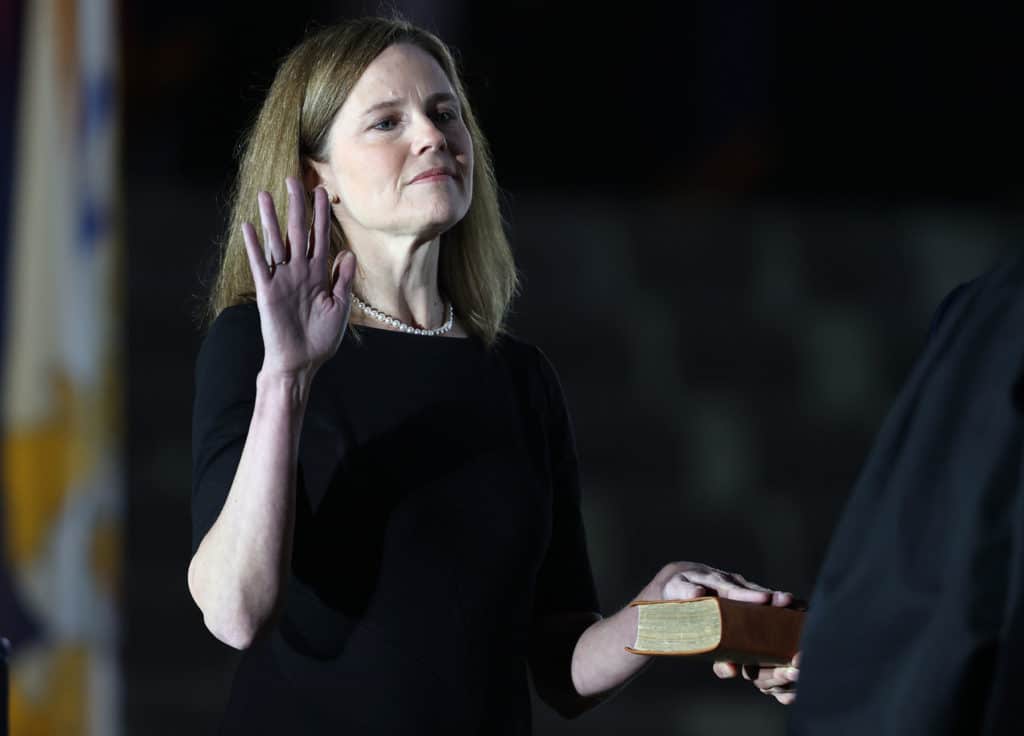
Amy Coney Barrett Sworn In to Replace Ruth Bader Ginsburg on the Supreme Court

WASHINGTON (JTA) — Hours after she was confirmed in a narrow party-line vote in the U.S. Senate, Amy Coney Barrett was sworn in at the White House as a Supreme Court justice.

Barrett, a conservative Roman Catholic who replaces Ruth Bader Ginsburg, the liberal Jewish justice who died last month, was sworn in Monday evening by Justice Clarence Thomas at an event where President Donald Trump presided.

Barely an hour earlier, the Senate approved her in a 52-48 vote. The sole senator to cross party lines was Susan Collins of Maine, a Republican who joined Democrats in voting against Barrett.

Sen. Mitch McConnell of Kentucky, the Republican majority leader, rushed through Barrett’s nomination before Nov. 3 elections, when polls suggest Democrats might take the presidency and the Senate.

The rush by McConnell and Trump infuriated Democrats, who noted with bitterness McConnell’s refusal to give a hearing in 2016 to Merrick Garland, nominated in March of that year by President Barack Obama, because McConnell said then it was inappropriate to approve a judge in an election year.

A number of liberal Jewish groups joined others in speaking out against Barrett, citing evidence in her past statements that she favored overturning Roe v. Wade, the 1973 Supreme Court decision upholding a woman’s right to an abortion, and undoing the Affordable Care Act, Obama’s signature legislation.

Conservative Jewish groups and figures, however, indicated their approval of Barrett, saying she would protect religious freedoms.

Amy Coney Barrett Sworn In to Replace Ruth Bader Ginsburg on the Supreme Court Read More »

Spotify Reportedly Declines to Remove French Rapper’s Anti-Semitic Songs

Spotify has declined to take down French rapper Freeze Corleone’s songs containing anti-Semitic lyrics, Digital Music News (DMN) reported.

Corleone, born Issa Lorenzo Diakhaté, released an album on September 11 called LMF [The Phantom Menace] that featured lyrics such as “I arrive determined like Adolf [Hitler] in the 1930s” and “Like Swiss bankers, everything for the family so that my children live like Jewish pensioner.”

An unidentified individual told DMN that he or she contacted a Spotify representative about possibly taking down Corleone’s songs containing anti-Semitism. According to a screenshot in the DMN article, the representative replied “We make music available as the artist intends it to be heard, and that sometimes includes explicit content. Based on the information they provide, we tag explicit releases with EXPLICIT or E.”

Jewish groups denounced Spotify.

“Social media companies, especially during the continuing pandemic have an outsized and dominating role in delivering and shaping culture—especially to younger generations,” Rabbi Abraham Cooper, associate dean and director of Global Social Action Agenda at the Simon Wiesenthal Center, said in a statement to the Journal. “Whether its Facebook, Twitter, YouTube, or Spotify, if anti-Semitism and hate have been delivered by one or more of the social media platform, those companies have an obligation to remove the hate. Yes it is that simple, no matter how much money Spotify makes from a particular artist. If they don’t, they can expect an influx of hate music from both sides of the Atlantic.”

Ari Ingel, director of Creative Community for Peace, said, “The Creative Community Digital Task Force has been engaged with a number of digital streaming platforms on this issue. For instance, through our efforts, Soundcloud removed the entire Freeze Corleone album from their platform, while Spotify only removed one song featuring Freeze Corleone, called ‘Sacrifice de Masse Part 2.’ Despite being dropped by Universal Music France due to the racist nature of Freeze Corleone’s album, Spotify found that the album did not violate their content policy and therefore didn’t merit removal from their platform.

“We continue to engage them to better understand their hate policy, how music is reviewed, and how they come to these decisions. One would imagine that any music proudly praising Hitler would trigger automatic disqualification for streaming.”

The DMN report pointed out that Spotify has removed some of comedian Joe Rogan’s podcasts “featuring far-right guests” as well as podcasts from other hosts that promulgating “QAnon conspiracy theories.” Some of Spotify’s employees have also called for the music streaming platform to remove Rogan’s podcast featuring author Abigail Shrier questioning “why teenage girls are undergoing irreversible transgender surgeries and hormonal treatments,” per DMN.

DMN quotes Rogan as saying that “some of the lyrics [on Spotify] and some of the f—king music that you guys play over and over and over again makes my shit pale in comparison.”

Spotify did not respond to the Journal’s request for comment.

Universal Music France announced on September 18 that they are dropping Corleone from their record label because of the “unacceptable racist statements” on his recent album. French prosecutors are also investigating Corleone for “inciting racial hatred” in the lyrics on LMF.

Spotify Reportedly Declines to Remove French Rapper’s Anti-Semitic Songs Read More »

Israel to Begin Clinical Trials of COVID-19 Vaccine as Early as Nov. 1

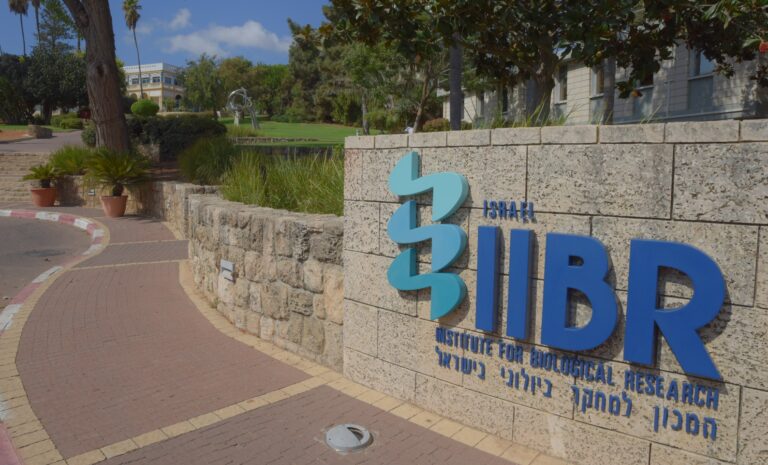
The governmental Israel Institute for Biological Research (IIBR) has approval from the Israeli Health Ministry and the Helsinki Committee to begin testing its SARS-CoV-2 vaccine, BriLife, on Nov. 1.

The IIBR has prepared 25,000 doses and has recruited the first volunteers in an 80-person clinical trial, 40 at Hadassah University Medical Center in Jerusalem and 40 at Sheba Medical Center in Ramat Gan.

Each volunteer, aged 18 to 55, will receive an injection (vaccine or placebo). After a few hours of supervision he/she will be discharged and monitored for three weeks for any possible side effects and for the development of antibodies to the virus in response to the vaccine.

The second phase will include extensive safety tests on 960 healthy volunteers, to begin in December in several medical centers across Israel. In this phase, scientists aim to complete vaccine safety precautions, determine effective dosage, and further determine the vaccine’s effectiveness.

The third and final phase is a large-scale trial to test the vaccine’s effectiveness, with the participation of up to 30,000 volunteers. Subject to the success of the first two phases, this phase is scheduled to begin in April or May. If it is successful, the vaccine may be approved for mass use.

On June 21, ISRAEL21c reported that a single dose of the IIBR’s recombinant VSV-∆G-spike vaccine had resulted “in rapid and potent induction of neutralizing antibodies against SARS-CoV-2” in Syrian golden hamsters in a successful preclinical trial. It was also tested successfully in mice, rabbits and pigs, paving the way for human trials.

“Our final goal is 15 million doses for the residents of the State of Israel and for our close neighbors,” said professor Shmuel Shapira, director of the IIBR.

The Israel Institute for Biological Research in Ness Ziona. Photo courtesy of the Israeli Defense Ministry Spokesperson’s Office.

The research institute in Ness Ziona, which is part of the Defense Ministry, has been directing all its efforts in the past few months toward novel coronavirus research.

In collaboration with several partners, the IIBR also is developing an antibody-based COVID-19 treatment and a new method to detect the virus through breath analysis.

Shapira said the name BriLife combines the Hebrew word for health, briut, with “il” for Israel and “life.”

This article was first published by Israel21c.

Israel to Begin Clinical Trials of COVID-19 Vaccine as Early as Nov. 1 Read More »

Turkey’s President Invokes Holocaust in Slamming France’s Crackdown on Radical Islam

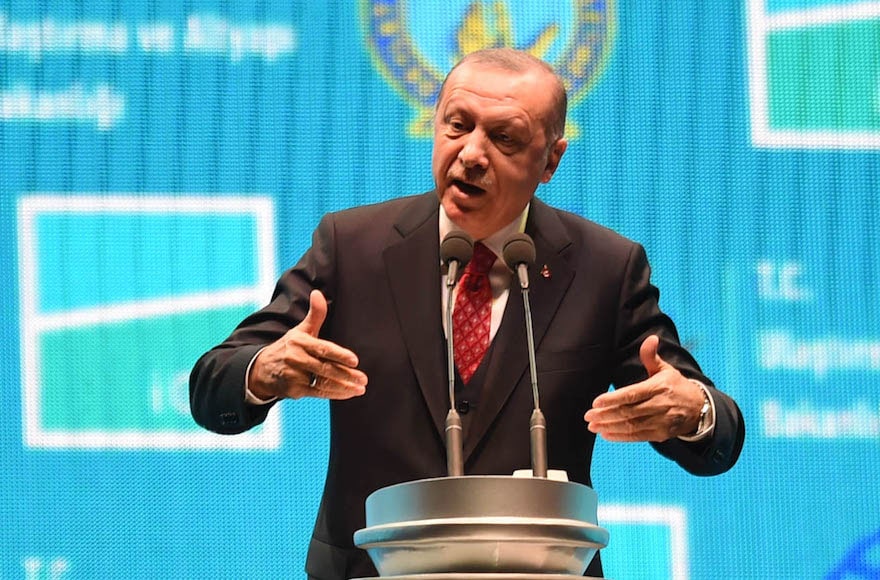
(JTA) — Turkish President Recep Tayyip Erdogan invoked the Holocaust in condemning France’s crackdown on radical Islam, calling it part of Europe’s history of criminality against members of minority religions.

In a speech Monday in Ankara, Erdogan slammed French President Emmanuel Macron’s recently announced plan to combat radical Islam by banning home schooling and dissolving some nonprofit organizations, among other measures.

“The rising Islamophobia in the West has turned into a wholesale attack on our book, our prophet and everything we consider holy,” Erdogan said. “Relocations, inquisitions and genocides towards members of different religions is not a practice that is foreign to Europe. The crimes against humanity committed against Jews 80 years ago, the acts against our Bosnian siblings in Srebrenica just 25 years ago are still in the memory.”

Erdogan’s comments come just days after he said Macron “needs mental treatment” and called for a boycott of French products at a meeting of his Islamist AKP party, Le Figaro reported. In response, France recalled its ambassador from Ankara over what the French foreign minister called an “insult.”

In a statement Monday, the president of CRIF, the umbrella group of French Jewish communities, urged France to take a firm line on Erdogan, whom he called “the tyrant of Ankara.”

France, Francis Kalifat said, “must not become the new arena for Erdogan’s follies.”

Turkey’s President Invokes Holocaust in Slamming France’s Crackdown on Radical Islam Read More »

Home Shalom Monday Message #28

Home Shalom promotes healthy relationships and facilitates the creation of judgement free, safe spaces in the Jewish community. Home Shalom is a program of The Advot Project.

Please contact us if you are interested in a workshop and presentation about healthy relationships, self-worth or communication tools. 

“Go and see what the people are doing.” – Talmud Berahot 45a 

There is a fascinating discussion in the Talmud concerning the blessings that accompany food and drink. Unlike today, at the time of the Talmud 1500 years ago, there were no fixed and agreed upon rules concerning how and when to use each blessing that Jewish tradition ultimately attached to almost every act that any person might do. In this particular discussion, the sages were arguing over what blessing to say before someone drinks water. The Mishnah begins with an anonymous rabbinic voice suggesting that the blessing should be: “Blessed are You, Adonai our God, Sovereign of the universe by whose word all things come into being (shehakol nihyeh bidvaro).” Rabbi Tarfon disagrees and suggests the blessing ends, “…who creates many beings and their needs (boray nefashot rabbot).” By the time the discussion is reproduced in the Talmud, a third rabbi named Rava bar Rav Hanan resolves the problem by creating a principle that becomes one of the most important in all of Jewish tradition, which is this: “Go and see what the people are doing.”

Jewish civilization has always been unified in its rejection of the absolute authority of rabbis or priests and, instead, its reliance on the wisdom that emerges from the lives of the Jewish people themselves. This is why there has never emerged a singular rabbinic authority like Catholics have with the Pope, for instance. There is no single authority who can issue “official” decrees that all Jews must follow.

This discussion in the Talmud is the epitome of how Judaism has actually functioned throughout history, which is in such a way that customs, traditions and the norms of Jewish life ultimately emerge from the lives of Jews themselves. Judaism is intended not to be an esoteric religious tradition but one that gives meaning and purpose, joy and celebration, in the lives of those who live it. “Go and see what the people are doing” is a reminder that for a religious tradition to matter it must inspire us with rituals and customs that bring meaning to our lives every day.

Home Shalom Monday Message #28 Read More »

More Speech, Not Enforced Silence Is the Answer to Anti-Semitism

In 2020, an arsonist torched the Chabad Center for Jewish Life at the University of Delaware. At the University of Southern California, Jewish student Rose Ritch resigned as student government president after students launched a social media campaign to “impeach her Zionist a**” and accused her of being a racist on the basis of her support for Israel.  At Arizona State University, posters appeared announcing, “Hitler was right.”

And this was just in August.

Also in August, Hillel International announced the launch of a new Campus Climate Initiative (CCI). The CCI will “provide measurement tools, best practices, education, and training designed to empower university leadership to understand the threats of antisemitism, take proactive steps to minimize them, and directly address them when they occur.” We hope this initiative will go a long way toward eradicating anti-Semitism on campuses.

What we hope the initiative does not do is encourage administrators and students to censor speech.

Too often, when faced with anti-Jewish sentiment on campus, the impulse is to silence it — either with administrative authority or through other means. A new study conducted by the Foundation for Individual Rights in Education (FIRE), with data on close to 20,000 students at fifty-five of America’s largest and most prestigious campuses, found that college students overwhelmingly choose to censor themselves and others. And on first blush, Jewish students appear to support censorship more than non-Jewish students.

When asked if it is ever acceptable to remove flyers or advertisements for an upcoming speaker or campus event, 71% of surveyed Jewish students said that this could be acceptable, versus 63% of non-Jewish students. Blocking an entrance to a talk was also endorsed by a higher proportion of Jewish students (42% versus 37%), as was shouting down a speaker to prevent others from hearing (69% versus 61%). The small consolation is that only 18% of Jewish students believed that using violence to stop a speech or event on campus was ever acceptable. That even 18% of Jewish students approve of such violence is extremely troubling (though non-Jewish students are equally approving).

There are certainly types of speech that are unacceptable: The First Amendment, for example, does not protect defamation, vandalism, incitement, true threats, or assault. But while in most cases removing flyers, blocking entrances, shouting down speakers, and engaging in violence in order to prevent a speaker from being heard is not protected by the First Amendment, many forms of anti-Semitism fall into the category of protected speech. Nonetheless, according to these data, both Jewish and non-Jewish students express a significant impulse to silence views they don’t like.

But Jewish students are often the targets of this silencing. So, shouldn’t we expect Jewish students to be advocates of open and rigorous debate –– especially since these are foundational to Jewish culture?

The FIRE data reveal that politically liberal students are generally less tolerant of speech they find offensive than moderate or conservative students are. And although the proportion of Jewish students in college is small relative to non-Jewish students (they make up only 2.5% of the survey’s sample), the proportion of Jewish students who are liberal (71%) is far higher than among non-Jewish students (51%).

But liberal Jewish students appear slightly more willing to censor than their liberal, non-Jewish peers. Forty-seven percent of liberal non-Jewish students say that it is sometimes acceptable to block an entrance to an event, compared to 51% of Jewish liberal students. Roughly three-quarters of non-Jewish liberal students say that it is sometimes acceptable to remove flyers (76%) and to shout down a speaker (76%), whereas 82% and 80% of Jewish liberal students (respectively) say that it is sometimes acceptable to do those things.

Maybe one reason these liberal Jewish students support these tactics is because self-identified liberal students increasingly believe that their campuses should be a place where they are not exposed to intolerant or offensive ideas. And liberal Jewish students have been exposed to plenty. 2019 saw the highest level of anti-Semitic incidents across the country in the forty years since tracking such incidents began.

Students whose Jewish identity includes Zionism have been subjected to an increasingly hostile campus climate. According to AMCHA, in 2019, incidents involving public shaming, vilifying, or defaming a student or staff member because of their perceived association with Israel increased by 67%; shutting down or impeding Israel-related speech, movement, or assembly increased by 69%; the unfair treatment or exclusion of students because of their perceived association with Israel increased by 51%. And challenges to the International Holocaust Remembrance Alliance (IHRA) definition of anti-Semitism increased by 370%. This movement to diminish what counts as anti-Semitism is rapidly gaining momentum on campus, and according to the report, is strongly linked to the harassment of Jewish students. It is no coincidence that this is happening at a time of rising leftist illiberalism on campus, which too often accepts anti-Jewish bigotry –– either out of anti-Semitism or ignorance. This puts the physical safety of Jews on campus at risk.

Historically, economic downturns and pandemics are associated with increased anti-Semitism. Just this month, Morton Schapiro, the Jewish president of Northwestern University –– who has in the past praised even violent student protesters–– became the target of ugly and potentially anti-Semitic protests. Student protesters, some of whom had engaged in vandalism and arson earlier that evening, stood outside his home in the middle of the night chanting, “f*ck you, Morty” and calling him “piggy Morty.”

“The latter comes dangerously close to a longstanding trope against observant Jews like myself,” he wrote in a letter on Northwestern’s website. “Whether it was done out of ignorance or out of antisemitism, it is completely unacceptable.” The question of ignorance or anti-Semitism was also raised this month, when the New York Times chose to publish an op-ed that mentioned Louis Farrakhan by name no less than seven times without a single mention of his virulent anti-Semitism.

Glossing over anti-Semitism encourages anti-Jewish bigotry. Consider what happened in Durham in 2018, when the city propagated the anti-Jewish conspiracy theory that U.S. police are being trained in inhumane policing tactics by the Israeli army (IDF). Despite there having been no discussions about –– much less plans for –– the Durham police to interact in any way with the military of Israel or any other foreign countries, the city proposed and then passed a resolution banning the Durham police from training with the Israeli military.

They are banned from training with no other country’s military.

Minister Rafiq Zaidi Muhammed, a self-proclaimed “follower of the honorable Minister Farrakhan in the Nation of Islam,” thanked the Durham City Council “because the move that you have made to approve this petition was one against forces that are unseen. There’s a synagogue of Satan,” he explained, “that’s always lingering in the background.” Toward the end of his speech, he expressed that his words might be criticized “by some.” But, he added, “I am obligated to point out the inordinate control that some Jews have over the political system in this city.”

Two weeks later, anti-Jewish posters began appearing in Durham.

The marriage between supporters of the Boycott, Divestment, and Sanction (BDS) movement and Black Lives Matter supporters plays on old anti-Jewish conspiracy theories: secret Jewish control (“forces that are unseen”) and hidden, evil power (Israeli military training police to behave in inhumane ways). This leaves Jewish targets of anti-Semitism and non-Jewish bystanders afraid to speak up for fear of being labeled racists –– as Rose Ritch was. When even the New York Times is silent about the bigotry of one of the world’s most notorious anti-Semites, the ability to silence anti-Jewish sentiment can seem very tempting.

But we must not give in to that temptation.

There are some bright spots. Perhaps because of the Talmudic tradition of written disagreement, a higher proportion of liberal Jewish students are willing to write articles expressing their views (70%) than non-Jewish liberal students (61%). And a slightly higher proportion of non-liberal Jewish students are willing to write op-eds than are non-liberal non-Jewish students (53% compared to 51%).

What is most striking, however, is how non-liberal Jewish students relate to freedom of expression. This is the group most likely to self-censor. Seventy-three percent of non-liberal Jewish students said that they could recall a time during college when they did not share their perspective for fear of how others would respond (compared to 66% of non-Jewish non-liberal students, 60% of non-Jewish liberal students, and 51% of liberal Jewish students). Non-liberal Jewish students were also the least likely to endorse censoring behaviors. Only 12% thought it was ever acceptable to use violence, 24% thought blocking an entrance was ever acceptable, 41% agreed that shouting down a speaker was acceptable, and 45% said that removing flyers was acceptable. These numbers are all too high, but the difference is stark.

Jewish students, whether liberal, moderate, or conservative, must demand and defend viewpoint diversity, not work toward shutting down speech. Censorship is an illiberal tendency, not a liberal one. As John Stuart Mill knew, “We can never be sure that the opinion we are endeavoring to stifle is a false opinion; and if we were sure, stifling it would be an evil still.”

Jewish students, whether liberal, moderate, or conservative, must demand and defend viewpoint diversity, not work toward shutting down speech.

We should laud Morton Schapiro for how he responded to the recent violence and vandalism on his campus. He highlighted anti-Jewish speech and explained why it was an example of anti-Semitism, and also wrote that Northwestern “firmly supports vigorous debate and the free expression of ideas — abiding principles that are fundamental for our University.” While defending activism, he condemned, “in the strongest possible terms, the overstepping of the protesters. They have no right to menace members of our academic and surrounding communities… we have moved well past legitimate forms of free speech.” Shapiro concluded by reminding students of the consequences for engaging in acts that do not represent protected speech. “An essential aspect of education is the discernment of actions and consequences. If you, as a member of the Northwestern community, violate rules and laws, I am making it abundantly clear that you will be held accountable.”

This balanced approach is exactly what we need. As uncomfortable as it is, Jewish students –– along with the rest of us –– must support a culture of discourse rather than working to shut down speech. The intention to interfere with others’ freedom of expression must end, even when those expressions are manifestly anti-Semitic. But we must not, ourselves, be silent in the face of anti-Semitism, even when it comes from people with whom we share other concerns.

As Justice Louis D. Brandeis wrote, we avert evil through education, not silencing. We expose falsehoods and fallacies through discussion, not censorship. Even when confronting falsehoods that comprise a historically pervasive and widespread evil –– anti-Jewish bigotry and conspiracy theories –– “the remedy to be applied is more speech, not enforced silence.”


Samuel J. Abrams is professor of politics at Sarah Lawrence College and a visiting scholar at the American Enterprise Institute.

Pamela Paresky is Senior Scholar at the Network Contagion Research Institute and a visiting senior research associate at the University of Chicago’s Stevanovich Institute on the Formation of Knowledge.

More Speech, Not Enforced Silence Is the Answer to Anti-Semitism Read More »
At a Long Island ‘Jews for Trump’ Rally, Orthodox Jewry’s Political Contradictions Take Center Stage

(JTA) — When Jacob Reich heard that Orthodox Jews would be staging a rally near his home to support President Donald Trump this weekend, just 10 days before Election Day, the Long Island father of two headed to Woodmere.

“It’s tough to make it to a Trump rally,” Reich said. “Obviously this isn’t the same as that experience, but it’s all about us coming together as a community, showing our support for the president, showing our support for the police, showing our support for patriotism.”

The Woodmere rally was one of several pro-Trump events organized this weekend across the New York City area by Orthodox Jews, who stand apart from the majority of American Jews for their support of the Republican Party and for Trump. Others included a larger rally in Marine Park, a neighborhood of Brooklyn, and a car parade that clogged traffic in Manhattan and Brooklyn. Counterprotesters threw eggs and other objects at the car parades and 11 people were arrested in connection to fights between the Trump supporters and counterprotesters Sunday.

In Woodmere, attendees filed into a parking lot as songs played from speakers, including a Jewish pop track reconstituted as an ode to Trump. The women, many wearing wigs and modest clothing, took up pink flags with the words “Women for Trump 2020” splashed across the fabric, while men wore kippahs or baseball caps that said “Trump 2020” or “MAGA” spelled out phonetically in Hebrew letters.

While some came ready to cheer on Trump’s Israel policies or support for religious freedom, others wore masks with messages like “worn by force, not by fear” and “this mask is as useless as the governor,” a reflection of the protests against COVID-19 restrictions that have roiled Orthodox Brooklyn and that have received support in other Orthodox communities in recent weeks. Indeed, the rally underscored the degree to which values within the community are in tension right now, even as most members are backing the same presidential candidate.

In one searing moment, a rabbi’s diatribe against mask-wearing caused a leading Orthodox politician, former New York State Assemblyman Dov Hikind, to threaten to walk out of the rally.

“I’m not here to endorse any of the flags, symbols, posters and so forth that are here because I think it’s very important that we rise above the personalities,” Rabbi Yitzchak Smith told the crowd decked out in Trump 2020 flags and hats. A rabbi and lawyer living in Passaic, New Jersey, Smith has recently gained a following by promoting the idea that COVID-19 testing is a government ploy to hurt Orthodox Jews.

Smith appeared to praise those who flouted school and synagogue closures during the pandemic, then urged rally attendees to do the same now.

“If we’re not willing to face a fine or a handcuff then what are we talking about,” he said. “What are you willing to do? Are you willing to live what you believe no matter what? Are you willing to stand in congregational prayer regardless of what threats are directed at you? Are you willing to demand that your children be free of medical testing? Are you willing to set an example in a world gone mad that we don’t wear masks because no human being should be forced to wear a mask? Are you willing to open new synagogues that will never close as I and my neighbors did?”

He went on, “Are you willing to pull your children out of schools that demand daily health affirmation, that put masks before children’s breathing, that teach that God is wearing a mask … and that are brainwashing our kids right now every day into taking a vaccine — are you willing to take your kids out and build a new option?”

The speech distressed Hikind, who was standing to the side, waiting to speak. He shook his head throughout portions of Smith’s speech before approaching one of the organizers, seemingly to voice his concerns, and then walked to the small stage to make his feelings clear.

“This is outrageous!” shouted Hikind. “I support Trump, my name is Dov Hikind, listening to this is outrageous. I’m leaving.”

Hecklers encouraged Hikind to leave as he walked across the parking lot, followed by some of his supporters. Soon Michal Weinstein, one of the organizers, approached him and convinced him to stay. “We don’t agree with him,” one woman told Hikind, referring to Smith. And after another speaker, Hikind took the stage, setting a very different tone.

“It is important to wear a mask, it is important to pray … It is not the biggest sacrifice in the world to wear a freaking mask even if you don’t think it works, maybe you’re protecting someone else,” Hikind said before turning to the subject he most wanted to speak about Sunday. “But that’s not why I’m here. I’m here to talk about the future of this country. I’m here to talk about the person who has possibly been one of the greatest presidents ever.”

Hikind, a longtime Democrat, went on to denigrate the Democratic party and praise Trump for his policies on Israel and criminal justice reform while noting his distaste for Trump’s manner of expressing himself. (He outlined those points in a video last week announcing that he would vote for Trump after not doing so in 2016.)

Just minutes after walking away from the rally, Hikind was leading the crowd in cheers of “four more years.”

He would do it again later that day, whipping up a larger crowd at a rally in Brooklyn’s Marine Park. There, he appeared alongside Boris Epshteyn, an Orthodox advisor to the Trump campaign, who touted Trump’s work on anti-Semitism on college campuses.

“President Trump is stomping out anti-Semitism on college campuses and universities, because from now on out anti-Semitism will be forever recognized as a hate crime,” Epshteyn told the assembled crowd, referring to Trump’s executive order that that made the Civil Rights Act of 1964 apply to Jewish college students.

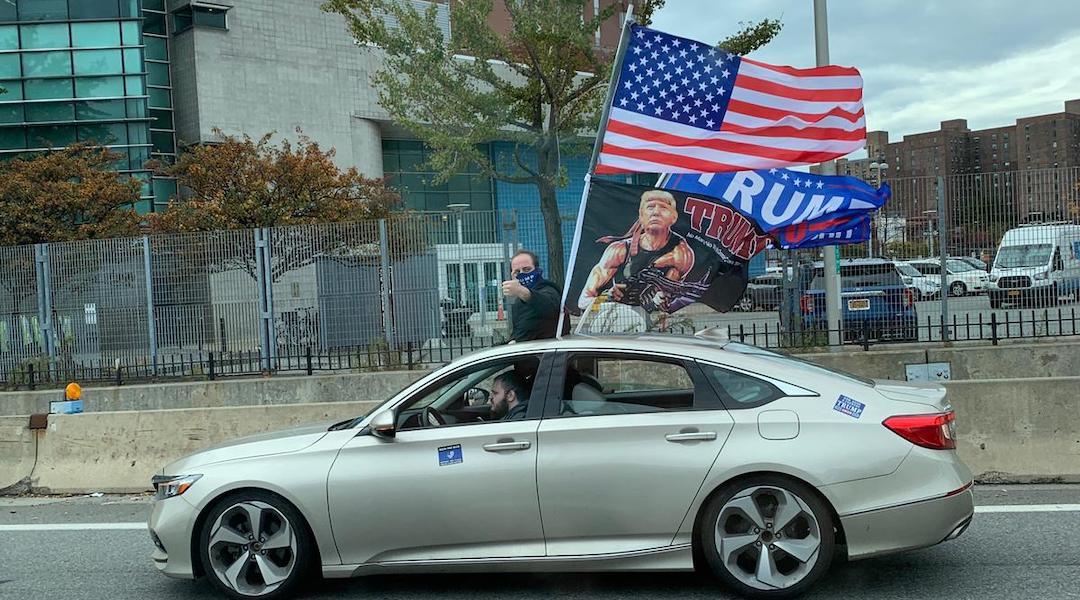
At the same time as the event on Long Island, Orthodox Jewish Trump supporters drove through Manhattan and Brooklyn with Trump flags billowing from their cars.

Cars drove through New York City Sunday waving Trump 2020 flags. (Shira Hanau)

A visible figure at some of the rallies Sunday was Heshy Tischler, the Borough Park radio host, ex-convict, City Council hopeful and provocateur who led Brooklyn’s Hasidic Jews into the streets earlier this month to protest pandemic restrictions on Orthodox neighborhoods with rising COVID-19 cases. Tischler was arrested last week for inciting a riot against a Hasidic journalist. He was released the next day.

At the Marine Park event, Tischler screamed the words “Trump 2020” from a bullhorn and danced with the crowd. Videos circulated on social media throughout the day of Tischler dancing in a party bus decorated with Trump signs and posing with Trump supporters during the car parades.

“When I shut down a city, boy can I shut down a city!” Tischler cried in one video taken from the middle of a noisy street in Brooklyn with cars decorated with Trump flags behind him.

Earlier in the day, Tischler joined another car parade in support of the president and stopped to make a video in front of Trump Tower in Manhattan’s Columbus Circle.

“Mr. Trump, I’m sorry for all the other idiots who are not voting for you, but I’m voting for you, we’re going to make sure the votes go through,” he said in a video with Trump Tower visible behind him and a small crowd of supporters and journalists huddled around him. He added: “Right now, I see a lot of support for Mr. Trump. I see this city turning red.”

Like Smith, Tischler rose to fame this summer for protesting government restrictions on Orthodox areas that were intended to stop the spread of the coronavirus and casting doubt on the accuracy of COVID testing.

While many of the people in attendance in Woodmere said they were not driven by resistance to COVID restrictions, it was clear that the calls to protect religious freedom represented them all under the banner of the Trump 2020 flags.

“I think people have been heavily debating what religious freedom is,” said Reich, who said his support for the president was animated more by other issues. “I think Trump has helped the cause, certainly what he’s done with his foreign policy, supporting the Jewish state, moving the embassy to Jerusalem.”

One Instagram personality who was scheduled to speak at the rally but couldn’t make it, an Orthodox Jewish woman named Linda who has nearly 23,000 followers and mostly posts about politics from a right-wing, pro-Trump perspective, posted a story to Instagram where she discussed the rally with Weinstein, another Instagram personality with over 20,000 followers and an organizer of the rally.

“Every single speaker here had their own life experiences, their own opinions, they all believe in Trump obviously, we all are unified by Trump but, you know, everyone has their own take on what’s going on,” Weinstein told Linda. “What are your thoughts on that?”

“At the end of the day, there’s a lot of divisions in America and we have to focus on the commonalities that we have, we’re all against certain things that we’re seeing, the corruption, we’re against the censorship and we have to focus on those key points because the unity is what will give us the blessing and the division is a curse,” Linda said.

The two agreed on what that point of unity could be.

“We are stronger united and that’s what we have to do, we just have to find what’s in common,” Weinstein said. “And one thing is Trump! We all love Trump.”

At a Long Island ‘Jews for Trump’ Rally, Orthodox Jewry’s Political Contradictions Take Center Stage Read More »

Butler Student Gov’t Fails to Pass Resolution Adopting IHRA Definition of Anti-Semitism

Butler University’s Student Government Association (SGA), located in Indiana, failed to pass two resolutions on October 21 that would have adopted the International Holocaust Remembrance Alliance (IHRA) definition of anti-Semitism and condemned the Boycott, Divestment, and Sanctions (BDS) movement as anti-Semitic.

The pro-Palestinian news outlet Mondoweiss reported that those two resolutions were pulled after members of Butler’s Students for Justice in Palestine (SJP) chapter and Jewish Voice for Peace (JVP) spoke about the resolutions. Instead, a resolution was passed condemning anti-Semitism generally and had no mention of the IHRA definition or BDS. The resolution concluded that the SGA “will not again address the definition of antisemitism for the remainder of this term.” The final vote total was not publicly released.

Butler SJP said in a statement to Mondoweiss, “Resolutions that oppose BDS and equate anti-Zionism with anti-Semitism not only harm Palestinians, but also uphold systems which have historically been used as weapons to silence marginalized voices across the Global South. We must reject and actively oppose such measures, while also reaffirming our commitment to freedom, justice, and equality for all peoples through mass action and popular education, in our communities and throughout our campuses.”

JVP also tweeted, “HUGE congratulations to SJP and JVP students at Butler University for their brilliant activism for Palestinian rights and defeating anti-BDS resolutions!”

Other Jewish groups condemned the SGA’s actions.

“We stand with Jewish students at Butler,” StandWithUs co-founder and CEO Roz Rothstein said in a statement to the Journal. “The IHRA definition reflects the ways Jewish people experience antisemitism and marginalization today. Rejecting it is a victory for hate on campus, sending a message that Jews don’t deserve the same basic rights and respect as everyone else. Butler’s SGA and administration should be ashamed, and reverse course immediately.”

BDS Report similarly tweeted, “The IHRA definition of antisemitism is the most widely accepted definition of antisemitism and is used by nearly 30 countries including the USA. Butler SGA failed to protect its Jewish students!”

This comes after the SGA’s Diversity, Equity, and Inclusion board hosted an event from October 6-8 in conjunction with Butler SJP called “Boycott & Safe Protesting 101.” The event featured artwork calling for people to “Boycott Israel,” according to Jewish News Syndicate (JNS).

On October 14, the Butler administration pressured the SGA to table the resolutions adopting the IHRA definition of anti-Semitism and condemning BDS, JNS reported. A resolution condemning anti-Semitism also failed in the SGA on October 7.

Butler Student Gov’t Fails to Pass Resolution Adopting IHRA Definition of Anti-Semitism Read More »

Jewish Celebrities and ‘Saturday Night Seder” Get Out the Young Vote for Biden

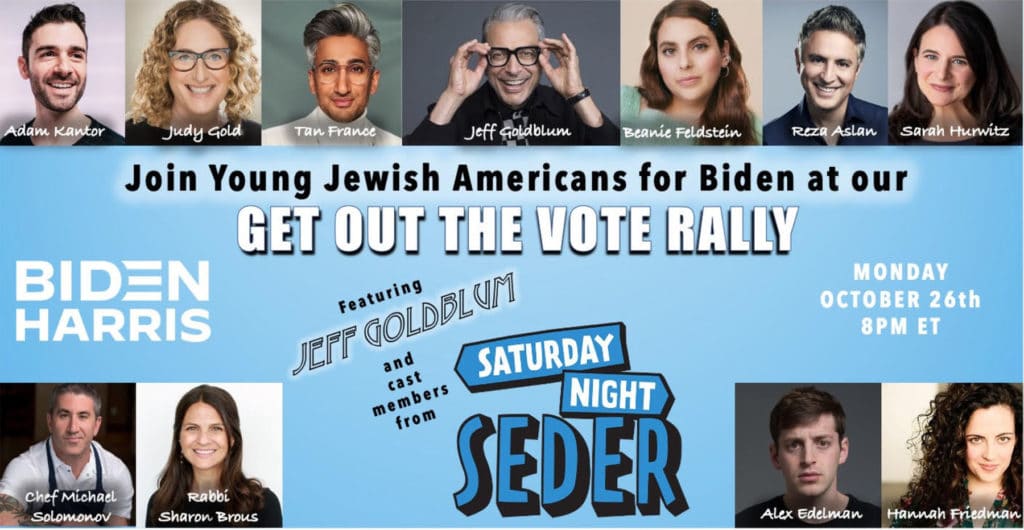
Jewish celebrities and cast members from “Saturday Night Seder” are teaming up Oct. 26 with Young Jewish Americans for Biden to make sure everyone votes by Nov. 3.

Coordinated by Alex Edelman, Adam Kantor and Jen Snow (producers and writers of “Saturday Night Seder”), the virtual event will take place at 5 p.m. PT to help spread awareness to young voters on the important role they play in this election.

Edelman told the Journal that it isn’t just about getting the word out for the 2020 election, it’s about “driving voter participation and interest” for future elections.

Edelman told the Journal that it isn’t just about getting the word out for the 2020 election, it’s about “driving voter participation and interest” for future elections.

“Making sure that folks participate in this campaign – one that puts them firmly on the side of decency – is so important to me,” he said. “It’s why a few of us are getting together to try to help get young Jews involved in ending this long, national nightmare.”

Jeff Goldblum, Kantor, Edelman, Judy Gold, IKAR Rabbi Sharon Brous, Beanie Feldstein, Reza Aslan, Sarah Hurwitz, Chef Michael Solomonov, Tan France and Hannah Friedman are the among the star-studded talent attending the virtual “Get Out the Vote Rally.”

Edelman told the Journal in August that the success of the virtual pandemic Passover “Seder” fundraiser—which raised more than $3 million for the Centers for Disease Control and Prevention— inspired the team to take part in more events that bring awareness to important causes. Many of the members attending tonight’s rally have attended one or more virtual fundraisers and events since the pandemic that promote social change.

To attend the event, click here.

Jewish Celebrities and ‘Saturday Night Seder” Get Out the Young Vote for Biden Read More »