fbpx

September 16, 2020

On Rosh Hashanah Call, Trump Tells American Jews ‘We Love Your Country’ and Asks for Their Vote

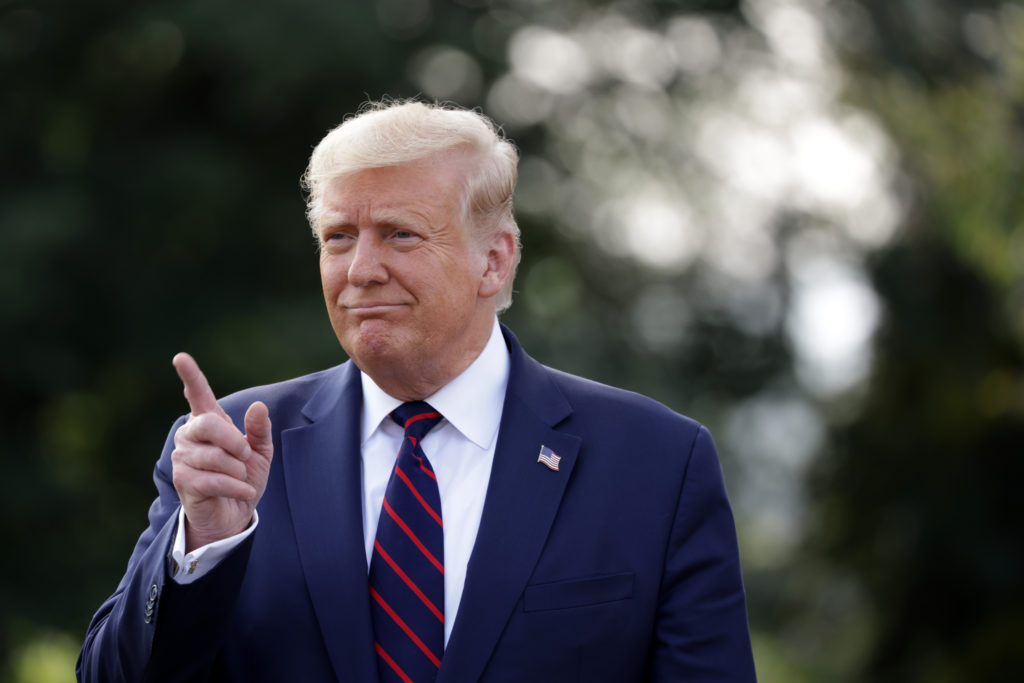
WASHINGTON (JTA) — President Donald Trump spent much of his 20-minute call with American Jewish leaders making the case for more American Jews to vote for him. He closed by repeating a line that has raised their eyebrows before.

“We really appreciate you,” Trump said as he signed off the call, an annual pre-Rosh Hashanah presidential tradition. “We love your country also.”

Earlier, introducing his Jewish son-in-law, Jared Kushner, who brokered the historic deals with the United Arab Emirates and Bahrain that were signed Tuesday at the White House, Trump called him “an unbelievable leader for Israel.”

The comments echoed others he has made in the past that suggest that American Jews think of themselves as Israelis, including at a White House Hanukkah party two years ago.

Trump’s comments on the call also blurred the line between White House events and campaigning. Until his presidency, campaign appeals from the White House have been seen as unethical, if not illegal.

He pressed listeners to campaign for him and suggested that Israel would suffer if he is not reelected this fall.

“I have to say this, whatever you can do in terms of Nov. 3 is going to be very important because if we don’t win, Israel is in big trouble,” Trump said.

The president listed what the United States was doing for Israel, saying it paid $4.2 billion in annual assistance to the country. The figure is $3.8 billion and stems from a deal brokered by Trump’s predecessor, Barack Obama.

“We’re in the Middle East because of Israel,” Trump said, a position at odds with the myriad interests, including the free flow of oil, that the United States has in the region.

Arthur Stark, the chairman of the Conference of Presidents of Major American Jewish Organizations, asked about Trump’s plans to assist Israel in confronting actors such as Iran and Turkey who back terrorist groups like Hamas and Hezbollah. Trump’s reply, again: Vote for Republicans.

“This is really a time that’s very important in the life of Israel and the safety of Israel. And we will do a great job,” he said. “If the other side gets in all bets are off. I think it’ll be a whole different story. I think it’ll be exactly the opposite.”

Trump also noted that he exited the Iran nuclear deal, which Israel reviled, and said Obama, who brokered the 2015 sanctions relief for nuclear rollback deal, humiliated Israeli Prime Minister Benjamin Netanyahu.

“I remember Bibi coming over and begging him, begging him to a point of humiliation that please don’t do the Iran deal,” Trump said. “He did it. I broke it, but he did it. And yet the Democrats get 75% sort of like habit. It’s automatic. I hope you can do better with that. I hope you can explain to people what’s going on.”

Jews traditionally vote in large numbers for the Democratic presidential nominee. A poll this week showed Joe Biden getting 67% of the vote and Trump 30%. But Jewish voters in swing states, particularly Florida, could swing what may be a close election, and Trump signaled that he was mystified about why he would not command a larger share of the Jewish vote.

“Which really amazes me, and I have to tell you, because I saw a poll that in the last election, I got 25% of the Jewish vote and I said here I have a son-in-law and a daughter who are Jewish, I have beautiful grandchildren that are Jewish. I have all of these incredible achievements,” Trump said. “I’m amazed that it seems to be almost automatically a Democrat.”

Aaron Keyak, the Jewish engagement director at the Biden campaign said that Trump “suggesting that Jewish Americans are somehow less than loyal to the United States of America” was not surprising, given past statements Trump has made that drew Jewish criticism.

“What remains astonishing is the silence of his supporters — especially those in our community,” Keyak said. “When Trump says to us that ‘we love your country also,’ we hear him loud and clear. So do the anti-Semites.”

On Rosh Hashanah Call, Trump Tells American Jews ‘We Love Your Country’ and Asks for Their Vote Read More »

Qatar Says It Won’t Normalize Ties With Israel

Qatari Assistant Foreign Minister Lolwah Alkhater told Bloomberg News in a Sept. 14 that Qatar won’t be normalizing ties with Israel.

“We don’t think that normalization was the core of this conflict and hence it can’t be the answer,” Alkhater said. “The core of this conflict is about the drastic conditions that the Palestinians are living under [as] people without a country, living under occupation.”

However, she did express optimism that the boycott against Qatar by Saudi Arabia, the United Arab Emirates (UAE), Bahrain and Egypt would soon end.

“It’s very early to talk about a real breakthrough [but] the coming few weeks might reveal something new,” Alkhater said.

In 2017, Saudi Arabia, the UAE, Bahrain and Egypt cut off diplomatic ties with Qatar and blocked Qatari travel routes in the region, and listed 13 demands for Qatar to adhere to in order to reinstate diplomatic relations. Among the demands include severing ties with the Muslim Brotherhood — which the four countries consider to be a terrorist organization — and shutting down Al Jazeera, the television network that the Qatari government funds. Additionally, the four countries demand that Qatar end its friendly ties with Iran.

Alkhater told Bloomberg that talks with the four countries have “moved beyond the 13 demands” but didn’t specify which of the four countries that Qatar is talking to.

Alkhater’s remarks came on Sept. 14, the day before the White House signing ceremony of agreements known as the Abraham Accords, normalizing ties between Israel and the UAE and Israel and Bahrain. President Donald Trump told reporters later that day Saudi Arabia would be among the seven to nine Arab states that might eventually join the UAE and Bahrain in establishing relations with Israel, although the Saudis have said that they won’t normalize ties with Israel until a two-state solution is reached with the Palestinians.

Palestinians responded to the Abraham Accord with “days of rage” protests throughout the West Bank. A Fatah activist also told The Jerusalem Post on Sept. 15, “We are on the brink of a third intifada. The Palestinian people feel betrayed by the Arabs and will show the world that the Palestinian issue remains the central issue of all Arabs and Muslims.”

Qatar Says It Won’t Normalize Ties With Israel Read More »

Anti-Slavery Was Built Into the American Founding

Righteous indignation at the legacy of American slavery has inspired appropriate and serious moral conversation, but also severe historical inaccuracy and mob violence.

In his Jan. 22 Atlantic magazine article “A Matter of Facts,” Princeton scholar Sean Wilentz disputes The New York Times Magazine’s 1619 Project, which claims slavery and racism were the foundations of U.S. history.

Wilentz clarifies that although the British monarchy ruled the American slave colonies, the colonists themselves had taken decisive steps to end the Atlantic slave trade from 1769 to 1774.

During that time, Maryland, New Jersey, Pennsylvania, Connecticut and Rhode Island either outlawed the trade or imposed prohibitive duties on it. Measures to abolish the trade also won approval in Massachusetts, Delaware, New York and Virginia, but were denied by English royal officials.

But as the speeches of Abraham Lincoln reveal, a proper understanding of the American Revolutionary period inspires a more nuanced respect for the record of the American founders on the slavery issue than what the 1619 Project suggests.

Claremont Scholar Harry V. Jaffa (“Crises of the House Divided”; “A New Birth of Freedom”) taught that in his debates, speeches and presidential leadership, Lincoln saw himself as the final Founding Father, dedicated to defending long-established anti-slavery laws and to extending the liberty and equality he found in the moral reasoning of the U.S. Declaration of Independence, which asserts: “We hold these truths to be self-evident, that all men are created equal, that they are endowed by their Creator with certain unalienable Rights, that among these are Life, Liberty, and the pursuit of Happiness.”

Princeton professor James M. McPherson (“Battle Cry of Freedom”) documents that in the 1854 debates over the Kansas-Nebraska Act, which sought slavery’s resurgence and extension, Lincoln presented the case that the American founders had opposed slavery.

First, he asserted, beyond the promise of the declaration, the U.S. Constitution never mentioned the words “slave” or “slavery.”

It is clear that anti-slavery political philosophy and law, built into America’s founding, along with the active efforts of abolitionist religious leaders, stood behind eventual legal emancipation of Southern slaves.

Next, the founders formally enacted the Northwest Ordinance of 1787, banning slavery from the vast Northwest Territory, enforced the prohibition of “importing” new slaves in 1807 — which the British brought to America in the first place — and passed the Missouri Compromise in 1820, which began the process of emancipation for existing slaves of a certain age. Before 1820, Northern states already had begun the process of emancipation.

Lincoln’s war against slavery began early. In 1838, a young Lincoln warned of ruling by “mob law” in his famous Lyceum address. In 1849, Lincoln formally proposed emancipation as an Illinois congressman. In his 1854 Peoria speech, Lincoln outlined American slavery as a cancer to be cut away as the slave states economically diversified.

Lincoln outlined the record of his heroes, the American founders, as he justified his anti-slavery appeal:

    • In 1794, laws prohibited an outgoing slave trade, preventing the sale of any slaves from the United States.
    • In 1798, laws prohibited any incoming slaves from Africa into the Mississippi Territory.
    • In 1800, laws prohibited American citizens from trading in slaves between foreign countries, i.e. from Africa to Brazil.
    • In 1803, laws prohibited intra-state slave trading.
    • In 1807, laws prohibited all African slave trading, with heavy penalties.
    • In 1820, laws declared slave trade as piracy, prohibiting it under penalty of death.

In Lincoln’s 1860 Cooper Union speech, he affirmed that a majority of the Constitutional framers voted to control slavery in the new territories to keep it from expanding, and that President George Washington had signed the legislation. Washington’s 1799 last will and testament called for the slaves he personally owned to be freed, although for some, this did not have an immediate effect.

Lincoln further revealed that Thomas Jefferson, author of the Declaration of Independence, had argued in favor of emancipation in Virginia: “It is still in our power to direct the process of emancipation, and deportation, peaceably, and in such slow degrees, as that the evil will wear off … .”

Finally, on Sept. 22, 1862, President Abraham Lincoln issued the Emancipation Proclamation during the Civil War, asserting that all slaves shall be free as of Jan. 1, 1863.

By Nov. 19, 1863, at the dedication ceremony of the Union cemetery at Gettysburg, Pa., Lincoln followed another two-hour speech with his own brief, moving Gettysburg Address, which needed fewer than 300 words to bring the promise of Philadelphia to the hallowed ground of the Civil War, extending liberty to every American:

“Fourscore and seven years ago our fathers brought forth, on this continent, a new nation, conceived in liberty, and dedicated to the proposition that all men are created equal. … that from these honored dead we take increased devotion to that cause for which they gave the last full measure of devotion — that we here highly resolve that these dead shall not have died in vain — that this nation, under God, shall have a new birth of freedom, and that government of the people, by the people, for the people, shall not perish from the earth.”

In these speeches, however, Lincoln was well aware of the fact that the founders were imperfect men often living in imperfect times.

To achieve the unification necessary to ratify the U.S. Constitution, the founders allowed the institution of slavery to continue in the Southern states. In this compromise, many of the founders who recognized the incompatibility of slavery with the meaning of American independence were unwilling or unable to change or challenge the economic realities of their time immediately, hoping instead that slavery would disappear over time through the formal abolition of the slave trade.

Similarly, to avoid civil war and the violent battles to save the Union, which ultimately cost him his own life, Lincoln spoke of compromise with racial views that were not as evolved as those we have today. However, Lincoln sought to identify and disseminate the anti-slavery impulses built into America’s founding through his speeches. It is clear that anti-slavery political philosophy and law, built into America’s founding, along with the active efforts of abolitionist religious leaders, stood behind eventual legal emancipation of Southern slaves.

Slavery has been the norm of human history, including in Native American territories before the Europeans’ discovery of America. Only in recent centuries has slavery become no longer ubiquitous, thanks in part to the American idea that all humans are created equal in the image of God.

While Europeans brought chattel slavery to the American colonies, America’s visionary founders promised freedom to all Americans in 1776. Their descendants secured that promise in the Civil War. And we are the inheritors of that tradition. 

We should be proud of that.

Larry Greenfield is a fellow of the Claremont Institute for the Study of Statesmanship & Political Philosophy.

Anti-Slavery Was Built Into the American Founding Read More »

Spielberg? Streisand? Gadot? You Can Vote for the Next Genesis Prize Winner

(JTA) — What do Elana Kagan, Sacha Baron Cohen, Barbra Streisand, Rabbi Jonathan Sacks, Gal Gadot, Marc Benioff and Steven Spielberg have in common?

Yes, they are all Jewish. And they all appear on the shortlist of the selection committee of the Genesis Prize to be this year’s laureate.

This is the first time that the selection committee has released a list of potential winners, and the first time that the global Jewish community has been invited to weigh in on the choice of a winner. Voting is open now on the Genesis Prize website.

Some 4,000 people were nominated by more than 45,000 people worldwide.

The recipient of the 2021 Genesis Prize will receive a $1 million prize. Previous winners have donated their prize money to support philanthropic causes such as improving the lives of individuals with special needs, advancing women’s equality and supporting refugees.

The Genesis Prize, known as the “Jewish Nobel,” was started in 2013 and is financed through a permanent $100 million endowment. The annual award honors “extraordinary individuals for their outstanding professional achievement, contribution to humanity and commitment to Jewish values.”

Previous winners include New England Patriots owner Robert Kraft, former New York City mayor Michael Bloomberg and musician Itzhak Perlman. U.S. Supreme Court Justice Ruth Bader Ginsburg received a lifetime achievement award in 2018.

Last year’s laureate was Natan Sharansky, a former Soviet dissident and former head of the Jewish Agency.

Spielberg? Streisand? Gadot? You Can Vote for the Next Genesis Prize Winner Read More »

Rosh Hashanah Without Shul: 1939 and 2020

I was sitting in my home office, working on a book about my grandmother’s Holocaust experience as a pandemic prowls outside my door, when a date I have always known jumped out at me anew.

The Germans invaded Poland Sept. 1, 1939. Nazis ripped into Sosnowiec on motorcycles on Sept. 4, megaphones blaring, Mausers blazing. On Sept. 9, they torched all three main synagogues in my grandmother’s hometown and dozens of other shtibls, pouring tar on the ruins of the Grand Synagogue on Policyjna Street so that the burn lasted for weeks.

Rosh Hashanah in 1939 was on Sept. 14, and smoke was still rising from the embers as the sun set on the first of Tishrei.

By the time the Nazis got to the synagogues of Sosnowiec, they were well into their murderous and humiliating rampage. But now I wonder if the thought of not going to shul on Rosh Hashanah and Yom Kippur was gut wrenching in its own way for the 30,000 Jews in Sosnowiec. Sevek, my grandmother’s younger brother, said in a taped interview that Jews ran to Policyjna Street to pick up and kiss the fallen bricks of the Grand Synagogue.

In my own world, the reality that life was shutting down hit with full force back in March when I received an email saying shul was canceled. Not being able to go to shul on Shabbat — and I don’t think I could have imagined then that I would be sitting in a parking lot minyan for Rosh Hashanah — was the first of many jolts that would upend my very identity.

Because I am in the middle of writing a book about my grandmother’s Holocaust story, I am seeing this Rosh Hashanah — and much of my pandemic experience — through the prism of my family’s Holocaust narrative. As this new year dawns on our broken world, I find myself thinking about some of the less-visible suffering inflicted by the Nazis, particularly in the tumultuous early days of the war, before the number “6 million” meant anything.

I know that my traumatized but fortified DNA can get through this, and much worse.

The sense of connection especially is palpable because my grandmother’s family was at the same life stage my family is in at this moment. When the war started, my grandmother was 23 and her youngest sibling was 14. My kids are around the same age range, and my husband and I are just a little older than my great-grandparents, Noach and Leah Nortman, were.

Although the danger they faced even as early as Rosh Hashanah 1939 obviously was more immediate and terrifying than our pandemic, I am realizing that living through the first few months of what eventually became the Holocaust  probably carried a much-amplified version of what my family and others are dealing with — plans smashed, everything familiar shuttered, futures uncertain. Like them, we are at the beginning of a new chapter in history, with the ending not yet written.

In 1939, my grandmother, Helen Nortman Gruenbaum, recently had moved back to her parents’ house in Sosnowiec with her baby boy after wrenching herself from a disastrous marriage. She was working with her brother in a furrier shop in nearby Katowice, hoping to reopen her tailoring business.

I think about the conversations my great-grandparents must have had when the Nazis invaded, about how to best protect their young-adult children; maybe even, at first, how to salvage the fragile cusps their children were on. Within weeks of the Nazi invasion, Sevek, who was starting a business as a furrier and studying to be a cantor, ran east, escaping through the sewers. A few weeks later, Leah and Noach sent Shmulik, a passionate Zionist who was apprenticing as a tailor, toward the Russian border in the middle of the night. My grandmother and her baby followed her brothers east weeks later. 

My great-grandparents having to figure out how to save their family from Hitler is nothing like my husband and me creating a much-mocked color-coded chore chart or setting social distancing rules when our college-aged kids returned home. A wartime decision to send children away to save their lives bears no resemblance to our agreeing, after a few months, that it was time for our kids to go back to their lives, to reclaim their independence.

However, I now have a deeper understanding of the torment of uncertainty, when everything you thought would happen is turned on its head; when you have to make life-or-death decisions based on conflicting or incomplete information. I don’t know if sending my kids from the hearth will have saved their futures, or endangered their lives or the lives of others. 

When my grandmother left home in 1939, she begged her parents to come to the Soviet Union with her. Her father refused to leave Sosnowiec, saying he would stay in his home to welcome his children back when the war was over. 

My grandmother pleaded with her father to let her take Rushka, her little sister. Her father’s answer is etched into family lore: “Do you see that chandelier hanging there? If you take my youngest child from me, you will find me hanging in its place.”

Noach was killed in Auschwitz in 1942. Leah and my grandmother’s little boy (she was separated from him during her escape) were killed in Auschwitz in 1943. Rushka survived horrific Nazi labor camps. Sevek rode the war out in the Soviet Union, and Shmulik got himself to Palestine in 1942; he was killed in June 1948, fighting Israel’s War of Independence. My grandmother met my grandfather on the transport to a Siberian labor camp, where they got married.

I think, too, about how my grandparents (all four were survivors) — and, for a few years, my great-grandparents — kept going when everything around them crumbled. Sometimes, when I leave the bubble of my house — where I am blessed to live with people I love and have enough of everything we need — the horror of today’s world sucks at my insides, and I fold into the emptiness. I leave the supermarket and burst into tears. I lose sleep over a Zoom meeting because this isn’t how humans are supposed to connect. I play out paralyzing scenarios about myself or someone I love getting sick and dying.

Then I think about my grandparents and great-grandparents, who did whatever they could to make it to the next day, despite living in ghettos or camps, despite facing an enemy infinitely more bent on killing them than the microbial lurker I now face down from the comfort of my own home.

I know that my traumatized but fortified DNA can get through this, and much worse.

I never asked my grandmother what Rosh Hashanah 1939 was like. But I can imagine she, her siblings and her parents, unable to go to shul, buried their faces in the pages of their machzors at home, and cried into the words: 

Who shall live and who shall die.

Who in good time, and who before their time. 

Who by sword. Who by plague. For we are all but flesh and blood.


Julie Gruenbaum Fax is a journalist and personal biographer living in Los Angeles.

Rosh Hashanah Without Shul: 1939 and 2020 Read More »

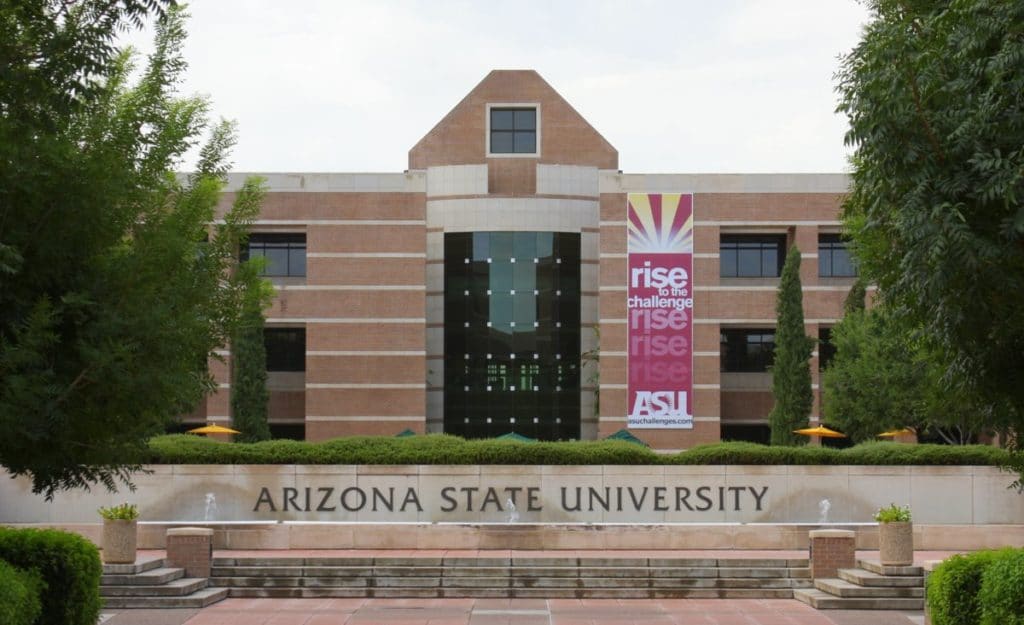
ASU Student Gov’t Passes Resolution Adopting IHRA Definition of Anti-Semitism

Arizona State University’s (ASU) student government passed a resolution on Sept. 15 adopting the International Holocaust Remembrance Alliance (IHRA) definition of anti-Semitism.

The resolution passed 15-1 with three abstentions. The Journal obtained a copy, which stated that “Jewish students on campus have repeatedly faced antisemitic slanders and hate speech by outside provocateurs and leaders of official student organizations.” The resolution cited as an example flyers found on campus on Aug. 30 stating, “Hitler was right.”

It went on to note that the IHRA definition of anti-Semitism is defined as “a certain perception of Jews, which may be expressed as hatred toward Jews. Rhetorical and physical manifestations of antisemitism are directed toward Jewish or non-Jewish individuals and/or their property, toward Jewish community institutions and religious facilities.”

“The Undergraduate Student Government of Tempe unreservedly condemns all acts of racism, bigotry, and violence against the Jewish community, both on and off the Tempe campus,” the resolution stated. “The Undergraduate Student Government of Tempe stands by the Jewish community and condemns all acts of racial, ethnic, or religious discrimination against members of the student body.”

ASU is the biggest university (by in-person enrollment) in the state; its main campus is in Tempe.

The resolution also called on the university to adopt the IHRA definition of anti-Semitism and for ASU President Michael Crow to issue a public statement denouncing recent instances of anti-Semitism on campus.

Jewish groups on campus, including ASU’s Chabad, Hillel and Alpha Epsilon Pi fraternity, issued a statement lauding the passage of the resolution.

“This is a welcome signal that Jewish students are heard and recognized by their peers and that our experiences with antisemitism on campus are going to be taken seriously and dealt with,” the statement read. “As one of the largest communities at ASU, we consistently aim to bring greater equity and inclusion to our community through leadership development, racial justice, civic engagement, and interfaith initiatives. We are eager to continue building and deepening partnerships with students across our greater ASU community.”

https://www.facebook.com/SSIatASU/posts/2614784435437579

Students Supporting Israel (SSI) President at ASU Koral Zaarur similarly said in a statement, “Calling on the university to adopt the IHRA definition was perhaps our biggest victory, as we secured a concrete definition for what antisemitism is, and what forms of anti-zionism and anti-israel propaganda is antisemitic. I am proud to have been a part of making this a reality and making our university a safe space for not only the class of Jewish students currently enrolled, but all Jewish students that will be enrolled at ASU in the future. We look forward to having a safe space on our campus and knowing that the university stands behind our community.”

The IHRA currently has 34 members, including the United States and Israel.

ASU Student Gov’t Passes Resolution Adopting IHRA Definition of Anti-Semitism Read More »

Laugh Factory Holding Live Stream High Holy Days Services

For the past 36 years, The Laugh Factory comedy club in Hollywood has opened its doors for free Rosh Hashanah and Yom Kippur services. This year will be a little different. 

Rabbi Bob Jacobs and Cantor Robin Winston will lead the virtual congregation live via Instagram, Facebook and YouTube, allowing congregants to participate while safely social distancing at home. The livestream will also allow people in hospitals, nursing and retirement homes, and in quarantine around the world to participate in the services, which are in the Conservative/Reform tradition.

“With everything that we’ve had to deal with here in America and around the world, we need the hope and joy our High Holy Days bring more than ever,” Laugh Factory owner Jamie Masada said. “There are people everywhere that need to celebrate a joyous Rosh Hashanah and a meaningful Yom Kippur. We will all be praying for a happier and healthier New Year for all people around our world.”

Rosh Hashanah services will take place Saturday, Sept. 19 at 11 a.m. PT. Yom Kippur services begin with Kol Nidre on Sunday, Sept. 27 at 6 p.m. PT, followed by a morning service at 11 a.m. and Neilah at 6 p.m. on Monday, Sept. 28.

Join the livestream on Instagram, @LaughFactoryHW on Facebook, and Laugh Factory on YouTube.

Laugh Factory Holding Live Stream High Holy Days Services Read More »

Study: More Than One in 10 Americans Under 40 Thinks Jews Caused the Holocaust

(JTA) — More than one in 10 American adults under 40 believes that Jews caused the Holocaust.

That’s one finding from a survey published Wednesday trying to gauge Holocaust knowledge among millennials and Generation Z, a cohort  ranging in age from 18 to 39.

The survey found that most respondents had heard of the Holocaust and 37% knew that 6 million Jews died. Slightly more than half could name at least one concentration camp or ghetto.

But 11% of the respondents believed the Jews were responsible for the Holocaust, 15% said they thought the Holocaust was a myth or has been exaggerated, and 20% said people talk about it too much. Nearly half said they had seen Holocaust denial online.

The survey of 1,000 respondents across all 50 states was organized by the Claims Conference, which coordinates restitution and reparations payments for Holocaust survivors and sponsors Holocaust education programs. It was conducted in February and March.

According to the poll, there was little correlation between state Holocaust education requirements and Holocaust knowledge. None of the 10 states with the highest  knowledge levels required Holocaust education in high schools, while three states in the bottom 10 — Delaware, New York and Florida — did mandate it.

(The knowledge levels, as defined by the survey, were based on whether respondents had heard of the Holocaust, knew 6 million Jews were killed and could name a concentration camp or ghetto.)

Holocaust knowledge was particularly low in New York, despite the state having the largest population of Jews in the country. Most respondents there could not name a single Nazi camp or ghetto, and 28% said they believed the Holocaust was a myth or has been exaggerated. Wisconsin had the highest knowledge score at 44%, while Arkansas had the lowest at 17%.

“Not only was their overall lack of Holocaust knowledge troubling, but combined with the number of Millennials and Gen Z who have seen Holocaust denial on social media, it is clear that we must fight this distortion of history and do all we can to ensure that the social media giants stop allowing this harmful content on their platforms,” Greg Schneider, the executive vice president of the Claims Conference, said in a statement. “Survivors lost their families, friends, homes and communities; we cannot deny their history.”

The survey had a national margin of error of 3% and approximately 7% for individual states.

It found that more than three-quarters of respondents had definitely heard of the Holocaust and another 10% said they probably had. Among those, more than 70% knew that Adolf Hitler was responsible for the genocide and 86% knew that the Jews were its primary victims.

Lower numbers of respondents were aware of other facts about the Holocaust. Among those who had heard of the Holocaust, more than a third wrongly believed that 2 million Jews or fewer were killed, while nearly half (48%) could not name any concentration camps or ghettos. Asked to describe Auschwitz, the largest Nazi concentration camp, 64% described it correctly.

“The expectation was that at this point in time, a lot of this information would be more familiar,” said Amy Wexler, a Claims Conference spokesperson. “It felt like it was lower than anyone expected.”

The survey also found that approximately half the respondents had seen anti-Semitism and Holocaust denial online. Some 49% had seen seen Holocaust denial or distortion online, with 10% saying they had seen it often. A total of 56% reported seeing Nazi symbols on social media, in their communities or both.

Nearly 60% said they believed something like the Holocaust could happen today.

“The indicators are of concern, and that relates to ongoing concerns we have that education is in decline and social media use of hate and anti-Semitism is on the rise,” said Gretchen Skidmore, director of education initiatives at the U.S. Holocaust Memorial Museum in Washington, D.C., and a member of the task force that oversaw the survey. “The work is very important, and Holocaust education is very important to counter these trends.”

Respondents agreed that Holocaust education is important, with 64% believing it should be compulsory in school. Currently, 15 states require Holocaust education in high school, according to the Holocaust museum. A bill providing $10 million to the museum to enhance Holocaust education was signed into law this year.

Skidmore said that in addition to mandating Holocaust education, states must ensure that teachers have proper training to teach the subject matter.

“There are some conditions that need to be present for Holocaust education to be successful,” Skidmore said, adding that the survey showed there was “fundamental knowledge missing.”

Skidmore said “Holocaust education can be very effective when these conditions are met, when teachers are trained, when they feel confident to bring this complex history into their classrooms.”

Study: More Than One in 10 Americans Under 40 Thinks Jews Caused the Holocaust Read More »

Jews Have Lived in Bahrain for 140 Years. The Country’s Peace Deal With Israel Changes Their Lives

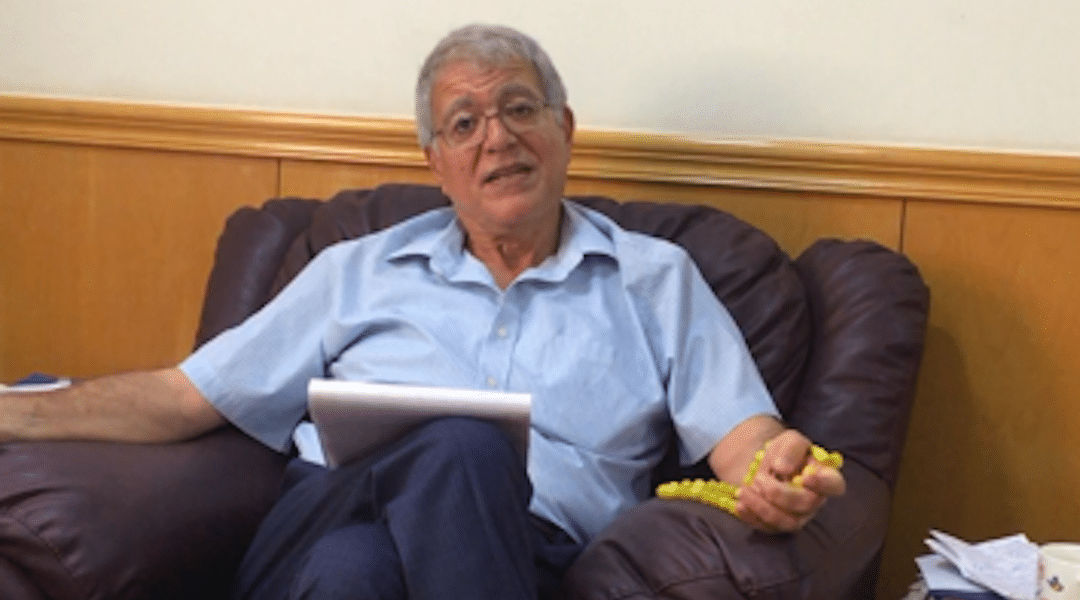
(JTA) — Ebrahim Dahood Nonoo, the leader of Bahrain’s tiny Jewish community, was among the Gulf country’s approximately 50 Jews who thought peace with Israel would never arrive “in our lifetimes.”

“It just didn’t seem possible,” Nonoo told the Jewish Telegraphic Agency from Manama, the capital city where he lives with his wife.

Tuesday’s signing of the agreements called the Abraham Accords is expected to open up routes for collaboration, trade and travel between Bahrain and Israel, which had all been restricted. It will have a significant impact on Bahrain’s Jews, many of whom have relatives in Israel  they have not been able to visit.

Bahrain’s Jews weren’t the only ones shocked when President Donald Trump announced that he had brokered peace agreements between Israel and two Arab states, the United Arab Emirates and Bahrain, within a month of each other.

Israel only has relations with two other Arab nations in the region, and most of its neighbors have long isolated the Jewish state and at times even gone to war with it.

“We can talk to our relatives and we can feel more comfortable now about going and coming. It actually changes quite a lot,” said Nonoo, a businessman who in 2001 became the first Jewish person appointed to serve on to the country’s Shura Council, the upper chamber of its National Assembly.

Ebrahim Dahood Nonoo’s family has been in Bahrain since the late 1800s. (Courtesy of Nonoo)

The Jewish community in Bahrain, an island nation of some 1.5 million people, dates back about 140 years to the late 1800s, when a group of Iraqi Jews arrived in search of economic opportunities. Many were poor and lacked education but found jobs, and eventually success, in the clothing industry. Nonoo’s grandfather came as a 12-year-old together with his uncle and found a job picking silver threads out of discarded dresses and selling them.

“They were kind of misfits coming out of Iraq,” Nonoo said of the first arrivals. “In other words, they weren’t getting anywhere in Iraq, so they decided to try their luck in Bahrain.”

A smaller number of Jews also settled in Bahrain from Iran at around the same time. At its height in the 1920s and ’30s, the community had about 800 members, according to Nonoo, though others have said the number was as high as 1,500. Though community members mixed socially with Bahraini Muslims, they mainly married within the community and lived close to each other in Manama. Members continued to speak a Jewish dialect of Iraqi Arabic and still do.

In 1935, a member of the Cartier family, the Jewish clan who founded the eponymous jewelry company, passed through on a business trip and ended up donating money to build a synagogue and bring in a rabbi, according to Nonoo. Over the next 10 years, the community continued to flourish economically and gathered in the synagogue for services.

“[That] was a fantastic time for all of them,” Nonoo said.

But things took a turn for the worse following the 1947 U.N. Partition vote, which recommended the creation of a Jewish state in then-Palestine alongside an Arab one. The move led to anti-Semitic riots throughout the Arab world, including in Bahrain.

A group of rioters — Nonoo said they were migrants from other Arab countries — burned the synagogue to the ground and stole the country’s only Torah scroll. Most of the community left after the attack or in the decade and a half following, settling in Israel.

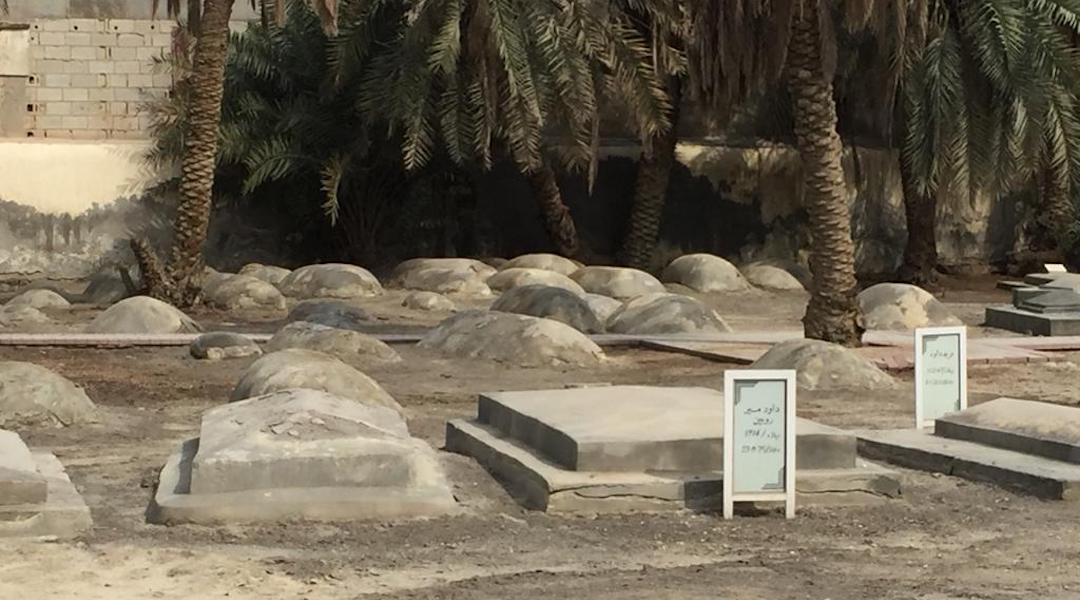
Manama still has a functioning Jewish cemetery. (Courtesy of Nonoo)

The few who remained or their descendants make up the 50 or so Jews living in the country. There is an active Jewish cemetery, but the synagogue — rebuilt by Nonoo’s father in the 1980s — never officially reopened and most of the community continues to pray at home. Nonoo is renovating the building and hopes to reopen it next year as a house of worship and museum.

And on Monday, Jared Kushner, Trump’s Jewish son-in-law who serves as his senior adviser, gifted Bahrain’s King Hamad bin Isa Al Khalifa a Torah scroll for the synagogue.

Most of the community members today are financially successful and continue to be represented in the Shura Council, which has designated a seat each for representatives of the country’s Jewish and Christian populations. Nonoo’s successor was Houda Nonoo, who later went on to serve as Bahraini ambassador to the United States. She was succeeded by Nancy Khedouri, a relative of the powerful Kadoorie family, a Hong Kong-based Jewish family of Iraqi origin who went on to become one of the wealthiest families in Asia (and transliterated the surname differently). Houda Nonoo and Khedouri are Ebrahim Nonoo’s cousins.

“It is indeed a privilege to be part of the Law-making process with my multi-faith Colleagues, where we all enjoy Equality and Freedom of Expression and where we continue to strive to draft out Laws to be implemented, that will be fair, serving in the best interests of our Country and to all Citizens, regardless of Religious differences,” Khedouri told JTA in an email.

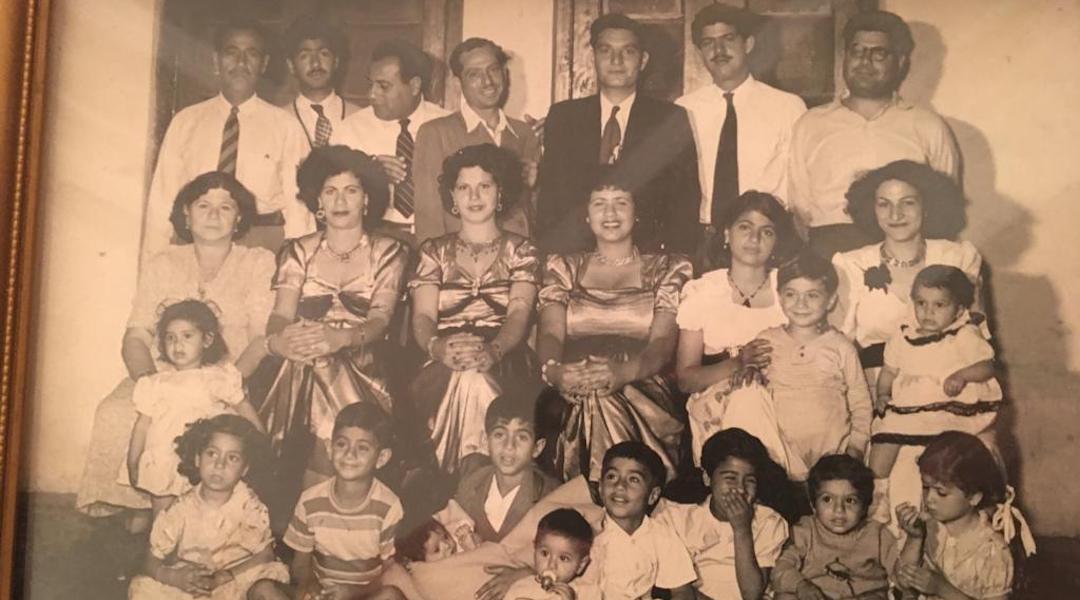
Ebrahim Nonoo’s family can be seen here in a family photo taken in the 1950s in Bahrain. (Courtesy of Nonoo)

Still, the local Jewish community is aging, as many young people leave to study abroad and often choose to remain in other countries after their studies — including Nonoo’s children, who both live in the United Kingdom.

“Hopefully they’ll be back soon,” he said.

Nonoo hopes the new agreement with Israel will turn around the trend and that plans to build the Abrahamic Family House, a site that will host a church, mosque and synagogue in the nearby United Arab Emirates, may draw more Jews to settle in the Gulf.

“We are very, very happy to see that that’s going to be a place that many Jews can stay in the UAE and build up families there, so we’re hoping that with that we will get Jews coming to Bahrain,” he said.

For his part, Nonoo doesn’t see himself settling anywhere else.

“Our religion is Jewish, but really our culture is very Arabic, and we feel very at home,” he said. “I honestly could not see myself living anywhere else.”

Jews Have Lived in Bahrain for 140 Years. The Country’s Peace Deal With Israel Changes Their Lives Read More »

Trump Says Saudi Arabia, Several Other Arab Countries Will Soon Normalize Ties With Israel

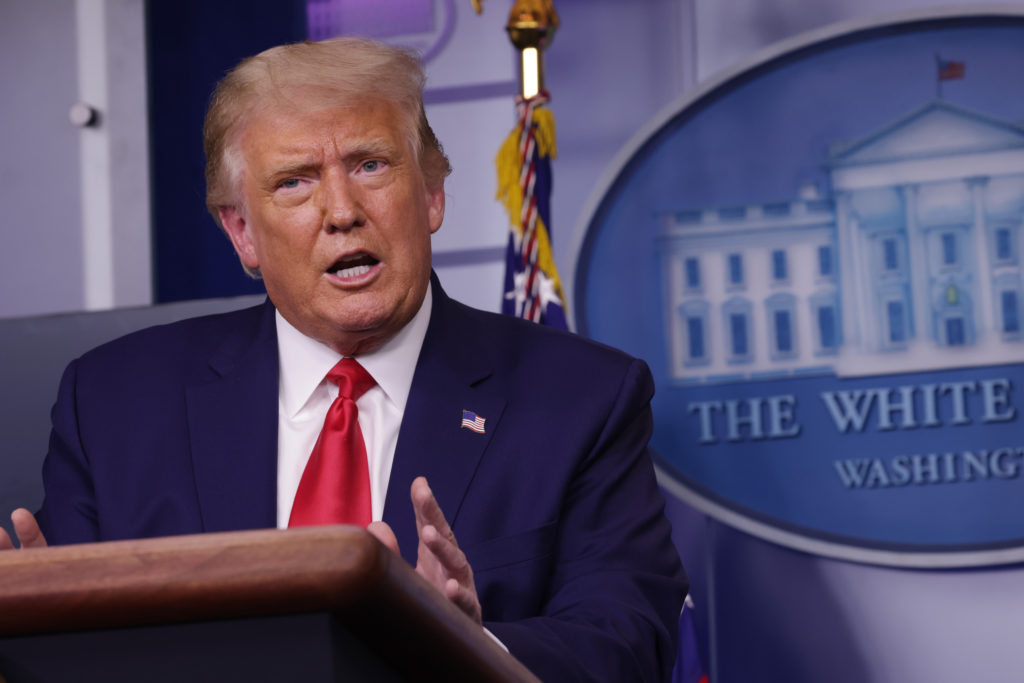
President Donald Trump told reporters on Sept. 15 that Saudi Arabia will be among the seven to nine Arab nations that eventually will normalize relations with Israel.

Trump said in response to a reporter asking if Saudi Arabia would join the United Arab Emirates (UAE) and Bahrain in an agreement with Israel, “I spoke with the king of Saudi Arabia. At the right time, I do think they will come in, yes, I do.” He later added that “we will have other countries coming in fairly rapidly,” estimating that it would be around “seven or eight or nine” more countries.

The UAE and Bahrain are only the third and fourth Arab states to establish full relations with Israel in more than 70 years. There already was a de facto peace between the Arab nations and Israel, but the pact opens the door for commerce and tourism. Earlier in the day, Trump had estimated that it would be “at least five or six countries” that would soon establish relations with Israel.

“They’re warring countries but they’re tired of fighting,” Trump said. “You’re going to see a lot of very great activity. It’s going to be peace in the Middle East.”

He also expressed optimism that the Palestinians eventually would join in and agree to peace with Israel. But for now, prominent Palestinian political figures have condemned the agreement. Middle East experts say the Palestinians feel betrayed because long-standing Arab solidarity with the Palestinians was seen as a bargaining chip in the fight for a two-state solution in Israel. The Times of Israel reported, “Said Saeb Erekat, the veteran Palestinian negotiator, ‘I never expected this poison dagger to come from an Arab country.’ ”

Hundreds of Palestinians took to the streets in the occupied West Bank and Gaza Strip on Sept 15 to protest the signing ceremony.


On Aug. 21, Al Jazeera reported that Saudi Arabia leadership reiterated that it would not establish ties with Israel until a sovereign Palestinian state is established, with Jerusalem as its capital.

On Sept. 15, the White House had held a signing ceremony of the agreements between Israel and the United Arab Emirates (UAE), and Israel and Bahrain. Trump declared that the agreements, known as the Abraham Accord, “mark the dawn of a new Middle East.”

Israeli Prime Minister Benjamin Netanyahu said he was “deeply moved” to be at the signing ceremony, as he understood that “those who bear the wounds of war cherish the blessings of peace.” He said that there would be massive ramifications across the Middle East with the signing of the Abraham Accord.

“This peace will eventually expand to include other Arab states, and ultimately it can end the Arab-Israeli conflict once and for all,” Netanyahu said. “Second, because the great economic benefits of our partnership will be felt throughout our region, and they will reach every one of our citizens. And third, because this is not only a peace between leaders, it’s a peace between peoples — Israelis, Emiratis and Bahrainis are already embracing one another.

“We are eager to invest in a future of partnership, prosperity and peace. We’ve already begun to cooperate on combating corona, and I am sure that together we can find solutions to many of the problems that afflict our region and beyond.”

UAE Foreign Minister Abdullah bin Zayed Al-Nahyan said during the signing ceremony that the world is witnessing “a change in the heart of the Middle East.” He thanked Trump for his work in brokering the Abraham Accord and thanked the Israeli government for suspending its plans to annex parts of the West Bank.

“Every option other than peace would signify destruction, poverty and human suffering,” Al-Nahyan said. “This new vision, which is beginning to take shape as we meet today for the future of a region full of youthful energy, is not a slogan that we raise for political gain, as everyone looks forward to creating a more stable, prosperous, and secure future. At a time when science is prevailing, the region’s youth are looking forward to taking part in this great humanitarian movement.”

Bahraini Foreign Minister Abdullatif bin Rashid Al-Zayani said that the Abraham Accord is simply “the first step” toward peace in the region, calling for a two-state solution to the Israel-Palestinian conflict.

“We have shown today that such a path is possible, even realistic,” Al-Zayani said. “What was only dreamed of a few years ago is now achievable, and we can see before us a golden opportunity for peace, security and prosperity for our region. Let us — together, and with our international partners — waste no time in seizing it.”

Quotes from the signing ceremony provided by transcripts from The Times of Israel.

Trump Says Saudi Arabia, Several Other Arab Countries Will Soon Normalize Ties With Israel Read More »