fbpx

September 4, 2020

A Moment in Time: Breaking Boundaries

Dear all,
As I was prepping milk for my children the other day, I saw the most incredible sight in the briefest moment in time. There they were, each peeping over the boundaries of their cribs, smiling at one another!
In Judaism, we learn that the story of our exodus from biblical Egypt was a metaphor: as slaves, we had restrictive vision. But as free people, our minds expand, our wisdom deepens, our souls broaden, and our world comes just a little closer together.
Indeed, when we break boundaries, we ultimately break down boundaries!
What will your role be in breaking boundaries that hold the world back?
With love and shalom,
Rabbi Zach Shapiro

A Moment in Time: Breaking Boundaries Read More »

Karlie Kloss, Joshua Kushner’s Wife Who Converted to Judaism, Will Join Biden Campaign Event

(JTA) — The Kushner-Trump family drama continues: Karlie Kloss, the wife of Joshua Kushner — brother to President Donald Trump’s senior adviser Jared Kushner — is helping out Joe Biden’s presidential campaign.

Kloss, the supermodel who converted to Judaism in the process of marrying (and now loves Shabbat) will join Biden and Reshma Saujani, founder of the Girls Who Code nonprofit, for an event Thursday on young women and STEAM — or science, technology, engineering, arts and mathematics (the A for arts is an addition to the traditional STEM acronym, included to foster “inquiry, dialogue, and critical thinking”).

“For those who know Karlie, this event makes a lot of sense,” an unnamed source told People on Wednesday. “She cares deeply about the future of women in STEAM and has always supported the candidates who stand for the issues she’s passionate about.”

Kloss and Joshua Kushner haven’t shied away from their support of Democratic causes in the past; the younger Kushner even attended a Women’s March in 2017.

Karlie Kloss, Joshua Kushner’s Wife Who Converted to Judaism, Will Join Biden Campaign Event Read More »

Floating on Uncertainty

Lately, I haven’t been the best version of myself. 

I used to be the one making waves. Now? I’m just trying not to drown.

I’m not kvetching. I’m not blaming the coronavirus. I’m not asking people to throw me a life preserver. I simply need to be alone and float quietly for a bit.

I’m depleted. I don’t have it in me to do what gives my life meaning, which is to uplift others.

In the last month, I lost a close friend to cancer, I ended an almost three-year relationship, I sold my house and dealt with the drama of both of my college-student sons deciding whether to attend school online, and I still haven’t figured out how to redesign my youngest son’s bar mitzvah this October in a COVID-19 world. So, yes, I’m struggling.

I used to be extraordinary. OK, well, maybe really productive. Fine — I moved fast and got stuff done.

I had endless energy for self-care, for my three sons, my wealth management clients, entrepreneurs, the San Diego single Jewish community and random strangers. I had time for everyone and always hosted events, striving to build community. 

I used to be the one making waves. Now? I’m just trying not to drown. I’m not asking people to throw me a life preserver. I simply need to be alone and float quietly for a bit.

Today, I’m happy if I take care of myself, my kids, my clients and keep my house clean.

That doesn’t look like the old me. 

Basic self-care, yes; wearing makeup and heels, no. Kids fed, yes; cooking, no. Clients’ investment portfolios managed, yes; solving their personal problems, no. House tidy, yes; me cleaning it, no.

I need a break, a pause, a timeout and permission to cocoon. 

I feel like a failure admitting this. I’m energized by others, not by solitude.

I’m an extrovert. What the hell am I thinking that being quiet is healing? 

My friends keep inviting me out. I feel guilty because I keep saying no. I’m afraid that if I disappear for a while, they’ll write me off. 

I feel I’m only as good as the last good deed I did.

In the past when I was single and felt down, I’d do the online dating game to feed my ego. Today, I have no desire to flirt, date or even be touched. 

I’d rather lie on the edge of my king-sized bed and drift off to sleep, holding my own hand. 

I’m enough for me right now.

My life today can be defined in how my walks with my dog, Lexi, have changed. I used to make a call before her leash was even on. By the time we’d be back, I’d close a deal, introduce a couple, pay bills, arrange a kid playdate and plan a Shabbat dinner.  

Today, I walk her quietly — no phone — look at nature, listen to the birds and feel the air on my skin. I don’t think of what I need to do, I’m simply present without the sense of urgency to be extraordinary or even productive, but instead … to just be.

It’s not intentional. I’m no Zen master. It’s merely all I can do right now.

I’m in the flow, not causing the flow.

The dynamic that keeps me still is uncertainty. The uncertainty of the world has dampened my desire to move, swim or make any waves. 

But there is a small swell of joy that keeps me buoyed through the week. Every Sunday night, I study Torah virtually with a woman I’ve never met in person — Jessica Weiss — through the “Partners in Torah” program.

Before COVID-19, I yearned to learn the ethics that define our people, so I’m studying Pirkei Avot (Ethics of the Fathers). I’ve canceled almost everything in my life but this. Why? Because a stranger is making time to give to me, the way I used to give to strangers. 

I guess that is what I need most right now — to receive.

Although I’ve never felt this way before, I’m confident I’ll get through it, rise up on a wave and lift others alongside me.

Until then, I encourage you to give to a stranger. You never know if your act of kindness is what keeps them afloat.


Audrey Jacobs is sixth-generation Texas Jew who lives in San Diego. She is a financial adviser and has three sons. 

Floating on Uncertainty Read More »

The Struggle for a Jewish History of the Holocaust

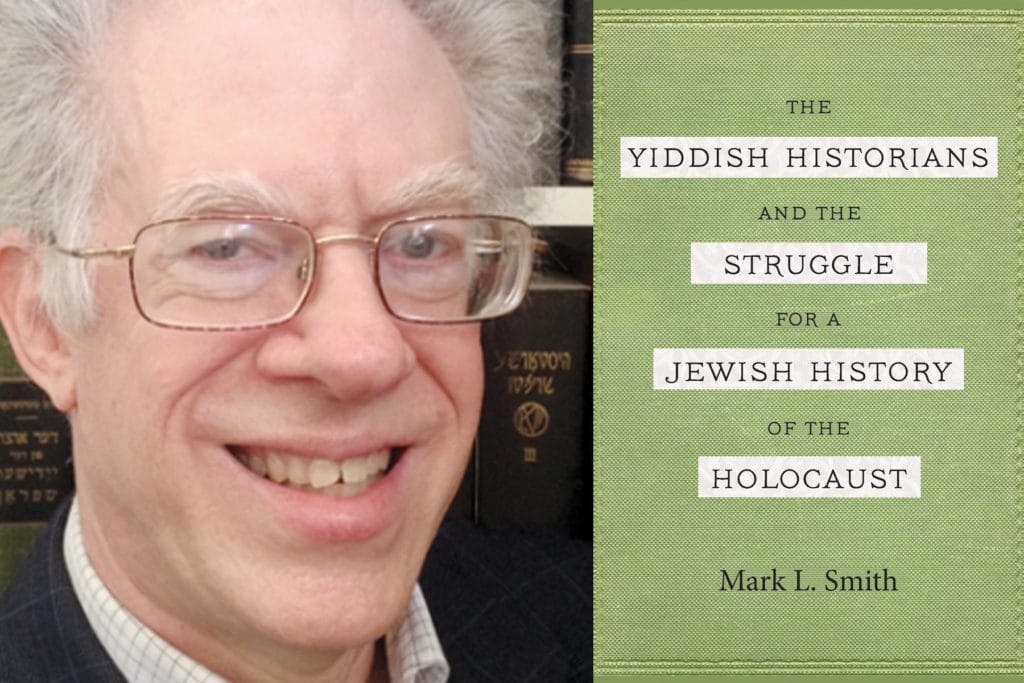
Mark L. Smith’s “The Yiddish Historians and Struggle for a Jewish History of the Holocaust” (Wayne State University Press) is a significant work. A successful architect turned historian, Smith explores the life and work of five Yiddish historians, all steeped in the prewar tradition of Yiddish historiography, who chose to continue their historical work in the language of those they left behind. Theirs was an act of homage to those who died in the Holocaust and of solidarity with their fellow survivors.    

Educated in a trilingual culture, many spoke and wrote in many more than three languages. They came of age in interwar Poland but persisted doing their work in Yiddish even as they made their homes in Israel, Paris or New York. 

They wrote for a broad readership explaining to them what happened to their own community. They wrote for a diminishing readership as the sons and daughters of the Yiddish reading public read in other languages. 

Had postwar Poland been more hospitable to Jewish revival, they may have remained there, but after the pogroms, communism and Stalinism, they emigrated. The sparks of post-Shoah revival were quickly extinguished.   

Who were these men? Philip Friedman (1901-60), Isaiah Trunk (1905-81), Nachman Blumenthal (1905-83), Joseph Kermish (1907-2005) and Mark Dworzecki (1908-75).    

For whom did these men write?   

They wrote for educated laypeople who wanted to understand their past. Many of their contemporary scholars prided themselves on the density of their scholarship, boasting of its inaccessibility.    

What did they write about?   

They wrote as participant observers of the everyday life of the Jews, not of their  murders. Surprisingly, after all they had gone through, they were advocates of the anti-lachrymose theory of Jewish history, believing that Jewish history is not all about pogroms and persecution, anti-Semitism and discrimination but about the life of real people. Trunk said: “how the ghetto lived is no less important than the question of how it was murdered.”    

They fiercely denied the uniqueness of the Holocaust; their critique was twofold. The uniqueness of the Holocaust is not connected to anything that the Jews did but is rooted in the Nazi accomplishment. Furthermore, they were categorically against the mystification of the Holocaust. Trunk was adamant: “If the Holocaust was regarded as unassailably unique therefore ineffable and unfathomable, it would elude the tools of historical inquiry,” and thus defeat the very nature of their historical efforts, singular and collective.   

The Yiddish historians directly and unapologetically confronted the accusation that Jews went like sheep to the slaughter. 

Many participated in the trial of Nazi war criminals by providing essential documentation, but they regarded that as a civic duty, seemingly unrelated to their historical task. When pressed, Nachman Blumenthal agreed to testify — “not as an accuser but as an expert.”   

Those who went to Israel — Kermish, Dworzecki and Blumenthal — fought against the dominant Zionist ideology of shelilat hagolah [the negation of the exile]. They were unimpressed by efforts to create the “new Jew” and reticent to transfer their allegiance to the Hebrew language. The spearheaded an internal revolution within Yad Vashem where the primary emphasis in the years of its inception was on the role of the perpetrators. They argued that the task of the Jewish memorial was to tell the Jewish story. Their enduring legacy: Yad Vashem has depicted its new exhibition as telling the story from the Jewish perspective.   

They were most willing to confront the dark side of Jewish behavior. Dworzecki’s admonishment: “Remain Silent or tell the whole truth.”   

Smith depicts their collective achievement as redeeming Jewish honor by recognizing the many ways that Jews struggled to remain alive under Nazi domination.

These historians were pioneering. Long before feminists began to write about the role of women in the Holocaust, these Yiddish historians of the Holocaust — and they were all men — wrote of the unique role that women played both in the ghetto, when many men who could no longer provide for their family lost a sense of self-worth, and wives and mothers had to provide for the entire family. They depicted the role that women played in the resistance because their Jewishness could not be revealed by circumcision. 

The Yiddish historians directly and unapologetically confronted the accusation that Jews went like sheep to the slaughter. 

They detailed the obstacles Jews faced: The choice to resist was met by disproportionate punishment. The Nazis skillfully practiced the classical tools of domination: conquer and control, divide and rule.

Jews lacked arms or even sources for arms. Facing two enemies, the Nazis bent on their destruction and the native anti-Semites who were rewarded for turning in a Jew and punished often by death for shielding Jews, they could not count on the support of the local population.

Traditionally law abiding, Jews were often optimistic, a fatal communal and individual flaw when an enemy is determined to kill and destroy without restraint. Jews had illusions of faith in humanity and divinity, in the West and even in the German people. 

These historians documented many instances of self-help. As a professor at Bar Ilan University, Dworzecki made his students work with survivors and listen to survivors at a time when they were still pejoratively called sabnonikim [soaps], referring to the discredited rumors that Nazis made soap from the fat of corpses of those who died in concentration camps. 

Jews had to summon the inner resources to survive. Cultural activities were essential to combat depression and apathy. Religious observance and study preserved and enhanced the spirit. The very act of staying alive longer than the Germans predicted was an act of resistance. 

Armed resistance was not the first instinct of Jewish leaders. They sought clarification and compromise, to plead, to bribe, to amend, to spiritually defy their masters, to seek religious solace and to work out some form of accommodation. 

It was not a question of courage. Armed resistance was only one form of courage. It took courage for fathers to stay with their families, for mothers to comfort their children, for teachers to teach in the ghetto, for rabbis to remain with their congregants and for simple Jews to maintain their values. 

Ironically, Yiddish historians avoided comparisons to the non-Jewish world. They did not ask — as others do — how was it that Soviet POWs, trained fighting men of military age unburdened by family and community, could die in massive numbers — 3.3 million — without rising in resistance. 

Yiddish historians contend that spiritual resistance was the only means of resistance in which the great masses of Jews could and did engage in and which might reduce the threat of their immediate or eventual deaths. The concept of Amidah made its way into Holocaust history, standing up and remaining resilient in the face of oppression. 

Smith’s research is voluminous. He devotes 90 pages to a bibliography of each of these five men, the books and articles by them and about them in the multiple languages in which they wrote. He has written a collective not an individual biography of men who knew one another, worked with and for one another, admired and liked one another, memorialized and celebrated one another — remarkable for a group of scholars. 

They shared a common enterprise to write a history of the Jews, how they lived and how they endured what they had to endure, how they sought to preserve their honor and dignity in a world determined not merely to kill them but to dehumanize them. This book is not about the people who killed the Jews but about the Jews they killed.


Michael Berenbaum is director of the Sigi Ziering Institute and a professor of Jewish Studies at American Jewish University.

The Struggle for a Jewish History of the Holocaust Read More »

Jessica Krug, the Professor Who Faked an Afro-Latina Identity, Went to Jewish Day School in Kansas City

(JTA) — The George Washington University African history professor who revealed that she had fabricated an Afro-Latina identity grew up attending Jewish day school and a Conservative synagogue outside of Kansas City.

In her Medium post Thursday announcing her decades-long deception, Jessica Krug said she had “eschewed my lived experience as a white Jewish child in suburban Kansas City under various assumed identities within a Blackness that I had no right to claim: first North African Blackness, then US rooted Blackness, then Caribbean rooted Bronx Blackness.”

She added, “You should absolutely cancel me, and I absolutely cancel myself.”

Krug attended Hyman Brand Hebrew Academy, a nondenominational Jewish school, at least through middle school, and her family belonged to Congregation Ohev Sholom in suburban Prairie Village, a person who grew up in the community at that time told the Jewish Telegraphic Agency.

Her father had been a member of a local Orthodox synagogue before moving to Las Vegas, where he died in 2017, according to a death notice that lists Jessica Krug as his daughter.

In June, Krug delivered testimony virtually in a New York City Council meeting in which she criticized the New York Police Department as being trained by the Israeli army. Police officers from across the United States have received training in Israel, in an arrangement frequently criticized by pro-Palestinian activists. Organizers of the trainings maintain that they are leadership seminars that do not encourage police brutality or teach physical, on-the-ground tactics.

Krug’s story has captivated widespread interest, with many likening her to Rachel Dolezal, the white Washington State woman who was revealed in 2015 to have adopted a Black identity.

Jessica Krug, the Professor Who Faked an Afro-Latina Identity, Went to Jewish Day School in Kansas City Read More »

Table for Five: Ki Tavo

One verse, five voices. Edited by Salvador Litvak, the Accidental Talmudist

I led you through the wilderness for forty years; the clothes on your back did not wear out, nor did the sandals on your feet. You neither ate bread, nor drank wine nor other intoxicating drink, so that you would know that I am the Lord, your God.  –Deuteronomy. 29:4-54-5


Dini Coopersmith
Director, Women’s Reconnection Trip 

After all the curses, where life promises to be very dire indeed if we, the Jewish people, fail to keep the Torah and mitzvot in happiness and goodness of heart, God gives us a hint as to how to achieve true joy. Finally, after 40 years, we are about to enter the land of Israel, and God stresses all the ways in which He has taken care of us, so that we “will know that He is your God.” If we appreciate all the details of kindnesses that God has shown us, from the time we were born until this very day, we will be happy. 

If we focus on what we lack instead of appreciating the blessing in what we have, we will be miserable. 

When we appreciate, we develop a deep trust in the Almighty, we know that He loves us, and does only good. Then we will develop serenity and joy. At the end of this complicated and unusual pandemic-marred year, we can choose to focus on the inconveniences and challenges, or we can see incredible benefits: how we connected through Zoom to more Torah learning and self-growth, how we were physically closer than ever to our families, how we realized that our choice of where to live need not be dependent on a workplace because so much can be accomplished remotely. When we focus on the good, this will lead us to realize that we can trust God, which will lead us to a joyful and serene new year. 

David Porush
Student, teacher, author at davidporush.com

Not one happy hour in 40 years? 

Well, it was impractical to grow a vineyard or grain for spirits when you don’t know when you’re going to be wandering again. So why does the Torah even mention it? 

And why in a list of things to be grateful for? The key is in the story of the spies. They brought back giant grapes, showing off the promise of the land to produce wine but also a fearful report, so their entire generation is forced to wander. But what’s the punishment when God provided them with everything they needed? 

Rabbi Schneur Zalman of Liadi (1745-1813) taught that the spies had the loftiest intention. Relieved of work, they wanted to continue to live in spiritual bliss dedicated to delving into God and Torah. The austerity of the desert gave them unimpeded communion with God. Occupying Canaan and the promise of wine were both threats. Wine meant plowing, planting, harvesting and fermenting — a poor substitute for transcendent intoxication. The spies feared that in conquering Israel and doing all the pedestrian work to survive on their own and build a nation, they would crash from their spiritual high. Their sandals would wear out and their feet would touch the dust, just as our verses are telling us: I took care of all your needs and deprived you of wine and booze so you would be intoxicated with Me.

Levitating ecstasy takes us away from our even holier duty to live in reality and learn to govern a nation and ourselves. 

Tova Leibovic-Douglas
Rabbi, spiritual counselor and educator 

When we recall the moments that touch our hearts, we often think about a significant miracle in our lives such as the birth of a child, the moment the adoption paperwork comes through, coming out to a family member, a conversion and mikveh experience or the moment a medical professional saves a loved one. These are memories embedded in us and, in some ways, forge the resiliency needed in life. They are potent seeds of hope. 

This verse is not talking about such miracles. It is not the verse of the Red Sea parting or the Ten Plagues or the Ten Commandments, but rather a reminder that even in the wilderness, even in some of our harshest moments, there are small miracles. There are times in our lives and in the collective experience, like the one of our day, which may feel impossible or unstable, as if we are in the wilderness. Yes, even in such moments, tiny everyday miracles are present. 

Rosh Hashanah swiftly approaches, and I wonder what it looks like to lower our expectations. Instead of looking for grandeur such as the parting of the sea, we can also focus on the smaller miraculous moments in our wilderness. We acknowledge that we don’t have precisely what we used to have or what we want, but we do have some version of what we need. This task is a timeless one, but one that seems to call us at this moment. It is time to see the small miracles. 

Rabbi Miriam Hamrell 
Ahavat Torah LA 

What was Moses insinuating? Were the People of Israel not aware? Did they not understand or appreciate their daily sustainable, awe-inspiring miracles God had done for them for 40 years? Is it possible that they forgot to be grateful and no longer rejoiced in their daily miracles? 

One of the answers is, yes, they were taking their daily miracles for granted, just like many of us. In Talmud, Berakhot 58a, we find Ben Zoma questioning, “How many labors Adam carried out before he obtained bread to eat! He plowed, he sowed, he reaped, he bound, he threshed and winnowed and selected the ears, he ground and sifted, he kneaded and baked, and then at last he ate; whereas I get up, and find all these things done for me.” 

How often before we take a bite of bread into our mouths, do we think about the many laboring hands that touched that piece of bread? I think the art of gratitude is somewhat lost on us, the generation of instant gratification. Our tradition teaches us that we ought to be able to find 100 opportunities a day to thank God for a something. Is it our good health, a roof over our heads, food on our tables, clothes on our backs, shoes on our feet, breaths that we are able to take? Which daily sustainable, awe-inspiring miracles, are we not grateful for? 

May we live grateful lives and find 100 opportunities a day to thank God for our miracles. Amen.

Rabbi David Block
Associate head of school, Shalhevet High School 

What does it take to know God? 

From these verses alone, the answer seems clear: the desert miracles. But these verses come in the middle of a sentence; their true power comes when they’re seen in context. 

Right beforehand, God says that the people already had seen all of His great miracles in Egypt, and that should have been enough to create knowledge of God. And, yet, it didn’t work. The verses create a contrast: The miracles in the desert accomplished what the miracles in Egypt were meant to do. The question is: What’s the difference between the plagues in Egypt and the sustenance in the desert? Don’t they both incontrovertibly point to the Divine? 

Israel never struggled with the existence or omnipotence of God. But they may have wondered whether God cared for them personally. Yes, God is a God of wonders, of power. But is God also a God of love, of intimacy, of care? The wonders of Egypt can teach one to know of God but not to know God. To see God, to feel God. For that, the people would need to see God’s personal, consistent love. 

What’s amazing is that before the desert miracles, God takes responsibility for their lack of faith: God never gave them the tools (the heart, the eyes, the ears) with which to know God — until now (29:3)! It’s a relationship. Only after God showed that God would live with us could we be expected to live with God. 

Table for Five: Ki Tavo Read More »

Ki Tavo Collection

This week’s Torah portion — Parashat Ki Tavo (Deuteronomy 26:1-29:8) — begins with Moses instructing the people of Israel to bring the first fruit they reap in the holy land to the holy temple in gratitude to God. The portion goes on to state the laws concerning tithes given to the Levites and the poor. Moses then gives the children of Israel instructions on the blessings and curses they must say at Mount Gerizim and Mount Ebal (the “Mount of the Blessing” and the “Mount of the Curse”). At the end of the portion, Moses lists the good and bad things that will happen to the Children of Israel if they follow or stray from the Torah. The following rabbis have discussed Ki Tavo with us since 2013.

Rabbi Hayim Herring:

https://www.youtube.com/watch?v=8YKJxYoYdUk


Rabbi Abby Jacobson:


Rabbi Paul Lewin:

https://youtu.be/vpEFbqTLdAc


Rabbi Serge Lippe:

https://youtu.be/m5v33C1LAm0


Rabbi Michael Ragozin:


Rabbi David Fine:


Ki Tavo Collection Read More »