When it comes to the Democrats and Israel, the 2020 Democratic Convention presents us with a dilemma: Should we trust words when we see contradictions?
The Democratic Party seems to be completely disinterested in foreign affairs in general and in the Middle East in particular. The convention, however, was rich on President Donald Trump and domestic affairs. This tells us something about the mood in America. It also tells us something about political calculations. Talking about other countries is complicated and could be controversial. Talking about Trump is easier and more effective.
There are only two things to consider as we attempt to predict the policies of an incoming Biden administration. The first is the party’s platform which is reasonably measured on Israel and completely off on Iran. As if written in a parallel universe, the Iran platform wishes to restore an outdated agreement with Tehran — as if the country did not advance its capabilities; as if it does not attempt to advance into Syria; as if there was no Beirut blast with Hezbollah munitions; as if Israel and the Emirates did not just announce an alliance whose aim — among other things — is countering Iran.
We also must consider the general message the Biden campaign conveyed during the first night of the convention. Ohio’s 2016 GOP presidential candidate John Kasich was the most effective carrier of this message, which was: “I’m sure there are Republicans and independents who couldn’t imagine crossing over to support a Democrat. They fear Joe may turn sharp left and leave them behind. I don’t believe that, because I know the measure of the man — reasonable, faithful, respectful. And you know, no one pushes Joe around.”
The message is clear. Biden is not a leftist. He will handle America and world affairs in a measured, responsible, realistic fashion. From an Israeli viewpoint, we have a contradiction. If we believe the platform on Iran, there is reason to worry. If we buy the message of moderation, we have less reason to worry.

So what should we believe? Neither. When it comes to foreign affairs, the platform is hardly important. It captures the sentiment of party activists, and Democratic activists are not the most pro-Israel crowd. But the platform is not a good predictor of actual policies. Similarly, convention speeches are not the most reliable. These are campaign propaganda tools, not measured expressions of future policies.
So, what will Biden do on Iran and Israel? I’m not sure he knows. I surely don’t.
Comedian Hannah Einbinder brought together a virtual lineup of artists on Aug. 17 for a good cause.
“Hannah Einbinder Presents! Musicians and Comedians Would Love it if You Came to Our Virtual Show and Donated to the Cause” is a mouthful—and Einbinder knows it— but she told the crowd of 14,000 viewers during the event that it perfectly describes what she wanted from this “super loose” and “very casual” Just for Laughs Facebook Live show.
Tribe members Robby Hoffman (“I’m Nervous”), Alex Edelman (“Saturday Night Seder”), Chloe Fineman (“Saturday Night Live”) together with Reggie Watts (“Comedy Bang Bang” and “The Late Late Show with James Corden”) and MACKandgold, donated their talents to raise money for Jews for Racial and Economic Justice (JFREJ) New York.
According to its website, for the past 30 years, JFREJ has fought to dismantle racism, fight all oppression and advance systemic changes around the world.
“[JFREJ] does a lot of work in New York. They’ve been against police brutality, they work a lot for workers’ rights…they’ve fought to protect the little guy in New York,” Einbinder said during the event. “It is a Jewish value to heal the world so it’s just a really wonderful organization that I love. Right now, we are living in a moment where everyone’s being very politically active but these guys have been on the case for a while.”
Hoffman kicked off the virtual event by joking about traveling during a pandemic;“Harry Potter” author J.K. Rowling’s transphobic comments on Twitter and talk show host Ellen Degeneres. Hoffman’s latest comedy special “I’m Nervous” was produced and recorded through Crave TV and Just for Laughs, and while it isn’t distributed in the United States, you can view it by private messaging Hoffman on Instagram @robbyhoffman.
“Saturday Night Seder” head writer and comedian Alex Edelman is promoting his first ever comedy album “Until Now,” and said he was surprised by the number of Jews in a single lineup.
“This is such a Jew-heavy show, usually I’m the only Jew. This is an embarrassment,” he said. “I’m so thrilled for [Einbinder] for cultivating such a list of Jews.”
Following a mini acoustic session by Indie performer Mackandgold, SNL newcomer Chloe Fineman “Zoombombed” the evening as one of her quarantine characters to discuss Cardi B’s latest song, “W.A.P.” Shortly after she removed her wig, she showed the virtual crowd her wig collection and did a speed round of celebrity impersonations including Timotheé Chalamet, Rosanne Barr, most of the cast of Greta Gerwig’s “Little Women” and “Jew Berrymore,” a hybrid of Drew Berrymore and Fineman’s Jewish impersonations.
“I once took an acting class in Hollywood and I was told that my type is ‘Jew Berrymore,’” Fineman joked jumping in and out of character. “I’m obsessed with her.”
Israeli scientists at Sheba Medical Center are conducting a trial run of a COVID-19 test that delivers results in 1 second.
The Times of Israel (TOI) reported the test involves patients rinsing with a specific type of mouthwash and then spitting into a tube, which is then put into a machine called SpectraLIT. TOI described SpectraLIT as “a USB-powered machine the size of an ashtray.” The machine uses a light on the sample to determine if the patient is COVID-19 positive.
Sheba is currently 50% through its trial of 400 patients; thus far, the test has resulted in 95% accuracy, TOI reported. The current form of COVID-19 testing, known as PCR (polymerase chain reaction) testing that involves a nasal swab, has an 80% accuracy rate.
Sheba Center for Geographic Medicine Professor Eli Schwartz, who is leading the trial, touted the test as a means to save lives if it catches an asymptomatic individual who needs to quarantine himself or herself.
“This system is very rapid, cheap, and is looking reliable,” he told TOI. “It’s suitable for mass screening, as well as airport screening, screening at nursing homes, and even screening at home.”
Eli Assoolin, CEO of Newsight Imaging, which worked with Sheba in developing the test, told TOI that the test could ameliorate a shortage in current PCR test kits.
“We hope that by the end of this year, the system will be commercially available to everyone, and before then we hope it will be used in large pilots, including in airports,” Assoolin said.
However, Amos Panet, a professor of virology at Hebrew University in Jerusalem, told Reuters that the levels of COVID-19 found in a patient’s saliva tend to increase as a patient’s condition worsens. Therefore, it could be difficult for the test to catch those who are asymptomatic, he warned.
“It will be a game changer only if we see validation of this technology against the current technology,” Panet said.
Israel had 2,071 newly confirmed COVID-19 cases on Aug. 17 as well as seven deaths from the virus, bringing the country’s respective totals to 92,680 and 685. Israel COVID-19 Commissioner Ronni Gamzu is going to recommend that the country be locked down during the High Holy Days, according to The Jerusalem Post.
(JTA) — William Latson, a high school principal in South Florida, was fired after telling a parent he could not say that the Holocaust was a “factual, historical event” because “not everyone believes the Holocaust happened.”
A state administrative judge ruled last week that his dismissal was in error.
In October, the Palm Beach County School Board fired Latson from his post at Spanish River Community High following a four-month suspension.
The judge, Robert Cohen of the Division of Administrative Hearings in Tallahassee, ruled Thursday that Latson should have been reprimanded or reassigned to another position within the school system rather than fired. He recommended that Latson be rehired but reassigned to another position and receive back wages for his suspension without pay.
Latson “made some unfortunate choices in expressing his thoughts,” the judge said, and failed to communicate with supervisors while on vacations — the main reason given by the school board for his firing — but none of his actions rose to the level of “gross insubordination” required to be fired, the Palm Beach Post reported.
He was with the school district for 26 years and had been principal at Spanish River since 2011.
In an April 2018 email, Latson told the mother of a student “not everyone believes the Holocaust happened” in response to an inquiry about the Holocaust not being taught at the school. The school’s educational offerings on the Holocaust exceed the state’s requirements, he told the parent.
“I can’t say the Holocaust is a factual, historical event because I am not in the position to do so as a school district employee,” he wrote. “You have your thoughts, but we are a public school and not all of our parents have the same beliefs.”
I was riding with Baila Romm to the Los Angeles Police Department (LAPD) Ahmanson Recruit Training Center in Westchester. Romm has served as a volunteer liaison between the Pico-Robertson Jewish community and the LAPD for 15years. She’s also a past member of the Community Police Advisory Board and has helped to expand Neighborhood Watch networks in our area.
We were bringing lunch for 70 officers and civilian support staff: several pans of hot lasagna, eggplant parmesan and salads from Kosher Pizza Station. Women in the Pico-Robertson community baked cookies. It smelled really good in that car.
Then Romm’s phone rang. “Are you guys almost here? Everyone’s hungry.” Lisa Tofler, the only LAPD Orthodox female officer and a training officer, was checking in. We pulled up soon afterward and within a few minutes, officers were tucking into their catered meals with gusto, and al fresco. The training center has a very pleasant outdoor eating area.
This lunch was part of an ongoing effort to support the LAPD. Over the past two months, several women from our neighborhood have spearheaded these efforts to boost morale by bringing catered meals. One of them is Holly Magady, who found herself “sickened and very frustrated” by the spasm of anti-police protests and violence. “I had to stand up and do something concrete to show the police that so many in our community respect, admire and support them.”
Magady floated her idea with Romm, who also was planning to bring meals to the West Los Angeles police station, with her friend Dina Leeds. When word got out about their fundraising, contributions poured in from more than 80 families, enabling the women to continue their catering for many weeks for the West L.A. division and the training center. Other local women are fundraising separately and bringing meals to the Wilshire, North Hollywood and Beverly Hills police stations.
If you see a cop, smile, wave or say “Thank you.”
At the training center, Magady had brought a poster-sized card with a thank-you message from the community, as well as dozens of personalized expressions of thanks from individuals by name. The officers repeatedly thanked us and also gave us thank-you cards.
Cuts to LAPD’s budget that take effect next year mean that more than 350 retiring officers will not be replaced. Nor will 15 squad cars that were destroyed in the protests. The training center usually admits 30 to 40 new recruits every month, but will be able to accept only one or two new cohorts in 2021. Yet violent crimes, particularly murder, swelled by 23% in June across 23 major cities, compared with the same period last year, according to a crime analysis published by Forbes on Aug. 4. Forbes cited experts who theorized the cause might be the protests in the wake of George Floyd’s death while in police custody, the current economic downturn and the pandemic lockdown.
An LAPD vehicle burns after being set alight by protestors during demonstrations following the death of George Floyd on May 30, 2020 in Los Angeles, California. The vast majority of protestors demonstrated peacefully. Former Minneapolis police officer Derek Chauvin was taken into custody for Floyd’s death. Chauvin has been accused of kneeling on Floyd’s neck as he pleaded with him about not being able to breathe. Floyd was pronounced dead a short while later. Chauvin and 3 other officers, who were involved in the arrest, were fired from the police department after a video of the arrest was circulated. (Photo by Mario Tama/Getty Images)
Showing our support and respect for police doesn’t mean we ignore or are unconcerned about abusive policing when or where it exists. But the calls to defund police or make draconian cuts to police budgets already have shown to invite more crime.This is especially true in poorer and minority communities. In his June 11 opinion piece in USA Today, Erroll G. Southers, a Black former cop, former FBI agent and current director of the USC Safe Communities Institute, argued that the most likely cuts will be to community interaction programs that foster healthy relationships between police and minority members, who might otherwise encounter cops only in dangerous situations. The value of police in minority and poorer neighborhoods also is underscored by a Gallup poll released on Aug. 5, revealing that 81% of Black people polled wanted more policing, not less, as did 83% of Latinos. Only 19% of Black people wanted less policing in their neighborhoods.

(The defunding the police movement advocates reallocating funds that would have gone to police departments into non-policing forms of community support and public safety programs. The Los Angeles City Council voted on June 16 to study ways to slash the LAPD’s budget.)
I was thrilled to learn about these morale-boosting efforts organized by friends and eager to come along for a few of the deliveries. It was important to me to look these officers in the eye and tell them from my heart, “Thank you. We appreciate you, and we pray for your safety.”
During lunch, I sat with Sgt. Owen Berger, who trains recruits. “The media often report negative perceptions of the police, so any positive outreach from the community serves as a refreshing reminder to police officers that there is a majority of people who support them,” he said. “Even for small gestures, the effect on morale is immense, and it is like a breath of fresh air.”
As anti-Semitic attacks have grown more frequent and more menacing, Romm’s volunteer role has grown more vital. She has a public safety WhatsApp group, often fields calls and texts by community members, and can quickly access senior lead officers with questions and concerns about security.
“I can’t stand that the world is lumping the majority of good cops with the few bad ones,” she said. “I have known these officers for years. They are decent, kind human beings and their only thought is to protect and to serve in a tough world. They are my heroes.”
The morning after the October 2018 Tree of Life synagogue shooting in Pittsburgh, one of Romm’s LAPD contacts called her at 6 a.m. to ask for the addresses of all of the West L.A. synagogues. Romm immediately compiled the list, and LAPD dispatched officers to keep an eye on our vulnerable community.
It’s quintessentially Jewish to express gratitude, and to do it with food. This inspired effort to show our support for the men and women in blue makes me proud to be part of this community.
If you see a cop, smile, wave or say “Thank you.” Offer to buy a meal, or at least a coffee if you’re in line at the same place. Mail a thank-you note to your precinct. The police are working harder than ever to support our safety. Now is our time to support them in return.
Judy Gruen’s latest book is “The Skeptic and the Rabbi: Falling in Love With Faith.” She is a writing coach and book editor.
Home Shalom promotes healthy relationships and facilitates the creation of judgement free, safe spaces in the Jewish community. Home Shalom is a program of The Advot Project.
Please contact us if you are interested in a workshop and presentation about healthy relationships, self-worth or communication tools.
“Without synagogues and houses of study, the Divine Presence will depart from the world.” Midrash ha-Gadol Genesis 27:22
Rabbi Abba bar Kahana said, “There is no greater philosopher among the nations than Avnomos Ha-gardi. The nations gathered before Avnomos and asked, ‘Can we overcome Israel?’ He said to them, ‘Go and see what is happening in their synagogues and houses of study. If you hear the sound of children humming there, you cannot overcome them. If not, you can overcome them. That is what the Patriarch Isaac meant when he said, ‘The voice is the voice of Jacob.’ Whenever the voice of Jacob is humming in houses of study, the hands of Esau have no power.”
So too Rabbi Shimon bar Yochai taught, “If you see cities that are desolate in the Land of Israel, know it is because they did not support the schools there. How do we know this? Because the prophet Jeremiah said, ‘Why is the land in ruins, laid waste like a wilderness with none passing through?’ God replied, ‘Because they forsook My Torah which I had set before them.’ (Jeremiah 9:11-12) What did the evil King Ahaz do when he wanted to drive God’s presence from the world? He destroyed the synagogues and houses of study, thinking, if there are no school children, there will be no adult students, if no adult students, no disciples, no disciples, no Sages, no Sages, no Torah, no Torah, no synagogues and houses of study. Without synagogues and houses of study, the Divine Presence will depart from the world!” Midrash ha-Gadol Genesis-Toledot 27:22
The true strength of the Jewish people lies in the voices of children and adults who continue, even in our own time, to study Torah and the ethical and moral teachings that Torah represents. When we no longer study the sacred texts of our tradition so that every generation can know how it touches and inspires our lives, the ideas and ideals that matter will cease to exist and so then will our religious civilization itself. What might the world be like if we saw this as a personal challenge each week to find one idea, one text, one teaching that will remind us that what we say matters, that what we do matters and that who we are matters? If these ideas and teachings remind us of who we really are, of the difference that each one of us can make in the lives of others, they just might change the world itself.
Rabbi Steven Carr Reuben, Home Shalom and Naomi Ackerman, The Advot Project
American-Israeli singer Omer Adam has been invited to perform in the United Arab Emirates (UAE), following an agreement between Israel and UAE normalizing relations between the two countries, Israeli media reported.
This comes after Israel and the UAE reached a United States-brokered agreement on Aug. 14 establishing diplomatic ties between the two countries. Israel and the UAE plan to sign future agreements establishing economic relations. The two countries also will work together on developing a COVID-19 vaccine.
As part of the agreement, Israel suspend its plans to annex parts of the West Bank. Israeli Prime Minister Benjamin Netanyahu has said annexation “remains on the table,” but White House senior adviser Jared Kushner said on Aug. 17 that the U.S. won’t be supporting Israeli annexation for a while.
Adam is the most popular singer in Israel; among his hits is the song “Two Crazy People.”
Adam posted a video on Instagram a few months earlier, congratulating the UAE for providing aid to the Jewish community in the country, according to The Jerusalem Post. Adam’s publicist, Ofer Menachem, told Hebrew media on Aug. 16 that the UAE royal family subsequently invited Adam to perform a private concert in the country, The Times of Israel reported. Adam and the UAE still are negotiating the matter.
Most local private schools, including Jewish schools, resume at the end of August. But this year is anything but normal. Principals and administrators have spent much of the summer ironing out multiple plans to return, whether in-person, online, or some combination of the two. That’s because no one knew whether kids would be back in school; in school but in smaller groups; in ‘pods’ as they are known; or ‘distance learning’ from home.

As of press time, it was expected that all students in first through 12th grades would start the year at home. (Kindergarten students are legally allowed to learn in-person but it is up to individual schools whether to do so). Fortunately, schools have had several months of practice with distance learning.
That wasn’t the case back in March when the coronavirus shut down everything. “We quickly pivoted in the springtime to virtual VBSDS, our virtual platform for school, which was designed in about 48 hours, the same as all the other independent schools,” Rabbi Deborah Schuldenfrei, head of school at Valley Beth Shalom Harold M. Schulweis Day School in Encino, told the Journal. “It was almost like a yetziat Mitzrayim (leaving Egypt) moment. Like we had to just make sure everyone made it to the sea.”
Now, the VBS faculty, like so many others, are veterans of online teaching. They, along with the administrators, also have had time to reevaluate the schedule that originally was created under less than ideal conditions.
“We really believed the most important thing was to have as much synchronous learning as possible,” Schuldenfrei said. (Synchronous learning refers to live virtual lessons usually with one’s teacher and classmates as opposed to recorded lessons.) “We didn’t think as much about built-in snack breaks and naming it that. So, we’re going to be building a schedule that consciously aligns those things we learned from the spring. Because as much as we loved having so much synchronous learning, it’s also a problem having a kid on screen from 8 to 1:45.”
In a letter sent to families earlier this month, Schuldenfrei wrote, “We learned that we need to balance our students’ minds, bodies and souls. … We will encourage ‘brain breaks’ and movement.” (Brain breaks, she explained to the Journal, are movement-based activities such as simple dances or short walks “designed to get the blood flowing and heart pumping so that we maximize our learning power.”)
Students at Abraham Joshua Heschel Day School taking part in “distance learning.” Photo courtesy of Abraham Joshua Heschel Day School
Abraham Joshua Heschel Day School in Northridge has committed to “create opportunities of small group instruction” by using Zoom breakout rooms, Head of School Larry Kligman told the Journal. He gave the example of a seventh-grade math class to illustrate the importance of small-group work, stating that teachingmath to 16 seventh-graders online is not the same as teaching 16 seventh-graders in the classroom.
“In school, when they are working on their math problem, [the teacher] can walk around the room and kind of watch what they are doing. They can see: This kid has it, this kid is struggling. On Zoom, unless [students] hold their paper up, it would be kind of hard.” Breakout rooms, he said, make it easier for teachers to provide individualized attention. There also are additional benefits to breakout rooms, Kligman said. “So much of our curriculum is about collaboration and critical thinking and you really need to be in small groups to do that.” The school also will be instituting online teacher office hours in the fall, he added, so students “can get that immediate feedback.”
“So much of our curriculum is about collaboration and critical thinking and you really need to be in small groups to do that.” The school also will be instituting online teacher office hours in the fall “so students can get that immediate feedback.” — Larry Kligman
Wise School in Bel Air is doing something similar. “Every day will end with half an hour of study hall and teacher office hours so students have a chance to do some homework and ask questions,” Wise Head of School Tami Weiser told the Journal. The period will likely be optional for students.
Other changes Wise has made since the spring include “a much more structured schedule for all grades,” Weiser said, with everyone taking recess and lunch at the same time. This, she explained, will allow families with multiple kids at the school to stop and take breaks at the same time.
Wise School students also will be required to wear their school uniforms during the school day, which wasn’t the case in the spring. “It sort of speaks to the tone of learning,” Weiser said. “Kids would ‘come’ to school in various states of dress. We want them to know they are in school. So, there’s no costumes, no pajamas.”
The hope, Wesier said, is that these changes “will normalize the school day for everybody.”
At Shalhevet High School in the Pico Fairfax neighborhood, the spring term provided multiple takeaways related to distance learning. “Changing the way we think about homework and assessments was something that was really helpful,” said Associate Head of School Rabbi David Block, adding that it was student feedback that led a closer look at homework load.
Block also noted that most teachers were likely assigning the same amount of homework as usual, though some may have been giving slightly more, thinking kids were stuck at home anyway. However, at the grade level meetings the school regularly hosts to “check in” with students, a significant number expressed feeling overwhelmed. Especially with all the stressors around the pandemic, Block said this was “really important for us to hear,” and as a result, “we had conversations with faculty.”
The school also put a lot of thought into what testing would look like. “How do we ensure academic integrity?” Block said. “Our students are pretty good with that. But you have to be concerned about that in any school.”
He also noted that some schools with which he was in contact planned to use software that shuts down student access to all other resources during test taking, or requires students to turn their computer cameras on during tests. But Block and his colleagues felt these were not only extreme measures, but “probably would not create a great feeling with students. Instead, we decided to focus largely on different forms of assessments that weren’t tested,” such as portfolios, research projects and presentations that “tend to assess for higher levels of thinking.”
Schools also are investing in programs to give teachers more tools and students more opportunities to learn and grow. Wise School for example recently purchased IXL, an online education platform. Several schools have partnered with Treedom — a platform that enables students to find community service opportunities that speak to them and keeps track of their participation, although the company doesn’t use the term “community service.” Founder Michael Kadisha, a graduate of Milken Community Schools, suggested that term doesn’t always have positive connotations for young people.
Several schools have partnered with Treedom which was founded by a Milken Community Schools graduate.
“We followed the principles of TikTok and gamified it,” Kadisha said. “We want to make community engagement interesting for students.” Among the Los Angeles Jewish schools using Treedom are YULA Boys and Girls High Schools and Kadisha’s alma mater, Milken, which just signed on.
Of course, the 2020-21 school year presents at least one very new challenge, said Marc Lindner, the new head of school at Sinai Akiba Academy in West Los Angeles. (Lindner, a New York native, was most recently associate head of school at a Jewish day school in Maryland.)
“Our school theme for this year is chazak v’ematz. (strong and resilient). And so, I hope that this is the year that we teach kids and adults you’re strong and you’re resilient, because this is really all about being that and knowing how to keep changing and keep growing.” — Tami Weiser
“Last spring, we started the school year in a normal way, went through about three-quarters of the school year and then had to very quickly pivot and shift to a new thing, but they all knew one another,” Lindner said. “Now — and this is true for all schools — we are all faced with kids and teachers forming relationships without being physically present together. That’s a major difference. That’s what we’ve been thinking about: to be as careful and thoughtful and deliberate about that.”
He added, “Educators know that students learn best when they trust the teachers. That’s why the relationship formation is really crucial. Usually that’s when students feel like they can take some risks and do things that are out of their comfort zone. This is why we’ve got to make sure that we’re thinking about how much time do we have to take, what are good ways, activities, etc., to help them form the relationships, build trust, so the learning can take place.”
Sinai Akiba Academy classrooms have been reconfigured for when the state and county say in-person learning can resume. Photo courtesy of Sinai Akiba Academy.
It’s not just students and teachers being impacted by the switch to virtual learning. Schools regularly host popular community events for parents and families but when they began distance learning in the spring, the calendar emptied out. The absence was felt.
“We were losing community,” Kligman said. “We realized that this is our opportunity to redefine the word ‘community.’ Community doesn’t necessarily mean you have to physically be together.” So Abraham Joshua Heschel School scheduled several events including a challah baking lesson, an Israeli dance session and multiple game nights — all virtual. “I think our highest was [having] 90 families participate,” Kligman said. They even had an all-school Shabbat the last Friday of the school year, with parents, staff and administrators delivering Shabbat boxes to every household. They plan to continue similar community events in the fall.
Because schools did so much advance planning for every imaginable scenario over the summer, the school leaders who spoke with the Journal all indicated they feel ready to switch to in-person learning when they get the green light. Several schools were expecting to be fully in-person at the start of the school year as recently as early August thanks to a waiver offered by the state for elementary schools.
However, on Aug. 4, the Los Angeles County Department of Public Health announced that because of high COVID-19 rates, it would not consider any waiver applications.
Among the modifications schools have made for the return of students to campuses is spacing desks at least six feet apart, planning for smaller class sizes and repurposing rooms and campus spaces. At Heschel for instance, “where it used to be a classroom of 16, is now only a classroom of 11,” Kligman said. He added that the dance room and music room have been converted to classroom spaces.
“Dance can now be outside,” Kligman said. Students will continue to study music in their respective classrooms.
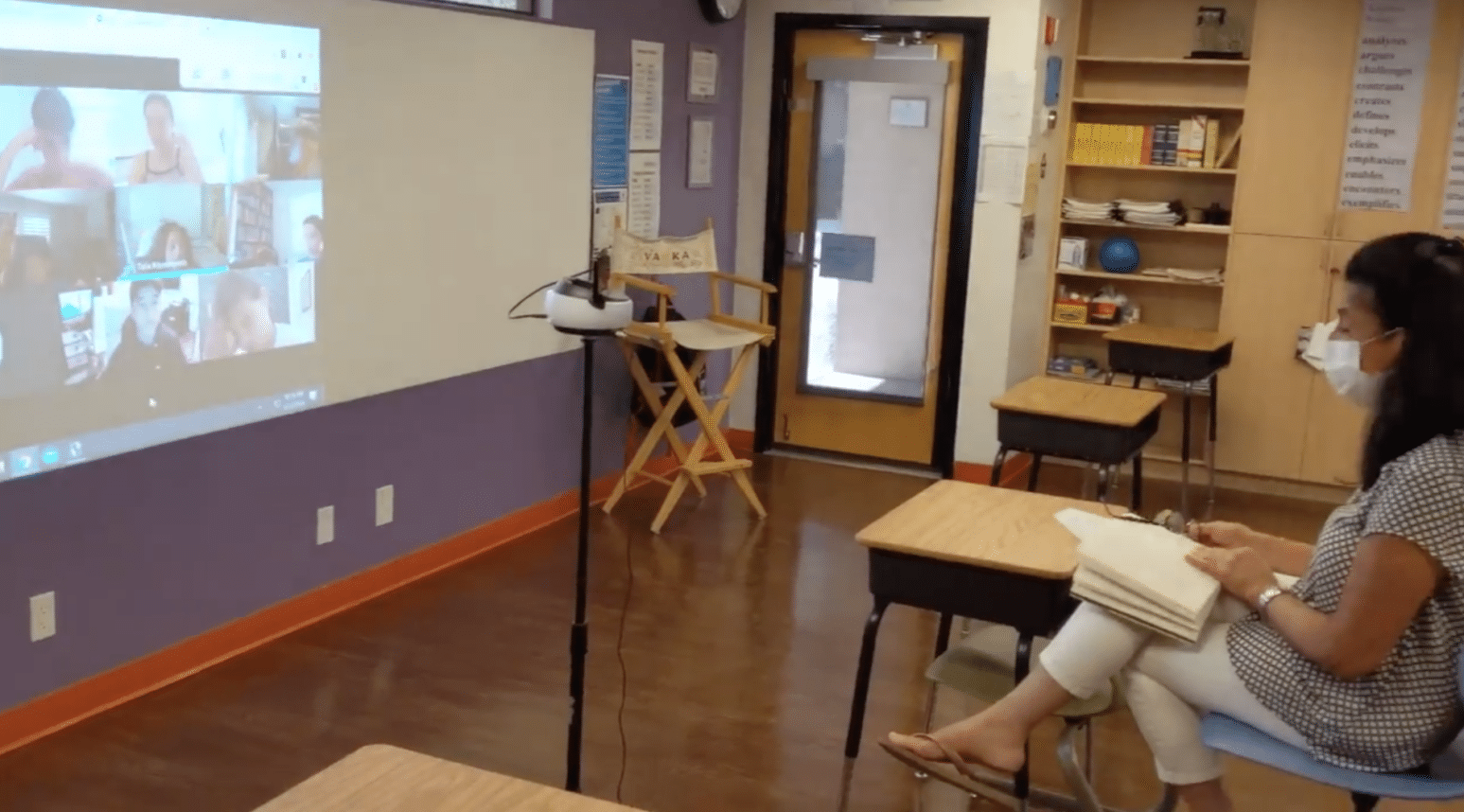
Some schools also have invested in new technology that will enable teachers to bring their classroom lessons into students’ homes. This is distinct from Zoom. Wise School, for example, purchased 16 Meeting Owl cameras (a 360-degree smart videoconferencing camera). Heschel invested in something similar for every classroom.
According to Weiser, teachers at Wise School will have the option of using the Meeting Owl cameras even during distance learning — teaching from their regular campus classrooms, albeit classrooms without students.
Said Kligman, “When we do have the option of being on campus and feel like we are meeting the guidelines of our county and the CDC (Centers for Disease Control and Prevention), for families that don’t want to partake in that, they can have the option of we’re going to be able to livestream the class to the home. For the kids, they will be able to be live [and] interactive, seeing the teacher, seeing their classmates, being able to be part of the group discussion.”
Kligman also is hopeful that this option will make it easier for parents to keep kids home when they aren’t feeling well. It will take the worry about missing class and falling behind out of the equation. And lastly, if a student or student’s family member does contract COVID-19 and is required to quarantine, they can still attend class from home.
As the start of the school year looms, the schools are aware that there are still a lot of unknowns. “It’s a very fluid situation,” Kligman said. “We realize as a school that whatever plans we have in place … may not be how we open. And whenever that first day of distance learning is, or whenever that first day of in-person instruction is on campus, I imagine two weeks later, four weeks later, we’re already at plan C.” Nonetheless, he added, “this is not a time to feel discouraged. This is a time to connect. I keep on using that word. That’s my magical word.”
“Like everything we’re learning with this, it’s flexibility and adaptability,” Weiser said. “Our school theme for this year is chazak v’ematz. (strong and resilient). And so, I hope that this is the year that we teach kids and adults you’re strong and you’re resilient, because this is really all about being that and knowing how to keep changing and keep growing.”
An Aug. 13 Anti-Defamation League (ADL) report chronicles how white supremacists have spread anti-Semitism on the social media app TikTok.
According to the report, there are more than 800 million users of TikTok. Carla Hill, a research fellow for the ADL’s Center on Extremism, told the Journal that the spread of hate on TikTok is “concerning because it’s a platform used by very young people.”
She said the primary method used to promulgate white supremacist propaganda is through voiceovers on existing videos. The report cited one example that includes a user saying over a video of Swedish YouTuber PewDiePie, “Hey, guys, PewDiePie here. Death to all Jews. I want you to say after me: Death to all Jews. And you know, Hitler was right. I’ve really opened my eyes to white power and I think it’s time we did something about it.” Another example involved a clip from “The Incredibles” movie portraying Mr. Incredible’s supervisor “as a hateful and manipulative Jew bent on enacting globalist policies.”
“This is also a way to avoid detection, I think,” Hill said. “The [TikTok] editors have to listen to every video to pick up on the fact that it is anti-Semitic. And that’s where I found a lot of anti-Semitism.”
Another way white supremacists avoid detection, according to the report, is through purposeful misspellings, known as “spoonerisms.”
“The strategy includes misspellings, transposition of the first letters of two words and the use of numbers in place of letters, such as 4 for the letter ‘A,’ 3 for the letter ‘E,’ and 1 for the letters ‘I’ and ‘L,’ ” the report stated. “Some examples of the tactics include ntupidsigger, kuuklixklan, 4d0lfH1t13r, N4z1 and negr0ki11er. One individual on the platform uses Morse code in their bio to say, ‘Kill the gays.’ ”
White supremacist TikTok users also direct people to sources of extremist content outside of the app at the end of seemingly normal music videos, Hill said. Examples include a series titled “Siege” and a book titled “The Turner Diaries,” both of which involve neo-Nazis calling for a race war. “They use them in their screen names, they hold the books up in videos, they have pictures of the authors on their TikToks,” Hill said. “We definitely see a lot of that.”
White supremacist TikTok users direct people to sources of extremist content outside of the app at the end of seemingly normal music videos, including a series titled “Siege” and a book titled “The Turner Diaries,” both of which involve neo-Nazis calling for a race war.
Hill estimates that the white supremacist TikTok users are “young to mid-20s,” although she acknowledged it’s difficult to know for sure since they tend to be anonymous. She said TikTok has been making an effort to remove extremist content from its platform, but the challenge is that when it does remove these accounts, new extremist accounts are created in their place. It is so easy to buy TikTok followers that new accounts can gain 10,000 followers the same day they are made.
“They just create another profile almost immediately and they learn from their mistakes on how they’re caught,” Hill said.
She believes the best way for TikTok to combat hate on its platform is to be aware of the various trends in white supremacist content and techniques to spread that content.
“It’s just absolute constant change in graphic stuff that extremists use on social media,” Hill said. “It comes from the culture of young people creating these new memes and you have to stay on top of it, and they [TikTok] were certainly open to our information and our work and are willing to try. And that’s all you can do.”
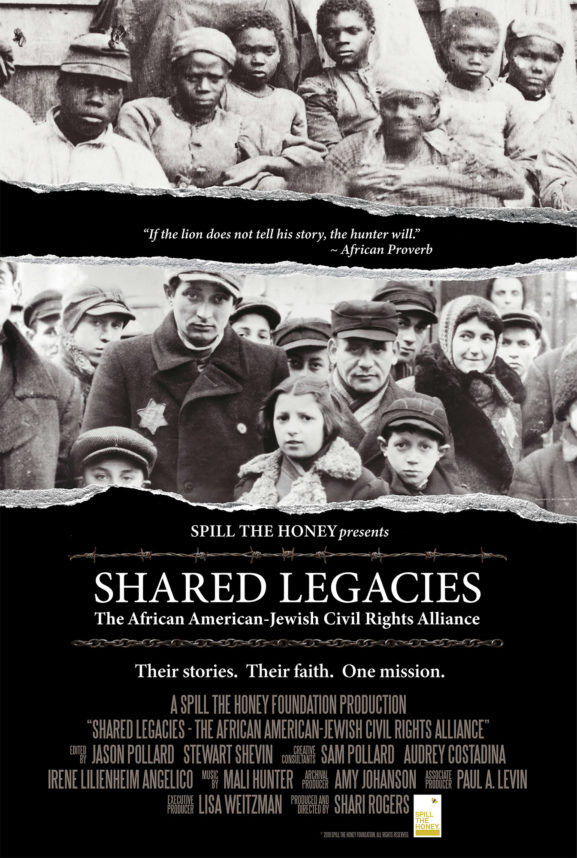
“Shared Legacies,” a documentary detailing the historical bond between Jews and Black people, especially during the civil rights movement, couldn’t be more on target for director-producer Shari Rogers and executive producer Lisa Weitzman, who are lifelong social activists. Weitzman’s mother is a Holocaust survivor who was saved by Catholics. On a deeply personal level, Weitzman appreciates what it means to step up to the plate.
Rogers, a clinical psychologist, previously co-produced “Eli: Inspiring Future Generations,” a PBS documentary examining the life of Holocaust survivor Eliezer Ayalon, a Yad Vashem tour guide. She also is the president and founder of Spill the Honey, a Michigan-based nonprofit committed to promoting human dignity as well as advancing public knowledge of the Holocaust and the civil rights movement.
Weitzman is a real-estate/corporate executive who has served as a board member of several nonprofit organizations including the Simon Wiesenthal Center in New York. In 2015, she joined the executive committee of Building Relationships at Spill the Honey.
At its close, the film acknowledges that the Black-Jewish bond came to an end with the deaths of Martin Luther King Jr. in 1968 and Rabbi Abraham Joshua Heschel in 1972. There’s no commentary on Israel or Black anti-Semitism as causes for the rift, though one of the talking heads obliquely refers to affirmative action (“meritocracy” issues) as a contributing factor.
Both women are committed to the notion that the time is ripe to celebrate how connected Blacks and Jews once were and should be again. A renewed alliance is especially relevant at this moment of racial reckoning and the rise of anti-Semitism, Rogers asserted during a three-way phone interview (with Weitzman). What’s particularly disturbing to her is that many people are unfamiliar with the historical interconnection of Jews and Blacks.
As an example, director Ava DuVernay’s film “Selma,” commemorating the 50th anniversary of the Selma march (leading to the Voting Rights Act), made no mention of Jewish participation in the march or indeed the civil rights movement. “But it’s not our goal to serve as a corrective to any one film, or individual, or group,” Rogers said. Rather, she explained, the goal of the film is reconciliation.
“Shared Legacies,” which will kick off the Los Angeles Jewish Film Festival’s online screening series as part of its “Courageous Conversations” screenings, interweaves archival footage and interviews with Holocaust survivors and civil rights leaders including Clarence Jones, the late U.S. Rep. John Lewis, actor and activist Harry Belafonte, and the late philosopher and social activist Rabbi Abraham Joshua Heschel, among others. Along with tracing the long-term coalition between Blacks and Jews, starting with the founding of the NAACP in 1909, the film explores the shared bigotry and segregation that both groups have encountered and their intertwined relationships throughout.
Photo courtesy of Lisa Weitzman and Dr. Shari Rogers
A Q&A webinar discussing the film and its application to the current cultural and political landscape will take place on Aug. 26. In addition to Rogers and Jones, the panelists will include Gina Belafonte, daughter of Harry Belafonte, and Sherry Frank, co-founder of the Black-Jewish Coalition. It will be moderated by Michael Berenbaum, the film’s historical consultant.
Rogers said that one of the more striking anecdotes she came across in her research was the recollection offered by Rabbi Saul Berman, a professor of Jewish studies at Yeshiva University. “He said that when he was released from a Selma jail on Shabbos — he had been arrested for participating in a march the previous day — he was unable to take a car ride to the next demonstration,” she said. “But he was determined to go despite the long walk. Many fellow protesters, Black and white, accompanied him on foot so that he wouldn’t have to make the trek alone.”
The most moving testimony in the film centers on a Holocaust survivor recounting the Black troops liberating the concentration camp where he was housed. It’s a familiar narrative, but it packs a punch each time.
The film touches on many complexities and contradictions, including the Orthodox rabbis and the Southern Jewish businessman who participated in the civil rights marches at great personal risk, Weitzman said.
Still from “Shared Legacies” Photo courtesy of Lisa Weitzman and Dr. Shari Rogers
Yet half a century down the road, some scenes in the film exist in a time warp. Consider: Danny Kaye and Harry Belafonte jointly singing “Hava Nagilah.” At its close, the film acknowledges that the Black-Jewish bond came to an end with the deaths of Martin Luther King Jr. in 1968 and Heschel in 1972. There’s no commentary on Israel or Black anti-Semitism as causes for the rift, though one of the talking heads obliquely refers to affirmative action (“meritocracy” issues) as a contributing factor.
Rogers and Weitzman said the conversation itself, with players on all sides of these emotionally and politically fraught issues, and, indeed, the making of the documentary, has been an unexpected step toward healing. And this is just the beginning. The film is slated to be shown at many community events and schools. Its educational value cannot be overestimated, according to Rogers, who is developing an accompanying curriculum.
But for Rogers and Weitzman, the most emblematic event of recent months was the heartfelt atonement expressed by Black entertainer Nick Cannon for his anti-Semitic remarks. For them, redemption and bridge-building is no far-flung fantasy. It’s a reality, right here, right now.
The Los Angeles Jewish Film Festival presents a virtual premiere of “Shared Legacies: The African American Jewish Civil Rights Alliance,” with webinar Q&A at 5 p.m. Aug 26. Purchase tickets here.The film will be available to stream online in advance of the webinar from Aug 23-26 here.
Correction: A previous version of this article incorrectly stated that Harry Belafonte sang “Hatikvah.”
Simi Horwitz is an award-winning feature writer and film reviewer based in New York.