fbpx

July 31, 2020

Seattle’s Only Freestanding, Certified Kosher Restaurant Closes Amid Pandemic Pressure

(JTA) — If you keep kosher in Seattle — whose metro area is home to more than 60,000 Jews — you now have to head to the suburbs for a restaurant meal you can eat.

The city’s only freestanding, certified kosher restaurant, Bamboo Garden, is serving its last meals today. The vegetarian restaurant became kosher nearly three decades ago after local Jews contributed expertise and money to allow it to achieve certification, according to a piece in the Seattle Times about the restaurant and what it has meant to Seattle Jews.

The author, Joy Resmovits, an assistant metro editor and observant Jew, wrote that Bamboo Garden was the only local restaurant where she could take her parents when they visited from New York. Others had similarly meaningful associations, she wrote:

“When news broke earlier this month that the restaurant would shutter at the end of July, because of recent pandemic-related challenges and the owners’ desire to retire, I received messages from lifelong Jewish Seattleites about their ‘mourning’ this loss. How their only experience of dining out involved Bamboo Garden. How, to my friend Nina Garkavi, eating there became part of a night-out ritual during any visit to the symphony or opera or trip to the Space Needle with tourists.

“Its regulars call it a place that bred diversity, feeding Buddhist monks, vegetarians and observant Jews, but also familiarity — a place where they could count on running into each other; servers who greeted diners with Hebrew phrases, anticipated your order and remembered your daughter’s age even when you hadn’t been there for a year or two. …”

“When you’re a Jewish kid growing up in Seattle, you don’t eat at a restaurant that’s kosher and just say, ‘I really don’t like it,’” said [Jessica] Russak-Hoffman. “Every kosher restaurant you eat at you think is the best restaurant.”

Seattle still has a host of vegetarian and vegan restaurants for Jewish diners who want to avoid eating non-kosher meat but may be comfortable without kosher certification. And there are a handful of kosher restaurants in the suburbs, including a vegetarian Indian restaurant that became kosher following the Bamboo Garden playbook.

But Seattleites must drive several hours to British Columbia to eat kosher meat in a restaurant, Resmovits writes.

Seattle’s Only Freestanding, Certified Kosher Restaurant Closes Amid Pandemic Pressure Read More »

Shalhevet Institute Explores Black and Orthodox Jewish Identities

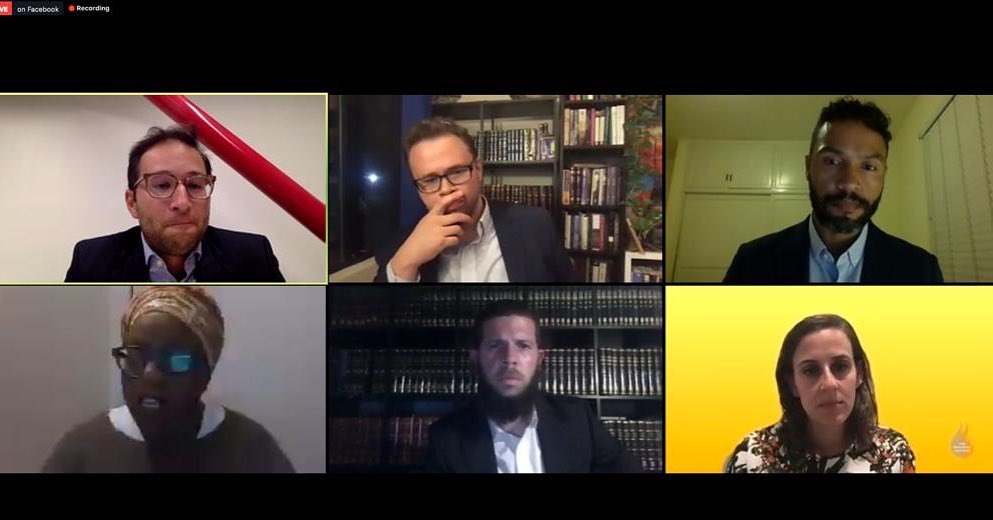
By his own admission, Noam Young, a mixed-race man who converted to Judaism and is looking to find community, was at a crossroads. The call from Ari Schwarzberg of the Shalhevet Institute to participate in a discussion on the intersection between Black and Jewish lives came at an opportune time. 

“Before Ari called me, I was sure that there was a zero percent chance that there is a place for me and my wife and the kids we hope to have one day in the Orthodox world.” Young made this comment to an audience of about 140 Zoom attendees at the Shalhevet Institute’s “Black & Jewish Identities: Opening a Conversation” event on July 27. “And,” he added, “I am still close to zero, but I have some hope and some faith, and I think our faiths are bound up together. So, if you are willing to listen, I’m willing to share.”

Young’s candid admission was one of several frank and not always optimistic statements by the four panelists who participated in the discussion moderated by Schwarzberg and Na’amit Negel. As Black or mixed-race Jews, Young and fellow panelists Chava Shervington, Yonosan Perry and Isaiah Rothstein each expressed strong views on the topic of the Black experience both within the Jewish community and in the country at large. 

The first of the two-night event, titled “Voices,” focused on discussion of personal experiences. The second session, “Texts,” scheduled for Aug. 10, invites attendees and panelists to consider several reading materials, including James Baldwin’s 1967 New York Times essay “Negroes are Anti-Semitic Because They are Anti-White.”

“The Shalhevet Institute is a space in L.A. that’s interested in bringing people together to study Torah seriously and to think deeply about Jewish ideas, texts and literature in a way that enriches and broadens our community,” Schwarzberg said in his introductory remarks. “Tonight, we are taking a step toward broadening our community and hopefully it serves as a fulfillment of ahavat Yisra’el (love of the Jewish people) and our charge to be mamlechet kohanim (a nation of priests).”

“My white Ashkenazi mom brought me to the [district attorney’s] office to file a formal complaint against whatever officer. I don’t know how many people in yeshiva education are listed in the gang-related book in their town, but I am.” — Yonosan Perry

Despite experiences that overlapped in some respects, the four panelists came from diverse backgrounds. Shervington is a practicing attorney, a board member of the Jewish Multiracial Network and a mother of two. Perry, the son of an Ashkenazi mother and a Black father, is a Chabad rabbi. Rothstein is an Orthodox rabbi who has written extensively about issues of race and diversity, and Young works in software regulatory compliance and the arts. All the panelists live in Los Angeles except Rothstein, who Zoomed in from his New York home in Harlem. Each expressed his or her wish that events such as the Shalhevet discussion would help create a bridge toward building a better world for their own children and for future generations.

Their own upbringings — even within upper-middle-class families — contained early lessons that Black people are treated differently. Rothstein spent holidays in Los Angeles and recounted spending Shabbat with family in Inglewood before meeting up with friends in the Pico-Robertson area. Although he is of mixed-race parentage, Rothstein passed for white. He said as an “undercover brother,” he had a unique view of ways in which Blacks and Jews are treated and the ways they treat one another. 

The mention of Inglewood, for example, would prompt people to say, “My parents don’t let me drive there,” while references to his current home in Harlem elicits a “Yeah, make sure the windows are rolled up and the doors are locked.”

“Because I pass for white, I tend to have a front-row seat to certain things we call micro-aggressions; things people say not to be outright hostile or to treat you in a disrespectful way, but because maybe these things were ingrained in their thinking,” Rothstein said. “I think a lot of us in the 21st century feel in between in different ways, holding dual identities.” 

When asked whether she considers herself more Black or more Jewish, Shervington said she is wholly both and that there is no distinction.

“The reality is that Blacks in America can’t avoid Blackness or racism,” she said. “From the time we’re children, our parents teach us, ‘You have to be quiet. You can’t be loud like your friends.’ For your entire life, there is so much energy in constructing a persona that makes other people feel comfortable.”

All of the panelists recalled having multiple encounters with law enforcement, everything from being stopped constantly while driving to, in Young’s case, being pulled out of kindergarten because a woman accused him of stealing her purse. 

When he was a young teenager, Perry’s father told him to always obey police officers because if he didn’t, “ ‘They will kill you and no repercussions will happen.’ It still didn’t stop certain altercations from coming about, from being pulled over on my lunch break in high school and having to tell my mom what happened,” Perry said. “And my white Ashkenazi mom brought me to the [district attorney’s] office to file a formal complaint against whatever officer. I don’t know how many people in yeshiva education are listed in the gang-related book in their town, but I am.”

Toward the end of the discussion, the panelists were invited to give a constructive rebuke to the Orthodox community for the way that it deals with issues of race. Perry said he would like to see a decrease in the constant questioning of mixed-race Jews about their background. Young, noting that he had heard bigoted remarks at Shabbat tables and in kosher restaurants, saved the largest rebuke for himself. 

“I need to speak up more,” he said. “I hear things way too often and I don’t say anything because I’m afraid of how it will affect my security in different ways. But I need to speak up. We all need to speak up more.” 

Shervington, stressing the importance of education, condemned the politicization of race. “Everyone, regardless of their politics, whether they’re fiscal conservatives, fiscal liberals or whatever it is, should acknowledge that a system of discrimination and oppression is wrong,” she said. “I want to contribute to that.” 

To register for the Aug. 10 session, click here.

Shalhevet Institute Explores Black and Orthodox Jewish Identities Read More »

UNRWA Head: There is no Glorification of Terrorists at UNRWA Schools

The head of the United Nations Relief and Works Agency for Palestine Refugees in the Near East (UNRWA) told The Jerusalem Post in a July 30 article that the agency doesn’t glorify terrorists in their schools.

UNRWA Commissioner-General Philippe Lazzarini told the Post, “Let’s be clear, there is no glorification of martyrs being taught in UNRWA schools. There is none of that. No teacher is teaching that.”

He also said that UNRWA has “a very strict regular process of review of all the materials which are given by authorities and the government to UNRWA to be taught in the schools.”

The Post asked Lazzarini about how Palestinian Authority (PA) textbooks frequently glorify Dalal Mughrabi as a martyr; according to the Post, Mughrabi was a part of a 1978 hijacking of an Israeli bus, which resulted in 38 Israelis dead, 13 of whom were children.

“I know this keeps popping up, but UNRWA has given clear instructions that this not be taught in the schools because it can be perceived as incitement, depending on how it is brought to the attention of the children,” Lazzarini said on the matter.

U.N. Watch Executive Director Hillel Neuer disputed Lazzarini’s assertion that UNRWA doesn’t glorify terrorists in their schools, highlighting a September 2019 U.N. Watch press release stating that UNRWA staff members’ Facebook page has “posts endorsing and glorifying murderous terrorists like Hamas bomb-maker Abdullah Barghouti, responsible for killing 67 Israelis and injuring hundreds more during the Second Intifada, condoning knife and car ramming attacks, and portraying Adolf Hitler as a humanitarian.”

“Despite our prior identification of UNRWA teachers who endorse Hitler and call for killing Jews, I am not aware of a single UNRWA teacher who has been fired as a result,” Neuer said in a statement. “When racist and anti-Semitic statements by teachers in other countries were exposed, the offending teacher was immediately fired. Why is it that an ostensibly neutral UN agency that supposedly teaches tolerance continues to employ terrorist-supporting and anti-Semitic staff?”

Palestinian Media Watch (PMW) Executive Director Itamar Marcus told the Post that he has never seen any course material from UNRWA that promotes peace and that the agency uses PA textbooks.

“Since UNRWA is using this material, why does PMW have to research and scream to the international community about the hate and terror promoted in the schoolbooks?” Marcus said. “If UNRWA had any decency, and if they cared for the well-being of the children who are being poisoned by this material, they would be the ones calling out the PA and condemning them from the floors of the UN and in all capitals of PA donor countries.”

The Trump administration eliminated funding to the UNRWA in 2018, arguing that the agency needs to be reformed and that Arab nations need to provide more aid to UNRWA.

UNRWA Head: There is no Glorification of Terrorists at UNRWA Schools Read More »

Dutch-Jewish Resistance Fighter Whose Factory Was Used to Make Yellow Stars Dies at 98

AMSTEDAM (JTA) — Henk van Gelderen, a Dutch-Jewish resistance fighter whose textile factory was used to produce yellow stars for the Nazis, died at 98.

The De Stentor newspaper reported Tuesday about van Gelderen’s death.

Van Gelderen’s factory in the eastern city of Enschede, NV Stoomweverij Nijverheid, was confiscated by the German occupation forces soon after they invaded the Netherlands in 1940 and was used to produce 569,355 of the stars that Nazis forced Jews to wear.

Van Gelderen himself went into hiding in Amsterdam, assumed a false identity and teamed up with a resistance cell that was well-known for its high-quality forgeries of identity and travel documents for those wanted by the Nazis.

His older brother, Matthieu, who was also in the resistance, was arrested and murdered shortly before the Netherlands was liberated by Allied forces.

In March, Van Gelderen was named honorary mayor of Enschede.

In an interview, Van Gelderen how he felt about the workers who made yellow stars for the Germans with machines he had bought.

“What could they have done?” he said. “The factory had a German boss. They got the order. They had to eat. If they hadn’t done it, others would have.”

Dutch-Jewish Resistance Fighter Whose Factory Was Used to Make Yellow Stars Dies at 98 Read More »

Philanthropist Anne Bernstein, 105

Anne Bernstein, matriarch of one of the founding families of the Los Angeles Orthodox community, died on June 17. She was 105.

Together with her husband, William, they were early founders and supporters of Los Angeles Jewish day schools, Zionist summer camps, several synagogues and religious Zionist organizations. 

Known universally as Bobie (grandmother), Anne presided over elegant events at the family’s iconic Mediterranean mansion in Hancock Park, hosting luaus, dances, parlor meetings and lectures. She wore her long brunette locks in a signature updo that added at least 6 inches to her height, and she baked and prepared much of the food for her events on her own. Around her Shabbat table, generations of friends and family were treated to her unfiltered wisdom and opinions, delivered with a combination of humor and grace.

Born April 1, 1915, in Vilna, Lithuania, Anne was the oldest of Rabbi Herschel and Sara Leah Pennes’ four children. The family immigrated to Wheeling, West Virginia, in 1924 and then moved to Pittsburgh. During the Depression, Anne worked at hosiery shop in Pittsburgh, where she also designed hats. Later in life, she understood that her father’s decision to move to the United States saved them from the Holocaust. Growing up in the Depression, she also understood want, and used that knowledge in her philanthropic efforts. In addition to supporting institutions, she always had a small roster of families she quietly provided for.

She met her husband, Willie, in Pittsburgh when they were 12. They married in 1938. He received a World War II medical exemption due to his asthma and doctors advised him to relocate to a warmer climate. The Bernsteins then moved to West Adams in Los Angeles with their baby daughter, Michele, in 1943.

Willie built his business by peddling items out of the trunk of his car, which eventually grew to become the industry-leading Federal Wholesale Toy Company, while Anne cared for their growing family. Together, they focused on creating institutions to serve the Los Angeles Jewish community.

They founded the California Hebrew Academy at B’nai Rubin in the late 1940s — one of Los Angeles’ first Orthodox day schools. The school evolved into L.A. Hebrew Junior High, which served as the foundation for Rambam high school, the precursor to today’s YULA High School, all of which the Bernsteins helped found and support. Anne was PTA president at Rambam and many of the other schools where her children were educated.

The Bernsteins also were supporters of Mizrachi, a religious Zionist organization, and Anne was active in Amit, Mizrachai’s women’s branch. The Bernsteins helped open Bnei Akiva’s Camp Moshava on the West Coast in the 1950s, and emissaries from Israel regularly stayed in their home. They were members of Agudath Achim in West Adams, and then, when they moved to the Fairfax area in the early 1950s, of Rodef Shalom, which merged to become Temple Judea. Their daughter and several grandchildren are now members of B’nai David-Judea Congregation, the successor to Temple Judea. When the Bernsteins and their four children moved to Hancock Park in 1964 — one of the first Orthodox families in the now heavily Jewish area — they joined Congregation Shaarei Tefila, where Willie was president and Anne was a leader.  

A prodigious reader who always kept up with the news, Anne visited Israel more than 40 times. She built and nurtured relationships with all of her children, grandchildren and great-grandchildren, many of whom live in Israel.

Anne continued her hosting and philanthropic work after Willie died in 1991, particularly with Amit, which works to educate Israel’s disadvantaged children. She was honored by Shalhevet High School when she celebrated her 100th birthday in 2015. 

She is survived by her children, Michele Harlow, Jacqui Fishman, Nini (Leslie) Mendelsohn and Eddie (Denise) Bernstein; 10 grandchildren, many great-grandchildren and her brother, Robert Pennes.


Julie Gruenbaum Fax is a Los Angeles-based writer.

Philanthropist Anne Bernstein, 105 Read More »

david suissa podcast curious times

Pandemic Times Episode 74: A Test of Jewish Resiliency

New David Suissa Podcast Every Monday and Friday.

Rabbi Nicole Guzik shares her thoughts on “opting in” to communal life during these pandemic times.

How do we manage our lives during the coronavirus crisis? How do we keep our sanity? How do we use this quarantine to bring out the best in ourselves? Tune in every day and share your stories with podcast@jewishjournal.com.

Pandemic Times Episode 74: A Test of Jewish Resiliency Read More »

A Father, Electrical Engineer Created a Device that Helps Understand Baby Talk

When Evgeni Machavariani’s son was born six years ago, his wife, Mary, was attuned to the baby’s needs from the get-go. “I was surprised and shocked that my wife understood each cry and knew exactly how to help him. It came to her intuitively,” he said. “I, too, wanted that superpower.” 

So, Machavariani, an electrical engineer and physicist, researched if it was possible to distinguish between a baby’s different cries. Once he started down the rabbit hole, Machavariani realized the potential of what he had unearthed was limitless.

He recruited Shauli Gur Arieh, with whom he served for nearly a decade in the Israel Defense Forces’ military intelligence technology unit, and founded LittleOne.Care. Today, they are the CTO and CEO, respectively, of the company, which produces a wearable device for babies that provides real-time alerts that track a baby’s motions and sounds. The device (currently in beta testing with 50 babies) also gathers data for long-term artificial intelligence insights. Machavariani said his experience with motion sensors and navigational algorithms in the military were crucial to creating the technology for LittleOne.Care, but added, “If I wasn’t a father, I never would have thought of this.” 

The real-time functions comprise lifesaving alerts as well as alerting the caregiver what the baby needs based on his or her cry. In the case of the former, the device maps out breathing, temperature and heartbeat patterns so it can predict serious issues ahead of time, unlike existing baby monitors that only emit warnings once an event has already occurred. When it comes to interpreting cries, an LED light on the device will turn blue, yellow, white or red corresponding to exhaustion, a dirty diaper, hunger or pain. 

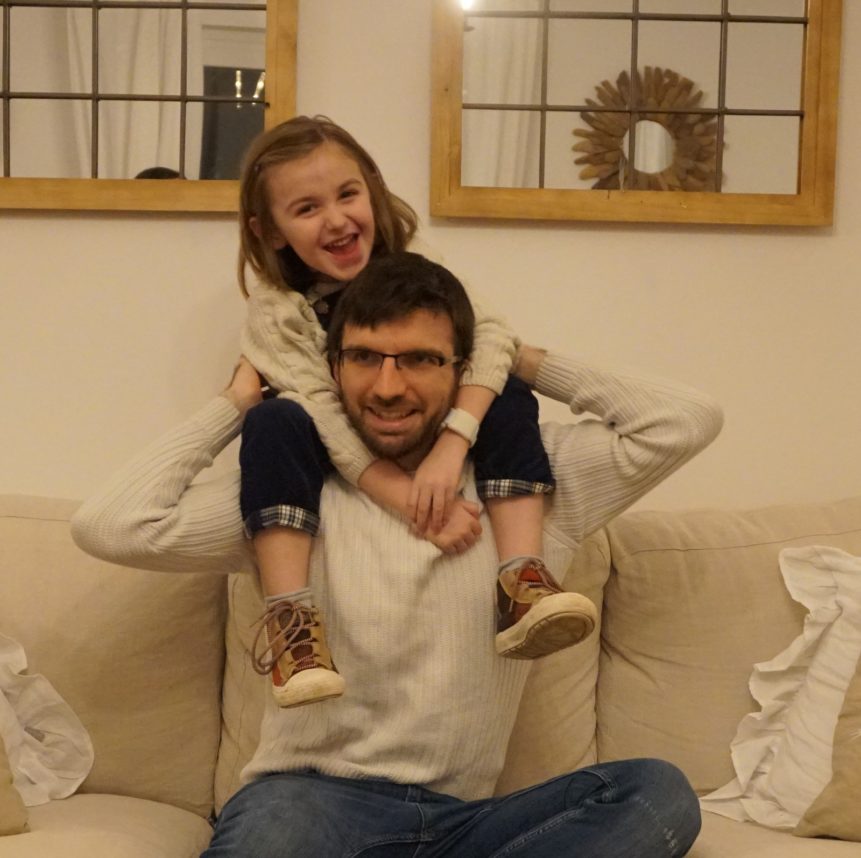
Machavariani and his son.

The tiny device, which is worn on the baby’s stomach 24/7, also can warn if a baby is being mistreated, whether he or she has spent too much time watching television, received enough tummy time, enough sleep, enough food and more. However, it’s not all doom and gloom. Parents and caregivers are applauded when things go right, for example if the baby laughs a lot or cries less than usual. 

LittleOne.Care also has cloud functions that can delve deeper into a baby’s development. It can discern a baby’s first mutterings as well as unpack his or her motor skills and instruct parents what needs to be worked on. Machavariani said studies show that girls speak earlier than boys because mothers tend to speak more to daughters. LittleOne.Care incorporates this data into its algorithms and acts accordingly. In the case of Machavariani and his wife, it was important for them to know they weren’t missing any aspects of the development of their son, who began reading at only 18 months and started learning basic arithmetic not long after that, “but we weren’t balanced in what we were teaching.”

Their son, who is mostly homeschooled, was 4 when he was entrusted to a stranger’s care for the first time. Things may have been different if LittleOne.Care had been around then, Machavariani said. 

LittleOne.Care, he explained, “is designed to empower families to enjoy the fascinating experience of raising a baby.”

A Father, Electrical Engineer Created a Device that Helps Understand Baby Talk Read More »

NY Comedy Club Owner Al Martin on What Stand-Up Will Look Like Post-Pandemic

Al Martin didn’t intend to work in comedy. Over three decades ago, he went to an open mic night on a dare and happened to fall in love with it. He went on to open four comedy clubs: New York Comedy Club in Boca Raton, Fla., and three in Manhattan: Broadway Comedy Club, New York Comedy Club and Greenwich Village Comedy Club, where comedians including Dave Chappelle, T.J. Miller, Laurie Kilmartin, Dave Attell and Artie Lange have performed over the years. 

In his new book, “Did It On a Dare: How I Created a Comedy Empire in 30 Short Years,” Martin chronicles his adventures in comedy and how he became the successful club owner he is today. The Journal caught up with him to talk about the book and how he imagines clubs will look when New York reopens after the coronavirus pandemic. 

Jewish Journal: How did you get into comedy?

Al Martin: I was dating a girl who was a stand-up comedian. She was doing a lot of open mics and she asked me to go watch her show one night. It was so bad. She asked me how it was and if I’ve ever learned anything in life, with people you’re dating, you can’t tell them the truth. Same thing with comedy. I said it sounded good to me. She didn’t believe me. Finally, after she asked me for the 10th time, I said, “All right, it was terrible.” We got into a 15-minute fight. She said, “You know, you’re pretty funny. Why don’t you go onstage next week?” 

A week later, I signed up for an open mic. Just as it was my turn to go up, after 2 1/2 hours in, Andrew Dice Clay walked in. It was 1989. He was rehearsing for his HBO special. He ran the whole 45 minutes before I went up. When he was done, it was 1 in the morning. No one wanted to listen to more comedy. When the emcee announced me, he didn’t even know my name. There were two people in the audience. I bombed about as bad as you can onstage. But in the three hours I waited to go up, I met some interesting characters. I had nothing going on socially or work-wise, so I hit up other mics. I had the bug. 

JJ: When did you go from doing comedy to running shows?

AM: About a year in. I wasn’t able to get stage time. I started a room. It took off. We were operating six or seven nights a week. I stumbled into a full-time comedy club. 

JJ: When did you open your clubs? 

AM: I opened New York Comedy Club [in Manhattan] in 1989. Then I opened up Broadway Comedy Club, which was initially supposed to be called the Jackie Mason Comedy Club. I had struck a deal with Jackie Mason and he invited me to watch him perform in Vegas. He might be popular in New York, Los Angeles, Chicago, Boston and Florida, but nobody gives a crap about him in Vegas. He was in a 5,000-seat arena and there were 300 people there that night. Most of them were getting wheeled in or they were using walkers or canes. I told my wife, “Honey, I think we need to change the name of the club. I don’t know if anyone who likes him will be around in 10 years. They might be dead.” Initially, we were the Improv and then we became the Broadway Comedy Club. In 2007, I opened the Greenwich Village Comedy Club on MacDougal Street around the corner from NYU. 

JJ: Are there any stories in the book that stick out?

AM: For a brief time, I owned a comedy club in Boca Raton, which has a high population of Jewish people. My partner and I would always stand there in amazement because when people walked in the door, they were never happy no matter where you sat them. You would put them in the first row and they’d say, “I don’t want to be there, they’ll pick on me.” I’d put the next people in the third row and they’d say, “Why am I in the third row? The first row is empty!” This one person said she loved the smell of food, so we put her near the kitchen. She said, “You’re going to mess up my diet.” It’s like Jackie Mason says in his joke, Jewish people always walk into a restaurant like they’re a partner. 

One time at New York Comedy Club [in Manhattan] in the late ’90s, we were doing a show with Dave Chappelle, Tracy Morgan, Chris Rock and Damon Wayans. This little kid walked in and everyone made fun of him. They said, “Hey, shortie, are you doing comedy?” That kid who walked in is the biggest one of them all: Kevin Hart. 

JJ: Which Jewish comedians have performed at your club?

AM: Quite a few Jewish comedians got their start at my club, like Dan Naturman and Cory Kahaney. Rodney Dangerfield appeared in my club. The last week Johnny Carson was doing “The Tonight Show,” Rodney came in and did a spot to rehearse for it. 

JJ: You grew up in Brooklyn, yes?

AM: Yes. There was a dividing line in Brooklyn: Nostrand Avenue. If you were on one side, it was almost 100% Jewish, and if you were on the other side, there were a lot of Irish and Italian people and almost no Jews. My mom didn’t have a lot of money at the time but she wanted to get a house for us. Her attitude was that it was only a couple of blocks, big deal. A couple of blocks could mean an entire world. We wound up on the gentile side of the tracks and I was viciously bullied. To make up for the fact that I didn’t have any Jewish friends or influences, they put me in a really Orthodox Hebrew school. I was getting beaten up during the day because I was Jewish, and then in Hebrew school I wasn’t Jewish enough, so a lot of kids would pick on me there. When my mother found out that one of our neighbors was slapping me around, she went nuts on him. She’s 93 now. She was a tough cookie. She taught me not to take crap from anybody, and now I live my life like that. 

JJ: How are you managing during the pandemic?

AM: My main job has been trying to negotiate with landlords over long-term leases. I want to make sure we can get ready to open. It’s going to be a whole new comedy world. We are going to have to take people’s temperatures. The audience might be wearing masks. We might have to put up plexiglass to protect the comics from the audience and vice versa. But I do think people are ready to go out. They want to laugh. 

NY Comedy Club Owner Al Martin on What Stand-Up Will Look Like Post-Pandemic Read More »

Black British Paper Pulls Rapper’s Remarks About Jews but Defends Publishing Them

(JTA) — The Voice, a British weekly aimed at the African-Caribbean community, pulled an interview with the rapper Wiley in which he repeated anti-Semitic tropes about Jews.

But in a statement Friday, the paper defended its decision to publish the interview.

“The Voice has not, and makes it clear again, supported or in any way condoned the outbursts by Wiley that the Jewish community finds offensive,” the statement said. “We do not support the stereotyping of any race or group.”

But the paper said that its role was to give voice to Black Britons and that should not be construed as an endorsement of every view it publishes.

“As a black media outlet, we are here to give our people a voice,” the statement said. “That doesn’t mean we will always agree with everything that is published.”

Wiley, who this week was banned from Twitter and Facebook over his views, said of British Jews: “They see us as slaves.”

Speaking about Jews, Wiley also wondered in the interview “why all of these families are rich, or all of these people have heritage, not just England, like, worldwide.” The interview followed Wiley’s apology for previous remarks about Jews.

In the article, the paper’s arts and entertainment editor, Joel Campbell, weighed Wiley’s claims that Black artists depend on Jewish lawyers to succeed.

“There is no way to put this all in one nutshell but the hypothesis that you need to get a Jewish lawyer in order to progress in the music business may be a complete fallacy (I haven’t done the numbers, looking into the correlation in respect of who is and isn’t successful with or without one), but yet it remains,” Campbell wrote.

“I’ve never seen anyone Jewish refute or confirm this,” he added, “but maybe, it’s a discussion that needs to be had?”

Black British Paper Pulls Rapper’s Remarks About Jews but Defends Publishing Them Read More »

The Bagel Report

Seth Rogen’s in An American Pickle

Esther’s already seen “An American Pickle” and Erin is still waiting; until the Bagels are brined and ready to discuss it, they join in the conversation about Seth Rogen’s comments on Israel and Judaism on Marc Maron’s podcast, and consider the failures of the American Jewish educational system. Later, Esther reviews some newly available Israeli TV shows and Erin’s roommates support her ongoing “Jojo Rabbit” obsession.
Helpful Links:
Follow ErinEsther and The Bagel Report on Twitter! 

Seth Rogen’s in An American Pickle Read More »