fbpx

July 10, 2020

Pinchas

It’s always nice to see a project through to the end.

Especially one you’ve been working on for forty years,
a lifetime really, though back then people either lived
much longer or they were prematurely smitten for
lying with a Midianite.

So when Moses who’s been working on this project,
this project of getting all the people into the promised land,
who’s been working on this project since back in the days
when the Lord was just a glint of fire on a bush, halfway
up another mountain…

So when Moses, who already knows he’s not going to
see this through to the end because of a brief transgression
with a rock and a stick…

So when Moses is asked to climb to the top of a mountain,
Mount Abrim if you really must know, the mountain across
Jordan…When Moses is asked to stand on top of this mountain
and view the promised land, the culmination of his life’s work,
a distant soil his shoes will never know…
it must have been…well you can imagine. You’ve probably
been there. If you’ve ever experienced anything unrequited
you know exactly how Moses must have felt. Moses, the star
of books two through five, turned lame duck leader, asked to
pass his spiritual power onto Joshua the rookie.

The end is in sight and it’s not the land he sees from the
top of this mountain. These old bones will rest in Moab.
But don’t let me skip ahead. We’ve still got a whole book
to go and it’s the longest one. Heck, there are still two
chapters left in this one.

You can’t blame me. I get nostalgic about things that
haven’t happened yet. More often than not the present
moment escapes me as I worry about its passing.

How many of us exist perpetually on our own Mount Abrims
pining for the distant vista, completely missing the glorious view?

This is the curse of the thoughtful human, the task focused.We, temporary mammals, this Earth not ours, but meant for the next, and, when it comes down to it, not them either.

Unbreakable cycle. Know this – the promised land is where
your feet are right now. Where this air enters your nose.

Concentrate on that breath and you will never be left
alone on a mountain.

Pinchas Read More »

Josh Malina: Why Doesn’t ‘Cancel Culture’ Apply to Anti-Semitism?

Actor Josh Malina, who is Jewish, asked in a July 7 tweet why what’s known as “cancel culture” doesn’t apply to anti-Semitism.

The Algemeiner reported that the tweet read: “Why’s it so hard to get cancel culture on the line when the problem is anti-Semitism?”

Comedian Elon Gold chimed in, tweeting: “Nobody gets cancelled for hating Jews. From [Joseph] Goebbels to [Mel] Gibson.”


The Creative Community for Peace (CCFP) tweeted that it’s important to “unite together against all forms of hate,” adding that “only together can we defeat all forms of racism and bigotry.”


Malina’s tweet came after Philadelphia Eagles wide receiver DeSean Jackson came under fire for Instagram posts over the weekend sharing a disputed quote from Adolf Hitler and glorifying Nation of Islam leader Louis Farrakhan. The Eagles issued a statement on July 7 condemning Jackson’s posts.

“Regardless of his intentions, the messages he shared were harmful, offensive and appalling,” the statement read.

Malina tweeted, “‘Regardless of his intentions’? His intention was to quote Hitler in order to smear Jews.”


Jackson has since apologized.

“Cancel culture” refers to the increasing propensity for people to be rebuked if he or she expresses a viewpoint that people think is offensive.

Jonathan Tobin, editor-in-chief of Jewish News Syndicate (JNS), similarly asked in a June 19 op-ed why anti-Semitism seems to be absent from cancel culture, pointing out that actress Chelsea Handler received support from her colleagues after calling a clip of Farrakhan “powerful” in a June 15 Instagram post. Tobin also noted that the House of Representatives didn’t censor Rep. Ilhan Omar (D-Minn.) after accusing supporters of Israel of having dual loyalty and that the American Israel Public Affairs Committee (AIPAC) buys support for Israel in Congress.

“It says something truly ominous about our society and culture that questioning the BLM [Black Lives Matter] movement — even while avowing that, of course, black lives matter — can destroy a career, while endorsing anti-Semites and even engaging in Jew-hatred is not considered a big deal,” Tobin wrote. “We already know that the consequences of giving anti-Semites a pass can lead to horror. Apparently, those who pose as the supposedly enlightened guardians of our culture have either forgotten that or no longer care about it.”

Josh Malina: Why Doesn’t ‘Cancel Culture’ Apply to Anti-Semitism? Read More »

Stephen Jackson Talks With Rabbi, Says ‘I Understand the Hurt’ Over Rothschild Comment

Former NBA star Stephen Jackson disavowed hatred against Jews and walked back the inflammatory comments he made earlier in the week suggesting Jews control the banks.

In a conversation with Los Angeles Rabbi David Wolpe livestreamed on Instagram Thursday night, Jackson expressed regret for his comment that the Rothschild family “owns all the banks,” the Forward reported.

“Even with the Rothschilds, I hate saying that,” Jackson said, “because that’s the same type of stereotype as, when you see a black person, [saying] he’s a gangsta.”

Jackson found himself embroiled in controversy earlier this week after coming to the defense of NFL player DeSean Jackson (no relation), who created an uproar of his own after posting a number of tweets over the weekend that “white Jews” work to “blackmail” and “extort” America and that Adolf Hitler “was right.”

Stephen Jackson wrote on Instagram that DeSean Jackson was “speaking the truth.” Then, in an Instagram video discussion with a user whose handle is @kosherwhitewine, Stephen Jackson brought up the Rothschild family, a prominent fixture of anti-Semitic conspiracy theories positing Jewish domination of international finance.

“Do you know who the Rothschilds are? They control all the banks, they own all the banks,” Jackson said.

Wolpe told Jackson that Jews remain highly sensitive to references to Hitler and anti-Semitic notions of financial control, saying Jews sometimes react to such comments with hurt and fear.

“I understand the hurt,” Jackson replied. “That’s why I was comfortable initiating an apology. Your hurt and our hurt is no different.”

Wolpe also broached the topic of Nation of Islam leader Louis Farrakhan, who Jackson has quoted online. But Jackson declined to address Farrakhan directly.

Stephen Jackson Talks With Rabbi, Says ‘I Understand the Hurt’ Over Rothschild Comment Read More »

Owner of DeSean Jackson’s NFL Team Produces a Documentary About Hitler

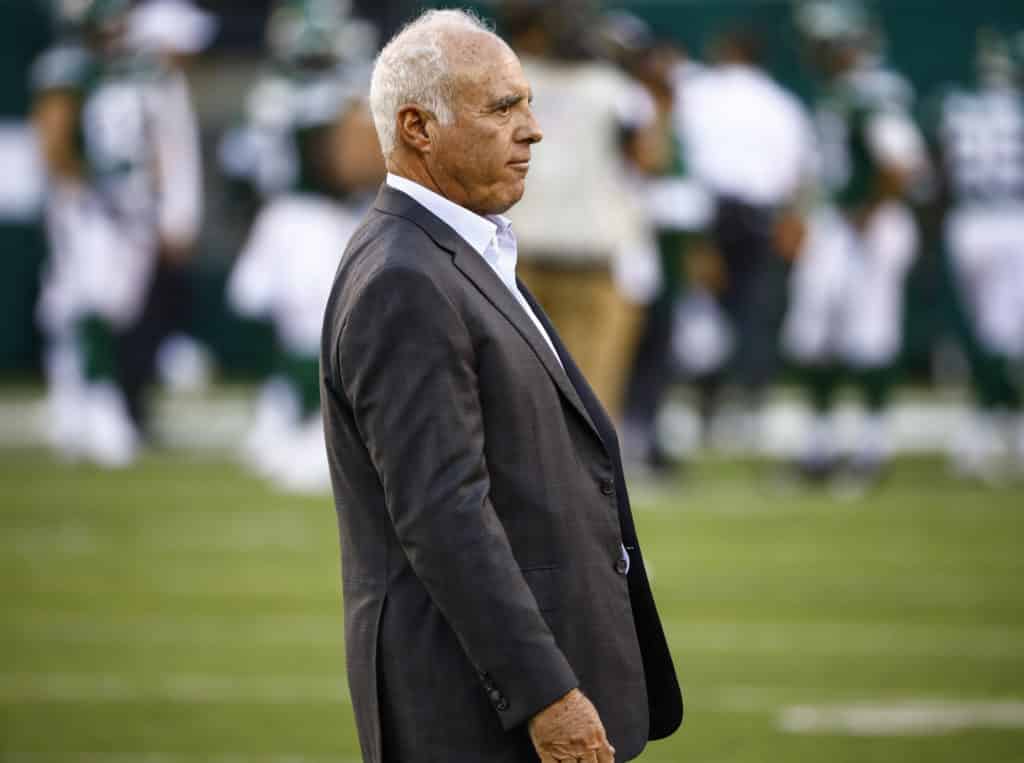
Amid continuing controversy over one of his player’s approving comments about Adolf Hitler, Philadelphia Eagles owner Jeffrey Lurie announced the completion of a documentary about the Nazi leader.

Lurie’s production company Play/Action announced Thursday that it had completed production of “The Meaning of Hitler,” the company’s first film, Dateline reported.

Taking its title from a 1978 book by the German journalist Raimund Pretzel, Lurie’s film traces Hitler’s rise to power and features interviews with historians Deborah Lipstadt and Yehuda Bauer, among others.

The announcement comes amid continuing fallout over comments by Eagles wide receiver DeSean Jackson, who caused an uproar over the weekend with tweets featuring quotes dubiously attributed to Hitler and claiming that “white Jews” will work to “blackmail” and “extort” America and that the Nazi leader “was right.”

In a statement Tuesday, the team said Jackson’s comments were “offensive, harmful, and absolutely appalling.”

“We are disappointed and we reiterated to DeSean the importance of not only apologizing, but also using his platform to take action to promote unity, equality, and respect,” the team said. “We are continuing to evaluate the circumstances and will take appropriate action.”

In a statement to Deadline, Lurie made no mention of the Jackson controversy.

“We couldn’t be prouder that ‘The Meaning of Hitler’ is the first completed film made by our new documentary production company, Play/Action Pictures,” said Lurie, who is Jewish. “I envisioned Play/Action to be a leading creative force for films that engage with the most crucial and challenging issues of our time. The rise of white supremacy and neo-fascism in the United States and the world over are among the most important and serious threats we face today.”

Owner of DeSean Jackson’s NFL Team Produces a Documentary About Hitler Read More »

The British Veterinarian Producing Anti-Viral Masks

The coronavirus threw veterinarian Jason Migdal a curveball. London-based Migdal, who has a master’s degree in medical microbiology and public health, decided to join a five-month program run by Israel Experience — an educational tourism provider for Masa Israel — that brings thousands of young Diaspora Jews to Israel every year. The program matches young professionals with paying jobs. 

Migdal began working for Sonovia, a company that develops antimicrobial textiles. “If it wasn’t for the pandemic, I probably would have gone back [to London] in April after the program,” Migdal said, “but by that time, we were already so involved in the technology that it didn’t bother me that I couldn’t get home.” The team behind Sonovia realized how crucial its invention was in the coronavirus landscape, and Migdal was promoted to microbiology research and development strategist, and the company began producing antiviral masks.  

According to Migdal, the SonoMasks, as they’re known, are able to fend off harmful microorganisms using zinc oxide, which has antiviral properties. The zinc oxide mechanically is infused into the textile using patented ultrasound technology and “constantly produces a positive charge, almost like an electrical field and reacts with the air to produce molecules that destroy the virus’ membrane,” Migdal said. “It’s a system that is continuously reproducing itself.” 

The masks are made in a textile factory in the northern Israeli town of Nahariya. With regard to design, Sonovia works with students from the Shenkar College of Engineering and Design. The masks have been tested in labs in China and Austria and were found to have retained antiviral properties against COVID-19 even after 65 industrial washes. 

When N-95 masks became a rare commodity in Israel, Sonovia donated around 3,500 of its masks to health care workers. It also donated to food banks, supermarket workers, Israel police and several nonprofits overseas. While taking care of front-line and essential workers was a top priority for the company, “At the same time, the general public needs a level of protection which is currently not being offered,” Migdal said, noting that standard masks run the risk of self-contamination. 

He also noted the environmental aspect of the Sonovia masks. “Disposable masks fill landfills and beaches and contribute to microplastic levels,” he said. “The SonoMask is an ecological solution.” 

Sonovia aims to roll out an industrial implementation with large garment manufacturers to produce clothes. For now, however, its main focus is battling the pandemic. The company hopes to leverage the sale of masks to reduce production costs and expand in order provide additional protective products including medical gowns and linen for hospitals. Among its investors is Europe’s leading textile machinery manufacturer, Brückner, which engineers the Sonovia machinery on commission. 

Migdal credits Sonovia’s success to a sense of community shared by the team members. “I’ve been to Shabbat meals at my boss’ house and me and my [colleagues] go to the beach on the weekends,” he said. “It’s really a unique atmosphere. I feel almost as if it was a calling to come to Israel and even if I do go back home for a time, I will always feel like I have a home now in Israel …. I think that’s the greatest thing.”

The British Veterinarian Producing Anti-Viral Masks Read More »

A Moment in Time: “We’re All in the Same Boat”

Dear all,
When the pandemic began, my sister arranged for my participation through Gotham Group to share my Children’s book, “We’re All in the Same Boat” (Putnam, 2008) on their newly formed youtube channel, “Gotham Reads.” The message of the story reflects the reality of today: it’s no fun to be quarantined for months on end, so we have an opportunity to make the best of our circumstance.
The pandemic is painful. The quarantine is nerve-wrecking. The economy is hurting. The lack of being able to hug people is sad, really sad. But it’s still important to take a moment in time each day to harness goodness, take note of miracles, and embrace our blessings.
With love and shalom,
Rabbi Zach Shapiro

A Moment in Time: “We’re All in the Same Boat” Read More »

Table for Five: Pinchas

One verse, five voices. Edited by Salvador Litvak, the Accidental Talmudist

“Take a census of the whole Israelite community from the age of twenty years up, by their ancestral houses, all Israelites able to bear arms.”
Numbers 26:1-2

Rivkah Slonim
Education director, Rohr Chabad Center, Binghamton University, New York

We count what is precious and beloved. We count to affirm and to confirm. And at the beginning of the Book of Numbers, God teaches that when Jews are counted (nine national censuses are recorded in the Hebrew Bible and the 10th will take place when the Mashiach comes), it is for the purpose of elevation, to be uplifted. A census underscores how important each individual is. At the same time, it highlights an essential equality. Each person — no matter how accomplished or unproductive, how learned or untutored — is counted exactly once in the national reckoning. 

Chassidus teaches that the counting highlights the essential core of each individual; it spotlights the transcendent aspect that surpasses external expression. It underscores the intrinsic, default, invaluable nature of each Jew that far surpasses individual accomplishment or lack thereof. 

The second census mentioned in the Book of Numbers comes after the Jews were stricken with a plague. Rashi teaches that God wanted the Jews counted to see who had survived. Alternatively, since God had entrusted the Jews to Moshe when they left Egypt, God now asked for a reckoning as Moshe nears the time of his leave-taking from this world and from his flock. Moshe, their faithful shepherd, who had seen them through thick and thin — who had taken so much abuse from them, all with near perfect equanimity —  was perfectly suited for counting them. He could lift them up, yet again, and reveal their true essence upon which he had been focused all along.

Rabbi Chaim Tureff
Pressman Academy, director of STARS Addiction Recovery

Do we ever really enjoy looking back and assessing a situation that went awry? And especially when you are partially or wholly responsible for the mess? Step 4 of Alcoholics Anonymous asks us to take a searching and fearless moral inventory of ourselves. As anyone who has worked the steps knows, there is a great way to work Step 4, affectionately called a Resentment Chart. First you write down your resentment, then write down what was the cause, how it made you feel and then your part in it. These verses have all the makings of a searching and fearless moral inventory. 

Rashi asked incredulously why there was a count at this time. He gives two reasons. According to one, after the Jews sinned with the Midianites in the previous chapter and subsequently died, there was a counting. Rashi uses the analogy of a shepherd counting their flock after an attack by an animal. According to the previous Lubavitcher Rebbe, aside from the 24,000 Jews who died in the plague, which was administered by God, Moshe felt personally responsible for the additional 166,000 deaths at the hands of the judges, since all rulings went through Moshe. 

This regret and sense of responsibility would embolden Moshe to be a better leader in the future. Just as someone in recovery needs to look within as they move forward on their journey through sobriety, so Moshe needed to assess and look within as he continued his journey as the leader of the Jewish people. 

David Sacks
Torah podcaster at Torah on iTunes  

A man borrowed money from his neighbor and didn’t repay the loan. The lender saw the Vorker Rebbe visiting the borrower’s house, and thought, “I’ll ask for the money while the Rebbe is there. He won’t have the chutzpah to deny that he owes me in front of the Rebbe.” The Rebbe asked, “Did you take out the loan?” The man said, “Yes, Rebbe but I don’t have the money to repay.” The Rebbe asked, “Do you have any money?” The man said, “I have a few coins, but not nearly the whole sum.” The Rebbe said, “Bring what you have.”

The Rebbe laid the four coins on the table and started to count. “One, two, three, four,” but then, instead of stopping, the Rebbe continued counting the same coins, “five, six, seven, eight,” and then counted them again, “nine, ten, eleven, twelve …” counting and recounting them until he arrived at the amount of the money owed.

The Rebbe put the coins into the lender’s hand and asked, “Do you accept this as full payment for the loan?” And he said, “Yes, Rebbe, I do.” The Rebbe blessed him, and the lender became very wealthy.

So, it is with us.

HaShem never stops counting us as a people. Rashi explains this is because we’re so precious to Him. But it’s even deeper than that. HaShem also never stops counting and recounting every mitzvah we do. Even the ones you’ve forgotten about, HaShem hasn’t forgotten.

Why?

Because HaShem loves us so much.

Lori Shapiro
Rabbi, Open Temple

Parashat Pinchas portrays a parallel universe to 2020: call-out culture for sexual misconduct (#MeToo); a mass interest from Israelite men in BIPOC, most specifically, their daughters (#JewsforBIPOC); a plague sent “by God,” taking the lives of many of these men (#COVID19Pandemic); and the awareness that we need to prepare the next generation as it rises to the call to restore and even redefine justice (#BLMProtests). 

Just as Parashat Pinchas establishes the rights of all people — including women in inheritance — and sets the course of time observances, our country might benefit from heeding its call, and consider our next steps as we restore our holy container. America, like a desecrated holy of holies, must establish a new era of social reconstruction. Numbers 26:1-2 suggests one answer: mandatory service for all people. At a time when the nature of university life faces existential re-examination, unemployment is high, and a display of inspiring images of young people taking to the streets in a civil rights movement for the new millennium, what better time to revisit the National Youth Administration of the 1930s under the Works Progress Administration, and comprise a plan for mandatory public service for young Americans? Through economic distress and uncertainty, perhaps the time has come for all of us to consider how every one of us, from all ancestral homes, must unite and take up arms as spiritual warriors for a renewed America built upon the holy hosts of all of its people, with liberty and justice for all. 

Nina Litvak
Writer, Accidental Talmudist 

The Book of Numbers begins and ends with a census. The two censuses are similar — both count male Israelites over age 20 who are able to bear arms — but the aftermaths are vastly different. After the first census, the Children of Israel misbehave and blow their chance to enter the Promised Land. After the second census, a new generation is able to conquer the land and start the difficult work of nation-building. 

A closer look at the censuses provides a clue to why the first generation failed. The first census is a dry list of numbers laid out in a formal manner. The Israelites are presented as statistics rather than multidimensional human beings. The second census feels more personal, mentioning individual names and sometimes pausing to provide more information about specific characters. Paradoxically, when the Israelites are regarded as individuals, they become more effective as a group. 

According to Rabbi Avigdor Miller, God made the Jewish people the most diverse of nations because He places a high value on individuality. He loves us for being different from one another. A group of Jews is not a faceless crowd but a community of distinct individuals. Ahavas Yisrael is the commandment to love our fellow Jew — not just for being Jewish, but for being one of a kind. Miller emphasizes our responsibility to look for what’s special in every Jew. Only when we see our fellow as a unique creation of God can we be a strong and healthy nation.


Table for Five: Pinchas Read More »