fbpx

July 10, 2020

‘Free Palestine’ Spray-Painted on University of Wisconsin Hillel

The outside of the Hillel building at the University of Wisconsin in Madison was vandalized on Tuesday, according to the organization.

The words “Free Palestine” appeared on the concrete structure that welcomes people to the building, also known as the Barbara Hochberg Center for Jewish Student Life.

“We view this act of vandalism as targeting the Jewish community and as an incident of bias,” said UW Hillel president and CEO Greg Steinberger in a Facebook post on Tuesday on the UW Hillel Foundation page.

Steinberger said Hillel has contacted the Madison Metropolitan Police Department and the University of Wisconsin Police Department, in addition to notifying UW Hillel’s student leaders and board of directors.

“Our campus community is resilient and strong, and we will clean up the graffiti, work with the community on the investigation and move forward leading with our commitment to empowering students to build vibrant community based on values of love, respect, justice and peace,” said Steinberger.

Out of 44,411 students at the university, 5,200 of them are Jewish or around 12 percent, according to Hillel International.

‘Free Palestine’ Spray-Painted on University of Wisconsin Hillel Read More »

DeSean Jackson to Meet With Julian Edelman and Holocaust Survivor

Julian Edelman, the Jewish wide receiver for the New England Patriots, has spoken with fellow NFLer DeSean Jackson following anti-Semitic social media posts by the Philadelphia Eagles player.

“DeSean and I spoke for awhile last night,” Edelman tweeted Friday. “We’re making plans to use our experiences to educate one another and grow together. Stay tuned.”

Meanwhile, according to reports, Jackson met with an anti-Semitism educational group on Thursday and was set to meet with 94-year-old Holocaust survivor on Friday.

Jackson had posted quotes attributed to Adolf Hitler on Instagram, including one accusing “white Jews” of having a “plan for world domination.” He also posted admiringly about the Nation of Islam leader Louis Farrakhan, who has compared Jews to termites and otherwise disparaged Jews. The Eagles wide receiver later removed and apologized for the posts.

On Thursday, Edelman had invited Jackson to tour the U.S. Holocaust Memorial and Museum with him and in turn tour the National Museum of African American History and Culture, both in Washington, D.C.

“I know he said some ugly things, but I do see an opportunity to have a conversation,” Edelman said in an Instagram video. “I am proud of my Jewish heritage. But for me it’s not just about religion. It’s about community and culture as well.”

DeSean Jackson to Meet With Julian Edelman and Holocaust Survivor Read More »

‘Spanish Schindler,’ Who Reportedly Saved Over 5,000 Jews During WWII, Finally Gets Tribute

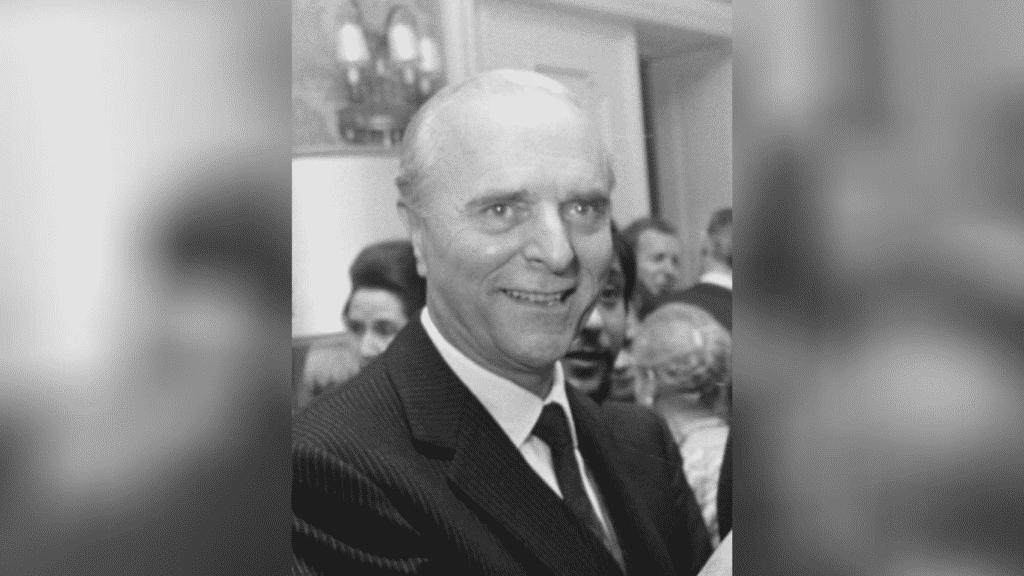
BUENOS AIRES, Argentina (JTA) — Angel Sanz Briz, a Spanish diplomat who reportedly saved over 5,000 Jews from Nazi persecution in Hungary, was given an online tribute 40 years after his death.

Sanz Briz was appointed to a diplomatic post in Hungary in 1944. As the Holocaust worsened there, he offered to protect Jews of Spanish origin and bring them Spanish passports. He received the consent of the Hungarian authorities to enable 200 Spanish Jews to receive them, but he turned that into 200 families, and kept increasing the number, according to Yad Vashem, the Israeli Holocaust museum that recognized him as Righteous Among the Nations in 1966.

It is believed that in the last seven months of 1944, Briz issued forged Spanish documents to 5,200 Jews.

Thursday’s tribute, which was hosted by the chief Sephardic rabbi of Buenos Aires, Isaac Sacca, was organized by Menora, an Argentine Sephardic institution, with the support of the Center Sefarad Israel in Spain, the Argentine Jewish political umbrella group DAIA and the Federation of Jewish Communities in Spain, or FCJE.

Among those on hand were Sanz Briz’s daughter Angela; a Holocaust survivor, Eva Bohrer; and Spain’s ambassador to Argentina, Javier Sandomingo.

“My father thought that what he had done in Budapest was the most important and rewarding thing in his life,” Angela Sanz Briz said after the event. “He also considered that he had simply done his duty, that he could not look the other way. And he used all the means at his disposal to do so.”

“He never expected recognition or thought he had to have it.”

Sanz Briz died in 1980 at 69 years old.

‘Spanish Schindler,’ Who Reportedly Saved Over 5,000 Jews During WWII, Finally Gets Tribute Read More »

New York City’s Flagship JCC Cuts 35% of Jobs as Pandemic Layoffs Continue

(JTA) – Just days after the expiration of a federal program meant to preserve jobs during the pandemic, one of the largest JCCs in the country has laid off or furloughed 35% of its employees.

The Marlene Meyerson Jewish Community Center of Manhattan laid off 32 people and furloughed 40 last week as it faces decreased revenue as a result of the pandemic. The JCC, which operated on a budget of $34 million before the coronavirus hit, expects to cut that in half moving forward.

Among the positions eliminated were most of the marketing department, managers of the studio arts and culinary programs, the senior athletics director and a birthday party coordinator.

Other positions dealing with the JCC’s extensive Jewish learning offerings also were eliminated.

“The Center for Jewish Living … has a skeletal staff and budget at this point, as the JCC regroups and forges its way ahead,” Rabbi Abby Treu said this week in an email to people in a mikvah training program that the center had run. Treu said that she also lost her job.

The Manhattan JCC had 192 employees before the pandemic. In addition to the 32 people laid off and 40 furloughed employees, those who remain at their jobs and earning more than approximately $52,000 are taking pay cuts of 5, 7 or 10%.

A bingo game at the Kaiserman JCC outside Philadelphia in 2015. This week, nearly all of its employees were laid off due to the coronavirus. (Screenshot from YouTube)

Most of the furloughed positions are on the health and wellness staff. Rabbi Joy Levitt, the center’s executive director, said the plan is to bring back those employees soon as the building, which includes an extensive fitness facility, is able to reopen fully.

“We’re looking for everything that is possible for us to do,” she said, noting that the center plans to open its nursery school in person in September in line with guidance from the city’s Health Department. But she said the organization had no choice but to mitigate costs related to upkeep of the JCC’s 14-story Upper West Side building, which has been closed since March.

The layoffs came just days after the end of the federal Paycheck Protection Program, which offered loans to cover payroll at small businesses during the pandemic-induced financial crisis. The Manhattan JCC received between $2 million and 5 million through the program, according to data from the Small Business Administration. (Levitt declined to share a more specific number.)

The layoffs at the Manhattan JCC are likely at the front edge of a rising wave because of the federal loan program’s rules. Employers who maintained their March staffing levels through June 30 would be eligible to have their loans forgiven. With the passing of that date, there is little financial incentive to retain employees whose work has ended because of the pandemic.

The Valley Jewish Community Center boys 16-and-under soccer team won the gold medal at the 2017 JCC Maccabi Games. Photo courtesy of Lori Larcara

That includes many employees of JCCs across the country, which mostly operate on a fee-for-service model. Some members of the Manhattan JCC have donated the amount that they would normally pay in membership fees, and 1,700 donors gave to an emergency fund, Levitt said. But the JCC, which operated with an annual budget of $34 million before March, plans to slash that budget in half due to the pandemic.

Even once the building can reopen, Levitt said she doesn’t anticipate all offerings resuming immediately. Many arts programs primarily served older adults who may not feel comfortable coming back until there is a COVID-19 vaccine, she said.

“The reason that we had to lay these folks off is not because they are not mission consistent — they are vital to the core mission of the JCC,” Levitt said. “We can’t wait to get back to in person.”

New York City’s Flagship JCC Cuts 35% of Jobs as Pandemic Layoffs Continue Read More »

At Virtual Retreat, Jewish Men Embrace Vulnerability and Reckon With Patriarchy

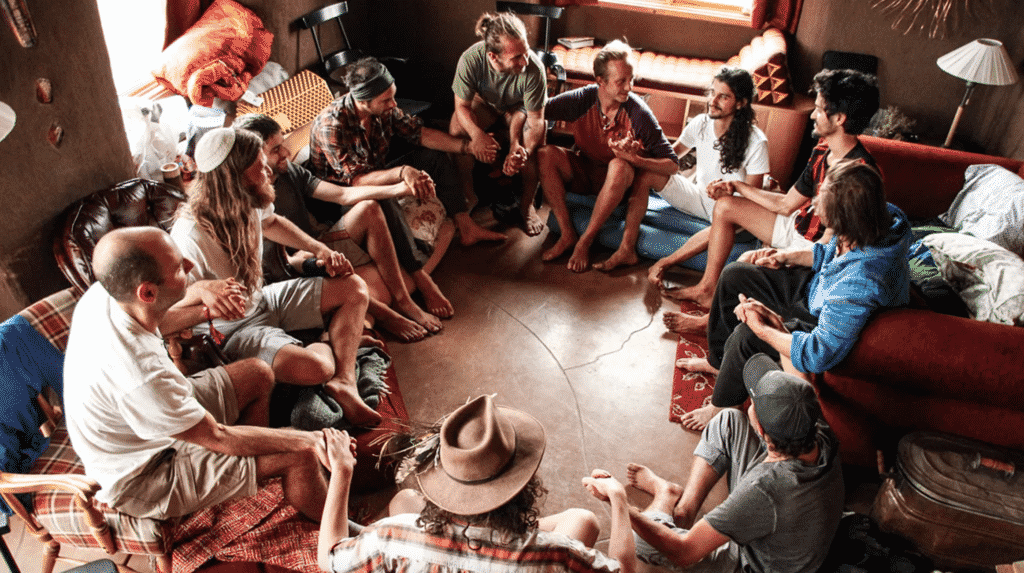
(J. The Jewish News of Northern California via JTA) — The young men sit alone in their bedrooms, living rooms and backyards. One is shirtless, eyes closed in meditation. Another burns white sage, explaining its power to make your soul feel “clear.” A third takes a sip of coffee and adjusts his headphones.

Together, the 25 participants do some breathing exercises, turning their attention to the second chakra — the area of the body that includes the sexual organs.

“Allow yourself to feel whatever you need to,” the facilitator says.

After several moments of silence, the facilitator speaks again: “I’m going to begin with this loaded word. We may have heard it a lot. Maybe we are confused about what it means. That word is patriarchy.”

On a Sunday morning in May, these Jewish men — many of them sporting quarantine beards — have congregated from across the country via Zoom for a virtual men’s retreat sponsored by Moishe House and supported by MenschUp, a relatively new initiative from Shalom Bayit, a nonprofit that works to prevent domestic violence and assist victims.

Born of the #MeToo era, MenschUp aims to bring Jewish men together in an effort to demonstrate authenticity, responsibility and respect, with an eye to promoting safety in Jewish spaces.

For three days, participants in the “Embodied Brotherhood” retreat have been engaging in conversations and activities focused on fostering healthier relationships with others, themselves and nature.

On this, the final day, facilitator Ophir Haberer is asking the men — straight or gay, singled or partnered up — to reflect on how they have been conditioned by patriarchal systems to think and behave, and to account for the ways they actively or passively perpetuate those systems.

One expresses unease about the way he, as a man, is fully accepted and honored in synagogue settings in ways that women sometimes are not. Another tells a story about the “cognitive dissonance” he experienced while pledging a Jewish fraternity in college and learning to sing a song glorifying date rape.

“That resonates,” a participant writes in the online chat box, and others chime in with words of recognition and support.

“It’s so deeply healing for this society for us to just take a moment to notice these things,” Haberer says, “so thank you for taking that time to notice.” He then directs the participants to bounce their shoulders up and down and wave their arms, a symbolic shaking off of shame and trauma.

He then directs the participants to bounce their shoulders up and down and wave their arms, a symbolic shaking off of shame and trauma.

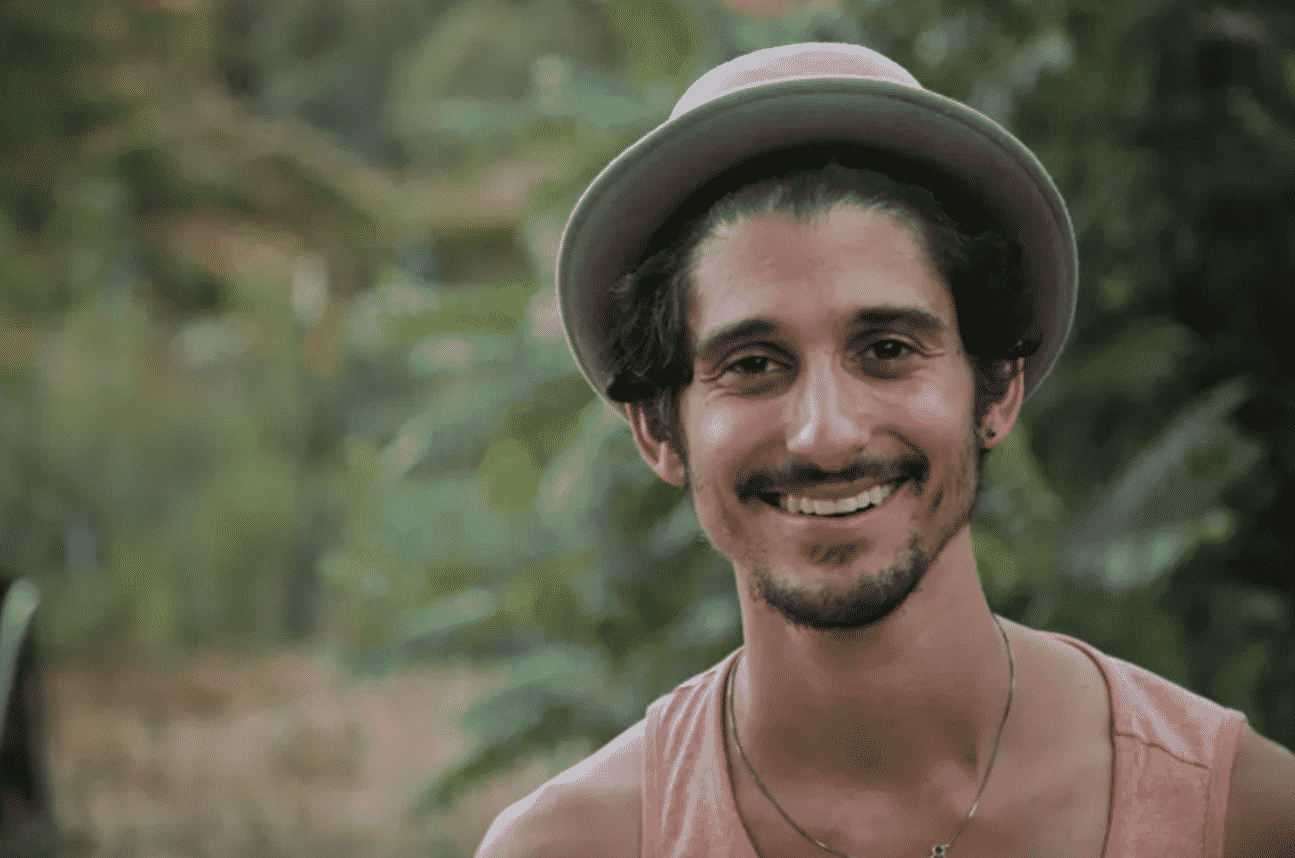
“My approach is learning with, not teaching to,” Haberer, 29, said in a post-retreat interview.

Born on a kibbutz outside of Jerusalem to Israeli parents with Moroccan and South African heritage, Haberer grew up in St. Louis in an enclave of Israeli immigrants. In high school he was taken by the work of Henry David Thoreau and other transcendentalist writers, and at Tulane University he studied sustainable development (a hybrid of economic development and environmental studies).

At Tulane, he brought a farmers market to campus, worked with the university on a composting system, and started an urban farming project in New Orleans to address a lack of access to affordable and nutritious food.

“I grew up with such a negative stereotype around farming and its connection to poverty,” he says. “There were a lot of different narratives at play, especially for immigrants to America like my family. But the second I got my hands in the soil, it felt really liberating.”

After teaching English in Vietnam on a Fulbright scholarship and traveling through Thailand and Cambodia, Haberer moved to California in 2015 and reimmersed himself in earth-based education. For example, he did a seed apprenticeship with an Indigenous woman from the Mohawk people and became involved with Wilderness Torah, the Berkeley-based nonprofit that runs outdoor Jewish experiences.

Inspired by candid conversations among Wilderness Torah staff and participants about power and gender dynamics in Jewish spaces, Haberer and his twin brother, Dor, decided to create their own retreat for men to “start unpacking the way patriarchy lives in their bodies,” Haberer said. In 2018, he and Dor, a shiatsu practitioner who is studying “ecosocial design,” assembled a group of men in rural Colorado. (Haberer believes that being twins gives both unique insight into “what male intimacy and accountability could look like.”)

The brothers have led five men’s retreats to date, all of which were sponsored by Moishe House. Haberer also has participated in several retreats for his own edification and growth, including one in the Mendocino National Forest organized by the author Michael Meade. Last year he joined the Shalom Bayit team as the lead facilitator for MenschUp, which was started in 2019 and has formulated workshops and curriculum. Information and details on how to get involved are available here.

The name is a play on the phrase “man up,” which is used to shame boys for showing emotion, according to Suzanne Amor, Shalom Bayit’s community outreach program manager.

One in four women in the United States will experience domestic violence in their lifetimes, Amor said, and there’s no reason to believe that the situation is any better in the Jewish community.

One in four women in the United States will experience domestic violence in their lifetimes, Amor said, and there’s no reason to believe that the situation is any better in the Jewish community.

“There’s no way to end domestic violence unless we’re engaging men in the solution,” Amor said. “Ophir helped me to understand that that starts with men first having a safe place to talk with each other about how patriarchy has affected them.”

Amor said that at the pilot MenschUp retreat, held in person last summer, Haberer asked participants to raise their hands if, when seeking emotional support, they turn to female confidants before turning to men. Everyone did.

MenschUp programs — online workshops, as well as more intimate conversations for smaller groups, or “MenschUp minyans,” led by Haberer — are designed to help men feel more comfortable being vulnerable with each other. The hope, Amor said, is that they will then become better allies to the women in their lives, as well as advocates for gender equity.

While “men’s work” has grown in popularity in recent years along with other wellness trends, Amor believes it is especially important during this extended period of social isolation due to the pandemic.

“This is obviously a time where everybody is experiencing a lot of pain and grief and sadness as we lose control of our lives,” Amor said. “MenschUp can provide a space for men to talk about their emotions and be supportive.”

Benny Amon said he felt “less alone” after participating in the virtual retreat. A 31-year-old musician who was raised in Davis and Fairfield, California, Amon said men tend to be “very isolated in their own emotions, and it leads us to not live as full, healthy lives as we can.”

He decided to join the retreat from his home in New Orleans after spending a few years trying, on his own, to bring “more vulnerability, freedom and possibility” to his relationships with other men. Amon said it’s important for men to talk to other men about uncomfortable issues.

“The truth is, we’re all shaped by patriarchy and gender roles and different forms of homophobia and transphobia and classism and racism,” he said, adding, “We have work to do as Jewish men with respect to how we show up in the world.”

David Waksberg, the recently retired CEO of the San Francisco-based Jewish LearningWorks, recorded a video for Shalom Bayit’s “MenschUp May” social media campaign in which he talked about his experiences years ago counseling men who committed violence against women. Many of them learned that “to be a man” required them to suppress “whole ranges of emotions,” including grief, tenderness and openness.

“There’s a way in which men enjoy the privilege that comes with the patriarchy, but it’s a trade-off and we end up learning how to shut off part of our humanity in the bargain,” Waksberg, a member of MenschUp’s advisory committee, said in an interview. “I think that’s a bad bargain for everyone.”

Waksberg said he is a fan of the MenschUp approach and believes that many Jewish men, including his peers, are attuned to changing social dynamics and would participate in a workshop.

“Ultimately the job of Judaism, the job of any religion, is to help us understand what it means to be human and how to be good at being human, and I see MenschUp in harmony with that agenda.”

“Ultimately the job of Judaism, the job of any religion, is to help us understand what it means to be human and how to be good at being human, and I see MenschUp in harmony with that agenda,” he said.

For the past year and a half, Haberer has lived at Canticle Farm, an interfaith intentional community in Oakland. During quarantine he has spent a lot of time gardening, homesteading and hiking the nearby trails. He also participates in a weekly men’s group with other Canticle residents.

“Overall there’s a lot of beauty for me in things slowing down and tending to the place that I live, and being in relationship with the people I live with,” he said. “When we’re all busy, and there’s so much outward focus, then it’s so easy to miss each other.”

The pandemic has forced Haberer to take his healing work online for the time being, which he said is not ideal for building intimacy. On the bright side, he has been able to reach a wider audience — men from Los Angeles, Oregon, New Orleans and New York were among those who joined the May retreat — without having to worry about the logistics of an in-person retreat.

Moving forward, Haberer said he is eager to work with groups of older men.

“It is really important for them to have a younger facilitator who’s really tuning in to ‘where are we at right now’ [and] ‘what are the asks of this generation,’” he said.

For now he will be leading two more Moishe House retreats this summer. He is also incubating his own organization that will offer a variety of men’s programming outside of the retreat format.

“My work is not about making men feel shame for their role in patriarchy,” he said. “It’s about helping them heal the impact of patriarchy in themselves and support each other so they don’t further perpetuate it. No one can do that alone.”

At Virtual Retreat, Jewish Men Embrace Vulnerability and Reckon With Patriarchy Read More »

tel aviv

Israel Outlaws Solicitation of Prostitution

Over the objections of some government agencies and social welfare groups, a new Israeli law has gone into effect that makes it illegal to seek the services of a prostitute.

Under the terms of the law that went info effect Friday, first-time offenders will be fined about $530, The Times of Israel reported. If the offender repeats the crime again within two years, the amount of the fine would double.

LGBTQ and women’s rights groups had sought to delay the law’s implementation, as had the Community Empowerment and Advancement Minister Orly Levy-Abekasis and the Public Security Ministry.

“Women and men who enter the cycle of prostitution to earn a living cannot escape if the authorities don’t extend a hand,” said Hila Peer, chairperson of Aguda-The Association for LGBTQ Equality in Israel, one of several groups that petitioned the Israeli Supreme Court to delay the implementation.

But Justice Minister Avi Nissenkorn declined to postpone.

“Women are not property and their bodies are not for rent at any price,” Nissenkorn tweeted Friday.

A 2016 government study estimated that Israel has about 12,000 sex workers and the industry is worth about $318 million annually. In 2005, Israel was added to a U.S. State Department human trafficking watch list, but matters had improved enough by 2012 that the country was removed.

Israel Outlaws Solicitation of Prostitution Read More »

Sen. Susan Collins Is Facing a Major Challenge in Maine. Jewish Voters May Be One Reason Why.

This week, we’re taking a look at an important Senate race in Maine, where 23-year Republican incumbent Susan Collins is facing a serious challenge from Democrat Sara Gideon.

Gideon, who is favored to win the Democratic primary on Tuesday, is drawing support from Maine’s 10,000-15,000 Jews and from national political Jewish organizations — and not just because she is married to a Jewish lawyer.

In a new story, I outline four big reasons why Collins has lost her luster for centrist Jews and why Gideon is getting their support. They range from Collins’ support for President Donald Trump’s Supreme Court picks to Gideon’s uncontroversial views on Israel to the fact that any seat vulnerable to being flipped is getting a full-court press this year.

“She had really good votes, we met with her, we had a good relationship with her, she was pro-choice, but after she chose to support those two Supreme Court nominees, to us it was clear that she was no longer in our corner and that she was no longer pro-choice,” a representative of a Midwestern Jewish political action committee told me about Collins.

The progressive J Street PAC is working to spend $300,000 to support Gideon as part of a massive push to elect Democratic senators.

“Without winning those [seats] you’ve really got a hard path to transforming the Senate — which is one of our top electoral priorities besides defeating Donald Trump by electing Joe Biden — transforming the Senate to make sure that we have a pro-Israel, pro-peace majority,” Ilya Braverman, J Street’s national political director, told me.

No one I spoke to could say whether Gideon is involved in Maine’s small Jewish community. But one Jewish colleague from the Maine House told me her outlook reflects that advanced by progressive Jewish activists: “She brings forward liberal progressive ideas and repairing-the-world ideas.”

Read my whole rundown on Maine’s Senate race here.

Sen. Susan Collins Is Facing a Major Challenge in Maine. Jewish Voters May Be One Reason Why. Read More »

Roy Moore’s Lawsuit Against Sacha Baron Cohen Over Being Pranked Can Proceed, Judge Rules

The lawsuit filed by Roy Moore, a former Alabama chief justice, against Sacha Baron Cohen stemming from his appearance on the comedian’s show is going ahead.

The decision by a District Court judge in New York to deny a motion to dismiss the 2018 federal suit was announced Monday, The Hill reported. Showtime and CBS are also named.

The suit alleges defamation and emotional distress, and asks for $95 million in punitive and compensatory damages.

On the third episode of “Who is America?,” Cohen in his guise as Israeli terrorism expert Erran Morad delved into allegations that Moore sexually harassed and assaulted multiple women decades ago, including minors. The allegations came to topple Moore’s Senate campaign in a special election in 2017. Moore has denied the allegations.

Cohen as Morad demonstrates what he calls a pedophile-detecting device that beeps when it comes near Moore. He also gives Moore a prize for his support of Israel.

By the time the episode aired, it was widely known that Cohen was punking public figures.

Roy Moore’s Lawsuit Against Sacha Baron Cohen Over Being Pranked Can Proceed, Judge Rules Read More »

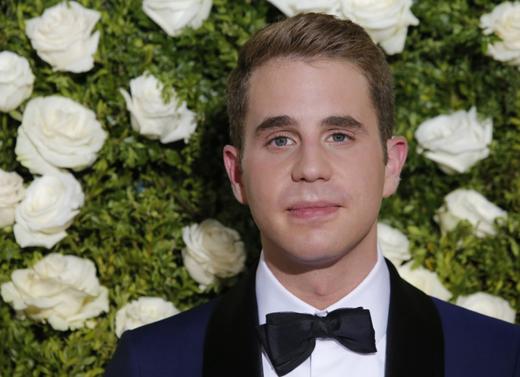
Ben Platt Came Out as Gay During His 8th Grade Israel Trip

In a recently released Netflix film, Broadway star Ben Platt shared his coming out story — and it involves a trip to Israel.

He shared the vignette from “Ben Platt: Live from Radio City Music Hall,” which debuted in May, in a clip on his Twitter account on Monday.

https://twitter.com/BenSPLATT/status/1280248409140555776

As Platt explains, he realized he was gay when he was 12, but hadn’t felt it necessary to tell anyone.

I was in eighth grade on a trip to Israel, like you do in the eighth grade. When you’re a Jew. A kid in my class who was on the trip made a comment something like, “Oh, Ben, is so lucky. Because he’s gay he gets to hang out with all the girls and be in their hotel room because they don’t care.”

It was no derogatory thing at all.  It wasn’t a bullying thing. It was just true. All my friends were girls and they would let me hang out with them. But the chaperone overheard this.

The chaperone assumed Platt was being bullied and planned to call his parents. He didn’t want them to find out that way, so he went back to his Tel Aviv hotel and dialed home.

His mother, Julie, answered and he told her he needed to tell her something important. Before Ben could finish his sentence, mom blurted out: “Is this about your sexuality?”

She added: “You spent most of your childhood dressed as Dorothy from The Wizard of Oz. No one is surprised.”

Platt ends by wishing the same “nothing experience” for other young people struggling to come out.

Platt, who has starred in Broadway shows such as “Dear Evan Hansen” and transitioned to TV in Netflix’s “The Politician,” released his debut album of original music last year.

Ben Platt Came Out as Gay During His 8th Grade Israel Trip Read More »

Bethany Mandel Will Not Be Canceled

Bethany Mandel wasn’t unnerved back in May when people all over the world were decrying her as a “Grandma killer.”

After all, the mother of four and rising star in the world of conservative thinkers had invited the moniker when she posted a cri de coeur on Twitter against what she saw as indiscriminate application of quarantine restrictions.

“You can call me a Grandma killer,” Mandel wrote. “I’m not sacrificing my home, food on the table, all of our docs and dentists, every form of pleasure (museums, zoos, restaurants), all my kids’ teachers in order to make other people comfortable.”

Mandel’s six-tweet thread instantly turned into a battlefield in the culture wars, offering a salient indicator of the deep divide over how to handle the coronavirus that is crippling any efforts in the United States to bring the pandemic under control.

On the one side, fellow conservatives praised her bravery in the face of a new orthodoxy about the importance of “flattening the curve.”

On the other Noah Berlatsky, a culture critic for the Independent, a British newspaper, made her the poster child for what he said was a plague of “vice signaling” best exemplified by President Donald Trump’s embrace of dangerous behaviors as somehow patriotic.

A tweet by Warren Leight, a showrunner for the “Law and Order” franchises, was typical: “Can I also call you Nurse Killer, Friend Killer, Mentor Killer, EMT Killer, Jazz Musician Killer, Doctor Killer, NYPD Killer, Transit Worker Killer, Meat Plant Worker Killer, Immuno-compromised Person Killer?”

Mandel says she thinks her critics missed the point she was trying to make about government overreach.

“It’s not like, ‘Please call me Grandma killer because I want to kill Grandma,’” the Jewish writer, homeschooler and social media influencer said in a recent interview. “It’s like, ‘You can say those things but I don’t care because this is the situation.’ I thought that was pretty clear.”

But she also seemed to revel in the attention. “Grandma killer” is now in her Twitter bio.

Indeed, it is on Twitter — where she has nearly 80,000 followers — that Mandel does most of her battles. She relishes the fight and at the same time despairs of it, a contradiction that in a 90-minute chat earlier this summer she never quite resolves.

Mandel decried the current polarized political moment.

“Everything now has become politicized, every single thing, and it sucks,” she said.

But she said she finds it hard not to engage in the battle.

“I’m an only child, and I hate being told what to do. And that is so much of what drives my combativeness,” Mandel said.

Her fierceness is not just a function of being an only child. Mandel’s mother had suffered from lupus since before Mandel’s birth, and her father left home when she was a small child. Her mother raised her in upstate New York in relative poverty, including a period in a trailer park. Her mother died when she was 16 and she sought out her father to reconcile with him; he killed himself when she was 18. She had been born Bethany Horowitz, but as a young adult she changed her last name to her mother’s, Murphy.

“She’s a survivor, she’s strong, she’s determined,” said Sal, who for a time was her stepfather. (He asked that his last name be kept private.) “She’s not going to let life get the best of her or anyone else get the best of her. That’s who she’s become.”

Her mother was Roman Catholic and her father was Jewish. Given a choice of religions when her parents split up, she embraced Judaism, saying that the Jesus statues creeped her out and that she found resurrection to be implausible. Plus, her mother told her Jews were the people of the book, and she loved books.

Mandel attended Rutgers University in part because of the reputation of its Hillel. It was through friends she made at Hillel that she met her husband, Seth Mandel, and converted to Orthodox Judaism.

She learned years later that the Washington, D.C., rabbi who supervised her conversion, Barry Freundel, had set up an elaborate peeping system in the synagogue’s mikvah. She had been filmed while preparing for the ritual bath that would mark her conversion.

After the revelations about Freundel, Mandel began seeing tolerance for abuse everywhere in the Orthodox community.

“We stepped back,” she said. “We stepped back from the organized Orthodox community. We’ve never really stepped back in. We don’t go to shul. We have our like nice little like Orthodox life here, but we don’t — we don’t send our kids to school, we don’t go to shul. There’s definitely a conscious disconnect for us.”

The Mandels moved up through the ecosystem of conservative thought, working together at Commentary. Seth Mandel moved on to editing the New York Post’s op-ed page and is now the editor of the Washington Examiner’s weekend magazine. Bethany Mandel contributes opinions to Jewish publications (including occasionally to the Jewish Telegraphic Agency) and to a number of conservative outlets. She is an editor, writer and podcaster at Ricochet, a site that calls itself a place for “conservative conversation.”

Her boss there, CEO Scott Immergut, said he valued her ability to break from tribalism, praising Trump when she thinks he merits it and damning him when he does not.

“She’s Trump-agnostic. You know, she praises him for the things that she likes and she attacks and she criticizes him for the things that she doesn’t, which is the way it should be,” Immergut said. “There’s a certain portion of the Republican Party who says he is the president and he can do no wrong. I think that’s a little bit creepy, no matter who the president is.”

In our interview, Mandel cites as an example of her Trump bifurcation his North Korea policies.

“I’m passionate about North Korea human rights,” she said. “He had a great State of the Union two years ago and he brought defectors and that was incredible. … That was amazing Trump, and then like two weeks, three weeks later, he’s like talking about his buddy, Kim Jong Un.”

She fundraises for refugees from North Korea and is helping to modify for Jewish consumption a homeschooling curriculum originally tailored for Christians. (She is homeschooling her four children.)

Her experiences drive her pen to paper; she often uses them to close a wound, whether it’s suicide or clergy abuse or the loss of a parent. Her longform writing is elegant and expansive. Absent is the pugnaciousness she brings to her social media, and in its place is unhurried research culminating in a measured recommendation.

Her voraciousness for research dates to her childhood, said Sal, with whom she remains close even after he divorced her mother. When she was about 10 years old, he recalled, “She wanted to understand where waste went. Waste management. Human waste. So instead of asking about it, she went to the library and took out a book on sewage treatment. What child does that?”

It was another childhood memory that prompted Mandel’s previous foray into viral notoriety. She recalled befriending a girl on her school bus who was volleying anti-Semitic epithets, and then revealed that she was Jewish.

That anecdote was her lead-in to a 2017 Forward article about three people, an African-American and two Jews, who reached out to people in hate groups instead of isolating them and succeeded in turning them away from hate. It was titled “We need to start befriending neo-Nazis” and the headline has haunted her since, repeatedly surfacing on the left as an extreme example of bothsidesism.

Yet her prescription of interventions to draw away young people susceptible to the far right is a liberal orthodoxy. The Obama administration subsidized intervention programs targeting nascent white supremacists, and the Trump administration drew liberal fire for ending them.

Mandel acknowledges that the headline was clickbait, but again she could not resist the fray.

“So I wrote that neo-Nazis piece and I got it and I’m still paying for it all the time,” she said. “So I made my Twitter banner the headline for like six months.”

She followed that article with one titled “How the Angry Left turned me into a Nazi.” Her husband and her editor at the Forward advised her against the second headline.

“They’re like, ‘You’re just hitting the bee’s nest’ and like, yes, right. Yes, that is exactly what I’m doing,” Mandel said.

What inclines Mandel to engage with the abuse that has driven so many others from Twitter? Another friend, the journalist Salena Zito, says it’s important to understand that Mandel’s maternal instincts extend to the ideas she embraces and the political company she keeps.

“She’s very much a mom, and very protective,” said Zito, who, like Seth Mandel, has written for the New York Post and the Examiner. “And that quality of hers is sort of transferable into how she protects things on social media that she thinks is important.”

The story of how Zito and Mandel became friends is illustrative: Mandel’s embrace of Zito preceded the friendship. Mandel came to Zito’s defense in 2018, when Zito was accused of manufacturing quotes in her political coverage of Trump country. An outraged Mandel volunteered herself and her husband to go through Zito’s recordings to demonstrate that the quotes were real, a multi-day enterprise.

“She was my Joan of Arc,” Zito said. “She barely knew me, and you know the combative nature that you talked about, she came with her sword and protected me and the work that I do in a very noble and vibrant way.”

Mandel, who grew up moving from town to trailer park and whose parents disappeared before she exited her teens, who was grotesquely betrayed by the rabbi she trusted to guide her into a religion she loves, curates her community, and then builds guardrails around it.

She has four close friends who all had babies at around the same time, and like her are also iconoclastic conservative writers. One of them, Mary Katharine Ham, has her own Bethany story: Her first husband died suddenly just before she gave birth to her second daughter, and her friends, frantically, wanted to help her.

“A bunch of people got together and said, ‘Let’s ask her what she needs,’ and Bethany smartly gathered a bunch of people and said, ‘Do not ask her what she needs. I will tell you what she needs. She needs a night nurse.’ And she had people donate thousands of dollars to a fund for me to have someone around once the baby was born,” Ham recalled.

Mandel shares her family online in ways that 59-year old me can barely grasp. I am, unsettlingly, familiar with the three adorable mini-Mandels who greet me on the lawn because she and Seth have described them so accurately on Twitter. I can immediately pick out voluble and astute Altima, his social media name, the boy who was born three years ago on a New Jersey thoroughfare in his parents’ car.

Her living room and dining area are covered with books because Bethany Mandel has loved books since she was a child, which I know because it’s what she tells the world, and because Bethany Mandel homeschools her kids, which I know because it’s what she tells the world.

The day after I visit, Mandel posted a video of her husband rescuing a baby doe from a window well. Not long after she posted a thread about surviving a crisis in her marriage that nearly ended in divorce.

She posts what she knows her family will tolerate. Her kids’ faces do not appear online, nor do their real names.

“I can confidently say he’s never going to mind that we tell funny stories about him,” she said of Altima. “And they’re never — like they’re never — him doing like awful things — because he does awful things — but like when he says something cute.”

Mandel lives an expansive life online and off, one curated from a defensive crouch, ready to take on all comers.

It all makes sense, said her friend Ham.

“Once you’ve gone through losing both your parents before 19, I guess, and come out the other side, people yelling at you on Twitter doesn’t seem like that big a deal,” she said.

But while Mandel lays bare so much of what she believes and does online, she said she plans to keep one big decision private: her voting plans in November’s presidential election. In 2016, she joined a vocal contingent of NeverTrumpers. “I’m loathe to become an avatar for a particular position” this year, she said.

“A lot has happened in the last few months. I thankfully live in a state where it doesn’t matter,” Mandel said. “Once I make a decision I’m going to keep it to myself this time around.”

Bethany Mandel Will Not Be Canceled Read More »