fbpx

June 3, 2020

Am I Alive?

In this virtual programming world, there’s a new question many of us ask without realizing it: Am I live?

We say this phrase in the context of whether or not the entire world can see us online. These words transition us from authentic beings to whomever we want the camera to see; whichever piece of our lives we’re ready to reveal. Hair brushed, makeup on, smiles big — going live doesn’t necessarily mean the online world sees the reality of our living world. We present what we want to present; not always showing what’s really taking place beyond the camera.

And yet one of the silver linings of offering so much virtual programming is that the two worlds are blending. Quickly. There isn’t much time to think about the right outfit or how the kids are behaving or which perfect segment of life everyone should see. Going live is starting to mean: Here we are, raw and vulnerable, ready to teach and ready to learn. Going live is now a path of connection, a chance to invite others into our hearts when we can’t invite them into our homes. Going live is less about pretending who we are and more about displaying the deep, sacred imperfections of our soul.

Going live shows we’re living. Breathing, failing, trying, grasping, hoping, praying, loving, yearning. Living.

Modeh Ani Lifanecha. Dear God, thank you for my life. My messy, beautiful life.

And for all of us watching one another’s lives splashed across the screen, how blessed we are to share these unscripted moments together.

Shabbat shalom.

Am I Alive? Read More »

Today Jews Need to Support Black Lives Matter; Tomorrow We Can Talk About Israel

The morning after I saw the video of George Floyd’s death-by-police, I gave a small donation to Black Lives Matter (BLM) and shared a link on social media encouraging friends to do the same. A fellow member of my temple’s Tzedek Council took exception. He declared that while he supports the cause of ending police brutality against African Americans, he couldn’t in good conscience contribute to BLM because of their support of the boycott, divestment and sanctions movement (BDS), and condemnation of Israel.

In President Donald Trump’s America, on the subject of Prime Minister Benjamin Netanyahu’s Israel, there are divisions even among progressive, Reform, Social Justice Warrior (SJW) Jews in West Hollywood.

Three days later, on Shabbat morning, I learned of the planned BLM protest at Pan Pacific Park, adjacent to the Holocaust Museum in the heart of the historically Jewish Fairfax district. Having publicly proclaimed that I’d take a bullet protecting innocent Black lives from police, I told my wife Sa that I had to show up.

She was displeased — not primarily out of concern for my safety, but because of COVID-19. “People won’t be social distancing,” she said. “I don’t want to get sick or become a carrier. Otherwise I’d go with you.” I demurred.

At first.

Then CNN reported live from the demonstration. It was peaceful. I proposed a compromise. We go, but stay in our car. Make a sign, hold it out the window, bear witness, maybe document with a few pictures. My wife tentatively agreed, and we gathered masks and a camera. I asked her, the artist in the family, to make a sign. She asked me, the writer, what it should say.

I thought about my exchange with my fellow congregant, about BDS and about Israel. I thought, Jewish and Black people should support each other. Our ancestors, too, were once slaves. Rabbis marched with Dr. Martin Luther King in Selma, Ala. What went wrong?

Louis Farrakhan.

If, in these insane times, Chabad youth and Black Lives Matter protesters can find common cause with this Reform Social Justice Warrior, then perhaps there is hope for the fight against racism in America after all.

But Jews need to support black people, BDS or no, because… well, “First they came for the Blacks and I did nothing.”

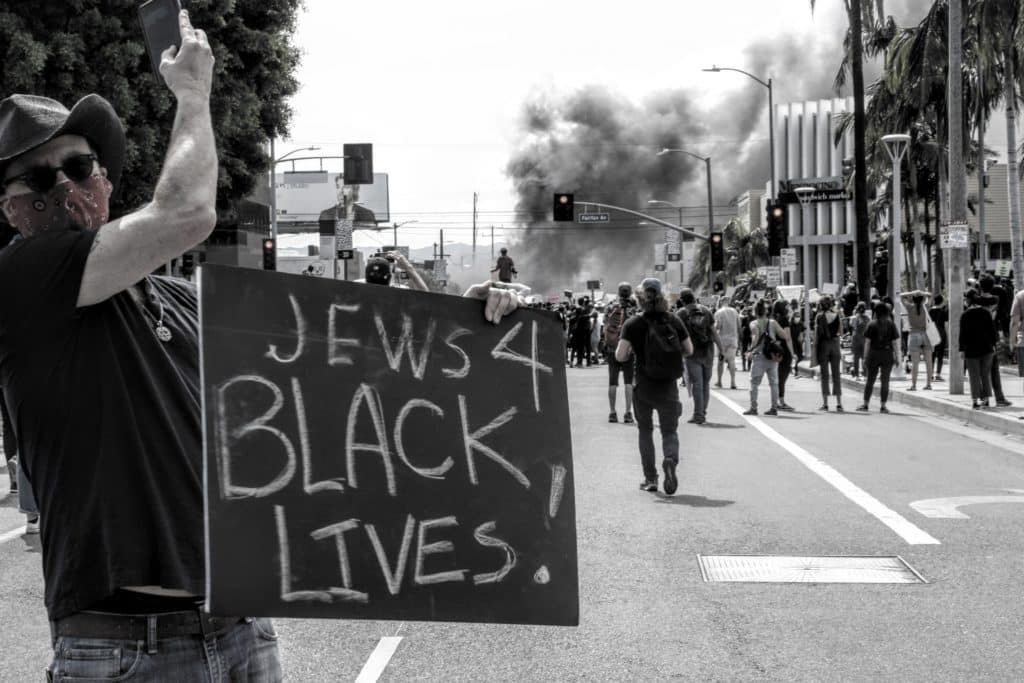
I told Sa: “Jews 4 Black Lives.”

Before we headed out the door, we checked the news. The protest had turned heated: pushing and shoving in the skirmish line, protesters shouting at cops. The camera bag was over my shoulder, but we hesitated. “We stay in the car,” I said.

As we approached Pan Pacific Park, we passed protesters going in both directions. I displayed our sign while she drove. At a stoplight two blocks from the protest, a black woman sitting on the curb holding a BLACK LIVES MATTER sign read ours and her face lit up. “Thank you. Thank you,” she said.

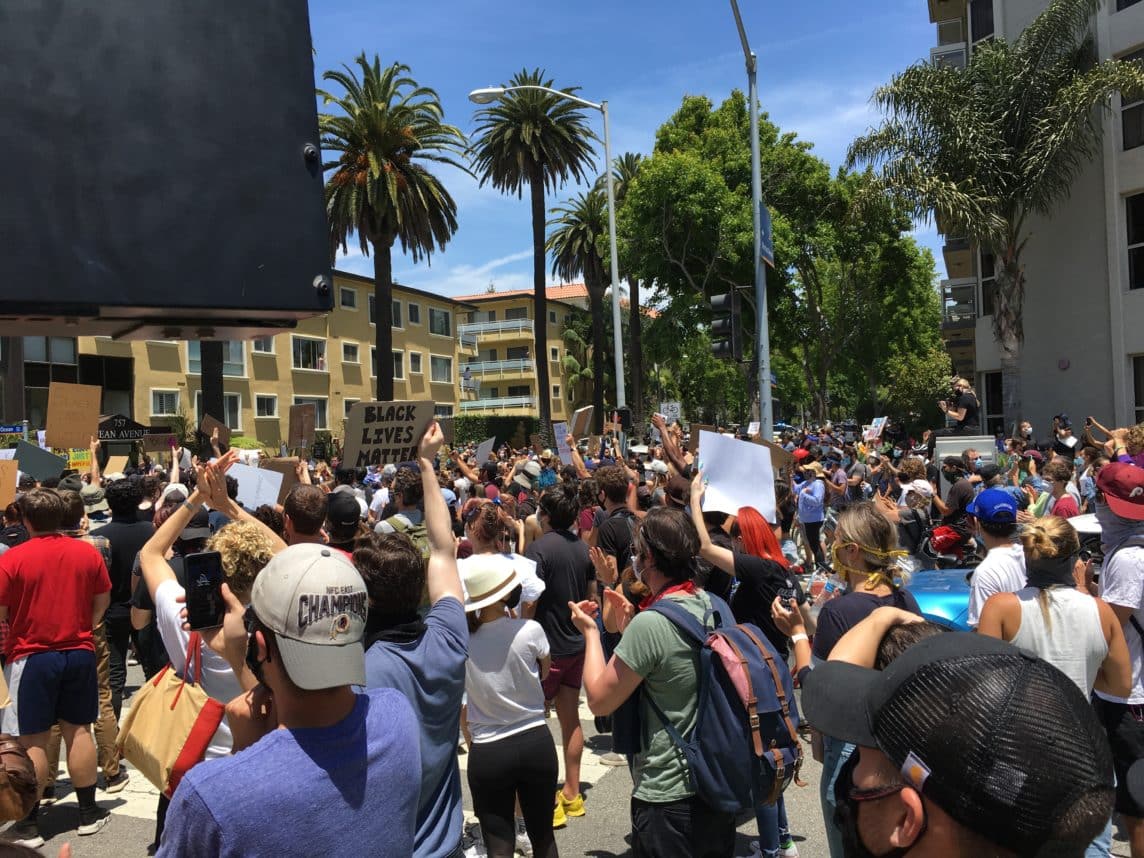
Protestors march in Santa Monica on May 31. Photo courtesy of Lorelei Laird

We were able to get within a block of the main crowd of protesters, which had moved from the park to 3rd Street, just east of Fairfax. Here, behind the march, the street was almost empty. “Can we get a couple of quick photos?” I asked, and Sa agreed.

Just as we got out of the car, we heard a boom. A black cloud of smoke went up from the midst of the crowd, and the mood darkened. People ran past us yelling “Get  out!” I posted a video on Instagram documenting what I later learned was a car ablaze.

Sa headed back to the car with the sign. An African American man stopped her and asked for a picture. A group of four young Chabadniks, wearing tzitzit and kippot but no masks (a kippah would make a fine mask, guys), ambled by. One gave her a thumbs up and said, “Cool.”

My big takeaway from that day — and the days since, when so many people at protests, black and Jewish alike, have given me thank-yous and thumbs-up while I carried the same message — is this: If, in these insane times, Chabad youth and Black Lives Matter protesters can find common cause with this Reform SJW, then perhaps there is hope for the fight against racism in America after all.

Israel is another story.

Today Jews Need to Support Black Lives Matter; Tomorrow We Can Talk About Israel Read More »

Mohamed Hadid Removes Apology for Sharing Cartoon Blaming Israel for Police Brutality

Mohamed Hadid, a real estate mogul in Los Angeles County, took down an apology for sharing a cartoon insinuating that Israel is to blame for police brutality in the United States.

The Algemeiner reported that Hadid, 71, had posted a cartoon to Instagram depicting a U.S. police officer and an Israeli soldier with their arms around each other as they’re kneeling the necks of a black man and Palestinian man, respectively. Hadid wrote in a caption for the post, “Two sides of the same coin.”

On May 31, Hadid issued an apology on Instagram for sharing the cartoon, explaining that the post stemmed from anger over the shooting of an unarmed, autistic Palestinian man in East Jerusalem on May 30.

“If my remark came off with anti-Semitism toward the Jewish people I do apologize,” Hadid wrote. “I think it was a wrong time for me to be angry about what happened in Jerusalem yesterday … you are right to be upset .. love and peace and coexistence is the answer.”

Hadid, who is of Palestinian heritage, explained that Arabs and Jews are cousins and that’s important to set differences aside and work toward ending the perpetual cycle of violence in the Israel-Palestinian conflict.

“I am confident that the life of [the] Palestinians and the Israelis will improve in the near future,” Hadid said. “I want to live to see the day.”

Hadid accompanied his apology with a picture of an Israeli soldier helping an elderly Arab man walk.

Israellycool blogger David Lange noted in a June 1 post that Hadid’s apology has since been taken down. Lange pointed out that there had been a growing backlash to Hadid’s apology on social media.

“In a strange twist of irony, by giving in to the haters and removing his conciliatory message to Jews, Hadid has effectively shown why peace and coexistence is so far off,” Lange wrote.

Hadid is the father of models Gigi and Bella Hadid; his son, Anwar, is dating British singer Dua Lipa, who shared a since-deleted Instagram post calling the Israeli government “fake Jews” and accusing Israel and the United States of creating Hamas.

Various pro-boycott, divestment and sanctions (BDS) groups, such as the U.S. Campaign for Palestinian Rights and DSA [Democratic Socialists of America] BDS and Palestine Solidarity, recently have argued that Israeli soldiers have been training U.S. police officers to be racist. Bryan Leib, former national director of the Americans Against Anti-Semitism watchdog, said in a statement to the Journal that such allegations “are disgusting and completely false. It’s true that special operations teams in local and state law enforcement like SWAT do train with Israel but the average police officer has never received training from Israel! Will Twitter and Jack Dorsey be ‘fact checking’ these modern day blood libels being spread about Jews?”

Mohamed Hadid Removes Apology for Sharing Cartoon Blaming Israel for Police Brutality Read More »

Letters: Annexation and History, Poor Choice for Award 

Annexation and History
Shmuel Rosner offers much food for thought regarding Israel’s annexation of Judea and Samaria (“Annexation Complications,” May 15).

There are two opposing issues: moral and practical. It boils down to whether Jews have a moral right to live in the West Bank and would the Palestinians be treated by Israel’s moral standards.

Historically and based on the Balfour Declaration and similar mandates from recognized international authoritative organizations, Jews have every right to live there.

On the other hand, until recent years, there was no semblance of a Palestinian nation, nor did the Arabs or Muslims claim that land.

Would Israeli annexation force the Palestinians living there to suffer South African-type apartheid? One need only observe how Palestinians currently serve in the Israeli parliament, attend its universities, work in its industries and receive treatment in its hospitals.

Then there is the practical matter as to whether “Israel might turn into a binational state and lose its Jewish majority.” That is an issue to be considered in the future as we see how things develop over time.

Second, I agree with Larry Greenfield — that Biden would not be good for Israel (“Would a President Biden Be Good for Israel?” May 15).

Biden has opposed Israel’s annexation of the West Bank. Historically, there is no doubt that the land under consideration was part of its home going back to the days of Moses when the Hebrews escaped from slavery in Egypt, and that it was set aside to be part of the national Jewish home, starting with the Balfour Declaration in 1917 and re-confirmed by several recognized international authoritative organizations.

On the other hand, Halie Soifer, who favors Biden, focuses primarily on President Donald Trump’s inadequacies and that “we cannot afford another four years” of Trump in the White House.

Yes, the proposed annexation would be a deterrent to a two-state solution to the Israeli-Palestinian conflict. But there are other more important  factors — such as planting the seeds of hate in the minds of the Palestinians and other Arabs/Muslims. I question whether a two-state solution is realistic at this point.

That Biden aligns with the Jewish community on many policy priorities has nothing to do with the question: Would a President Biden be good for Israel? No.
George Epstein, Los Angeles

Columnist’s Buddy
Mark Schiff’s column about his close relationship with a Palestinian is so appropriate in our nation’s current situation (“A Palestinian Muslim Calls Me His Brother,” May 29). A person doesn’t have to be black to be outraged by what happened in Minneapolis and a person doesn’t have to be white to be outraged at the looting across the country. We are all in this together, whites and blacks, Jews and Muslims and all political foes. We may disagree and may want to protest but there’s a respectful way to do so.
Richard Katz, Los Angeles

Poor Choice for Award
I was saddened to learn that San Francisco State University (SFSU) professor Rabab Ibrahim Abdulhadi was given an academic leadership award (“SFSU Professor Who Called Zionists White Supremacists Selected for Academic Award,” May 22).

To put this into perspective, imagine that a public university with a history of discrimination against a racial minority group issues an apology. A racist professor then condemns the apology on official university media. Should that professor be honored?

That’s basically what happened here. SFSU has a long, shameful history of condoning anti-Jewish and anti-Israel extremism by pro-Palestinian groups. In 2017, SFSU President Leslie Wong even suggested that Zionists, notwithstanding the First Amendment, weren’t welcome on his public university campus. A year later, he apologized, saying: “Let me be clear: Zionists are welcome on our campus.”

Abdulhadi, an ethnic studies professor who has praised Palestinian terrorists Rasmea Odeh and Leila Khaled, condemned Wong’s apology, calling it a “declaration of war.” Her post appeared on the official SFSU Facebook page for a program Abdulhadi directs. Subsequently, graffiti saying, “Zionists not welcome” covered the campus.

Abdulhadi abused her academic position to promote hate. That’s the very antithesis of academic excellence.
Stephen A. Silver, San Francisco

ZOA and HIAS
A recent Journal online story reported on a letter that maligned me and my organization (Zionist Organization of America) for opposing the election of HIAS chair Dianne Lob to become chair of the COP (Conference of Presidents of Major Jewish Organizations).

The letter misleadingly identified its signers as caring “young Jews.” In fact, these “young Jews” were predominantly J Street U officials or members. Top J Street U signers also recently tweeted in honor of “Nakba Day” (meaning Israel’s rebirth was a catastrophe); supported teaching a notorious, virulently anti-Israel “Colonizing Palestine” course at Tufts; and boasted about helping to organize J Street’s campaign to insert anti-Israel planks into the Democratic Party platform.

J Street’s letter wrongly claims that it is “odious” to oppose resettling “heavily vetted” Muslims.

In fact, numerous bipartisan experts, including top Obama officials (including former FBI Director James Comey and former director of National Intelligence James Clapper) confirmed the weakness of U.S. vetting, and the unavailability of needed information.

ZOA does not oppose anyone “because” they are Muslim. ZOA opposes the entry of and HIAS’ resettlement of certain people because they come from nations where ADL polls show that 74% to 93% of the population is anti-Semitic, and where studies confirm that schools teach hatred of Jews and Israel, and glorify “martyrdom” from early childhood onward. HIAS may well be endangering American Jews and support for Israel by resettling anti-Semitic refugees who also likely will oppose strong U.S.-Israel relations and will vote for and lobby for those promoting these ugly beliefs.
Morton A. Klein,
National President
Zionist Organization of America (ZOA)

Intergenerational Magic
Emma Steuer, thank you for honestly describing the Pressman Academy students’ mixed emotions about their visit to the Iranian Senior Jewish Center (“Bringing Joy,” May 29). It is truly a beautiful, rewarding journey of give and take that you have begun.

As a creator of many intergenerational and intercultural programs for almost 30 years, these visits are a great opportunity for students and seniors to learn about commonalities between generations and cultures. The collaborative aspect of this explorative journey is essential, and art, music and oral histories are wonderful vehicles.

When I lived in Mount Washington, a hillside community near downtown L.A., a group of Jewish, African American, Japanese, Italian American and Irish women and I gathered with a multi-ethnic sixth-grade class at the Mount Washington School.

Through the five senses and probing questions, we met one another as equals, unified across experience and generations. Through music from our varied ethnic backgrounds, we created movements that expressed our emotions, dancing together  undaunted by physical limitations. We shared ethnic food, smelled flowers and spices, and listened to one another’s voices. We created collages and exhibited our stories in art galleries and on community center walls.

Yes, there is a miracle in survival, but the greater miracle lies in how much wisdom we gain from living, each of our stories unique and precious. Also, our sages teach that, in the times of the Messiah, the children will teach their elders. What can we learn, and what can we teach? The journey itself will tell.
Mina Friedler, Venice

Several weeks ago, members of the various boards of the Los Angeles Jewish Home were asked to volunteer by calling the residents to say hello and let them know that we are thinking about them this difficult time.

Because the of the isolation and complete shutdown of outside visitors to the campuses because of the COVID-19 pandemic, physical contact was completely cut off. I was given the names of 30 residents to contact by phone. To my great surprise and astonishment, all 30 residents that I spoke with clearly understood the necessity of the lockdown and expressed deep appreciation for the extraordinary measures the facility took to make them safe and remain healthy. All spoke glowingly about the extra efforts of the administration, doctors, nurses and staff to make them comfortable and knowledgeable about social distancing and masks. One woman expressed her disappointment in not being able to play cards with her friends, and a 92-year-old man from Ukraine, said to me, “This isn’t a retirement home … this place is paradise!”

All of us in the Los Angeles Jewish community should take great pride and satisfaction that our most vulnerable elderly members are so happy, so well taken care of and so safe during this unprecedented health crisis.
Sheldon Steier, via email

Watch New Life Emerge
We are the children of the “Parparim” (butterfly) class at the Early Childhood Center of Pressman Academy of Temple Beth Am. Our parents read Rabbi Bradley Shavit Artson’s story  (“Sheltering in Our Cocoons, Preparing to Soar,” May 29) and we all could relate to the metaphor of being in a cocoon because we recently did an amazing project. We ordered caterpillars online (insectlore.com) and watched them develop into butterflies in a mesh habitat that we kept in our homes.

We would like to recommend this as a wonderful activity for people of any age to witness this incredible, magical transformation. It is a particularly appropriate activity for this period of quarantine, when you might be lucky enough to be present to see the butterfly emerge from the cocoon like we did! We hope that, as Artson described in his story and as we saw with our butterflies, our society will indeed do the work necessary to emerge from this challenging time changed, stronger and more beautiful than ever.
Pressman Academy’s “Parparim”, Temple Beth Am, Los Angeles

Letters: Annexation and History, Poor Choice for Award  Read More »

JFLA Executive Director Discusses Loan Program for Looted L.A. Businesses

Since the outbreak of the coronavirus pandemic, the Jewish Free Loan Association (JFLA) has been working remotely to ensure people receive their interest-free loans.

“It’s extremely gratifying to be able to help people when they are in such times of crisis,” JFLA Executive Director Rachel Grose told the Journal. “It’s difficult to see so many people facing such difficult times, and I think it is important for the public to know how devastated a lot of the city is.”

And in the wake of the looting that occurred after weekend protests against police brutality over the death of George Floyd, JFLA announced on June 1 it will offer loans to small businesses affected by the looting.

“The idea is to be here for all the small businesses in L.A. and Ventura counties,” Grose said. “It is a time when businesses were just going to start opening up, especially restaurants and clothing stores. To have people already experiencing such economic devastation, to be almost ready to try and recover and to be on the receiving end of looting and destruction, it’s devastating.”

Under the program, interest-free loans of up to $18,000 are available to all residents of L.A. or Ventura counties, provided they are U.S. citizens. The loans can be used toward debris cleanup, graffiti removal, construction needs, inventory replacement and more.

“It’s difficult to see so many people facing such difficult times, and I think it is important for the public to know how devastated a lot of the city is.” — Rachel Grose

While the loans don’t require the borrower to put up any collateral or pay any fees, JFLA requires two guarantors who can repay the borrower’s debt if he or she is unable to pay it back themselves.

This is not the first time JFLA has offered loans to businesses impacted by civil unrest in the city. After the Watts riots in 1965, the organization assisted businesses in rebuilding, Grose said.

“Jewish Free Loan has been around since 1904 providing loans in good times and bad to people of all faiths who reside in L.A. or Ventura counties,” she said. “On the one hand, we aren’t doing anything new —we’re offering the same loan. On the other hand, we are responding in very direct ways to new needs.”

With the coronavirus pandemic, followed by these latest protests, Grose said, “I think the majority of society is living close to the edge. We’re seeing that every day.”

For  more information on obtaining a loan, visit JFLA.

JFLA Executive Director Discusses Loan Program for Looted L.A. Businesses Read More »

LA Museum of the Holocaust to Host Virtual Events on Anti-Semitism, Confronting Racism

Anti-Semitism has been on the rise worldwide in the last few years, but hate crimes have increased since the Coronavirus outbreak and risen even further since the murder of George Floyd and the civil unrest that has taken over American cities in its wake, including Los Angeles.

The Los Angeles Museum of the Holocaust is partnering with the Oregon Jewish Museum and Center of Holocaust Education and the Jewish History Museum of Tucson to present an online talk on this timelier-than-ever topic on June 10. Featuring Holocaust scholars Michael Berenbaum and Steven Wasserstrom in conversation, “Antisemitism in the Time of Coronavirus” will take place at 12 p.m. via Zoom.

According to Berenbaum, the recent surge in antisemitism and the nature of contemporary antisemitism must be understood in context – the context of an increased permissiveness in the expression of hatred, the context of political polarization and the context of the battle over Israel and Zionism. Yet the overwhelming context has been a time of relative prosperity. But what happens in a in a period of high unemployment, fear over one’s future and over the economic future of the world as we have known it – in the US and globally? These and other questions will be addressed in the talk. Register here.

Two upcoming Zoom events feature Holocaust subjects. In Nazi-occupied Poland, two Catholic girls rescued 13 Jews by hiding them in an attic for nearly two years, at considerable risk to their lives. Stefania and Helena Podgórska were named Righteous Among the Nations by Yad Vashem in 1979, and Stefania spoke at the dedication of the United States Memorial Holocaust Museum in 1993. The sisters’ story became the subject of a 1996 TV movie, “Hidden in Silence,” and a 2020 novel, “The Light in Hidden Places.” Stefania’s children Ed Burzminski and Krystyna Diamant will participate in a conversation on June 4 at 11 a.m. Register here.

Jerry Weiser will relate how he survived the Holocaust, thanks to a mother who smuggled him out of the Bratislava Ghetto as an infant and gave him to a priest who found a safe home for him with a farmer’s family in a talk that will stream on Facebook Live on June 9 at 11 a.m. Register here.

Lastly, on June 8 at 12 p.m., LAMOTH will present “Building Bridges: A Cross-Cultural Dialogue About Confronting Racism,” featuring leaders from the Hispanic- African-American, Asian, and Jewish communities talking about the challenges we’re facing in a very divided America. Michael Lawson, of Los Angeles Urban League; Helen Torres of Hispanas Organized for Political Equality; Charlie Woo of Center for Asian Americans United for Self-Empowerment; and moderator Dan Schnur, a professor at USC’s Annenberg School of Communications and LAMOTH board member, will discuss solutions and a path forward.

“The fabric of our society is threatened in a moment when so many of our communities, who make up this country, are in pain,” LAMOTH board chair Michele Gold said in a statement. “We must show up for humankind during these challenging times.  There are great injustices impacting our brothers and sisters and we are working vigorously to be part of the solution. As we have since 1961, we will continue to foster dialogue amongst ostracized groups and individuals who can shed a light and create opportunity to alleviate these burdens.”

Register here.

LA Museum of the Holocaust to Host Virtual Events on Anti-Semitism, Confronting Racism Read More »

Free Online Screening to be Available of Holocaust Rescue Film ’50 Children’

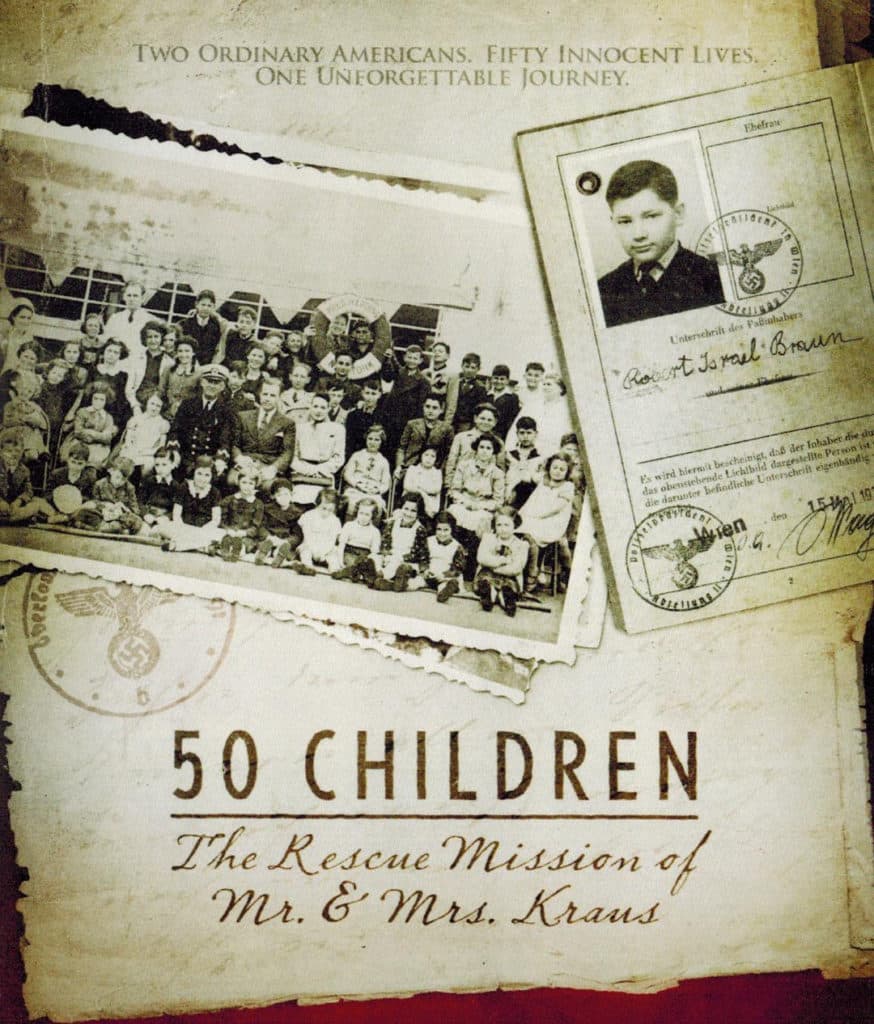
The documentary “50 Children: The Rescue Mission of Mr. and Mrs. Kraus” explores the previously untold story of a Jewish couple from Philadelphia who risked their lives to save the largest group of children allowed into the United States at the time.

Blending historical footage, personal photographs, interviews with nine surviving members of the 50, and narration by Alan Alda and Mamie Gummer (reading from the memoir of Eleanor Kraus — the “Mrs.” of the movie’s title), the film reveals the Krauses battling bureaucracies abroad and at home and racing against the clock to get the children out of Vienna as atrocities escalated in 1939.

The Krauses’ efforts might have remained a footnote lost to history had filmmaker Steven Pressman not read the unpublished memoir written by Eleanor, who died in 1989, 14 years after her husband, Gilbert.

Marking the 81st anniversary of the children’s arrival in the United States and presented in conjunction with the Philadelphia Jewish Film Festival, Pressman is screening the film today, June 3, at 4 p.m. PT via Facebook Live, followed by a Q&A. Register here.

Free Online Screening to be Available of Holocaust Rescue Film ’50 Children’ Read More »

No Excuses, Wear a Face Mask

As I recently walked my dog on Hollywood Boulevard one morning, two young men approached me, not wearing masks. I worried. Then I gestured to my mask-covered face, hoping they would get the idea. One guy shook his head “no.” I darted across the street to avoid possibly being exposed to COVID-19, but what about next time?

Were these gentlemen too self-absorbed to care, or had they simply not heard about the mayor’s new order requiring all Angelenos to wear facial coverings outside their homes?

While driving on the 405 Freeway, I saw signs advising Angelenos to “Remember to practice social distancing” and “Remember to wash your hands.” But one sign was notably absent: “Remember to wear a face covering.”

Many around the city share my frustration with people not complying with the mayor’s order. As we struggle to understand the dissent of non-mask wearers, or occasionally lash out at them in anger, I believe we must seek creative solutions to the problem.

Some people may need tickets and fines to be convinced, but others might merely be unaware. If this sounds like the four children at the Passover seder, perhaps re-reading the Haggadah can inspire us to find ways to educate with compassion and creativity, using the powerful tools of technology and brainpower. Wearing masks is new for most Americans. We enjoy the freedom to dress and speak as we like. We are not used to donning masks to avoid the spread of illnesses.

But the reality is that washing commonly touched surfaces cuts down on the spread of the coronavirus. Wearing masks is crucial for public safety, especially as we reopen our economy. One can avoid touching items and carry sanitizer, but we must breathe.

We must keep the entire city in our hearts and minds to combat COVID-19 successfully and pave the way for a brighter future for our beloved city.

Los Angeles County’s population of approximately 10 million is larger than New York City’s or Hong Kong’s. Wearing masks may go against our individualist grain, but it certainly would help many stay alive, and would keep those who venture out of their homes safer.

Los Angeles endures unprecedented loss of lives and livelihood. Sadly, the pandemic stubbornly persists. As retail shops reopen, life resumes — but at what cost? If we wish to help our city get back on its feet, stand proud and strong, and not tumble again in the near future, we need to ensure every person follows best practices.

As a former elementary and high school teacher, I believe strongly in education. I also believe we Jews cannot idly stand by. We can find ways to educate the public because one-to-one battles are dangerous, exhausting and inefficient. We have laws, but don’t want cops on every corner.

The other day, I walked by three people with masks on their chins. As I approached wearing my mask, they pulled on theirs. In this instance, my individual example worked, but reached only three people. This message needs to be shouted from the rooftops. Our synagogues could schedule Zoom meetings to brainstorm. We could create apps, hire creatives, use nonprofits, volunteers and even college students at home for the summer.

We must keep the entire city in our hearts and minds to combat COVID-19 successfully and pave the way for a brighter future for our beloved city. As we head back to the beach, and to our beloved synagogues — although we don’t know how that will work yet — let us keep in mind the parts of the city where the disease is still running wild. Eighty-six percent of people who tested positive in nursing homes had no symptoms. The only way to stop this deadly virus from spreading is for everyone to wear masks. We still need to work out how to chant Torah with masks on, but I am sure it can be done!

The sky’s the limit to what we can accomplish when we work together. Communication is an art. Let us become angels for our City of Angels and help Angelenos through this crisis.


Deborah Fletcher Blum is a Hollywood-based writer and documentary filmmaker.

No Excuses, Wear a Face Mask Read More »

June 5, 2020

CLICK HERE FOR FULLSCREEN VERSION

June 5, 2020 Read More »

There Are Now 500,000 Negative Tweets About George Soros Every Day. Many Claim He’s Funding George Floyd Protests.

Right-wing conspiracy theorists are increasingly claiming that George Soros is funding recent protests and riots across the United States in the aftermath of the George Floyd killing.

According to the Anti-Defamation League, “aggressive language towards Soros has exploded on social media” this week. Negative tweets about the billionaire Jewish philanthropist rose from 20,000 per day on May 26 to 500,000 per day on May 30.

The posts, according to the ADL, mostly allege (without evidence) that Soros is funding riots across the country, and that he is backing Antifa, a loose network of anti-fascist activists whom President Donald Trump has blamed for the violence, also without citing evidence.

The ADL says that the Soros theories “can serve as a gateway to the antisemitic subculture that blames Jews for the riots.”

People posting about Soros include prominent Trump supporters like Twitter pundit Candace Owens and actor James Woods.

Soros, a Hungarian-born financier who funds a variety of liberal causes in the United States and globally, is a favorite bogeyman of the right and conspiracy theorists in particular. Recent Soros conspiracies have alleged that he is driving the spread of COVID-19 in order to profit from a future vaccine and that he pays left-wing protesters.

Trump tweeted in 2018 that Soros paid protesters opposed to Brett Kavanaugh’s Supreme Court confirmation. Hungarian Prime Minister Viktor Orban also put up a billboard campaign in 2017 opposing Soros that was criticized as anti-Semitic.

There Are Now 500,000 Negative Tweets About George Soros Every Day. Many Claim He’s Funding George Floyd Protests. Read More »