The unity behemoth is coming. A coalition of more than 70 Knesset members (perhaps close to 80), and a government of more than 30 ministers, not to mention a dozen or so deputy ministers, is expected to be sworn in next Wednesday — the first since 2015. After three election cycles, it’s about time we had a new government.
The Supreme Court ruled unanimously on Wednesday night that letting Prime Minister Benjamin Netanyahu form a new government is legal. Eleven justices signed the ruling, signaling that this was not a controversial conclusion. Not by a long shot. It also decided the court had no reason to intervene in the agreement between Netanyahu and Benny Gantz. For now. The court could still revisit the legal arrangements later. For example, when it becomes Netanyahu’s turn to be the “alternate prime minister.” At such time, if the justices rule that the alternate prime minister is like any other minister, Gantz will be forced to dismiss Netanyahu (under the current law, a minister cannot serve under indictment). The result will be an end to the coalition.
But this is far in the future. For now, the court has paved the way for the Knesset to pass the necessary legislation, for the president to hand Netanyahu the mandate to form a government, and for the heads of the blocs to begin closing the deal with the other parties and select the ministers for each office. All of this is slated to happen by next Wednesday, when the Knesset will vote in favor of the unity government.
Four important things to note as the government forms:
There was a lot of skepticism among analysts, pundits and other observers as to whether Netanyahu truly wants to form a unity government or was looking for a way to prompt a new election. Such skepticism was not misplaced but has its limitations. Prophecy is dangerous, especially when the prophet has a clear agenda (in this case, to make Netanyahu look bad).
For 18 months we became used to (or maybe became addicted to) the game of politics. Political maneuvers are an important part of public life, but the new government faces serious challenges. Hopefully, this will be reason enough to take a break from political games and focus on policy making.
Netanyahu’s trial is slated to begin in a few weeks. We have to see how he functions when the court discusses the allegations against him.
Is the government ready to annex parts of the West Bank? Apart from coronavirus related matters, including health measures and economic remedies, annexation is the next big question on the table. According to his understanding with Gantz, in two months Netanyahu can make a move. Two months is an eternity. And it is also just around the corner.
I like going to synagogue. It’s painful that our synagogues have been on lockdown during this coronavirus pandemic. Just when we need a dose of connection, understanding and reflection — they’re not open for spiritual business. At the same time, because I’m a doctor, I am sensitive to the importance of keeping people healthy and safe.
The challenge in front of us, then, is this: If we wanted to re-open our synagogues, what are the necessary precautions we must take? How would we incorporate current civic guidelines? What are the open questions that still need to be considered?
These questions began to crystalize when I was asked to be an author on a COVID-19 national guideline for the American College of Occupational and Environmental Medicine (ACOEM)[1]. In reviewing all the science and coming through with our recommendations, faith gatherings were on the outs.
My thoughts below are a first step to bring these gatherings back in. I have consulted with rabbis, politicians, hospitals and medical colleagues. They are guidelines to consider as we move to a re-opening of our houses of worship. Remember that there is a medical/science answer and then a social determination.
What has to be emphasized is how important it is for religious leaders to build on their strengths. They must focus their thoughts on engagement, telling people what they CAN do, not what they can’t do. Spiritual leaders can actively change the mood of defeat and fear.
On the medical side, the information base is growing exponentially. Issues of transmission (droplet vs aerosol vs fomites), testing (PCR Antigen vs ELISA Antibody), treatment (outpatient or mild symptoms vs inpatient life-saving interventions) and prevention (social distancing, cleaning products and masks) are clarifying the field of battle. At the same time, the art of medicine reminds us that no test is perfect, no symptom always completely diagnostic and accepting uncertainty is what those of us on the front lines always do. There is no perfect answer that fits every situation or patient. People have to consult with their doctor now more than ever.
What has to be emphasized is how important it is for religious leaders to build on their strengths. They are not doctors, nurses or affiliated medical professionals. They already have enough on their plate taking care of the spiritual and psychological needs of so many. They must focus their thoughts on engagement, telling people what they CAN do, not what they can’t do. Spiritual leaders can actively change the mood of defeat and fear.
Clergy also has to think of making a strong value proposition of why congregants should come back. While I know this is a sensitive topic, people will opt to either stay home or do their own minyans. On a medical basis, a small home minyan may appear safer, but there’s no reason why a congregation that adheres to strict guidelines can’t be even more protective. At the end of the day, returning to a communal space remains our mission.
Steps that I have been recommending include accepting uncertainty but at the same time, being very attentive to risk groups. While not fully developed yet, it is far more probable that a healthy recovered individual will have protective antibodies that last for at least 6-9 months and probably years. Maybe having some of those congregants back early can start the nucleus of regeneration. Remind people that there is much literature of the negative health consequences of being out of work and socially isolated-participation in your faith community can help.
All of these suggestions are to give people a sense that re-opening our houses of worship is not an outlandish idea, but a feasible one if we do it responsibly.
Send a clear communication to congregants before opening the doors of all the concrete steps that your institution has promulgated — cleaning, plastic covering, making disposable gloves and paper towels available in key locations, arranging seats, tables or pews to allow families to be together while giving others some reasonable space. Maybe the Rabbis and Leaders can have small group Zoom sessions for a spiritual checkup and explain their preparations. Maybe keep the younger ones at home for the first few weeks while everyone gets comfortable together. Have the doors propped open to limit touching. Keep the donation plates open and uncovered. Have designated leaders take responsibility for the logistics that were once an open-ended first-come-first-serve “honor” or “Aliyah”. Give congregants honors in advance so they know they count. Consider a set-up where minyans can sign up in advance to limit size. If you run minyans at homes, have the clergy rotate to visit.
All of these suggestions are to give people a sense that re-opening our houses of worship is not an outlandish idea, but a feasible one if we do it responsibly. I have been consulting with major Jewish institutions that are planning to release a formal statement outlining guidelines for re-opening. Synagogues will need all the help they can get.
Ultimately, this will always be a personal decision. Not every congregant will choose to opt-in right away. And for those who do, it will require from their synagogues detailed planning, due diligence, and constant monitoring. Committees of implementation will need to be formed.
There is a Yiddish proverb that says, “You can’t control the wind, but you can adjust the sails.” The coronavirus windstorm we are experiencing is unprecedented. But if we put all hands on deck, we will improve the odds of a successful return to our beloved synagogues. I’ll see you (hopefully soon) in shul.
Dr. Hyman practices on the front lines in Internal Medicine in Westwood. He lives in Beverlywood, with his wife and all four boys who are home during the pandemic.
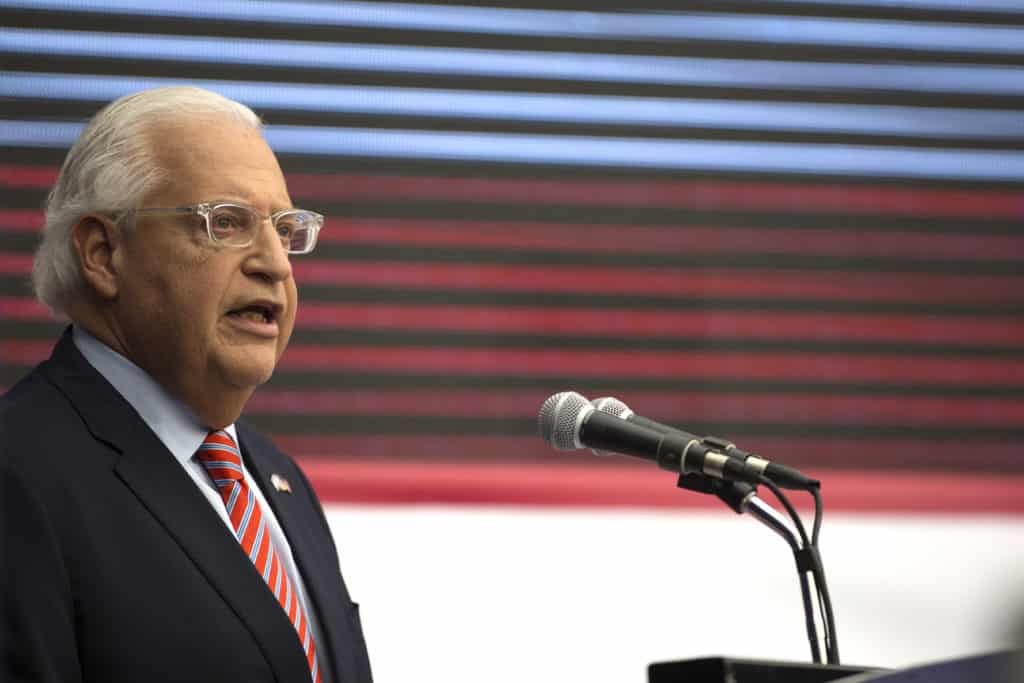
The United States is ready to recognize Israeli sovereignty over the Jordan Valley and other parts of the West Bank with conditions, the U.S. ambassador to Israel told an Israel newspaper.
In an interview with the Israel Hayom daily, David Friedman said Israel must freeze building in other parts of the West Bank and prepare to reenter peace negotiations with the Palestinians on the basis of the Trump peace plan.
The plan requires the Israeli prime minister to agree to negotiate with the Palestinians “in good faith” for four years, which Benjamin Netanyahu has already agreed to. Friedman noted in the interview that the Palestinians have rejected the deal, which also mandates a settlement building freeze on the 70 percent of the West Bank that would make up a future Palestinian state.
Israel’s new government coalition agreement allows annexation of some parts of the West Bank beginning from July 1.
Excerpts of the interview with Friedman, conducted to mark the second anniversary of the U.S. Embassy’s move to Jerusalem from Tel Aviv, were published Wednesday. The full interview is scheduled to be published Friday.
Israel Hayom, which is owned by philanthropists Sheldon and Miriam Adelson, is seen as being an advocate for Netanyahu. The Adelsons, major givers to Republican candidates, have backed Donald Trump and said they will do so in the 2020 presidential election.
Friedman said the United States would not impose any new conditions not found in the Trump administration’s peace plan, which was rolled out in January. He said the U.S. will be ready to recognize Israeli sovereignty following its declaration by Israel and its government agrees to stipulations of the plan.
Los Angeles County officials announced on May 6 that the county will begin to reopen on May 8.
Businesses that can start to reopen include certain retail stores, florists and car dealerships, although they will all have to provide curbside pickup. Hiking trails and golf courses also will reopen. Those on the trails will be required to wear a mask or some other type of face covering.
#LIVE: Here is a deeper look into what is reopening on Friday in Los Angeles County.
The county has a five-stage plan to reopen; May 8 will be the first part of Stage 2. Stage 2 later will feature the reopening of other low-risk businesses such as offices, libraries, museums and outdoor recreation. The county has not yet specified when the rest of Stage 2 will occur.
Under Stage 3, certain businesses deemed as higher risk — movie theaters, bars, nightclubs, gyms, nail and hair salons, etc. — would start to reopen, as will schools. Entertainment venues, large conventions and sporting events will reopen under Stage 4 and Stage 5 in a full return to normalcy.
#LIVE: Here is a deeper look into what is reopening on Friday in Los Angeles County.
County Public Health Director Barbara Ferrer urged those at higher risk of developing serious symptoms from COVID-19 to stay at home.
“If you’re part of one of these groups, you need to take every precaution imaginable to protect yourself from COVID-19,” she said.
On May 4, California Gov. Gavin Newsom, a Democrat, said that the state could start to reopen on May 8, laying out a similar roadmap to reopening that the county presented on May 6.
“Los Angeles County cannot be more lenient on which stores can reopen than the state dictates,” County Supervisor Kathryn Barger said. “This list is less about the products that are sold, are more about the ability to maintain social distancing.”
As of this writing, there were 851 new COVID-19 cases and 55 new deaths in the county on May 6, putting the county’s totals at 28,644 cases and 1,367 deaths. Around half of all COVID-19 deaths in the county have stemmed from institutional facilities such as nursing homes and jails.
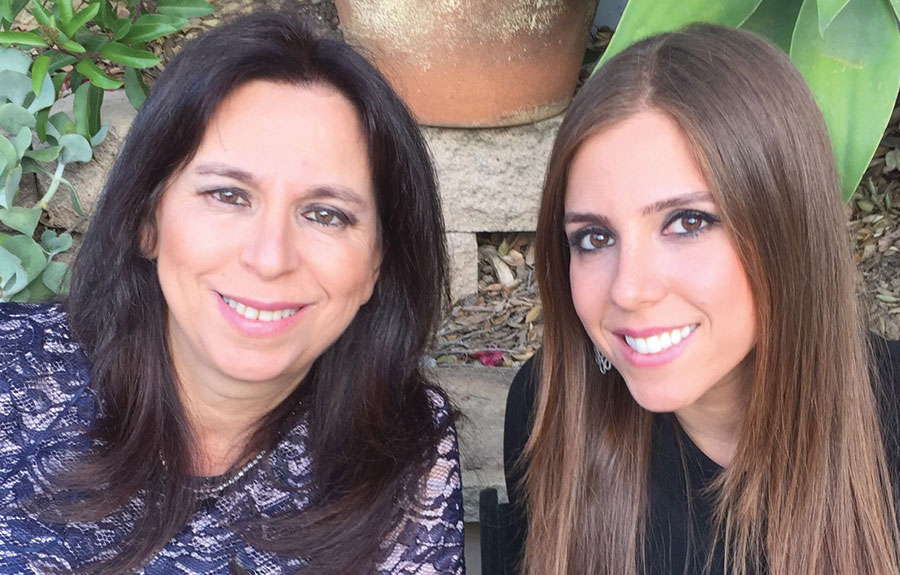
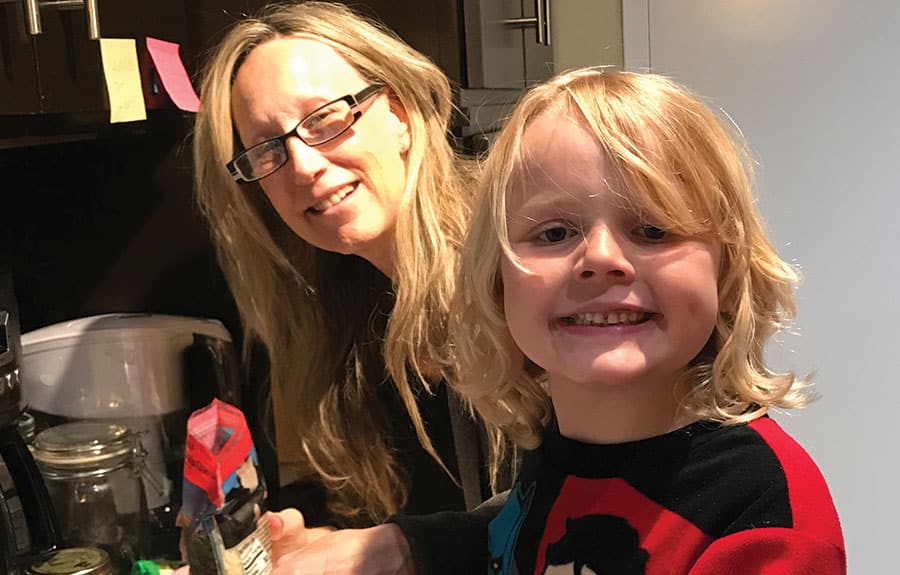
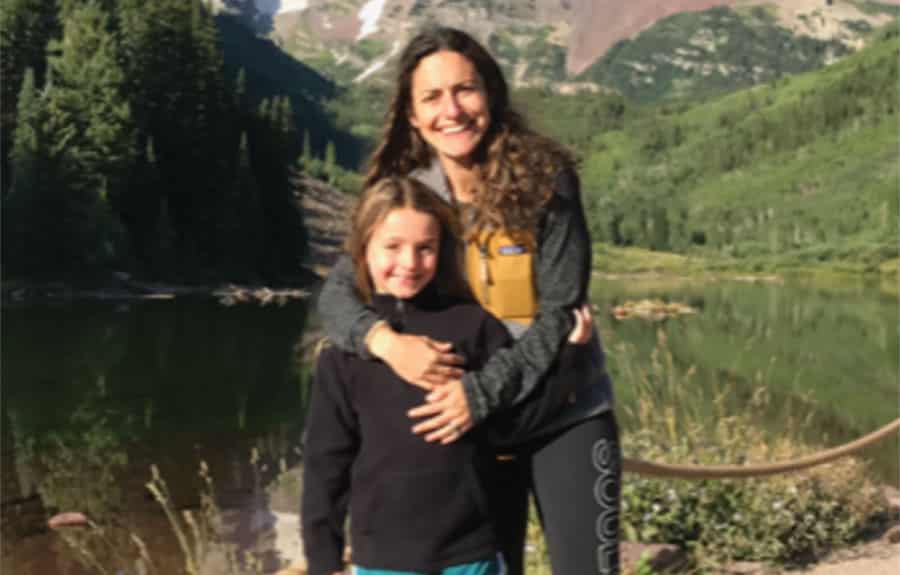
In honor of Mother’s Day, we asked moms how their lives have changed during this pandemic and we asked moms how they’ve navigated their new roles while in quarantine. Here’s what they had to say.
Some of the submissions have been edited for length and clarity. You can read what their kids had to say here.
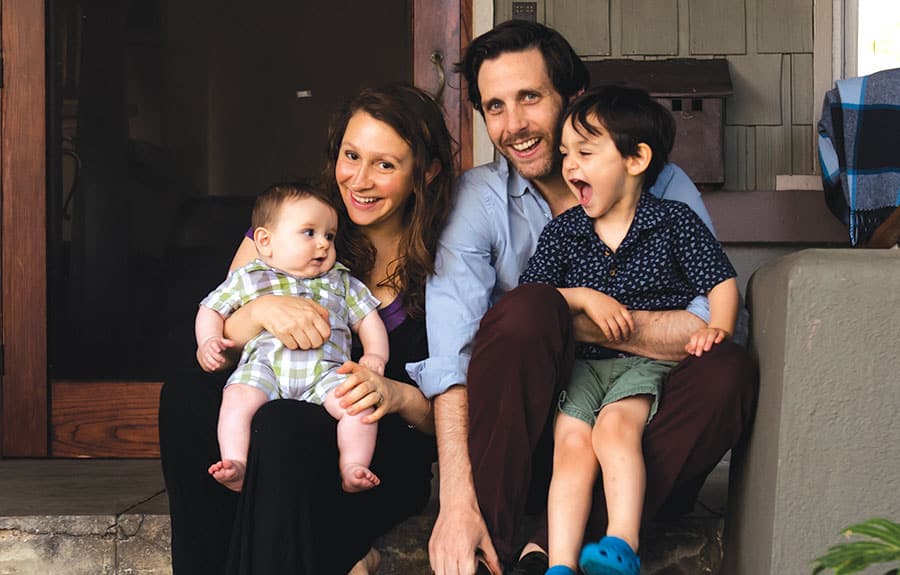
Julia Moss and her family
I wasn’t prepared for coronavirus motherhood I was not prepared for this. I love being a mom. I love it so much I had a second child. I’ve even contemplated having a third. But then the coronavirus hit and my love of parenthood changed. Don’t get me wrong. I love my children unconditionally. My 3-year-old and 6-month-old are the lights of my life. But never did I think I would have to be a mom without the support systems I rely on: schools, grandparents, baby-sitters. I love being a mom precisely because I am privileged enough to have those supports. My husband and I juggle our schedules, taking turns doing work and providing childcare starting at 7 a.m. and going until our kids go to sleep (after which we typically keep working). I pray each day for life to return to some semblance of normal, where I’m not trying to be a full-time worker, mother, preschool teacher, playmate, housekeeper, chef and nanny all wrapped into one. But even more importantly, every day I thank God for how blessed I am — that my frustrations are only over a lack of time, not a lack of a ventilator. And I pray that all of us can one day soon feel the safety and love that I try to create for my children each and every day. Julia Moss
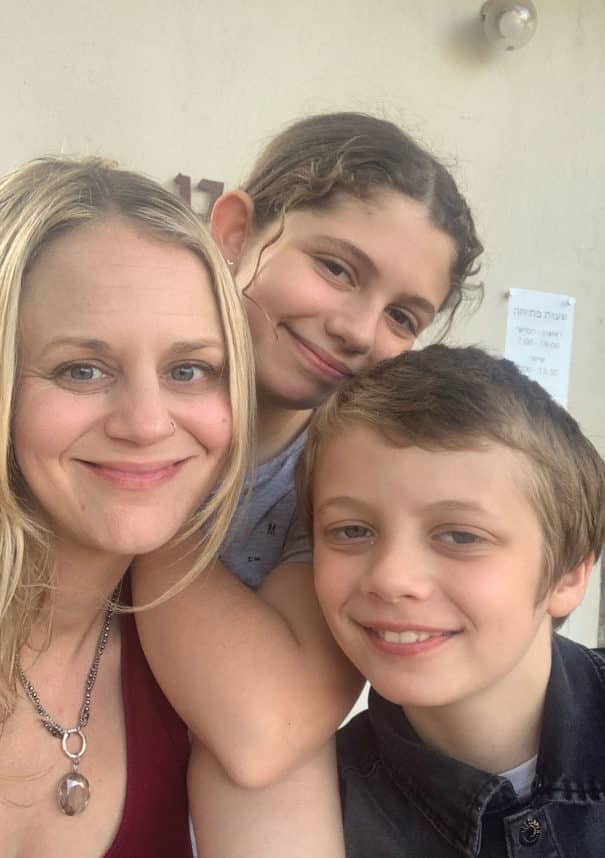
Sarah Tuttle Singer and her family
Feeling everything with my kids during COVID-19 The coronavirus has changed our entire world. Our schools are shut. We’re working from home. Our roads are empty and you can hear the wind moving through the trees. And the kids are home. It sucks. I’m anxious again. The same triggers. Germs. Only this time, no one is laughing. No one is telling me “It’ll be OK, don’t worry.” I’m the one saying it to my kids because I’ve felt this before, and I’ve lived it before, and I remember it now. And yes, it’s scary and the dangers are real, and we are stuck at home, bored out of our minds, but we are together.
And I get another chance to feel all of it. And I am leaning into it — all of it — this sticky middle, and it isn’t pretty. We’ve screamed at one another. I broke a pane of glass in one of the doors when I slammed it during a particularly difficult moment … but I felt it. I was there. My daughter talked back to me and it hurt my feelings … but I felt it. I was there. My son ignored me when I asked him to do the dishes, and I was frustrated … but I felt it. I was there. We have dance parties to strengthen our bodies. We listen to the Ramones, and the “Rent” soundtrack, and “Princess and the Frog.” I bought us each notebooks and we write in them every day — stories about our feelings, stories about our fears. And even with the kids and my partner, I am lonely since the world is changing into something new.
And there will be messy, noisy times when I’ll feel angry and heartbroken and terrified and trapped … but I am here, right here … and I am feeling every last bit of it. Sarah Tuttle-Singer — Israel
Marion Haberman
Feeling the emotional weight of this new reality I’m a stay-at-home mom, but since quarantine life began I’ve become a stay-at-home AT-ALL-TIMES mom, and the emotional weight of this new reality is heavy. I feel guilt and pressure to make up for my children missing the social connections they left behind at preschool. Visits with grandparents and play dates with friends were supportive building blocks that I’m trying somehow to compensate for at home. My 3-year-old uses phrases like, “When this is over,” and asks when he’ll be able to go to the grocery store again. It’s heartbreaking to lack the words to explain what’s going on to him, mostly because I can’t comprehend it myself. On the other hand, we are wearing our pajamas until noon, we never have to stop playing for anything but bedtime, special desserts are being baked all the time, and mountains of home art projects are being created. When I can forget about all we’re missing, I feel full from everything we have right here. Marion Haberman
Sally Abrams
Creating ‘Nanny’s Korona Kitchen’ For six weeks, I’ve been cooking a huge dinner every day (except Saturday) and packing it up for my local children to take home. Like so many parents, they are working from home and caring for their very young children. It’s all so hard and exhausting. Helping them gives me peace and purpose. I call my project “Nanny’s Korona Kitchen.” Sally Abrams
Joyce and Mark Snyder
Embracing motherhood after being near death I collapsed last July and was near death after being alone for three days, unconscious in my condo. My son came to find me hardly able to breathe. Paramedics took me to St. John’s in Santa Monica and saved my life. I was on a ventilator and the amazing teams there saved my life. I was in two hospitals and a rehabilitation center for a total of five weeks. When I became conscious and saw my son (who was at my side every day around the clock), my role as a mom and psychotherapist was to immediately assess him for post-traumatic stress disorder (PTSD). Since this is my area of specialization, I knew he was seriously traumatized. I was not fully aware of the complexities of my own medical condition at that time. I have grown so much closer to my son who saved my life. My role as a mother has become more meaningful since I was so close to death. Joyce Snyder
Gerilyn Shorten
The gift of ‘Coronavirus Quarantine’ Short order cook.
Cleaner.
Laundress.
Confidant.
Therapist.
Baker.
University did not prepare me for this, nor did real life . Before the coronavirus, I was “just” a mom and “just” a party planner. But I’m embracing the roles in the list above to transform into the things my family needs from me. My darlings are 17 and 14. There is an old saying: “Cherish the times you have because you won’t get them back.” And like most, life just moved on faster than a speeding bullet. But as much as we miss seeing our outside family and friends, “Coronavirus Quarantine” has been a gift. I’ve had the chance to nourish their bodies and stop rushing. We have long meals, afternoons at the pool, the time to do a 1,000-piece puzzle and binge watch a show. We have taken joy in doing, and being the recipients of, chesed. With my social kids up and running (and driving), they were busy with school, sports and socialization. Now I can hold them hostage and enjoy them under the guise of “quarantine.” Gerilyn Shorten
Amanda and Benjamin Morin
My best is good enough I’d love to say quarantine has made me more present and patient, but the truth is it’s made me realize that doing my best is going to have to be good enough. I always tell my kids they can’t do better than their best. It’s advice I’m going to have to take right now. Amid all this uncertainty, I’m distracted and worried, and it affects my productivity. But it’s still the best I can do. And I can’t do any better than that. Amanda Morin
Lisa Hanish
Baby birds returning to the empty nest My husband and I were enjoying the finally, long-awaited “empty nest” stage when the “safer-at-home” orders began and both our daughters moved back home from out-of-state colleges. They were not thrilled about this either. The groceries, the laundry, the cleaning. Trying to find a quiet place to teach my fifth-grade students online was difficult. But then, something special happened. We began to have family dinners every night. We would share the events of our day. This has been an amazing gift. We are cooking, baking, exercising, binge watching “Dave” all together. I hope when all is said and done, this will be the thing we remember most about COVID-19 and 2020. Lisa Hanish
Stacy Mintzer Herlihy
A port in the coronavirus storm As someone on the verge of sending my teen out into the world soon, the immediate future suddenly feels like a leap into the unknown. My oldest daughter is 17. She’s a high school junior. Her SATs were canceled in April. We think about college the year after next and come up blank. She asks me about her what’s going to happen in the next year. I can’t tell her. Here in New Jersey, we are sitting in the middle of some of the worst numbers of the entire pandemic. My daughter wants to know what will happen when she’s an adult and finishes college. She asked me if we’ll be friends and possibly even best friends. The truth is, I hope, for something far, far better: I want to be her safety net. I look five and 10 years to the future. I want to be there when she needs me as much as she needs me now. I want to be the person she can ask for help and get it without strings attached. I can’t be my daughter’s friend. We are too unalike. She can barely believe I grew up in a world with electric typewriters and phone cords. I want to run from the room when I hear Taylor Swift. She thinks Suzanne Vega is boring. She likes pink and I find it insipid. She’s a vegetarian, a lover of reptiles and snow. I adore hamburgers, the beach and dislike snakes the way I dislike leaf blowers and pineapple on pizza. Instead, we sit here right now together with the same goals as I hope we’ll always have. I am now her port in the coronavirus storm that is our lives. It’s one place I want her to have for the rest of our lives. Stacy Mintzer Herlihy
Sandra Suissa-Moghrabi
Reversing mother-daughter roles I always hated the title “stay-at-home mom.” I never stay home. I drive, I drop-off, I pick-up, I deliver, I purchase, I Costco, I get stuck in traffic (I curse), etc.
Mother’s Day 2020, though, will rather be about me as a daughter. Because of the current pandemic, we decided to have my mother stay in our home. It has been a month now. I used to be queen of my castle (aka my kitchen) and I had to move over to make way for the woman who has not lived with me for me 21 years. To the surprise of everyone who knows my mother, this transition was quite seamless. The years I missed being an active learner and participant in my mother’s kitchen, were gifted back to me at a time when the world is suffering. This quarantine has changed the entire mom dynamics in my house. In essence, this year, both of our roles have changed — mine as a daughter, hers as a mother and grandmother. I assure you, my siblings will thank me one day. Hopefully even my kids. In their kitchens. Sandra Suissa-Moghrabi — Canada
Judith Sudilovsky
These precious coronavirus months It was the beginning of the coronavirus pandemic restrictions in Israel and I was supposed to be handing over my oldest son to the army. We didn’t know when he would be coming home again — word was at least a month — because of the coronavirus precautions. So there were my tears as he disappeared down the path and into that dreaded doorway, his broad shoulders swaggering a bit as he carried his black backpack filled with the required supplies we had rushed out to buy a few days earlier before the stores were forced to close. But the army doctor postponed his induction for three months because of a knee injury he had received in a judo competition in October and the subsequent operation he had in November.
Now, with the coronavirus, we have had him at home for three months. We have watched movies together, played poker and monopoly, had meals together, yelled at each other, and spent too much time on screens isolated from each other.
And as I have watched him these weeks, learning how to weld from my husband and building the railing around our second-floor balcony with his younger brother, calling me now to come sit with him for a lunch of the precisely cut tomato and cucumber salad he has made and homemade humus, I am keenly aware of how precious these coronavirus months with him at home have been for me, my own personal respite from the uncertainty of the situation and the uncertainty of the future as he enters the army. Judith Sudilovsky — Israel
Eiles and Ezra Schlanger
Trying to turn my son into a Jewish mother “David, don’t you think it’s time he gets potty trained? And for heaven’s sake, get that binky out his mouth — he’s almost 3!” This is one of the many unsolicited suggestions I have given to my 47-year-old son, and a COVID-19 stay-at-home dad. I’m just trying to encourage his maternal instincts, to help him become just a fraction of a Jewish mother. I am afraid my words fall on deaf ears, but I won’t give up. I can’t. Right now my grandsons (Ezra, 3, and Miles, 3 months) need me. Their mother, Sara, is a doctor. She is at work from 8 a.m. to 7 p.m. all week long. She’s exhausted. My son is cooking and cleaning, feeding and washing and is sorely lacking in maternal instincts. I have no memory of him ever making a bed. He takes all my well-meaning suggestions as criticism, but in the end, tries out a few. Sometimes, in those rare moments when he can listen, he hears me. He cradles Miles lovingly in his arms, all hours of the day, rocks and sings to him. He plays catch with Ezra, teaches him drumming, and limits his TV watching. I can’t visit, and not being able to hold and kiss them hurts. But I have the phone and FaceTime. I’ve learned all these tech tricks just in time to know my son had and still has … a very good mother. Carol Schlanger
Carol Szabo
Being mindful during these unprecedented times I am the proud mom of two wonderful boys, Aleksandr 11, and Massimo, 10. I am French originally, Sephardic from Tunisia. My husband is French Hungarian. I grew up in Paris, have lived in New York, London, Dubai and Mumbai; we have been in Los Angeles since 2011 and I love this place and its infinite beauty.
After six years in the most amazing elementary school, my fifth-grader Aleksandr won’t get to graduate with his friends. I said to my kids, “There are things we will miss and there are things we will appreciate. I want you to imagine this is June 30 and you are looking back at these past few months in confinement. How do you want to remember these months? How do you want to show up during this unprecedented time?” From that reflection, we chose to be mindful of our thoughts, to quiet the voices in our heads and to go to our creative brains to make this time the most meaningful possible, and I feel that we have accomplished just that. Caro Szabo
Coronavirus Thoughts As a journalist and as a decades-long paid subscriber to the Journal as well as numerous daily, weekly and monthly publications, I have to commend Journal Editor-in-Chief David Suissa on his column “In This Crisis, It’s Do or Die Time” (May 1). I have not read a better analysis of the COVID-19 crisis and what the president of the United States should do about it.
Suissa points out exactly why we are all so concerned, especially as Jews who regard life itself as so important.
This is a column that should be circulated nationally, and internationally. Martin A. Brower, Corona del Mar
David Suissa correctly describes the many ways in which “the imminent fear of death” manifests in our society now. Yes, I remember those days with the flu “that’s going around.” I’ve lived over 60 years and have caught that flu multiple times and, yes, after several days, I was back at work. But I was and am well aware that many people were dying from the same flu.
I have read the King James version of the Bible but couldn’t find one text giving us an assurance there will be no disease and death while living on Earth. My first question is: Is there such assurance in the Torah? Where is the “pervasive fear of dying” coming from?
We can argue a lot about what “the core issue of the crisis” is. But I want to mention that mental disorders are more serious than the physical ones and require totally different approaches and treatment.
My final questions are: Do you believe that a man, whose way of handling his personal business crisis is by filing for a bankruptcy, is capable of handling a national crisis of these proportions in a different way?
Do you really believe the current president loves his country? Svetlozar Garmidolov, Los Angeles
As the oldest — and only Jewish — global refugee resettlement agency, HIAS has for 140 years fought to protect Jews fleeing persecution. The extraordinarily diverse Los Angeles Jewish community exists because of HIAS and the American Jewish community’s advocacy for tens of thousands of Jewish refugees from Iran, the Middle East, North Africa, the former Soviet Union and Europe who now call L.A. home. And, to correct the record, HIAS continues to and will always advocate for and assist Jewish refugees who need our help. Jews and other religious minorities from Iran, for example, remain a high priority for HIAS.
We’re blessed to live in an unprecedented moment when very few Jews are fleeing persecution. Today, with robust support from Jews across America, and from across the political spectrum, HIAS applies its experience to help refugees and asylum seekers of all backgrounds and faiths. We welcome the stranger because we, too, have been strangers in strange lands for most of our history.
HIAS used to help refugees because they were Jewish; now we help refugees because we are Jewish. David Suissa suggests that a Google search is needed to know what HIAS stands for. That may be true for those of us lucky to live in safety and peace. But a refugee in Kenya, Colombia or any of the 16 countries where we provide lifesaving support and services, knows what HIAS stands for: cash when they need to buy food, legal help so they can complete an asylum application, job training and caring social workers who help them heal from their trauma. HIAS is a Jewish organization that stands for refugees. Joe Goldman, HIAS Community Engagement Director for the Western Region, Los Angeles
David Suissa responds:
I thank Mr. Goldman for reaching out. I specifically applauded in my article the work HIAS does with non-Jewish refugees and called it “virtuous.” My key question was: What about the Jews? There is no shortage of oppressed Jews throughout the world who could benefit from HIAS’ deep expertise with “Hebrew Immigrant” assistance. I saw no reference to specific or comprehensive programs to help Jews on either HIAS’ website or in its annual report. Why not? Also, if HIAS is proud of its Jewish values and Jewish identity, why eliminate its Jewish name (Hebrew Immigrant Aid Society) and use only the acronym? If Jews aspire to be a “Light Unto the Nations,” shouldn’t we recognize our Jewish identity with those very nations we are helping?
Quiet Healers
My husband, Eli, is a mind doctor,
Yeshivish and Johns Hopkins trained
Who treks to Kaiser hospital in Chinatown
most mornings, undaunted by invisible foes.
His weapons are a white coat, mask, sanitizer,
and his calling is
Taking to heart the mother who lost her job
To COVID-19,
A young man who didn’t pull the trigger
but could have
And all the others
yearning for solace.
“En Davar,” Trumpeldore, a fighter for Israel, said … Never mind, we’re not here
to be recognized.
Just do what you need to do.
Our reward is understanding
rising in haunted eyes,
Speaking for those who can’t speak
for themselves.
Sometimes a tree grows.
Other times, we think nothing grows
Yet, a seed always remains in the quiet soil.
Even if the earth’s parched,
the rains will come.
Everything heals.
It’s that simple.
That complicated. Mina Friedler, Venice
Science vs. Nature Dennis Prager uses modern Hebrew in his translation of the word “Hivshuva” (Genesis, Chapter 1:28), which also means “to subdue.” Prior translators used the word “master” or “tame” (“Genesis Was Right: We Need to Subdue, Not Worship, Nature,” May 1).
Rashi puts a different spin on this word that contemporary women wouldn’t appreciate. The responsibility and burden to subdue all the negative aspects of nature fall on science. It protects us from the bitter cold of winter, the burning heat of summer. Science builds hospitals, trains doctors and nurses and restores health. Science builds places of worship and transportation to get us there. Science does not venerate nature. It conquers it.
Science helps us to appreciate and harness the positive aspects of nature by using solar power, building dams, bridges and conquering vast distances with ships and planes. But, science also designs and builds deadly weapons of death and destruction.
While religion and faith may have subdued somewhat the negative aspects of human nature, science cannot be blamed for the delay in achieving a better society of human beings. There is a lot more of “subdue it” to be done before humans would be eligible for membership in a future Garden of Eden. Ken Lautman, Los Angeles
Gantz, Through a Fair Lens “Betrayal, treason, abomination” — these are words to describe a despicable person’s actions yet in the Israeli media, they’re being used to describe Benny Gantz, an Israeli politician who has sacrificed his political career for the safety and preservation of Israel.
I found the column by Shmuel Rosner to be sensible and objective (“In Joining Netanyahu, Gantz Didn’t Betray His Voters,” May 1). He articulately laid out the fault in Israeli media and how it’s to blame for the dehumanization of a hero. The stories of Gantz joining a coalition with Benjamin Netanyahu blew the whole situation out of proportion and portrayed Gantz as betraying Israel by joining forces with the enemy.This sensationalized story’s purpose was to fuel the uproar and exacerbate political tension. Rosner points out that the majority of Israel supported his actions.
His column sets the record straight, reminding Israel’s citizens that Gantz is a hero, not a traitor, and his actions should be acknowledged as such. This dramatic act is setting a precedent in Israeli politics and enforcing the fundamental political principle that a leader’s actions shouldn’t solely focus on pleasing the supporters and followers, but truly work toward the preservation and success of the state of Israel. Jake Stephen, Los Angeles
Now it’s your turn. Submit your letters to letters@jewishjournal.com
I know you have a lot on your mind, what with preparing for what one hopes will be an actual, in-person Democratic convention, and dealing with the recent charges of sexual misconduct. But I think it’s fair to assume that you will be the Democratic Party’s nominee, so I’d like to focus on your vice presidential pick. I know you are getting lots of input on this, and that you’ll soon have a committee looking into it.
I hope you will excuse my temerity in writing to you in this fashion, via an open letter. My qualifications for doing so are slight. I’ve followed, and voted in, every presidential election for the past 55 years. Not always for winners. Like you, I’ve seen many campaigns. Oh, and I wrote a column last December, printed in the Journal, comparing Sen. Bernie Sanders (D-Vt.) to British politician Jeremy Corbyn and urging “moderate Democrats to come out in droves in the coming primaries to reclaim their party or risk repeating the Labour debacle” in Britain. Although I don’t think my scribblings were the key, Democrats did just that.
I’m urging you to celebrate that outcome by doing exactly what the voters did: repudiate the Bernie Sanders vision.
Now I’m urging you to celebrate that outcome by doing exactly what the voters did: repudiate the Bernie Sanders vision. Curiously, Sanders isn’t a Democrat; he’s a self-described “democratic socialist.” And although many of his ideas radically would transform American capitalism, he never fails to note that “we are the richest country in the history of the world.” He typically follows this accolade with a criticism, for example noting that there are homeless people in America or Americans without adequate health insurance.
Former Vice President Joe Biden (L) listens as Sen. Bernie Sanders (I-VT) speaks during the Democratic Presidential Debate at Tyler Perry Studios in Atlanta, Georgia on November 20 2019. (Alex Wong/Getty Images)
Although Sanders says that these and other issues can be addressed precisely because we are the richest country in the world, what is astonishing is his failure to appreciate why this is so, and what it means for the so-called progressive solutions that he is urging.
America is prosperous because of its embrace of capitalism, the very economic system that troubles Sanders. Now, capitalism certainly needs rules, and it’s fair to argue about what those rules should be. But the underlying principle is that self-interested economic behavior can be made to work for the benefit of society as a whole. That people can become rich, and be rich, is not a deplorable problem but rather a motivation, an incentive. Taking away the profit motive — by demonizing those with money, by requiring corporate boards to have a large percentage of members whose interests are not in corporate prosperity, by taxing the accumulation of wealth, and by restricting the ability to pass wealth on to one’s children (which is one of the incentives for accumulating wealth) — undermines the very reasons that America is so wealthy.
The progressive agenda was overwhelmingly rejected by Democrats in the primaries this year.
Mr. Vice President, you know all of this. But my point is that in choosing a running mate, it would be best to look for someone who shares your views, and not those of Sanders; someone who unites Americans, not someone who polarizes us into angry, warring groups. Usually the choice of a vice president has little or no positive impact on a presidential election outcome. However, it can have a negative impact, as when Sen. John McCain (R-Ariz.) selected Gov. Sarah Palin in 2008.
Some say that progressives will sit out the election if you don’t give a progressive the nod. But the progressive agenda was overwhelmingly rejected by Democrats in the primaries this year. The bigger risk for Democrats is if moderates sit out this election, or vote for a write-in, or even cross over to the other side.
Putting aside the recent, disputed charge of sexual misconduct, it is your age that hangs over this election. As the Clancy Brothers sing in “Isn’t It Grand Boys,” “the longer you live, the sooner you’ll bloody well die.” This is what makes your choice of a vice president so crucial. To many, in this election, the vice presidential choice will matter. To anoint someone from the progressive wing of the Democratic Party, which you so soundly defeated, is an invitation to disaster.
Gregory R. Smith is an appellate attorney practicing in Los Angeles.
In honor of Mother’s Day, we asked children how their moms have stepped up during this pandemic and we asked moms how they’ve navigated their new roles while in quarantine. Here’s what they had to say.
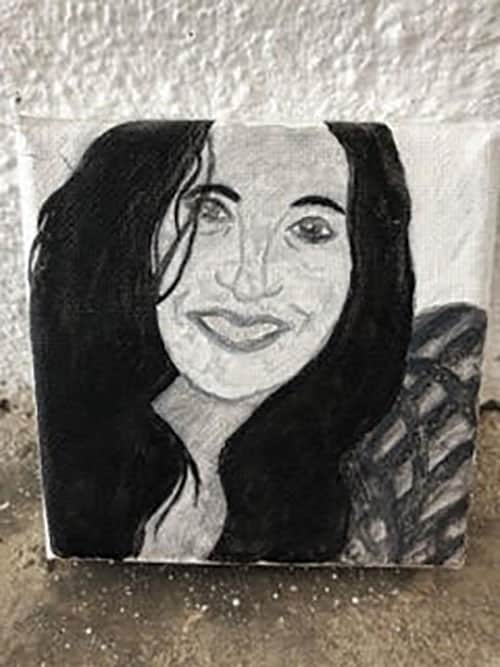
Noami Ackerman portrait by daughter Ella Harrington
Our mom is a positive role model We wanted to give a shout out to our mom, Naomi Ackerman, for being so thoughtful and caring during this quarantine. Not only has she managed to navigate raising three children during a pandemic, she has been working to help countless people outside of our family as well. She has spent hours collecting games, cards and materials to donate and deliver to lockup facilities and juvenile centers across Los Angeles. Even though she has been working remotely, she makes it a point to bake challah with us every Thursday night so that we are able to go out Friday and deliver them to family friends and members of our synagogue who may not have access to a store to buy challah. She is constantly thinking about how to help others while encouraging us to do the same. We are so lucky to be growing up with such a positive role model in our lives and are so grateful for all that she has done to make this quarantine more manageable.
Love you very much, Mom. Zohar (16), Ella (14) and Hadar (12) Harrington
My mom makes quarantine fun Hey, Mom. Happy Mother’s Day. I love you so much. I love how in quarantine you’ve scheduled all these things like the Lego challenge that we get to do with me and my friends. It’s also so nice how you’ve been scheduling my days. It’s just awesome. Thank you. I love spending time with you. More time with you now. Grover Siegel (12)
Lara Rodin
My mom is my loudest cheerleader For my mom, Andria. My loudest cheerleader, my personal chef and chauffeur.
A shoulder to cry on, a hand that is always there to pick me up when I fall.
Each of your moments you give to others. How do you find a moment for yourself? For my mom, my best friend, my most trusted confidant. Thank you.
Happy Mother’s Day. Lara Rodin — Canada
Noa Kligfeld
Our mom provides endless support For my mother, Havi Kligfeld. While working full days, helping my siblings (Ayden, 16, and Lev, 8) in online school, and entertaining them when they don’t have class, my mom still puts incredible dinners on the table every night. Ima, your empathy, patience, sense of humor and seemingly endless support lift our family. I love you. Noa Kligfeld (18)
Becca and Josh Cohn
Our mom is super mom To our mom, Sherri Cohn. Dear Mom, we love you so much and are extremely lucky to have a mother who loves us unconditionally. We are sorry that your birthday and Mother’s Day have fallen during quarantine but it will definitely be a year to remember. You are Super Mom because you’ve been working at home, cooking, walking the dog, cleaning and giving us the support we need to make quarantine not too bad. You are incredible and never forget that.
Love you more than words can explain. Becca and Josh Cohn
Riley Jackson
My mom is a hero For my mom, Shauna Jackson. A hero can be defined in several ways, and these days, I have been thinking even more about who our true heroes are in this world.
Some heroes care for you when you’re sick — we call them doctors and nurses.
Some heroes would run into a burning building just to save you — we call them firefighters.
Some heroes enforce rules to help keep you safe — we call them law enforcement.
Some heroes educate you and impart important life lessons — we call them teachers.
Some heroes help you when you’re struggling emotionally — we call them psychologists.
Some heroes feed you when you’re hungry — we call them bakers and chefs.
Some heroes advocate for those who can’t advocate for themselves — we call them lawyers.
Some heroes help answer life’s most challenging questions — we call them scientists.
Some heroes take you anywhere you need to go and help you navigate the world — we call them drivers and pilots.
Some heroes find simple solutions to complex problems — we call them inventors and entrepreneurs.
Some heroes fill our lives with beauty, culture and music — we call them artists.
Some heroes put their lives on the line just to save yours — we call them soldiers and first responders.
Some heroes will always have your back and drop anything to be there for you — we call them best friends.
And some heroes do all of the above, and more — I call her Mom.
Thank you for everything you do for me, Mom. Happy Mother’s Day. I love you! Riley Jackson (14)
Photo courtesy of Chloe Ross
A mom for all seasons Neshe is the best mom, grandma and woman I know. She has raised eight amazing and beautiful children, who in return brought her beautiful and loving grandchildren, created a designer home and welcomed me as art into her family for over 20 years. Happy Mother’s Day, Neshe. With great affection. Chloe Ross
Shelly Davis and her mom
My mom is my favorite art collaborator During quarantine, I’ve been struggling a lot with my mental health but my mom has been my savior through this time. One of the many things we love to do together is travel and make art. My mom suggested we work on this documentary film we’ve been talking about making for ages. It’s important during this time to find something to keep you busy and filled with joy and passion. My mom has motivated me to get up in the morning and I would be lost without her. Here’s to the amazing woman who knows exactly how to challenge me to be my best self. Thank you for being my best friend and my favorite art collaborator. I love you. Shelley Davis (22)
Sharona Hassidim
My mom is a hero without a cape My mother has been the rock of my family many years before quarantine. My mother’s built-in sensors would wake her up in the middle of the night to tend to my sister and me for any panic-ridden situation. Flash forward to quarantine, even while feeling under the weather herself, she wanted to get out of bed to cook dinner for the family. Obviously we didn’t let her and, in turn, I learned how to cook Moroccan fish for the first time. As a front-line social worker, my mother motivated me to continue my work even through my fears, and when my work hours were cut and I lost the normalcy of having a schedule, she supported my new hobbies of gardening and cooking, and motivated me to remain positive. My mother is a hero without a cape and a constant pillar of strength for my family.
Thanks, Mom, for everything you do. Sharona Hassidim
Hudson and his mom Hillary Helstein
My mom keeps me safe I just turned 7 during quarantine. I don’t like the coronavirus pandemic. It makes me feel sad. The playgrounds are closed and I can’t go to first grade anymore, and I can’t even see people. My mom, Hilary, keeps me safe and tries to calm me. She helps me with things. I love that I can cook together with her and we play together and take walks every day. I love you so much, Mommy. Thank you for being my mom. Happy Mother’s Day! Hudson Helstein (7)
Amelia and Hilary Teeman
Mom is guiding us through the worst times To my Mom, Hilary. Our mom is the one who guides us through the worst times possible. She is the one who cares for the whole family without being asked to. She is the one who talks to us nicely when we have done something wrong. She is the best at cooking and doing things that she knows we will love. The awesome thing about our mom is that she will do anything to make our family happy. She doesn’t care if she has to wake up at 2 a.m. to buy food online, she just thinks of us. Our mom is the best mom to get us through tough times. To sum it up, our mom is the best mom in our family’s heart! Amelia Teeman
Hayley Goldstein
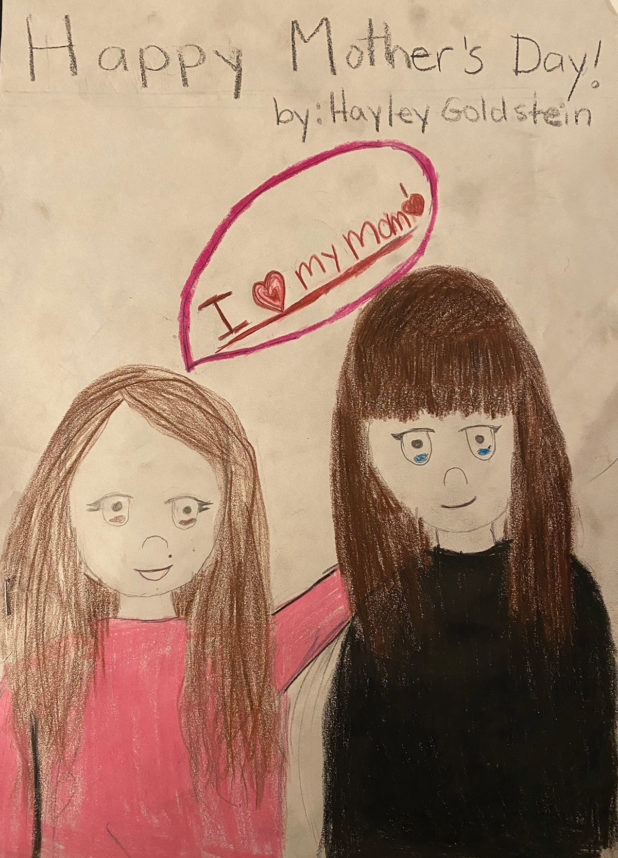
My mom is a great teacher My mom’s name is Cara Shapiro. She is the best mom in the entire world and she does really nice things for me all the time. My mom has made staying at home for the quarantine way more fun. She bakes with me, we go on walks and we watch movies together. She also helps me with my schoolwork and she’s a great teacher! I am lucky to have a mom like her and I drew this picture for her for Mother’s Day. Hayley Goldstein (9)
Tallulah and Katie Younger
My mama makes me smile For my mom, Katie.
Mother’s Day. A day to celebrate mothers around the world. What a great way to show how much we kids — and adults — care about our mothers. Because no mother goes unnoticed. There are truly no words to describe the love I feel for my mama. When I think of my mama, I smile. Maybe not always externally but always internally. She brings me joy. Her mere presence brings a new kind of happiness to me, no matter how I feel. I could talk endlessly about how amazing my mother is as a person. I would do anything to make her happy because I care about her. So as Mother’s Day draws nearer, let’s acknowledge the things, even the little things, that mothers, not just our mothers, do for the world. They’re super. Tallulah Younger (11)
Israeli billionaire and philanthropist Michael Mirilashvili, who was born in the nation of Georgia, reportedly is aiming to deliver hundreds of generators to the Gaza Strip that produce water out of air.
The Associated Press (AP) reported that Mirilashvili’s company Watergen created a device that is able to produce 200 gallons of water a day through converting moisture into potable water. He donated one of the machines to Al-Rantisi Medical Center in Gaza City; it was installed on the roof so it could operate through solar panels.
The machine now provides drinking water for the hospital’s pediatric cancer patients.
Mirilashvili told the AP that he thinks that the Watergen machine can solve Gaza’s water crisis and he plans to sell them to areas of Gaza at a significant discount.
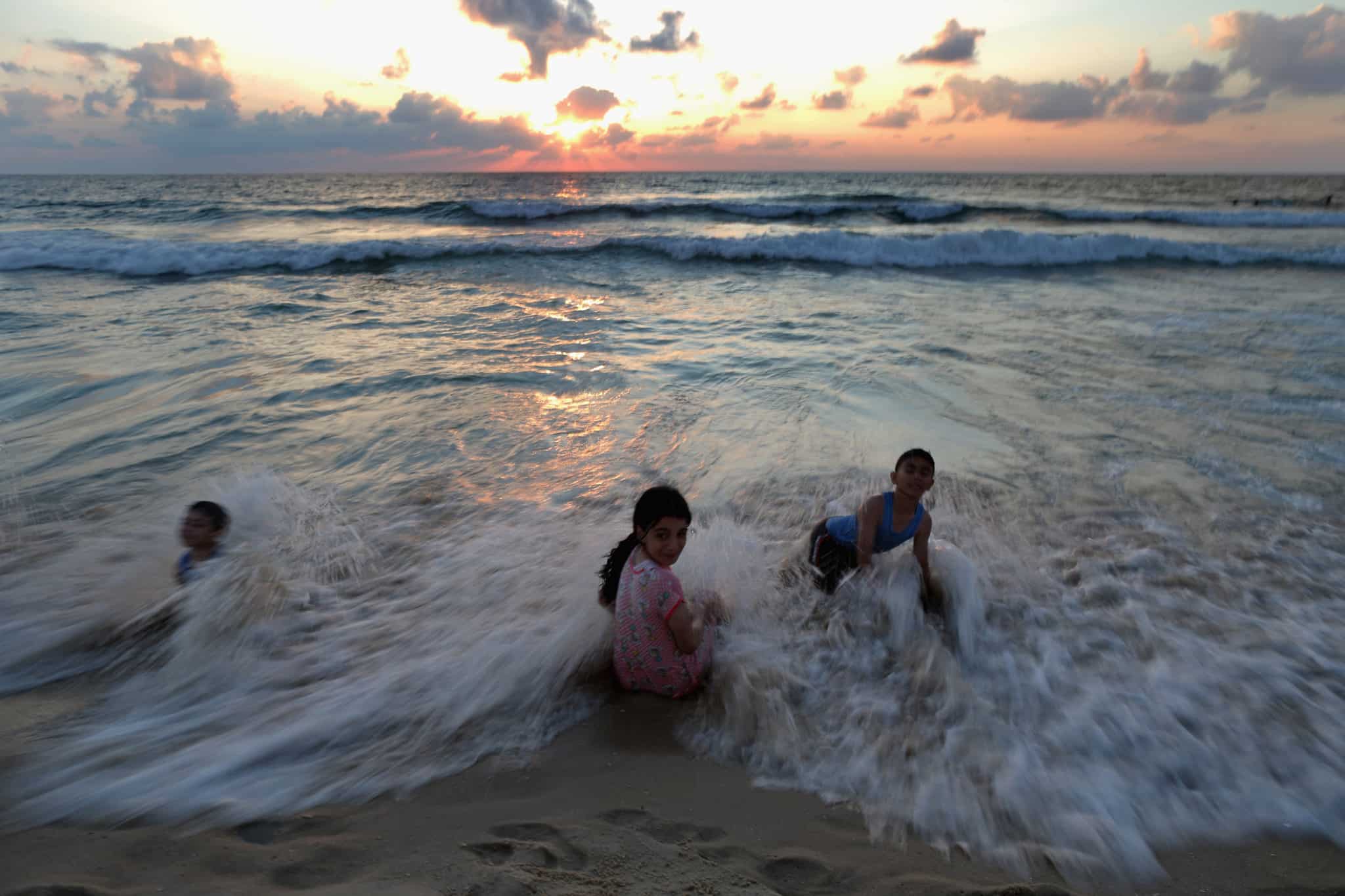
GAZA CITY, GAZA – JUNE 13: Palastinian children enjoy a dip in the ocean at Gaza beach on June 13, 2015 in Gaza City, Gaza. Palestinians are taking the opportunity to relax and enjoy picnics on Gaza beach before the holy month of Ramadan which starts next week. Thousands of Palestinians descend on the 75km sandy beach of Gaza each day to relax, fish and escape the noise and heat of the city. The devastation across Gaza can still be seen nearly one year on from the 2014 conflict between Israel and Palestinian militants. Money pledged by the international community six months ago to rebuild Gaza has not materialised leaving many Palestinians impoverished and still suffering with the poor economy. (Photo by Christopher Furlong/Getty Images)
“They [Gazans] are our neighbors and it’s a great pity to look at them suffering from such severe water shortages,” he said.
Fayez Husseini, who runs solar and water businesses in Gaza, told the AP that he first suggested to Mirilashvili that he donate the Watergen device to the Gaza hospital.
“I think both sides need to take electricity and drinking water off the table,” Husseini said. “This should not be part of politics.”
Gaza is heavily dependent on an aquifer for drinking water, but 97% of it has become undrinkable because sea water has seeped into it. Gazans also rely on private waters to desalinate water, but most of it is contaminated because the lack of electricity in Gaza has made it difficult for sewage to be removed from seawater.
Some blame the Israeli blockade for creating the water and electricity shortages in Gaza; according to Jewish Virtual Library, Israel routinely provides humanitarian aid — including electricity and water — to Gazans; Israel delivers around 3 billion gallons of water a year to Gaza.
It took the Israeli military bureaucracy more than a year to approve Mirilashvili’s first delivery of the Watergen machine to Gaza; the device initially was delivered to an undisclosed town in southern Gaza for a different matter.
Mirilashvili owns several casinos, hotels and real estate; he spent eight years in a Russian prison on kidnapping charges but was released in 2008 after the European Court of Human Rights concluded that Mirilashvili didn’t have a fair trial.
If you’ve tried to buy Clorox or Lysol disinfectant wipes, you know they are impossible to find in stores right now. But you can whip up your own disinfectant wipes with just a few simple ingredients.
Now, let me start by saying I am not a doctor or epidemiologist, nor have I played one on television. So I don’t want to make claims that this recipe will eliminate all the germs and viruses in your home. I have checked with the CDC, however, and for homemade surface disinfectants, they recommend either a household bleach solution or an alcohol solution that is at least 70% alcohol.
I’ve found several tutorials for bleach disinfecting solutions, but I didn’t like that they are effective for only 24 hours after you’ve mixed them. Basically, you have to mix a new batch every day, and that didn’t seem practical. Also, bleach can dull some surfaces such as unsealed granite. And don’t get me started on the fumes.
The wipes I’ve made are of the 70% alcohol variety. When panic buying started in late February and early March, rubbing alcohol was all sold out in stores. But just last week, I found it in stock at my local market, so I’m thinking it’s slowly becoming more available.
If you find 70% alcohol at the store, you can use that undiluted in your wipes. But if you have 91% alcohol, like I did, you’ll want to mix it with water to get a 70% alcohol ratio. Why? Isn’t 91% alcohol more effective against viruses than 70% alcohol?
Here’s my little science spiel. Keep in mind that to kill viruses, the alcohol solution needs to remain wet on surfaces for a few minutes for it to be effective. Erica Hartman, an expert in environmental microbiology at Northwestern University, explains that when the disinfectant interacts with viruses, “those chemical reactions aren’t instantaneous — they take a certain amount of time. So what you’re doing when you’re keeping the surface wet is you’re basically allowing time, allowing the chemical reactions to take place.” However, 91% or 99% alcohol evaporates too quickly for the surface to stay wet. The additional water content in 70% alcohol slows down the evaporation.
Alcohol does dry out your hands, though, so use gloves when disinfecting or apply moisturizing lotion immediately after use. And remember that these wipes are for hard, non-porous surfaces and not to be used on fabrics or skin.
So grab your supplies, and I’ll see you in the laboratory, I mean, kitchen.
What you’ll need: 1 cup isopropyl alcohol, at least 70%
1/4 cup distilled water (if using 91% alcohol)
Essential oils such as lavender (optional)
Paper towels
Plastic or glass container with airtight seal
1. If you have 70% alcohol, use it undiluted. If you have 91% alcohol, mix one part distilled water with four parts 91% alcohol (equivalent to 1/4 cup of water with 1 cup of alcohol). That means that 80% of the mixture will be alcohol, and 80% of 91% alcohol gives you alcohol that’s just above 70%. (Like my math there?) If you don’t have distilled water, there is an easy way to make it on your stovetop with tap water. Just google it. Also, you can add a few drops of essential oils to counteract the smell of the alcohol. I used a little lavender.
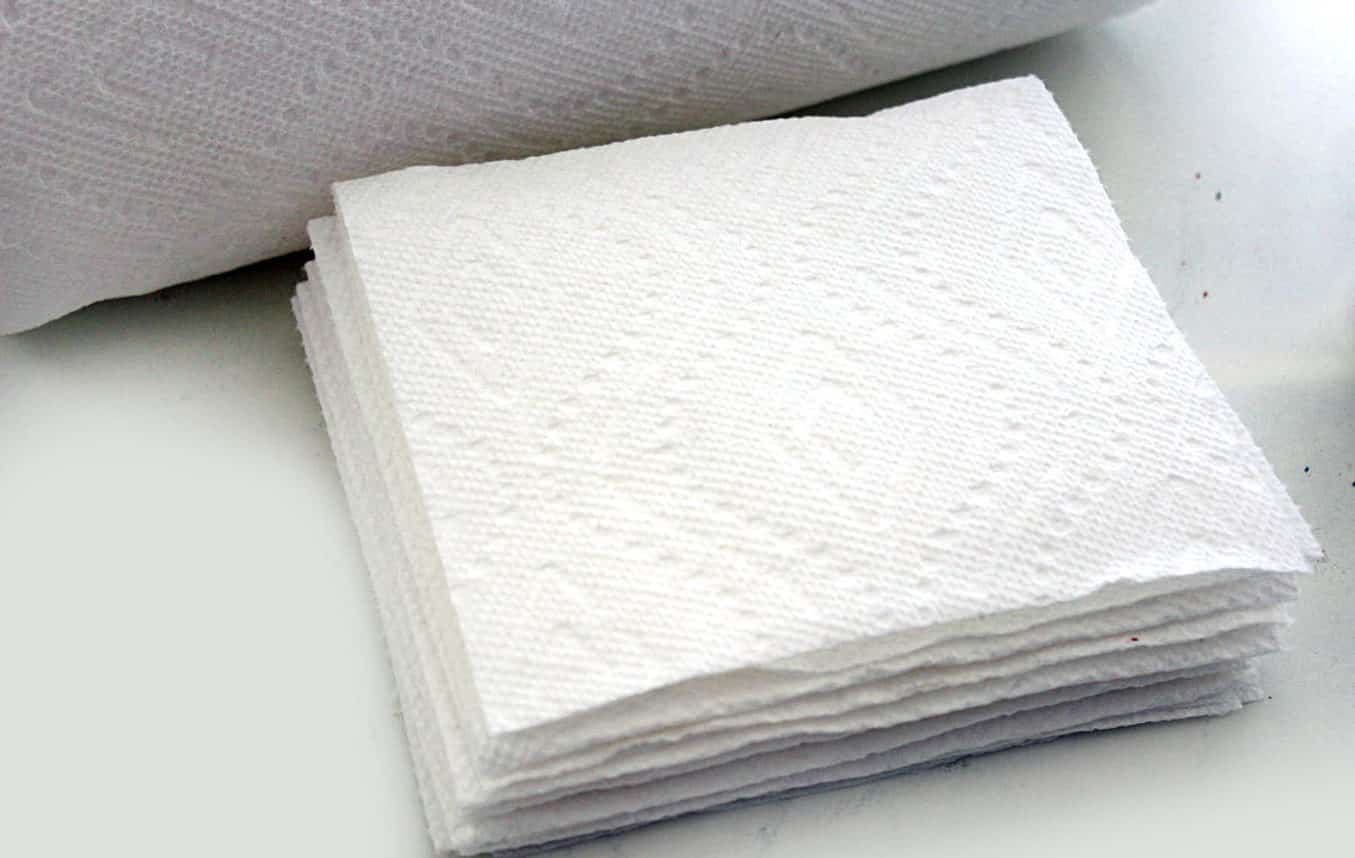
2. Find a plastic or glass container with a lid that will give you an airtight seal. I had a square Rubbermaid food container. Then fold paper towels in halves or quarters that will fit in a stack in your container. Use thick, high-quality paper towels for these wipes so they don’t disintegrate in the solution.
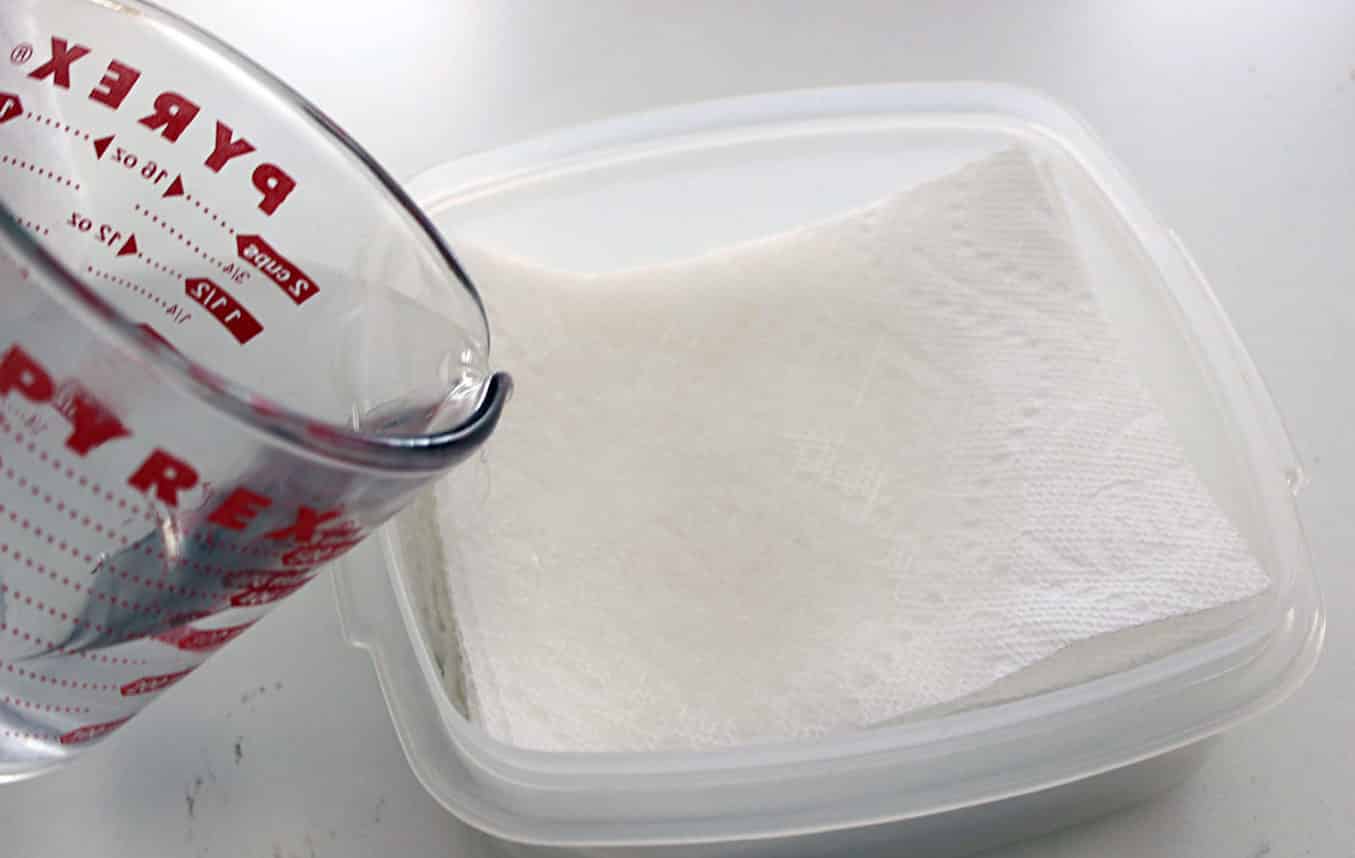
3. Place the stack of folded paper towels in your container, and pour the alcohol solution over them. The paper towels will absorb the solution and be ready to use. I was able to soak about 40 paper towels with the 1 1/4 cup that I mixed. Be sure to fit the lid on tightly to prevent the alcohol from evaporating.