fbpx

April 22, 2020

We Can’t Take The Bond Between American and Israeli Jews for Granted

Ambassador Dani Dayan, consul general of Israel in New York, shared a short message with readers ahead of Yom Hazikaron and Yom Ha’atzmaut.

Dear Jewish communities across the United States, I wish to extend my warmest greetings upon the arrival of Yom Hazikaron and Yom Ha’atzmaut. While our world faces challenging days, one thing remains certain: The bond between American Jews and Israeli Jews cannot be taken for granted. Strengthened by our unity, the Jewish people have been blessed with historical and modern-day miracles. After 3,000 years of survival despite unrelenting persecution, our people’s return to our ancient homeland is nothing short of a miracle.

As Ben Gurion once said, “In Israel, in order to be a realist you must believe in miracles.” During our recent Zoom seders, we celebrated how miraculously, with the parting of the Red Sea, our people found our way to freedom and eventually the Promised Land. Still today, we depend upon our strong will — and our belief in miracles — to overcome our struggles as a Jewish people, especially in these perilous times.

Every year on Yom Hazikaron, we bow our heads in grief as we remember those soldiers and victims of terror in Israel whose lives have been stolen from us. Our pain is immense; with each life lost to hate, we pray it will be the last. And then comes Yom Ha’atzmaut, and we lift our heads in pride, our hearts filled with “Hatikvah” as we rejoice in our people’s re-establishment of our homeland. We are a people of miracles, resilience, and strength — yesterday, today and tomorrow. And while today we cannot stand hand in hand to celebrate together, we know that our bond is deeper than that.

We Can’t Take The Bond Between American and Israeli Jews for Granted Read More »

Can The UK Labour Party Win Back Jews While Working With Corbyn Allies?

To many British Jews, the election of Keir Starmer as leader of the Labour Party this month has been greeted Las an end to four years of fear and disappointment under his predecessor, Jeremy Corbyn.

Starmer is a 57-year-old prosecutor-turned-politician whose wife is Jewish and who has said he wholeheartedly supports Zionism. Immediately after his election on April 4, Starmer acknowledged that Labour had failed to address its anti-Semitism problem under Corbyn for years.

Starmer is a 57-year-old prosecutor-turned-politician whose wife is Jewish and who has said he wholeheartedly supports Zionism.

With the far-left anti-Israel campaigner Corbyn at its helm, Labour was fractured by multiple scandals and lost the support and confidence of a large portion of the country’s Jewish population.

Three weeks into his leadership, however, Starmer has begun to walk a tightrope — between flushing out the anti-Semitism controversy and appealing to the large number of the party’s Corbyn loyalist holdovers — that has given some British Jews reason for concern.

Starmer has already promoted three lawmakers with strained relationships with the Jewish community to leadership positions.

Afzal Khan, Starmer’s pick for shadow deputy speaker of the House of Commons, the lower house of the Parliament, once shared a link on Facebook to an article titled “The Israeli Government are acting like Nazi’s [sic] in Gaza.” In 2015, Khan shared a video on Facebook with captions about the “Israel-British-Swiss-Rothschilds crime syndicate” and “mass murdering Rothschilds Israeli mafia criminal liars.” He later apologized, but then reportedly claimed the video was not anti-Semitic.

Starmer has already promoted three lawmakers with strained relationships with the Jewish community to leadership positions.

Lisa Nandy, Starmer’s shadow foreign secretary, is chair of Labour Friends of Palestine and the Middle East group, an internal lobbying platform. She has expressed support for fighting anti-Semitism within Labour but has endorsed on several occasions the Palestine Solidarity Campaign, a group whose Facebook and Twitter accounts often fail to delete the rampant anti-Semitic rhetoric on their pages. She also signed on last year to a platform that calls for the “return of Palestinians” to the State of Israel — a demand Israel’s advocates say is a euphemism for ending the world’s only Jewish sovereign nation.

Lloyd Russell-Moyle, Starmer’s pick for point man on the environment, in 2017 called for reinstating a Labour activist, Melanie Melvin, who had been suspended for claiming that the BBC faked footage of a Syrian gas attack at the behest of the “Israeli lobby.”

Last week, the Campaign Against Antisemitism, a major communal watchdog, published an analysis of the track records of 32 of Starmer’s nominees for top party positions. The Campaign said that it said shows that Starmer “is not showing zero tolerance to antisemites.”

“He will find his honeymoon short-lived if he delays the hard decisions and actions that are necessary,” the Campaign added in its report.

Labour Against Antisemitism, a group inside the party that grew out of opposition to Corbyn, wrote in a statement that Starmer’s nominations “leave unanswered questions” on Starmer’s commitment to fight anti-Semtism and that “despite some positive signs,” he is “as capable of making inappropriate appointments as his predecessor.”

Starmer’s team did not reply to emails and a telephone query asking for a reaction to these allegations.

However, people with inside knowledge of internal processes within Labour disagree with the assertion that Starmer is reverting to a Corbyn-like system.

“The nominations look bad, but it’s actually a reflection of limited choice,” said one pro-Israel party activist, who spoke under condition of anonymity.

“The nominations look bad, but it’s actually a reflection of limited choice,” said one pro-Israel party activist, who spoke under condition of anonymity.

Following last year’s elections, Labour now has 202 lawmakers in the Parliament — its fewest since 1935. At least 12 former lawmakers had left Labour under Corbyn.

“This means that Starmer is limited. He needs to nominate dozens of MPs, and there are fewer to choose from, so he needs to make compromises,” the activist said.

Labour, which was established in 1900, has dozens of positions that must be filled — the activist says at least 100 — with its lawmakers.

There’s also the trickier task of appealing to the Corbyn supporters who still make up a sizable portion of the party’s base and governing infrastructure. At least 100,000 members joined under Corbyn, constituting about 17% of 580,000 members in total.

“[If] Corbyn loyalists are made to understand they have no place in Labour under Starmer, that’s simply making sure they’ll misbehave,” the activist said.

Gideon Falter, the executive chief of the Campaign Against Antisemitism group, acknowledged these constraints. But while they may explain Starmer’s calculus, they also illustrate how “Corbyn’s poisonous legacy of anti-Semitism has so permeated the Labour Party that there are too few untainted figures amongst its parliamentarians to fill even these few coveted posts,” he said.

Despite the appointments, Starmer has taken several strong steps to distance himself from Corbyn and the scandal that marred his tenure. British Jews have noticed.

Despite the appointments, Starmer has taken several strong steps to distance himself from Corbyn and the scandal that marred his tenure. British Jews have noticed.

Four days into Starmer’s leadership, the president of the Board of Deputies of British Jews, Marie van der Zyl, said in a statement that he had achieved “more than his predecessor in four years in addressing antisemitism within the Labour Party.”

The previous day, Starmer had removed Corbyn nominees from Labour’s governing body, the National Executive Committee. It ended the pro-Corbyn majority in that forum.

Within days of winning the internal elections, Starmer had also set up meetings with leaders of major Jewish groups in a stated effort to mend relations that had effectively been frozen under Corbyn, whom the previous chief rabbi of Britain, Jonathan Sacks, has publicly called an anti-Semite.

Within days of winning the internal elections, Starmer had also set up meetings with leaders of major Jewish groups in a stated effort to mend relations that had effectively been frozen under Corbyn.

Starmer additionally demoted Richard Burgon, a Corbyn loyalist who in 2014 said that “Zionism is the enemy of peace” and who has declined to endorse the party’s own definition of anti-Semitism. Burgon was Corbyn’s shadow justice secretary, the party’s point man for the justice portfolio.

Starmer didn’t say why he sacked Burgon, but many understood it as a powerful statement on the seriousness of his stated intention to clean up Labour’s act.

Critics of Labour’s handling of anti-Semitism have called for years for Burgon’s removal from positions of influence. Mark Gardner of the Community Security Trust, British Jewry’s watchdog on anti-Semitism, wrote in a Jewish Chronicle op-ed from February that Burgon’s remarks “show how deep Labour’s antisemitism problem runs.”

The new leader’s rhetoric on anti-Semitism is also different than his predecessor’s. While Corbyn had apologized after much internal pressure, he never directly acknowledged that the distress for which he was apologizing was genuine — a fact that for Jews added extra sting to the whole scandal. Corbyn had also always insisted that Labour had tackled anti-Semitism firmly and fairly under his leadership.

Starmer, in comparison, has spoken in direct terms.

“I know that the failure of the Labour Party to deal with anti-Semitism has caused great grief in Jewish communities,” Starmer said in a video greeting for Passover on April 8, in which he apologized for the failing.

“If you are anti-Semitic, you cannot and should not be in the Labour Party. No ifs, no buts,” Starmer wrote in an April 7 op-ed published in the Evening Standard. “I will leave no stone left unturned in the fight against anti-Semitism. That is my promise to the Jewish community.”

“If you are anti-Semitic, you cannot and should not be in the Labour Party. No ifs, no buts,” Starmer wrote.

He added that this is “a moral imperative, not a political one.”

“This is not Corbyn continuity. And that’s huge,” said David Hirsh, a senior lecturer on sociology at Goldsmiths, University of London and author of the book “Contemporary Left Antisemitism.”

Starmer’s wife, attorney Victoria Alexander, comes from a Jewish family and has family in Israel. Starmer told the Jewish News that he hoped to travel soon to Israel with their two children.

“I absolutely support the right of Israel to exist as a homeland,” he told the newspaper, and “I support Zionism without qualification.”

Starmer led the Crown Prosecution Service, the main public criminal prosecution agency for England and Wales, for five years until 2013. In 2015, he took up a top spot within Labour under Corbyn as the party’s point man about Brexit.

Even back then, Starmer’s track record on anti-Semitism indicated that he did not see eye to eye with Corbyn on the issue.

At a time when Corbyn was trying to get the party to reject the International Holocaust Remembrance Alliance’s definition of anti-Semitism because it lists some examples of Israel hatred, Starmer publicly said the party should adopt that definition.

At a time when Corbyn was trying to get the party to reject the International Holocaust Remembrance Alliance’s definition of anti-Semitism because it lists some examples of Israel hatred, Starmer publicly said the party should adopt that definition.

“I believe in the full definition. Councils, institutions across the country have accepted the full definition. I think that’s the right position to be in,” Starmer said in a BBC interview in 2018.

Whereas Corbyn insisted on an individual review for anyone accused of ant-Semitism, Starmer called for automatic punitive action.

“I would support a rule change that says you expel in clear cases of anti-Semitism automatically, just as we do for people who support another political party in an election,” Starmer told the BBC last year, when he was shadow Brexit secretary and formally prohibited from diverging from the party line.

He also issued what had been his strongest criticism of Corbyn prior to his election in that BBC interview.

“Be very clear: If you deny we’ve got a problem, that’s part of the problem,” Starmer said.

Can The UK Labour Party Win Back Jews While Working With Corbyn Allies? Read More »

UNRWA Says Hand Grenade, Military Vest Found At One of Its Gaza Schools

The United Nations Relief and Works Agency (UNRWA) announced in an April 22 statement that it discovered a hand grenade and military vest at one of its schools in the Gaza Strip. The statement noted the military items were found during a routine inspection at an empty school on April 21, and UNRWA informed Israeli and Gaza officials.

“UNRWA strongly and unequivocally condemns the individual or group responsible for this flagrant violation of the inviolability of its premises under international law and calls on the de facto authorities in the Gaza Strip to ensure that this inviolability is respected and upheld,” it stated.

The statement went onto say UNRWA does not allow weapons at its schools.

“At all times, and especially during exceptional circumstances like this period, the sanctity and integrity of UN installations must be respected,” the statement concluded. “The use of schools for military purposes is strictly prohibited under international humanitarian law.”

In 2015, the U.N. released a report stating Hamas and Islamic Jihad stored rockets in several UNRWA schools in Gaza in Operation Protective Edge in 2014; one of those schools was open for children to use the playground. Hamas and Islamic Jihad also launched rockets toward Israel from Gaza schools.

Pro-Israel activist Arsen Ostrovsky tweeted, “Just another day at @UNRWA…”

UNRWA was established in 1948 after Israel won the War of Independence, to provide aid to Palestinian refugees. The Trump administration ceased U.S. funding of the agency, arguing UNRWA needs to be reformed.

UNRWA Says Hand Grenade, Military Vest Found At One of Its Gaza Schools Read More »

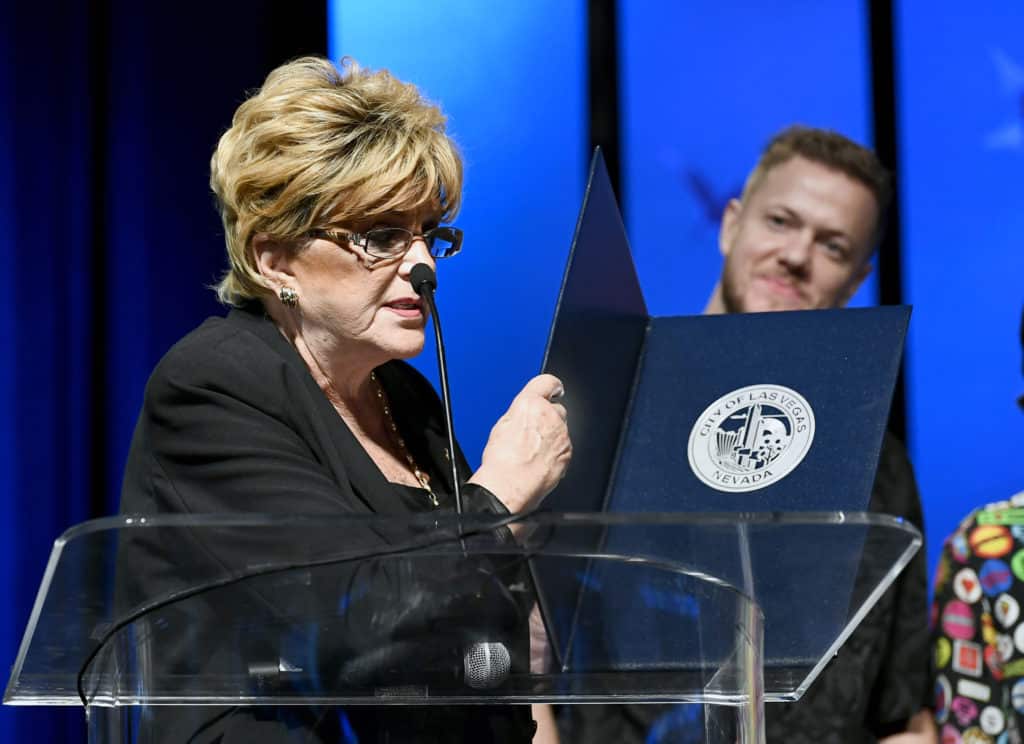
Las Vegas Mayor Carolyn Goodman Offered Her City As a Test Case for Reopening Amid Coronavirus

(JTA) — The mayor of Las Vegas, Carolyn Goodman, offered her city as a test case for bringing people back to work during the coronavirus.

“I offered to be a control group,” Goodman said Wednesday on CNN. She also said “it was turned down” but did not say by whether it was the state or federal government.

Anderson Cooper, the CNN host, said that would mean people would likely die as part of the experiment.

“You don’t know that,” she replied.

Goodman said the city statistician explained to her that because people routinely commute to Las Vegas from other parts of the state, Las Vegas would not provide useful data.

The mayor does not have the power to reopen businesses — that’s a matter for the state government — but she has been on a publicity tear asking authorities to reopen the city and its casinos for business.

“We do deal in crowds and we have lived through all of these viruses, highly contagious diseases, and yet we have managed to continue to have wonderful conventions come up here,” Goodman said Tuesday on MSNBC.

Goodman said businesses would be responsible for ensuring clients kept the required social distancing of six feet from one another.

Goodman, an Independent, has been mayor since 2011. Her husband, Oscar, was mayor from 1999 to 2011. For years she was involved in her city’s organized Jewish community.

Las Vegas Mayor Carolyn Goodman Offered Her City As a Test Case for Reopening Amid Coronavirus Read More »

Is COVID-19 Unprecedented? Not Really…

We are in our sixth week of “Safer at Home.” What we are going through collectively and globally, is unprecedented—in our lifetimes but not in world history.

In 1831, there was a cholera outbreak that swept across Europe, killing tens of thousands of people. Jews of that time turned to their rabbis for advice about how to conduct themselves in the face of the contagion. One of the great leaders of the day, Rabbi Akiva Eiger (1761-1837) of Posen, which was then part of Prussia, was asked how the community should best respond to the crisis. Here’s some of the advice that Rabbi Eiger shared: Gathering in a small space is inappropriate, but it is possible to pray in groups, each one about 15 people altogether…

…Collect for each community member… six large coins, and use this to fund saving [the] lives [of those stricken with the disease]…

Be clean. Don’t leave any filth or dirt in the home…

And try not to worry. Distance yourself from any kind of sadness… When the sun is shining, take a stroll in the fields for some fresh air…

Wise counsel even 189 years later: practice social distancing, collect funds to provide support for the community, practice good hygiene, get outside for some exercise, and endeavor to remain hopeful.

We will survive this, just as Rabbi Eiger’s community did. We will be changed by it, to be sure, but we will—collectively—survive. In some ways, I imagine and I hope, we will grow from this and be even stronger. And, just like in Rabbi Eiger’s time, the path to survival is a shared one. We need each other—right now—more than ever. Now is the time to support one another, our congregations, our schools, our community more fully. Now is the time to find comfort and strength in the wisdom of our tradition.

This is a challenging moment. How grateful we are to be part of a community that knows how to navigate such difficult times.


Rabbi Yoshi Zweiback is the senior rabbi at Stephen Wise Temple and Schools.

Is COVID-19 Unprecedented? Not Really… Read More »

Progressive Woman Nominated to Chair Major American Jewish Organizations Conference, Stirs Backlash

The Conference of Presidents of Major American Jewish Organizations, an umbrella group with 53 politically and religiously diverse dues-paying member organizations, announced this week that it is nominating Dianne Lob, a former chairwoman of HIAS, to be the new chairwoman of its executive board.

Unlike the appointment of previous chairmen, who serve for terms of one to two years, the surprise nomination has caused a major backlash among longtime active Conference members and donors.

“Ms. Lob was recommended by a splintered Nominating Committee, and her nomination has caused a serious rift in the Conference of Presidents,” said Roberta Goldstein, former national chairwoman of the State of Israel Bonds.

“It is very sad to see this happening at a time when the Conference should be working to unite the American Jewish community,” Goldstein told JNS.

Previous nominees for Conference chairperson were recommended unanimously to member organizations prior to a formal vote, even if there were dissenting votes within the nominating committee. Lob’s nomination, by contrast, is reported to have been approved by just a single vote, with the other members of the committee refusing to allow the recommendation to be issued unanimously.

A press release announcing Lob’s nomination stated that “the nominating committee unanimously recognized the integrity and thoroughness of the nominating process that led to this recommendation.”

The wordsmithing led to some confusion among member organizations. In an email sent by Sheila Katz, CEO of the National Council of Jewish Women, to member organizations encouraging their vote for Lob obtained by JNS, Katz wrote, “I’m thrilled that Dianne Lob has unanimously been voted as the nominee for the incoming chair of Conference of Presidents by the selection committee and we will all get to vote her in soon. This is the first time in over a decade that a progressive woman is the nominee … ”

Roll-call vote scheduled to take place this coming week via Zoom

While Conference members range from progressive to conservative, the organization, led until this year by executive vice-chairman Malcolm Hoenlein, was a comfortable home for many organizations that aligned closely with the policies of Israel’s right-wing government. They felt that the Conference walked a careful line balancing right-wing and left-wing political agendas, and found consensus among the diverse Jewish member organizations. Many of the Conference’s longtime financial supporters came from this camp.

This past year, Hoenlein announced that he would step into a part-time vice chair role, with the appointment of William Daroff, longtime senior vice president for public policy and director of the Washington office of the Jewish Federations of North America (JFNA), as the new CEO of the Conference. Daroff, who previously worked on the campaign staffs of three Republican candidates for president, was seen as a candidate who could successfully work with liberal mainstream Jewish American organizations without alienating the Conference’s right-wing base, which over the years has demonstrated its strong loyalty to Hoenlein.

Lob’s nomination has drawn ire from many longtime members (including JNS publisher Joshua Katzen), who were not even aware of her candidacy.

In addition, many members are concerned that a roll-call vote scheduled to take place this coming week via Zoom in light of coronavirus travel restrictions will not allow for appropriate debate of Lob’s candidacy.

Of particular concern to many Conference members and donors is Lob’s role as immediate past lay chairwoman of HIAS, widely considered to be one of the member organizations most critical of Israeli government and Trump administration policies. Many members are now openly questioning whether HIAS, formerly known as the Hebrew Immigrant Aid Society, should continue to be a member of the Conference.

According to Conference bylaws, its mission is “to strengthen all aspects of the U.S.-Israel relationship, and to protect and enhance the security and dignity of Jews at home and abroad.”

The bylaws state that membership is “available to those major national Jewish organizations whose primary purpose is to serve the interests of the American Jewish community, and whose activities are consistent with the goals and objectives of the Conference of Presidents.”

The HIAS website states that while the organization was founded as the Hebrew Immigrant Aid Society, “as we expanded our mission to protect and assist refugees of all faiths and ethnicities, we realized our name no longer represented the organization. We are now known as HIAS, the global Jewish nonprofit that protects refugees.” In recent years, the majority of refugees HIAS has worked to assist in coming to the United States are not Jews, but Muslims, and people from other religions and nationalities.

Professionally, Lob is head of Global Business Development for AllianceBernstein, a global asset-management firm.

Alexander Smukler, president of the National Coalition Supporting Eurasian Jewry, told JNS that “I am surprised that the Conference, which has always been a strong supporter of Israel, would choose someone from an organization that has such a clear record of partnering with anti-Israel organizations like J Street, IfNotNow, CAIR and others.”

Morton Klein, president of Zionist Organization of America, sent a lengthy and detailed letter to the current leadership of the Conference as well as member organizations insisting that, “electing Ms. Lob would undermine and create multiple serious conflicts with the COP’s mission to help Israel and the Jewish people, and would damage the COP’s relationships with U.S. federal, state and local governments and the Israeli government and people.”

‘Chair’s role is to build and present the consensus view’

In a letter written to member organizations by outgoing Conference chairman Arthur Stark in response to the backlash, he wrote that the rules of the nominating process “were rigorously followed by the Nominating Committee,” which he said “reflects the wide spectrum of our member organizations. It was a deliberate process that followed the same sequence as previous years, other than the meetings and interviews taking place via video, due to the COVID-19 crisis.”

Addressing concerns that Lob is unknown to most of the members who attend multiple meetings each year, as well as a weeklong summit in Jerusalem each February, Stark wrote that “some of you who have not had the opportunity to meet Dianne appear to be drawing conclusions about her views or positions. Dianne became involved with HIAS in the days of the Soviet Jewry movement. I would recommend that your view of HIAS should not be conflated with Dianne as a leader. She has demonstrated, in seeking to take on this role, a thoughtful and centrist outlook. My guess is that you will recognize this upon getting to know her.”

In a second letter to member organizations, the Conference identified Lob as “chair elect” over a week prior to the upcoming election on her candidacy—a strong indication that the current Conference leadership expects the nomination to be confirmed. Lob wrote in the letter that “the Conference must continue its historical commitment to support the democratically elected government of Israel and to strengthen the ties between Israel and the United States, as well as with the American Jewish community.”

She added that “the role of the Chair is to build and present the consensus view that will ensure a unified communal response on the important challenges and issues of the day. I will wholeheartedly uphold that responsibility and will work to strengthen unity in our community.”

Neither Daroff nor Hoenlein agreed to provide comments to JNS on the record, but both insisted that Lob is a qualified candidate. Each expressed their view that she would likely be confirmed during next week’s vote.

For the longtime dues-paying members and donors of the Conference’s right-wing flank, Lob’s nomination serves a notice that the Conference now led by Daroff intends to more closely align itself with larger and much-better funded liberal mainstream Jewish organizations, including JFNA, where Daroff previously worked, and the Anti-Defamation League, which is widely seen as having become increasingly critical of Israel following the retirement of longtime national director Abe Foxman and the installation of Jonathan Greenblatt, a former special assistant to President Barack Obama.

For Daroff and Lob, the reaction to the nomination serves as notice that attempts to shift the Conference’s positioning and messaging from those maintained for decades by Hoenlein will be met with significant backlash.

But given a choice between maintaining the loyalty of a smaller and older right-wing Zionist base, or aligning with a larger and better funded liberal Jewish communal structure, Daroff and the nominating committee may be actively and intentionally shifting the Conference’s direction, effectively putting an end to Hoenlein’s 35-year strong influence over the Conference.


Alex Traiman is the managing director and Jerusalem bureau chief of Jewish News Syndicate.

Progressive Woman Nominated to Chair Major American Jewish Organizations Conference, Stirs Backlash Read More »

L.A. County to List Restaurants With Coronavirus Outbreaks

Los Angeles County will start to compile a public list of restaurants that have had verified reports of COVID-19.

The Los Angeles Times reported that on April 21, County Public Health Director Dr. Barbara Ferrer said, “Later this week, we will be including on this list restaurants that have had outbreaks as well.” The list she referenced includes institutions such as jails and nursing facilities that have had outbreaks of the virus.

The Times noted that Ferrer did not specify how the county would enforce this policy. The newspaper’s Twitter account started a poll on what users thought of the measure; as of this writing, around 68% said they approved and an estimated 19% disapproved.

Ferrer announced in an April 22 press briefing that there were 1,318 new cases and 66 deaths from the virus, bringing the county totals to 16,435 and 729, respectively. She added that 40% of the county’s COVID-19 deaths have been in nursing homes and that the county is moving toward testing everyone in those facilities, even if they’re asymptomatic.

“It’s become clear that asymptomatic people are capable of spreading the virus,” Ferrer said.

On April 20, the county published a report finding that as many as 440,000 people in the county have COVID-19 antibodies. The nonprofit myCovidMd is offering free drive-through tests on April 24-25 in Culver City for people to be tested for these antibodies.

California Gov. Gavin Newsom, a Democrat, said in an April 22 press briefing that although he still could not give a firm date on when the state will lift its shelter-in-place order, California is starting to see the curve flatten. He also said that hospitals now can start to perform non-COVID-19-related procedures, such as surgeries to remove tumors.

“We are working with our health directors and throughout the health care delivery system to reintroduce the capacity to get these scheduled surgeries up and running again,” Newsom said. “We will be very thoughtful and judicious about how we do that.”

L.A. County to List Restaurants With Coronavirus Outbreaks Read More »

Half of Jewish Groups That Applied Got Government Loans Totaling $264 Million, Survey Finds

(JTA) — A new survey found that Jewish organizations have received at least $264 million in U.S. government loans under the recently passed stimulus bill.

As of now, the federal loans collectively represent the largest infusion of cash into the Jewish organizational world since the beginning of the COVID-19 pandemic. But even according to conservative estimates, the money fills less than half the anticipated need for Jewish nonprofits.

A document produced last month by Jewish Federations of North America, an umbrella group for communal fundraising bodies, says that Jewish organizations will require at least $650 million to weather the crisis. Other leaders have quoted higher numbers.

Jewish Federations CEO Eric Fingerhut said “it wouldn’t surprise me if it’s higher.”

Fingerhut, whose group published its survey of American Jewish nonprofits on Wednesday, said the government “will turn out to be the largest single contributor filling the hole” in the short term.

He said the grants are “a tremendous, tremendous benefit” — but they’ll need supplementing.

“Private philanthropy will play a very, very important role. But government will turn out to have been the largest share, which is appropriate,” Fingerhut said. “This is a government-scale crisis.”

The Jewish Federations survey garnered more than 1,100 responses from Jewish nonprofits that applied for loans. Approximately half the respondents, 579 groups, said their applications were accepted, according to the initial results.

The loan amounts ranged from $5,000 to nearly $5 million, with the median at $256,000. Jewish Federations estimates that Jewish groups in total could receive as much as $500 million in government loans.

Some donors have pledged funds to help Jewish groups. This week, a coalition of leading Jewish philanthropic foundations created an $80 million fund for groups that focus on “education, engagement and leadership.” Some Jewish federations, which act as communal funding bodies, also have announced COVID-19 relief funds. New York’s UJA-Federation has dedicated $44 million to organizations during the crisis.

The Jewish Federations survey said that in addition to the accepted applications, another 418 were still waiting for a response.

The initial government stimulus package, which began taking applications earlier this month, provided nearly $350 billion in loans to small businesses and nonprofits. That pool, called the Paycheck Protection Program, has since run out.

On Tuesday, the Senate approved a stimulus package that included another $320 billion in loans for small businesses. The House of Representatives is expected to vote on the package this week.

Half of Jewish Groups That Applied Got Government Loans Totaling $264 Million, Survey Finds Read More »

‘The Gift of Presence: A Mindfulness Guide for Women’

Like many type A’s forced into the slow lane by the coronavirus, I’ve continued to find ways to cram my days with online and home projects. Stopping to think made me sink. Mindfulness was becoming “mine-fieldness.”

Reading Caroline Welch’s “The Gift of Presence:  A Mindfulness Guide for Women” (Penguin Random House) during this quarantine has transformed my fear-fueled speed into a more contemplative and aware retreat from the monkey mind.

The author, CEO and co-founder of the Mindsight Institute in Santa Monica, has aggregated the most accessible wisdoms of thought leaders in brain health and meditation and targeted them to women who habitually want to be it all.

From her extensive research Welch provides scientific evidence that women maintain far higher stress levels than men and take more responsibility internally.  Females juggle more purposes per pound of flesh than males and must discern who they are (mother, homemaker, wife, cook, office worker, daughter).

Welch advises that we are a “fruit salad” of separate purposes, rather than a pureed “juice.” Trying to be a blend of all roles at the same time is ill advised, she wirtes.

Taking time to become newly present between meaningful phases—whether in the shower, or allowing yourself to truly see a sunbeam, or hear raindrops — regains you the grace essential for balance, she instructs.

Since finishing her book, I’ve found myself breathing deeply when on hold in a state of gratitude, which is a gateway to the mindfulness I’ll need when some lovely tech support person gives me complex information. With these small steps I’m building the capacity for longer periods of meditation when my need grows even greater.

If you’ve never mastered a formal sitting meditation practice, yoga or tai chi, if you’ve given low priority to developing inner peace, Welch advises that you make every moment a portal for “presence,” for being in the moment. She suggests starting with three-breath “mini-meditations,” gazing at a nearby object. These buffers between overreacting and simply responding from calm “without interpretation,” can gradually extend mindfulness of the thing itself into every waking moment. With that calm, we can dismantle our mental constructs and our negativity bias from a peaceful remove.

Welch offers helpful acronyms like FOMO (fear of missing out), and MOON (missing out on now), to help  discern what our mind is experiencing. She guides us to give ourselves credit for WWW (what went well) in gaining the ability to observe what we are doing with our minds on purpose. Just recalling what the letters stand for slows me to a healthier pace.

And when you have the presence of mind and time to sit, Welch recommends trying these three simple approaches: focused attention on an object; or open monitoring—a flexible awareness of phenomena around you, including your own thoughts; and lovingkindness meditation—extending compassion to others, which comes most naturally at this time of crisis. And she advises us to extend self-compassion most frequently to ourselves.

Although researched and published just before our stay-at-home orders commenced, “The Gift of Presence: A Mindfulness Guide for Women,” could not have been released at a better time. Our current circumstances make these lessons more valuable and will provide an essential resource for all the healthier eras to come.

‘The Gift of Presence: A Mindfulness Guide for Women’ Read More »

United Hatzalah CEO Returns to Israel After Monthlong Battle With Coronavirus

United Hatzalah CEO Eli Beer landed in Israel on April 21 after spending over a month in Florida battling COVID-19.

Video can be seen of Beer arriving in Israel to applause as he was reunited with his family:


However, Beer is unable to stay with his family for the time being because his family lives on the fourth floor of a building that has no elevator and he’s still too weak from the virus to use the stairs, according to Yeshiva World News. He is currently residing at a friend’s apartment in Tel Aviv.

Beer was hospitalized in Florida on March 18 after developing COVID-19 symptoms and was in a coma from March 22 to April 10. He attended a Purim event in Miami as part of a fundraising trip for United Hatzalah. He told The Jerusalem Post on April 22 that his COVID-19 symptoms started with a sore throat, prompting a doctor to initially diagnose him with strep throat. Beer was hospitalized when he had difficulty breathing.

Beer said that when he was intubated and put under sedation, he “was sure I was not waking up.” After Beer woke up, he said that the ensuing days were an “an extremely hard, emotional journey.” The medication used to help him recover from the virus caused him to hallucinate that the doctors were trying to kill him; he was unaware that Passover was over.

Beer told Yeshiva World News on April 20 before boarded the plane back to Israel, “I fought for my life for several weeks. Now I’m returning to Israel to continue saving lives.”

United Hatzalah Director-General Eli Pollak told the organization’s volunteers on April 20, “God is rejoicing today. Thank you for the prayers, hopes, life-saving work and good deeds.”

United Hatzalah is a Jerusalem-based, free, volunteer-staffed emergency medical service.

United Hatzalah CEO Returns to Israel After Monthlong Battle With Coronavirus Read More »