fbpx

April 20, 2020

I’m Not Going To Take It

Editor’s note: This story was originally published July 27, 2015. It has been reformatted for Yom HaShoah.


I interviewed Sidonia Rosenheck Lew in 1996, when she was 74 years old. Her nephew’s parents had both passed away, and Sidonia was his best link to the stories about their lives in Eastern Europe, so he arranged for the interviews.  This is an excerpt from her in-depth oral history.

Sidonia was almost 20 when the Nazis came to their small Galician town, Tslumatchik, in the Western Ukraine, then part of Poland. From 1941 to 1943, she was in the nearby ghetto in Kolemeya until her escape.

“Every day, I had to go to work; it was hard labor.  The streets were concrete and paving stones they told us to break up the street–men and women together– and put the cement and rocks into wheelbarrows.  Then we had to take a shovel, dig up the soil and clean up the little rocks and plant there vegetables.  It was maybe about two acres of land.  We worked every day.

Near the end of 1943, a doctor Horovitz, a good friend and on the Jewish council, was there with a family and two children. He brought poison for his family and for us.  I said, ‘I’m not going to take it’ and my father, Yedudah-Zeide Rosenheck agreed and said, ‘Good for you. Whatever is meant to be it’ll be.  We’ll come to heaven without any sin on our back.’

One day, some people in our streets had to go to the registration.  If not, they were going to pick them up and kill them.  My father, Yehudah,  figured maybe he’d have a chance so he went to the registration. They pointed to the right or left.  My father went to the side that was for killing.  They took him away, I didn’t know where to.  Later, I found out it was Belzac death camp.

Every day, there were more and more transports to the east.  They started grabbing anyone they could find.  They were hungry for Jewish blood.  They were making the Ghetto ‘Juden Rein’.

I took a shawl and I wrapped myself around with it and I jumped over the fence to get away.  The shawl got caught on barbed wire and I was hanging.  I couldn’t get free, so I unwrapped it and I left the shawl there.

I was hiding in the woods. In the morning the people used to come to cut the trees, and I was not safe, so I came to my town and I went to the priest. He was good friends with my father.   It was late at night when I got to his house.  He opened the door and looked at me. ‘My God in heaven, how did you make it up until now?  I heard that all of you got killed.  You can stay with us, but not in the house.  I’ll put you in the barn.’

He brought me in a bucket some good food every day for a week.  I used to cover myself with hay, and one day I heard somebody with a pitchfork, taking hay for the horses.  He felt me, so he put down the fork and found me.  He recognized me right away.  He was the mailman and he used to be so happy to bring us mail because it was always from America.

He said to me, ‘You can stay here as long as you want, I wouldn’t tell nobody you’re here.’  But I didn’t trust him;  I didn’t trust anybody.  Soon he went away and I figured that he probably went straight to the Gestapo and they would come to pick me up, so I escaped from there.

Our father used to teach us to tell time and direction and I knew where was east and west, south.  So I knew where to go.

I don’t know how it happened, but I got caught.  They took a group of us to the Shiporova forest.  They took many groups there for “aryan labor” and they were never seen again. There they were taking Jews to dig one big grave.  Then they put a board across the width of the grave and they told the people to go undress completely, and made us stand on the board.  They were shooting one by one, and the bodies fell. I got so frightened that I fainted.  They didn’t know I wasn’t dead because so many people were on top of me, dead already.

I don’t know how many hours it was before I came to and then I didn’t know what happened.  I was so wet and sticky, so I figured there must be more people and more blood than my own.  I touched myself all over and I didn’t have any pain. I got out and there was still,  under a tree, a big bundle with clothes.

Everyone else was dead.

The barns they locked, because they had trouble with the Jews hiding there and eating up the food from the pigs and cows.  So they didn’t leave them open anymore.  So I slept in caves.

I was running in deep snow and I came to a place where there were Polish people who were very strict and plain Christians. My father always thought were anti-Semitic and said to never go to this guy because he will be the first to kill you.

This man, when he saw me coming, picked me up and carried me into the house.  The wife washed me because I was so filthy. I had lice in the body already.

He gave me a place in the hay, on top of the stables and he gave me food.  It was so delicious, stuffed cabbage.  He brought a lot and I hadn’t eaten for years and I was so hungry and I ate and ate.  That night I will never forget.  I thought everything was going to break inside of me.  So much terrible pain.  He gave me some medicine.  I figured if it was poison I don’t care already, it was too hard to struggle. But he was good to me. You could never believe that he was not like my father thought he was.  I don’t remember his name.

I left there eventually and walked and walked and walked.  I didn’t know where I was walking.  It was winter.  I stole clothes from the clothes lines. They were frozen when I would get them, and the sun melted the ice.

I went back to the ghetto.  There were still a few people in the ghetto but they were hiding out in a cellar.  We were safe there for a few days.

Then the Nazis came with dogs.  They picked us all up and they sent the whole group on a train to Belzac.

I heard someone say, ‘Soon we’re going to be in the concentration camp.’

I decided it was time to do something. The train was moving slowly around a bend and moving up hill.  I saw my chance and I took it.   I jumped through the window, just like the cowboys do. I broke the window and I rolled down a long hill and I fell in a deep hole.  I hurt my back, and I still have trouble with the pain.

I walked and walked through the woods and came out to the fields already.  No homes, only fields —they had a lot of land, these very rich farmers.  Finally I saw a little house, and I figured I have to get into this house because I can’t make it anymore.

I thought, if they know I’m Jewish they’ll put me away.  Fortunately, I was dressed in clothes like a Russian peasant girl.

The man asked, ‘Who are you?  What happened to you?’  In perfect Ukrainian, I said, ‘The Nazis were taking Ukrainian people to work in Germany.  All of them went and I escaped.’

He said, ‘Oh, Jesus’ mother.  How did you get from there?’ I told him that I jumped off the train.

He said, ‘It’s amazing. Don’t worry. Here you’ll have plenty to eat and if you can work you’ll work.  If not you’ll rest until you get your strength.’

I was so worn out I couldn’t eat anything, but eventually I got stronger.

The men were all drafted in the war and this family had so much land and they didn’t have people to work on it.  They were so happy I was there and I worked hard to make them keep me.  They told me they were going to pay me.  They don’t have any money but they will pay me when I’ll go home; they’ll send somebody with a wagon and grains.

I worked for him for a while, and then I left and I walked to another house and they accepted me graciously.

At that time the snow was melting. It was probably spring of ’44.

After a while, the people in the house were crying and saying, ‘It’s a disaster.’  I said, ‘What’s going on?  Why are you crying?’  They said the Russians came in and the Nazis pulled back. The people were afraid to be with the Russians.  I thought, oh, God bless you that they sent the Russians here.

The Russians moved in and liberated and they were very wonderful to the surviving Jews.

They took me to an orphanage to work.  It was in a Polish palace.  The king used to live there years ago.  It was also near the woods, beautiful with balconies and there was a ballroom.  They told me to go to scrub the floor in the ballroom.

I worked very hard but it didn’t bother me. I had peace of mind.


 Ellie Kahn is an oral historian who saves family stories. She can be reached at ekzmail@gmail.com and here.

I’m Not Going To Take It Read More »

Antibody Tests Estimate that 4.1% of L.A. County Adults Had Coronavirus

USC and the Los Angeles County Department of Public Health announced on April 20 that antibody tests from earlier in the month show that around 4.1% of the county’s adult population has antibodies to COVID-19.

According to a press release, 1,000 people in the county were tested at six sites on April 10-11. The results suggest that the number of those infected with the virus was 28-55 times higher than nearly 8,000 cases reported earlier in the month, meaning that from 221,000-441,000 adults had contracted the virus.

Los Angeles Times reporter Soumya Karlamangla noted on Twitter that the antibody testing suggests that the COVID-19 fatality rate in the county is 0.09-0.15%.


USC Professor Neeraj Sood, one of the study’s lead investigators, said in a statement that the results “suggest that we might have to recalibrate disease prediction models and rethink public health strategies.” County Public Health Department Chief Science Officer Dr. Paul Simon, on the other hand, said, “Though the results indicate a lower risk of death among those with infection than was previously thought, the number of COVID-related deaths each day continues to mount, highlighting the need for continued vigorous prevention and control efforts.”

County Public Health Director Dr. Barbara Ferrer said in an April 20 press briefing that it’s unclear if those who have COVID-19 antibodies are immune to the virus.

“More research is really needed to understand what protection do people have who have already been infected with COVID-19,” she said.

Similar antibody test results in Santa Clara County and Chelsea, Mass., were released on April 17. The Santa Clara results suggest that 2.49%-4.16% of the population in the county have COVID-19 antibodies; 32% of the 200 participants in the Chelsea study tested positive for the antibodies.

As of this writing, there are 13,816 confirmed cases in Los Angeles County and 617 deaths from the virus.

Antibody Tests Estimate that 4.1% of L.A. County Adults Had Coronavirus Read More »

Religious Observance Is An Asset, Regardless of The Faith

We now are in the midst of an unprecedented world health crisis, of which the length and depth of destruction still are unknown. It will be interesting to see whether, as our uncharted course continues to evolve, society will rethink the bad rap religion has been receiving as of late in the United States.

The current distancing of our mainstream society from religious tradition is an unfortunate byproduct of a world that increasingly prizes autonomy and personal preferences. Even so, it is a positive sign that many people of different religious backgrounds still observe the traditions they find personally meaningful.

Maintaining religious rituals and participating in religious-based activities not only help preserve distinct cultural-religious traditions but also has been shown to afford important personal benefits to individuals and families. At this time, these benefits are especially important.

In November, 2019, a study by the American Enterprise Institute documented how participation in religious activities among American families, including religious education, is a strong downward trend. Although nearly two-thirds of Americans agree that raising children in a religious tradition is important because it reinforces good values, only 53% of young adults agree with this view. Interestingly, the study found that even among people who are religiously affiliated, young adults are less likely to see the importance of religion compared to senior adults.

The declining appreciation for religious tradition in the general society mirrors the all-too-familiar findings of the 2013 Pew Report of the Jewish community, which revealed that the percentage of American adults who say they are “Jews by religion” has declined since the 1950s. In contrast, “the number of people with Jewish upbringing who consider themselves Jewish but describe themselves as atheist, agnostic or having no particular religion appears to be rising.”

Fewer houses of worship may not be the only casualty of this trend away from religious observance. A 2018 study by the Harvard T.H. Chan School of Public Health showed that children brought up with weekly attendance at religious services reported greater degrees of happiness as young adults as compared with  other children. They also were 29% more likely to engage in volunteer activities and 33% less likely to use illicit drugs. Additional studies also have demonstrated a connection between involvement in religious life and better health outcomes.

Plenty of anecdotal evidence also supports the view that religion has tremendous potential for adding meaning to life and providing a path for coping with difficult times. The idea that religion can provide an important foundation for personal well-being pushes back against the current trend that devalues religion.

The current distancing of our mainstream society from religious tradition is an unfortunate byproduct of a world that increasingly prizes autonomy and personal preferences.

In these difficult times, parents might do well to ponder the benefits of providing children with at least some exposure to religious tradition, even if they are not inclined to join the ranks of the most religiously observant. The good news for people wanting to raise their children with some degree of Jewish tradition is that Judaism’s action-rich religion provides a wealth of opportunity for parents to lay the groundwork for a lifetime of spiritual health. For religiously liberal Jews, observance does not have to be an all-or-nothing proposition. Given the beauty of Jewish tradition and its power to add meaning to our lives, Jews of all levels of observance can benefit from some consistent Jewish practice, even if that practice is “remixed.”

A key element of a remixed approach to Jewish tradition is infusing select aspects of authentic Jewish tradition with personal meaning. A second element of remix is consistent observances of these selected practices. Although annual celebrations such as Passover are important, a weekly celebration of Shabbat, even in a remixed fashion, provides a vital opportunity to imbue family life with Jewish tradition.

Consider the benefits of celebrating just a one-hour, technology-free Shabbat dinner on Friday night with candle lighting and blessings over the challah and wine. This is a feasible goal for most busy families and has the potential for laying a solid groundwork for appreciating the benefits of Shabbat, one of the foundational elements of Jewish practice. Similarly, the rules of keeping kosher provide families with ample opportunities to select and consistently observe elements of Jewish tradition that can be fused with concern for other causes, such as animal welfare and the environment.

Parents who seek to transmit some religious and cultural elements of Jewish tradition must thoughtfully develop and implement personal and family norms of ritual observance. For families who have no interest in living completely according to Jewish law, what matters most is framing their chosen ritually based practices in a positive manner so children learn to respect and value Jewish tradition. Children need to be taught to love Jewish tradition in general and to appreciate the value the authentic rituals practiced by their families can bring to their lives.

Children need to be taught to love Jewish tradition in general and to appreciate the value the authentic rituals practiced by their families can bring to their lives.

This remixed approach to Jewish tradition has great potential to convey to children the importance of religious tradition, and it can provide a path for developing a Jewish journey that is viable for the majority of American Jewish families. Equally important, it provides parents with a way to invest in the spiritual and emotional health of their children.

Our current situation provides a perfect opportunity for parents to contemplate how to best nurture the spiritual development of their children.


Roberta Rosenthal Kwall is the Raymond P. Niro Professor at DePaul University College of Law. She is the author of “Remix Judaism: Preserving Tradition in a Diverse World” (Rowman & Littlefield, 2020), “The Myth of the Cultural Jew”(Oxford University Press) and “The Soul of Creativity” (Stanford University Press).

Religious Observance Is An Asset, Regardless of The Faith Read More »

In ‘Don’t Go Crazy Without Me’ Deborah A. Lott Unpacks Being ‘Extraordinary’ Or Mentally Ill

Lott is a widely published memoirist, essayist and reporter, and the author of “In Session: The Bond Between Women and Their Therapists.” She teaches creative writing and literature at Antioch University. Perhaps the most telling entry on her CV is that she works with psychiatrists at the UCLA Neuropsychiatric Institute in writing trauma case studies about their young patients.

“As I write these children’s stories, I wonder which of them will grow up to be memoirists,” Lott muses in the preface to her new book. “I also can’t help but think about my own story … [as] if I could fix my childhood firmly in the past and not feel haunted by it.”

From the outset, when she flashes back to her own experiences as a 16-year-old patient at NPI in 1968, it is clear Lott’s father figures crucially in her own troubled childhood and adolescence. “Oh for some fatherly comfort, the blessing my father used to deliver with his outstretched hands over the congregation at Sabbath services: May God shine his countenance upon you and grant you peace.” At that very moment, she reveals, her father was confined to the psych unit at Glendale Adventist Hospital, where doctors “are running bolts of electricity through his brain.”

Suddenly, the meaning of the intriguing title of Lott’s courageous and endearing memoir snaps into sharp focus. “My father and I were not ordinary,” she writes. “Oh no, we had formed an alliance around being extraordinary.” Even as a 4-year-old, she recalls, her mother used the Yiddish word tummel to describe “psychic commotion” that characterized her father, “noise and hilarity, noise and calamity.”  Yet, she was fascinated by her “shape-shifting” father – “would-be actor, teller of dark truths, funhouse amusement, sexy gorilla, and his favorite role: lay rabbi of the La Crescenta Valley Jewish Community Center.”

“My father was nuts, but maybe I didn’t have to be.” – Deborah A. Lott

As a memoirist, Lott performs a breathless tightrope walk between “my mother’s ceaseless attempts to simulate normalcy” and her father’s “recklessness [and] obsession.” Peril of many kinds, real and imagined, lurk underfoot at every moment. She recalls her parents chose to live in La Crescenta because of “its claims as a health haven”; yet, the air quality was so poor that she tasted metal in the back of her throat when she took a breath. “I just assumed that it was normal for breathing to hurt,” she writes. Nearby Glendale was the home of the American Nazi Party and her parents “received threatening phone calls suggesting that, as Jews, they would be happier living among their own kind.”

Above all, however, it is Lott’s father who almost literally haunts the pages of “Don’t Go Crazy Without Me.” Many of the scenes and incidents Lott conjures up from childhood are poignant, comical or both, and she is utterly frank about her own sexual exploration with a cousin at the very moment when their grandmother was on her deathbed. But the reader soon realizes that her father, a source of chaos and dysfunction, always is implicated in one way or another. “When his psychic engine wasn’t running on impulse, it was running on regret and recrimination,” writes Lott, who comes to resemble her father in ominous ways. “Strange things were happening not just to my body and my family, but to the whole country.”

For her brother, Paul, “my father was a villain, a maniac, a sadist,” she writes. As her mother saw it, young Deborah was under her father’s malign influence: “When are you going to stop being so suggestible to your father’s mishegoss?” But Lott sees her father from her own unique perspective. “For me, it remains much more complicated.”

Indeed, she is capable of extracting and refining the inner afflictions that hurt her father in madness by introducing us to the elusive concept of “offness,” her father’s go-to when confronting what he regarded as a cosmic full of imagined risks. “Food could be off, any of the body’s nefarious organs could be off, and things with moving parts that my father relied on others to fix were particularly prone to offness,” she explains. “Behind my father’s back, things were always changing, and with change came the potential for offness, and with offness came the risk of bodily harm.”

At one fateful moment in Lott’s adolescent life, she began to manifest her own mishegoss. On the first day of 10th grade, she was issued a textbook that once belonged to a girl named Julie, who had since died in an accident. “Having Julie’s book scares me,” she told the teacher. “I felt responsible for killing her all over again.” Soon, she was seized with an offness of her own. “I started to notice strange coincidences between numbers and objects and events, what was in my head and outside.” Lott is a superb storyteller but, ironically, she suddenly was tormented by the very act of speaking or writing. “Writing – even saying or thinking – the wrong words could hurt me or someone I loved.”

The final pages of her memoir reach a peak of tension and threat, but the book ends on a redemptive note. “My father was nuts,” she writes, “but maybe I didn’t have to be.” She recognized the path to health and wholeness was “to battle to take my writing back.” Indeed, “Don’t Go Crazy Without Me” ultimately and essentially is the story of how she fought and won that epic battle.


Jonathan Kirsch, author and publishing attorney, is the book editor of the Jewish Journal.

In ‘Don’t Go Crazy Without Me’ Deborah A. Lott Unpacks Being ‘Extraordinary’ Or Mentally Ill Read More »

A Fourth Grader Solves a Murder in ‘Home Before Dark’

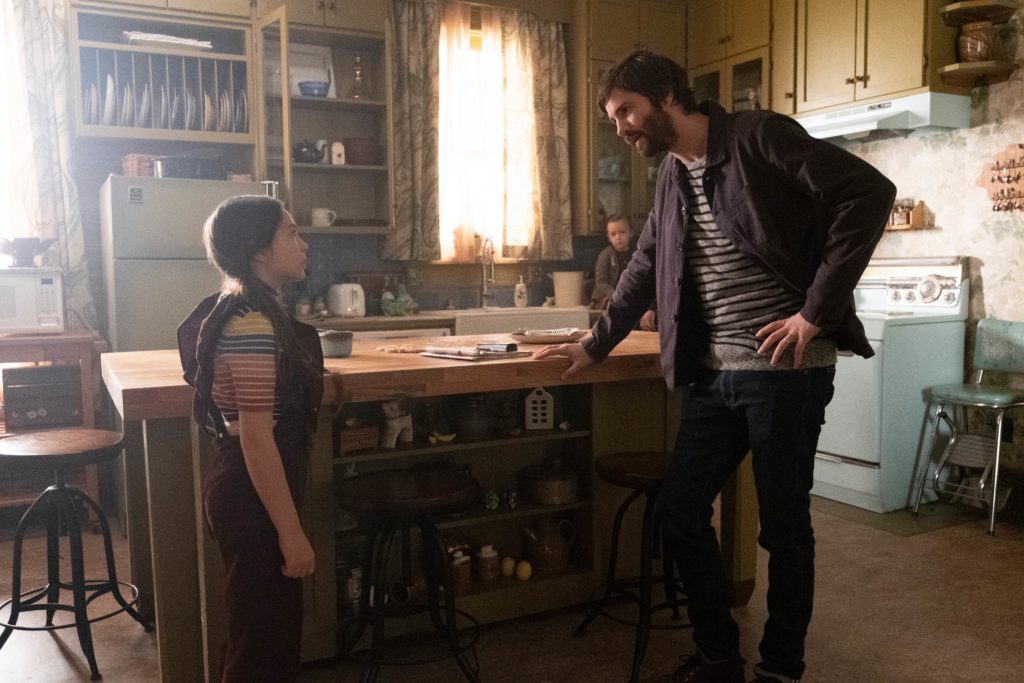
The heroine of the Apple TV+ series “Home Before Dark” is an independent, smart, capable and resourceful journalist who puts her investigative skills to use in solving a murder linked to a long-buried cold case with ties to her father’s past. She’s also 9 years old. While this sounds fictional, it’s based on fact. The real-life inspiration is Hilde Lysiak, a crime reporter’s daughter who scooped her town’s newspaper with the story in her self-published newspaper, “Orange Street News.”

Starring Brooklynn Prince (“The Florida Project”), with Jim Sturgess and Abby Miller as her parents, “Home Before Dark” is a cliffhanger-filled mystery families can watch together. Writers/executive producers/showrunners Dara Resnik and Dana Fox were drawn to the inspirational and aspirational themes of female empowerment, social justice, standing up to bullies and fighting for the truth inherent in Hilde’s story, and incorporated them into the fictional mystery they invented.

“We conceived of this in the wake of the 2016 election when all the fake news was going viral. This little girl was shining a light on truth, and that felt incredibly current,” Resnik told the Journal. “Now we’re in a pandemic and you can’t trust half of what you hear at these news conferences. I think it’s incredibly relevant. It’s something that families who are quarantined can watch together and be entertained. Families go through hard times and they try to get through it and make it work. I wanted to make it clear that the world isn’t always fair, and it’s our job to try to make it better.”

“In the world we’re in right now, we’re all so disconnected from each other. [The message is] no matter how uncertain the times are, as a family, you can get through it together,” Fox added. “We shine a light on things we’re all scared about, and also teach parents how to take their kids seriously.”

The father-daughter relationship is the emotional core of the story, which brings the disaffected, disillusioned dad back to journalism to help Hilde solve the case. “I think on a lot of levels, we all kind of want to save our dads,” Fox said.

A native of Rochester, N.Y., Fox grew up loving movies, theater, language and reading, but didn’t pursue creative writing at Stanford University. “The fear of failure and looking stupid and making mistakes frequently holds girls back from taking risks, and it was the case with me,” she said. That changed when she took a screenwriting course at USC Film School.

“My involvement at IKAR started to inform the artistic choices that I was making. I felt this deep sense of obligation that if I was going to put content out into the world, I should be making better choices and make the world a little better than when I started — the tikun olam of it all. I’m incredibly proud of the show because we nudged that needle.” — Dara Resnik

Resnik also landed at USC after studying economics at Tufts. Always interested in film, TV and writing, she tried it herself after reading one bad script after another. “It came organically to me, and the more I look back, I realize it had been calling me the entire time,” she said. “I just wasn’t listening.”

Resnik also realized that her chosen profession made perfect sense for a Jewish woman. As people who always are slightly out of the mainstream, “There’s an observational quality to everything we do,” she said. “And our culture is so steeped in narrative — the Torah itself.” Resnik grew up in Manhattan in a “semi-Conservadox” family, descended from a Russian ultra-Orthodox rabbi on her father’s side and less religious, more assimilated Romanian and Austrian Jews on her mother’s side. “I was steeped in Jewishness, but it was not feminist,” she said. “I wasn’t allowed to read the Torah or open the ark at my bat mitzvah.”

As a “sad, lonely and depressed” college freshman, Resnik literally found her Tribe in the campus Hillel group, chairing the arts committee and forming lasting friendships. Years later, she again turned to Judaism when her marriage to a non-Jew ended. “In the depths of despair, I started synagogue shopping and I found IKAR.”

An active member and on the congregation’s development committee, Resnik calls IKAR’s Rabbi Sharon Brous “my friend and my hero. She inspires me every day to make television that says we can make a difference, and further; that it is incumbent upon all of us to do so. When we see injustice, we must act,” she said. “That is the only way to a better, more just world.”

Following her experiences with films and series that did not particularly reflect her Jewish and feminist values (the collaborative, all-female-made Amazon series “I Love Dick” (2016-17) being an exception), Resnik was happy to work on a show that does. “My involvement at IKAR started to inform the artistic choices that I was making. I felt this deep sense of obligation that if I was going to put content out into the world, I should be making better choices and make the world a little better than when I started — the tikun olam of it all. I’m incredibly proud of the show because we nudged that needle,” she said.

Her dream project is to make a limited series about Ellis Island, incorporating the Jewish immigrant experience. Dana Fox’s “Cruella,” a Cruella de Vil origin story starring Emma Stone, is awaiting release, and other ideas are percolating. “I’d like to find another project that speaks to my heart as much as [“Home Before Dark]  does,” Fox said.

“Home Before Dark” was renewed for a second season months before its April 3 premiere, and most of the scripts and three full episodes were complete before the COVID-19 outbreak forced a production shutdown. Audiences will have to wait longer for a resolution to its surprising ending that provides some resolution but raises new questions. “You’re satisfied because you found out something cool,” Fox said. “But you realize it’s not the end of the mystery, but a beginning of something else.”

“Home Before Dark” is streaming on Apple TV+.

A Fourth Grader Solves a Murder in ‘Home Before Dark’ Read More »

Jewish Summer Camps Are Stepping Up For Kids, Even During A Pandemic

Many of us have now entered our seventh week of social distancing. On one hand, these challenging days of quarantine and isolation have added a level of anxiety and uncertainty that threaten to overwhelm us. On the other, we can be inspired by those who have brought creativity, innovation and light to these dark times. Either way, we are grappling with the unknown and seeking normalcy.

Usually at this time of year, excitement and preparation for weeks away at camp would be building. Packing bags, labeling clothing, group chats with friends as they find out bunk assignments. Hours would be filled listening to playlists with favorite camp tunes and anticipating the smell of the medurahs (bonfires) and the taste of s’mores.

At its core, Jewish camp illuminates the best of the human experience. Friendship. Belonging. Kindness. Resilience. Connection. Being part of something larger than ourselves.

From left: Wilshire Boulevard Temple Camps’ Ari Kaplan, Seth Toybes, Erica Feinman, Andrea Cohen and Rabbi David Eshel at CSU Channel Islands, the temporary site for Camp Hess Kramer and Gindling Hilltop Camp for the summer of 2019. Courtesy of Wilshire Boulevard Temple

Much of this quarantine experience has been characterized by discovering a renewed sense of gratitude and deeper appreciation for institutions and opportunities we perhaps had taken for granted. Jewish camp is no exception. Just as the impact of camp lasts beyond a single summer, the impact of not going to camp may have a similarly outsized effect. People look forward to camp all year long; it has always been “a light at the end of the tunnel.”

But what happens if — suddenly, inexplicably, unprecedentedly — the tunnel grows and stretches, leaving no indication of where it may end?

I can tell you what happens. Camps adapt and innovate, creating new ways to bring light, joy and communal connection into our lives — no matter the circumstances.

The challenges circumstances of COVID-19 give camp staff and organizers a chance to act as creators and shine a new light on our world. Without missing a beat, they have pivoted to creating virtual programming, bringing a much-needed sense of joyful Judaism and communal connection into people’s homes.

I have limitless admiration and gratitude for the dedication and talent of camp professionals, and I’m truly in awe of the resilient, innovative and community-centered way they have faced the challenge of this pandemic. We all can learn much from these amazing Jewish communal assets.

 “Once all this is over, we will need to rebuild together — and we have the opportunity to rebuild with intentionality.”

I have participated in multiple online gatherings – from song sessions to Havdalah services — with camp families, alumni and professionals. No matter their ages or locations, it’s clear camp people are comforted and uplifted by these opportunities to meaningfully connect with the larger community. Camp still can be a powerful “home away from home” − even when we’re at home!

Please visit Jewish Camp at Home on Facebook, where you’ll see firsthand the inspiring work of these talent camp professionals. This new group was the brainchild of L.A.-based Jewish camp organizers, who were the first to come together to offer a wide range of online programming. The group has since expanded, with Jewish camps across North America collaborating as a field to uplift the entire camp community and beyond.

Once all this is over, we will need to rebuild together — and we have the opportunity to rebuild with intentionality. What do we wish to return to? What can we improve upon? What is essential and what can we do without? We have the opportunity not just to survive, but to thrive.

There is no denying a summer without Jewish camp — at least in the way we are accustomed to experiencing it — would be a profound loss for the Jewish community. But no matter what form summer 2020 may take, Jewish camps will never cease to innovate, adapt, connect and provide joy. That is their sacred mandate. That is their gift.

We hope the day soon will come when we once again gather in safety and in health. Until that time, let us help Jewish camps in the ways they continue to help us – by maintaining a cycle of creation and renewal, modeling resilience and inventing new opportunities to sing, dance, laugh and come together.


Jeremy J. Fingerman is the CEO of the foundation for Jewish Camp.

Jewish Summer Camps Are Stepping Up For Kids, Even During A Pandemic Read More »

Zalman Kossovsky, Former Chief Rabbi of Zurich and a US Marines Chaplain, Dies at 80

Rabbi Zalman Kossovsky, a former chief rabbi of Zurich who led congregations on three continents during a career that spanned decades, has died.

Despite German language media reports, Kossovsky’s synagogue in Boynton Beach, Florida, stressed that he passed away Sunday of natural causes unconnected to the coronavirus pandemic. He was 80.

Born in Tehran to Lithuanian refugees fleeing the Soviet takeover of their country, Kossovsky was raised in South Africa. He later went to Israel for his rabbinic studies before migrating to the United States, where he stayed for better part of the 1960s and ’70s, serving at one point as a chaplain in the U.S. Marines and working on his doctorate in sociology.

He later served as a congregational rabbi of the Kenton Shul in London before accepting the role of chief rabbi of the ICZ, a communal umbrella organization representing Orthodox, Liberal and secular Jewish streams in Switzerland’s largest city,  which he led from 1991 to 2007.

“His biggest accomplishment was he kept the community together,” said Rabbi Pinchas Goldschmidt, president of the Conference of European Rabbis. Kossovsky served on its standing committee.

“On the one hand you could see he was a very elegant and aristocratic person, but on the other hand he had a very warm and welcoming side and was very people orientated and very soft spoken.”

Kossovsky was a scholar who toiled to find solutions for agunot, women trapped in marriages because their husbands refused to give them a biblical bill of divorce, or get.

Rabbi Noam Hertig, the current chief rabbi of Zurich, recalled Kossovsky as “very kind and always smiling.”

“He was my Rav. He was the one who encouraged me to become a rabbi,” Hertig said.

Hertig recalled his playful side and his big-time interest in technology.

“He always had the most advanced technical gadgets, a pager and then a Palm Pilot,” he said, “and always the newest phone.”

Zalman Kossovsky, Former Chief Rabbi of Zurich and a US Marines Chaplain, Dies at 80 Read More »

Tel Aviv Professor Obtains U.S. Patent for Coronavirus Vaccine

A Tel Aviv University professor scored a patent from the United States Patent and Trademark Office on April 19 to develop a vaccine for COVID-19.

The professor, Jonathan Gershoni, told The Jerusalem Post that he used his research on vaccines for Severe Acute Respiratory Syndrome (SARS) and Middle East Respiratory Syndrome (MERS) to design the COVID-19 vaccine. COVID-19 is related to SARS and MERS.

The vaccine would create antibodies to attack COVID-19’s receptor binding motif (RBM), the part of the virus that enables it to infect cells in the human body.

Gershoni told the Post that although the vaccine is still more than a year away from being completed, he believes there is only a third of the process left to complete the vaccine.

“Development of such an RBM-based vaccine should take months and then would need to be tested in Phase 1, 2 and 3 clinical trials, which would then take up to a year,” he said.

Gershoni also told Zman, The Times of Israel’s Hebrew website, that the vaccine still needs a pharmaceutical company to take hold of it, and there have been preliminary talks on the matter.

“[The vaccine] needs a company that understands how to integrate our template for a vaccine into their product,” Gershoni said. “That is something that can take months.”

Israel’s Galilee Research Institute (MIGAL) and Israel’s Institute for Biological Research (IIBR) have also been working on COVID-19 vaccines. The former is reportedly in the final stages of development; the latter is currently being tested on rodents. Additionally, various Israeli treatments for the virus have seen initial success in clinical trials.

As of this writing, there are 13,713 confirmed cases in Israel and 177 deaths from the virus.

Tel Aviv Professor Obtains U.S. Patent for Coronavirus Vaccine Read More »

‘Bubbies Know Best’ Star Beats Coronavirus

Linda Rich is one of the co-stars of Jewish Life Television’s (JTLV) reality matchmaking series, “Bubbies Know Best.” She also recently was diagnosed with COVID-19, but said she is now fully recovered.

Rich told the Journal that on March 14 she started feeling feverish and achy, and had difficulty breathing. She went straight to the emergency room at Valley Presbyterian Hospital in Van Nuys, where she said she was diagnosed with bronchitis. She was denied a COVID-19 test, even though she had attended a party earlier that month with approximately 100 people, including someone who had tested positive.

When her symptoms worsened, she and her husband, Philip, went to a drive-through testing facility in Glendale, where she obtained a test. On March 29, she learned she had tested positive.

“I got a call from the doctor and I was sort of praying, ‘Please say negative,’ and he said, ‘Positive,’ ” Rich said. “I thought, ‘What do I do now?’ ”

 “I don’t ask a lot of things from God, but I thank Her or Him a lot. It brings out a lot of gratitude in me. When I first came down with this, my first thought was, ‘Thank you God, it’s not worse.’ ” — Linda Rich

What she did was get plenty of rest. Her condition gradually improved. However, her husband also tested positive earlier this month, despite having initially taken a test on April 2 that said he was negative. Rich said he, too, has recovered.

Before joining the cast of “Bubbies Know Best,” where she, along with two other “bubbies” help match people of all ages and backgrounds looking to date, Rich was a cantor. In the 1970s, she became the first female cantor to be ordained in the Conservative movement. She said her faith helped her through the challenging weeks with COVID-19.

“I do have a close relationship with God,” she said. “I am always so grateful. I don’t ask a lot of things from God, but I thank Her or Him a lot. It brings out a lot of gratitude in me. When I first came down with this, my first thought was, ‘Thank you God, it’s not worse.’ ”

While she did not tell many people about her diagnosis, Rich did share the news with her co-stars, Bunny Gibson and S.J. Mendelson. “They are like family,” she said, and were supportive of her.

Presuming she is now immune to the disease, Rich wants to donate her antibodies to the Red Cross to help others. “I feel like I have a purpose in a way,” she said.

Born in Boyle Heights, Rich is the daughter of Cantor Israel Reich, who served at the historic Breed Street Shul in the 1940s and ’50s. She was a theater major with acting dreams but fell in love with singing in synagogue. “The minute I got on the bimah, I thought, ‘This feels right,’ ” she said.

In 2012, she was working as a cantor when her congregation, Temple Ner Maarav in Encino, merged with another congregation. Retiring from the bimah, she returned to acting and sent in an audition tape for “Bubbies Know Best.”

Brad Pomerance, executive producer of “Bubbies Know Best” and outgoing president of Open Temple in Venice, said the program has resonated with audiences. “People like to hear from Jewish grandmothers, whether you are Jewish or not,” he said. “There is a sense that Jewish grandmothers are wise … yentas in the best sense, that have been setting people up for centuries.”

Pomerance recently was interviewed on Fox local news after he lost four friends and family members to COVID-19, and spent 14 days in isolation after returning from Japan following the outbreak.

As for Rich, she’s looking forward to the end of the coronavirus, “[when we can] finally flatline this thing and go back to our lives.”

‘Bubbies Know Best’ Star Beats Coronavirus Read More »

The Mediterranean Sunshine in a Jar that Boosts Immune System

Our group of young friends was enjoying Shabbat lunch alfresco. Rachel was a newlywed and already proving to be an amazing cook and hostess.

I still remember taking a bite of her Israeli salad and thinking, “What is that incredible flavor?” The citrus tang was familiar but had an intensity and depth that I had never tasted before. After a few more flavorful mouthfuls, I still couldn’t figure out what it was. So I asked Rachel, “What am I tasting?”

She laughed and answered, “Preserved lemons.”

Rachel’s mother, Rica, soon showed me how simple they are to make.

An indispensable ingredient in the Moroccan kitchen, preserved lemons add a burst of sunshine to any dish. Not too tart or acidic, they enhance any fish, chicken or lamb dish and add a unique twist to any salad. I have learned from Rachel to keep a steady supply in my refrigerator.

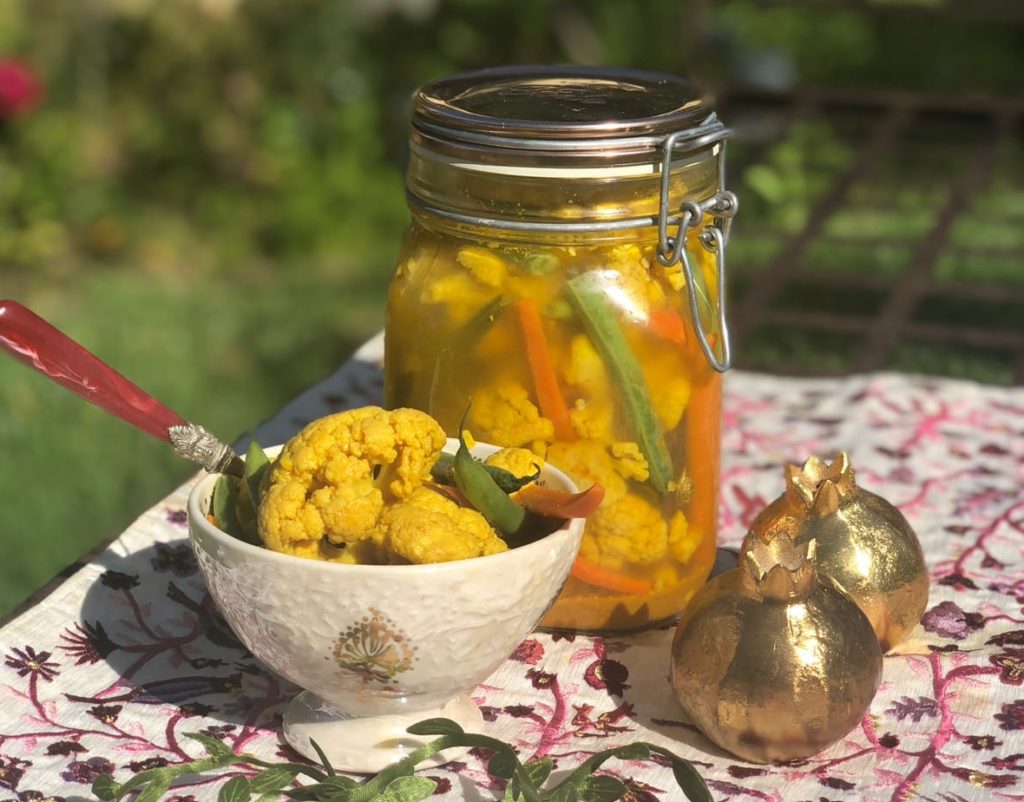
My Iraqi grandmother Aziza always had a bowl of preserved lemons as a condiment on her table. She sliced the lemons in rings and brined them in salt, paprika and turmeric, which gave them a reddish tinge. I was too afraid to taste them. Although I never tried her preserved lemons, her Turshi was an obsession of mine. Turshi are vegetables pickled in a salty, sugary, curry and turmeric brine. My kids love it, too, so I always have a few jars of Turshi in my fridge. This pickle dish, also known as chakla bakla, has a quick cooking method that ensures that the vegetables retain a delightful crunch, as well as most of the fiber and nutrients.

Besides their delicious flavor and use in numerous Middle Eastern and North African recipes, these pickles and preserved lemons are full of probiotics that boost gut health and the immune system.

RACHEL’S PRESERVED LEMONS
12 medium thick-skinned lemons, washed and dried
1 cup kosher salt

Remove the stem of the lemon and make one cut down halfway, then crisscross the lemon and make another cut halfway, making sure that the lemon stays intact in four sections.

Stuff all sides of the lemon with a good quantity of kosher salt and squeeze lemon closed.

Place lemons inside 1-liter glass jar with airtight lid, and repeat, pushing down the lemons and adding more until jar is full.

Seal jar tightly and shake contents, then set on countertop.

The next day add a few more lemons, and repeat the following day, until jar is so full no more can be added.

Shake daily for a week so juices coat lemons.

After one week, place in refrigerator for a month or two, when they will be ready to use.

NANA AZIZA’S TURSHI
2 cups white vinegar
1 cup apple cider vinegar
1/4 red wine vinegar
1 1/2 cups water
1/4 cup kosher salt
2 tablespoons curry powder
2 tablespoons turmeric
1 tablespoon sugar
1 pound cauliflower, cut into florets
1 pound green beans, trimmed
2 carrots, sliced into thin strips
1 red pepper, sliced into thin strips
6 cloves garlic, chopped

Combine all vinegars with water and spices and bring to a boil.

Add vegetables and boil for 3 minutes.

Transfer vegetables to bowl to cool. Reserve brine.

Place vegetables in airtight jars, then cover with brine.

Pickles are ready to eat after 3 days in the refrigerator.


Rachel Emquies Sheff’s family roots are Spanish Moroccan. Sharon Gomperts’ family hails from Baghdad and El Azair in Iraq. Known as the Sephardic Spice Girls, they have  collaborated on the Sephardic Educational Center’s projects,  SEC Food Group and  community cooking classes. Join them on Facebook at SEC FOOD.

The Mediterranean Sunshine in a Jar that Boosts Immune System Read More »