It would make sense to start the Jewish year on Rosh Hashanah, literally the “head of the year,” but that’s not how it goes in the Bible. There, just as we are about to leave Egypt, with great signs and wonders, the first commandment given to the nation is initializing the calendar. So the Jewish year actually begins with Nissan, the month of Pesach, making the preceding month of Adar the last one of the year. Adar is a time to celebrate and a season of reckoning.
The secret of Adar is concealed behind the “mask” of Purim. The scroll we read, Megillat Esther, is one of the closing entries in the Jewish biblical canon and, interestingly, has no mention of God’s name. We start the year with the Pesach haggadah and its manifold recitations of gratitude to God for the miracles performed on our behalf. By the end of the Jewish calendar year, God is out of the dialogue and it’s all about Mordecai and Queen Esther. What changed?
Over the Jewish year, we transition from an emphasis on God’s revealed hand in our redemption (Exodus) to a focus on the action of individuals while God operates behind the scenes (Esther). The message: God is always with us, even when His presence is hidden. To retain our freedom of choice, God is concealed, to the exact degree that we must strive to find God. This spiritual awareness is the engine of our enhanced joy during this special month. Megillat Esther can be translated as “revealing the hidden.” This remarkable tome serves as a lesson plan for perceiving God’s hand behind all events, for all time.
The month of Adar provides us with the opportunity to bask in the emunah (faith) we have crafted over the Jewish calendar year. Every holiday — beginning with our national homecoming (Pesach), receiving the Torah (Shavuot), then the High Holidays and Sukkot — serves to bolster our perception of this invisible shield of divine love and protection. By Purim, we rejoice in a seemingly “God-less” story, knowing with simple faith that God’s grace is behind all the triumphs and mishaps in our lives.
The month of Adar provides us with the opportunity to bask in the emunah (faith) we have crafted over the Jewish calendar year.
One of the central tenets of Judaism is that each of us has a crucial role in tikkun olam. This is emphasized at the climax of the Purim story, when Mordecai gives Queen Esther the chance to be the heroine, saying, “If you remain silent at this time, relief and deliverance for the Jews will come from another place.” All of us are faced with this fundamental challenge. We can opt in or relegate ourselves to the sidelines. God will get the job done regardless. I say, let’s go for it.
Celebrate Purim with heartfelt exuberance. Take advantage of the transformative power of the four mitzvah opportunities: hear the Megillah chanted both night and day, give to the needy, offer neighbors packages of a few items of food as a token of friendship, and eat a hearty meal at the end of the day. For many of us, intoxication gets us to a place where the heart is opened; we can love more readily and tears of joy flow. For some of us, getting intoxicated is a mistake. For me, after a few l’chaims, my empathy muscle is stronger.
Apply the lessons of Purim year-round. Acknowledge the miracle of God’s stewardship behind the scrim of our lives. Be there for a friend with a gift of food, the gift of time and a patient ear. Seek out opportunities to serve the needy. Be deeply grateful for the feeling of belonging to this remarkable nation. Share words of Torah with a lighthearted song and a smile.
May we always seek to emulate the courage of Queen Esther, not standing idly by with all the challenges facing our people and the world.
Sam Glaser is a performer, composer, producer and author in Los Angeles. His Jewish CDs include “The Songs We Sing,” “The Promise,” “Hineni” and “A Day in the Life.”
It is almost impossible to watch television or view other forms of media without being inundated with advertisements for 23andMe or ancestry.com, where viewers learn the stories of everyday people who, tracing their DNA and ancestry, learn they are related to great chieftains, famous jurists, inspiring social activists or President George Washington. We watch on screen as large family trees filled with numerous branches and leaves are traced back decades and generations, across time and countries, and we are encouraged to join the genetic revolution and trace our own family histories.
My mother is 93 and has advanced dementia. She is the last alive of her two brothers and two sisters, and their spouses. My grandparents are long gone. Having only recently been reunited with my maternal cousins after 44 years, I have learned they are as unaware of the details of our family history as I am; and we sadly realize any hope of finding answers to our past from my mother’s generation of aunts and uncles now lies dying in the withering mind and memory of my mother, who has no recollection of my name, much less of our family history. We lament that ours was not a family that spoke of such things and we children did not have the foresight to probe.
All we collectively knew is our family arrived from Slonim, Poland, in New York in the late 1920s. We knew they took the name Kaplan when they arrived. We assumed our name in “the Old Country” was Kaplansky. We had small bits of information: The oldest son of our bubbe, from a previous marriage, initially was left behind in Slonim because his family couldn’t get a visa for him; my maternal grandfather died shortly after they arrived in the United States. Bubbe had to clean houses to support the family in Brooklyn, yet did not have sufficient means to support them all, so she temporarily gave my mother to her aunt to raise. The children went to work as youngsters to help support the family.
These are typical tales for immigrants from Eastern Europe arriving in Brooklyn, N.Y., just in time for the Great Depression.
Any hope of finding answers to our past from my mother’s generation of aunts and uncles now lies dying in the withering mind and memory of my mother, who has no recollection of my name, much less of our family history.
This year, I was inspired to do more research into my maternal family history — not only by the 23andMe and ancestry.com crazes, but by my taking a trip to Poland and Lithuania. This gave me the opportunity not only to find my roots, but to go back to the very places where these roots began. I could stand and walk in the footsteps of my family’s past.
Perhaps I should have begun this quest much sooner, but I thought the few months I allotted myself would yield enough information perhaps to find a house, an address in Slonim I could stand before and feel the presence of my past.
In my research, I visited the local Mormon Latter-day Saints Genealogical Library and, although the staff was very helpful, I continued to encounter one dead end after another. Finally, with the help of a genealogist in New York and her colleague in Berlin, I located the ship manifest for my paternal grandfather, then another ship manifest for my maternal grandmother, my mother and three of her four siblings. I was ecstatic. I learned wonderful things. I learned my family name was not Kaplansky, but Kapic. I learned my paternal grandfather, Harry, was Hercz.
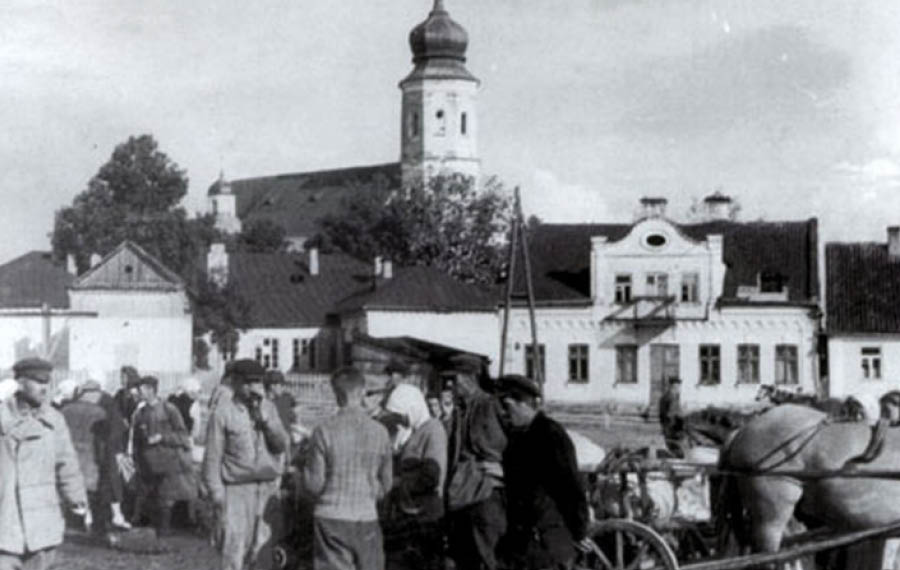
People in Slonim, Poland circa 1930-1939. Photo from Wikimedia Commons
Hercz was a tanner in Slonim, who miraculously got a visa and left his wife and four children (including his then 6-month-old daughter, my mother) in Poland in June 1926 to head to America. In 1930, visas were obtained for my grandmother, mother and three of my aunts and uncles. I learned their Polish names and dates of birth, the name of the ship on which they sailed to America, the date they left from France, and the date they landed in the Port of New York. But other than knowing they came from Slonim, I could not find an address, a place in Slonim that would connect me to them once I got there. I did learn of a name of a sister my grandmother had left behind in Slonim.
Further sleuthing, I found my mother’s 1948 U.S. naturalization papers, from which I learned my grandmother’s Polish maiden name. But once again, all references to Poland were to the town of Slonim and not to any street address. I hoped that once I actually got there, I might be able to search the local archives and, finding birth records, marriage records and the like, locate some physical addresses I could visit.
Our trip to Slonim took us beyond the borders of Poland and Lithuania and into what is now Belarus. After World War II, Slonim came under Soviet control. In 1991, it gained independence from Russia and reverted to Belarus. Slonim was no stranger to such upheaval. During its history, Lithuania, Russia, the Tatars, Germany and Poland ruled over it.
As a Jew walking through and around Slonim, this indifference to the lost Jewish past and lack of Jewish presence is palpable.
Its storied past includes a rich and celebrated Jewish tradition. In the late 19th century, through the beginning of World War II, Slonim was a hub of Jewish commerce and Jewish spiritual and political life. It was home to many Jewish movements and movers, including Haskalah, Maskilim, Chasidim, Magidim, Mitnagdim, the Jewish Bund, religious Zionists (the Mizrachi), general Zionists and labor Zionists. Although Jews there suffered from pogroms and anti-Semitism, the Jewish population of Slonim swelled in the years leading up to the war, as Jews from other parts of Poland and Eastern Europe fled to Slonim.
By World War II, 70% of the population in Slonim was Jewish. By December 1942, after the last of five “aktions” by the Nazis, 25,000 Jews in Slonim were killed. The 400 to 500 Slonim Jews who survived did so by escaping — some into the forest, or because the Soviets had deported them to Siberia. The rest are under the earth in the killing fields that surround the town.
Before arriving in Belarus and Slonim, I knew something of the horror of this annihilation. But it did not prepare me for the shock of being there. I felt sadness, emptiness and outrage beyond anything I had ever felt during my travels visiting Jewish heritage sites in Germany, along the Rhine River, in Lithuania or in Poland. Belarus — in particular, Slonim — was different; it was punch-in-the-gut different. And it was not just because it was the place from which my family came. It was a difference made very clear by our incredible Belarusian guide, Alexander, who spent three days taking us to several places, including Baranovichi, Mir and Minsk.
Today, when one drives into the main square of Slonim, if one has a learned eye for history and architecture, one can pick out which of the buildings would have been Jewish homes or businesses. Moreover, although it bears no outward sign or identification, one also cannot miss the incredible, fenced-in, dilapidated, crumbling structure that once was one of the largest and most magnificent synagogues in Eastern Europe.
What you do miss (if you are looking) are Jews. Any Jews. Even worse, what is missing is any sense or consciousness at all in the town or its current inhabitants of what was, at one time, an important and significant presence of Jews.
Alexander, hearing us speak about how there seems to be a resurgence of interest in Jews and Judaism in Poland, summed up the situation in Belarus with incredible insight and impact: The Polish people, many of whom today, individually and as a nation, feel they have lost something as a result of the loss of the Jewish people and culture. They are engaged in trying to recapture some part of this loss (even if, as some argue, they may not be taking sufficient responsibility for the loss). However, the residents of Slonim, and Belarus in general, don’t seem to take note of the loss of Jews at all, or even feel they have lost anything as a consequence of losing the Jews.
As a Jew walking through and around Slonim, this indifference to the lost Jewish past and lack of Jewish presence is palpable. You can swallow it; you can taste it. It’s a bitter, bitter taste.
Unlike Jews who can trace their ancestry to Poland, Lithuania or even Ukraine, those of us seeking our previously unknown family history in Slonim or elsewhere in Belarus are pretty much out of luck.
The loss I felt in Slonim compounded when I learned from Alexander that any effort I might make to locate any documentation — such as birth, marriage or property records of my family — would be futile. After the Soviets came to power in Belarus, they destroyed all prewar records of the Jewish people who lived in what is now Belarus. Unlike Jews who can trace their ancestry to Poland, Lithuania or even Ukraine, those of us seeking our previously unknown family history in Slonim or elsewhere in Belarus are pretty much out of luck.
So there is no house I can stand in front of or street I can walk down, knowing my family was once there. There are no records to help me find members of my family.
Yes, I can stand in front of the great Slonim Synagogue and imagine my family might have stood there, even prayed there. I can walk along the river and try to feel their footsteps beneath mine as they enjoyed a stroll on a beautiful summer day. I can try to hear in my mind the gleeful laughter and shouts of young children, among whom would have been my 4-year old mother, playing in the public square and parks.
I can go a short distance to the perimeter of town, up a hill and stand in the big killing field, wondering if my grandmother’s sister who was left behind, as well as other unknown relatives, breathed their final breaths as they stood here, surrounded by pastoral beauty that is evident even today. When I stand in that field, am I standing in their footsteps?
Returning from my travels, I still will try to do what research I can to track down information about my family. It does seem much of what I may be able to learn is going to be about the lives they lived here in America. I feel blessed to know my family’s correct surname. I feel blessed to have been to Slonim, to see the town where my grandfather was a tanner and where my grandmother, mother and her siblings were born and lived until 1930.
But there is an overwhelming anger and grief; not only over the destruction of the Jews of Slonim, but from the subsequent Soviet destruction of the records of their very existence. I am angry those branches and leaves of my history can never be found or added to my family tree. I am angry for myself and for all the Jews in the world for whom 23andMe and ancestry.com can never be options as we seek our pasts.
Nevertheless, although many of us may not have individual family trees, we still can find a past that is precious, significant, meaningful and enduring. A past that lives on in each one of us. As Jews, we are part of a larger family whose history is remarkable, relevant, important, worldwide in scope, well-documented and continuing.
We are not just 23andMe. We are 6MillionandMe, and beyond.
Aleta Bryant has degrees from UC Berkeley in history and in law, and recently retired after 31 years as a practicing attorney. She lives in Southern California and spends her time traveling, learning and restoring her 97-year-old home.
Joe Biden’s sweeping South Carolina victory on Feb. 29 may be the most important state primary election in the history of presidential politics. Jimmy Carter and Barack Obama used Iowa as their first steps toward the White House. Ronald Reagan and Bill Clinton achieved comeback victories in New Hampshire that propelled them toward their presidencies. And both George Bushes relied on the South Carolina firewall to protect their candidacies against threatening challengers.
But none of those men ever faced the near-death experience that Biden has confronted over the past several weeks. After fourth- and fifth-place finishes in Iowa and New Hampshire, his political career appeared to approaching terminal status. His second-place finish in Nevada established a heartbeat. But the size and scope of his win in South Carolina created an unprecedented level of momentum that carried him to a series of Super Tuesday triumphs onMarch 3 that now have made him a reborn front-runner in the race for the Democratic nomination.
To be clear: This campaign is far from over. Biden is no more a certainty to be his party’s standard-bearer than Bernie Sanders was after the Nevada caucuses, than Pete Buttigieg was after Iowa, than Elizabeth Warren was last fall, than Kamala Harris last summer or Beto O’Rourke last spring. Sanders is a formidable candidate fueled by a relentless online fundraising apparatus, a passionate grass-roots army, and huge levels of support from young people and Latino voters. Michigan and Missouri, the next key states to hold primaries, are very friendly turf for him. So writing off Sanders now would be tremendously premature.
The more likely scenario is an extended battle between these two men, representing two opposing wings of the Democratic Party and two different visions of their party’s and their country’s future. Expect this fight to continue through the end of primary season in June — and possibly to the floor of the convention in Milwaukee in July.
Dan Schnur is a professor at USC’s Annenberg School for Communication and Journalism, UC Berkeley’s Institute of Governmental Studies and Pepperdine University.
Grab your groggers, your mask, your costume: Purim is March 10. Often misleading and misunderstood, this outrageously raucous holiday comes in the last month of the year, Adar, fulfilling the much-needed expression of joy and feasting as the winter months come to an end. It is the culmination of a yearlong expression of emotion, spiritual enlightenment and our relationship to God, which begins in the first month of the year, Nissan, with Passover.
Passover and Purim begin with the Hebrew letter peh, which means mouth. Both these holidays of remembrance “speak” loudly of the Jewish challenge for survival in a non-Jewish world. What begins in the darkness of Egypt, entrenched in slavery and the fear and hatred of the powerful Pharaoh, ends in the foreign land of Persia, in exile again, with the evil presence of another enemy, Haman. What begins with liberation from slavery by God’s awesome acts of wonder (Ten Plagues and splitting the sea) and protective moments of intervention (killing Pharaoh’s soldiers), ends without one word about God. Throughout the year God’s truth, teachings and historical connection demand our attention and yet we come, full circle, to a holiday where God’s name is missing and it is wo/man’s presence and actions that save the day.
We learn from the beginning of Torah that evil exists in the world. It begins with the serpent who tries to separate Eve from Adam, and both of them from God, then all the many peoples we battle in Torah and, finally, the individuals with power, the continuing line of Jew haters beginning with Amalek, the one who came from behind to annihilate the people on their way to the land; and those that follow — Assyrians, Babylonians, Greeks, Romans, Catholic crusaders, English, French, Spaniards, Russians, Germans, Iranians, etc. The Purim story represents one of those moments when one man, Haman, in his arrogance and hatefulness, plots to annihilate all the Jews. The two main Jewish characters in the story, Mordecai and Esther, personally and politically intervene and everything turns on its head. The gallows that Haman prepared for Mordecai ironically becomes the place where Haman’s life ends.
This is a resolution without God’s intervention. It is a reminder that “we,” God’s partners, must fully engage in resolving conflict, difficulty and assure Jewish longevity. Mordecai and Esther use their spiritual practice to bolster their actions — fasting, grieving, crying out — but rely on their wit and wisdom to save their people.
We come, full circle, to a holiday where God’s name is missing and it is wo/man’s presence and actions that save the day.”
Although God’s name never appears in the story, the rabbis remind us that what is not seen isn’t necessarily absent. They turn to a passage at the end of Torah, “Anochi haster asteer panai bayom hahu,” “I, the Lord, will surely conceal my face on that day.” In fact, the word “asteer” with different vowels, means “Esther.” The mystics see her as a representative of the feminine aspect of the Holy One, Shechinah, and Mordecai the representative of the male aspect of the Divine, Kadosh Baruch Hu. Together they enact, in this world, the Divine presence. God’s name may be missing but the wisdom and spirit of divinity are ever present.
The book ends, disturbingly, with the Jews vengefully killing thousands of Persians, “They wreaked their will upon their enemies.” On Purim, we are to get so drunk that we can barely tell the difference between Mordecai and Haman. For me this is a message of how easy it is to become like our oppressors.
The book of Esther reminds us we are representative of the Holy One and it is our task to express, through our actions and speech, sacred moments and Divine presence. We begin the year with gratitude for God’s gift of liberation but we end the year expressing joy and celebration in our freedom, remembering it is in our hands now. The rabbis teach that this holiday will remain with us in the days to come; ”These days should be remembered and celebrated … their remembrance shall not perish.” Perhaps they wanted us to maintain an awareness, of how easy it is to go from humility, joy and pride to arrogance, self-importance and revenge, even until today.
Eva Robbins is a rabbi, cantor and author of “Spiritual Surgery, Journey of Healing Mind, Body and Spirit.”
My partner is from Jerusalem. He was born there. So were his parents. And his grandparents. He traces his roots in Jerusalem back to the fourth century. He is from one of the oldest communities living in the land. But this was the first time he could vote.
He received his citizenship only a month ago after waiting seven years in a Kafkaesque bureaucratic limbo. Seven years. When he began the process, he filled out his application exactly as asked. But a few months later, they changed the application, so they voided his. And then they made him wait a year to reapply. The next time he applied after waiting an entire year, they said he hadn’t turned in the right papers, even though he had.
“We are sorry but you will need to wait another year to apply.”
Again.
He was fed up, but instead of giving up, he fought and he sued the Ministry of Interior through the High Court. And finally he won his case and his passport and his right to vote for the party that oversees his life. And on March 2, we went to vote.
So many choices:
“Bibi habibi! He’s going to win, anyway.”
“Lieberman is the man. At least he is honest about being a racist.”
“Maybe Shas. They take care of the poor, even poor Arabs.”
“Khalas; the system is corrupt anyway.”
So many choices in an embattled political landscape. But I promised him ice cream if he voted.
Most voting places require that you live in the same area, but there a few polling spots open to everyone as long as you provide your ID number and address and father’s name. And so he did. We created quite a stir.
He was fed up, but instead of giving up, he fought and he sued the Ministry of Interior through the High Court.
“It’s my first election,” he told everyone.
“Where is he from?” the security guard by the polling place with the black yarmulke asked.
Meanwhile, a crowd had assembled behind us.
“Jerusalem,” I answered.
“Why couldn’t he vote?”
“He isn’t Jewish.”
“But he lives in Jerusalem. He should be allowed to vote.”
“Our government only lets citizens vote, and unless you’re Jewish if you’re from East Jerusalem, you aren’t a citizen unless you apply, and even then they don’t grant it to everyone.”
“That’s stupid,” the guard said. “He should he allowed to vote if he was born anywhere in Jerusalem. United Jerusalem.”
By this time, there were a dozen people in line — a light-skinned woman with a tumble of red curls and a peace sign tattoo; an ultra-Orthodox man with a natty white beard and three grandchildren at his side; an Ethiopian Israeli soldier with a yarmulke.
“It’s his first time voting,” the guard said. “He just got his citizenship. He’s from East Jerusalem.”
“Wow. All the respect,” the ultra-Orthodox man said.
“Congratulations,” the soldier said.
“Maybe he will bring luck and we will finally have a good government,” the woman with the red curls said.
I watched him take his envelope and walk to the big blue box. From behind the box I heard a shout: “Khalas, Sarah, What are these letters?”
The ballots aren’t always clear. Each party gets letters assigned to it and they don’t always make sense unless you are versed in the minutia of Israeli politics.
“Sarah, I don’t want to vote for Bibi habibi. Where’s the other guy?”
The voting monitors laughed and one said, “Leave your envelope and come outside and your girlfriend can explain to you which party is which.” So he did. The security guard gave him a pen so he could write down the letters on his hand.
In a country where everyone hates waiting, people waited for him. Not only did they wait, they waited patiently, and even smiled and patted him on the back. After all, he had been waiting his whole life to do what he should have been allowed to do from the beginning.
He cast his ballot for the first time. And then we got ice cream to celebrate.
Sarah Tuttle-Singer is an author and the new media editor at The Times of Israel.
I just spent three days at a conference where the theme was being bold.
It was run by a foundation I was honored by, a foundation where I am now a grantee. It is a foundation that has style, panache, and is insanely bold in the choices they make every day, about who they choose to fund and what they support.
Being bold, and making bold choices was discussed, highlighted and encouraged.
I met person after person who absolutely blew me away.
Like-minded people who, like me, walk through the trenches of the nonprofit world navigating our dreams, reality, and the sometimes impossible distance between the two.
Be bold was the message. What they told us is that being bold sometimes is stopping, and changing direction. This is not giving up; it is simply re-assessing.
These few days nourished my heart and soul literally and figuratively since they did not stop feeding us.
It reminded me that, honestly, I am not alone, although many days that’s how I feel.
I am seen. I am supported.
And there is someone telling me to, inviting me to
Sit down,
Breathe,
Be.
And be bold.
On my flight home I sat on the exit row.
What a score I thought, win, win, win.
But, alas, my seat was absolutely freezing, and I was cold to the bone. I could feel the flu literally entering my body and making me sick. I had a million deadlines this week.
I had been away for a few days.
I hear the voices saying to me “Be bold. Be bold!”
I knew that being bold would be getting into bed and taking it easy for a few days.
This is a bold moment in time for woman.
The #MeToo movement.
Harvey Weinstein going to jail.
The movie “Bombshell” that I watched on the plane.
We tell our girls to be bold, speak up, and speak out.
It is easy to say and so incredibly hard to do.
You need a cheerleader to stand on the side telling you that you are good, you are enough, and you are worthy.
A few years ago, a beloved colleague came to see my show on domestic violence.
She waited until everyone left.
She came to see me at a location far from her home.
She looked at me.
I knew.
She has two daughters. I love them both.
“Who?” I asked her.
She told me.
We cried.
“She can’t be bold. She is so broken! What should we do?” she asked me.
“Well,” I said. “We will be bold for her.”
We arranged a lunch. I invited her daughter to see the next show.
It was not easy.
She let us help.
That, in itself, was bold.
She got out.
We told the rabbi.
He was incredibly bold.
He spoke up. He took the right stand.
She got a divorce.
You see, people don’t just stand up and be bold.
They need someone to hold them up, to catch them if they fall or, maybe just to say quietly, “Hey, I’m here!”
At this incredible conference I was given tools.
I made new friendships.
I was given important books to read.
It was inspiring.
It gave me the perspective that being bold has many shades and comes in lots of shapes and sizes.
A wise woman told us that if you can’t decide today, sleep on it and decide tomorrow.
Being bold is having the wisdom to wait.
My biggest take away is that it is so much better not to be bold alone.
So why don’t you be the person this week that helps someone else be bold?
That in itself is a super bold move.
Naomi Ackerman is a Mom, activist, writer, performer, and the founder and Executive Director of The Advot (ripple) Project a registered 501(c)3 that uses theatre and the arts to empower youth at risk to live their best life.
WASHINGTON (JTA) — Mike Bloomberg, the former New York mayor who ran a self-funded campaign for the Democratic presidential nomination, dropped out of the race the day after disappointing Super Tuesday results.
“I’ve always believed that defeating Donald Trump starts with uniting behind the candidate with the best shot to do it,” Bloomberg said Wednesday in a statement. “After yesterday’s vote, it is clear that candidate is my friend and a great American, Joe Biden.”
Bloomberg, a media magnate and one of the wealthiest Americans, spent at least $500 million on his campaign, but was not on the ballot for the first several nominating contests, only coming on when 14 states, a territory and Democrats Abroad went to primaries on Tuesday. He picked up just 12 delegates, six of them in American Samoa.
Even while he was running, Bloomberg said he would pledge his resources to oust Trump, no matter who the candidate is.
Bloomberg’s departure essentially whittles the race down to two candidates: Biden, the former vice president, and Bernie Sanders, the Vermont senator. Sanders and Bloomberg are Jewish.
We call this format a Timesaver Guide to Israel’s Coming Elections. This will be a usual feature on Rosner’s Domain until a new government is formed. We hope to make it short, factual, devoid of election hype.
Bottom Line
Election Handbook: Narrow, Unity or Fourth?
Main News
Right: Netanyahu’s bloc is likely to have 58 seats, three seats short of what’s needed for a coalition. Netanyahu is still seen by many as the victor, but his victory seems smaller today than what it seemed just two days ago.
Coalition: The PM is searching for defectors who might agree to join his coalition. Thus far, all obvious suspects denied any such intention.
Blue and White: A move to use the 62 no-Bibi majority to pass a new law that will prevent the president from appointing a person charged in court to form a government. Simply: Rivlin will not be able to ask Netanyahu to form a government.
And do not miss my cover story for the weekend Jewish Journal on Netanyahu, Sanders, national election and primary election (online and in print tomorrow).
Developments to Watch
Final count: It could take a few more days before we know for sure the number of seats allocated to each party and bloc..
President’s intentions: Rivlin did not yet hint if he is going to try broker a unity government. He tried and failed back in September and might not want to fail again unless he gets indications from both sides that they are ready to compromise.
The Blocs and Their Meaning
Here are the options for the next few weeks, assuming the rightwing bloc remains at 58 seats. The bottom line is clear: A fourth election is fast becoming much more realistic than before.
Additional reading material
The Indefatigable, Unbeatable Benjamin Netanyahu (my NYTimes article): “Facing a trial for corruption (to begin March 17), the fatigue of many voters (he’s served as prime minister for more than a decade), two failures last year to form a coalition (in April and September), a formidable opponent (a party headed by three former generals), and a general sense that his era is coming to an end (why else would we go through three elections in one year?), Mr. Netanyahu nonetheless mounted a fierce campaign.”
The Politics of the Rule of Law (my Moment Mag article): “The debate about the power of the law enforcement branch is old and tired, but it gains urgency in a year of three election cycles in which the prime minister is slated to stand trial.”