fbpx

February 12, 2020

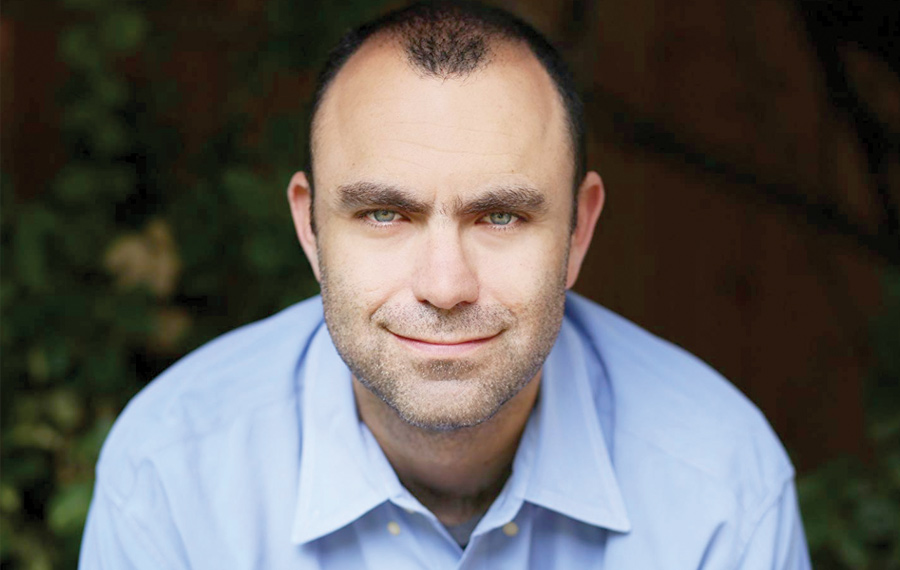
Hollywood Writer Aron Eli Coleite on Writing From Jewish Values

After the apocalypse wipes out the world’s adult population — turning some into zombies and obliterating the rest — it’s up to the teens of Glendale to rescue their friends from feral gangs trying to survive in the new world order. 

In the Netflix series “Daybreak,” (which was canceled in December) these teens protect themselves by wielding swords, golf clubs and all manner of weapons: except guns. This omission is deliberate, creator Aron Eli Coleite told the Journal, because the series was greenlit after the Feb. 14, 2018 school shooting in Parkland, Fla., and because it’s an expression of his Jewish values.

“If kids were reinventing the world … they wouldn’t be hung up on guns and LGBTQ issues the way adults are. They’d approach it through their own lens,” Coleite said. “My Jewish identity is wrapped up in ideals of social justice, community and what it means to be an extended family, [in] who you surround yourself with and [how you] fight for a world that’s better. The kids of “Daybreak” are fighting for that… This is how we change the world. The Jewish soul of the show is the liberal Jewish agenda. I’m not apologizing for it.”

There are some inherent Jewish moments in “Daybreak,” including a techno “Havah Nagilah” that plays over a frenetic segment. One character, Mona Lisa, criticizes another for “giving us grief like a Jewish bubbe” and another issues a sharp, somewhat random “Shabbat shalom, bitches” to a group of apocalypse survivors. 

When Netflix canceled “Daybreak,” it also scuttled Coleite’s Season Two plan to explore Mona Lisa’s identity as a young Jewish woman of color, adopted by two gay dads. Coleite said he wanted to tell the story of someone who felt “like an insider and an outsider” in her Jewish community.

“In a world where there are so many shows, it’s really hard to make sure you have honest voices for the diversity of our world,” he said. “My hope is that we get to tell our unique and original stories that speak to an audience that makes it feel universal to everyone, even if it’s a Jewish story.” 

“My hope is that we get to tell our unique and original stories that speak to an audience that makes it feel universal to everyone, even if it’s a Jewish story.” — Aron Eli Coleite

Coleite’s Jewish connections run deep. He grew up attending Valley Beth Shalom, went to and staffed camp at Hilltop and Hess Kramer and met his wife through various Jewish involvements including Ramah Israel Seminar. The family lives in Los Feliz and belongs to IKAR, which “reminded us of our experience at summer camp and with powerful rabbis.” he said, mentioning the late Rabbi Harold Schulweis, Rabbi Ed Feinstein of Valley Beth Shalom, and IKAR’s Rabbi Sharon Brous. Those camps, he said, were “based around social justice and community involvement. The people there were scrappy and welcoming and wanted to change the world.” 

He always knew he wanted to be a writer. But over the years, his family — among them rabbis and psychologists — had some concerns about his professional future. “My overnight success took 25 years,” he said, “so it was a constant question at the seder table or Shabbat dinners. They would ask this in the way only a Jewish parent can, both passive aggressive and aggressive at the same time, [saying] ‘It’s time to give up on your dream and be realistic’ and at the same time say ‘I believe in you.’ ” 

He even considered an industry executive job but “I searched my heart and said, ‘I don’t want to give up on this.’ ” He recommitted to “consistently pushing myself to continue writing no matter what. Writing is an art that I truly believe anybody can do. A lot of this is talent and luck but I believe talent can be learned. If you work at anything hard enough you can become a master. I’m still working.” 

After serving as a writer’s assistant on “Party of Five,” he got his first staffing job on “Crossing Jordan,” then worked on “Heroes” among other shows, en route to showrunning “Daybreak.” 

People who want to be writers can always find time to write, he said. “To direct, you need actors, money and a camera, other people to help you. Acting, same thing. You need to get a role. But the only person stopping you from writing is yourself.”

Coleite said he relies on his children ages 14, 12 and 5 for inspiration. “I want to write something they can watch, laugh and cry at a coming-of-age story, and find resonance in the work that I do. Coming-of-age stories are timeless. It’s one of the most important times in your life, when you’re trying to find out who you are.” 

“Locke and Key,” a supernatural horror drama Coleite co-developed based on Joe Hill’s comic book of the same name, currently is streaming on Netflix. Coleite also wrote the show’s first episode about a family that discovers a series of keys that unlock magical abilities. 

“The whole journey as a writer is about different amounts of failure, picking myself up and doing it again, trying to do it different and better the next time,” he said. “If it has anything to do with my Judaism, it’s knowing that you can find hope in any of our Jewish stories. A lot of my steadfastness in overcoming adversity has a little bit of a Jewish soul.”

Hollywood Writer Aron Eli Coleite on Writing From Jewish Values Read More »

Friendship Circle Celebrates Tu B’Shevat

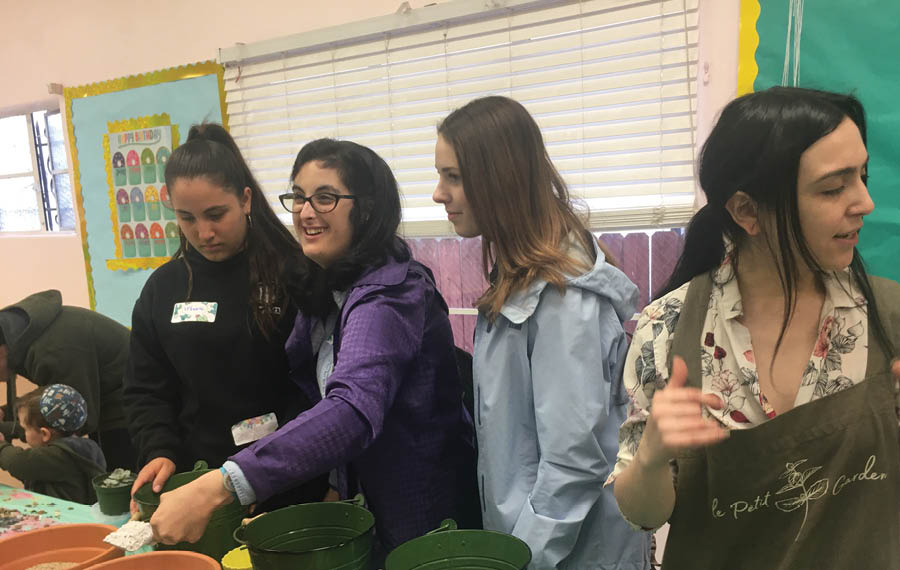
In one room, children lined up at tables with small succulents and buckets of plant food, including volcanic sand, and stuffed soil into pots. And in the recreation room, kids enjoyed arts and crafts, decorating frames with butterfly stickers.

The activities were part of the Feb. 9 “Tu B’Shevat in the Desert” program by Friendship Circle Los Angeles (FCLA), the organization that works with Jewish children with special needs. 

Rebecca Suissa, owner of Le Petit Garden, brought her DIY potting business to the event at FCLA. A longtime volunteer, Suissa said, “I would do anything for the Friendship Circle, for children with special needs.” 

The event’s focus on the desert was an acknowledgment of the arid climate in Los Angeles, so Suissa brought succulents and taught the children how the plants are able to retain water in dry climates. 

The succulents were kept in “children-preferred” pots made of recycled plastic. The plant mix included coarse sand, perlite and soil, Suissa said.

“We’re going to give your roots a haircut,” one of the FCLA volunteers explained to the children as he cut some of the stringy fiber dangling from the bottom of a plant. 

Esti Krintzman, 29, who has a form of autism known as a pervasive developmental delay, was among the approximately 300 people who turned out for the day’s activities. 

Krintzman was busy decorating her artwork with stickers alongside Neshamah Ben-Yehuda, a 10th-grader from Bais Yaakov School for Girls. Krintzman has been involved with FCLA since its inception in 2003, while Neshamah began volunteering with the organization a couple of weeks ago.

“It gives me energy,” Neshamah said. “If I had a hard week, I look forward to coming here. I love being with Esti, and I have a really good time.”

UCLA School of Dentistry students came by to offer dental demonstrations for the children, reinforcing that the holiday of Tu B’Shevat ought to not only be about caring for the earth but also self-care.

The Tu B’Shevat program is one of many holiday gatherings FCLA holds. Past events have included a Lego-inspired Hanukkah and a Moroccan-themed Purim. “Each of the programs, we theme it and it makes it super fun for the kids,” said Gail Rollman, FCLA’s development director.

She added the events also provide respite for the parents. While the children were enjoying various Tu B’Shevat-themed activities, their parents attended a workshop on “How to Organize Your Home,” a skill, Rollman said, that may elude parents who face the all-consuming challenge of raising special needs children.

UCLA School of Dentistry students came by to offer dental demonstrations for the children, including teaching them how to properly brush their teeth. The dental demos reinforced that the holiday of Tu B’Shevat ought to not only be about caring for the earth but also self-care, Rollman said.

Miriam Rav-Noy, who co-founded FCLA with her husband, Rabbi Michy Rav-Noy, said FCLA creates bonds among special needs families who are otherwise “socially isolated. This becomes, for many families, their community,” she said. “Ultimately, these kids and young adults with special needs, they want to belong.”

Friendship Circle Celebrates Tu B’Shevat Read More »

Democratic Presidential Surrogates Discuss Israel, Jewish Issues

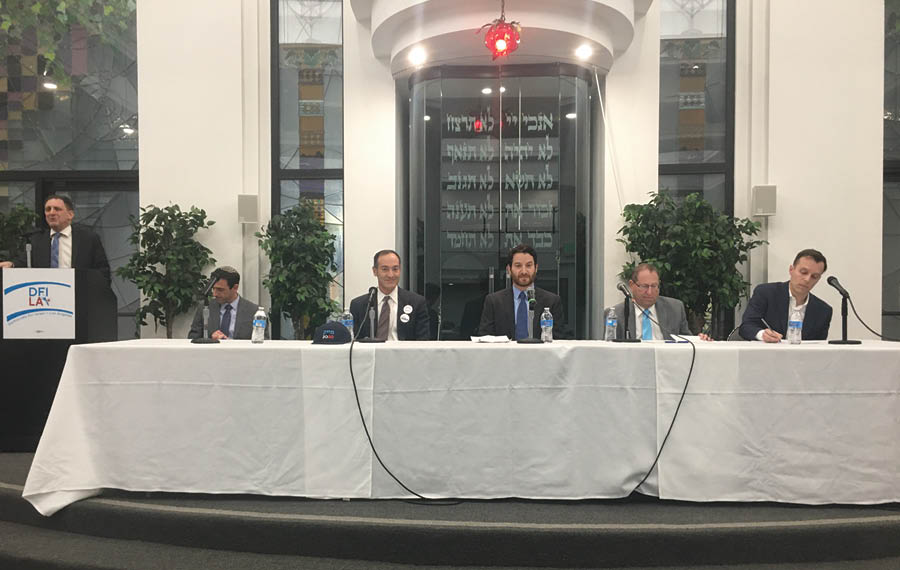
In a forum at Valley Beth Shalom on Feb. 10, Democrats for Israel in Los Angeles (DFILA) hosted surrogates for some of the Democratic presidential candidates, where they outlined their positions on Israel and other Jewish issues.

Former Vice President Joe Biden, Mike Bloomberg, Sen. Bernie Sanders (I-Vt.) and Tom Steyer were represented at the forum. Sen. Amy Klobuchar (D-Minn.), Sen. Elizabeth Warren (D-Mass.) and Pete Buttigieg chose not to participate, DFILA President Andrew Lachman told the Journal.

The debate was largely civil, with speakers agreeing on the need to take back the White House. Lachman said at the start of the event that any of the current Democratic candidates “will be a vast improvement over what we [currently] have.”

Biden was represented by Los Angeles City Councilman Paul Koretz, who said the former vice president was the “one person with enough credibility” to negotiate peace between the Israelis and the Palestinians. 

Scott Richman, Bloomberg’s deputy director for Jewish outreach, said the former New York City mayor has always been a strong supporter of Israel. He cited Bloomberg’s flight to Israel in 2014 despite a Federal Aviation Authority ban at the time against the Jewish state. 

Joel Rubin, Sanders’ director for Jewish outreach, said Sanders would work hard to ensure Israel’s security and in securing a state for the Palestinians.

Rabbi Joel Simonds, founding executive director of the Jewish Center for
Justice, moderated the two-hour discussion, which drew approximately 100
attendees.

The evening included discussion of the boycott, divestment and sanctions (BDS) movement. Richman said that Bloomberg was opposed to BDS, believing it anti-Semitic and that Bloomberg adhered to the principles set forth by former Jewish Agency Chairman Natan Sharansky that the “three Ds” of anti-Semitism were delegitimization, demonization and double standards.

Rubin said although Sanders is opposed to BDS, the Vermont senator believes that “Americans have a constitutional right to participate in nonviolent protests.” 

Rob Meyerhoff, a Steyer staffer, said Steyer, who has made climate change the focal point of his campaign for the Democratic nomination, also saw support for BDS as falling under the banner of free speech.

“I’m not a regular surrogate for Joe Biden,” Koretz said. “I just think he’s the right candidate for the right time.”

As for Bloomberg, Richman said, “He has the experience and the toughness to stand up to Donald Trump.” 

While Rubin highlighted the extensive support Sanders has received across the country, Simonds called out some of those supporters. Without mentioning anyone by name, he asked Rubin to explain why Sanders has had political ties with anti-Zionists. In response, Rubin urged people to focus on Sanders’ words about Israel, not those of his supporters who may have made troubling remarks about the Jewish State. 

After the event, Lachman told the Journal, “I think it went very well. There was some very good back-and-forth discussion. I think everyone had the chance to make their case.”

Democratic Presidential Surrogates Discuss Israel, Jewish Issues Read More »

Limmud Festival: A Feast for Jews From All Walks of Life

The worldwide global phenomenon known as Limmud that offers hundreds of sessions on Jewish life to thousands of participants began with a handful of volunteers back in 1980 in the United Kingdom. Today, you can attend a Limmud conference pretty much anywhere in the world. But the largest is held every year in the last week of December in England, where today it is known as Limmud Festival. 

In 2019, from Dec. 20-26, close to 2,500 people from around the globe made the trek to this year’s festival at the Hilton Birmingham Metropole, to dine on a smorgasbord of Jewish educational opportunities, offered up by over 300 presenters, all of whom (as is the Limmud way) volunteered their time. The 2019 event also coincided with Hanukkah. 

With sessions covering everything from “How to Write Jewish Satire” and “Humorous Stories of Chelm,” to “The Laws of Bikur Cholim” (visiting the sick) and “Israel and the Jewish-Christian Dialogue,” there was something for everyone.

That’s the beauty of Limmud. It continues to find ways to bring in participants from all walks of Jewish life. There was a mixture of both religious and nonreligious Jews and sessions designed to discuss LGBTQ and transgender issues, even down to making certain bathrooms gender neutral, which, in turn, sparked heated debate among those who believed it was a bold and necessary step and those who said they were offended by such a notion.

“I hate tolerance with a passion. I think it should be for lactose or the weather, not people.” — Abby Stein 

Limmud began less than two weeks after the U.K. elections and in the midst of the impeachment proceedings against President Donald Trump, so politics — on both sides of the pond — together with issues surrounding anti-Semitism dominated the festival both in sessions and in casual conversation. 

While it is common for presenters to offer around three to four sessions at Limmud, a clear breakout star was 28-year-old transgender activist Abby Stein, who held nine separate sessions. Stein asked the same question in each of her sessions: “Who here has had a bar mitzvah?” Men would raise their hands. She’d then ask, “Who here has had a bat mitzvah?” Women would raise their hands. Finally, she’d ask, “Who here has had both?” And she’d shoot her hand in the air. 

Stein’s final session based on her memoir, “Becoming Eve: My Journey From Ultra-Orthodox Rabbi to Transgender Woman,” saw religious and nonreligious alike sitting on the floor, holding up walls, even perched on railings to hear her speak. 

Photos courtesy of Limmud

Said Stein, “I hate tolerance with a passion. I think it should be for lactose or the weather, not people.” She explained that she doesn’t want Jewish teens to come out to their parents and have them simply say, “I love you,” but rather they should say, “This is so exciting. Let’s have a party.” “That is how,” Stein said, “we are taught in Judaism to celebrate people.” 

A rising star across the Jewish divide, Stein is determined to ensure that all branches of Judaism embrace every single Jew no matter where they are on their journey.  

In an extraordinary look at the history of the Jews in Shanghai, Kaifeng and Harbin, 17-year-old non-Jewish presenter Nicholas Zhang explained what drove him to research the history of Chinese Jews. His great-grandmother went on vacation from China in 1949, leaving behind five children. However, while she was away, the Communist Party took over China and closed off the country from the West. She subsequently made her way to New York and worked in restaurants in Chinatown. 

For all the sessions and questions and answers within each session, many of the greatest conversations were held in the lobby bar, wandering the hallways or in the vast dining room at meal times.

“Then she went north to this area called the Catskills,” Zhang said, to much laughter from the audience, and she found a job at the Concord Hotel, owned by the Parker family. “They employed her and were good to her,” he said, and in the 1980s, when his great-grandmother returned to China, the Parkers eventually sponsored all 20 members of her immediate family to come to America, putting them to work in their hotel and their kosher Chinese restaurant.

Standing room only for Abby Stein; Photos courtesy of Limmud

That’s why, Zhang said, “My mother grew up lighting the candles for Hanukkah while burning incense for Chinese New Year.” 

Educational director of the Elijah Interfaith Institute in Jerusalem, Australian-born Peta Jones Pellach spoke about the importance of women in interreligious dialogue. (Full disclosure: I worked with Jones Pellach two decades ago in Sydney and we reunited at the festival.) 

“I’m really going to do what is recommended here at Limmud and that’s [talking about] the struggles I’ve had as a woman and on behalf of women,” Jones Pellach said. Advocating for women not being brought to the negotiating table when it comes to the Israel-Palestinian conflict, she said, “There is not a reason in the world why women should be denied to be part of the dialogue toward peace and security.”

Citing a study on the women who participated in negotiating peace between Catholics and Protestants in Northern Ireland in 1998, Jones Pellach said, “What we found is … women contributed to and perhaps were even the essential ingredient in [that] final peace agreement. They have provided the inspiration for women who want to get involved in interfaith dialogue.”

She went on to speak about an initiative in Israel called “Women Wage Peace” and how it should be unacceptable that the top five members of the current Likud party are all men. 

On a lighter note was the participation of Israeli-born Noam Shuster, a 32-year-old peace activist and comedian currently on a fellowship at Harvard University to create a one-woman comedy show about coexistence. Raised in Israel’s only Israeli-Arab cooperative village, Neve ShalomWahat as-Salam, Shuster joked about her mixed Ashkenazi and Sephardic (Persian) heritage and how she does her stand-up in three languages: English, Hebrew and Arabic.

“I was the brown kid with black hair,” she said. “In second grade, [Prime Minister Benjamin Netanyahu’s wife] Sara Netanyahu and Hillary Clinton came to visit our school. I sang ‘Shir L’Shalom,’ (Song of Peace) and Sara said to me, ‘Your Hebrew is so articulate.’ That was my life,” Shuster quipped. “This Ashkenazi woman assuming I’m an Arab living in this village.” 

Yet, for all the sessions and questions and answers within each session, many of the greatest conversations were held in the lobby bar, wandering the hallways or in the vast dining room at meal times: think a Jewish “Harry Potter,” with plastic tablecloths and minus the instantly appearing food and candelabras. 

But like “Harry Potter,” Limmud was, and continues to be, magical.

Kelly Hartog was invited to present at Limmud Festival.  

Limmud Festival: A Feast for Jews From All Walks of Life Read More »

Sweets for Your Sweetie

I had just arrived at my friend’s house in Sonoma when she ran inside carrying a huge jar of milk and a carton filled with small, blue-shelled eggs and said, “Look what the neighbors just dropped off. Feel the milk. It’s still warm from the cow. And these are from their hens. They brought me this as a thank-you for letting their goats graze on my property.”

She put the milk in the fridge and set down the eggs. She was leaving for a week in San Francisco while I’d house-sit and work on my cookbook.

“What are you going to do with all that milk?” I asked. “It’ll go bad before you’re back.”

“You drink it.”

I don’t drink milk. I can’t stand the taste. And although I was willing to make an exception for milk this fresh, there was no way I could get through the whole jar. It would kill me to waste it.

So I set out to make a custard. I slowly heated the milk, tossed in some cardamom pods and cinnamon, and let the flavors gently infuse. I picked a branch from a juniper bush, and threw it in. I raided my friend’s liquor cabinet and added some rose-infused gin. I let the flavors sit all day. Then, I added a touch of sweet, raw honey and the blue-shelled eggs. Finally, I mixed it all together and baked it.

Because you probably don’t have cows nearby, or blue eggs, or a juniper tree, or rose-infused gin, I adjusted this recipe. Get the freshest milk you can find — raw if you live in a state where it’s legal — and allow the flavors to infuse. Don’t rush this recipe. 

Cloud Nine Custard
A 9-inch tart pan is required to prepare this dish.

2 cups whole milk
2 cups whipping cream
3 cardamom pods, cracked open a bit with side of knife
4 juniper berries, cracked open a bit with side of knife
1 stick cinnamon
3 tablespoons gin
1/2 teaspoon rosewater, optional
1/4 cup raw honey
2 whole eggs
2 egg whites

Pour milk and cream into small saucepan. Add the cardamom, juniper berries, cinnamon, gin and rosewater, if using. Heat uncovered on medium-low to medium heat for two hours, whisking intermittently to integrate the skin that forms on top with rest of the mixture. The milk should be at an active simmer, steaming but not at a rolling boil. It’s OK if a little milk sticks to the bottom of the pan. Liquid should be reduced to just over 2 1/2 cups.

Let mixture rest uncovered for another two hours off the heat. 

Preheat the oven to 325 F.

Using slotted spoon, remove cardamom, juniper berries and cinnamon stick from saucepan. Whisk in honey, eggs and egg whites.

Place tart pan in larger pan so that it fits and can hold some water on sides. It’s tricky carrying uncooked custard to the oven, so I recommend pulling out the oven’s center rack and nestling two pans on it.

Pour custard mixture into tart pan and carefully add water to outside pan until it reaches halfway up tart pan. This cooking method is called a bain-marie; it helps to cook the custard evenly. Carefully push oven rack back in, close oven and bake for 80 minutes.

Remove tart pan from oven and let custard rest for 30 minutes. Cut and serve. It’s delicious cold or at room temperature. The cooler or colder it is, the better chance of slicing it into neat pieces like a cake.

Serves 6 to 8.


Elana Horwich is the author of “Meal and a Spiel: How to Be a Badass in the Kitchen” and the founder of the Meal and a Spiel cooking school.

Sweets for Your Sweetie Read More »

Weekly Parsha: Yitro

One verse, five voices. Edited by Salvador Litvak, Accidental Talmudist

You shall not covet your neighbor’s house. You shall not covet your neighbor’s wife, his manservant, his maidservant, his ox, his donkey, or whatever belongs to your neighbor. -Exodus 20:14


Rabbi Ilana Grinblat
Vice President of Community Engagement, Board of Rabbis of Southern California

Recently, I took the kids skiing at Mountain High, rushed home for Shabbat dinner and then played a board game called Codenames. At bedtime, when saying the Shema, I realized that my favorite moment of the day was not on the ski slopes but rather laughing with the kids at the crazy clues my son gave during the game. I’d driven for hours and paid to ski, but the day’s highlight turned out to be at home, free of charge. 

I recalled the talmudic saying, “From one who runs after greatness, greatness flees. But one who runs away from greatness, greatness follows. One who forces time is forced back by time. One who yields to time finds time standing by one’s side.” I’d chased after joy all day, but only when I yielded to Shabbat did joy find me. 

The Tenth Commandment, “Do not covet,” has puzzled people for centuries. How could the Torah prohibit a feeling that isn’t entirely in our control? Even if a person doesn’t want to covet, he or she may still do so nevertheless. Rabbi Yehiel Michel of Zlachov explained that “you shall not covet” is a “promise: A person who observes the first nine commandments carefully will not covet.” 

The Fourth Commandment, Shabbat, slows us down, so God can catch up to us. In those moments, we don’t feel envy. Instead, we realize, as the great raapper Big Sean said, “The grass ain’t always greener on the other side. It’s greener where you water it.”

Lt. Yoni Troy
Munitions Officer, Israel Defense Forces

When I was 14, I was a short, overweight, Canadian immigrant in a tough Israeli society. Trying to change my self-image — and better defend myself — I began working out. 

As a teenage boy in a media-dominated society, I wanted to look like a Hollywood action hero. Naturally, I fell in love with the change-your-life-in-90-minutes movies — transforming an out-of-shape person into a top-tier athlete through a cool montage with great background music, “Rocky”-style. 

I soon realized how fake these movies really are. By digging deeper, reading about actors’ health regimens, I learned that “Rocky” montages are as realistic as the Force in “Star Wars.” There’s only one way to reach “Rocky”-level success in the real world: hard work. 

When we covet, we look from the outside in, like watching a montage. All the failures, sleepless nights and worries occur off-screen. All that’s set out in front of us is the happy ending. 

For the most part, life does not have shortcuts. Coveting is essentially trying to escape the inevitable path we must take — the path of blood, sweat and tears. 

Usually, envy is accompanied by the complaint that life “isn’t fair.” Instead of complaining about what the other has and what we lack, we should focus on our shortcomings, understand why, roll up our sleeves and get to work. 

The path of the coveter can only lead to discontent, failure and destruction. May we have the strength to stop looking outward, start looking inward, work hard and achieve success.

Rabbi Tal Sessler
Sephardic Temple Tifereth Israel

The philosophy of wealth in the hegemonic culture surrounding us is one of material excess, coupled with a luxurious attachment to the superfluous and the decadent. As such, it also constitutes a sure recipe for a life of constant dissatisfaction, a chronic sense of illusory paucity and overall existential discontent. 

This is why the final, and the most psychologically demanding, of the Ten Commandments is all about mental and emotional self-mastery and self-restraint. About resisting what political sociologist Robert Gurr called “relative deprivation,” which is the ludicrous sense of envy and false shortage that a person who inhabits a beautiful and spacious condo might experience when beholding his friend’s $20 million mansion in Bel Air. Envy of others is as fierce and as ferocious a psychological affliction as inhabiting hell itself, the Bible teaches us in the Song of Songs. And envy, the midrash in Ethics of the Fathers reminds us, is a psychological pathology that “removes a person from this world,” by breeding chronic emotional embitterment and smallness of soul. 

The Tenth Commandment, which cautions us against the mental pitfalls of self-destructive cravings, is not so much a mitzvah formulated for the sake of heaven, nor for our fellow mortals. Rather, it is there to save each and every one of us, as distinct individuals, from a life of emotional disempowerment and psychological reactivity. From the claws and clutches of a life of lustful passivity, rather than an existence typified by redeeming self-initiative and proactivity.

David Sacks
Torah Podcaster, “Spiritual Tools for an Outrageous World” at Torahonitunes.com

What is jealousy? Rabbi Shlomo Carlebach taught, “Jealousy is thinking someone else took your portion.” 

In other words, it’s looking at what someone else has and feeling deep down that it really belongs to you. 

What’s the greatest proof that it really belongs to them? The fact that they have it and you don’t. If it was yours, you’d have it. 

If I want to uproot this quality in myself, the first thing I need to know is … 

If I don’t have a Ferrari, it’s not because God ran out of Ferraris. The same goes with children, husbands, wives, jobs, houses and everything else. 

We’re so used to thinking that whatever we want is beneficial for us. But that’s not always the case. Sometimes if we got what we wanted, it would be harmful. 

I experienced this in my life. I wanted to get married very much. And waited years for the blessing. Once I got it, thank God, I looked back and realized that had it come when I asked for it, it would have been a disaster because I wasn’t ready for it. 

Therefore, don’t judge your success by what other people have. God didn’t put us into this world to amass wealth. We’re here to reveal the Oneness of God, and to fix our souls. 

What we want may still be on the way. Meanwhile, know that we will always be given the tools for everything we need in order to accomplish our mission in this world.

Nina Litvak
Writer, accidentaltalmudist.org

The Tenth Commandment — Do not covet — can seem difficult to follow. How can we control our thoughts? Isn’t it what you do that matters, not what’s going on inside your head? An answer to this can be found in the First Commandment, the only other one that addresses our thoughts rather than our actions. 

The First Commandment is to know the Lord our God, who brought us out of slavery in Egypt. Reminding us of God’s role as redeemer encourages us to trust God and thank God, just as our forefathers did when they left Egypt. Ibn Ezra says that when we truly believe that everything we have was apportioned to us by the Holy One, we won’t covet what has been apportioned to someone else. If we trust in God and thank God constantly, the natural result is that we stop comparing ourselves to others. As it says in Pirkei Avot, “Who is rich? One who rejoices in his lot.”

When the Tenth Commandment feels challenging, we should refocus on the First Commandment. Fully accepting that our house and our spouse are personalized gifts from a loving God inoculates us against coveting. Indeed, there’s a circularity to the Ten Commandments — if you have trouble with the last one, start back at the first. And if you’re struggling with the first, the Tenth Commandment will help you understand what knowing God means. It means rejoicing in what we have, because it was chosen for us by our loving Creator.

Weekly Parsha: Yitro Read More »

Poem: Yitro

Autocorrect wanted to change
the title of this poem, from Yitro to Nitro
I almost didn’t change it back.
God, after all, descends from the mountain
amidst thunder, lightning and smoke.
Like a super-hero named Nitro.
Like Stan Lee dreamed up the whole thing.
Only instead of the awe one would expect
when one costumed in fire comes to
stop the robbery, get the cat out of the tree
and generally save the day, the people
are scared out of their Egyptian pajamas.
Beg Moses to do all the talking.
We love our fantasies on paper
and digital screens. But
I guess we should leave them there.
When buildings really start to come down
we’ll blockbust our way home
so fast.

The people arrive at the mountain of all mountains.
Seven weeks into feeling pretty good about
their triumph in the narrow place.

Enter the father in law with familial advice
Trumped by the Father of all laws
and a famous list of ten,
the original historical document.

I take one, one, one ‘cause there is something
bigger than you. Wear a reminder on your head
and don’t forget.
and two, two, two because you’re worshiping
an idol right now. Stop it.
and three, three, three because words hurt
so take care before they spill out of your mouth.
and four, four, four ‘cause everybody
needs a vacation, even just a day once a week.

and five, five, five for your mother and father
who, despite how you felt about them as a teenager
made it so you existed at all.

and six, six, six ‘cause all we have is life
and if you take a life, you’ve taken everything.
and seven, seven ‘cause she is the
other half of you, one soul, one flesh.

and eight, eight I forget that what I have is enough.
and nine, nine, nine for a lost truth
and the damage it causes.
and ten, ten, ten, ten for everything
everything I already have in my own house.
It’s all I need.


Rick Lupert, a poet, songleader and graphic designer, is the author of 23 books including “God Wrestler: A Poem for Every Torah Portion.”

Poem: Yitro Read More »

Has The New York Times Lost Faith in America?

Elie Wiesel always carried his U.S. passport. Justice Hugo Black kept a copy of the Constitution in his pocket. And at the 2016 Democratic National Convention, Gold Star father Khizr Khan waved a pocket-sized Constitution at then-GOP presidential candidate Donald Trump, asking him, “Have you even read the United States Constitution?” 

Wiesel, Black and Khan — a Holocaust survivor, a former Ku Klux Klansman turned liberal Supreme Court justice and a Muslim-American patriot — cherished the power of those documents and the ideas they convey. As Rev. Martin Luther King  Jr. explained in his 1963 “I Have a Dream”  speech, “the magnificent words of the Constitution and the Declaration of Independence” essentially were “a promissory note to which every American was to fall heir.”

In the politically correct world of 2020, it has become hip to trash the redemptive poetry of those words and the expansive power of those ideas. Instead of seeking to more fully realize King’s “promissory note,” too many reject America’s not-yet-fulfilled ideals as fundamentally flawed. They confuse the art of writing American history with the act of indicting our predecessors by defining them by their worst deeds and ignoring whatever good they contributed.

Welcome to the 1619 Project.  

In August 2019, The New York Times marked the 400th anniversary of the arrival of the first slave ship to our shores by reinterpreting American history. With its impressive reach, it created an instant spin, a new shorthand for reducing American history from an unsteady march of progress to a stagnant swamp of crimes, forever cursed by America’s irredeemable original sin: racism. And with characteristic hubris, it chose not to mark the project as opinion, initiating the development of curricula and other learning aids to conquer classrooms.

Leading American historians have critiqued the 1619 Project, correcting the writers’ false claims that the American Revolution was launched to perpetuate slavery and that Abraham Lincoln was racist. Despite their impeccable credentials, they have been dismissed and denigrated as “white historians.” Lest one think their criticism is merely political, their liberal and anti-Trump credentials are as impressive as their academic bona fides.

From America revised to America Reviled
As with most totalitarian expressions of political correctness today, a constructive idea taken to its extreme becomes destructive. Most historians today acknowledge that racism still haunts the United States. The New York Times’ claim that “anti-black racism runs in the very DNA of the country,” makes racism immutable — and America unfixable.

It is true that at one time, the study of American history was too “red, white and blue” and far too simplistic, formulaic and romanticized. This was an America that rarely faltered and never failed. As the Southern historian C. Vann Woodward wrote in the 1950s, the America of that era was a country that had “simply never known what it means to be confronted by complete frustration.” This shallow rendering helped create a country that believed, as Woodward wrote in his 1960 book, “The Burden of Southern History” “history is something unpleasant that happens to other people,” and reduced discussions of the past to toasts celebrating America’s defining ideals: life, liberty and the pursuit of happiness.

It is true that at one time, the study of American history was too “red, white and blue” and far too simplistic, formulaic and romanticized.

In 1968, the chaotic year that saw the King and Robert F. Kennedy assassinations, the Vietnam quagmire, race riots, street crimes, and campus chaos, Woodward eulogized “the legend of national innocence [and] invincibility.” America started rewriting its past. 

By 1979, Frances FitzGerald, who had made her reputation reporting from Vietnam, analyzed the sanitized textbooks that peddled the American legend. In “America Revised: History Schoolbooks in the Twentieth Century,” FitzGerald showed that historians were finally, belatedly, balancing American history and the contemporary American conversation, warts and all.

FitzGerald’s demand for a complex, honest accounting echoed the stereotypical baby boomers’ trajectory from conformist to rebel. She warned that, “bland fictions, propagated for the purpose of creating good citizens, may actually achieve the opposite: they give young people no warnings of the real dangers ahead, and later, they may well make these young people feel that their own experience of conflict or suffering is unique in history and perhaps un-American.” 

While applauding the progress, FitzGerald noted that partisan rivals kept turning history into “propaganda for their version of the social good.” Rejecting history by polemics, she proclaimed: “To teach history with the assumption that students have the psychology of laboratory pigeons is not only to close off the avenues for thinking about the future; it is to deprive American children of their birthright.”

A year later, with exquisite timing, a radical Boston University professor named  Howard Zinn hit the progressive jackpot, writing a mega-bestseller that made him very rich. The book was about the very poor and oppressed. With more than 2 million copies sold, “A People’s History of the United States” probably changed more people’s understanding of American history than any other textbook.

They confuse the art of writing American history with the act of indicting our predecessors by defining them by their worst deeds and ignoring whatever good they contributed.

Born in 1922, Zinn was the son of Jewish immigrants. Growing up, he recalled living “in all of Brooklyn’s best slums.”  An aspiring bourgeois Bolshevik, he recalled a police beating at a Communist rally that knocked the liberalism out of him. Rather than believing “in the self-correcting character of American democracy,” Zinn became “a radical, believing that something fundamental was wrong in this country — not just the existence of poverty amidst great wealth, not just the horrible treatment of black people, but something rotten at the root.”

Seeking an “uprooting of the old order,” Zinn wrote history about “a world of victims and executioners” from the bottom, up. He emphasized “the fierce conflicts of interest (sometimes exploding, often repressed) between conquerors and conquered, masters and slaves, capitalists and workers, dominators and dominated in race and sex.” Zinn also highlighted “the cruelties that victims inflict on one another as they are jammed together in the boxcars of the system.”

As movies such as Oliver Stone’s nihilistic, overly-conspiratorial 1991 take on the John F. Kennedy assassination replaced Hollywood’s Disney-fied version of history, Zinn’s blockbuster textbook went Hollywood. “You wanna read a real history book?” Matt Damon’s character challenges his therapist, played by Robin Williams, in “Good Will Hunting” (1997). “Read Howard Zinn’s ‘People’s History of the United States.’ That book’ll … knock you on your ass.” 

Even as it became a go-to book in high schools and colleges, many historians dismissed it. Arthur M. Schlesinger Jr. branded Zinn “a polemicist, not a historian.” The co-editor of Dissent, Michael Kazin, declared “A People’s History” “bad history, albeit gilded with virtuous intentions. Zinn reduces the past to a Manichean fable ….”

More recently, the intellectual historian Wilfred M. McClay wondered, “Why learn what the Wilmot Proviso was, or what exactly went into the Compromise of 1850, when you could just say ‘we had this original sin of slavery’?” 

Forty years after his work appeared, Zinn has led America into an ideological wilderness. Like most of the spies who saw the Biblical Zin in Numbers 13 as no more than a “land that devours its inhabitants,” The New York Times’ 1619 Project legitimizes, popularizes and mainstreams Zinn’s cynicism. Caricatured as a doomed patient riddled with the cancer of racism, America revised becomes America reviled.
The 1619 Project: It all “dates back to slavery”
I regret criticizing a project conceived with good intentions, that made millions feel included and triggered an historian’s dream — nationwide debates about what America’s history means to each of us. But The New York Times’ attempt to “reframe the country’s history by placing the consequences of slavery and the contributions of black Americans at the very center of our national narrative” rests on an absurd foundation of distortions and exaggerations.

The opening salvo claims “our democracy’s founding ideals were false when they were written.” No. The fact that our ideals are not yet fulfilled doesn’t make them fundamentally untrue. The project’s initiator, Nikole Hannah-Jones, makes demonstrably incorrect and even upside-down claims that the American Revolution was fought to perpetuate the slaveocracy and that Abraham Lincoln was more white supremacist than anti-racist. Her essay ends by lamenting that “all the black men and women in my family … never got ahead.” She won a 2017 MacArthur Foundation Genius Award and is a New York Times staff writer. 

While these massive expressions of support for American Jews are unprecedented, American Jews have long countered this country’s few Jew-haters by appealing to Americans’ better angels.

Most absurd are the disproportionate claims in essay after essay that every American ailment “dates back to slavery.” It’s “the brutality of American capitalism” and “poor health outcomes.” It’s concentrated power, gaps in wealth, traffic jams and the NBA’s dynamics. “No aspect of the country … has been untouched by the years of slavery.”

Really? 

Consider the article about professional basketball. Seeing “much of what transpires … through the lens of race,” we learn that the “word ‘owner’ … dates back to slavery.” According to the article, each player had “little control over his destiny,” being “dumped or traded on a whim.” This goes “beyond money. It’s about power, history and the long quest for black self-determination,” tracing a long, sad line “to the modern NBA from antebellum slavery.” Yet, those words also describe lily-white baseball’s dynamics long before Jackie Robinson integrated America’s national pastime in 1947.

The new American nihilism indicts but doesn’t explain
In a Jan. 22 article in The Atlantic, Princeton history professor Sean Wilentz, an ardent defender of former Presidents Bill Clinton and Barack Obama and zealous foe of Donald Trump, asserted that  the central problem is “A Matter of Facts.” A bigger problem for historians, though, is that it’s intellectually uninteresting. Rap sheets listing American crimes are as boring as cavalcades of American successes. Turning racism into the singular cause of so many American problems is as reductionist as celebrating liberty as the all-healing, all-American wonder drug.

Both extremes sidestep the central mystery of American history which our new sensitivity to America’s shortcomings has highlighted. In 1975, Yale’s Edmund Morgan framed the question deftly. “American Slavery, American Freedom” tackled the “central paradox of American history,” namely, how could the very Virginians who enslaved so many have invented these extraordinary ideas and structures dedicated “to human liberty and dignity.” Morgan concluded that George Washington, Thomas Jefferson and James Madison protected freedom so effectively because they lived with unfreedom so intimately. Tellingly, on the eve of the American Revolution, Washington cautioned that “the once happy and peaceful plains of America are either to be drenched with Blood, or inhabited by Slaves.”

Morgan was no less moral than the 1619-ers and no less sensitive to racism’s devastating costs. He wasn’t absolving the slaveholding Founders. Rather, he explained how people who collaborated in something so evil also could also unleash the words, ideas, and frameworks that created so much good.

Beyond its intellectual emptiness, this new American nihilism poses a paralyzing ideological threat. This misreading of American history offers too pinched a reading of America itself. Demonizing America far too much rather than romanticizing America just a little takes the pressure off the dominant power structure while squashing those subversive catalysts in America that have saved the country from its worst self over the centuries. If America can’t be reformed, why bother trying?

Our country’s history of continuously expanding its hopes and dreams, and of consistently broadening every citizen’s rights and improving the quality of life offers basic training in what Norman Vincent Peale in 1952 called the power of positive thinking. Nations that doubt themselves stagnate, crushing their weakest members. Nations that dream of being better than themselves stretch, redeeming one and all.

Once upon a time, in a not-yet-“woke,” New York Times, cultural critic Leon Wieseltier wrote in 1984, “A culture is nourished by myths, not by facts. The historian finds facts and dispels myths.” Perhaps the balance we seek will come as a result of realizing that a country whose history is never critical lacks brains; a country whose myths never inspire lacks soul.

Inherently un-Jewish, implicitly anti-Jewish?
Especially in our skeptical age, thoughtful historians can prop up collective memories credibly. This especially is true for Americans and Jews because both histories are amazing, whatever their misfires. The sins, traumas and challenges reinforce ideals, values and achievements. 

Jews shift; we don’t wallow. We celebrate our wins while mourning our losses, without being defined by them. Rabbi David Hartman repudiated the “moral narcissism” of defining ourselves only as victims, or competing in the victimology sweepstakes popular on campus, assuming those who suffered most now can be the most insufferable. Using “Sinai” as shorthand for Judaism’s and Jewish history’s inspirational, aspirational, moral, ethical and ritual package, Hartman wrote in 1982, “We will mourn forever because of the memory of Auschwitz. We will build a healthy new society because of the memory of Sinai.”

That is the zen of Passover, Purim, Hanukkah and even of Tisha B’Av. The name of the book of Torah we currently are reading, “Shemot,” (Exodus), reveal the Jewish approach to overcoming slavery and appreciating history in all its complexity. Shemot highlights the individual’s power to do good, to individuate when possible and bond together as necessary. Without ignoring slavery’s horrors, Shemot affirms history isn’t stagnant: It’s progressive, toward freedom.

This is the Zionist way, not just the Jewish way. We respond to hatred as tree-planters, not just firefighters. We defend ourselves when forced, but choose to build, celebrate, stretch and live. That’s the secret to Israel’s success. We understand  as — Zionist thinker Beryl Katznelson taught in “Revolution and Tradition” in 1934 — “that People are endowed with two faculties — memory and forgetfulness. We cannot live without both. Were only memory to exist, then we would be crushed under its burden. We would become slaves to our memories, to our ancestors … . And were we ruled entirely by forgetfulness, what place would there be for culture, science, self-consciousness, spiritual life?”

Offering a reading of Passover far richer and three-dimensional than 1619’s simplifications, Katznelson confessed, “I know no literary creation which can evoke a greater hatred of slavery and love of freedom than the story of the bondage and the exodus from Egypt. I know of no other remembrance of the past that is so entirely a symbol of our present and future as the memory of the exodus from Egypt.”

The fact that our ideals are not yet fulfilled doesn’t make them fundamentally untrue.

Spirited 1776ers versus dispirited 1619ers
Today, we must practice what we’ve preached for millennia. As anti-Semitism in the U.S. surges, too many American Jews only see America’s few, marginalized anti-Semites instead of our country’s anti-anti-Semitic majority. As awful as it was to see the goons of Charlottesville, Va., and hear Donald Trump’s hesitancy, no act of anti-Semitism in American history was ever so widely repudiated in so many different corners of U.S. society — until the Pittsburgh synagogue shooting in October 2018. And the pain of that massacre triggered mass moments of kindness toward Jews from sea to shining sea.

While these massive expressions of support for American Jews are unprecedented, American Jews have long countered this country’s few Jew-haters by appealing to Americans’ better angels. Cesar Kaskel lobbied Lincoln to rescind Gen. Ulysses S. Grant’s General Order No. 11 in 1862 expelling “Jews as a class” from parts of the South during the Civil War. Lincoln responded, and Grant spent the rest of his life regretting and repenting. Aaron Sapiro sued automaker Henry Ford for spreading anti-Semitic libel. Embarrassed and eventually forced to apologize, Ford shuttered his hate-spewing Dearborn Independent weekly newspaper in 1927.

These and countless other blows against bigots banked on the spirit of ’76, not the dispirited 1619ers’ approach. Most Jews treated America as having more Lincolns than Fords — and Americans usually have lived up to our expectations and our shared, defining American ideals.

Perhaps the balance we seek will come as a result of realizing that a country whose history is never critical lacks brains; a country whose myths never inspire lacks soul.

For American Jews, the twisted ahistorical spin of the 1619 Project is particularly damaging. Defining the United States of America as inherently racist is inherently un-Jewish and implicitly anti-Jewish. Treating America as an irredeemable villain clashes with American Jewry’s constant celebration of our many successes. If America is one big, criminal enterprise, then anyone who succeeds — and especially any group that celebrates its successes — is not hard-working or talented or even lucky, but criminals who should be found guilty of their crimes. Beyond raining on our parade, the mass indictment implies you can win only by joining the bad guys and becoming an oppressor yourself. 

Dismissing Jewish fears about anti-Zionism as anti-Semitism on campus, or Jew-hating street crimes because Jews supposedly have “white privilege” renders our problems invisible. It also treats us as culpable. The way “white privilege” is used against Jews stereotypes all Jews as white and rich. It’s particularly infuriating because when it was cool to be white, we weren’t deemed white. Only now do some of our critics condemn us as “white” because it’s uncool.

We respond to hatred as tree-planters, not just firefighters. We defend ourselves when forced, but choose to build, celebrate, stretch and live. 

Few have acknowledged the ideological damage the misreading of American history causes, especially among America’s students — our future. This assault on American history assails Americanism itself. Treating America as one big crime scene brings out the worst in us not the best in us; it’s a recipe for torpor, not progress. Lincoln understood this when he appealed to “the better angels of our nature.” King (barely mentioned in the 1619 Project) understood this when he had “a dream that one day, this nation will rise up, live out the true meaning of its creed.”

In this existential battle between the spirited ’76ers and the dispirited 1619-ers, idealism clashes with a paralyzing defeatism. To win, we should mobilize all of our storytellers, from history professors to Hollywood screenwriters. We need to recall the boring, plain-vanilla decent people as well as the extraordinary reformers and leaders. We need thoughtful, critical, yet constructive histories, and sweeping romantic movies and miniseries.

Temperamentally, let’s juggle different thoughts, impressions and realities. Let’s keep expanding those ideals and living those values, not just remembering old heroes, but becoming new ones. We must be constructively infectious pathbreakers and dreamers who help define us all by the best we can be — not the worst sins our ancestors ever committed.

That, after all, is truly our birthright.


Gil Troy is a distinguished scholar of North American history at McGill University in Montreal and author of “The Zionist Ideas.”

Has The New York Times Lost Faith in America? Read More »

Israel’s Next Coalition: Pick Your Poison

Heba Yazbek will be a member of the next Israeli Knesset. Likud member and Minister of Public Safety Gilad Erdan thinks this is an outrage. Blue and White leader Benny Gantz thinks this is a shame. Most Israelis don’t want her there, and four Supreme Court justices agree with them. Israel’s law doesn’t allow for supporters of terrorism to be Members of Knesset (MKs). Yazbek called a man who butchered a 4-year-old Israeli girl, by smashing her head, “shahid” — a martyr. She praised other killers of Israeli civilians. Justice Noam Sohlberg explained: “Common sense, basic morality, law and justice, all lead to the conclusion that those who cheer [terrorists] Samir Kuntar and Dalal Mughrabi, and murderers like them, should not have a place in the Knesset.”

Five justices disagreed with Sohlberg. They disagreed with Blue and White’s (B&W) Yair Lapid and Likud’s Amir Ohana. Five justices ruled to let Yazbek remain on the ballot. By making this decision, they demonstrated again to right-wing Israelis (a majority) that the court is in need of an overhaul. But in the more immediate term, they complicated Israel’s prospect of having a coalition after the next election. 

Here is the math (the graph at right sheds light on the argument). Arab Israelis are about 20% of the population. According to most polls, in the next election the main party that represents them, the Joint List, will have 13 to 15 seats out of 120. This leaves about 105 seats for the other parties. More than 60 of those will be filled by right-wing or religious parties whose voters will never accept a political partnership with a party that tolerates a member such as Yazbek. This leaves 40 seats — the seats of centrist Blue and White and leftist Labor-Meretz. 

No coalition can be formed with 40 members. B&W, the main party of the bloc, will need more partners. But who? Let’s say it turns rightward, and Yisrael Beiteinu and Yamina are peruaded to join (not an easy task). This will get them somewhat close to 60, but still short of the needed 61. What if they drop Yisrael Beiteinu and get the ultra-Orthodox and Yamina on board? Still not enough. They will need to persuade the ultra-religious to sit with the ultra-secular (and vice versa). 

Some members of Blue and White want their party to form a minority government based on a coalition with Labor-Meretz and Yisrael Beiteinu.

All this is complicated, so some members of B&W want their party to form a minority government based on a coalition with Labor-Meretz and Yisrael Beiteinu. That’s about 50 seats, give or take. But if the Arab party doesn’t vote against it, the government can still function (for a vote of no confidence the opposition needs a 61 majority — and it will not have it). 

This basic math is clear to most Israelis and is the basis for a vicious Likud campaign against B&W. The party doesn’t have a coalition without the Arabs. And even if B&W entertained such an option, the presence of Yazbek makes it less feasible. Three of four B&W leaders are former Israel Defense Forces chiefs of staff. Can they base their rule on the vote of people who call them “war criminals”? Can they rely on the neutrality of a party that opposes President Donald Trump’s Mideast peace plan — a plan that a B&W government will be hard-pressed to accept?

On Feb. 11, a leader of the Joint List said that his party is unlikely to support a B&W coalition even from the outside. “Gantz is going to try to form a unity government and he will do everything possible to exhaust this option. I am not sure if he will even engage with us,” MK Ahmad Tibi said. 

There is no way to know what’s in Gantz’s heart. It’s possible that he doesn’t yet know either or that he still hopes the next election completely changes the political map. 

If not, he’s likely to have four unappealing options: a minority coalition supported by the Joint List — if that’s still possible; find a way to fully undermine the right-religious bloc and convince anti-Charedi Avigdor Lieberman or leftist Labor-Meretz to join a coalition with Charedis and rightists; form a unity government with Likud, with likely two caveats — first, accept the ultra-Orthodox as members of this coalition, and second, accept Benjamin Netanyahu as prime minister until his trial begins; accept the miserable reality of a fourth election. 

Does anyone wish to be in Gantz’ shoes?


Shmuel Rosner is senior political editor. For more analysis of Israeli and international politics, visit Rosner’s Domain.

Israel’s Next Coalition: Pick Your Poison Read More »

Family of Georgetown Girl in Need of Liver Transplant Asks for Help From Community

Editor’s Note: The following post has been reshared from the Wildman Halperns Family in order to find a compatible donor for a liver transplant.

Our warrior needs a new liver.

By Sarah Wildman —

We are facing round four of chemo at Children’s National Medical Center. We’ve decorated the room, brought in our soft blankets and stuffed animals, checked to see if Orli’s friends are here, chatted with our nurses.

In the early days of Orli’s cancer she asked me several times: have you ever had pain like this? But her pain had already long since surpassed the space I knew, it had lapped labor pains in its elasticity and longevity. We, her parents, were desperate to shoulder it for her.  Over the last weeks I’ve often heard that children rebound better than adults, that they tolerate pain at a higher threshold, accommodate discomfort better than we do. If anyone has shown us this, it is Orli. And that pain, thank God, has subsided. She’s a warrior.

Orli’s progress from day one of chemo back on December 6 to today has been nothing short of remarkable. But chemotherapy is only one piece of Orli’s story.

Here’s the stark news: Orli needs a liver transplant. 

And for that we need a liver donor. We start by seeking blood type and age: O or A, positive or negative, age 18-55. There are other factors, but those are the gateway. The liver can come from a living or a deceased donor; but a living donor allows us to plan, to advance her recovery, to ensure she won’t be at risk for infection on the days chemotherapy has depressed her ability to fight off germs. Most importantly it is a far, far faster path towards transplant. The waitlist for a deceased donor is months long. We don’t have the time.

(Those interested can apply here. There is a place on the web form to indicate Orli Wildman Halpern as recipient. Georgetown has a dedicated live-donor team – trained to counsel prospective donors about the process and realities of becoming a live donor, as well as a dedicated surgical team for the donor alone. 202-444-1360)

It feels nothing short of bizarre to type this out. Surreal. When this journey began, we hoped chemo would be curative. Perhaps, we thought early on, she’ll need surgery, but not a transplant. And in just 7 weeks we have gone from praying to avoid a transplant, to actively praying to transplant soon, to find a liver for her, from a deceased donor, or a living one. We have gone now to both Georgetown, and up to Boston, where we met with the team at Dana Farber-Boston Children’s.

Everyone is in agreement. A transplant, expert after expert has said, means Orli has a chance.

As of this week Orli has been placed on the list for a deceased donor in two regions – New England and the DMV (DC-Maryland-Virginia). But because we can’t control whether  – or when – Orli matches for a deceased donor, we have to look harder. Simply put: Waiting means she will be subjected to ever greater rounds of chemo. But the toxicity of chemo is too high to tolerate indefinitely.

So what can we do? We can look for a  live donor, and this is the start of that search.
It is Orli’s response to chemo that makes this possible. A week ago Sunday it was sunny and brisk and we walked together a solid walk of some 30 minutes, uphill, to the center of the neighborhood we live in, to go to a farmer’s market, to a shop, to enjoy the day, to be outside. That such a walk is a victory is in and of itself indicative of our strange new normal. To say that wouldn’t have been possible December 6 is not enough: that week she could barely walk to the bathroom alone, could barely catch her breath; she had to be supported to get up from bed and had to take ever-increasing amounts of pain medication which made her walking even more difficult. When she returned home from the hospital the first time she eyed our stairs with dread. These days she actively plans and dreams of the future, both near term – (She wants to go to a Broadway play, to rejoin dance class, even to rejoin her schoolmates) – and further out – (She’s certain she’ll go to college in NYC).

And, as difficult as chemo weeks are for the family, we have studied now the dark arts of chemo support. We know we want treatment to start as early as possible in the day, so night might afford some rest. We know which nurse Orli prefers when it comes to administering the last shot of Neulasta. We know, as well, which drugs help Orli tolerate nausea and which medicines she deplores. We know when the hospital-wide bingo happens, when the service dogs come to visit, and that the art room, and art therapists, are a sanctuary. We know how much better it is to make friends.

Orli has vowed to train a therapy dog herself, and then bring that puppy back to visit each and every child, knowing how much joy those dogs have brought her. She wants to give that joy back. She wants to be a friend and mentor  to other kids with cancer.

And Orli plans for ways to make it more comfortable. Ima, she’ll say, let’s bring a 1000 piece puzzle. Or, Ima, let’s start watching this program. Or Ima, I don’t think I’ll want to do any school work at all. Or Daddy, I hope some of the friends I’ve made are on the floor when I come. Her sister fears these weeks, as well, she articulates her discomfort in having to be in a divided family. She misses her sister, and she actively worries over the parent who is absent. And Orli, too, in the days running up to the hospital, asks us not to speak of it.

She did very well in the hospital last time and we very much hope this fourth cycle will be similar.

But we have a talented team of oncologists from Boston to DC. All of them are telling us the same thing. A liver transplant is Orli’s option for a cure, and a normal life.

The team at Georgetown is hoping to review applicants starting next week.  It’s not a small ask. Donor livers grow back (like a starfish) but donors are advised to take off work at least 4 weeks.  Here’s the link and the phone number again is 202-444-1630.

Our friend Wajahat Ali and Sarah Kureishi went through this with their daughter Nusayba just a few months back. Orli and Nusayba shared a floor at Children’s National during Orli’s first chemo round. Their family has talked us through the process, held our hands from afar, assured us that they will be there on the other side of this process, when Orli has a new liver in her belly, when she can leave chemo behind, when she can return to class, to dance, to basketball, to live in a space that is beyond the walls of home or hospital.  We have seen Nusayba thrive and grow, heard her giggle again, and ring that bell at Children’s National Medical Center. We can only hope for the same.

This is all a lot to absorb. But here’s where we are. Thanks as always for your love, support and kindness. Please consider this appeal,  spread the word about live liver transplant – time is of the essence.

More on our story is here.

Family of Georgetown Girl in Need of Liver Transplant Asks for Help From Community Read More »