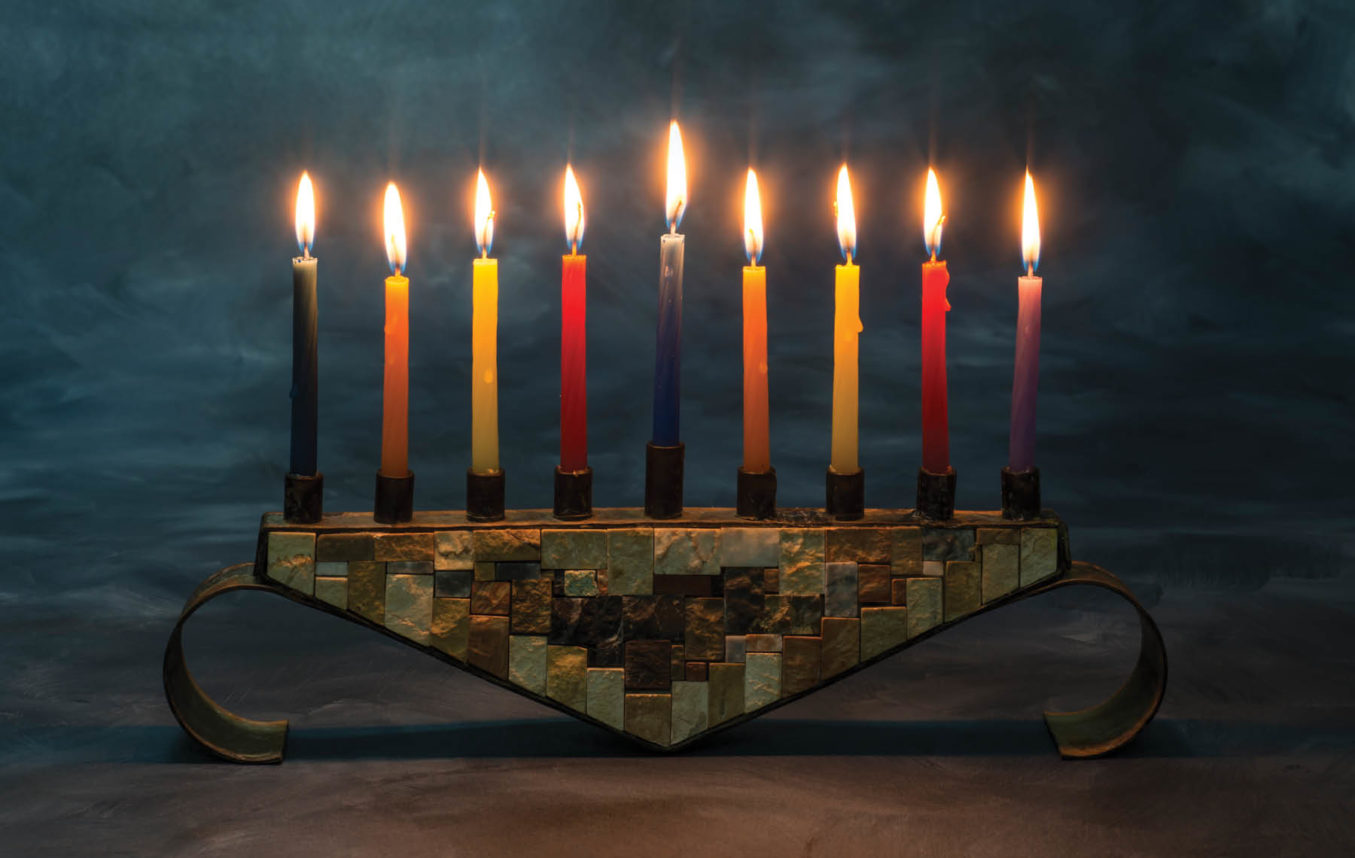
Starting on the 25th of the month of Kislev,Jews celebrate the 165 B.C.E. victory of the Maccabees, a brave troop of priest-warriors who vanquished the mighty Syrian Greeks. Every winter, Jews commemorate this military miracle by lighting Hanukkah candles, increasing the glow of spirituality in the world and saluting those who keep alive the dream of freedom.
The Torah portions we read at this time of the year also highlight dreamers. We learn about the visions of our patriarch Yaakov and his son Yosef, followed by Pharaoh’s butler and baker, then Pharaoh himself. The resounding theme of the power of dreams offers us hope amid darkness, echoing prophet Zechariah’s motto: “Not by might but by spirit” shall we all live in peace. Every flame on every hanukkiah(the Hanukkah menorah) is a small victory, a reminder of the triumph of good over evil. Hanukkah recalls those dreamers, from biblical times to the present, committed to the transformation of the world to one of liberty and justice for all. Moreover, we are reassured of the efficacy of the secret weapon in our arsenal: the power of dreams.
Jewish survival requires toughness and fortitude, an indefatigable resolve to advocate for liberty and self-expression. As a once-enslaved people, we instinctively rally against injustice inflicted on any group. Hanukkah further refines the Passover message of freedom, emphasizing that even in bondage, one can be spiritual. Our endurance is predicated on learning God’s word, remaining separate and worshipping as we choose.
The Greeks prohibited three things they perceived as crucial to maintaining the Jewish covenantal claim: observing the Sabbath, commemorating Rosh Chodesh, and circumcision. These fundamental mitzvot are not optional for sustained joy of Judaism, and the Maccabees were compelled to take up arms.
The loss of enthusiasm for these Jewish traditions can smother our spiritual sparks just as easily as the threat of physical annihilation. Hanukkah reminds us to keep alive the dream in spite of tribulations we face. During the week of Hanukkah, we can reflect on all injustices suffered by all people, feeling a sense of unity with those afflicted throughout history and today.
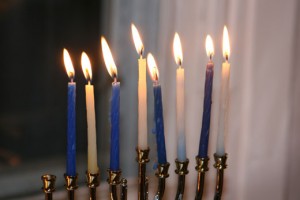
The standard box of Hanukkah candles contains 44 candles. We light “double chai” (36) over the eight nights to fulfill the mitzvah. Perhaps this represents chai(“life”) for the Jews and another chaifor our dream of peace for all nations. The eight leftover candles in the box serve as the shamash(“servant/aide”) for each night.
We light the shamashfirst, say the bracha, then use the shamash to light the other candles. But more than just igniting the others, the shamashserves an important function. Halachahdictates we can’t use Hanukkah lights for practical purposes, such as reading or working. These lights are purely spiritual and are solely for our metaphysical enjoyment. So don’t light and run. Avoid the urge to rush into presents, dreidel spinning and a latke feast. Sit and enjoy the candles. Take a deep breath, relax, converse with family and friends, or just sit alone and ponder the simple, everyday gifts we get from our Creator.
Most importantly, use those holy moments to rekindle your own dreams.
Hanukkah is the time to remember that the battle of the Maccabees must be fought in every generation. Like Yaakov and Yosef, whose stories illuminate this season, we must reclaim our connection with the dreams of our people — but not at the expense of our connection with humanity. We will continue to fight for a distinct Jewish identity while making this world a better place for all people and all nations. Let us realize Rev. Martin Luther King Jr.’s dream of a “day when all of God’s children, black men and white men, Jews and gentiles, Protestants and Catholics, will be able to join hands and sing together with the words of the old folk song, ‘Free at last, free at last. Great God Almighty, we are free at last.’ ”
Sam Glaseris a performer, composer, producer and author in Los Angeles. His Jewish CDs include “The Songs We Sing,” “The Promise,” “Hineni” and “A Day in the Life.” He scores for film and TV in his Glaser Musicworks recording studio.
Dan Messinger, who has owned Bibi’s Bakery Cafe in Pico-Robertson since 2011, has launched his second business, the Kosher Cookie Company, which will provide kosher-pareve (OK supervision) custom cookies for special occasions like b’nai mitzvah parties, holiday celebrations and donor relations campaigns.
The website went live on Dec. 15, just in time for Hanukkah.
“For the past few years, we have been looking for a second location to produce at because of the space limits of the Pico location,” Messinger told the Journal. “We are often close to capacity [in terms of] what we can produce out of that space.”
Messinger came up with the idea for the second business because “L.A. didn’t seem to have a hechshered, pareve, custom cookie-type bakery.” He noted that other “big-name” bakeries would do a special order “but no one was specializing.” When he saw the name Kosher Cookie Company was available, Messinger said he realized it “could be good as a business opportunity but also as a brand to create. It piqued the interest of my old self, who was working with brand management and brand influencing.”
At the second baking location, also in the neghborhood, the bakers produce batches of classic sugar cookie dough, decorated with blue and white or other color sprinkles. Special orders might call for cookies to be personalized, frosted with a name or custom logo, or whatever the customer wants, Messinger said. His company uses printable icing sheets (they are pareve and have a slight vanilla flavor, Messinger said) and edible inks. Other assortments available on the website include shortbread cookies and chocolate tea cookies, which, he quips in a British accent, “Is a cookie that’s very good with a ‘cuppa’ tea.”
Cookie packages run from $12.95 for a “Bucket-o-Cookies” to $39.95 for assorted cookie platters or a cookie sheet cake. Hanukkah Cookie Bundles are $24.95-$54.95, depending on quantity, and consist of special hand-decorated cookies alongside assorted dreidel, menorah and Magen David sugar cookies in a Hanukkah-themed package. In the store, a half-pound box costs $6. Between orders and in-store pickup, Messinger said his company expecting to make a few thousand cookies in its inaugural holiday season.
Messinger is hoping his community connections and the relationships he’s forged over the years will yield loyal and happy customers. For instance, for Rosh Hashanah this year, the Jewish Free Loan Association (JFLA) thanked more than a hundred of its biggest donors with a thank-you note in a package containing specialty Kosher Cookie Company cookies shaped and decorated like an apple or a beehive (for the traditional honey for a sweet new year). Some cookies were printed with the JFLA logo. The cookies, and the text accompanying them, also showed donors the impact of JFLA loans, since Messinger received a JFLA loan to help support his business.
JFLA Executive Director Rachel Grose told the Journal that Messinger was “exceptional to work with,” explaining how he had consulted with the association on the look of the cookies, suggesting different options. When the JFLA made requests, “He always said yes,” Grose said. “And they tasted great.”
Dan Messinger; Photos by Stephanie Waisler-Rubin
The Kosher Cookie Company has been taking smaller special orders for a few months, serving local organizations and businesses. But now the “sky is the limit for cookie production,” Messinger said, adding that he can fill orders from several dozen to several hundred, given the proper advance notice.
The cookies are pareve but not vegan (although vegan can be requested), and they aren’t gluten-free. Most of the recipes don’t use nuts, but thanks to some Russian wedding cookies and baklava, it’s not a nut-free facility.
Messinger hopes that his latest venture will have the same success as Bibi’s did when he took it over right before Hanukkah in 2011 and had to make vast quantities of sufganiyot. The experience, he said, was “a trial by fryer,” adding, “The miracle of Hanukkah is that I’m still in business.”
That first year, he said, Bibi’s made “an ungodly amount of doughnuts,” estimating several thousand for the season. This year, he estimates, the bakery likely will do several thousand in a single day, depending on special orders.
Sufganiyot are now available from Bibi’s through the end of Hanukkah, showcasing some of Bibi’s “greatest hits” flavors: classic strawberry jelly, custard, chocolate creme custard and two “super special” flavors: chocolate chip cookie dough and a cinnamon bun with cinnamon creme, each encased in sufganiyah dough and fried. Messinger noted that the prices are the same as last year — $2 each and $20 for a dozen, except the specialty flavors, which are slightly higher.
Photos by Stephanie Waisler-Rubin
Both Bibi’s and the Kosher Cookie Company are ritually kosher and are supervised by the OK. But as a statement on the website says, “a kosher life is more than just about ingredients.”
“Living a kosher life isn’t just about what you put into your mouth,” Messinger said. “It’s about the value that you have. Ten percent of any profits will be donated to hunger-type charities. That’s part of the gestalt of the idea of the Kosher Cookie Company.”
There’s more to Hanukkah food than Ashkenazi potato latkes and sufganiyot, and the Sephardic Educational Center (SEC) wants to help change that narrative.
That’s why around 100 women gathered at Kahal Joseph Congregation on Dec. 16 to share and taste 11 Sephardic and Ladino recipes in preparation for the eight nights of Hanukkah.
The recipes hailed from around the globe, including Spain, Turkey, Iraq, Morocco, Israel, France and Syria.
Longtime SEC member Sharon Gomperts emceed the evening. She told the Journal she provided an Iraqi frittata recipe for the cooking demonstrations that also featured Kahal Joseph president Yvette Dabby, Betty Sassoon, Esther Avrahamy, Laurence Wannon, Sharona Shabtay and Rachel Emquies Sheff.
Sheff maintains the SEC’s food page on Facebook, where she welcomes posts about Ladino and Sephardic recipes. “We are just a group of friends who love to cook,” Gomperts said.
Sheff told the Journal the SEC held a smaller, Rosh Hashanah cooking demo over the summer at a friend’s home with 50 attendees. It was so successful that Sheff’s friends convinced her to make it bigger so more members of the community could attend and learn how to make Sephardic dishes in their own homes.
“We’re not professional,” Sheff said. “We just want to get together and share with each other what we make at home.”
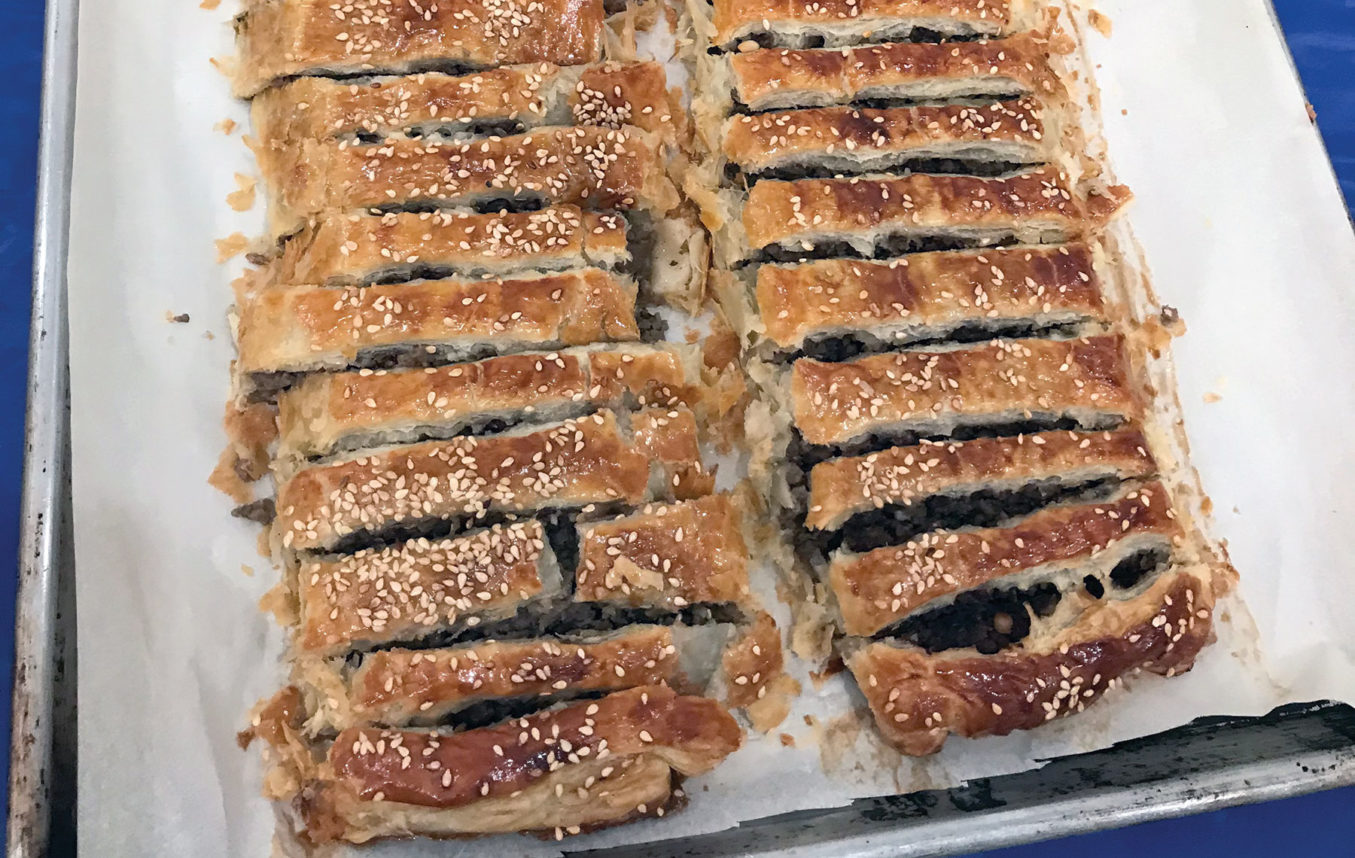
Each chef chose to make a comfort food recipe. Sheff made rosquitas and burmuelos doughnuts; Gomperts and Dabby made a vegetarian Iraqi aruk (like latkes); Shabtay made Matbucha salad (cooked with tomatoes and roasted peppers); Avrahamy made Israeli beef bourekas; Sassoon made Moroccan fish; and Wannon made Poulet aux Olives (chicken with olives).
Esther Avrahamy and Sharona Shabtay making Matbucha salad. Photo by Erin Ben-Moche
During the demonstrations, the women provided laughs, modifications and stories to accompany their preparations. Ultimately, their winning recipes were the ones that usually fed hungry children, picky eaters, grumbling tummies or accommodated food allergies.
While the homegrown chefs showed off their skills, the audience followed along in recipe booklets provided by the SEC, where they could take notes, make modifications and write questions.
Shabtay made almost everything from scratch when preparing her Matbucha salad. That included hand-mashing 4 pounds of Roma tomatoes. When asked if canned tomatoes could be used as a substitute, she replied, “You can use canned tomatoes but don’t tell my mom. She’ll kill me.”
Dabby and Gomperts reminisced about Shabbat meals when creating the Iraqi potato and bell pepper aruk. Dabby said while hers were vegetarian, meat can also be incorporated, but she made one thing certain: “Right off the pan, it’s gonna be eaten.”
“That’s the beauty of food,” Gomperts added. “It brings people together.”
Avrahamy eyeballed lots of spices including allspice and cinnamon in her meat mixture for her foot-long bourekas. While not everyone puts in a lot of spices, if any, in boureka meat, she said, “I’m Syrian. I add allspice to everything and I just love it.”
Each recipe had multiple variations because every woman in the room made each recipe differently, and would say so. The phrases, “Well, I usually do this” and “I do that” were heard often during each demonstration. Audience members added quick tips to their notes taken from both those doing the demos and simultaneous comments by those in the crowd around them — something you wouldn’t see on a Food Network cooking show.
“This is a community cooking class,” Sheff told the attendees. “We’ve never taught a class before, but we hope to do more and that some of you will [one day] be up here.”
The demo concluded with dessert made by Sheff. While she quickly created the dough for rosquitas cookies, she saw people appear timid to take on a “tricky” dough. “This recipe is foolproof,” Sheff promised. “There’s no real way to mess it up.”
Sheff said the Spanish dessert came from her mother. “We basically had no recipe until a few years ago,” she said. Because there were so many out there, she created a recipe that resembled what she grew up with and shared with the masses.
Many women jotted details as their mouths watered over the warm and inviting aromas that circulated the hall. Molly Jalali told the Journal that she loves coming out to the SEC food demos because she gets to taste all the food that is made.
Rosquitas and Sfenj doughnuts made by Rachel Emquies Sheff. Photo by Erin Ben-Moche
“We’re Sephardic,” Jalali said. “Could you imagine showing us the food but not letting us eat it? I go to other cooking demos. They don’t let you eat. Here, they do. It’s like going to a [jewelry store and] you look at the diamonds and you keep them.”
Jacalyn Shalom and her friends were excited to be at the Hanukkah cooking event because it was their ladies’ night outing.
“It’s nice to get out in the evening and [have] women friends, hanging out with women friends,” Shalom said. “The Moroccan fish [recipe] I knew, but the doughnuts were new, the chicken and olives were new. I think most of them are new. I’m looking forward to [trying them.]”
Sheff, who oversaw the event, is a believer in trying new recipes and wants others to have the confidence to do so. “Don’t be afraid,” she said. “It’s delicious and it’s something different than what you’d normally see.”
For more information on the SEC, visit their website.
The Jewish community isreeling after an attack at Nessah Synagogue in Beverly Hills in the early morning hours of Shabbat, Dec. 14.
The Beverly Hills Police Department (BHPD) is seeking a lone suspect who managed to enter the synagogue around 2 a.m. The suspect, believed to be a male, 20 to 25 years old, was captured on the synagogue’s security cameras. The video shows he has short, dark curly hair, a thin build, possibly wearing prescription glasses, shorts, low-top shoes (possibly Pumas). BHPD Lt. Elisabeth Albanese said he carried a backpack and pulled a rolling suitcase.
At a press conference held outside Nessah Synagogue around 2 p.m. on Dec. 14, BHPD said it responded to a call from the synagogue shortly after 7 a.m., after an employee notified security when he arrived for work and found an open door and items ransacked inside.
Police said the suspect committed a “series of minor vandalisms as he traversed through the Rexford/Elm alley south of Wilshire during the early morning hours.” He then forced his way into the synagogue. Police added, “He then moved through the synagogue, heavily ransacking the interior. He overturned furniture and distributed brochures and material throughout the interior. He damaged several Jewish relics but fortunately the main [Torah] scrolls survived unscathed.”
However, the “unkosher” Torah scrolls below the bimah were destroyed and thrown on the ground of the synagogue.
Police said it does not appear that anything was stolen. No one was inside the synagogue at the time and no one was injured. Although the police are investigating this as a hate crime, they say the suspect left no markings or other overt signs of anti-Semitism.
Beverly Hills Mayor John Mirisch issued a statement outside the synagogue saying, “This cowardly attack hits at the heart of who we are as a community. It is not just an attack on the Jewish community of Beverly Hills, it is an attack on all of us. The entire city stands in solidarity behind Nessah, its members and congregants. We are committed to catching the criminal who desecrated a holy place on Shabbat — of all days — and bringing him to justice.”
There were no services at Nessah Synagogue on Saturday morning. While some people arrived to discover the shul cordoned off, others received phone calls from members and friends before services were set to begin, informing them of what had happened.
American Jewish Committee Regional Director Richard Hirschhaut was at the scene and told the Journal, “We’re very pleased the Beverly Hills Police Department is treating this investigation as a presumptive hate crime. … This indeed is a grotesque act of hate and we look forward to the perpetrator being brought to justice.”
“This cowardly attack hits at the heart of who we are as a community. It is not just an attack on the Jewish community of Beverly Hills, it is an attack on all of us.”
— Mayor John Mirisch
Shortly after the vandalism, local resident Isaac Yomtovian sent out a statement, saying: “We, the Jews of LA and the US, must resist and fight these anti-Semitic acts, especially the destruction of our halls of prayers and homes of our holy scrolls of Torah. … The forces of evil must face justice. To do so, we must become united and vocal, demanding from our community, regional and national leaders to take action and stop the hatred of free citizens of United States.
“I highly recommend that:
(1) A day of fast be declared by all Iranian rabbis for the destruction of our holy scrolls of Torah;
(2) The day of fast should include lighting of the Hanukkah menorah and demonstrations in front of the mayor’s office, the offices of our senators and congressmen, as well as the Federal building;
(3) The entire Jewish population of LA must be mobilized to light the Hanukkah (Freedom) menorah in the streets and at home.
(4) We must reject these acts of anti-Semitism by writing to our senators and congressmen; and finally
(5) Demanding the FBI investigate these hate crimes and bring these thugs to justice.”
Nessah’s board of directors issued a statement on Dec. 15, saying, “Whether this
crime was committed by a hateful bigot
or a common thug who seized an opportunity to trespass and vandalize, we will not be intimidated. Rather, we are propelled to unite as a community, to unite with fellow Jews and to stand strong with good people of all faiths.”
Several community members spoke with the Journal the day after the vandalism. Cardiologist Afshine Emrani said he received text messages from friends about the break-in. “It took me immediately back to when we had to leave Iran during the revolution,” he said. “And I wondered if we would one day have to flee America, the country that has been my home for the past 40 years and I’ve come to love.”
At Elat Market in Pico-Robertson, Kevin Shokou called the vandalism “anti-Semitic” and “anti-humanity. There’s really nothing different between Jews, Muslims or anybody,” he said.
Having lived in the U.S. for 30 years, Shokou said, “It’s strange there are people living in this country who hate the Jews. It’s very awful.”
Ben Soleimani said he was walking to Nessah on Saturday morning when he saw the block cordoned off by police. “It was hate,” he said.
Sam Yebri, president and co-founder of the Jewish Iranian organization 30 Years After, issued a statement, saying, “30 Years After condemns in the strongest terms the act of vandalism that took place this Shabbat at the Nessah Israel Synagogue in Beverly Hills. In our society, no crime in any house of worship can be tolerated. We thank the Beverly Hills Police Department for their vigilance and support.”
Los Angeles Mayor Eric Garcetti tweeted: “Shocked and outraged by the vandalism at Nessah Synagogue. We will stand together and speak out strongly against any act of hate and intolerance in our community. We’re keeping our friends and neighbors in our thoughts as police investigate.”
Rep. Ted. Lieu (D-Torrance) posted on Facebook on Dec. 15: “Appalled that our neighbors, the congregation of Nessah Synagogue in Beverly Hills, were victims of vandalism overnight. We must condemn in the strongest terms acts of intolerance and anti-Semitism, and ensure that everyone in our community feels safe in their houses of worship.”
The Israeli-American Civil Action Network released the following statement: “Enough is enough, from the East Coast to the West Coast, Jewish communities are under attack,” said Vered Nisim, ICAN California chairwoman. “Just a few days ago, Jews were killed in Jersey City, and now today this vandalism. How many Jews have to die and how many synagogues have to be destroyed before serious action is taken?”
The Israeli-American Civil Action Network also hosted a free town hall open to the public on Dec. 18 at the Beverly Hilton in conjunction with the City of Beverly Hills under the banner Combating Anti-Semitism: Creating Safe Communities.
Anyone with any information on the suspect should contact the Beverly Hills Police Department at (310) 285-2125.
— Additional reporting by Managing Editor Kelly Hartog
As someone who has catered many Hollywood parties in Southern California, I know what people will and won’t eat. It’s important that people enjoy the art of indulgence, so I approach the table with a California mindset.
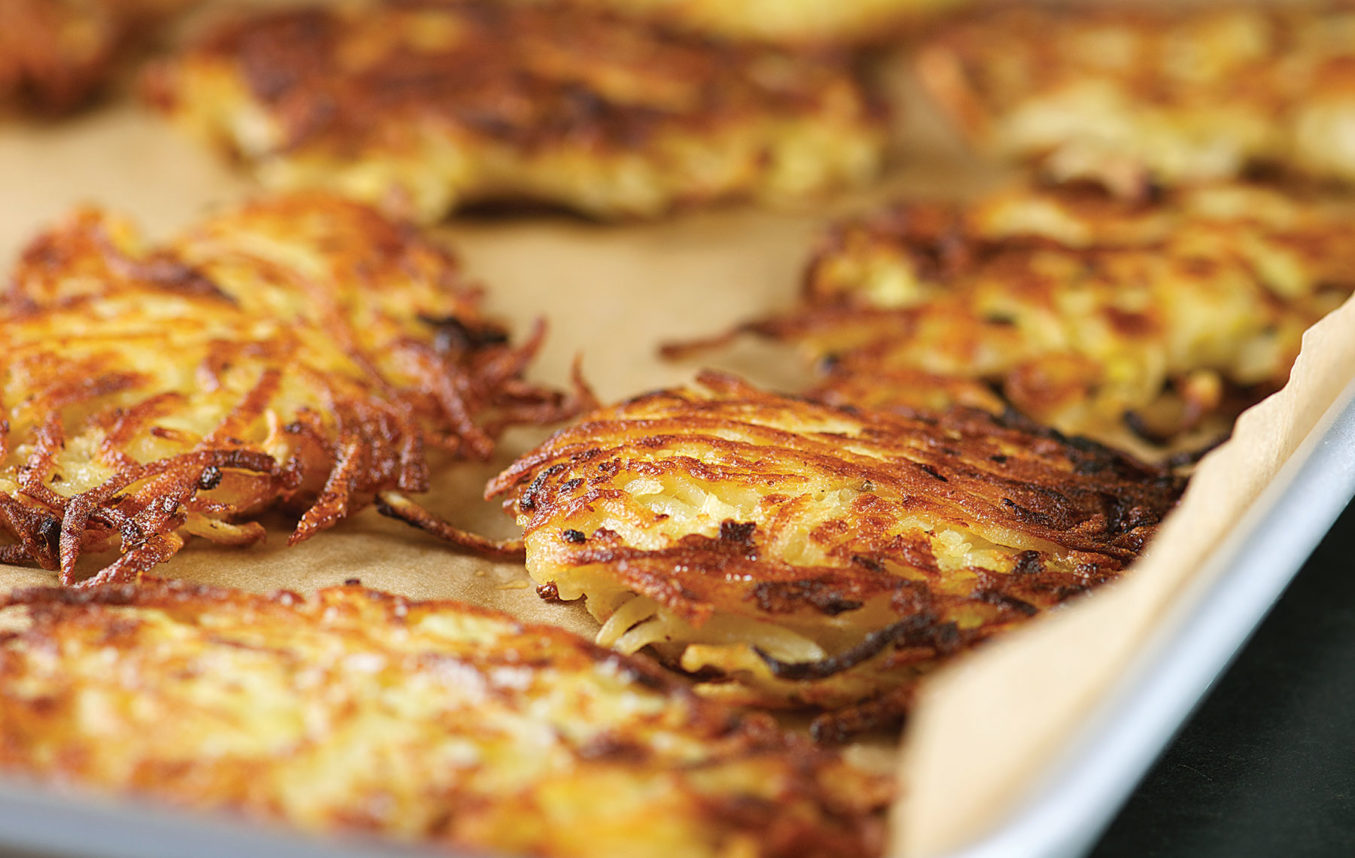
When it comes to hand-held appetizers, latkes are the perfect food for today’s conscious eaters. They deliver crunchy, salty, juicy goodness and can be made without gluten, grains or dairy. In a world where most hors d’oeuvres are made of frozen pastry dough and melted cheese, latkes offer an option for those seeking to avoid those food groups for allergy and other reasons.
But forget the health objectives for a moment. Latkes are a perfect food, particularly when made with lots of leeks, grated onions and only a touch of potato flour and egg to hold them together. The flavors remain pure and robust. Plus, I fry latkes in olive oil, the miracle oil of Hanukkah, the golden touch of the Mediterranean.
Potato Leek Latkes 2 pounds russet potatoes
1 yellow onion
2 leeks
2 tablespoons potato starch or potato flour
1 egg
1 teaspoon kosher salt, plus more for sprinkling
30 grinds of pepper mill
1 cup extra-virgin olive oil
Grate the potatoes into large mixing bowl using large holes of box grater. (Using a food processor won’t result in the same texture.) If potatoes start to turn brown, no one will notice after they’re cooked.
Grate onion using small holes of box grater. Add to bowl.
Remove outer layer of leeks and grate only white and light-green parts on small/medium holes of box grater. Add to bowl.
Add potato starch/flour, egg, salt, and pepper to bowl and mix with your hands.
Heat heavy-bottomed skillet over medium-high heat for 5 minutes or until quite hot. Add olive oil and let it get very hot. (Test temperature by dropping in piece of potato. If it sizzles and browns easily, oil is ready.)
Squeeze tablespoon-sized portion of potato mixture between your fingers to flatten and release liquid. Latkes should be thin and not perfectly circular. Frayed potato gratings along the sides will be the first to crisp. Pressing out water minimizes oil splatter.
Add each dollop to hot oil and fry until deep brown and crispy on each side. Transfer to paper towels.
Sprinkle with salt.
Makes about 35 latkes.
Latkes, Lox and Cream Cheese 20 Potato Leek Latkes
4 ounces (wild) sliced smoked salmon, ripped into 1-inch pieces
4 ounces cream cheese
1 bunch fresh chives, chopped
Ground black pepper, to taste
Top each latke with piece of salmon, dollop of cream cheese and chives. Grind pepper if desired. Serve immediately.
Makes 20 latkes.
Crispy Latkes with Spicy Tuna 1/4 pound sushi-grade ahi tuna
1 tablespoon (low sodium) tamari or soy sauce
1 tablespoon wasabi powder
Zest of 1/2 lime
Juice of 1/2 lime
1 tablespoon toasted sesame seeds
13 slices of serrano or jalapeno pepper
Either finely chop tuna with sharp knife or zip in food processor. Use knife if more texture is desired; use food processor for sushi-style texture.
Add tamari, wasabi powder, lime zest and juice and sesame seeds. Mix.
Top latkes with mixture, and garnish each with slice of serrano or jalapeno.
Serve immediately.
Makes about 20 latkes.
Latkes with Creme Fraiche, Pomegranate and Chives 35 Potato Leek Latkes
8 ounces crème fraîche
1/2 cup pomegranate seeds
1 bunch fresh chives, chopped
Top each latke with dollop of crème fraîche, a few pomegranate seeds and chives. Serve immediately.
Makes 35 latkes.
Lemony Latkes Avocado Toast 1 large avocado
1 green onion, white and green parts thinly sliced
Zest of 1 lemon, divided
Juice of 1 /2 lemon (about 1 tablespoon)
1/2 teaspoon kosher salt
In small bowl, smash peeled avocado with fork.
Add green onion, half lemon zest, lemon juice and salt.
Top each latke with dollop of avocado and garnish with extra lemon zest.
Serve immediately.
Makes 10-12 latkes.
Brisket-Topped Latkes Because brisket takes time to cook, I recommend you get two meals out of it. First serve it for dinner, then use leftovers for a latke party, or vice versa.
Top each latkes with warm brisket, dollop of crème fraîche, if desired, and chopped mint.
Best Brisket Ever 1/4 cup extra-virgin olive oil
6 to 8 pound brisket
2 onions, chopped
2 to 3 celery stalks with leaves, chopped
2 to 3 carrots, chopped
2 to 3 garlic cloves
2 to 3 sprigs fresh rosemary
2 bay leaves
2 to 3 sprigs fresh thyme
5 to 6 fresh basil leaves
1 28-ounce can whole peeled tomatoes, crushed
1/2 bottle red or white wine
2 to 3 teaspoons kosher salt
One or two days before serving:
Preheat oven to 325 F.
Heat large pot or Dutch oven over medium heat (let it get hot for a couple of minutes).
Add enough olive oil to cover bottom of pot. Add brisket, fat side up, and brown about 10 minutes on all sides. (In order to fit entire brisket in pot, it might need to be cut into two pieces, or squeeze it in pot with meat flaps up the side. Meat will shrink as it cooks.)
Remove brisket and set aside. If there is too much melted fat in pot for your taste, remove some before continuing.
Add onions and cook until translucent, about 5 minutes.
Return brisket to pot, fat side up.
Top with celery, carrots, garlic, rosemary, bay leaves, thyme and basil.
Add tomatoes including their juices and wine.
Sprinkle generously with salt.
Cover well and place in oven for 4 to 5 hours. It can cook for longer but at a lower temperature.
When brisket cuts using fork, it’s done.
Remove pot from oven and cool until it can be handled easily, about an hour. Remove brisket from pot and let it and juices cool completely.
Return the brisket to pot and refrigerate.
One day before or on the day of serving:
Place brisket on large cutting board. Use knife and/or fingers to remove all fat from brisket. Cut brisket against grain into 1/4-inch slices.
If brisket juice appears thick enough, place brisket slices back in pot. If juice should be thicker, boil it down uncovered on the stove. A portion of juices and veggies can be blended to add creaminess.
After brisket juices are desired thickness, place sliced brisket back in pot or in large casserole dish. Cover meat with sauce.
Cover and refrigerate until ready to serve.
On day of serving:
When ready to serve, re-heat brisket in one of two ways.
If using casserole dish, cover it very well in heavy-duty foil or wrap it in two layers of regular foil, and bake at 350 F for almost an hour until brisket is well heated through.
If everything is in original pot, reheat it on stove over medium-low heat or place it in oven at 350 F for one hour.
After it’s heated through, place meat on a serving platter, top with remaining juice and serve.
Brisket serves 8 to 10. As topper for latkes, serves 35 or more.
One verse, five voices.Edited by Salvador Litvak, Accidental Talmudist
The mitzvah of Hanukkah is that each day the head of the household kindles a light for himself and his household. And those who are meticulous in the performance of mitzvot kindle a light for every person in the household. And those who are the most meticulous adjust the number of lights daily. –Shabbat 21b, B. Talmud
Rabbi Miriam Hamrell Senior Rabbi, Ahavat Torah Congregation in West Los Angeles
Hanukkah is also called Hag HaUrim — the Holiday of Lights. We have an obligation to fulfill the mitzvah of lighting the Hanukkah candles and bringing the light in. Our talmudic verse suggests some ways of doing it.
Maimonides (Hanukkah 4:1) teaches that the basic mitzvah is that the head of family lights one candle for his whole family. If one is particular, mehadrin, he lights one candle each night for each member of his family including females, but not minors. However, if one is very particular, mehadrin min hamehadrin, he fulfills the basic mitzvah in an enhanced way, hiddur. This means that eight candles are lit the first night for the whole family and decreases each subsequent night, as taught by the students of Shammai. However, the students of Hillel say that the head of the household lights one candle on the first night for the whole household and continuously increases the number of candles each succeeding night.
Tosafot teaches that there are not three levels of holiness in fulfilling this mitzvah, but rather three ways to beautify, mehader, it. This is what it’s all about, bringing the light of Hanukkah into our hearts and into our soul. We do it through hiddur mitzvah, beautifying and glorifying the mitzvah. Our soul craves, desires and yearns for its glorious Hanukkah light, so give the soul what it wants.
I pray that each one of us will have the opportunity to soul-crave the light of every mitzvah we do. Amen.
Rabbi Scott Bolton Congregation Or Zarua
This talmudic passage lights souls on fire! The Gemara is saying you should kindle the flames of your Jewish neshamah on Hanukkah. Connect with the kosher way of performing the Hanukkah candlelighting and beautify the endeavor by adding light each night.
While the festival has historic foundations, we add candles and flames to discover which mitzvot we will rededicate ourselves to during and after Hanukkah. We align personal searches for holiness with our people’s. We consider more deeply how we will connect our own stories to the ongoing, unfolding story of the Jewish people, whose place must be maintained and claimed in every generation. The Maccabees showed us we have to physically fight for that sometimes, and our sages shared sacred dances that guide our feet, hands, hearts and souls.
Our talmudic passage invites us to extend beyond our self-defined ways of “doing Jewish” and even beyond the mitzvot that our immediate families routinely engage in. Adding more lights means developing our mitzvah practice according to Jewish law. We learn what is possible for our people and for ourselves when we pursue the light of the talmudic sages’ and Jewish leaders’ teachings in terms of how best to practice and fulfill the commandments. The fires of Hanukkah menorahs dance like Jews doing mitzvot in a dark world that deeply yearns for conflagrations of holiness. Spending time with those we love in front of our Hanukkah lights contemplating our mitzvah plans is the rededication our rabbis in the Talmud imagined on Hanukkah.
Rabbi Benjamin Blech Professor of Talmud, Yeshiva University
Oil is probably the most politically incorrect of all liquids. It simply refuses to compromise its uniqueness. If oil were a person, it would almost certainly be condemned for its stubborn unwillingness to blend in with others. It chooses to remain aloof, separate and distinct. Mix it with water and it stays apart and maintains its own identity. No matter how hard you try, oil stays true to itself and just won’t assimilate.
That’s probably why it deserved to become the ultimate symbol of the Hanukkah miracle. The story of Hanukkah is all about a clash of cultures. The Greeks weren’t out to kill the Jews. Their intent wasn’t genocide of a people. It was rather a battle against those who threatened their commitment to hedonism, their infatuation with the body, their obsession with athletic competitions to prove superior worth. In these they found beauty — and the very meaning of life. What the Greeks worshiped was the holiness of beauty. What the Jews wanted to teach the world instead was the beauty of holiness.
The victory of the Maccabees was the triumph of those who exemplified this unique characteristic of oil. They refused to assimilate; instead, they chose to pursue our mission to bring the moral light of Judaism to the world.
What was the secret of their success? They began by “enlightening” themselves. They moved on and concentrated on every single person in their home. Then they made sure they renewed their teachings every single day. And that is how we too will preserve our faith and our people.
Rabbi Aaron Lerner Executive Director, Hillel at UCLA
We all have practices that exceed the basic requirements. In many cases, our excessiveness is beautiful. Walk into a home on the eighth night of Hanukkah and behold dozens of candles aflame! It’s truly miraculous, and certainly more visually appealing than a single candle. But sometimes, we also fail to recognize the costs associated with going so far above and beyond.
In the extreme, even healthy habits like sleeping, diet and exercise can be associated with shorter life spans, eating disorders and injury. Our communal economic norms relating to material consumption, day school tuition or Los Angeles real estate can also be financially ruinous. The Jewish solutions to this quandary are moderation and awareness.
When it comes to Jewish practice, we are generally instructed to choose the middle path, not the extreme poles. For instance, everyone is supposed to give 10% to tzedakah (charity). We are all encouraged to give more, but commentators caution even the most well off not to give so much that it would endanger one’s family. In terms of awareness, it behooves us to slow down enough to pay attention to what we’re doing compared to what’s required. In this case, most readers are probably surprised to hear that everyone doesn’t need their own menorah. I would extend the question: Where else in your life are you going way beyond, possibly unaware of what would be simply “good enough”? Is that practice healthy and beautiful, or should you consider scaling back?
Rabbi Cheryl Peretz Associate Dean, Ziegler School of Rabbinic Studies, American Jewish University
One light for each household or one light for each person in the house — two opinions, one message. Every Jewish home — be it that of a single person, a married couple, a family or empty nesters — should be illumined with the lights of the Hanukkah menorah. We look and we watch, simply to beautify the holiday and see the light within.
What might have been if, after being victorious in their battle over assimilation, the Macabees had decided not to light the menorah at all? It was a demonstration of faith, courage and strength to rededicate the Temple using the small flask of oil, kindling the menorah in their day and igniting the sparks within Jews of all future generations. What an awesome moment it must have been and is to pour faith and yearnings into a small vessel, shining the ultimate light of life into this world.
In Hanukkah’s light, past and present unite to ignite a radiant light that guards against evil and indifference. This light leads away from the darkness of doubt and the fear that doubt engenders. Instead, we see the reflections of hope, of dreams and of possibility.
Light your candles. Turn off the lights and look at the flames, noting the mixture of red, yellow and orange. Concentrate and let it take you where it will. And experience the promise of Proverbs: The light of God is the human soul. That is indeed the promise of light for all in the house.
An Israeli orchestra performed in a Dec. 4 festival in Morocco despite pressure from boycott, divestment and sanctions (BDS) activists in the country.
The Times of Israel (TOI) reported on Dec. 17 that the Israeli Andalusian Orchestra-Ashdod opened the international Andalussyat Festival in Casablanca. The orchestra’s general manager, Jacob Ben Simon, said in a statement to TOI that he was thankful for the festival’s efforts to resist pressure from BDS activists to boycott the festival if the orchestra performed.
“People demonstrating for canceling the performance have no interest in music, peace and the added value of the concert and festival,” Ben Simon said.
StandWithUs tweeted, “Music won over hate.”
Despite pressure from anti-Israel organizations, the Israeli orchestra performed in Morocco. Music won over hate. https://t.co/fcE094iGMT
The orchestra first performed at the Andalussyat Festival in December 2018; the performance was not publicized beforehand in order to protect the Israeli orchestra members from those in Morocco who might want to harm them. The around 100 members of the orchestra performed with other musicians from northern African countries, including Algerians and Libyans.
According to Jewish Virtual Library, Morocco and Israel don’t have official diplomatic relations with each other; however, Israeli Prime Minister Benjamin Netanyahu met with Moroccan Foreign Minister Nasser Bourita in September 2018 to discuss the possibility of establishing such ties between the two countries.
Throughout 2019, BDS activists have attempted to cancel various artists from performing in Israel, most notably Bon Jovi,Jennifer Lopez and Lionel Richie. None of the aforementioned concerts in Israeli was canceled.
Two ears, two eyes, nose and mouth:
the seven gates
through which we perceive
the world
are also seven flames by which
we illuminate it,
like the seven-branched lamp
which stood in the Temple
until the Romans carried it away.
Like that ancient menorah, we burn
not only for each other,
but for God, who needs us
as much as we need
God, despite the occasional
miracle, like managing
to keep the Temple lamp lit
eight days — so that now we add
an extra candle, and visit
our children’s public school
classrooms to teach about our
traditions, as our mothers
once did for us, out of
pride but also to show
ourselves as simply human,
not to be feared or hated.
Now the nights grow longer
colder, and many of us are afraid.
The rabbis say, in a place where there is
no good person, be one.
I think they are talking directly
to us, saying: the darker it gets in this world,
the more we need to shine.
Alicia Jo Rabins is a writer, musician and Torah teacher. Her most recent book of poetry is “Fruit Geode.”
It can be either invigorating or unnerving to discover a previously unknown branch of the family tree that challenges everything you grew up knowing about your family.
Princeton University President Christopher Ludwig Eisgruber discovered such a branch. He spent most of his life surrounded by Catholicism. Raised Catholic, he went through adulthood as a “non-atheist” (his term). It was only when his young son had to do a project on ancestry that Eisgruber learned some of his family were processed through Ellis Island — and were Jewish.
After further investigation, he discovered his immigrant mother, who came from Berlin to New York at age 8, was Jewish. He had been told his mother converted to Catholicism from Protestantism before meeting his father. According to Eisgruber’s mother, his father was a member of Hitler Youth and was anti-Semitic. When Eisgruber learned about his roots, he voluntarily walked into the world of Judaism, although he still is a self-proclaimed “Jewish non-atheist.”
Elected in 2013 as Princeton’s latest president, Eisgruber has a host of degrees under his belt: a bachelor’s in physics from Princeton, a Master of Letters in politics from the University of Oxford and a J.D. from the University of Chicago Law School. For 11 years, he taught at New York University’s School of Law.
According to The Presidents of Princeton University website, Eisgruber returned to Princeton in 2001, “joining the faculty as the director of the Program in Law and Public Affairs and the Laurance S. Rockefeller Professor of Public Affairs in the Woodrow Wilson School of Public and International Affairs and the University Center for Human Values. He directed Princeton’s Program in Law and Public Affairs from 2001 to 2004, and he served for a year as acting director of the Program in Ethics and Public Affairs in 2002–03.”
It was only when his young son had to do a project on ancestry that Eisgruber learned some of his family were processed through Ellis Island — and were Jewish.
Eisgruber has a fierce belief in freedom of speech and inclusivity on campus, feeling the two do not have to be mutually exclusive. It is important to him that everyone have a voice and participate in discussions about controversial subjects, with “participate” being a key word. There is no room for violence or “nasty provocation” in his vision of free speech.
Eisgruber has lent his expertise on the U.S. Constitution to legislative bodies, testifying in regard to religious freedom. He is a prolific writer, having penned books delving into the law and the Constitution, including “Constitutional Self-Government” (2001) and “The Next Justice: Repairing the Supreme Court Appointments Process (2007).”
In addition to his earned degrees, the University of Edinburgh granted Eisgruber an honorary doctorate in 2015, and Oxford’s University College elected him an honorary fellow. Outside the realm of universities, he became a member of the American Academy of Arts and Sciences in 2014.
In keeping with his goal of mentoring and encouraging young people as well as his advocation for equal opportunity regardless of socioeconomic standing, Eisgruber is a steering committee member of the American Talent Initiative (ATI). The ATI consists of a group of colleges and universities “dedicated to substantially expanding opportunity and access for low- and moderate-income students.” The ATI includes Bard College, Dartmouth College, Duke University, Stanford University, Ohio State University and Princeton University.
Sharla Etkin-Ives is a freelance writer and editor who lives in upstate New York.
A host of crucial issues faces America today, including the eroding credibility of major institutions such as government and the media, climate change, a hyper-polarized society, income inequality, booming debt and a rise in loneliness and depression.
But if I had to pick one fundamental issue, one that most impacts the others, I’d pick the state of free speech. In recent years, this basic all-American freedom has been under assault by well-meaning dissenters, most notably on college campuses, who have focused on the side effects of free speech rather than its inherent value.
Maybe this was bound to happen. After all, the United States has some of the most liberal free speech laws in the world. Many people are shocked to learn that the First Amendment protects hate speech. So what speech is not protected? Primarily, speech that incites violence such as a physical threat or the well-known example of shouting “fire” inside a crowded theater.
Americans generally have the right to offend one another without the fear of being prosecuted. Ku Klux Klan members are free to march, burn crosses at rallies and spew their bigotry. This ugliness is the price we’ve had to pay for our cherished freedom.
But there’s a problem: Our world is changing. As an evolving society, we are becoming more inclusive and sensitive to people’s feelings of alienation. Inclusivity is giving free speech a run for its money. At such a moment in time, the First Amendment’s protection of offensive speech has come to feel downright un-American.
As an evolving society, we are becoming more inclusive and sensitive to people’s feelings of alienation. Inclusivity is giving free speech a run for its money.
That feeling is acute on college campuses. Many universities have bent over backward to accommodate students who refuse to be exposed to any speech they find hurtful and offensive. A whole new vocabulary has sprung up around these efforts, such as “microaggressions,” “safe spaces” and “trigger warnings.”
As a result, a vexing paradox has emerged: The place where free speech ought to be most vibrant and tolerated — the university campus — has become the place where it is most besieged. How universities navigate this paradox will help shape the future of America’s most fundamental freedom. Universities, which nurture and educate our future leaders, now are the social laboratories where free speech is being pushed and pulled and fought over.
A vexing paradox has emerged: The place where free speech ought to be most vibrant and tolerated — the university campus — has become the place where it is the most besieged.
Will free speech succumb to the assault from the “I have a right to not be offended” crowd? Or will it find a way to coexist with a popular and noble value such as inclusiveness?
One man who believes these two values can work together is Princeton University President Christopher L. Eisgruber. I was introduced to Eisgruber a few months ago and we chatted on the phone about this subject. It was clear from our talk that free speech and inclusiveness are issues dear to his heart and he’s given them plenty of thought.
After our conversation, I followed his writings and was struck by a remarkable keynote address he delivered Nov. 12 at the University of Pennsylvania Law School, titled “Contested Civility: Free Speech and Inclusivity on Campus.” Eisgruber added complexity to a subject I’ve always seen as pretty stark. I’m a free speech absolutist: Either we’re free to offend or we’re not. Either we tolerate hateful views or we don’t. Yes, free speech comes at a high cost, but all things considered, it’s priceless.
Eisgruber went in a more nuanced direction, focusing on ideals rather than legal doctrine. From the start, he telegraphed his attempt to thread the needle between two seemingly opposite values. He stated: “My first and principal claim is that public debate and, to a lesser but real extent, scholarly commentary have unnecessarily pitted free speech and inclusivity against one another. If rightly understood, free speech and inclusivity are both essential aspects of the university’s mission, and they are also often, though not always, complementary and mutually reinforcing ideals.”
How can free speech and inclusivity become “mutually reinforcing ideals”?
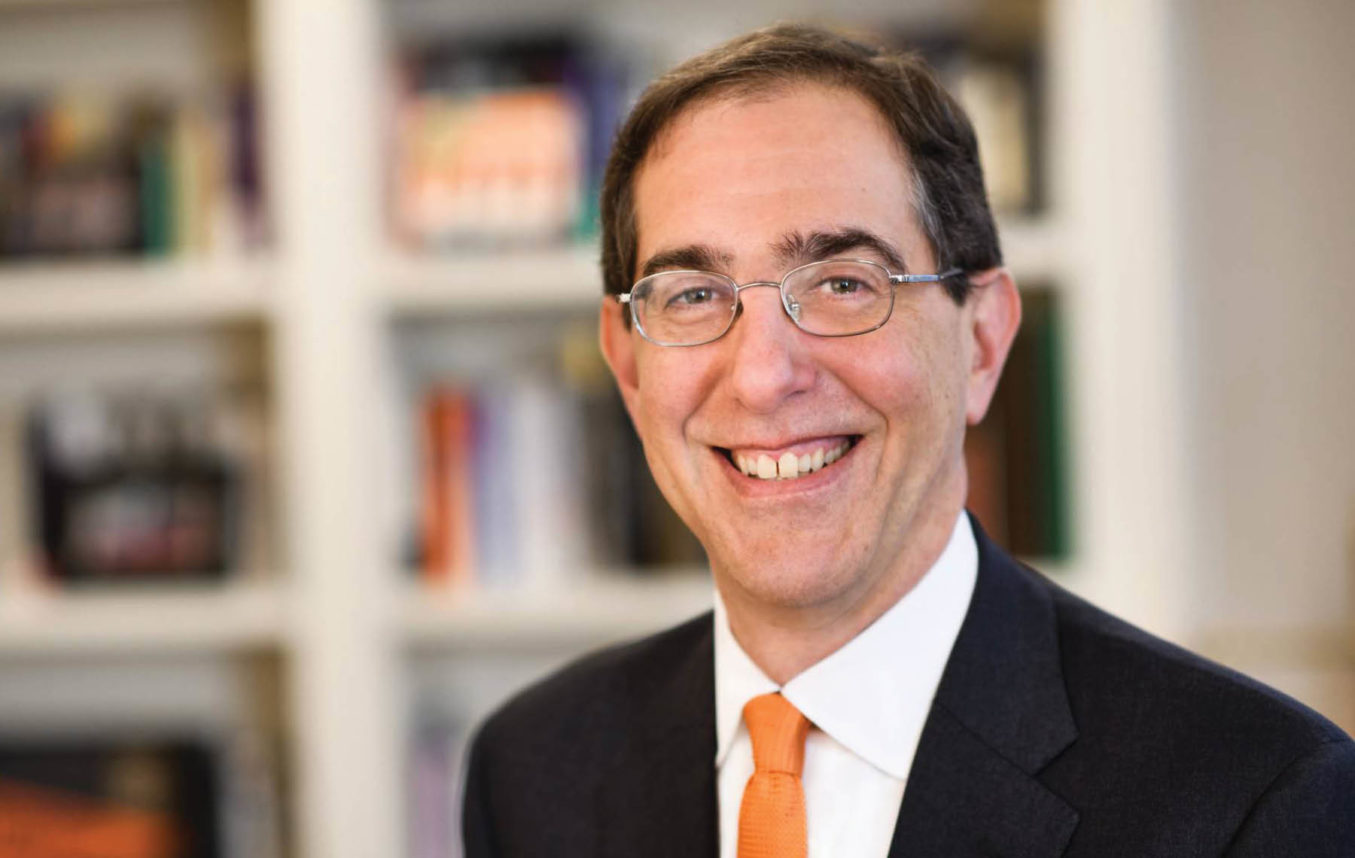
Princeton University President Christopher Ludwig Eisgruber
Eisgruber introduced a unifying idea to help answer that question. Instead of fighting over “free speech versus no free speech,” he suggested we take a step back and look at “truth-seeking,” and view universities as “truth-seeking institutions.”
This is a compelling reframing if for no other reason than everyone ought to support a search for truth.
Instead of fighting over “free speech versus no free speech,” [Eisgruber] suggested we take a step back and look at “truth-seeking,” and view universities as “truth-seeking institutions.”
But as Eisgruber acknowledged, this search carries both risk and opportunity: “For universities to carry out their truth-seeking mission effectively, people have to be free to challenge orthodoxies. To do that, they have to be able to state unpopular or heretical opinions without being shouted down, disrupted or disciplined for doing so.”
Truth-seeking requires what Eisgruber calls an “anti-censorship principle.” It requires freedom, not constraints. But the greater the freedom, the greater the amount of speech, both good and bad. In that spirit, Eisgruber summarized the famous quote from Justice Louis Brandeis: “The remedy for bad speech is more speech, not censorship.”
For a free speech junkie like yours truly, that should have been the end of it. We assert the extraordinary value of one of life’s greatest freedoms and move on.
Eisgruber, though, didn’t move on. He went deeper. For all his profound respect for the freedom to express “unpopular or heretical opinions,” he has a deep respect for civility and for creating an atmosphere where all students can feel included.
That’s where his truth-seeking is most helpful — it justifies a rational limit to the anti-censorship principle. As he states: “The anti-censorship principle does not by itself achieve effective truth-seeking discussion, nor in fact is the unqualified application of that principle even consistent with the practice of truth-seeking, which requires standards and processes to discriminate between truth and falsehood.”
In other words, freedom of speech, for all its noble value, is not necessarily conducive to finding truth. To do so, it needs accepted standards and processes. He illustrated this point with some clear examples:
“Anyone may stand out on Locust Walk and declare that the United States Constitution has no application within the state of Pennsylvania, or that the Supreme Court has original jurisdiction over any lawsuit filed by a college or university. No one should, however, expect these views to earn them good grades in a federal courts class or a faculty appointment at the law school.”
Eisgruber was alluding to a very Jewish idea. In Jewish tradition, freedom is not as valued as the boundaries of freedom, and how we must act and search for truth within those boundaries.
Anti-censorship is a boundary. The search for truth narrows that boundary. Should the boundary shift further depending on the environment? Should the classroom, which is governed by academic standards, be treated differently than the rest of the campus, where “an ethic of unfettered debate should prevail”?
Eisgruber eschewed that notion, arguing for a more holistic approach: “The anti-censorship principle and professional academic standards should not be regarded as two parallel and separate domains that happen to coexist on college campuses; they are instead two among many discursive models that contribute to the achievement of a larger ideal for campus speech.”
This larger ideal, as he expressed it, is that “universities should foster rigorous, constructive, truth-seeking discussions about questions of consequence.”
This is the language that aims to reconcile free speech and inclusivity. “Rigorous” and “constructive” discussions are not emotional, Twitter-friendly terms; they are objective, inclusive ones, as are “questions of consequence.” We are free to claim the U.S. Constitution is not applicable in Pennsylvania or California but that is so utterly false it is not a question of consequence.
This larger ideal, as he expressed it, is that “universities should foster rigorous, constructive, truth-seeking discussions about questions of consequence.”
Indeed, not every question is created equal.
“In addition to permitting people to speak freely, we should study questions that matter, not just any questions; we should proceed according to standards and with methods likely to distinguish better arguments from worse ones,” Eisgruber stated.
In that common and earnest search for truth, we’re more likely, as he said, to “treat one another with the kind of courtesy and respect that allow us to learn from each other, despite our differences in both viewpoint and background.”
It’s as if Eisgruber has metaphorically repositioned the free speech debate by presenting an extravagant buffet where everyone is free to choose whatever they want to eat — yet simultaneously, he makes an impassioned plea to not settle for the “popular” junk food and consider items that promote health, experimentation and communal well-being. Of course, he also reminds us that bad manners and food fights can cause indigestion:
“A forum in which people hurl nasty provocations at one another may be entirely compliant with the anti-censorship principle but grossly inconsistent with the speech ideal I have described.”
This “speech ideal” is where Eisgruber delivers on his promise to marry free speech with inclusivity. If the ideal revolves around the search for truth, the greater the inclusion of different voices, the deeper and broader that search will be. As he says:
“To maximize the value of campus discussion, colleges and universities must be able to attract talented people from all backgrounds, and all people on campus must feel able to participate in the conversation. The conversation will be better — that is, it will be more rigorous, more constructive and more likely to address questions of consequence — if it includes contributions from people with a wide variety of perspectives and experiences.”
If the ideal revolves around the search for truth, the greater the inclusion of different voices, the deeper and broader that search will be.
In sum, Eisgruber has studied the changing social landscape and laid out a path to a “better conception” of free speech — what one might call “Free Speech 2.0.”
He’s not naïve about its prospects. While not playing the alarmist card, he recognizes there have been “egregious, disturbing and widely publicized departures” from the anti-censorship principle, suggesting the pendulum has swung too far in one direction.
Eisgruber must have great patience and empathy to deal with some of today’s activists. It’s hard for me to muster much admiration for students who heckle speakers until they’re forced to leave or intimidate administrators into canceling events, as is happening at various campuses.
I find the woke definition of a safe space — a place where one is free from speech that may offend them — a sad development. Maybe it’s because I have a daughter living in Israel who has an entirely different conception of a safe space: a concrete bunker that will protect her from terrorists’ rockets.
I was born in the Third World, where a newspaper column criticizing a leader likely would earn me a visit from someone in a uniform. In America, I have written the sharpest criticism against presidents and other powerful leaders, and at no time has any official knocked on my door.
This freedom, for me, is as vital as oxygen. When I see racist, vile speech that disgusts me, I remind myself it’s the price I have to pay for the freedom to speak my piece. I remind myself that “the remedy for bad speech is more speech, not censorship.”
Today, however, many activists feel the remedy is less speech, so they’ll bully those whose ideas they can’t stand. That’s when the poisonous trend of self-censorship kicks in. People silence themselves because it’s simply not worth the risk of consequences.
Today, many activists feel the remedy is less speech, so they’ll bully those whose ideas they can’t stand. That’s when the poisonous trend of self-censorship kicks in.
I’m grateful Eisgruber is more patient than I am. In his position as a leader of an Ivy League school, he can’t afford to shy away from a subject as essential as free speech. His insightful and courageous dissection of what has become a highly divisive issue is precisely what is needed at the moment.
He has a talent for reframing delicate issues in a way that makes them more palatable. In his address, he gave an example from 2018 of a charged incident connected to race.
In a course named “Cultural Freedoms: Hate Speech, Blasphemy and Pornography,” a Princeton professor mentioned the most incendiary racial slur in the American language. As Eisgruber describes it, “a student in the class said that the slur offended him and asked the professor not to repeat it. The professor refused, saying he believed it necessary to state the slur explicitly so that students would comprehend the full, provocative force of the word. And comprehend it, they did.
“Several students became angry, left the classroom, returned to confront the professor and walked out again. They complained to the administration about his repetition of the slur.
“Both the anti-censorship principle and principles of academic freedom protect a professor’s decision to quote the slur for pedagogical purposes. I immediately affirmed his right to do so, as did his department chair … who wrote a letter to the student newspaper defending not only the professor’s pedagogical rights but also his character as a person and the value of his course.”
Here, again, Eisgruber didn’t settle for simply defending anti-censorship. He went deeper, trying to better understand the grievance:
“Students do sometimes phrase their objections to racial slurs or other language in terms of the ‘pain’ they feel, and that formulation lends credence to the view that the issue arises out of their sensitivity.
“The argument I have laid out suggests that the point might be reformulated to emphasize dignity rather than pain. The critical question, in my view, is whether explicit mention of the word shows appropriate respect for all members of a campus community and thereby promotes the likelihood of constructive dialogue among people of different backgrounds, rather than whether it makes someone feel bad.”
Dignity and inclusion, he suggests, are not just wonderful human values, they are values in the service of constructive speech that seeks the truth.
If Free Speech 2.0 has any chance of gaining traction, it will need this kind of supple thinking by college administrators across the country.
Dignity and inclusion are not just wonderful human values, they are values in the service of constructive speech that seeks the truth.
An important part of that supple thinking will be to distinguish between different levels of verbal aggression. Jewish students who support Israel, for example, haven’t had the luxury to complain about microaggressionsbecause they’ve had to brave the macroaggression of the boycott, divestment, sanctions (BDS) movement, which has created a hostile environment for many Jews.
Whether or not one agrees with President Donald Trump’s new executive order against anti-Semitism, any speech that may intimidate people demands a strong response. At the very least, BDS must be subjected to vigorous truth-seeking to expose its blatant discrimination against Jews and the little-known fact that it has done virtually nothing to help Palestinians.
In any event, whether we’re dealing with micro- or macroaggressions, with a fateful presidential election looming in 11 months, we can expect an environment as ugly and emotional as ever. Maybe the path Eisgruber laid out can be battle-tested in the coming year. Imagine universities fostering “rigorous, constructive, truth-seeking discussions” around difficult and divisive issues, even one as difficult as President Trump, arguably the most divisive figure of our time.
One title might be, “Is a Civil, Truth-Seeking Conversation About President Donald Trump Possible?” If that is too much for some, they can start with other divisive issues such as climate change, immigration or income inequality.
The serious problems facing our country today deserve the ideal described by Eisgruber: Free speech that seeks the truth, embraces dissent and honors dignity.
If our besieged First Amendment can withstand and empower such difficult conversations across our changing nation, we’ll be on our way to a healthy Free Speech 2.0. If not, we will wither and shrink, putting our feelings ahead of courage, curiosity and intellectual growth.
The serious problems facing our country today deserve the ideal described by Eisgruber: Free speech that seeks the truth, embraces dissent and honors dignity. Whether our universities can thread that needle and lead the way is the big question.