fbpx

December 18, 2019

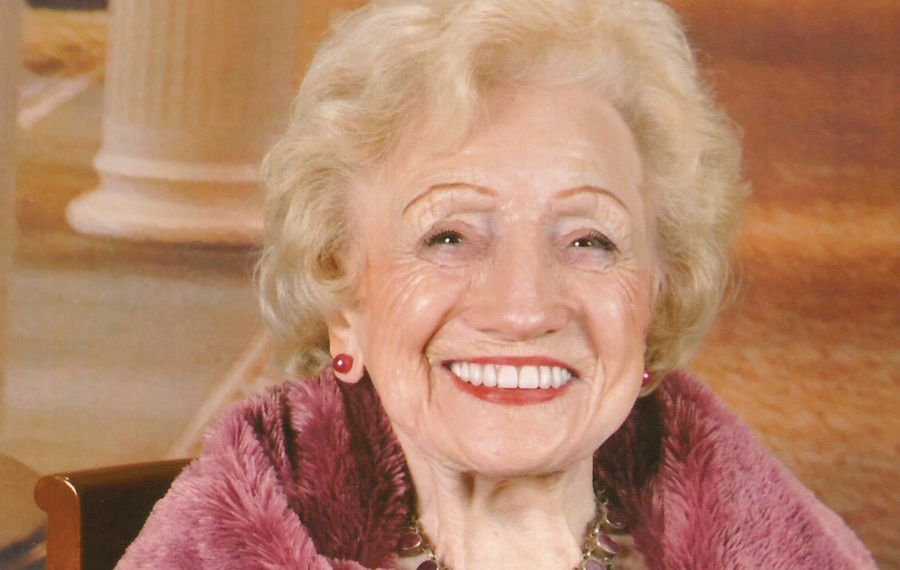
Rosalee Glass, Holocaust Survivor, 102

Holocaust survivor Rosalee Glass died Dec. 16, following injuries she sustained on a trip to Washington, D.C., after attending the White House Hanukkah party. She was 102.

Glass was the subject of a 2018 documentary made by her daughter,  called “Reinventing Rosalee.” The film covered everything from the horrors she suffered in a Siberian prison camp to her vivacious, irrepressible joy in her 80s and beyond. It led to her being invited by President Donald Trump to his Hanukkah party on Dec. 11.

Born Raisla Talerman in 1917 in Warsaw, Poland, Glass started making men’s shirts in her teens. She became so successful that by the age of 18 she had a staff of 10. 

Around the same time, she met her husband, Abraham, a violinist. After a confrontation with Nazi soldiers, the Glasses decided to move to what they thought was the safer, Russian-controlled part of Poland. They settled in Bialystock, but soon after their first son, Elias, was born, they were arrested and sent to a prison camp in Siberia. Elias died in the camps, as did a daughter, Perla. Another son, Manny, survived, and after the war the family was sent to a displaced persons camp in Germany. 

With the help of Jewish Family Services, the Glasses immigrated to Miami in 1951. They had another daughter, Lillian, and Rosalee went back to work, starting a successful drapery business. The couple eventually moved to a retirement community in Southern California, where Abraham died at 90 in 1996. Three years later, Manny died from a botched hospital procedure.

Glass, suffering from deep depression, moved in with Lillian. But when she turned 80, she decided to live the rest of her life to the fullest. She learned to play the piano and traveled the world with her daughter. In Poland, she buried photos of relatives who died in the Holocaust and had an audience with Pope Benedict XVI at the Vatican. 

At 90, Glass took up acting, appearing in commercials for Blue Cross, Porsche and Dodge. When she turned 100, she went riding with sled dogs in Alaska. Earlier this year, she became a movie star, walking the red carpet at the Cannes Film Festival at a screening of “Reinventing Rosalee.”

Asked the secret of living to 100, she told Journal contributor Kylie Ora Lobell, “Have love in your heart.” 

Glass is survived by her daughter, Lillian. n

Rosalee Glass, Holocaust Survivor, 102 Read More »

The Skin Tone of Jew-Haters Should Be Irrelevant

I have a dream that my four little children will one day live in a nation where they will not be judged by the color of their skin, but by the content of their character.” — Martin Luther King Jr.

On December 17, one week after the terrible anti-Semitic attack on the JC Kosher Supermarket in Jersey City, an African-American woman on the subway in New York City, physically attacked an Israeli woman named Lihi Aharon. Ms. Aharon was attacked, because she refused to be silent, while this same woman verbally and viciously harassed an elderly (and visibly Jewish) man. The video of Ms. Aharon describing the attack, as well as the actual footage of the attacker and her heinous anti-Semitic statements can be found here.

Sadly, the attack on Ms. Aharon was not an anomaly. Attacks on Jews in New York City are an all too common occurrence. From 2018 to 2019, anti-Semitic hate crimes are up 63%.  In a city where Jews account for less than 15% of the population, over 50% of the hate crimes target Jews. In Jewish neighborhoods in Brooklyn, physical attacks on the visibly Jewish are an almost weekly occurrence.  

Yet, right after the terrible shooting in Jersey City, after two Black Supremacist members of the Black Hebrew Israelite (BHI) cult deliberately targeted a kosher supermarket and a Jewish school for a murderous rampage, NYC Mayor Bill de Blasio incredibly tweeted: “This tragically confirms that a growing pattern of violent anti-Semitism has now turned into a crisis for our nation. And now this threat has reached the doorstep of New York City.”

The “doorstep”? For over a year there has been a virtual epidemic of violent assaults targeting Jews in Brooklyn, and de Blasio claims that violent anti-Semitism has only just “reached the doorstep of New York City”?  Adding to his apparent obfuscation and cognitive dissonance, despite practically every known violent attack on Jews in New York over the past 2 years being perpetrated by members of other minority groups in the city; back in June of 2019, de Blasio incredibly asserted that anti-Semitism is distinctly a “right wing movement.”

In addition to Mayor de Blasio’s “head in the sand” approach, we are seeing many other people – when the perpetrators of raw anti-Semitic violence – are not clear white Supremacists, also trying to obfuscate, dissemble and even excuse the hatred. 

J Street Rabbi Jill Jacobs recently asserted in a Tweet that when African-Americans direct the violence at Jews then, it is not due to anti-Semitism, and it “likely relates to long term tensions.” 

The New Yorker magazine, ran a story with the headline “Untangling the Hate at Heart of the Mass Shooting in Jersey City” in which the reporter discussed the local residents of the neighborhood in Jersey City chafing at the impact the “insular Hasidic Jews” had on the local real estate market. 

Notably, this story did not contain any reporting on the virulent anti-Semitic comments, recorded on video right after the shooting (see and hear them here); where many of the local residents expressly said the Jews deserved to be shot and did not belong in their neighborhood. One person said: “My children are stuck at school because of Jew shenanigans. They are the problem. Because if they ain’t come to Jersey City this s*** would never go on. Take that s*** somewhere else. I blame the Jews” … while another said, right next to the dead bodies of their Jewish neighbors: “Get them damn Jews the f**k out of here. Get these f***ing Jews. Get the Jews out of Jersey City.”  

Can anyone imagine – in the immediate aftermath of a violent massacre of Jews by white Supremacists – either Jill Jacobs or The New Yorker waxing philosophical on what caused a group of white Christians to violently hate or murder Jews? 

Can anyone imagine the media frenzy if there had been white Christian neighbors – following an attack on Jews by a white Supremacist group – recorded on video saying that the Jews deserved to be shot and “didn’t belong” in their neighborhood? 

Can anyone imagine any attempt to “untangle” the motives of any white Christian killers who posted blatantly anti-Semitic screeds about Jews before they attacked a Jewish school or market? Or, trying to rationalize why white Christians in that neighborhood, without shame, could speak of Jews as an undesirable “other” that does not belong and deserves to be shot? 

There is nothing here to “untangle.” This is the same anti-Semitism. Whether the anti-Semite is a white Supremacist, black Supremacist or Islamist Supremacist. The hatred is the same. Even much of their rhetoric and crazy conspiracy theories about Jews is the same. It is why, if you are reading their statements about Jews, it is often difficult to tell the difference between David Duke and Louis Farrakhan.

Which brings me back to this subway attack and the video posted by this brave Israeli girl, Lihi Aharon. When you watch the video – which you should – it is notable how much of the attacker’s vile rhetoric comes straight from the Louis Farrakhan playbook. It is also similar to the mendacious anti-Semitic tropes expressed by the BHI killers who attacked the Jersey City kosher supermarket. 

The Jill Jacobs and New Yorker Magazines of the world have no problem recognizing that the vile white Supremacist ideology and rhetoric motivated and incited the attacks on the Tree of Life Shul in Pittsburgh and on the Chabad Shul in Poway. However, when it comes to attacks against Jews by other types of supremacists, then suddenly – for them – it becomes a complicated issue needs to be “untangled.”


Enough. Jewish lives matter. No matter who tries to kill us or attack us for being Jewish. 

The motivations for these attacks on Jews are also just as straightforward. As is the cause. Raw, virulent anti-Semitic conspiracy theories and hate promoted by hate-mongers like David Duke, Louis Farrakhan, and many of their intentional and unintentional allies and enablers. People like Ilhan Omar, Linda Sarsour, and Tamika Mallory. People who traffic in anti-Semitic canards and regularly demonize the Jewish people and the only Jewish state. Their allies and close supporters, such as the highly inaptly named Jewish Voices for Peace – with their libelous and inflammatory “deadly exchange” program, which falsely, dangerously and incredibly blames police shootings of African Americans in the USA on Jews in Israel. 

It is the equivocation and refusal to treat this hatred and conspiracy theorizing directed at Jews with the same disdain as white Supremacist anti-Semitism that has enabled this dangerous Jew-hatred to grow and metastasize. All one needs to do is look at the comments by an African American member of the Jersey City Board of Education shortly after the kosher supermarket attack to see how deep this anti-Semitism can take root when ignored or excused. In a December 15 Facebook diatribe, Joan Terrell-Paige, referred to Jews as “brutes” with “bags of money and asked people to think about the “message” the BHI shooters’ “were sending” [with their attempt to mass murder Jews] and asked people if they “were brave enough to explore the answer to their message.” She also accused rabbis in New Jersey of “selling body parts.” If her references to “black people” were replaced with “white people” it could easily be mistaken for a Neo-Nazi rant. Yet, people like Jill Jacobs want to claim this hatred is not “based on antisemitism.”

Kudos again to Ms. Aharon for standing up to the anti-Semite who was shamelessly harassing an elderly Jewish man on a subway. On the opposite end of the spectrum, shame on all of the people who just watched this bigot harass and attack Jews and did nothing. 

Just as those who did nothing on that subway, should be ashamed of themselves, so should anyone else who tries to obfuscate and hide the cause of violent Jew-hatred simply because it comes from politically inconvenient perpetrators. History has taught us that anti-Semitic hatred and incitement – particularly the kind promoted by white Supremacists, Farrakhan’s NOI and the BHI – of “evil so-called Jews” who are to blame for all of your problems … or even for bad police shootings – often leads to violence and murder, even mass murder. 

None of us should allow people to get away with trying to hide that basic truth or be silent in the face of those who try to rationalize obvious Jew-hatred and incitement. Dayenu. Enough.

Let us remember: what hurts the victim most is not the cruelty of the oppressor but the silence of the bystander.” — Eli Weisel


Micha Danzig is a practicing attorney in San Diego and an advisory board member and local chairperson for StandWithUs.

The Skin Tone of Jew-Haters Should Be Irrelevant Read More »

Hanukkah Books Are Scarce; Yiddish Is Trending

Every year, children’s publishers usually add a title or two about the Hanukkah holiday by the time December rolls around, but this year the pickings are rather slim. What is notable, however, is that the world of Jewish children’s literature has seen a sudden glut of books celebrating all things Yiddish. Included in the new books here are three Yiddish-centered picture books, one spooky chapter book about a boy, his bubbe and a modern-day
Brooklyn dybbuk, and the one and only Hanukkah book celebrating an unlikely holiday food: kugel. 

“The Book Rescuer,” by Sue Macy. Illustrated by Stacy Innerst. (Simon & Schuster)
The full title of this beautiful picture book is “The Book Rescuer: How a Mensch from Massachusetts Saved Yiddish Literature for Generations to Come.” Adults familiar with Aaron Lansky’s amazing story will know what this means, but children are probably unaware of his heroic efforts to save Yiddish books from being relegated to a literal dustbin of history. The author follows young Aaron, an “all-American boy,” from his youth in Massachusetts to his college years (as he first began to learn Yiddish) and later, when he started collecting Yiddish book cast-offs from elderly Jews he knew. The book recounts how he ended up rescuing thousands of Yiddish titles, digitizing them, creating the fabulous Yiddish Book Center in Amherst, and almost singlehandedly being the catalyst for the resurgence of the study of the Yiddish language today. 

The engaging illustrations are inspired by the art of Marc Chagall. Aaron Lansky provides an “Author’s Note” at the end, and both author and illustrator provide explanatory pages, along with a useful Yiddish glossary. An inspiring tale for children that proves the power of one individual to change the world if they care enough.
Purchase on Amazon here.

“Yiddish Saves the Day,” by Debbie Levy. Illustrated by Hector Borlasca. (Apples & Honey Press)
Ashkenazi or Sephardic? Who cares about your DNA results when you can share funny rhymes like these with your child: “Oy, did I have a shlep! I fell on my shnoz when my foot missed a step! I tripped like a klutz and lost my left shoe! And, oy vey, my tuchis! I fell on that, too!” Each page contains adorable illustrations of exactly what kind of mishegoss is going on, along with a vocabulary box at the bottom with proper English translations and a pronunciation key. Follow along as our hapless shlemiel gets fartootst because he loses his notebook, but his menschy little brother and his food-obsessive mishpachah help him just in time for him to contribute enough outsized Yiddish words to bring to school the following day. Now he’s a maven, and his vocabulary-crazed teacher is duly impressed. 

“Yiddish words,” says the author in an endnote, “are so powerful, and so often comical, they’re like the superheroes of language.” This hilarious book proves it.
Purchase on Amazon here.

“Goodnight Bubbala: A Joyful Parody,” by Sheryl Haft. Illustrated by Jill Weber. (Dial Books)
The little old lady whispering “hush” from the original “Goodnight Moon” has nothing in common with this boisterous family of rabbit bubbes and zaydes and various grandchildren who descend upon a cute bubbeleh bunny getting ready for bed one Hanukkah night. They dance and sing, spin dreidels, nosh on bagels and knaidels, and play with a toy gorilla — an apparently useful item used later to rhyme with the line “the whole megillah” on the final page.

The humor here is overblown and silly, but kids familiar with the original may get a kick out of saying, “Goodnight knaidel and the shmeer on a bagel. Goodnight gelt, and goodnight dreidel, Goodnight little blocks, and goodnight tzedakah box.” You get the idea. The lively illustrations are also a parody of the original and full of Jewish ritual objects to spot and identify. Look for the “Easy Latke” recipe at the end, supplied by popular Jewish cookbook author Ina Garten. Purchase on Amazon here.

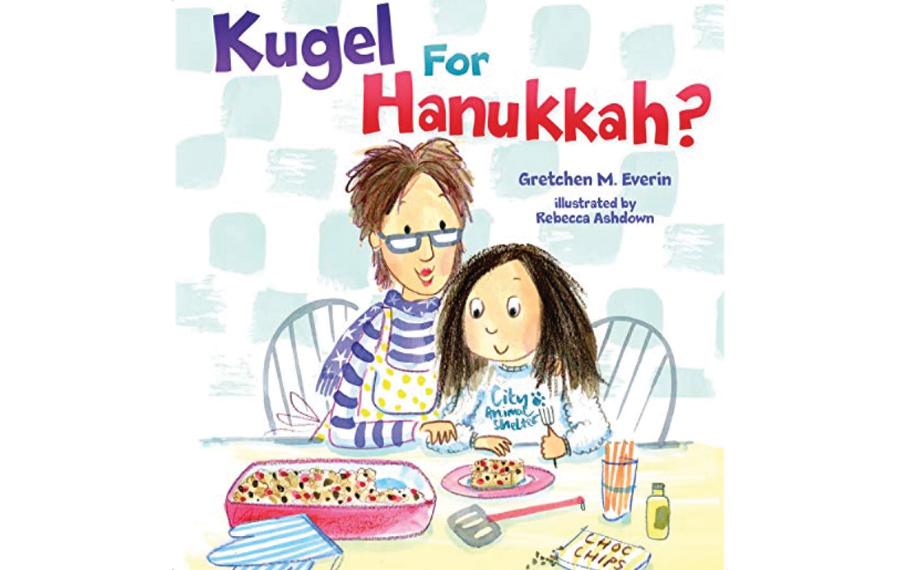
“Kugel for Hanukkah?” by Gretchen M. Everin. Illustrated by Rebecca Ashdown. (Kar-Ben Publishing)
A wide-eyed animal-loving young girl celebrates Hanukkah with her family, hoping for the gift of a pet, such as a puppy, kitten, bird or hamster. Instead, on the first night, she receives a hard metal lamp. On the second night, she gets a “strange kind of thermometer.” On the third night, she gets a squirty spray bottle. Things are becoming confusing! To add to the puzzlement, her grandma is receiving odd gifts, as well: chocolate chips, cinnamon sticks, a tiny bottle of vanilla and candied cranberries. As the clues grow, children will have fun trying to guess what the eighth night will bring. For Grandma, it turns out to be the ingredients for a family favorite holiday treat: Cranberry Chocolate Chip Hanukkah Kugel. (Recipe included.) By the last night, the delighted little girl has received all she needs for her new pet — an unexpected iguana!

There is a lot to this simple story for young children. Besides the eight candles, there are the eight different gifts to count, along with eight different kinds of latkes served (potato, carrot, turnip, beet, etc.) The illustrations are charming and reflect a newer trend in Jewish children’s books regarding realistic depictions of grandparents. Here, Grandma is not sporting gray hair or wearing pearls and a dress, but appears to be a slim, hip-looking 60-something with a purple-striped turtleneck and leggings. All the male characters are wearing kippot, which also serves as a teachable moment in many homes. A fun and appealing new Hanukkah story to share with animal-loving children.
Purchase on Amazon here.

“The Ghost in Apartment 2R,” by Denis Markell. (Delacorte Press)
This middle-grade chapter book made this year’s list and it is full of great references to classic (spooky) Yiddish literature and lore. The story begins when Danny’s older brother moves out to go to college and his (well-meaning but rather clueless) parents decide to rent out the now empty room on the new “AirHotel” app. This relegates poor Danny to the closet under the stairs, a la Harry Potter. When strange things start happening to guests who sleep in the rented room, Danny and his friends Nat and Gus do some sleuthing to figure out if the house is haunted. 

The multicultural Brooklyn neigh-borhood is full of fun and diverse characters, and the gentle scares keep the pages turning. As the clues pile up, Danny’s Bubbe Ruth (who speaks with a Yiddish-tinged cadence) provides some context with her stories of dybbuks, Ellis Island immigration and snippets of Yiddish songs such as, “Raisins and Almonds,” all elements of the creepy sounds emanating from the eerie room. Is there a young Jewish woman possessed by a dybbuk in search of her lost family haunting the bedroom? This clever mystery is highly entertaining and a sure winner for the fourth- through sixth-grade reader. Purchase on Amazon here.


Lisa Silverman is the director of the Burton Sperber Jewish Community Library located at American Jewish University.

Hanukkah Books Are Scarce; Yiddish Is Trending Read More »

Celebrities Share Their Favorite Hanukkah Memories and Traditions

During the Festival of Lights, it’s all about family traditions, gift-giving and of course, food. We asked some famous MOTs about their favorite Hanukkah memories, and how they celebrate now.

Photo courtesy of Lisa Marie Mazzucco

I remember we had a project in school to make a menorah and I made one out of a sweet potato. I put the holes in it for the candles and the shammash. At the end of Hanukkah, I could have eaten it but I don’t like sweet potatoes. Whenever I see [a sweet potato] now it reminds me of Hanukkah. — Itzhak Perlman, violinist


Marissa Jaret Winokur

When I was growing up, we didn’t do presents for Hanukkah. We just lit the candles. It was very much about religion and family. Birthdays were when we got our presents.
— Marissa Jaret Winokur, “Perfect Harmony”


Mimi Leder; Photo courtesy of Apple+ TV

I still give my grown-up daughter eight little gifts every Hanukkah. No matter how old your baby is, it’s still so much fun to continue the tradition.”
— Mimi Leder, producer and director, “The Morning Show”


Director Gideon Raff of The Red Sea Diving Resort – Photo Credit: Netflix / Marcos Cruz

I love Hanukkah. My family really didn’t do gifts. My grandfather would bring us little coins from the Lubavitcher Chabad. When I’m home in Israel, the only thing I try to do on Hanukkah is avoid bakeries. They have amazing sufganiyot all over Tel Aviv and I’m trying not to gain weight.
— Gideon Raff, writer, producer and director, “The Spy”


Jamie Masada; Courtesy of the Laugh Factory

When Jewish comedians come from out of town, they have no place to go for Hanukkah, so we invite them to come upstairs for latkes. I spend an hour or two with them and then I go home to celebrate with my family. 

One year, a few guys got together and got me a big, beautiful chocolate dreidel with “Jamie, Happy Hanukkah” on it. I put it in the storage room because I’m very sentimental about this stuff. I didn’t want to eat it. A few years later I had the guys over for latkes and told them I still had it. I went down to the storage room to get it, and it was a big, brown mess. I think ants had eaten it. Very sad, but we had a good laugh about it. 

When I was growing up, living in Iran, we were poor. I never got a present. But I got a lot of love and that’s the most important thing.”
— Jamie Masada, Laugh Factory owner


LLC/Photographer: Allister Foster

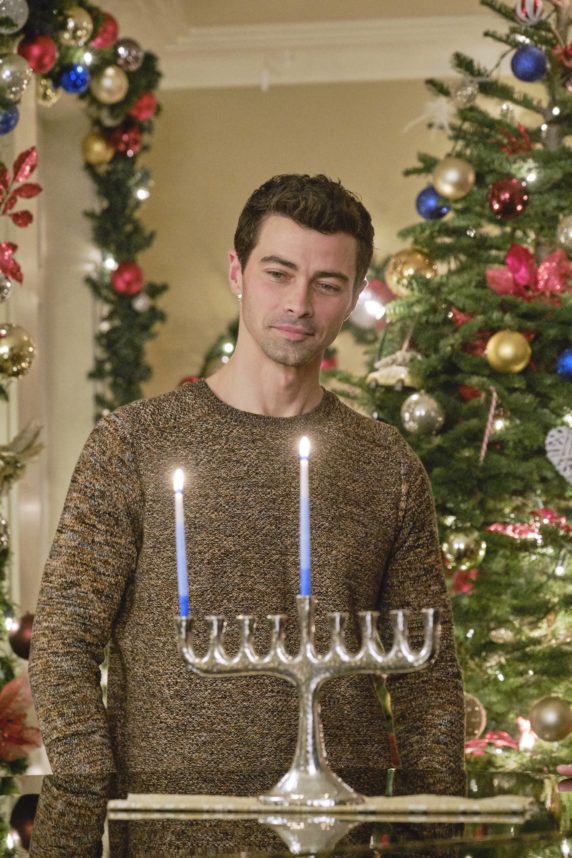
I loved Hanukkah because I was a potato latke maniac. If I was on a deserted island the only thing I’d want is a bucket of potato latkes and applesauce to dip them in. I know how to make them and made them once. They’re so delicious.
This year I’m going to try again.”
— Matt Cohen, actor, “Holiday Date”

Celebrities Share Their Favorite Hanukkah Memories and Traditions Read More »

Fox News’ Sexual Harassment Scandal Explodes in ‘Bombshell’

As explosive and impactful as its title suggests, “Bombshell” tells the timely story of the women who exposed the toxic culture at Fox News and brought down their abusive boss, Roger Ailes. Starring Charlize Theron as Megyn Kelly, Nicole Kidman as Gretchen Carlson, John Lithgow as Ailes and Margot Robbie as the fictional Kayla Pospisil, the docudrama was directed and produced by Emmy-winner Jay Roach (“Trumbo, “Recount,” “Game Change”) from a script by Charles Randolph (“The Big Short”).

“It’s probably seen as a #MeToo story but it happened a year before the news came out about Harvey Weinstein,” Roach told the Journal. “These women spoke up in the summer of 2016. The Harvey Weinstein news broke in the fall of 2017. By the time we made the film in 2018, there were other stories and more women were speaking up and it was a much bigger conversation.”

Roach was intrigued when Theron, also a producer on the film, brought him the script in February 2018. “When these women spoke up, especially at a conservative organization where a lot of women resisted the idea of being called feminists, it seemed like a remarkable and compelling story. They were unlikely underdogs to take on such a powerful guy in a place like this at a time like this,” he said. “For me, the most important part of the story was that these are issues that people across the political divide could agree on. Women should be safe at work. The problem is nonpartisan and the solutions are nonpartisan and I thought the film would be a useful part of that conversation.”

Randolph and Roach did extensive research to ensure accuracy, replicating the Fox newsroom and studio based on photos from the time and detailed descriptions of Ailes’ office from former staffers. They re-created news stories to run on monitors and interviewed multiple women whose experiences at Fox News inform Robbie’s sexually harassed character. “We acknowledge that we take license, but we also acknowledge that we have a huge obligation to try to get it right,” Roach said. “People who were at Fox who’ve seen the film described it as so authentic that it was almost traumatic for them, so I think we got some of it right.”  

“Bombshell’s” stars already have been nominated for Golden Globe (Theron, Robbie) and Screen Actors Guild awards (Theron, Robbie, Kidman and the ensemble cast). Roach welcomes the attention because “it gets people talking about sexual harassment. Anything that can expand that conversation is a good thing,” he said, noting that he hopes it gives men a new perspective on the issue. “We can remain part of the problem or become part of the solution.”

Roach first established himself with the “Austin Powers” trilogy and “Fockers” films and doesn’t rule out making more comedies. “But there’s something almost compulsive in me now to tell stories about issues that are relevant and trying to answer the questions or be part of the conversation about how we go forward as a civilization,” he said. 

“People who were at Fox who’ve seen the film described it as so authentic that it was almost traumatic for them, so I think we got some of it right.”
— Jay Roach  

An Albuquerque, N.M., native, he was an economics major and pre-law at Stanford University when he began taking photographs for the newspaper and making documentaries, which led him to shift gears and apply to USC film school. His numerous accolades include four Emmys, two each for “Game Change” and “Recount.”

Raised Southern Baptist, Roach converted to Judaism before he married Bangles singer-guitarist Susanna Hoffs. They met at an arranged dinner in 1991 and married two years later in Chicago, with her maternal grandfather, Rabbi Ralph Simon, officiating. “He was an incredible storyteller, a great guy to be around. I felt instantly close to him and his daughter Tamar, Susanna’s mother,” Roach said. “He couldn’t conduct the ceremony unless I was Jewish. The more I talked to them about conversion, the more I was drawn to the idea.”

Through his studies and preparation with the help of Tamar Hoffs, Roach discovered “so much of the spiritual and ethical philosophy of Judaism was in line with what I believe, such as the emphasis on education and family and the ability for anyone in the world to get to a righteous place by being a good person. The inclusiveness of the Jewish faith is really meaningful,” he said. “The deeper I got into it, the more moving the process became. It was a very meaningful rite of passage, definitely life-changing.”

Although he “didn’t become that stereotypically zealous convert, I definitely consider myself to be part of my wife’s Jewish family,” Roach said, noting that he is more appreciative of Judaism because he chose it. His family, which includes two sons, isn’t affiliated with a synagogue, “but we honor a lot of the traditions and Susanna’s mother is a great influence on that. We do seders and a lot of family observance.”

For his next directorial effort, Roach will continue in the historical docudrama genre with a television project about the deadly confrontation between unarmed students protesting the Vietnam War and National Guard soldiers at Kent State University in May 1970. Four students died and nine others were injured. 

“It was an incredible turning point in our history. We had tried to do it as a feature film, but I realized the series was an opportunity to get deeper into the characters and the contributing factors,” Roach said, noting the subject’s modern relevance. “It’s a very upsetting and compelling story. It was a time when we were actively dividing into tribes and attacking each other and it shows how language can become deadly. I was 13 when it happened, and it was definitely a turning point in my own consciousness.”

Roach hopes that like “Bombshell,” it will raise questions and encourage understanding. “Figuring out how to be a useful part of the conversation is what motivates me,” he said.

“Bombshell” is now in select theaters, opening wider Dec. 20.

Fox News’ Sexual Harassment Scandal Explodes in ‘Bombshell’ Read More »

‘Matzah Ball Books’ Teach Children Yiddish

Growing up, Santa Monica resident and children’s author Anne-Marie Asner recalled her bubbe speaking to her in fluent Yiddish. And yet, she couldn’t speak it herself. “I thought, what’s going to happen with Yiddish with the next generation?” Asner said in a phone conversation with the Journal.  

So, she decided to write children’s books that incorporated the Yiddish language under her own company, Matzah Ball Books. 

That was 15 years ago. Today, Asner has sold six titles in the series. They all center on original characters whose personalities are described with Yiddish words. The titles are: “Kvetchy Boy,” “Shmutzy Girl,” “Klutzy Boy,” “Noshy Boy,” “Shluffy Girl” and “Hanukkah With Noshy Boy and Friends.” She sells them on her website and they are also available online at Barnes and Noble, Amazon, in Judaica and indie bookstores, and at the Skirball Cultural Center. 

While each book is humorous, it also ends with a lesson. In the Hanukkah story, Noshy Boy hosts a Hanukkah party at his bubbe and zayde’s house. Bubbe and zayde read the story of Hanukkah and each child has his or her own take on it. Shmutzy Girl talks about how it must have been a big mess when the Temple was destroyed, while Kvetchy Boy says that King Antiochus sounded like a bully. 

At the party, the characters learn how to refine their personalities. Klutzy Boy is always falling, so he learns to slow down. Noshy Boy, who eats all the time, discovers how to make good food choices. Even though every character has his or her own flaw, bubbe and zayde don’t mind.

“The grandparents only see the good in them,” Asner said. “The moral is that when you love someone, you look for the good.”

The books, Asner said, are not so traditional or outdated that kids won’t be able to relate to them. “This is not Sholem Aleichem. They aren’t from the shtetl. They are fun and sweet and kind and accessible to Jews and non-Jews. They bring some of the humor and joy and keep Yiddish alive. They’re hopefully an inspiration for kids as they get older.”

“Yiddish is in my children’s heads. There’s a different warmth that comes through the language and it’s one of the main transmissions of culture.” — Anne-Marie Asner

She added her books have rubbed off on her 13-, 12- and 10-year-old children. Her daughter will ask her for a bissel (a little bit) more rice, and will say she’s folding her zaken (sock). “Yiddish is in my children’s heads. There’s a different warmth that comes through the language and it’s one of the main transmissions of culture, along with food of course, which is why [my company is] called Matzah Ball Books.”

Asner actively tours with her titles. Locally, she’s been hosted by (the now closed) Zimmer Children’s Museum, the Los Angeles Times and the Jewish Federation of Greater Los Angeles. On Dec. 10 she took “Hanukkah With Noshy Boy and Friends” to the Federation’s Hanukkah at City Hall’s annual gift presentation to the mayor and council members. 

Along with writing books, Asner creates shows for children’s television in her native Canada and the United Kingdom. She also co-founded Animation Israel, which she said “gives studios in Israel the training to do high-level animation work inside the country and [stimulate] economic growth.” . 

Matzah Ball Books, though, is her passion. “This is a mission-based company to bring the joy, fun and funny of Yiddish to the next generation,” she said. “There’s an element of creating something bigger than me that serves our greater community and keeps alive something that has passed. I’m doing it in a fun, current and popular way that’s accessible to today’s kids.”

Correction: This article has been updated to reflect that Asner is the co-founder, not the founder of Animation Israel. The original article also incorrectly stated that Asner has partnered internationally with brands including Disney, Mattel, Nick Jr. and the BBC. 

‘Matzah Ball Books’ Teach Children Yiddish Read More »

Haunting Portrait of a Jewish Prodigy in ‘The Song of Names’

We Jews are a complicated people and a challenging new film validates the claim.

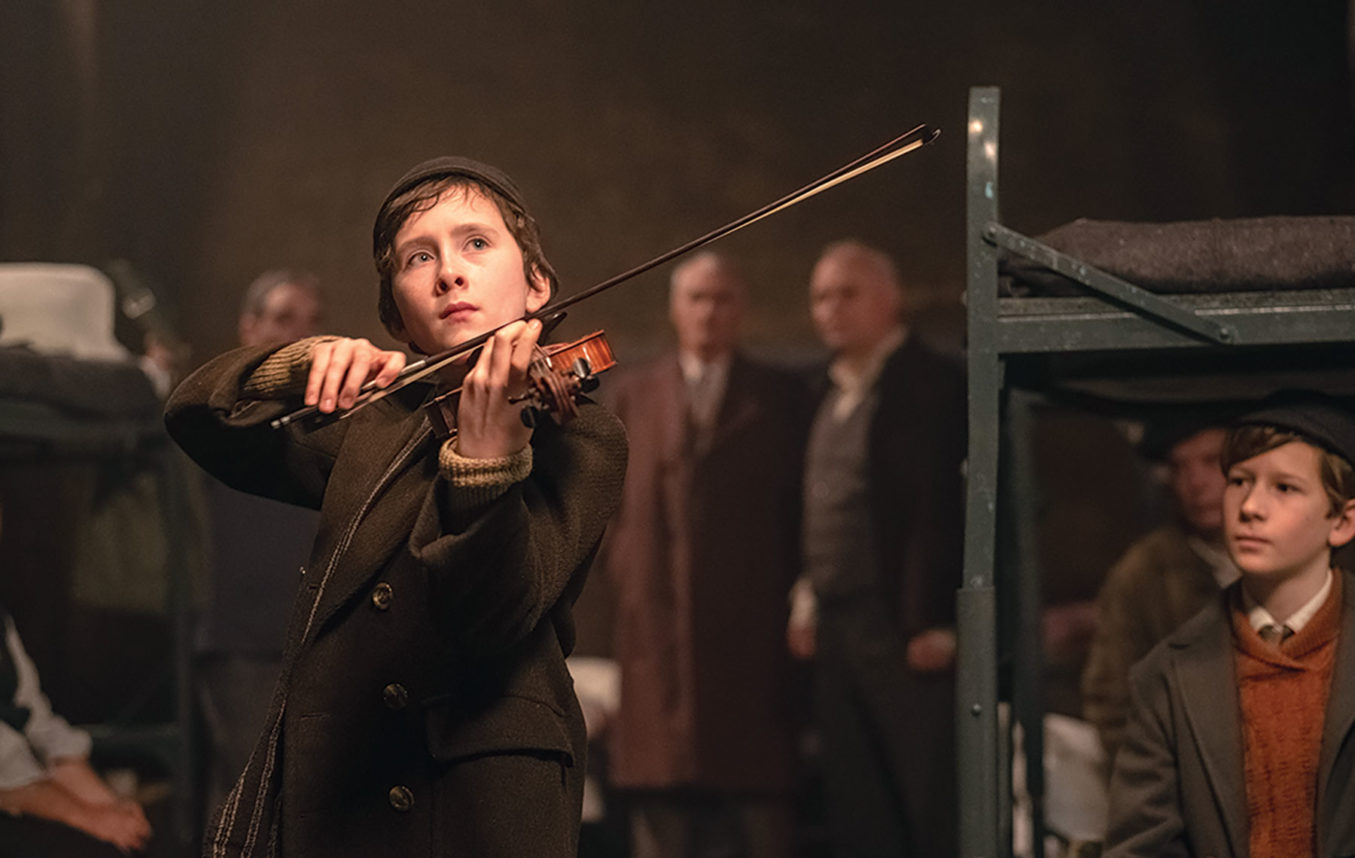
“The Song of Names” opens shortly before the outbreak of World War II, with Gilbert Simmonds, a London music publisher, inviting a 9-year-old violin prodigy from Poland to live in his home.

After some initial resentment, Simmonds’ son Martin bonds with the newcomer, named Dovidi Rappaport, and the two lads become as close as brothers.

They survive the war and Gilbert, recognizing Dovidi’s extraordinary talent, lavishes his attention on the boy and grooms him for his anticipated sensational debut in London. But on the evening of the premiere, Dovidi disappears — a calamity that bankrupts Gilbert  — who dies shortly thereafter.

The dual loss of his “brother” and father crushes Martin and for some 40 years he searches for Dovidi, finally tracking him down in a Chasidic quarter of London.

Martin is steered toward a small synagogue, whose rabbi, apprised of Martin’s search, opens his file of Polish Holocaust victims, including the entire Rappaport family, and mournfully sings out the names of the family members.

Much has been written and filmed about the Holocaust, but none has encapsulated the depth of the devastating tragedy of the Shoah as this single scene.

The film’s director, Francois Girard, and co-producer Robert Lantos spoke with the Journal at the recent Israel Film Festival in Los Angeles.

Girard, a non-Jewish French-Canadian, said he was particularly attracted to the film because of its emphasis on music. His previous movies include “The Red Violin” and “Thirty Two Short Films About Glenn Gould.”

Producer Lantos was born into a Jewish family in Budapest in 1949 before moving to Canada with his parents. While still a student at McGill University in Montreal, he founded Alliance Communications Corp., which went on to become the country’s largest film and television production enterprise.

Asked what was the most difficult part in making the film, Girard said finding actors to portray each of the two principal characters: first as young boys, then adolescents and finally as mature adults. The adult leads are played by Clive Owen (Dovidi) and Tim Roth (Martin).

The film is based on Norman Lebrecht’s novel of the same name. Lebrecht is a well-known and highly regarded BBC and Wall Street Journal commentator on music, politics and culture. Lebrecht’s latest book is “Genius & Anxiety: How Jews Changed the World, 1847-1947” (Scribner).

In it, he writes Jews made up only one quarter of 1 percent of the world’s population in 1847 and yet “they saw what others could not see.” Eventually, those “seers” ranged from Karl Marx, Sigmund Freud and Marcel Proust to Albert Einstein, Franz Kafka, Arnold Schoenberg and Leonard Bernstein.

As the first of the “Breakthrough Jews,” Lebrecht designates Benjamin Disraeli, the (converted) British prime minister under Queen Victoria, who, according to Lebrecht, was “the first to stand up to the immemorial insults howled at them by the Christians.”

One expounder of such insults was a fellow Member of Parliament Daniel O’Connell, an Irish Catholic, who routinely denounced Disraeli as a descendant of the killers of Christ, to which Disraeli responded calmly: “Yes, I am a Jew, and when the ancestors of the Right Honorable gentleman were brutal savages in an unknown island, mine were priests in the Temple of Solomon.”

That moment, according to Lebrecht, marked the point in history when Jews “burst out of the ghetto, brimming with the bottled energies of two millennia.”

“The Song of Names” opens Dec. 25 at the Laemmle Royal in West Los Angeles, and on Jan. 3 at the Playhouse 7 in Pasadena and Town Center 5 in Encino.

Haunting Portrait of a Jewish Prodigy in ‘The Song of Names’ Read More »

Idina Menzel on Work, Family and Giving Back

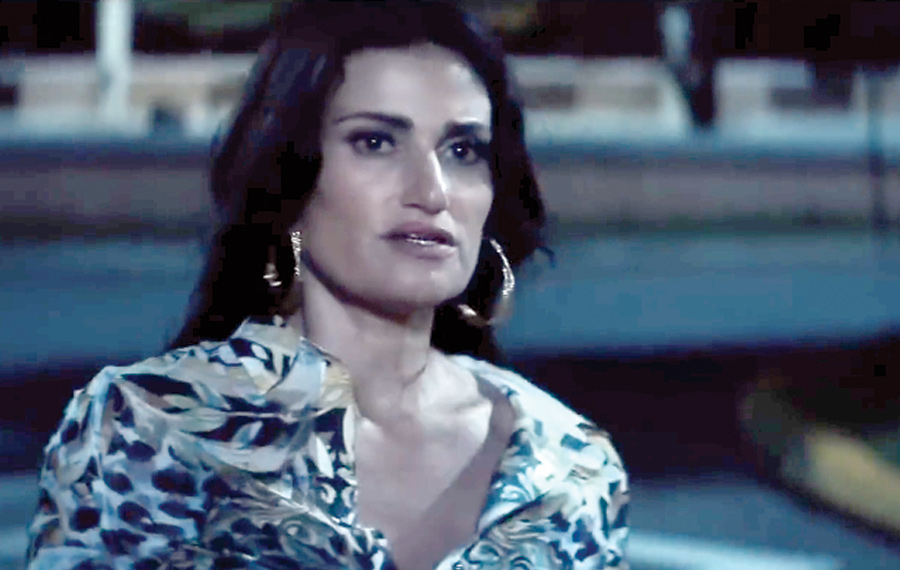
Idina Menzel currently has two hit movies in theaters. She’s reprising her role as Princess Elsa in the family-friendly “Frozen II” and starring opposite Adam Sandler in the gritty dramedy “Uncut Gems,” playing his exasperated wife. She seized the chance to work with Sandler and directors Benny and Josh Safdie on a role that struck a familiar note.

“I know a lot of women like her. I grew up on Long Island [N.Y.] and could identify with a strong-minded woman trying to raise a family with an unreliable husband,” Menzel told the Journal. “She’s really the truth teller in the movie. She’s the only person who says what she means to his face.”

Sandler plays a gambling addict whose increasing debts threaten his life and endanger his family. “He’s making a lot of bad choices,” Menzel said. “He really wants to be a winner for once in his life and I think people can identify with that no matter how despicable a character he is. Adam still finds a way to make the audience root for him. I think we all can identify with the desire to be a winner in life and see our dreams come true, in whatever way that manifests.”

“Frozen II,” meanwhile, already has earned close to $1 billion worldwide, which surprises Menzel despite the original movie’s enormous success. “There was a lot of pressure on everybody for the sequel and it feels really great to have it be so widely received again,” she said.

The movie’s soundtrack is topping the Billboard albums chart but it’s not her only holiday album. “Christmas: A Season of Love” features duets with Josh Gad, Ariana Grande and Billy Porter, and includes “Ocho Kandelikas,” a Latin-flavored Hanukkah song sung in Ladino. Leading into it is “Walker’s 3rd Hanukkah,” in which Menzel teaches her son the blessing over the candles. 

“I’m not too religious but I try to carry on the traditions,” she said. “It was always a special time when the family would get together and light the menorah. There were tough times in my teenage years when my parents divorced and the holidays became a little more complicated for my sister and I. I get to sort of rewrite all of that now that I’m a mother and define what those traditions are with my son, which is really a gift.”

Walker is Menzel’s child with ex-husband Taye Diggs. She is now married to fellow “Rent” alumnus Aaron Lohr, who sings “I’ll Be Home for Christmas” with her on the album and recently joined her on stage at Carnegie Hall. Although she loves touring — “it’s where I live and breathe — I’ve been traveling so much in the last few months, it would be nice to stay home with my family and check out for a minute before I make those decisions.”

“As long as you’re really honest and authentic, you will connect with people. That’s more important than any high note you sing.” — Idina Menzel

Menzel’s vocal prowess emerged long before “Rent” and “Wicked,” at the Concord Hotel’s day camp talent show. “I sang ‘The Way We Were’ in a really strong Long Island accent,” she said. “The whole audience flipped out and told my parents that their daughter had something special.

“There’s really only one role I’ve wanted to revive,” she continued. “Fanny Brice in ‘Funny Girl.’ Other than that, I’m very comfortable being in the embryonic stages of a musical in development and helping composers create new work.” 

She’ll next play the wicked stepmother in a film version of “Cinderella,” with Camila Cabello in the title role. “It’s a modern telling of the story with music, sort of like ‘Moulin Rouge,’ ” she said.

On Dec. 22, Menzel will host and perform on the CBS special “Home for the Holidays.”

“It’s a beautiful evening celebrating foster kids, chronicling their stories and helping them find homes,” she said. An active supporter of arts, education and LGBTQ-related charities, she established the A BroaderWay foundation, which operates a camp for girls. It was inspired by “the greatest six summers of my life” she spent at Camp Olympus, a Jewish camp in the Catskills, and her desire to give back.

“The way we can show our gratitude is giving back for the gifts that are given to us. Giving back gives you perspective in the world. But it’s not just giving back. It’s the reciprocity of the experience,” she said. “To be a role model, you have to live and breathe what you say, so it’s a reminder of who I want to be in this world as well.”

In November, Menzel received a star on the Hollywood Walk of Fame, with her family and her “Frozen” sister, Kristen Bell, in attendance. “It’s an incredible honor and to share it with Kristen Bell was even more special because we created these roles together,” she said. “It was nice to have my son there so he could see how cool his mommy is,” she added. 

Walker, now 10, is more interested in basketball than music. “But we overhear him singing in the shower once in a while and it’s clear that he has a great ear and a great voice. Maybe by high school he’ll change his mind,” she said. “I think he’s turning out to be a fascinating, loving, sensitive yet strong little man.”  

She’s also proud of the women she has portrayed. “I’ve tended to attract characters that speak to young audiences and give them permission to be their authentic selves and celebrate who they are,” she said.

She credits “hard work, discipline, practice and surrounding myself with people who are honest with me” for her success. “I try to remain vulnerable and open and be as real as possible,” she said. “It doesn’t matter what you do or what kind of mistakes you make. As long as you’re really honest and authentic, you will connect with people. That’s more important than any high note you sing.”

“Uncut Gems” is now in theaters.

Idina Menzel on Work, Family and Giving Back Read More »

Light in the Darkness

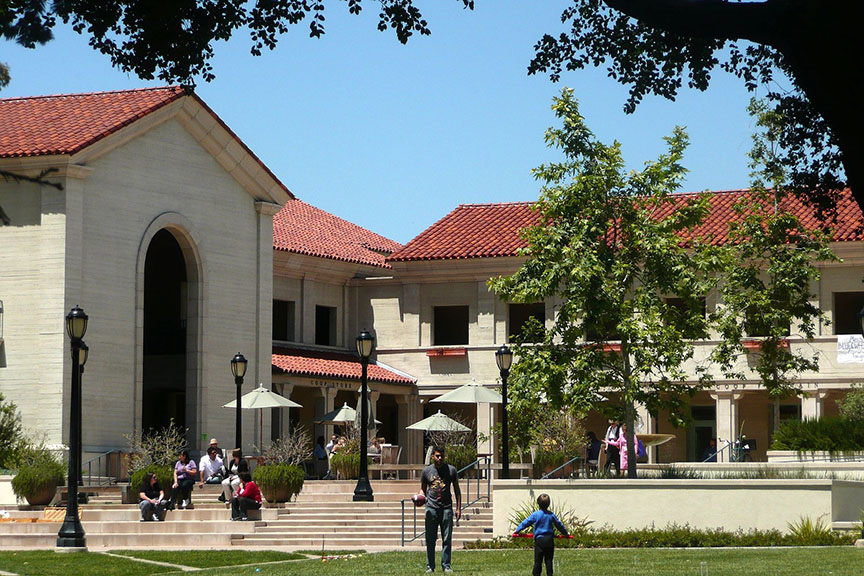
Our world feels very dark. The slayings that took place at the kosher supermarket in New Jersey,  the desecration of Nessah Synagogue in Beverly Hills, three Jewish college students attacked at Indiana University and, most recently, vandalism and graffiti at American Jewish University, among other Jewish institutions.

Hate begets hate. Insecurity and ignorance rise from the shadows and breed malice and fear.

But if there is one lesson to be gleaned from the Jewish people it is this: The darkness of the world only magnifies our sparks of light. The light of blessing. The light of kindness. The light of peace.

Ner Adonai Nishmat Adam. God’s light is the soul of each human being, which means that we are endowed with a God-given potential to illuminate the darkest corners of the Earth. To use our free will to brighten the bleakest days.

We must shine like a fully lit hanukkiah and remind those who want to take us down to take heed. Our spirit, fierce and strong, will continue to blaze for all of eternity. That is our promise. That is our legacy.

Shabbat shalom.


Rabbi Nicole Guzik is a rabbi at Sinai Temple.

Light in the Darkness Read More »

When the News Gets in the Way

Since this is our last issue of 2019, I had written a light-hearted, end-of-year column that was all set to go to the printer — until, that is, an accumulation of hot news items got in the way.

The column was a breezy reflection on the value of dreams. Now all I can dream about is that we’ll have a week quiet enough to publish it. For now, we must deal with the business at hand — an avalanche of news, mostly bad, some historic.

I’m writing this column early in the morning in the lobby of the King David Hotel in Jerusalem (with a little white cat swirling beneath my chair), having just participated in a four-day “Strategic Dialogue” between Israeli leaders and officials from Australia and the U.K.

Guess what people were asking me about at the closing gala? Yup, a certain synagogue incident in Beverly Hills. A potential future prime minister, Gideon Sa’ar, had just delivered a candid address, and people couldn’t stop talking about the ransacking of a sanctuary in Beverly Hills. Maybe it was the ZIP code. 

A few days earlier, we were abuzz about the midnight deadline that had just passed in Israel triggering an unprecedented third election in 12 months. The next day, we were consumed with the election results in the U.K., which are paving the way for Great Britain’s historic divorce from the European Union. 

In the meantime, other news items were intruding, like the articles of impeachment against President Donald Trump in the House of Representatives, for only the third time in U.S. history. 

Maybe instinctively, that’s why I stuck with the free speech cover — because Eisgruber’s ideal discourse is needed now more than ever.

And did I mention the latest deadly attack against Jews, this one in Jersey City,  and the president’s controversial executive order to combat BDS and anti-Semitism? Oh, and I almost forgot: The festival of Hanukkah is coming up!

In the middle of this news tornado, I was still working on a cover story I had planned for several weeks on one of my favorite topics: The state of free speech in America.

So, I had a decision to make: Should I bump the free speech cover for one on the killings in Jersey City? Or the presidential impeachment? Or Brexit and the fall of the anti-Semitic Jeremy Corbyn? Or Trump’s controversial executive order? Or the impossible stalemate in Israel? Or the attack at Nessah Synagogue?

While the free speech issue is timeless, the others are timely. Which should go first?

Maybe it’s because of my intense jet lag, but, as you can see, I decided to stick with the cover story on free speech and deal with the hot issues inside the paper.

For one thing, free speech is the foundation of a free society, not to mention the foundation of my profession, journalism.

But there’s something else: Free speech has become timely. That’s because it has come under assault, especially on college campuses, from activists who focus on its “microaggression” side effects rather than its fundamental value.

In these chaotic times, we need the freedom to rise up against the forces of hate, the wisdom to engage with dignity those with whom we disagree, and the curiosity and humility to constantly search for the truth.

These sentiments should not be casually dismissed by free speech junkies like yours truly. As I write in the story: “Our world is changing. As an evolving society, we are becoming more inclusive and sensitive to people’s feelings of alienation. Inclusivity is giving free speech a run for its money.”

The thrust of the story is on the innovative thinking of one man in the eye of the storm — Princeton University President Christopher L. Eisgruber.

Eisgruber is a man of deep thought, empathy and cautious optimism. He argues that a vigorous free speech can coexist with a noble value like inclusivity. He threads the needle by reframing the free speech debate around “truth-seeking,” and seeing universities as “truth-seeking institutions.”

Under this unifying ideal, Eisgruber marries two seemingly opposite values. Indeed, as I write: “If the ideal revolves around the search for truth, the greater the inclusion of different voices, the deeper and broader that search will be.”

I encourage you to read the entire story. It is based on a remarkable keynote address Eisgruber delivered recently at the University of Pennsylvania Law School, titled “Contested Civility: Free Speech and Inclusivity on Campus.” 

I call the address “remarkable” because it aspires to a higher level of discourse that honors intellectual rigor and human dignity in equal measure.

Maybe instinctively, that’s why I stuck with the free speech cover — because Eisgruber’s ideal discourse is needed now more than ever.

In these chaotic times, we need the freedom to rise up against the forces of hate, the wisdom to engage with dignity those with whom we disagree, and the curiosity and humility to constantly search for the truth.

If one considers that ideal a ray of light, well, maybe this was a Hanukkah cover story after all.

Happy Hanukkah.

When the News Gets in the Way Read More »