fbpx

December 11, 2019

That New Car Smell

Growing up in New York in the late ’50s and early ’60s, if a neighbor got a new car, it was a big deal. Back then, you got married forever and you kept your car forever. But if you did get a new car, the whole neighborhood knew it. 

If a kid wanted to check it out, and if his hands were sparkling clean and his shoes weren’t muddy, then the neighbor might let the kid sit in it. However, if it was the gold standard — a Cadillac — a kid wouldn’t try to get near it. If I got too close to a new Caddy, my parents would say, “Stand back and don’t touch it.” As if I might pull out a hammer and bang on the windshield. 

Because of the icy winters and heavily salted roads, your new car looked like an old, rusty can of Heinz beans in short order. Plus, New Yorkers squeezed into parking spaces by banging into your new bumper 38 times. When the bumper was hanging off your car, they were done parking. 

My father didn’t get his first new car until he was 42. He was so happy driving around in his brand new $3,000 1970 Dodge Swinger with AC and a vinyl roof. For months after, he couldn’t stop talking about the new car smell. “Smell it. Smell it” was his mantra. Once, when he was about to get a ticket, he asked the cop to stick his head in the window and smell it. The cop laughed so hard that he let him go. 

Back then, few people ate or drank in their cars. Cars didn’t have cup holders; just ashtrays. People smoked in their cars and got pregnant in their cars, but eating in the car was out of the question. I recently told my friend I wanted to get a slice of pizza. He said there was one in his glove compartment. 

And when you sold your car, no one ever asked if it was a nonsmoker’s car. The “nonsmoker car” question hadn’t been invented yet. In fact, the nonsmoker hadn’t been invented either. You could smoke in your hospital bed an hour after having lung surgery. 

Back then, cars didn’t have cup holders; just ashtrays.

When I started to drive, my parents occasionally let me borrow their car, which when I think back on it, was an incredible act of love considering the kind of lunatic I was back then. At the end of the night, I always put from 50 cents to a buck’s worth of gas in. Gas was 36 cents a gallon then. 

Practically everything my father taught me about a car could apply to living a better life. My father took great care of his car. How you drive and how you take care of a car says a lot about the person and who they are. If the inside of your car looks like a storage bin turned upside down, then there’s a good chance that your insides are also a mess. My father reminded me, “If you want to keep nice things nice, it takes work.” But we all know people who have to clear the front seat and floor of their car before you can get in, to prevent the possibility of stepping on something that was once alive. 

My dad taught me how to put air in the tires and how to check the oil. We’re Jewish so we only check the oil, not change it. These days, most people I know couldn’t find the dipstick because they don’t know where the hood release is. He also taught me how to use hand signals — even the ones that let people know exactly what you think
of them. 

His marriage tip was: If you see a woman and her car is broken down, stop to help her. She could be the one. When he was single, he worked at an auto school where one day my mother came in for driving lessons. A year later, they got married. She passed her driving test, and then proceeded to drive him crazy for the next 39 years.


Mark Schiff is a comedian, actor and writer.

That New Car Smell Read More »

Why Does Christmas Start in October?

Have you noticed that Christmas seems to come earlier each year? It’s technically on Dec. 25, but in terms of that tangible moment when the Christmas “spirit” starts, it’s more like October. Maybe even September.

I swear I saw Christmas tree ornaments at a crafts store in late August. I may be Jewish, but to me, that’s sacrilegious.

Speaking of sacrilegious, Puritans in Boston in 1659 made it a criminal offense to publicly celebrate Christmas, alleging a certain sinfulness in all the merrymaking. Maybe someone had put up decorations a little too soon and angered the towns-folk. That law was among those revoked in 1681.

I’m one of those Jews who loves singing along to nonreligious Christmas tunes — more “Jingle Bell Rock” and less “O Come, All Ye Faithful.” And although I love all the decorations in the stores and on the streets, their early arrival is becoming ridiculous.

There must be some psychological reasons behind all this.

Scientists theorize putting up Christmas decorations earlier makes people happier, according to a November 2017 story in London’s Evening Standard. “In a world full of stress and anxiety people like to associate to things that make them happy and Christmas decorations evoke those strong feelings of childhood,” psychoanalyst Steve McKeown said.

I guess because we’re living in a time of such divisiveness, maybe some early holiday cheer can help lift our moods. I recall there were some Democrats who went overboard with holiday decor after Donald Trump was elected president in November 2016. If he is re-elected next year, they may have to start their own reindeer farm.

“Therapy reindeer” could be a huge draw.

Still, I’m not convinced that the Christmas “spirit” seems to arrive earlier each year because we are more stressed.

I’m not convinced that the Christmas “spirit” seems to arrive earlier each year because we are more stressed.

I wondered if Jews in Israel catch the Hanukkah bug early. If the Christmas “spirit” is unleashed early because we’re under so much stress, wouldn’t it make sense for Israelis — who endure proxy wars, rocket attacks and relentless international demonization — to start celebrating Hanukkah three months early?

“The only sign of Hanukkah before it actually starts is all the sufganiyot (doughnuts) that seem to pop up right after the High Holy Days,” a friend in Israel observed.

Early arrival of doughnuts. Now there’s an inspiring holiday consumer trend.

I asked a friend who is in her 90s if she recalled the holiday season in the early 1940s. The U.S. was embroiled in a world war and collective stress was palpable, so by all reasoning, the Christmas spirit should have been evident months before December.

“Not at all,” she said. “Stores put up decorations two, maybe three weeks before Christmas. Anything earlier than that would have been too suggestive.”

Too suggestive of what? I asked.

“It would have seemed like Christmas was all about money and spending money at the stores, instead of something more meaningful.”

Bingo. Money, money, money.

I can’t quite put my finger on it, but money considerations aside, it seems silly for Jews to kick off the Hanukkah holiday weeks or months in advance.

Maybe Jews, whether in Israel or the United States, simply don’t feel the need to “go all out” once a year because we light candles every week — on Shabbat.

You don’t have to keep all the laws of Shabbat to be affected by its power to “decorate” your home and lift your mood with all things wonderful: food, family and even the good china plates,  which others normally reserve for only Thanksgiving and Christmas.

I still love the holiday spirit, even if it starts ridiculously early. But because Jews excel at complaining, would it kill someone to pass out the doughnuts a little earlier next year?


Tabby Refael is a Los Angeles-based writer and speaker.

Why Does Christmas Start in October? Read More »

Holding Judaism in Your Hands

Let’s play a little game: What is your favorite part of Judaism? Whenever I ask that question, I’m always amazed at the range of answers. Some Jews love learning Talmud; others love the culture. Some focus on Zionism; others on the pride of belonging to a people.

Some Jews love philosophy; others the rituals of the holidays. Some love the sense of “community” above all else; others prefer the mystical vibes of Kabbalah or the activism of tikkun olam (repairing the world). Some love Jewish poetry or liturgy; others literature or history. Some simply love the ethical clarity of God’s commandments. The list goes on.

Many Jews, of course, enjoy more than one thing. They may prefer an area or two, but they love the fact that Judaism offers such a rich and diverse offering that there’s something virtually for every taste, every Jew, every mood.

In fact, if you asked me to name my favorite part of Judaism, that might be it —the incredible diversity of the Jewish menu.

Just as some shul-goers love to float between different synagogues, I love to float between the myriad areas of Judaism. Each new area is an adventure. There’s hardly anything I come across under the enormous tent of Judaism that doesn’t arouse a part of my curiosity.

Where am I going with this? To a revelation that hit me recently: We rarely get a chance to feel the diversity of Judaism at one time and in one place.

I was sitting with a prospective donor and reviewing what the Jewish Journal is doing online— our new website, podcasts, social media initiatives, blogger network, Thursday Night Live, Morning Roundtable, Daily Roundup, and so on.

The fact that there’s so much to choose from in Judaism may be one of its greatest assets, especially for a new generation that loves to keep its options open.

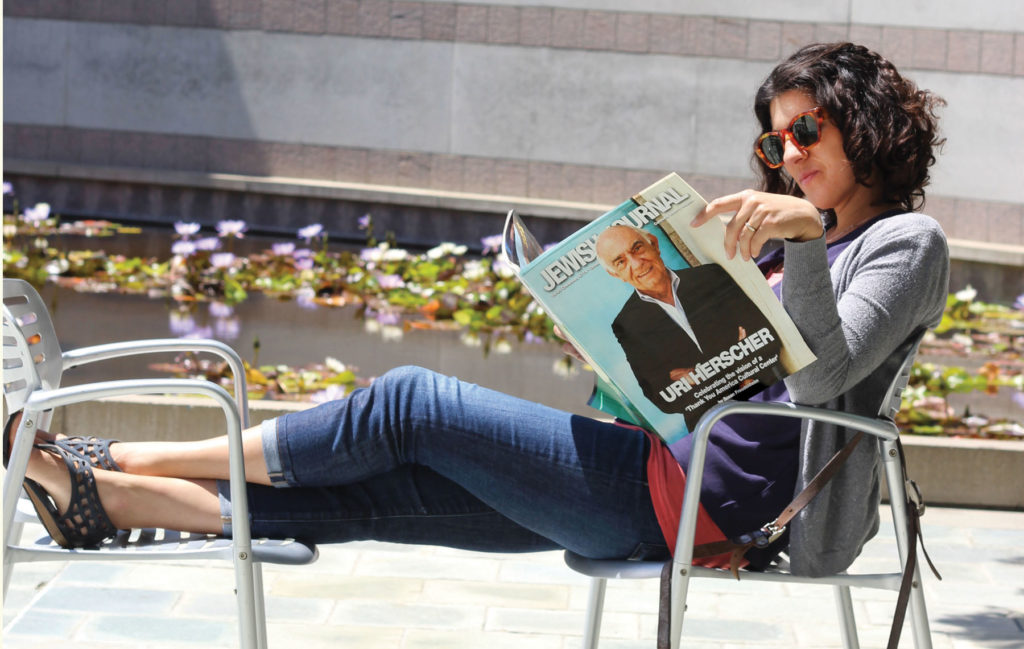
But when I got to the actual paper, I struggled to find a succinct way to explain its value. So, I came up with this: “You can hold all of Judaism in your hands.”

As much as I value the expansive powers of the digital world, I admitted there’s one thing it can’t do: It can’t make you feel the richness and diversity of Judaism at one time and in one place.

One of the well-known realities of the print world is that most people skim through the articles; they will read something only if it really interests them.

But this skimming is precisely the unique power of the paper: You don’t have to read every article to feel the full effect of the diversity.

Pick up a Journal and you’ll see what I mean. Go through each page and read only the headlines and highlighted quotes. By the time you’re done, whether you’ve read the articles or not, you’re very likely to conclude: There’s so much happening with this tradition and community — so many voices, so many stories and subjects, so much going on.

“So much going on” may, in fact, be the secret sauce of Judaism. People want choice. People crave choice. The fact that there’s so much to choose from in Judaism may be one of its greatest assets, especially for a new generation that loves to keep its options open.

Digital can’t make you feel the bulk and substance that you naturally feel when you hold a paper in your hands.

But let’s face it — how often do Jews get to see and feel the whole Jewish buffet in one place? Most Jewish groups or movements like to push their own menu items. Some favor religion, others culture, others social justice or history or Zionism or peoplehood.

Which Jewish group is ideally suited to consistently promote the Jewish buffet in one place? It’s the Jewish paper.

The smart phone in your hand may carry unlimited information, but you get this information one digital bite at a time. Digital can’t make you feel the “bulk” and substance that you naturally feel when you hold a paper in your hands.

While holding that paper, you are holding the community, the whole Jewish buffet, right there in one place, at one time. You’re seeing with your own eyes and feeling with your own hands that, indeed, there’s “so much going on” with this deep and broad tradition of yours.

One reason I’m optimistic about the future of the community paper is that people instinctively love to touch and feel things. And today, we’re all looking for ways to slow down. Paper helps us slow down. 

Of course, it’s up to individual papers to take advantage of these benefits and do justice to the great diversity of Judaism. Week in and week out, that is our  mission — to nourish you with a wide range of stories, voices and ideas that will “connect, inform and inspire” you and, in the process, elevate the communal conversation.

It’s the whole megillah, and it’s all-you-can-eat.

Holding Judaism in Your Hands Read More »

Ripple Effect: Connection

I went into this giving season with a vengeance.

I set a high fundraising goal for The Advot Project.

I decided to pick up every rock and look in every nook and cranny in an effort to connect with anyone and everyone in my network who can lead me to sources of funding.

The Advot Project is in a crucial moment of growth. By raising funds, we will be able to scale, expand and grow. Shamelessly, I am asking, requesting, exploring.


I want to ensure the vision that I know can be true. 

Communication skills and healthy relationships are crucial for an individual to be able to change his/her life.   

Communication skills and the quality of our relationships are crucial for EVERYONE to be able to live their best life.  


We, at The Advot Project, provide tools to attain those skills.

I have been calling, e-mailing, meeting with colleagues and friends who can help me connect with people who will support our work. 

I set a crazy, high bar. Slowly but surely, I’m climbing the mountain, hoping I will get to the top.

 
I read this week an anonymous quote: “Set a goal that you can’t achieve until you grow into the person who can.” I sure as hell am trying. 


It has been humbling, touching, and truly moving, regardless of the money I raise, to tap into and connect with my incredible, beautiful, insightful, wonderful village. 

Oh, my goodness, what a village. I cherish each and every connection.

In my class this week we discussed the necessity of asking for the things we need.

This is not something my students like doing. 

To be honest, neither do I. 

My students have been let down so many times in their lives, that they do not expect to ever get something they want or need. So why bother asking?

One student said, “Ms., I simply hate asking for things because I don’t like hearing ‘no’. I’ve heard ‘no’ so many times in my life, I’m simply not interested anymore. Hell no!”
 

I look at this young woman with pain all over her face and anger coursing through her body. 


I say gently, “If you don’t take the chance on the hearing the ‘no’, you do not give the opportunity for the ‘yes’ to arrive. If someone says “no’, it’s no. Nothing changes. But what if, what if they said ‘yes’? That could be monumental, don’t you think?”

“Ain’t nobody saying ‘yes’ to me. I’ve asked for the simplest things in my life. When I was homeless, when I was hurt, when I was sick, nobody said ‘yes’ to me, ever!”


I stand looking at her and I know no matter how kind I am, I cannot erase the cruelty and trauma that she has suffered. 

I try to practice what I preach and so I describe what I do:

I ask even when I don’t want to.

I explain to people about the work we do. 

I ask directly for what The Advot Project needs. 

Sometimes people say ‘no’. Lots of time they do.

Some people send me to or introduce me to other people. I follow through with every lead. 

But then, some people actually say ‘yes’. 

Sometimes the ‘yes’ is so much more than I asked for.

Sometimes the ‘yes’ is a lot less than I thought it would be. 

Nevertheless, I rejoice.  Because ‘yes’ is always a win to me.

The class has become very rowdy. 

They don’t like my suggesting not to be mad when someone says no.

“If you did something for someone. If you helped someone out on the street, they owe you, Ms. They are supposed to give you back, and if they don’t, you should cut them off. Walk by them as if they don’t exist,” one woman tells me.


I challenge that, and say, “If on that particular day someone cannot come through for you, that doesn’t mean that they need to be erased from your life.” 

There is an uprising in the class. 

“Ms., why you go give chances to people if they disappoint you? Cut them loose! I ain’t important enough that someone has got to go and lie to me in order to make me happy. You feel me? Listen, Ms., if someone’s got to lie because they don’t want to give me something, I don’t want nothing to do with them.” 

I have to say listening to her kind of makes sense, yet I push back.

I challenge again and say, “Human connections are complicated. People are complicated. Everybody’s story is complicated. I would not write someone off if they let you down.”
“Also,” I add, “By ignoring them and cutting them off, you are giving them a lot of power.”

It’s a rowdy class. Everybody has something to say. They are pissed at me AND, at the same time, they are amused at my ideas and my way of thinking. 


Now they push back and try to make me understand how wrong I am.

I am listening, reflecting on my own connections, my own asking people for things and my desire to cut people off when they simply don’t give me what I want.

“Life is filled with surprises,” I tell my students.

“You never know where those surprises will come from. I’m not saying to let people hurt you. I’m also not saying not to learn a lesson when someone lets you down.  But I am saying, leave the door open for the surprise to walk in.”

“Fuck! Ms. I don’t want no surprise walking through my door. I got enough of those in my life. Surprises left and right, surprises through the window, surprises in my face, surprises in my bed, surprises that I was completely unprepared for. I want to know what’s happening. I want to be ready. I don’t want no surprises. Actually, I want my door to be closed. That’s how I stay safe.”

I stand looking at this beautiful woman who got out of jail less than a year ago, working insanely hard to better her life, to stay in her lane, to keep her routine. 

“I got me one wicked temper,” she says. “Together with a cocktail of mental illness and trauma. That’s what got me locked up. I don’t want no surprises. If someone can’t be there for me, fuck that shit.”

The class claps for her.

I take a breath.

They all look and wait to see what I have to say.

“I admire that you know what you need,” I say. 

I can feel the entire room lean in.

I think to myself. I don’t have anything really smart to say. Why should they trust people who let them down?

I tell them what I say carefully many times.

I can only suggest and share my thoughts.

“I come to visit jail and then I can leave.

No, I don’t understand and yet I do know that holding anger is not good and that this class, this anger management class, is not about NOT being angry but about managing our feelings and figuring out what to do with them.”

I tell them that I want the world for them.

I tell them I want them to ask for things.

I want them to want, to need, and to aim high. 

Even if that means they will be disappointed and hear ‘no’. 

I tell them I believe that they deserve the ‘yes’.

My angry student from the beginning of class looks at me as she is leaving the room.

“Ms., I hear you. You are trying to make the connection between the person we were to the person we can be. That’s the ‘yes’.”

“No,” I say. “I want you to connect to the person you ARE. And I want to help you let go of the ‘no’, regardless of the ‘yes’.”

 She laughs out load, and for a moment her anger subsides.

“Think about it,” I say. 

“Okay,” she says, and walks out of the class.


Naomi Ackerman is a Mom, activist, writer, performer, and the founder and Executive Director of The Advot (ripple) Project a registered 501(c)3 that uses theatre and the arts to empower youth at risk to live their best life.

Ripple Effect: Connection Read More »

Jersey City Mayor Says Shooting Suspects Targeted Kosher Market

Jersey City Mayor Steven Fulop announced on Twitter that based on video footage, it appears the suspects behind the December 10 shooting were targeting JC Kosher Supermarket.

Fulop tweeted, “Last night, after extensive review of our CCTV system, it has now become clear from the cameras that these two individuals targeted the kosher grocery location on [Martin Luther King Jr. Drive].”

According to The New York Times, the shooting initially began at the Bay View Cemetery, where a police officer was shot and killed. The shooters eventually moved toward the Jersey City kosher supermarket, killing three people. Two of the victims were Hasidic Jews: 33-year-old Mindel Ferencz, the wife of the market’s owner, and 24-year-old rabbinical student Moshe Deutsch.

Both the Times and NBC News are reporting the shooting suspects – both of whom died at the scene – have been identified as David Anderson, 47, and Francine Graham, 50. Anderson is believed to have been connected to the Black Hebrew Israelites – which the Southern Poverty Law Center describes as a militant hate movement – and had anti-Semitic social media posts.

Anti-Defamation League CEO Jonathan Greenblatt tweeted, “New information indicates the shooting at the kosher market was a targeted attack. We must never forget the victims. We need to stand together as a community.”


https://twitter.com/JGreenblattADL/status/1204780974288052224


The American Jewish Committee similarly tweeted, “We are horrified by the murders in Jersey City and are deeply distressed by reports the attackers may have targeted the Jewish community. Our thoughts and prayers are with the victims and their families. We are heartened by the swift response by law enforcement and NJ officials.”

The Simon Wiesenthal Center tweeted, “One of the shooters was an #antisemite. We expect that authorities including FBI will provide answers and take steps to protect the #Jewish community from further harm.”

Jersey City Mayor Says Shooting Suspects Targeted Kosher Market Read More »

Dec. 13, 2019

For fullscreen click here.

Dec. 13, 2019 Read More »

Election Handbook: Third Election, First Update

We call this format a Timesaving Guide to Israel’s Upcoming Election. This will be a regular feature on Rosner’s Domain until the next scheduled election on March 2. We hope to make it short, factual and devoid of political hype.

Bottom Line

In a few hours, if we don’t see a dramatic and sudden change, our slogan will be revised to: Say no to a fourth election.


Main News

Midnight (Israel time): Four hours from now (this post goes online at 8 p.m. in Israel) the Knesset will be dissolved and a new election  will be set.

March 2 is the date for Israel’s third election in less than a year. How did we get here? Read this.

Likud primary election is likely to take place on Dec. 26. Prime Minister Benjamin Netanyahu will be challenged by Gideon Sa’ar, a former Minister of Education and of Internal Affairs.

Blame game As you’d expect, each party is trying to convince voters that the third election is the other side’s fault.

Polls are basically unchanged.


Developments to watch

Likud race: Will Netanyahu’s opposition within the Likud Party gain enough votes for his position as leader to be shaken?

Alliances: Will the United Right and Otzma Yehudit — the two most conservative right-wing factions — run together? Currently, neither crosses the electoral threshold. Will Labor and the Democratic Camp run as one party (or as one list)?

Comings and goings:  Another election is an opportunity for leaders to drop out (Moshe Kahlon, Ehud Barak) or reenter the race (Tzipi Livni?).


The blocs and what they mean

As you can see below, the blocs situation is similar to the synopsis before the last election. Netanyahu doesn’t have enough votes with which to form a coalition (unless someone from the other side agrees to sit with him). Blue and White can form a coalition only if it can persuade Avigdor Lieberman to sit in a coalition that relies on the support of the Arab Party. In short, the polls tell us that we’re still stuck. They tell us that a solution is based on one of the following scenarios:

  1. The polls are completely wrong.
  2. Public opinion, which barely has changed in the past year, suddenly will change.
  3. Parties that refused to sit with one another suddenly will agree to change their tune (but why now and not before the third election?).
  4. Netanyahu will decide or be forced to step down.

What can you see in the graph?

First: This graph is based on averages of all polls that were made public (poll by the media) plus the outcome of the two elections (in April and September).

Right: The graph doesn’t deal with parties. It describes the political blocs. Netanyahu’s bloc is the right without Lieberman (no one believes that Lieberman wants Netanyahu to be prime minister). You can see that this bloc declined slightly between April and now.

Lieberman: He is supposed to be a king maker but he chooses not to anoint any king. His numbers are solid.

Unity: Likud and Blue and White easily can form a coalition. They  just don’t want to.

Opposition 1: Without Lieberman, to show what happens if Blue and White decides to rely on the Arabs and drop Yisrael Beiteinu (for now, it is not yet enough for a stable majority coalition).

Opposition 2: If Lieberman is in, and the Arabs oppose the forming coalition, the numbers are even lower (and it is more difficult to get the Charedi parties to join in if Lieberman is part of the deal).

Trends: Currently, the only trend is that there isn’t one. Nothing changes in a way that, well, changes anything.


Party to watch

For Netanyahu’s bloc to have a shot at getting close to 60 seats, it needs all right-wing parties to get in and all right-wing voters to cast their votes for parties that can get in. This means — as was the case in April — that the right is going to gamble on letting the voters have multiple choices. Right-wing voters who are more liberal, culturally speaking, will have the option of the New Right, headed by Naftali Bennett. Right-wing voters of more conservative leanings would want the two most radical right parties, the United Right and Otzma Yehudit, to merge.

Why? Because, as you can see in this graph, these two parties don’t have enough votes to put them beyond the electoral threshold (3.25%). But together, they can meet the challenge, and if they do, the entire bloc gets much closer to 60 seats (currently, the polls give it 59 if it gets the extra four seats of the radical right).

Of course, there’s a price involved: This means that the voters of the bloc will be willing to sit alongside the followers of the ultra-nationalist Meir Kahane.


—–

Shmuel Rosner’s book, #IsraeliJudaism, Portrait of a Cultural Revolution, is now available in English. The Jewish Review of Books called it “important, accessible new study”. Haaretz called it “impressively broad survey”. Order it here: amzn.to/2lDntvh

Election Handbook: Third Election, First Update Read More »